
A complete issue · 20 pages · 1902
Life — February 20, 1902
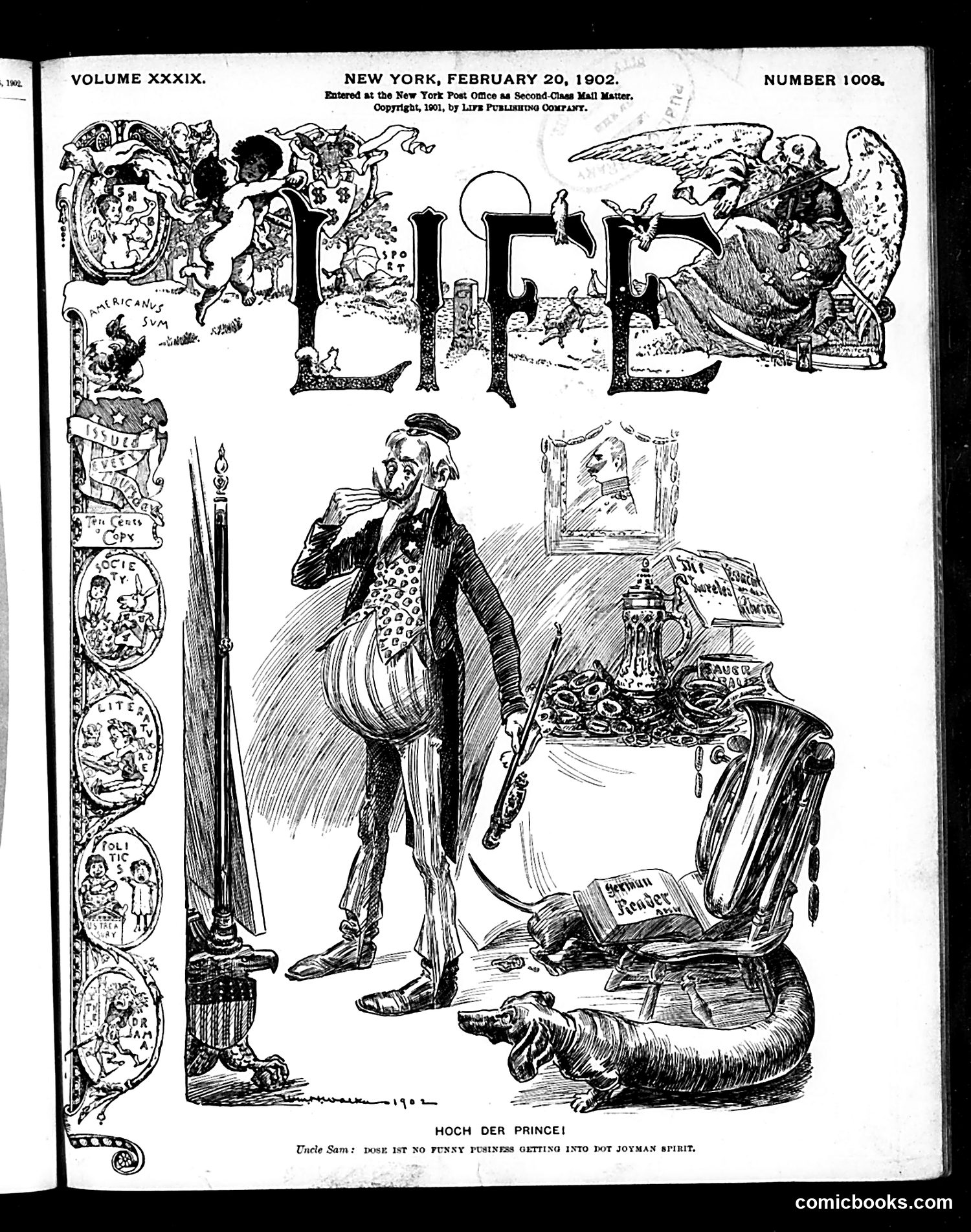
This cartoon, titled "Hoch der Prince!" satirizes German-American relations during the Boer War era. The central figure appears to be a German aristocrat or diplomat, depicted with exaggerated features and holding a cigar, examining contents on a table that includes what looks like a German newspaper ("Berliner Rundschau") and a dachshund. The caption reads: "Uncle Sam: 'Dosh ist no funny puniness getting into dot jokeman spirit.'" The satire appears to mock German pomposity and possibly German-American tensions over U.S. foreign policy. The dachshund (stereotypically "German") reinforces the ethnic caricature. The crude German-accented English in the caption was typical of period anti-German humor in American publications.
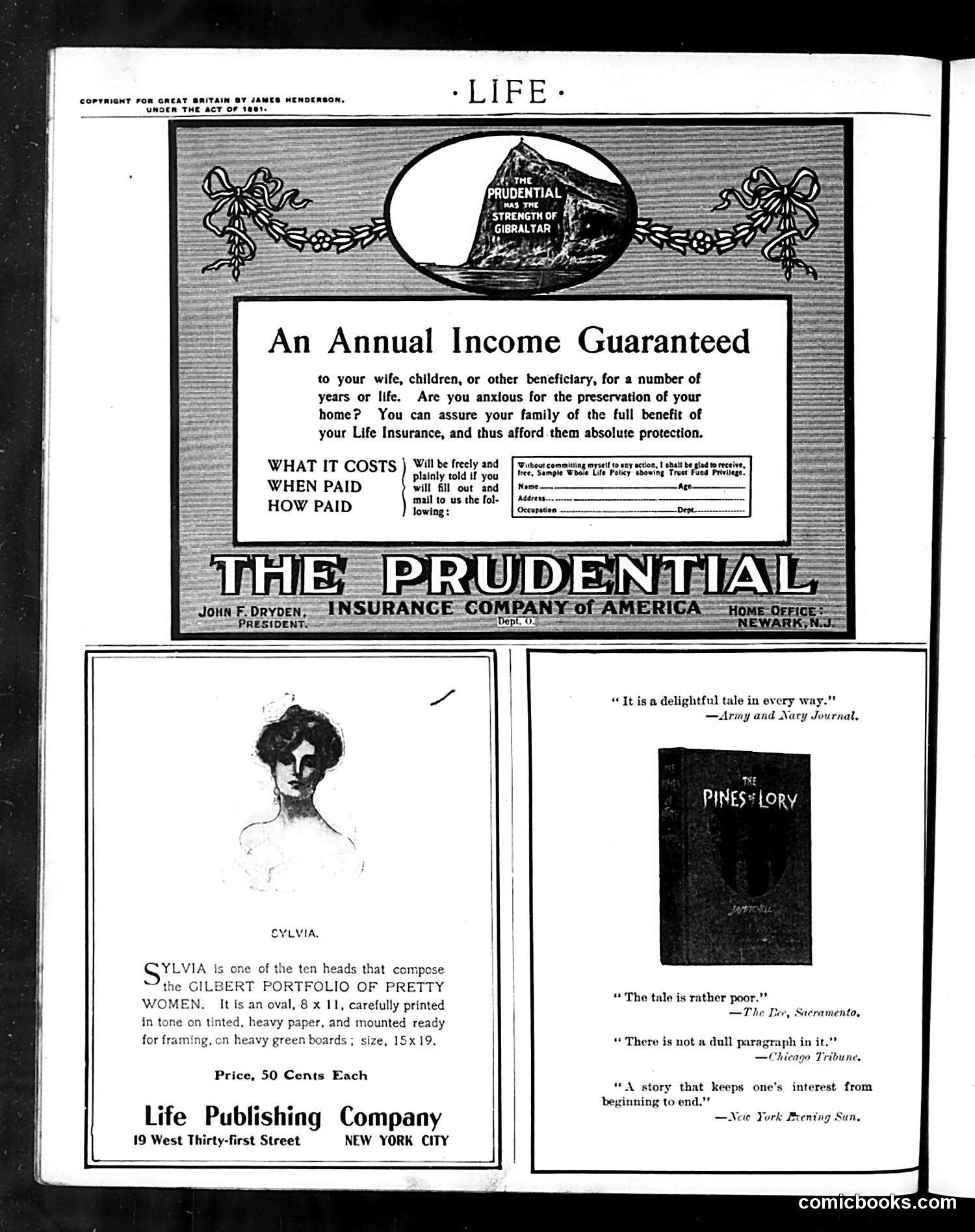
This page is **primarily advertising**, not satirical content. The top half features a Prudential Insurance Company advertisement promoting life insurance that guarantees "An Annual Income" to beneficiaries. The copy emphasizes family financial security—a common insurance sales pitch for the era. The bottom half contains two separate advertisements: one for a "Gilbert Portfolio of Pretty Women" print called "Sylvia" (50 cents), and another for a book titled "Pines of Glory" with favorable newspaper quotes praising it as an engaging story. There is no discernible political cartoon or satire on this page. It represents typical early-20th-century Life magazine content, mixing advertisements with editorial material to generate revenue.
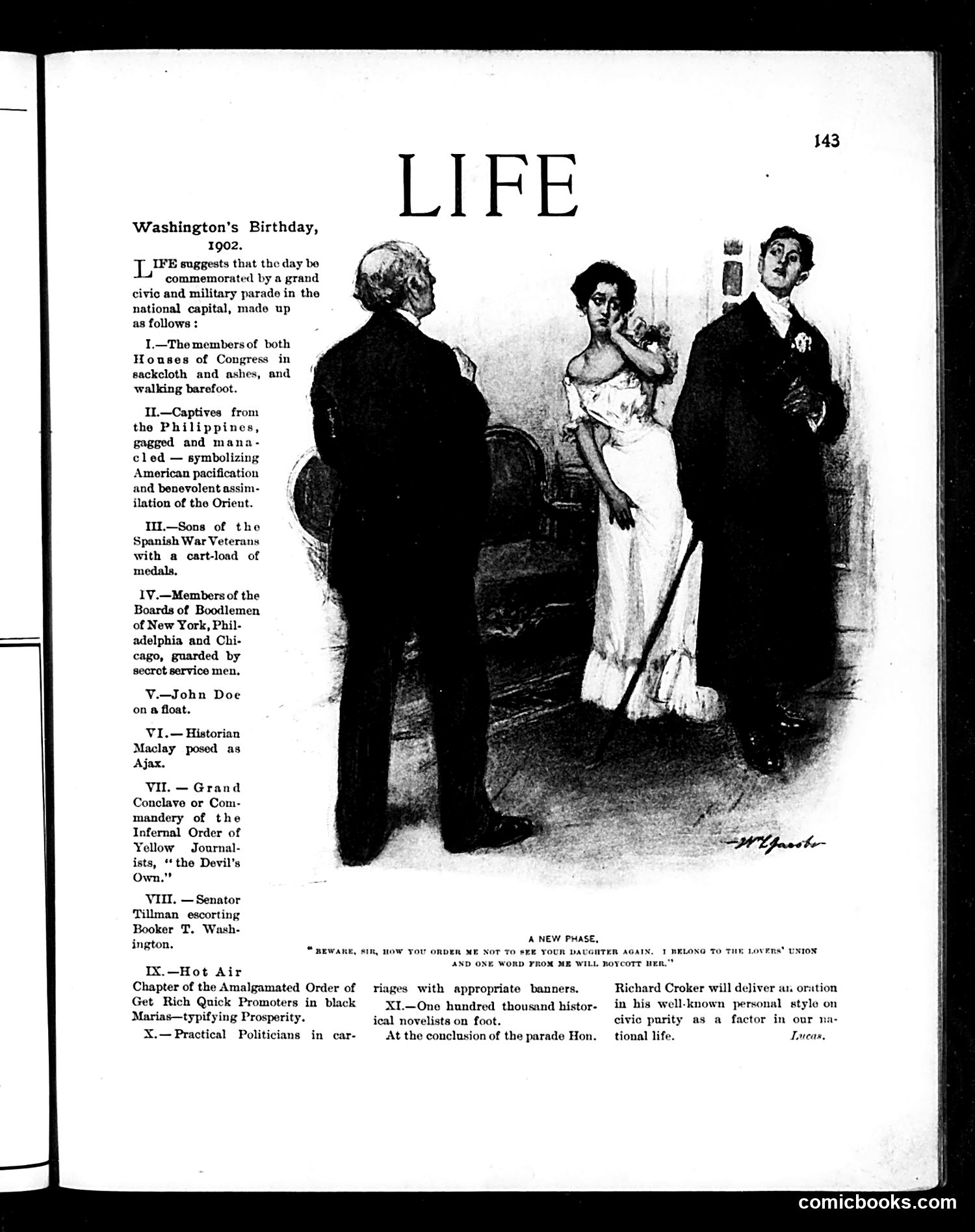
This Life magazine page satirizes the proposed 1902 Washington's Birthday parade in the nation's capital. The cartoon depicts a grotesque parade of figures representing various embarrassments to American civic life. The numbered annotations list the parade participants: members of Congress "in sackcloth and ashes"; Philippine war captives; Spanish-American War veterans; corrupt New York businessmen; John Doe on a float; historian Maclay as Ajax; a "Grand Conclave" of yellow journalists; Senator Tillman escorting Booker T. Washington; various fraudulent organizations; and "practical politicians." The satire mocks American hypocrisy—suggesting the nation should parade its actual disgraces rather than honor Washington's legacy. The pairing of Tillman with Washington (a Black educator) particularly highlights racial tensions and political corruption of the era.
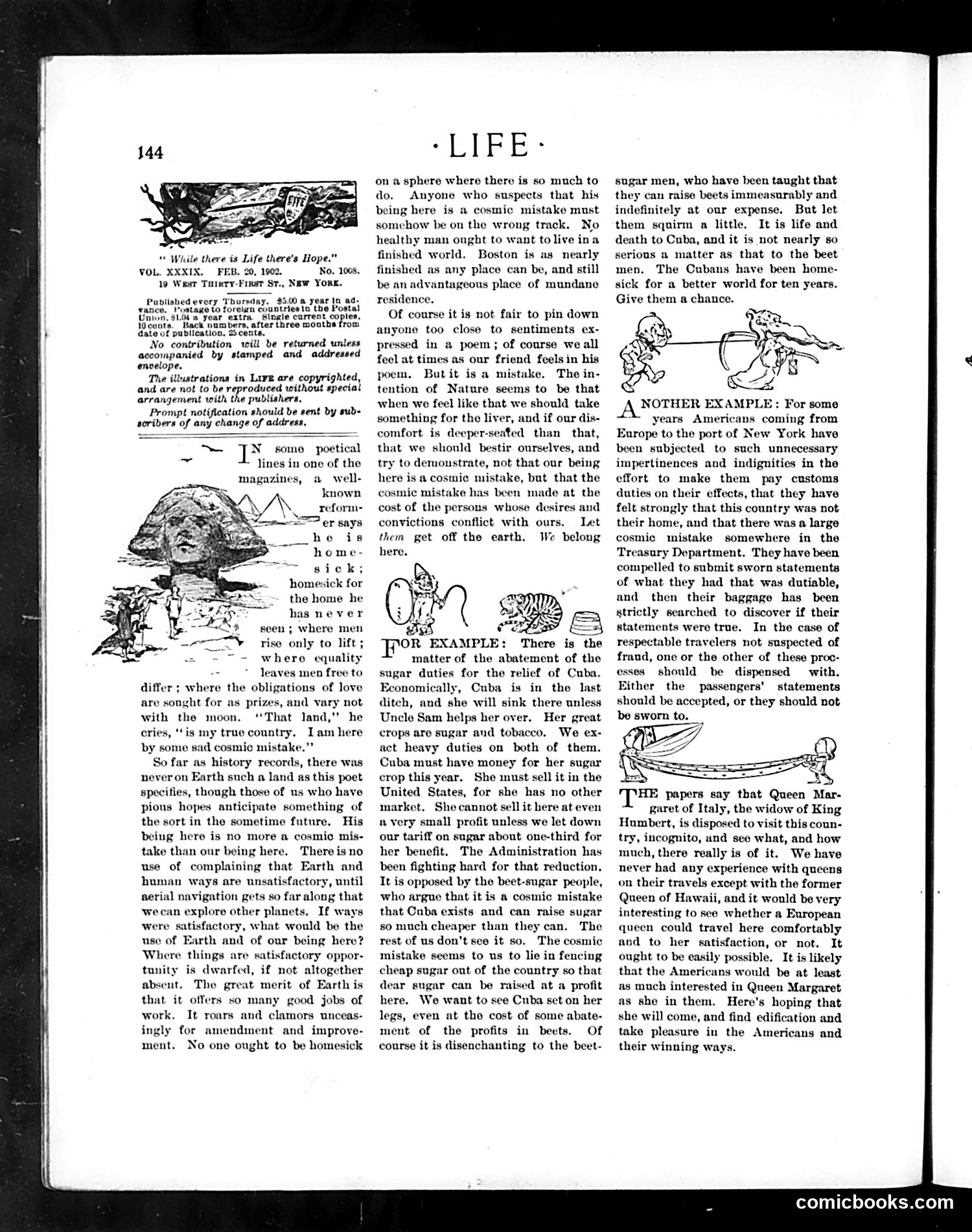
This page contains three illustrated examples addressing American attitudes toward foreign affairs and domestic issues: 1. **The "Home Sick" illustration** critiques Americans who romanticize their homeland while abroad, suggesting this represents a "cosmic mistake"—misplaced patriotism. 2. **The Cuba sugar duties cartoon** discusses tariff policy protecting American sugar interests while Cuba struggles economically. The text argues it's unfair to keep cheap Cuban sugar out, forcing Cuba to sell elsewhere. This reflects early 20th-century trade disputes and American protectionism. 3. **The Queen Margaret reference** humorously suggests a foreign queen might visit America, speculating whether she'd find Americans interesting enough to stay. The overall theme critiques American insularity, protectionist economics, and self-centered attitudes toward foreign relations during this era.
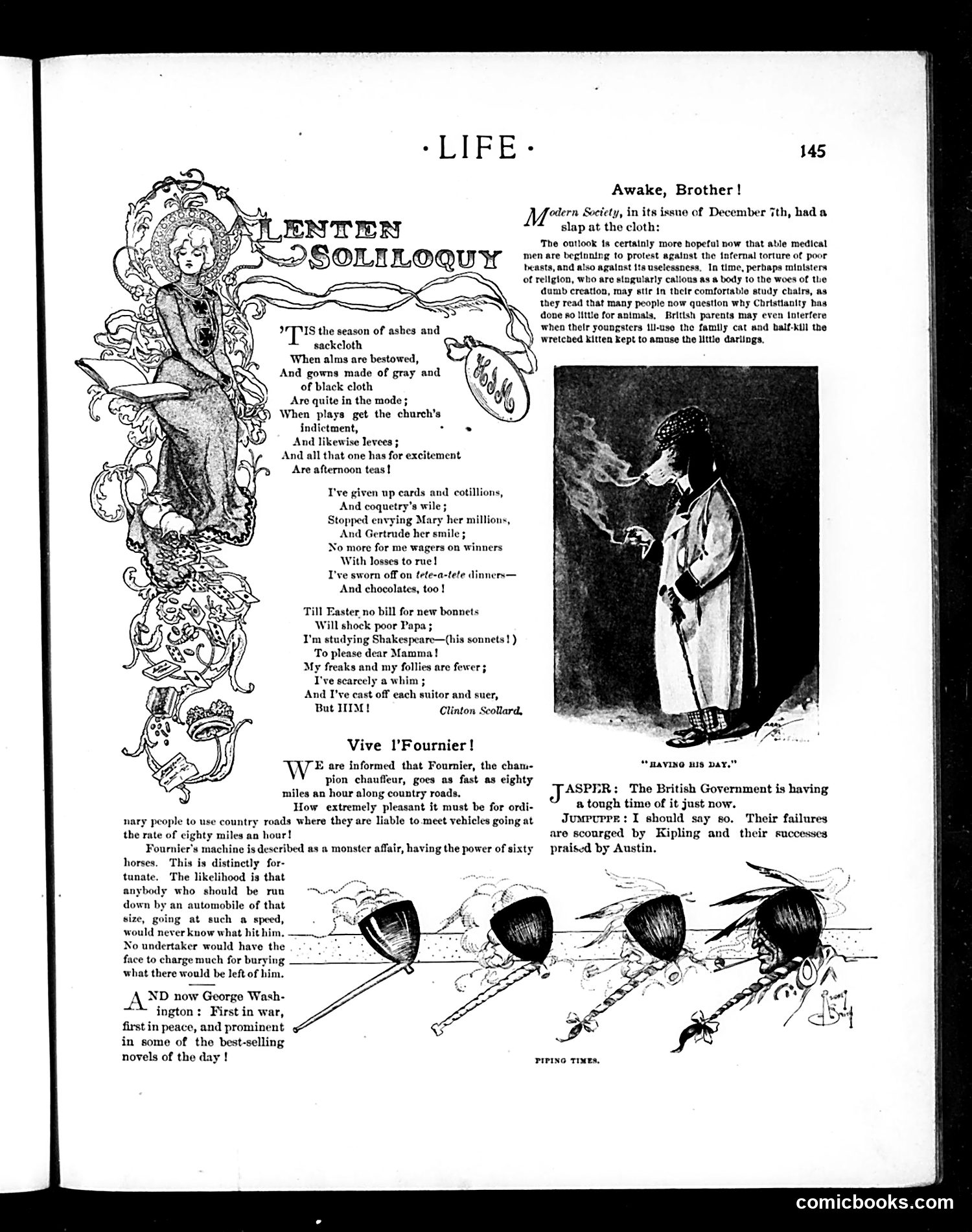
This page contains two distinct satirical pieces: **"Lenten Soliloquy"** (left): A decorative poem by Clinton Scollard mocking upper-class women's Lenten sacrifices. The speaker humorously claims to renounce cards, flirtations, and chocolates—trivial deprivations compared to genuine religious observance. The satire targets wealthy society women who treat Lenten abstinence as fashionable performance rather than spiritual commitment. **"Vive l'Fournier!"** (right): Commentary on Fournier, a French race-car champion traveling at eighty miles per hour on country roads. The satire criticizes both Fournier's recklessness and the British government's failure to regulate such dangerous driving. The cartoon below ("Piping Times") depicts pedestrians being knocked airborne by speeding vehicles—visual commentary on the collision between modern automotive technology and public safety. Both pieces satirize contemporary excess and institutional inadequacy.
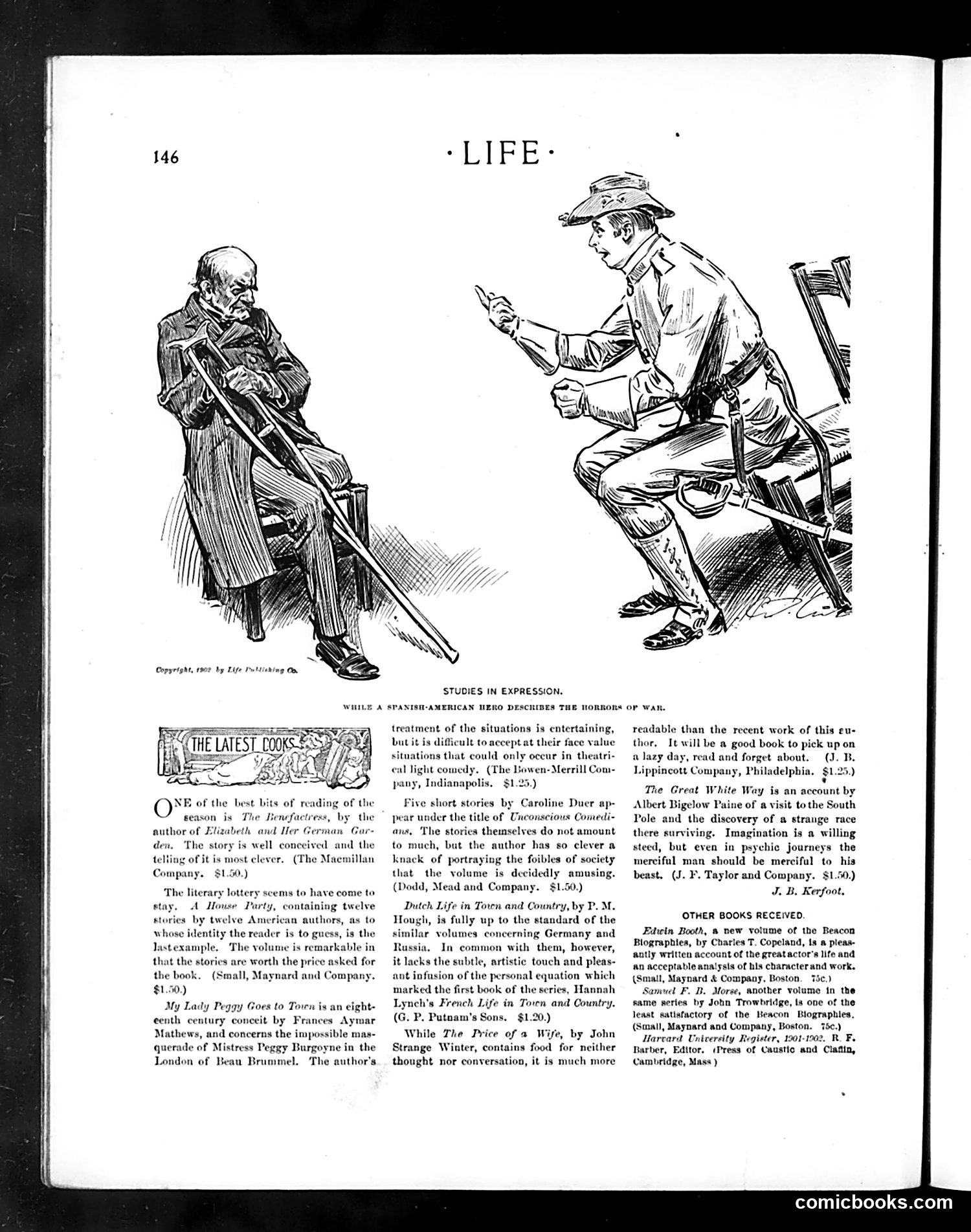
This cartoon illustrates a conversation between two figures discussing the horrors of war. The caption indicates it features "a Spanish-American hero describes the horrors of war." The left figure appears to be a Spanish or Spanish-American soldier in military dress, gesturing expressively while recounting war experiences. The right figure, dressed as an American soldier or scout with a hat and seated casually, listens. The satire likely mocks the contrast between soldiers' dramatic recollections of combat versus the reality of their experiences, or critiques how war narratives are presented and received. Given the Spanish-American War context (1898), this reflects contemporary American satirical commentary on that conflict and its aftermath.
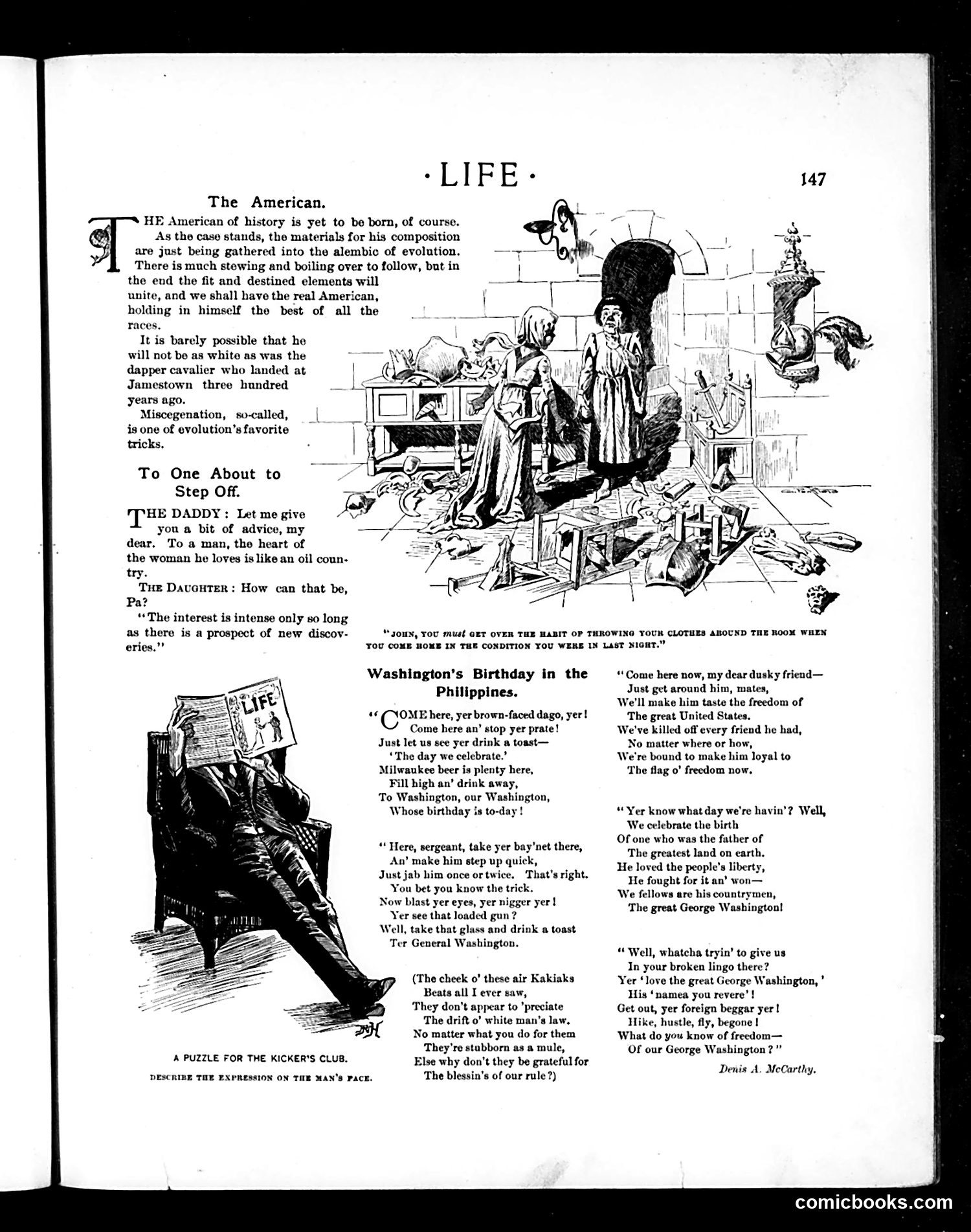
This page contains three distinct pieces: 1. **"The American"** — An essay on American identity and racial composition during the era of evolutionary theory. 2. **"To One About to Step Off"** — A dialogue between a father and daughter about a woman being "like an oil country," likely satirizing women as economic/romantic conquests rather than persons. 3. **"Washington's Birthday in the Philippines"** — A poem depicting American soldiers celebrating Washington's birthday while occupying the Philippines (likely post-1898). The text shows soldiers forcing Filipino people to celebrate American ideals and "freedom," revealing the satirical point: the contradiction between celebrating liberty while imposing colonial rule on non-consenting populations. The accompanying illustration shows a chaotic colonial scene.
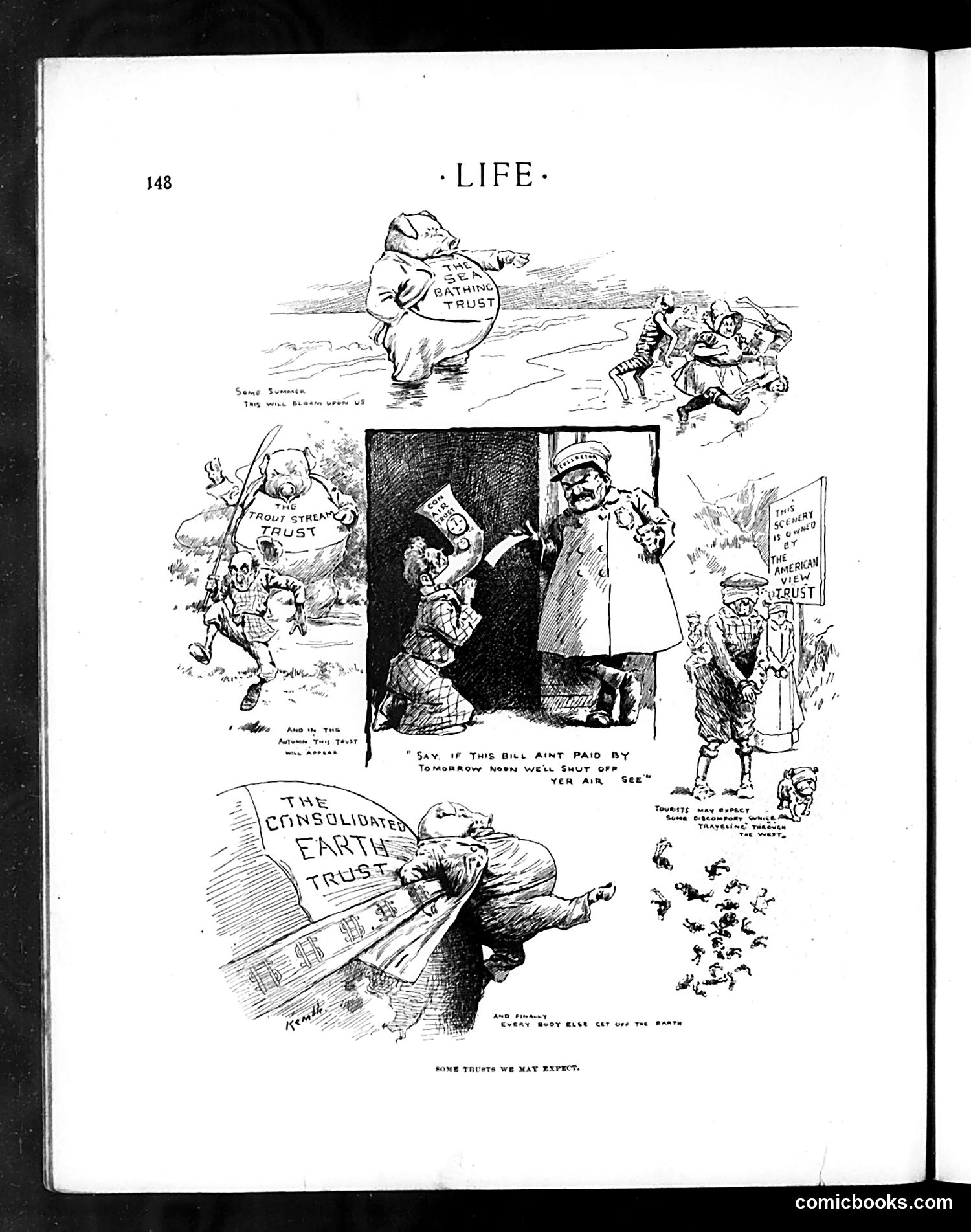
This page satirizes corporate monopolies ("trusts") through multiple vignettes. The cartoons depict various industries being consolidated under single corporate control: - **Bathing Trust**: A rotund figure labeled "Bathing Trust" stands in water while small figures scatter - **Front Street Trust**: Shows figures being squeezed or controlled - **Consolidated Earth Trust**: The largest image depicts a figure controlling a massive globe, with text "every body else get off the earth" - **American View**: References trust control over viewpoints/media The satire critiques the era's massive monopolies (likely early 1900s), suggesting that if consolidation continued unchecked, corporations would eventually monopolize even basic human activities like bathing and land itself. The phrase "Some Trusts We May Expect" sarcastically predicts absurd future monopolies if antitrust regulation failed.
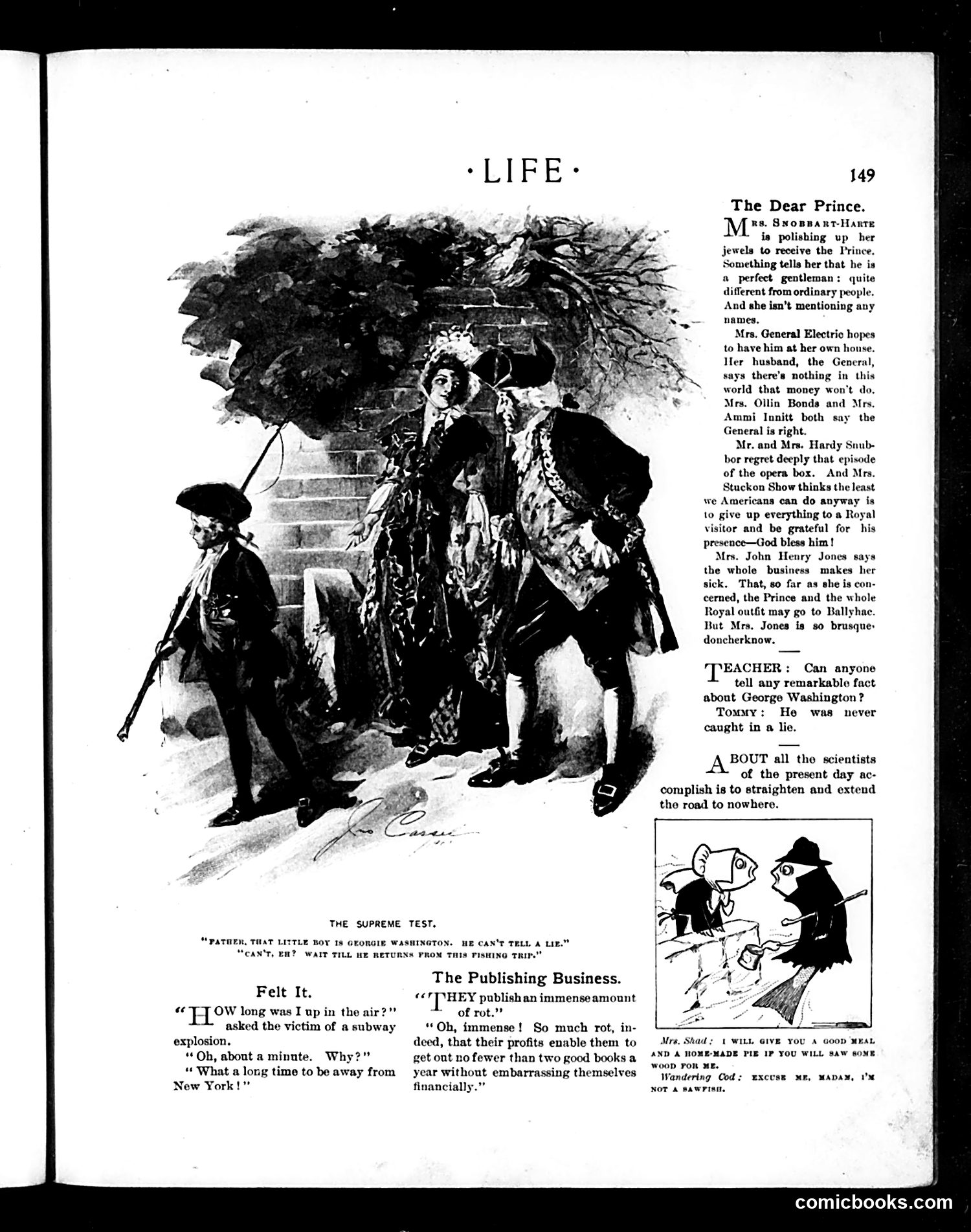
The main illustration satirizes royal protocol and American egalitarianism. It depicts what appears to be a European prince (identifiable by elaborate dress) visiting America, with the caption referencing a child who "cannot tell a lie" — likely alluding to the George Washington cherry-tree legend. The joke hinges on the contrast: Americans boast Washington "never caught in a lie," yet the text suggests even a truthful American child might tactlessly expose the prince's pretensions. The satire mocks both European aristocratic formality and American claims to honest directness. The accompanying "Publishing Business" joke and fishing cartoon are separate, lighter humor pieces typical of Life's miscellaneous content format.
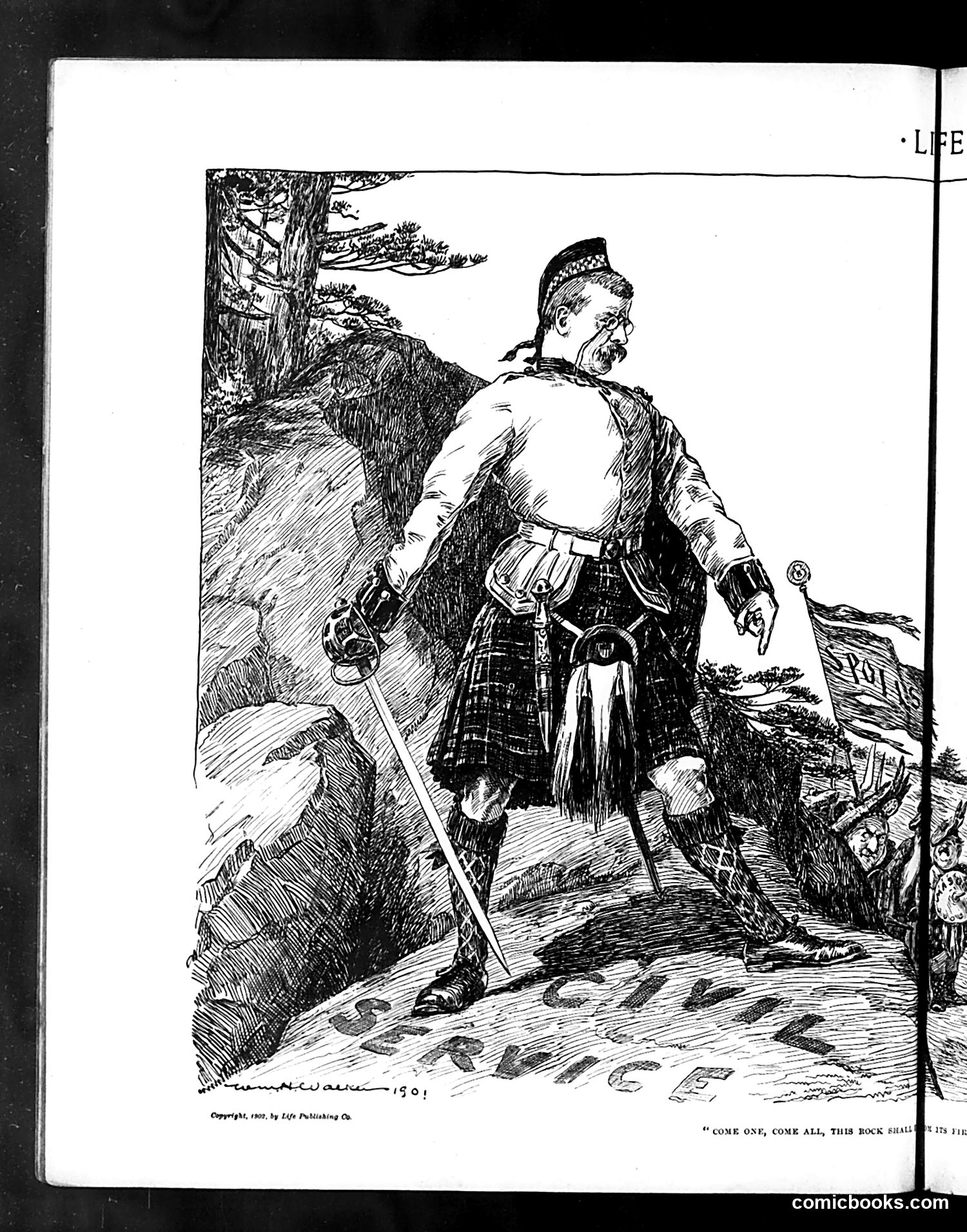
This is a political cartoon from Life magazine (copyright 1902). It depicts a Scottish Highlander in traditional dress—kilt, sporran, bonnet, and sword—standing in a mountainous landscape. The figure appears confident and resolute, gazing outward. The caption reads: "COME ONE, COME ALL, THIS BOCK SHALL BE THE TIE" This likely references Scottish identity and national pride, possibly related to early 1900s British political debates about Scottish autonomy or union. The "bock" (likely "rock") suggests permanence and strength. The cartoon uses Scottish Highland imagery—traditional dress and dramatic landscape—to represent Scottish resolve or defiance, though without additional context, the specific political situation remains unclear.
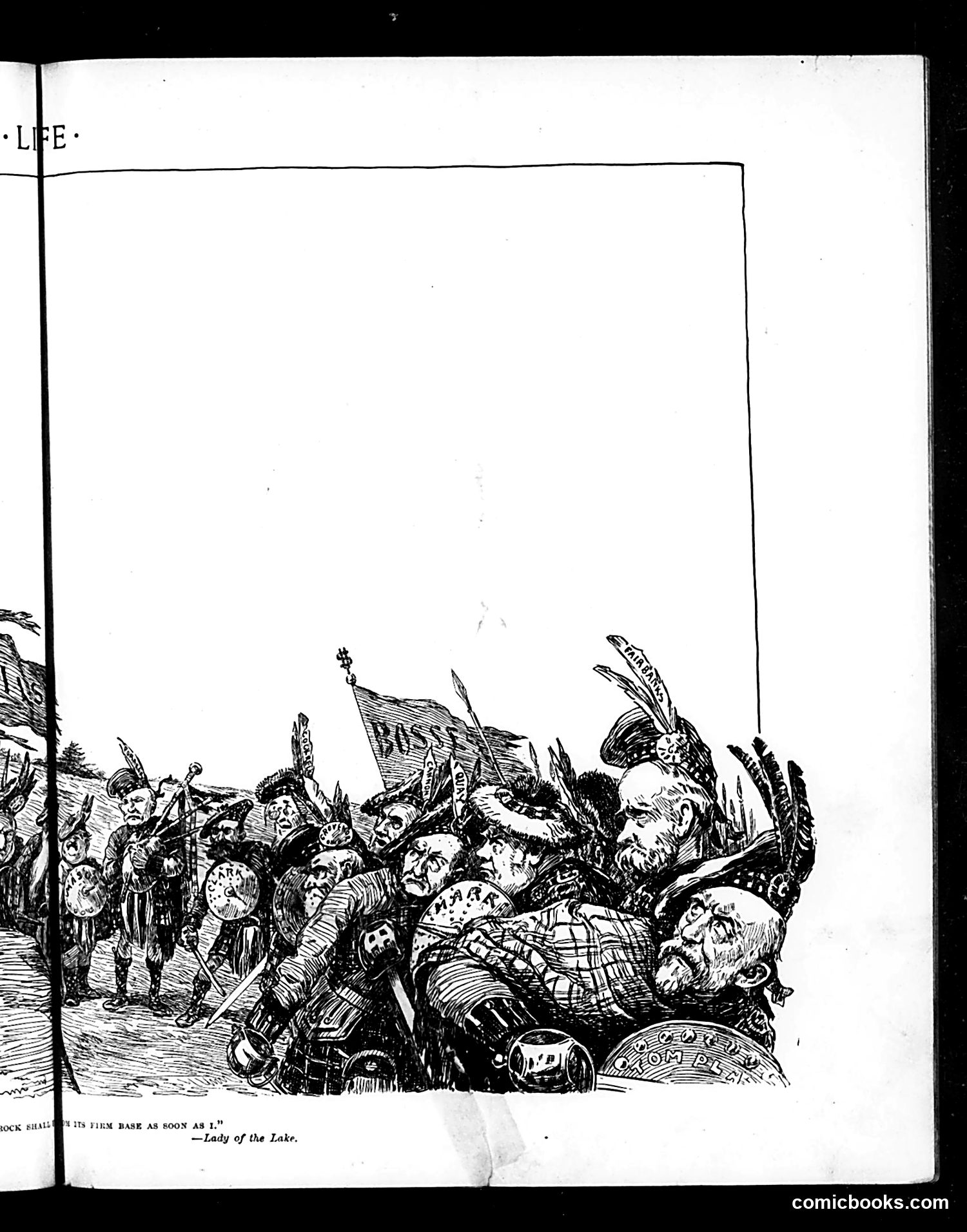
This page from *Life* magazine features a satirical illustration titled "Lady of the Lake." The cartoon depicts a chaotic gathering of figures in elaborate period costumes and regalia—appearing to reference Arthurian legend or medieval romance traditions. The scene shows multiple characters with ornate armor, feathered headdresses, and shields arranged in a crowded, somewhat absurd composition. The satirical point likely mocks either: 1. Contemporary political or social figures dressed in fanciful pretense, or 2. Overly romantic/theatrical adaptations of classical literature The crowded, undignified arrangement and caricatured features suggest the artist is ridiculing the subjects' pomposity or pretentiousness. Without the full article context, the specific political reference remains unclear, though the elaborate costumes indicate mockery of affected formality or false nobility.
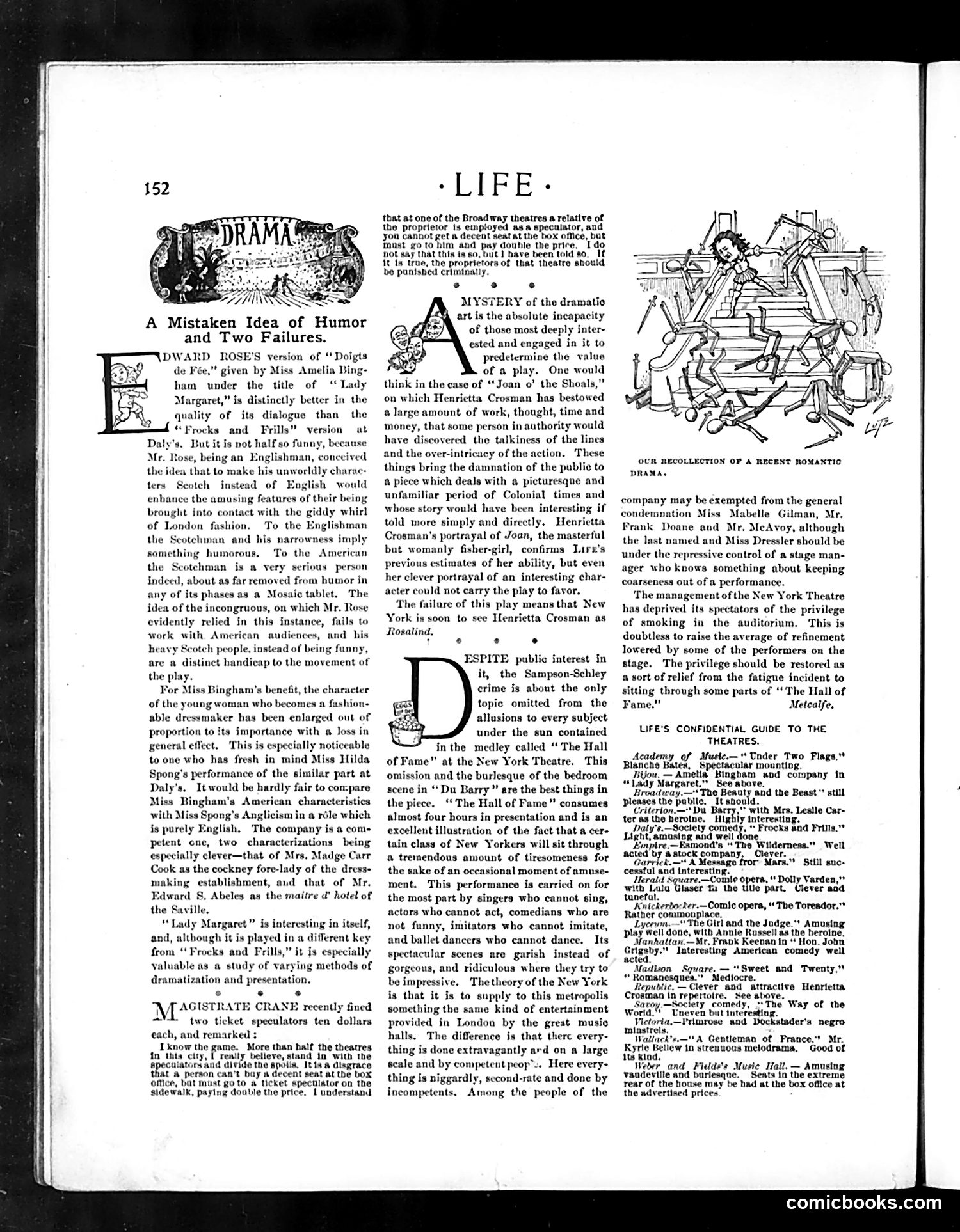
This page contains theatrical criticism and reviews rather than political cartoons. The main content discusses recent Broadway productions, including critiques of plays like "Joan of the Shoals" by Henrietta Crosman and "The Hall of Fame" at the New York Theatre. The right-hand column includes "Life's Confidential Guide to the Theatres" — a humorous listing of current shows with brief, witty descriptions meant to guide readers on which plays to attend. The small illustration at top right appears to show a chaotic theatrical scene, though details are unclear from this reproduction. The page reflects Life's role as a cultural arbiter commenting on New York's entertainment scene for educated readers.
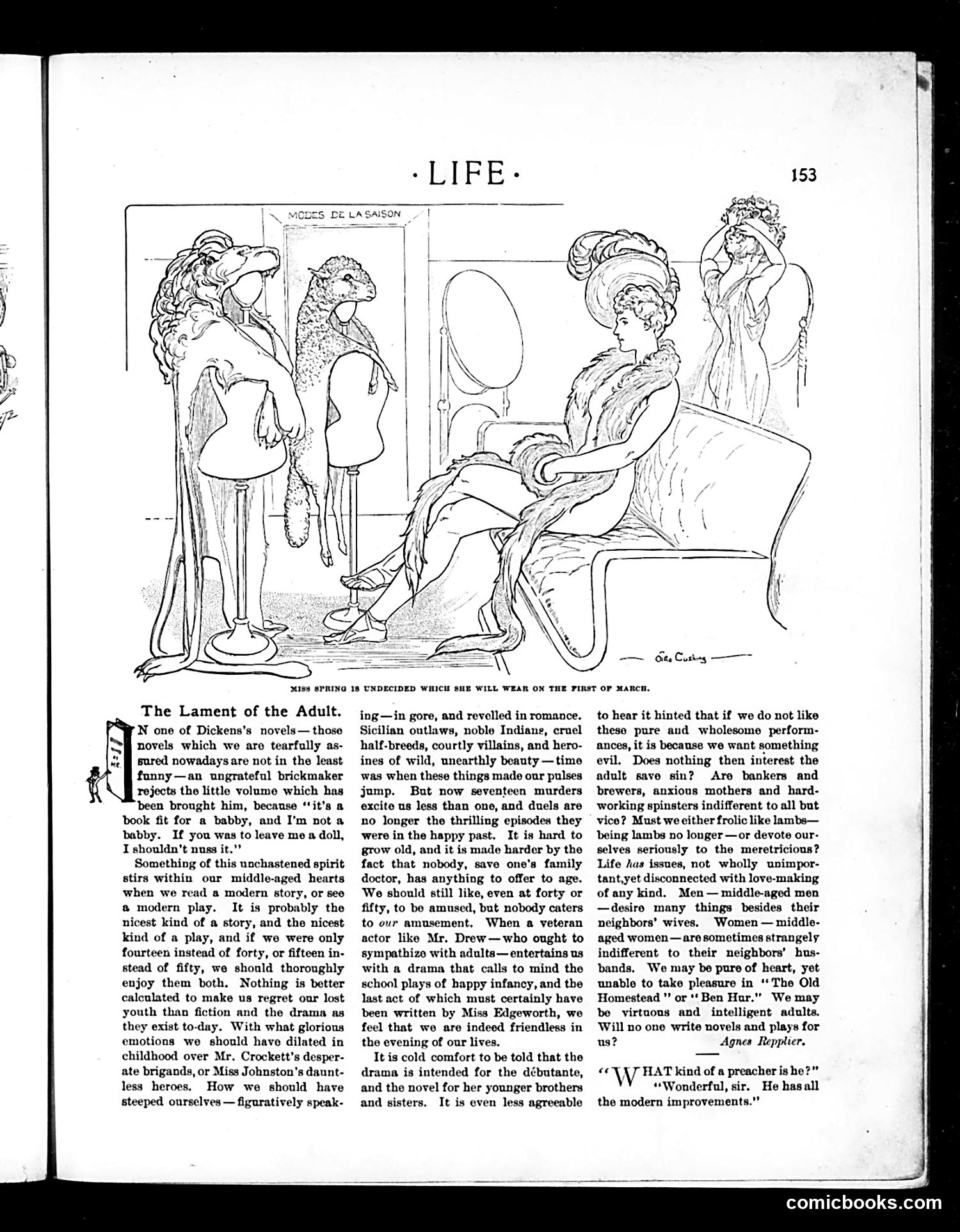
This page contains a satirical essay titled "The Lament of the Adult" by Agnes Repplier, accompanied by a cartoon illustration. **The Cartoon:** Shows an elegantly dressed woman seated, attended by servants or companions holding clothing items. The caption reads "Miss Spring is undecided which she will wear on the first of March"—a joke about spring's unpredictable weather forcing indecision about seasonal wardrobe. **The Essay's Satire:** Repplier critiques contemporary (early 20th century) fiction and drama as exclusively aimed at young people—particularly debutantes and their siblings. She argues that adults, even virtuous ones, lack entertainment catering to their interests. The essay sardonically suggests that writers assume adults only care about vice and romance, ignoring that mature readers (bankers, mothers, spinsters) have intellectual and emotional needs beyond youthful melodrama. She references older adventure novels favorably, implying modern "wholesome" entertainment patronizes adults by treating them as children. **The Point:** A sophisticated complaint about condescending cultural production that ignores adult audiences' sophistication and diverse interests.
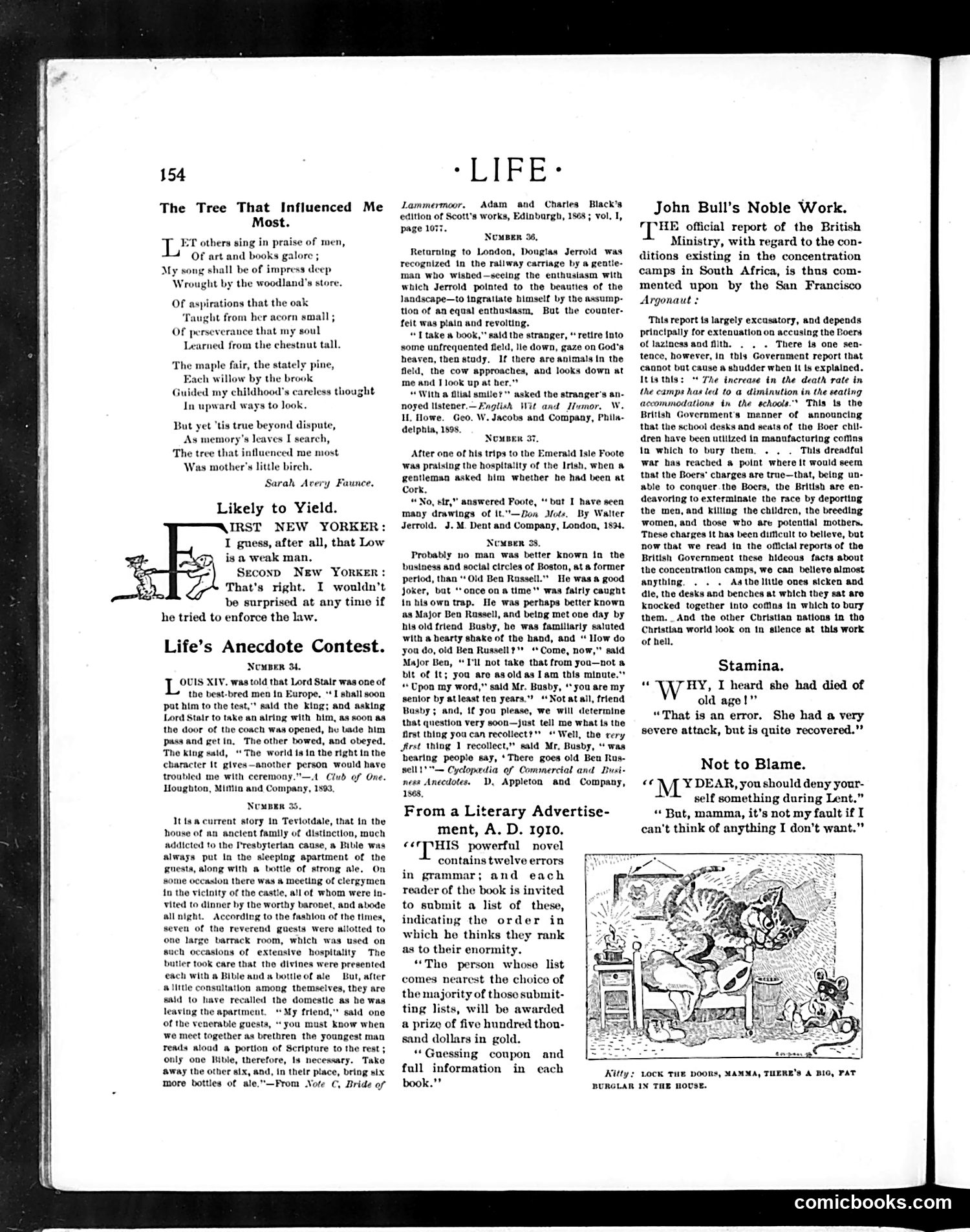
This page from the satirical magazine *Life* contains several distinct humor pieces: **"Likely to Yield" cartoon**: Two New Yorkers discuss someone named "Low" (likely Mayor Seth Low), with the joke being that enforcing the law would be surprising—implying Low is ineffectual or reluctant to enforce laws. The satire critiques mayoral weakness on law enforcement. **"Life's Anecdote Contest"**: The page prints humorous historical anecdotes submitted by readers, including stories about King Louis XIV testing Lord Stair's breeding, Scottish Presbyterian clergy prioritizing ale over Bibles, and witticisms from figures like Douglas Jerrold. These are presented as reader-submitted entertainment. **Illustration at bottom**: Shows a domestic scene with caption "KITTY: LOCK THE DOORS, MAMMA, THERE'S A BIG, FAT BURGLAR IN THE HOUSE"—a child's innocent misidentification for comedic effect. The page primarily serves as a humor/anecdote repository rather than focused political satire, typical of *Life's* mix of social commentary and light entertainment pieces.
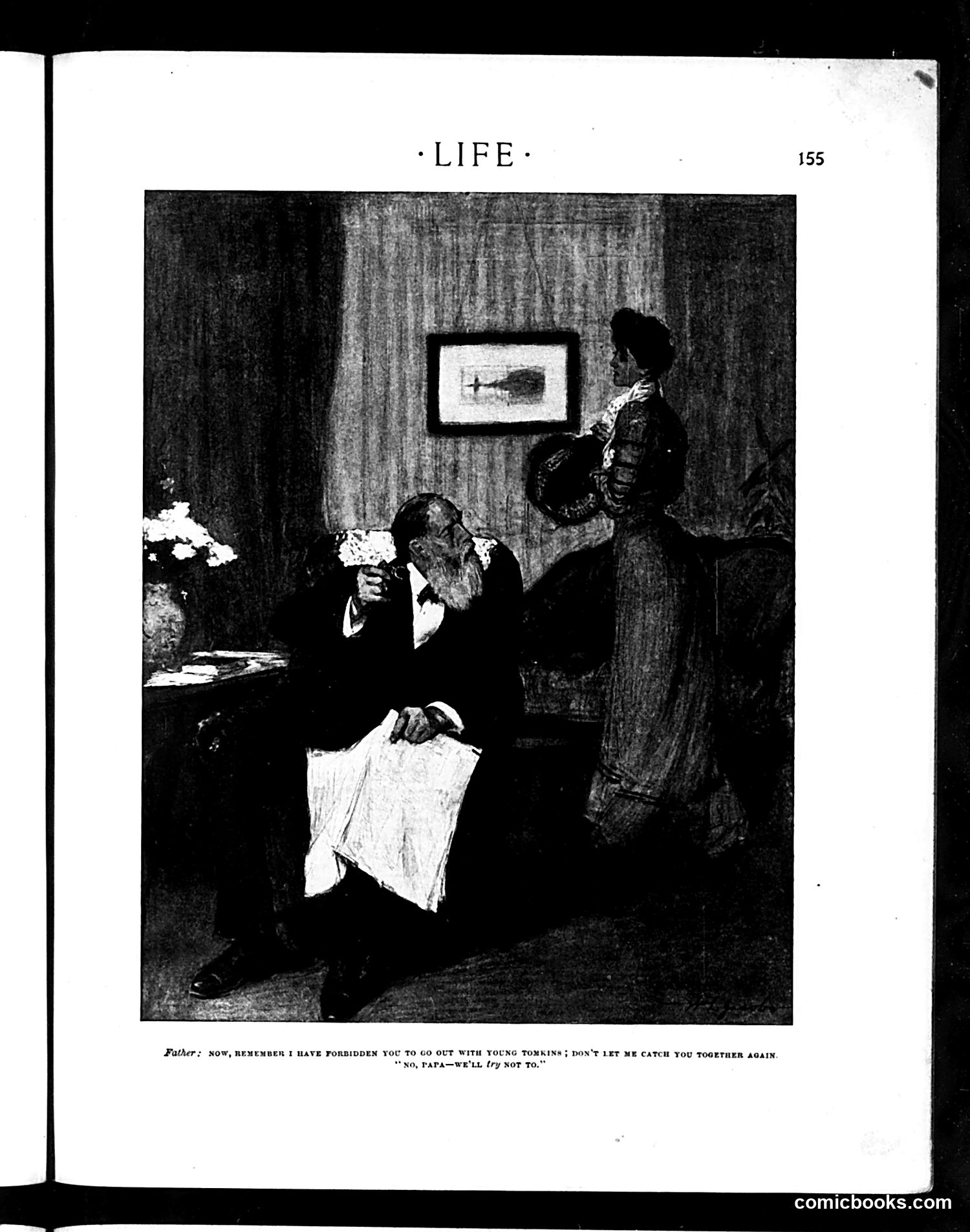
This is a domestic scene depicting a father sternly warning his daughter against seeing a young man named Tomkins. The daughter, standing with the young man present, meekly agrees to obey. The caption's awkward phrasing ("WR'LL fry NOT TO") appears to be an OCR error for "we'll try not to." The satire targets parental hypocrisy and ineffective discipline: the father explicitly forbids the couple from meeting, yet they're clearly together in his presence, making his prohibition laughable. The daughter's weak promise to comply—while standing right next to the forbidden suitor—undercuts her sincerity. This reflects turn-of-the-century anxieties about parental authority over courtship and youth independence. The joke mocks both the father's impotent authority and the daughter's transparent dishonesty.
This page contains two distinct satirical pieces from *Life* magazine: **"The Vaccinator"** is a humorous poem mocking mandatory vaccination—depicting the doctor's arrival with medical instruments and persuasive tactics as an inevitable "craze" Americans must endure. **The longer article** satirizes Prince Henry of Prussia's impending visit to New York. The author argues that royal visitors experience only sanitized America, missing "authentic" American life. The satire catalogs what the Prince *won't* experience: tobacco-searching customs officials, chaotic Brooklyn Bridge crowds, cramped elevated trains, loud department stores, and uncomfortable railroad travel with crying babies and orange-eating passengers. The humor is ironic: the author presents America's actual discomforts, filth, and chaos—crowded transit, unsanitary conditions, aggressive commerce—as the "true" America worth seeing. It's social commentary wrapped in mock-patriotism, suggesting that real American experience involves enduring precisely what polite society shields from dignitaries. The page's advertisements are unrelated to the editorial content.
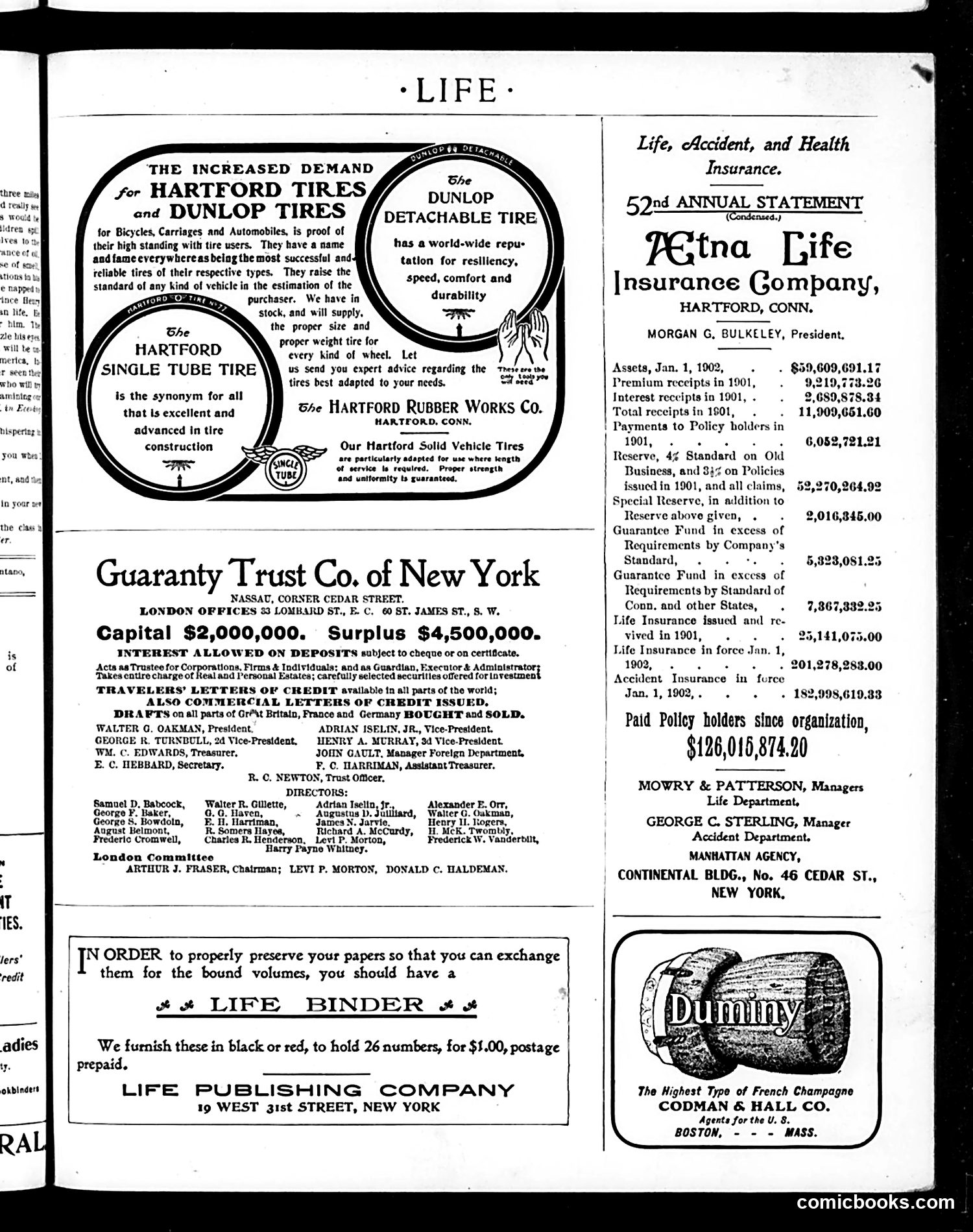
This is primarily a **collection of advertisements and financial notices**, not a satirical cartoon page. The main advertisements feature: 1. **Hartford Rubber Works** (top): Promotes Dunlop brand bicycle and automobile tires, emphasizing their reliability and worldwide reputation. 2. **Guaranty Trust Co. of New York** (center): A major financial institution advertising its banking services—capital, interest-bearing deposits, trust services, and letters of credit for travelers and commerce. 3. **Aetna Life Insurance Company** (right column): The company's annual financial statement, showing assets, premiums, and insurance policies in force. 4. **Life Binder advertisement** (bottom): Promotes storage binders for preserving and organizing magazine issues. 5. **Duminy Champagne** (bottom right): French champagne advertisement. This page reflects **early 1900s commerce and finance**—no satire is evident. It represents how Life magazine funded itself through high-end advertising targeting wealthy readers interested in investments, insurance, luxury goods, and financial services.
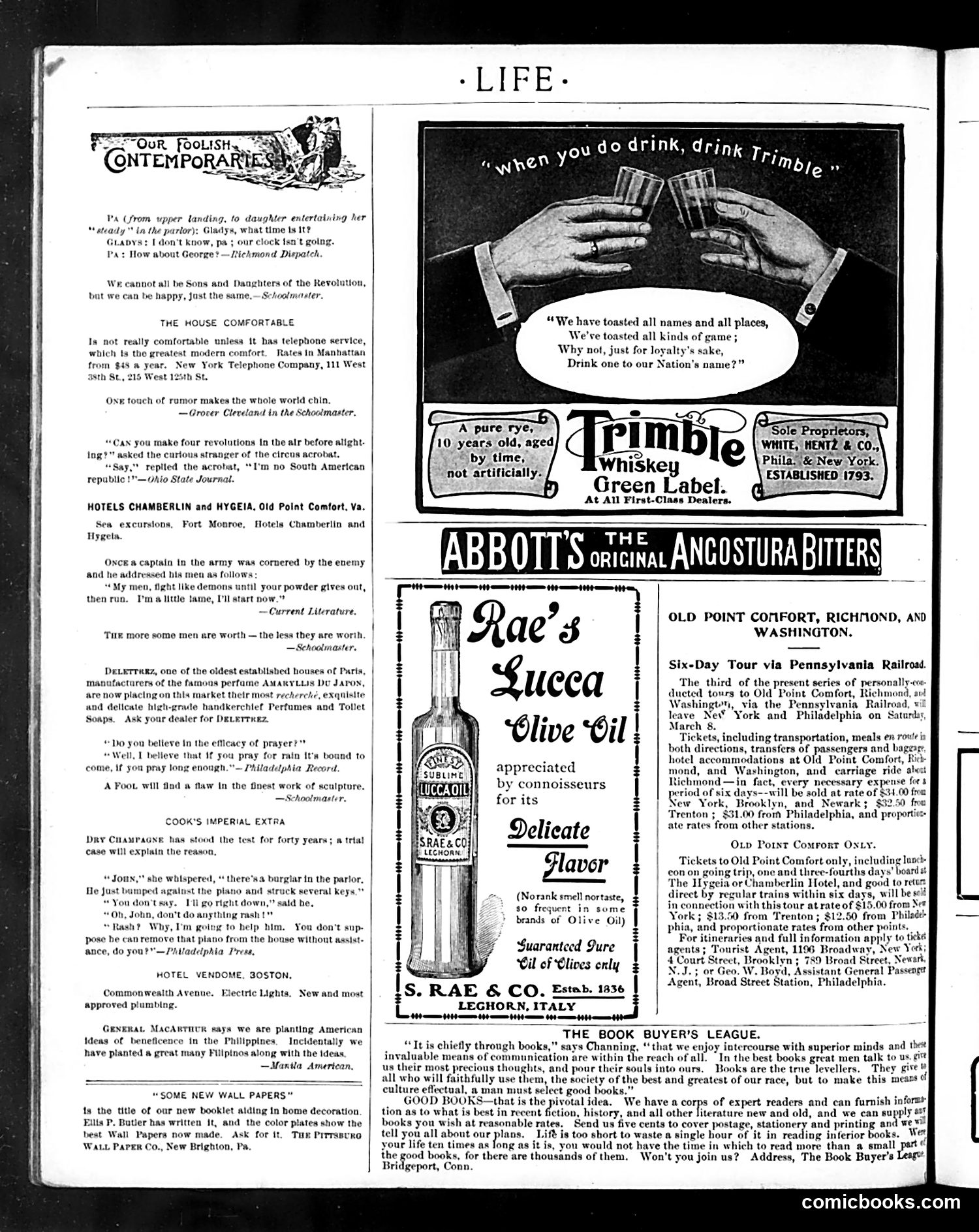
This page is primarily **advertising and humor fillers**, not political satire. The content consists of: **"Our Foolish Contemporaries"**: A humor section reprinting jokes from other newspapers. These are light domestic gags—a father asking his daughter the time, a circus acrobat refusing to "perform revolutions" like a "South American republic" (a mild jab at Latin American political instability), and a husband planning to help a burglar remove a piano. **Advertisements**: The bulk of the page promotes Trimble Whiskey, Abbott's Bitters, Rae's Lucca Olive Oil, Cook's Champagne, and travel packages. The Trimble ad includes patriotic rhetoric ("Drink one to our Nation's name") typical of early 1900s marketing. **No identifiable caricatures or specific political figures** are present. The content reflects genteel Victorian-era humor and commercial appeals to middle-class readers.
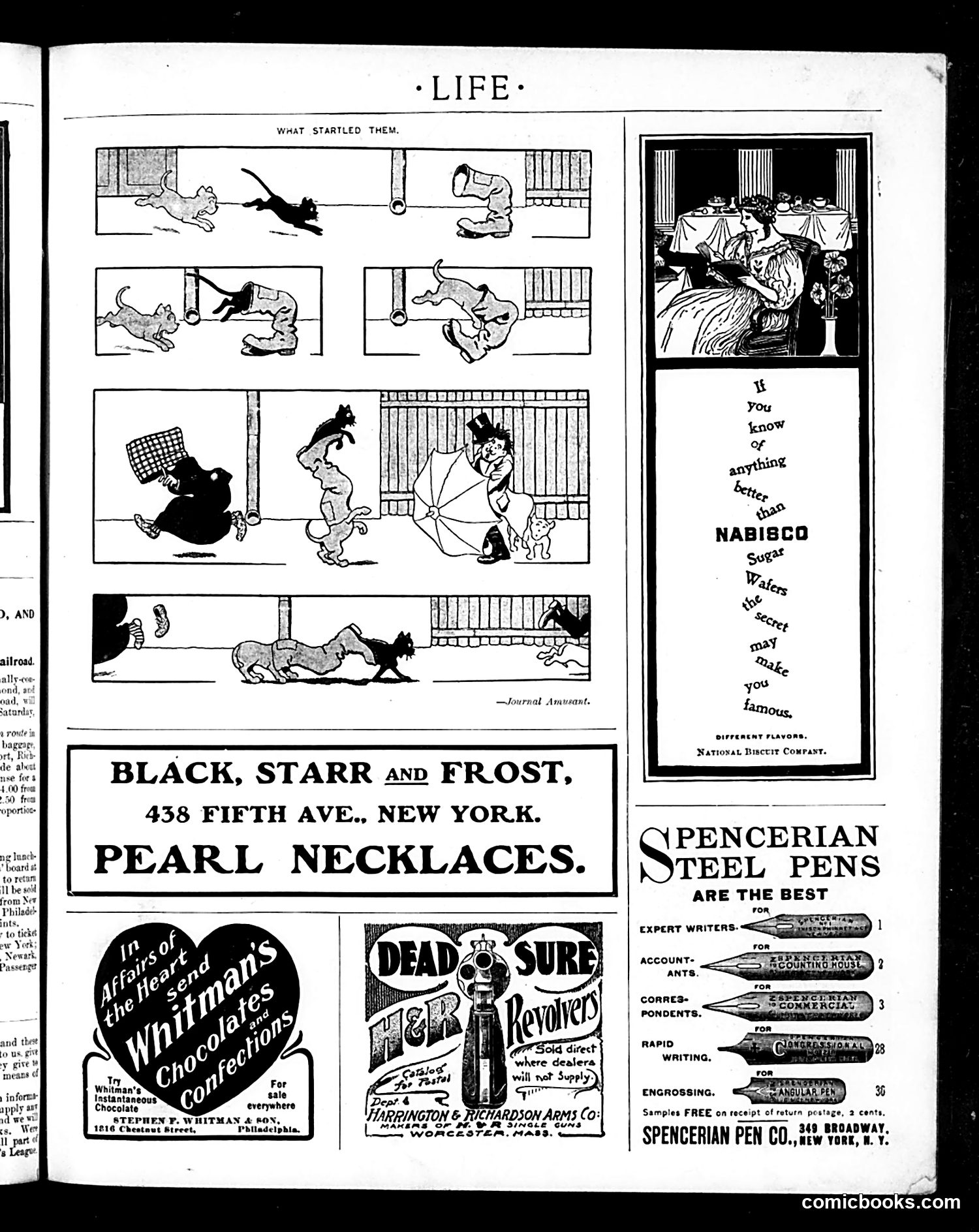
This untitled comic strip depicts a chain-reaction sequence of escalating chaos: a child chases a black cat, which startles a woman, who drops her baby carriage, triggering tumbling pedestrians and increasing mayhem. The final panel shows a man lying on the ground amid the disorder. The satire illustrates the **butterfly effect**—how minor incidents snowball into disproportionate consequences. This reflects early 20th-century anxieties about urban life's unpredictability and modern society's interconnected, chaotic nature. The humor derives from the exaggerated progression from innocent beginning (child and cat) to complete pandemonium. The page is primarily **advertising** (pearl necklaces, chocolate, fountain pens, revolvers), with the comic serving as editorial content amid commercial messaging—typical of Life's satirical-humor-plus-ads format.
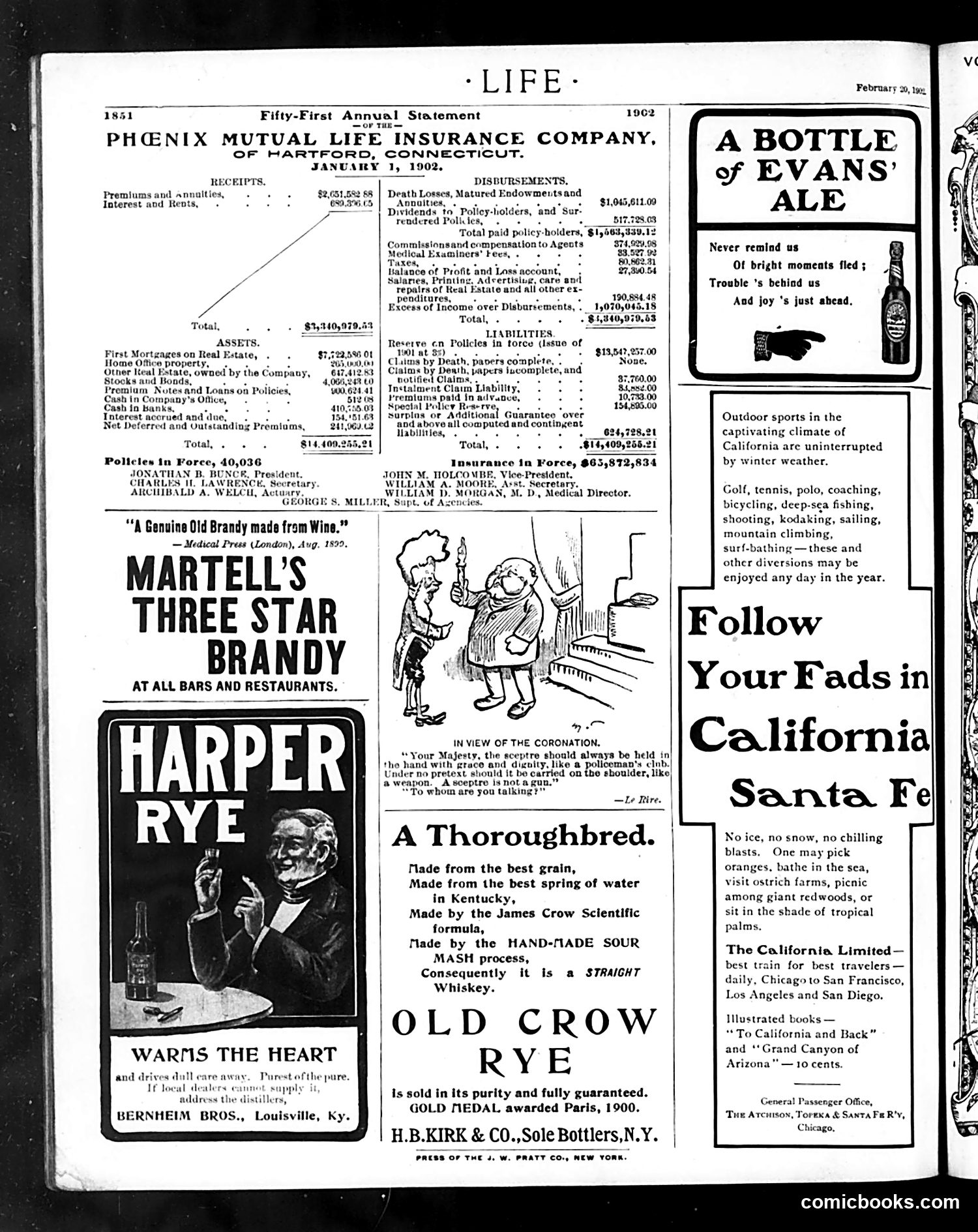
This page is primarily **financial and advertising content** rather than political satire. The top half features the Phoenix Mutual Life Insurance Company's annual statement—routine corporate reporting for a 51-year-old firm. The only cartoon present is titled **"In View of the Coronation,"** a small sketch apparently commenting on King Edward VII's recent coronation (1902). The joke depicts someone advising that a scepter should be held "like a policeman's club"—with grace and dignity—rather than "like a weapon" on the shoulder. This appears to be gentle humor about proper royal decorum, though the specific satirical point is unclear without fuller context. The remainder consists of period liquor and travel advertisements (Martell's brandy, Harper Rye, Old Crow Rye, Evans' Ale) and a Santa Fe Railway ad promoting California's year-round pleasant weather and sports opportunities. The page reflects *Life* magazine's mixed editorial-advertising format typical of early 1900s publications.