
Life, 1902-02-20 · page 13 of 20
Life — February 20, 1902 — page 13: what you’re looking at
What you’re looking at
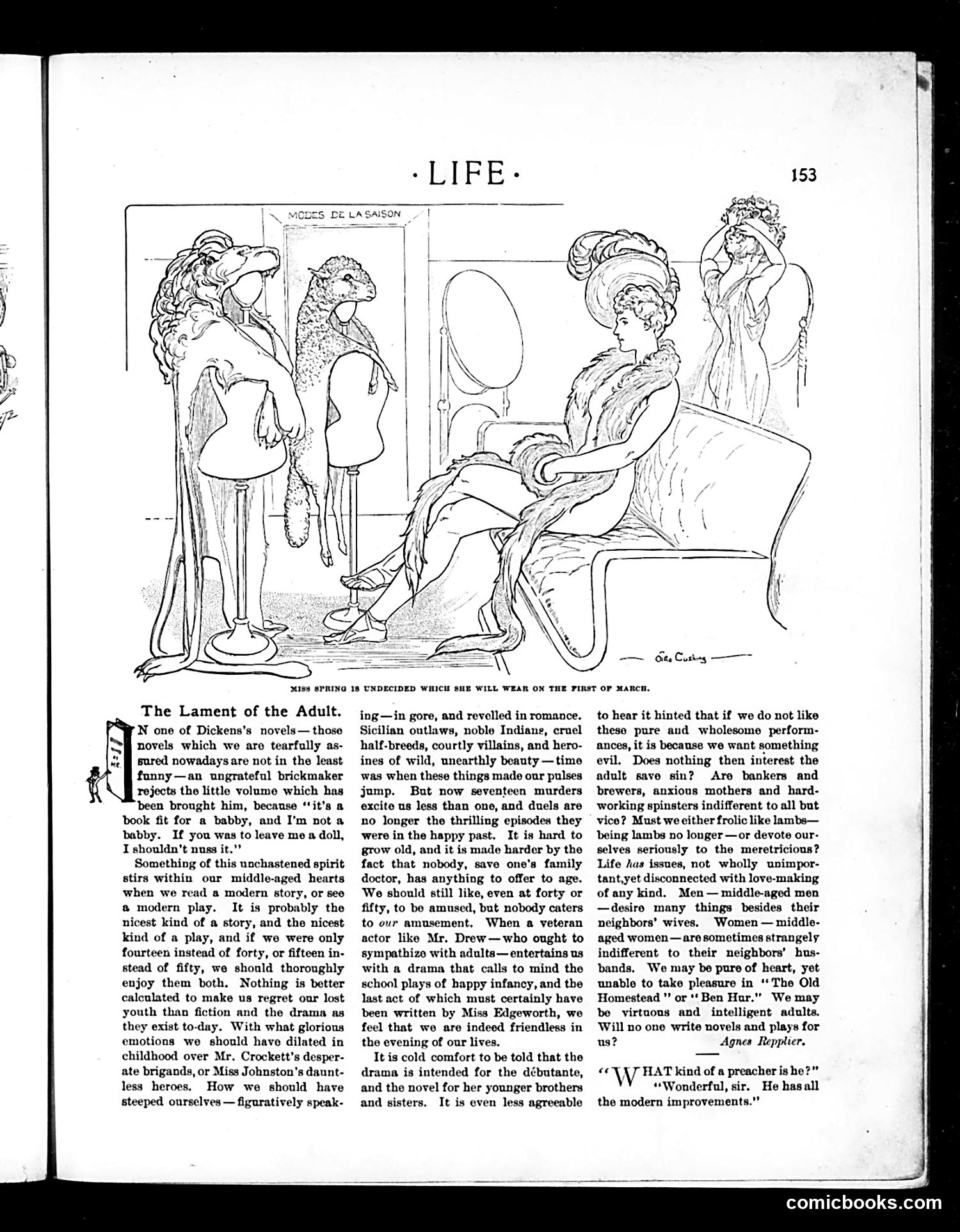
This page contains a satirical essay titled "The Lament of the Adult" by Agnes Repplier, accompanied by a cartoon illustration. **The Cartoon:** Shows an elegantly dressed woman seated, attended by servants or companions holding clothing items. The caption reads "Miss Spring is undecided which she will wear on the first of March"—a joke about spring's unpredictable weather forcing indecision about seasonal wardrobe. **The Essay's Satire:** Repplier critiques contemporary (early 20th century) fiction and drama as exclusively aimed at young people—particularly debutantes and their siblings. She argues that adults, even virtuous ones, lack entertainment catering to their interests. The essay sardonically suggests that writers assume adults only care about vice and romance, ignoring that mature readers (bankers, mothers, spinsters) have intellectual and emotional needs beyond youthful melodrama. She references older adventure novels favorably, implying modern "wholesome" entertainment patronizes adults by treating them as children. **The Point:** A sophisticated complaint about condescending cultural production that ignores adult audiences' sophistication and diverse interests.
📄 Transcribed text from this page (OCR, searchable)
Machine-transcribed from the original scan — historical spelling and the odd misread are preserved.
The Lament of the Adult. N one of Dickens’s novels— those novels which we are tearfully as- sured nowadays are not in the least fanny—an ungrateful brickmaker rejects the little volume which has been brought him, because ‘it’s a book fit for a babby, and I’m not a babby. If you was to leave me a doll, I shouldn't nuss it.” Something of this unchastened spirit stirs within our middle-aged hearts when we read a modern story, or see ® modern play. It is probably the nicest kind of a story, and the nicest kind of a play, and if we were only fourteen instead of forty, or fifteen in- stead of fifty, we should thoroughly enjoy them both. Nothing is better calculated to make us regret our lost youth than fiction and the drama as they exist to-day. With what glorious emotions we should have dilated in childhood over Mr. Crockett’s desper- ate brigands, or Miss Johnston's daunt- less heroes. How we should have steeped. ourselves — figuratively speak- DECIDED WHICH SHE WILL WEAR ON THE PINST OP MARCH, ing—in gore, and revelled in romance. Sicilian outlaws, noble Indiang, cruel half-breeds, courtly villains, and hero- ines of wild, unearthly beauty —timo was when these things made our pulses jamp. But now seventeen murders excite us less than one, and duels are no longer the thrilling episodes they were in the happy past. It is hard to grow old, and it is made harder by the fact that nobody, save one’s family doctor, has anything to offer to age. We should still like, even at forty or fifty, to be amused, but nobody caters to our amusement. When a veteran actor like Mr. Drew—who ought to sympathize with adults— entertains us with a drama that calls to mind the school plays of happy infancy, and the last act of which must certainly have been written by Miss Edgeworth, we feel that we are indeed friendless in the evening of our lives. It is cold comfort to be told that the drama is intended for the débutante, and the novel for her younger brothers and sisters. It is even less agreeable to hear it hinted that if we do not like these pure and wholesome perform- ances, it is because we want something evil. Does nothing then interest the adult save sin? Are bankers and brewers, anxious mothers and hard- working spinsters indifferent to all but vice? Must we either frolic like lambs— being lambs no longer —or devote our- selves seriously to the meretricious? Life as issues, not wholly unimpor- tant,yet disconnected with love-making of any kind. Men— middle-aged men —desire many things besides their neighbors’ wives. Women — middle- aged women—are sometimes strangely indifferent to their neighbors’ hus- bands, We may be pure of heart, yet unable to take pleasure in ‘‘The Old Homestead ” or ‘* Ben Hur.” We may be virtuous and intelligent adults. Will no one write novels and plays for us? Agnes Repplier, “ W HAT kind of a preacher is he?” “Wonderful, sir. He hasall the modern improvements.”” comicbooks.com