
Life, 1902-02-20 · page 12 of 20
Life — February 20, 1902 — page 12: what you’re looking at
What you’re looking at
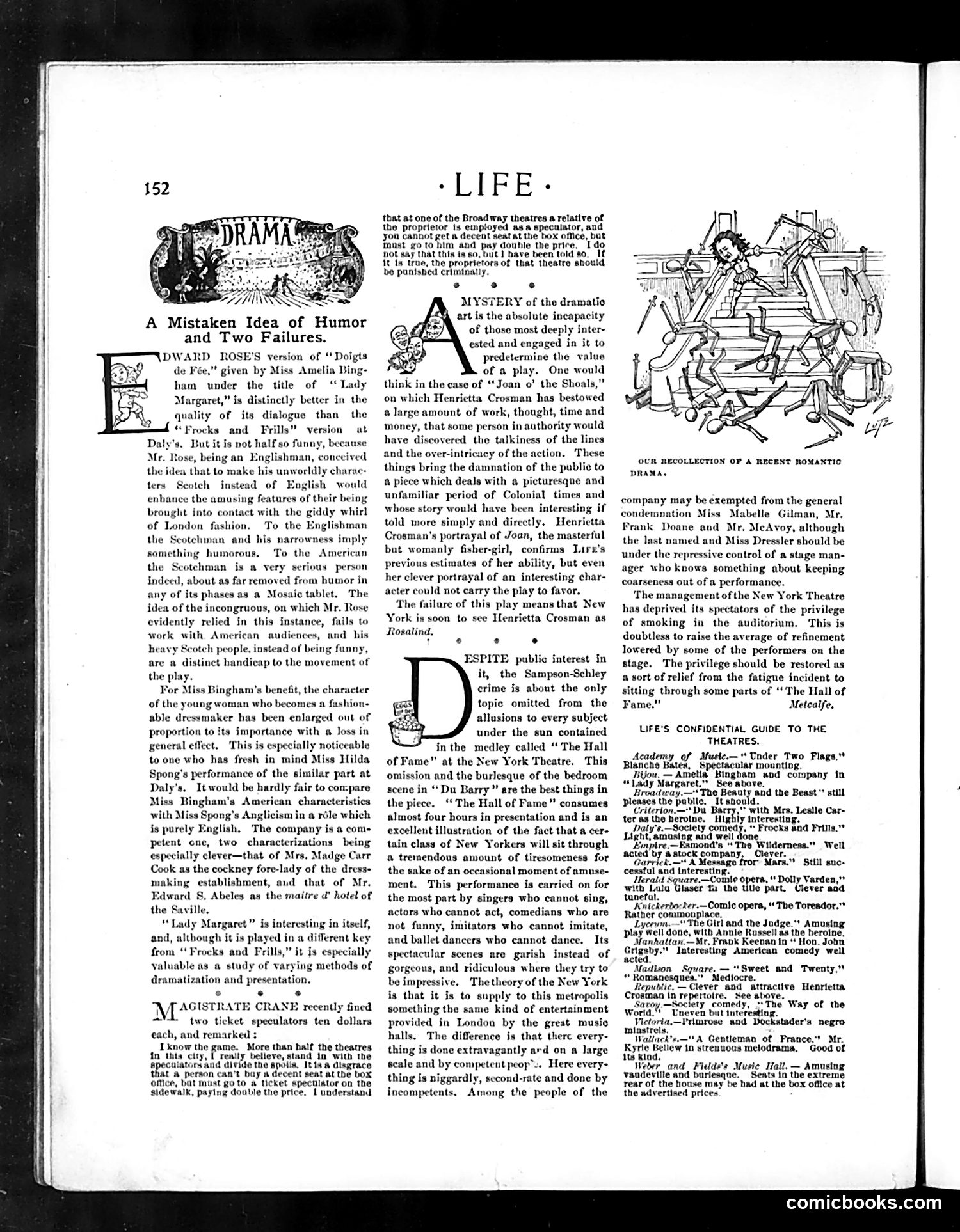
This page contains theatrical criticism and reviews rather than political cartoons. The main content discusses recent Broadway productions, including critiques of plays like "Joan of the Shoals" by Henrietta Crosman and "The Hall of Fame" at the New York Theatre. The right-hand column includes "Life's Confidential Guide to the Theatres" — a humorous listing of current shows with brief, witty descriptions meant to guide readers on which plays to attend. The small illustration at top right appears to show a chaotic theatrical scene, though details are unclear from this reproduction. The page reflects Life's role as a cultural arbiter commenting on New York's entertainment scene for educated readers.
📄 Transcribed text from this page (OCR, searchable)
Machine-transcribed from the original scan — historical spelling and the odd misread are preserved.
Iii ie - A Mistaken Idea of Humor and Two Failures. DWaRk SE'S version of “ Doigts "Ge," given by Miss Amelia Bing- ham under the title of ‘Lady Margaret,” is distinctly better in the quality of its dialogue than the “Frocks and Frills” version at Daly's. But it is not half so funny, because Mr. Rose, being an Englishman, conceived the idea that to make his unworldly charac- ters Scotch instead of English would enhance the amusing features of their being brought into contact with the giddy whirl of London fashion, To the Englishman the and his narrowness imply something humorous, To the American the Scotchman is a very serious person cotehn indeed, about as far removed from humor in any of its phases a3 @ Mosaic tablet, The idea of the incongruous, on which Mr. Rose evidently relied in this instance, fails to work with American audiences, and his heavy Scotch people, instead of being funny, are a distinct handicap to the movement of the play. For Miss Bingham's benefit, the character of the young woman who becomes a fashio able dressmaker has been enlarged out of proportion to its importance with a loss in general effect. This is especially noticeable to one who has fresh in mind Miss Hilda "s performance of the similar part at It would be hardly fair to con:pare ingham's American characteristics with Miss Spong’s Anglicism in a role which is purely English, The company is a com- t one, two characterizations being especially clever—that of Mrs, Madge Carr Cook as the cockney fore-lady of the dress- making establishment, and that of Mr. Edward S. Abeles as the maitre d’ hotel of the Saville. “Lady Margaret” is interesting in itself, and, although it is played in a different key from ‘Frocks and Frills,” it js especially valuable as a study of varying methods of dramatization and presentation. ° . . MAg8 TE CRANE recently fined = two ticket speculators ten dollars each, and remarked : I know the game. More than half the theatres in thts city, f really belleve, stand in with the speculators and divide tho spolin. Itts 8 disgrace iat & person can’t buy a decent seat at the box office, bat must goto # ticket speculator on the sidewalk, paying double the price. [ understand that at one of the Broadway theatres a relative of the proprietor 1s employed as a specalator, and you cannot get a decent seat at the box office, but Inust go to him and pay double the price. 1 do hot say that this 8 80, but I have been told 80, If At Is true, the proprietors of that theatre should be punished criminally, ° ° ° MYSTERY of the dramatio art is the absolute incapacity of those most deeply inter- ested and engaged in it to predetermine the value of a play. One would think in the case of ‘'Joan 0’ the Shoals,” on which Henrietta Crosman has bestowed a large amount of work, thought, time and money, that some person in authority would have discovered the talkiness of the lines and the over-intricacy of the action, These things bring the damnation of the public to a piece which deals with a picturesque and unfamiliar period of Colonial times and whose story would have been interesting if told more simply and directly. Henrietta Crosman's portrayal of Joan, the masterful but womanly fisher-girl, confirms Lire's previous estimates of her ability, but even her clever portrayal of an interesting char- acter could not carry the play to favor. The failure of this play means that New York is soon to see Henrietta Crosman as Rosalind, Ye ° . ESPITE public interest in it, the Sampson-Schley crime is about the only topic omitted from the allusions to every subject under the sun contained inthe medley called “The Hall of Fame” at the New York Theatre. This omission and the burlesque of the bedroom scene in “Du Barry” are the best things in the piece. ‘The Hall of Fame” consumes almost four hours in presentation and is an excellent illustration of the fact that a cer- tain class of New Yorkers will sit through @ tremendous amount of tiresomeness for the sake of an occasional moment of amuse- ment, This performance {s carried on for the most part by singers who cannot sing, actors who cannot act, comedians who are not funny, imitators who cannot imitate, and ballet dancers who cannot dance. Its spectacular scenes are garish instead of gorgeous, and ridiculous where they try to be impressive. The theory of the New York is that it is to supply to this metropolis something the same kind of entertainment provided in London by the great music halls. The difference is that therc every- thing is done extravagantly ard on a large scale and by competent peop’. Here every- thing is niggardly, second-rate and done by incompetents. Among the people of the OUR RECOLLECTION OP A RECENT ROMANTIC DRAMA. company may be exempted from the general condemnation Miss Mabelle Gilman, Mr. Frank Doane and Mr. McAvoy, although the last named and Miss Dressler should be under the repressive control of a stage man- ager who knows something about keeping coarseness out of a performance. ‘The management of the New York Theatre has deprived its spectators of the privilege of smoking in the auditorium. This is doubtless to raise the average of refinement lowered by some of the performers on the stage. The privilege should be restored as a sort of relief from the fatigue incident to sitting through some parts of “The Hall of Fame.” Metcalfe, LIFE'S CONFIDENTIAL GUIDE TO THE THEATRES. Academy of Muste.—‘* Under Two Flags."* Blanche Bates, Spectacular mounting. Bou. — Ametia Bingham xod company in “Lady Margaret," See above. Broadway.—*The Beauty and the Beast * still pleases the pubilc. It should. Criterton.—" Da Barry.” with Mrs. Lesile Care teras the herotne. Highly interesting. Daly's.—Soclety comedy, * Frocks and Frilis."* Light, amusing and weil done. Empire.—Esmond’s “The Wilderness.” Well acted by stock company. Clever. Garrick.—"' A Message fror Mars.” Still suc- cessful and interesting. Herald Square.—Comle opera, “ Dolly Varden,"* with Lala Glaser tu the UUe part, Clever add tunefal. Knickerbo-Rer.— Comic opera, “The Toreador."* Rather commouplace, Lycewn.-" The Girl and the Jodge."* Amusing play well done, with Annie Russell as the heroine, Manhattan.—Mr, Prank Keenan in“ Hon. Jobn Grigaby." Interesting American comedy well acted. Madison Square. — "Sweet and Twenty,” « Romanesques.” Mediocre. Republic, — Clever and attractive Henrietta Crosman in repertoire. See above. Saroy—Soctety comedy, **The Way of the World. Uneven but interesting. Victoria.—Primrose and Dockstader’a negro minstrels. % Wallack’s.—""A Gentleman of France,” Mr, Kyrie Bellew in strenuous melodrama, Good of its kind. Weber and Fields Music Hall. — Amusing vaadeville and buriesque. Seats in the extreme rear of the house may be had at the box office at the advertised prices comicbooks.com