
Life, 1902-02-20 · page 6 of 20
Life — February 20, 1902 — page 6: what you’re looking at
What you’re looking at
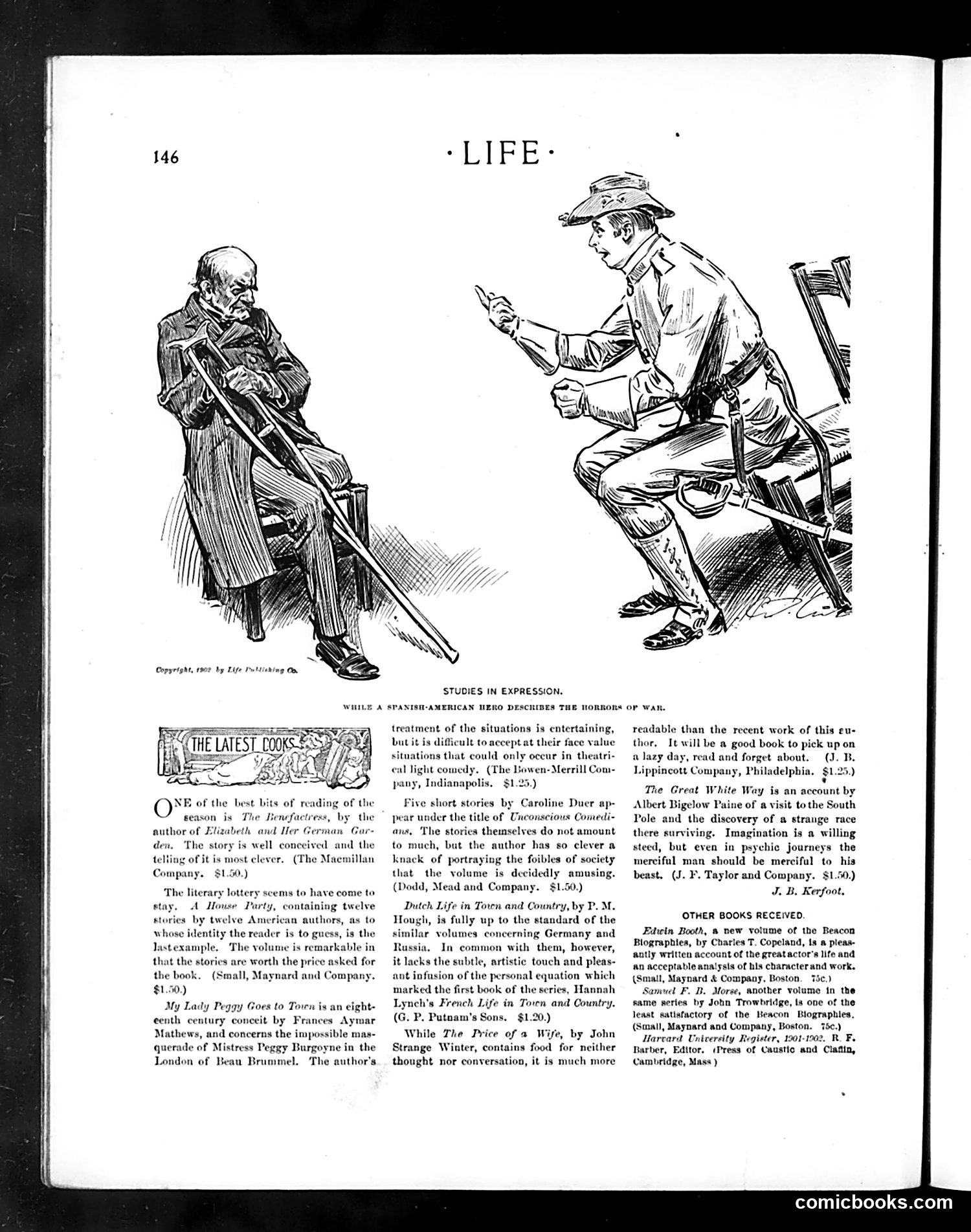
This cartoon illustrates a conversation between two figures discussing the horrors of war. The caption indicates it features "a Spanish-American hero describes the horrors of war." The left figure appears to be a Spanish or Spanish-American soldier in military dress, gesturing expressively while recounting war experiences. The right figure, dressed as an American soldier or scout with a hat and seated casually, listens. The satire likely mocks the contrast between soldiers' dramatic recollections of combat versus the reality of their experiences, or critiques how war narratives are presented and received. Given the Spanish-American War context (1898), this reflects contemporary American satirical commentary on that conflict and its aftermath.
📄 Transcribed text from this page (OCR, searchable)
Machine-transcribed from the original scan — historical spelling and the odd misread are preserved.
WHILE A STANTS SC) Tay “THE LATEST COOKE SS S of the bits of he Benefe author of Elizabeth and Mer Ge den, The stor telling of it Company. The literary lottery ses stay. A House Party, containing twelve stories by twelve American authors, as to whose identity the reader is to guess, is the lastexample. ‘The volume is remarkable in that the stories are worth the price asked for the book. (Small, Maynard and Company. $1.50) My Lady Peggy Goes to Town is an eight- eenth century conceit by Frances Aywar Mathews, and concerns the impossible mas- querade of Mistress Peggy Burgoyne in the London of Beau Brummel. The author's. se, by the man Gar- 1 the emillan is well conceived a t clever. (The M $1.50.) ms to have come to STUDIES IN EXPRESSION, treatment of the situations is entertaining, Lutit is dificult to accept at their face value ations that could only occur in theatri- light comedy. (The Bowen-Merrill Com- pany, Indianapolis, $1 Five short stories by Caroline Duer ap- pear under the title of Unconscious Comedi- ans, The stories themselves do not amount to much, but the author has so clever a knack of portraying the foibles of society that the volume is decidedly amusing. (Dodd, Mead and Company. $1.50.) Dutch in Town and Country, by P. M. Hough, is fully up to the standard of the similar volumes concerning Germany and Russia. In common with them, however, it lacks the subtle, artistic touch and pleas- ant infusion of the personal equation which marked the first book of the series, Hannah Lynch's French Life in Toren and Country. (G. P. Putnam's Sons. $1.20.) While The Price of a Wise, by John Strange Winter, contains food for neither thought nor conversation, it is much more AMERICAN HERO DESCRIBES THE NORRORS wan. readable than the recent work of this eu- thor, It will Le a good book to pick up on a lazy day, read and forget about. (J. B. Lippincott Company, Philadelphia. §1 The Great White Way is an account by Albert Bigelow Paine of a visit tothe South Pole and the discovery of a strange race there surviving. Imagination is a willing steed, but even in psychic journeys the merciful man should be merciful to his beast, (J. F. Taylor and Company. $1.50.) J.B. Kerfoot, OTHER BOOKS RECEIVED Edwin Booth, » new volume of the Beacon Biographies, by Charles T. Copeland, 1s a pleas. antly written account of the great actor's life and ‘an acceptable analysts of his characterand work. (Small, Maynard & Company, Boston. 5c.) Samuet F. B. Morse, another volume in the same sertes by John Trowbridge, ls one of the least satisfactory of the Beacon Biographies, (Small, Maynard and Company, Boston, 7c.) Harcard University Register, 1901-1902, R. Fe Rarber, Editor. (Press of Caustic and Ciafin, cambridge, Mass ) comicbooks.com