
A complete issue · 20 pages · 1901
Life — December 12, 1901
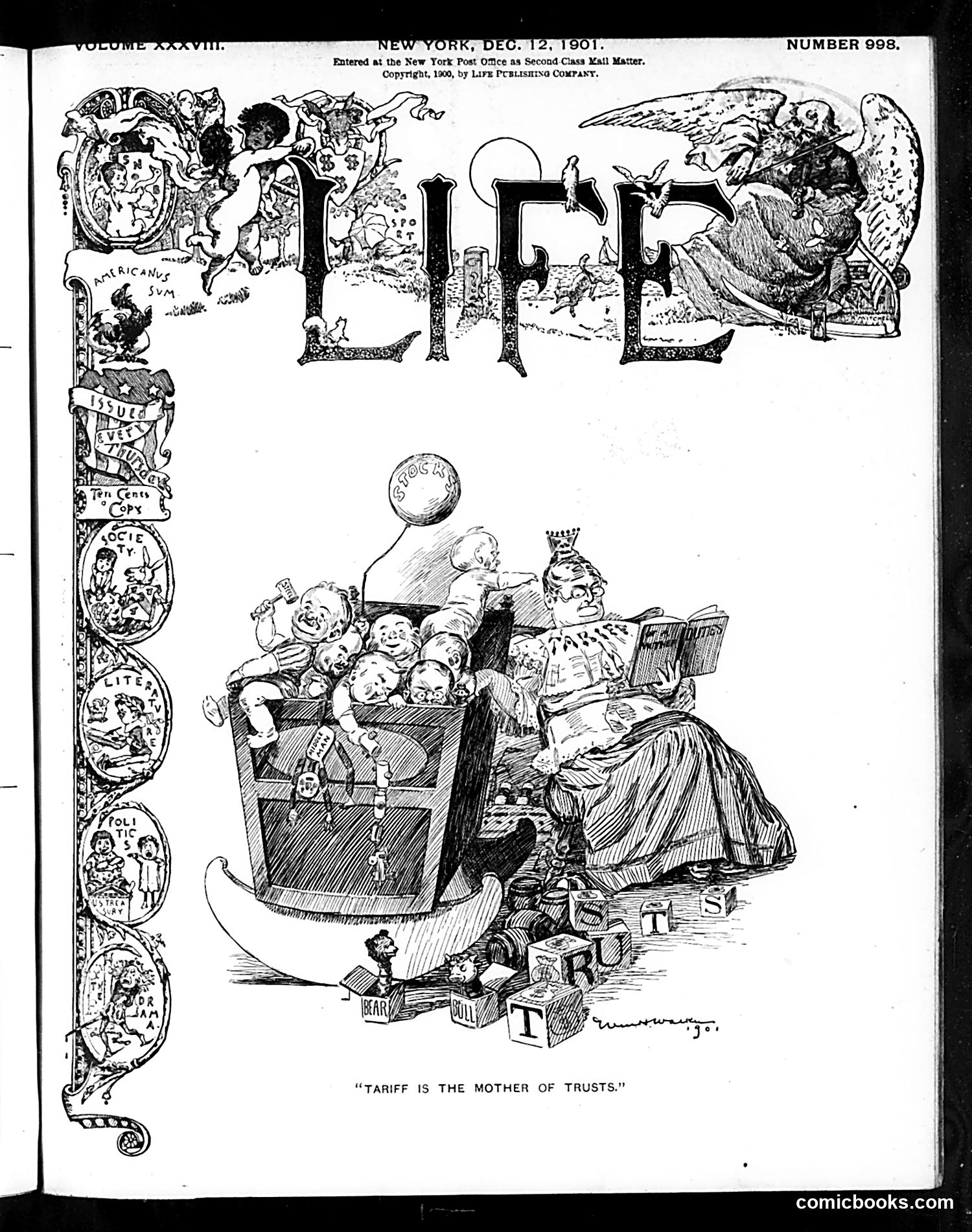
This December 1901 *Life* magazine cover satirizes the relationship between protective tariffs and monopolistic business trusts. The main cartoon depicts a wealthy, crowned figure (representing either a robber baron or personified Tariff itself) cradling a basket overflowing with babies labeled as various trusts—monopolistic corporations that dominated the era. The caption's ironic phrase suggests tariffs artificially protect domestic industries, allowing them to consolidate into powerful trusts that exploit consumers. The ornate left border contains smaller vignettes illustrating different aspects of American commerce and society. This reflects early 1900s Progressive Era anxieties about unchecked corporate power and protectionist trade policies that allegedly enabled monopolies rather than fostering fair competition.
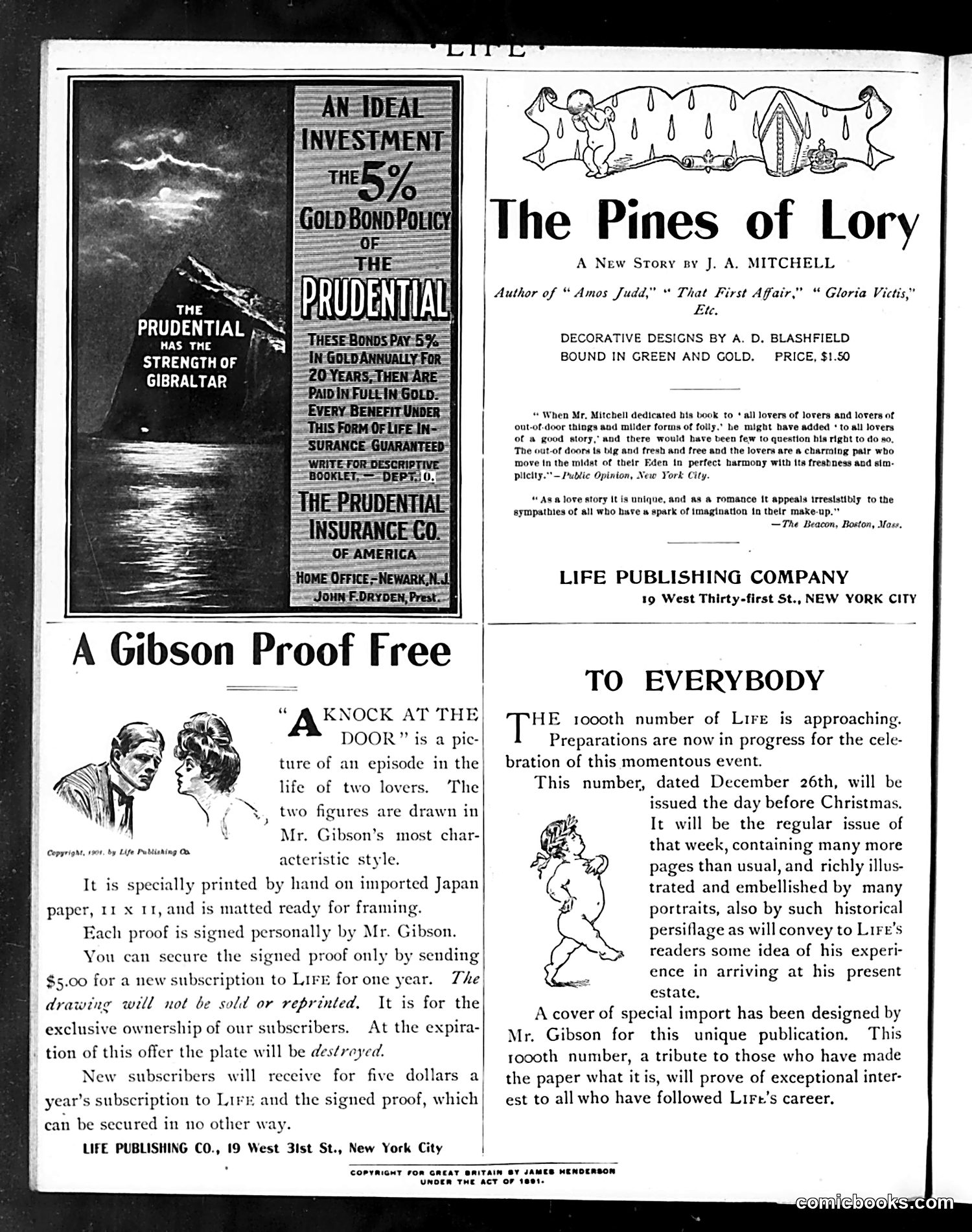
This page is primarily **advertising and promotional content** rather than political satire. The left side advertises Prudential Insurance's Gold Bond Policy, featuring dramatic landscape imagery. The top right promotes "The Pines of Lory," a new story by J.A. Mitchell published by Life Publishing Company. The bottom left offers a **Gibson Proof**—a signed artistic print by illustrator Charles Dana Gibson, available exclusively to new Life magazine subscribers for $5. The image shows Gibson's characteristic style: two figures (a man and woman) in profile, typical of his popular "Gibson Girl" era illustrations. The right side announces Life's approaching **1000th issue** (December 26th), describing it as a special, expanded publication celebrating the magazine's milestone. This is essentially a **subscription drive** using Gibson's celebrity appeal.
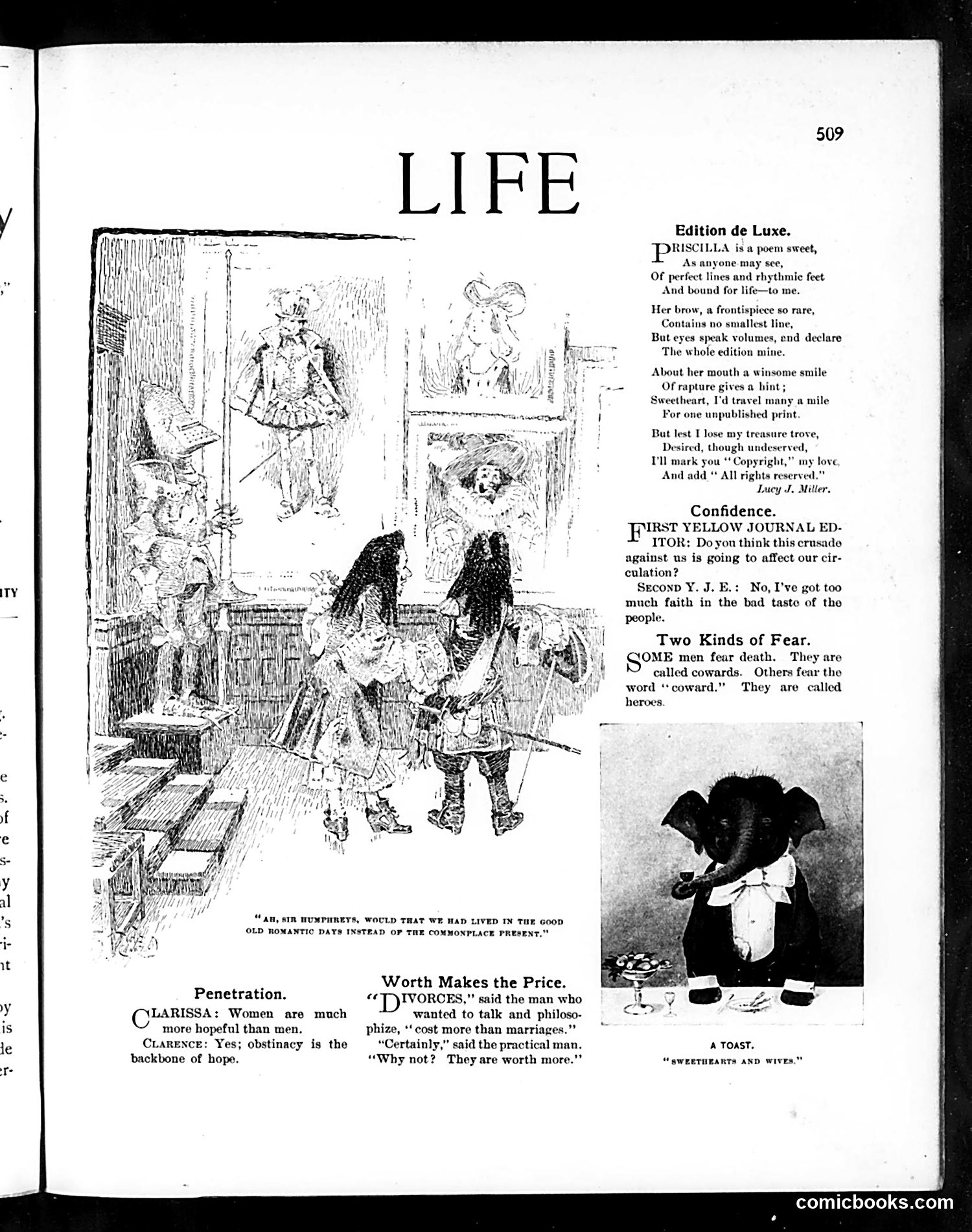
The main cartoon depicts two figures in period dress viewing portraits in what appears to be a gallery or home. The caption references "Sir Humphreys" and "romantic days" versus "the commonplace present," suggesting nostalgic commentary on changing social customs. Below are three short satirical exchanges: **"Confidence"** mocks Yellow Journal editors worried about crusades affecting circulation—topical satire about sensationalist newspapers. **"Two Kinds of Fear"** presents a cynical observation: cowards fear death; heroes fear being called cowards—social commentary on masculine honor codes. **"Penetration"** and **"Worth Makes the Price"** are brief dialogue jokes about women's intelligence and marriage economics, reflecting period attitudes toward gender. The page uses typical early-20th-century satirical humor targeting journalism, social pretension, and gender relations.
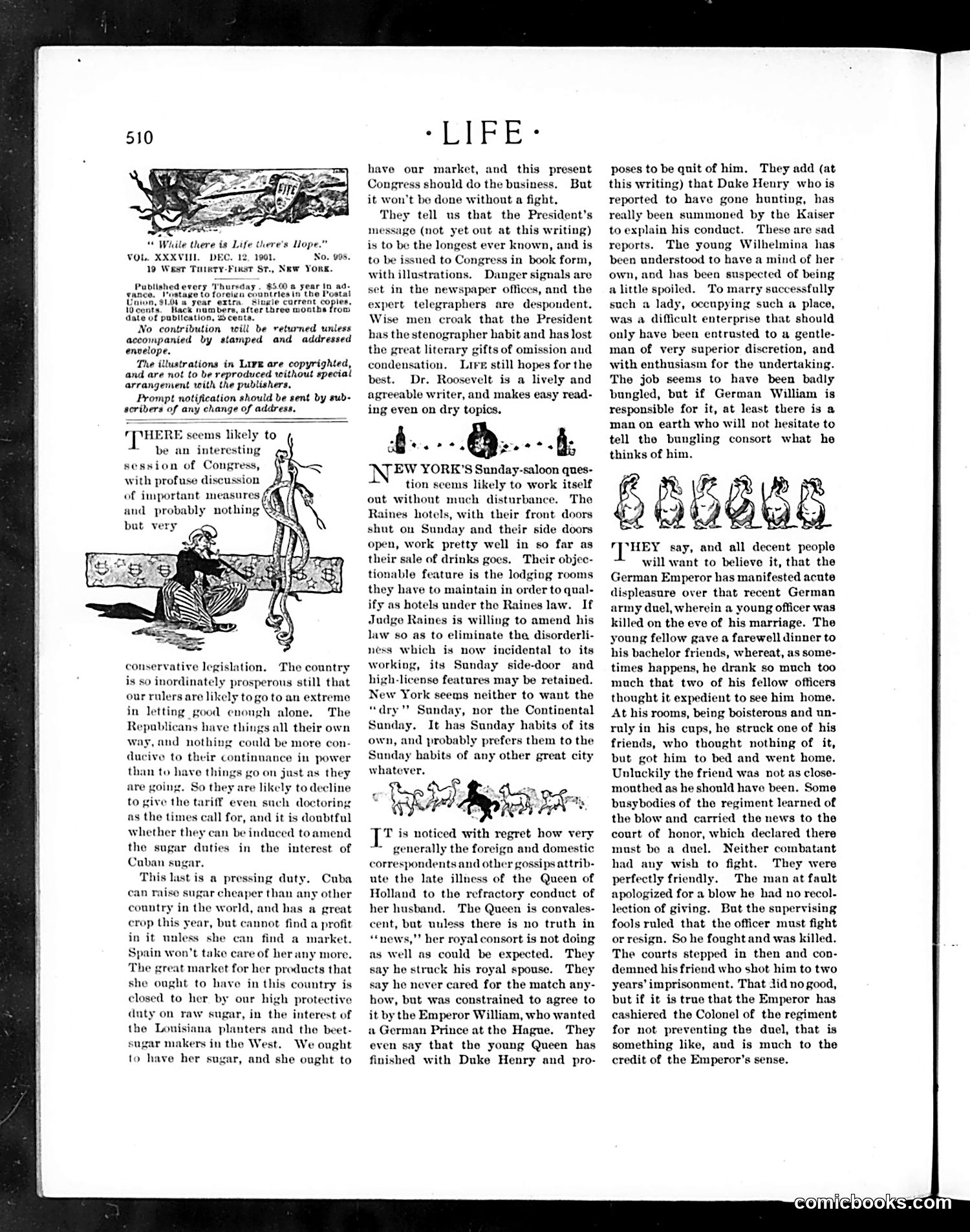
**Main Cartoon (left side):** This depicts a figure labeled "conservative legislation" as a tightrope walker, symbolizing the precarious balance Congress must maintain. The cartoonist suggests that conservative Republicans face pressure to either embrace extreme measures or lose political ground—implying they're walking a dangerous line between competing interests. **Right-side Commentary:** The text discusses Queen of Holland's recent marriage, criticizing her husband's conduct. It references a duel involving German officers and notes the Emperor's disapproval. The satirical point appears to be that old-world European protocols (like dueling) persist despite modern sensibilities, contrasting European tradition with American progressive values.
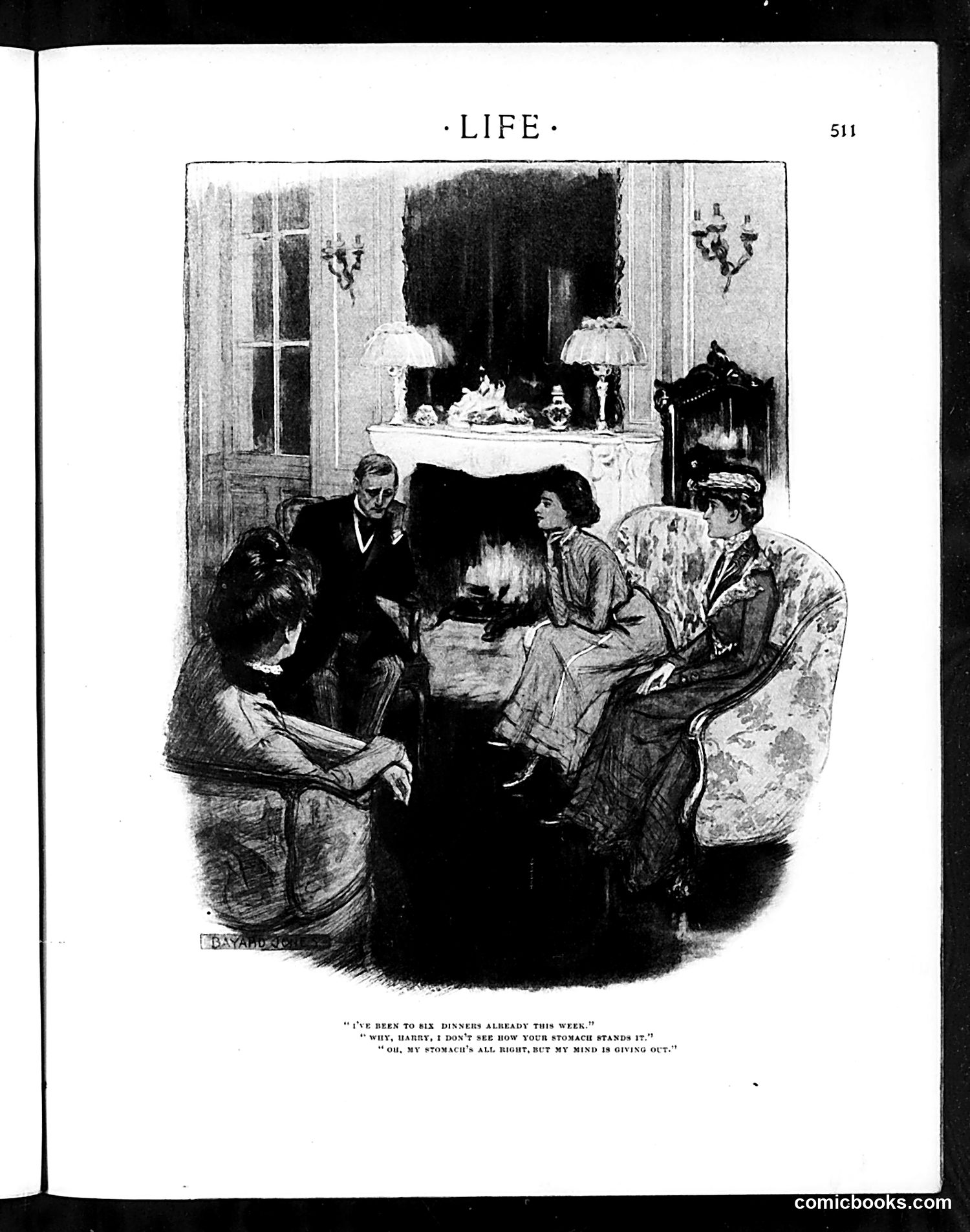
This illustration depicts a social gathering in an elegant early 20th-century parlor. The caption quotes a woman saying she's attended six dinners that week, prompting "Harry" to express concern about her stomach's capacity, to which she replies her mind is "giving out" instead. The satire targets the exhausting social calendar expected of upper-class women during this era. The joke plays on the tension between physical excess (overeating at multiple formal dinners) and mental fatigue from the relentless social obligations. The ornate fireplace, wall sconces, and formal dress emphasize the wealthy setting where such social demands were most intense. The humor reflects contemporary anxieties about women's health and the toll of maintaining social status through constant entertaining.
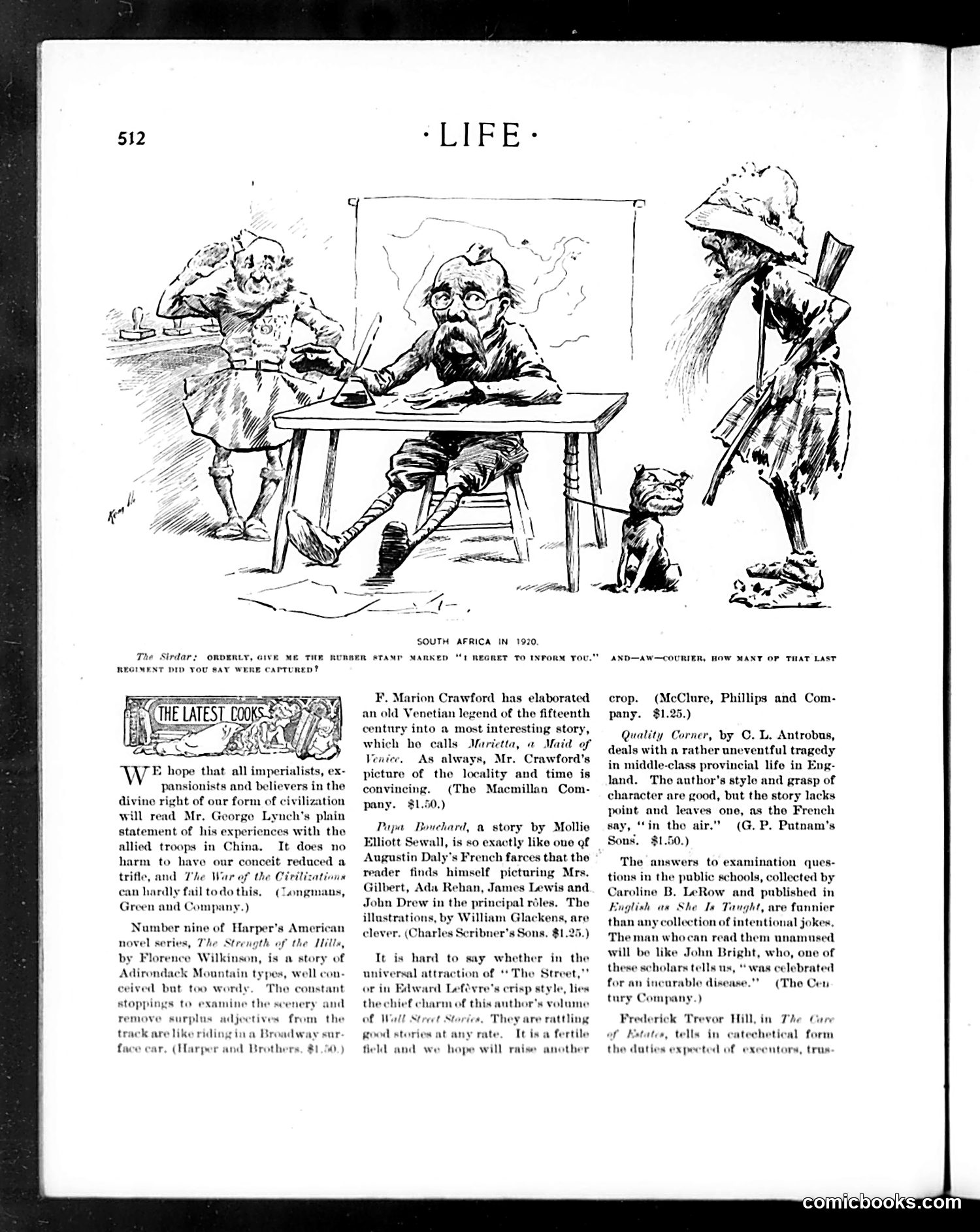
The cartoon depicts a confrontation during the post-WWI period in South Africa. A seated man with a distinctive beard (likely a Boer or colonial figure) is being interrogated by a British soldier, while another armed figure stands to the right. The caption references a "rubber stamp" and captured insurgents, suggesting this relates to the aftermath of the Boer War or subsequent colonial conflicts. The satire critiques British imperial authority and interrogation methods in South Africa. The composition emphasizes the power imbalance—the seated figure appears vulnerable before armed military representatives—likely commenting on heavy-handed British colonial administration or the suppression of local resistance movements. The date "1920" places this within post-war colonial tensions.
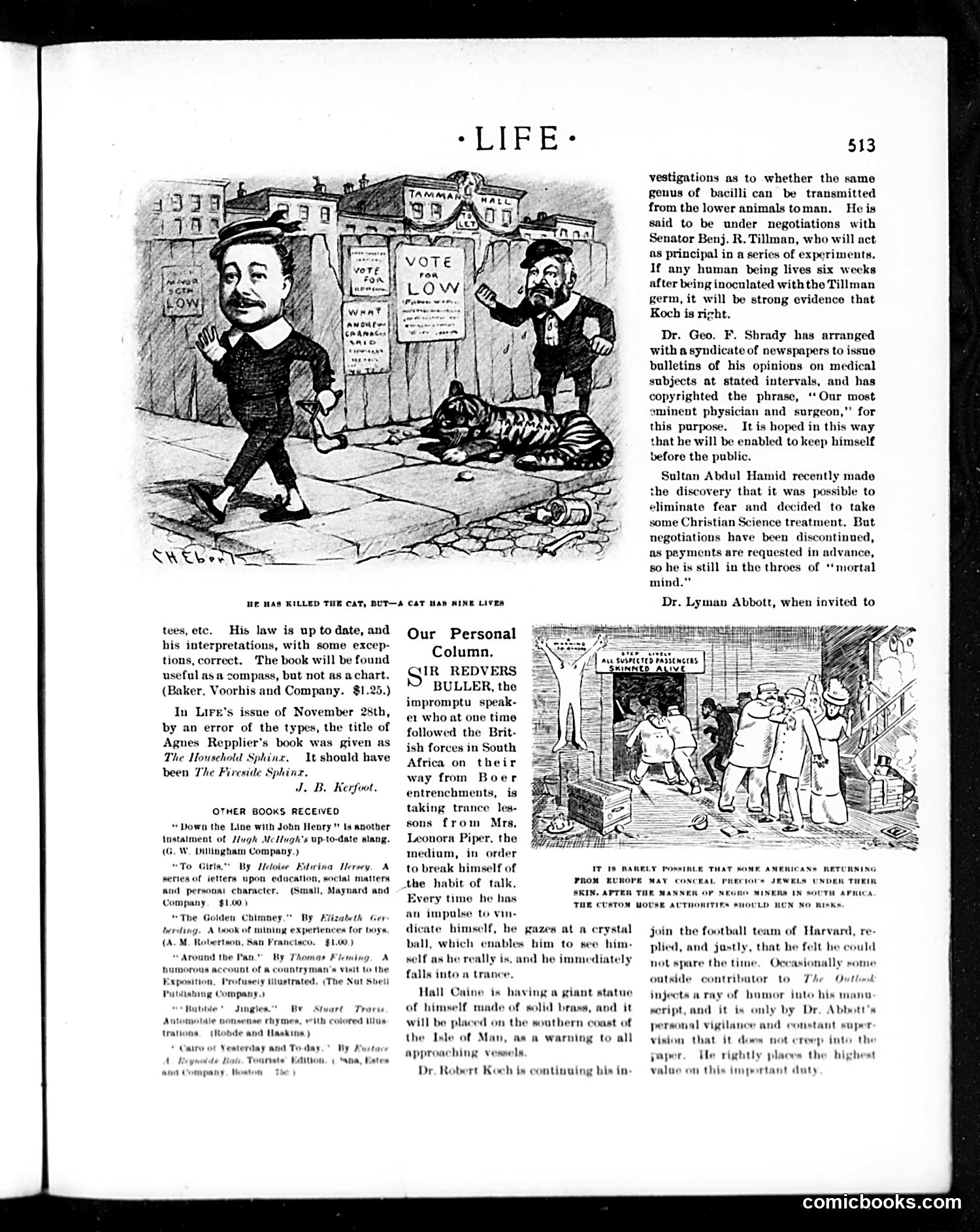
This political cartoon depicts two men in what appears to be a street scene with a dead cat. The caption suggests a metaphorical reference: one figure has "killed the cat," but the animal retains multiple lives—meaning a political opponent or problem cannot be permanently eliminated. Without additional context visible on the page, I cannot definitively identify the specific figures or the exact political situation referenced. The cartoon likely addresses a contemporary political controversy from Life magazine's era, where one faction believed they'd defeated an opponent or policy, yet it persisted or returned. The "nine lives" metaphor indicates the satirist's skepticism about the permanence of their victory.
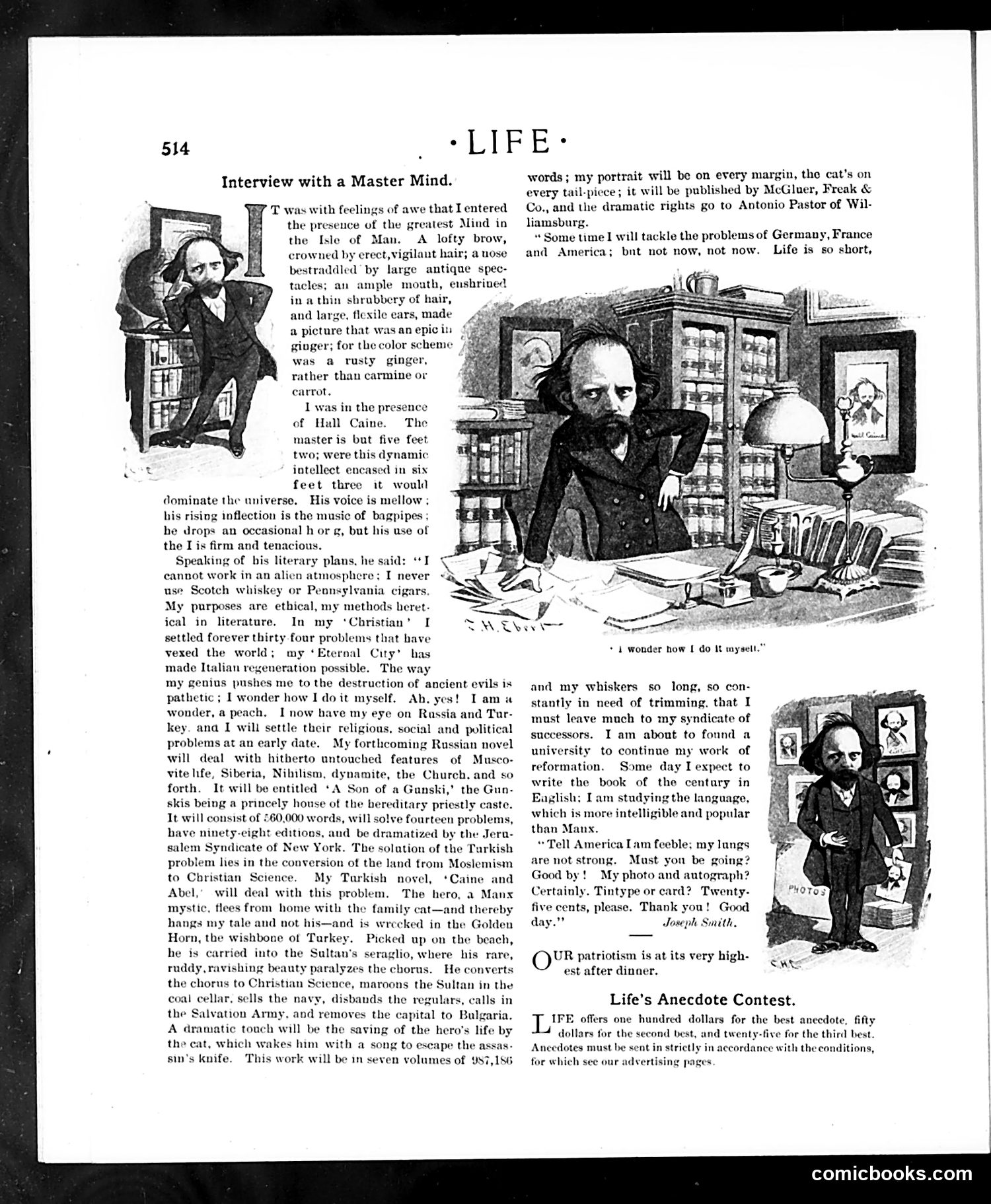
This page features an "Interview with a Master Mind" about **Hall Caine**, a prominent literary figure of the era. The left illustration shows Caine himself—identifiable by his distinctive appearance: lofty brow, abundant beard, and artistic dress. The satire targets Caine's grandiose ambitions and verbose self-promotion. He discusses his literary plans with inflated pomposity, claiming he'll write major works addressing Germany, France, and America, plus a 260,000-word Russian novel exploring religious and political problems. The cartoon mocks his pretentiousness through exaggerated physical caricature and his breathless listing of ambitious projects. The right illustrations show him in his study, surrounded by books and admirers—visual commentary on his self-importance. The humor derives from Caine's apparent narcissism and the gap between his grand artistic ambitions and his actual literary merit.
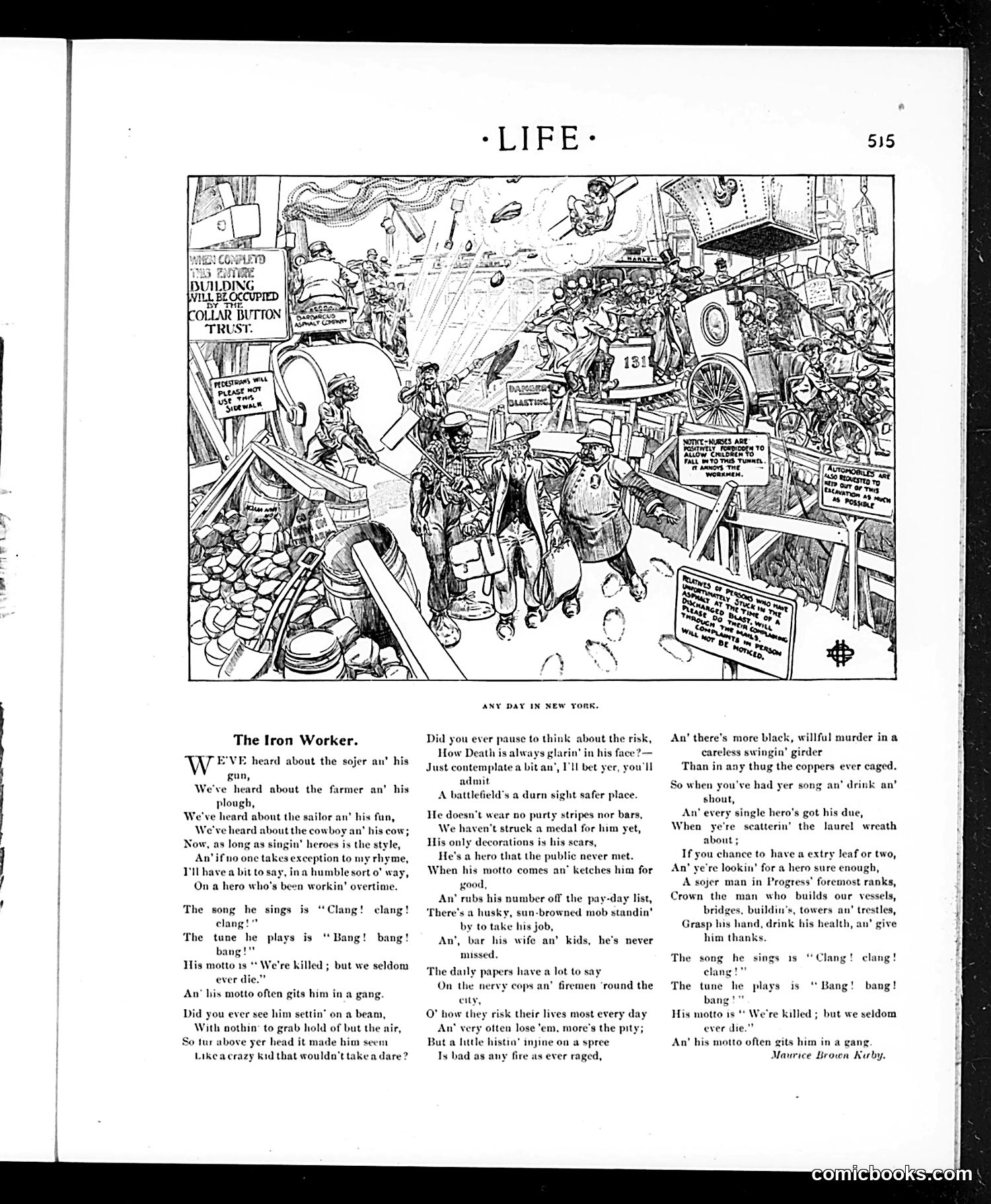
This page features a poem celebrating working-class heroes, specifically industrial and manual laborers. The large illustration depicts a chaotic New York City scene teeming with various workers and urban activity. The poem, attributed to Maurice Brown Kirby, glorifies "the iron worker" and other laborers—farmers, sailors, cowboys—as society's true heroes. It contrasts their genuine courage and sacrifice with the decorations and recognition given to military figures. The refrain "We're killed; but we seldom ever die" emphasizes how workers' contributions are undervalued compared to soldiers', despite comparable danger. The satirical point: working-class laborers deserve the same respect and honor as decorated war heroes, yet society overlooks their essential contributions and daily risks to life and limb.
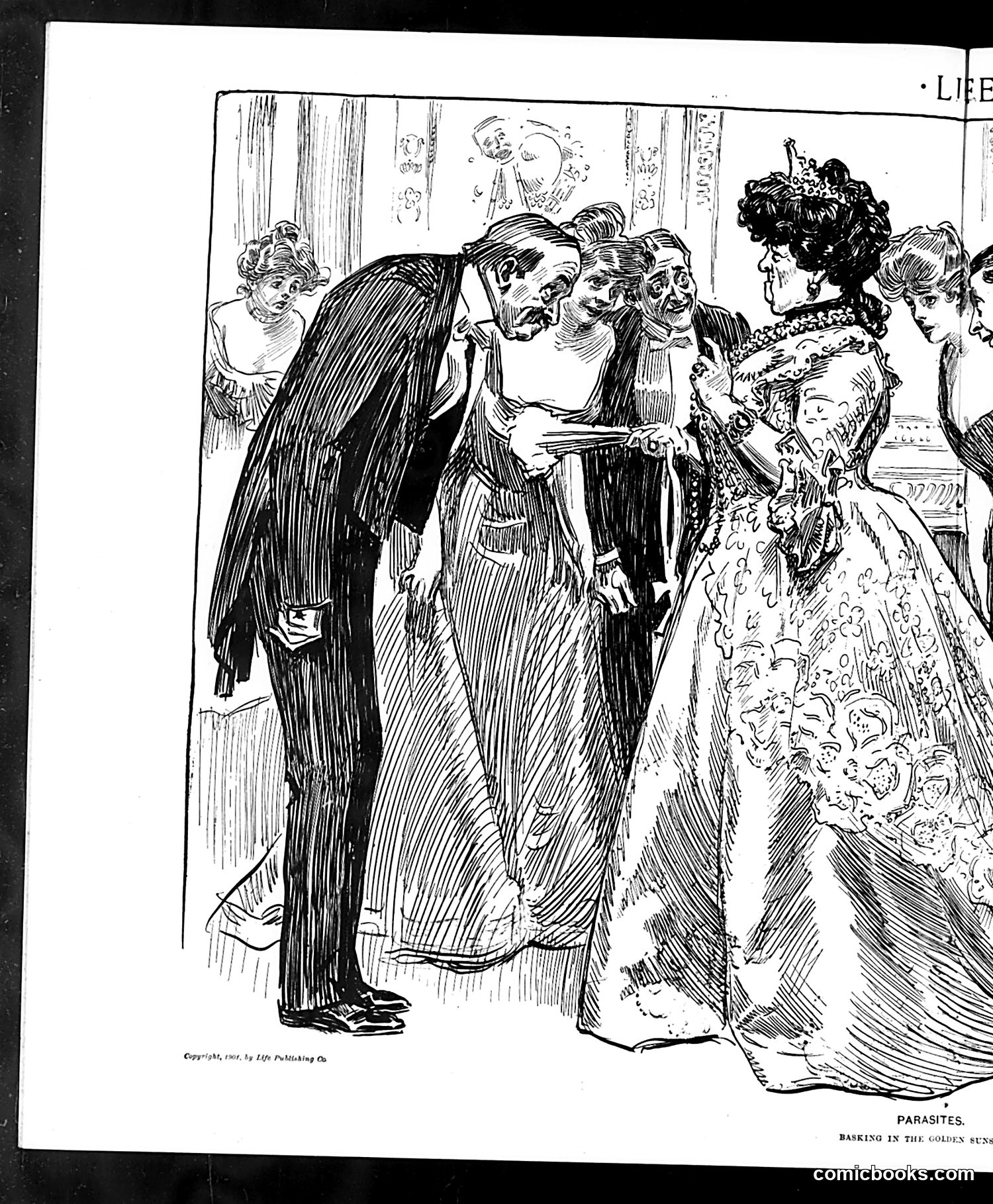
This Life magazine cartoon satirizes wealthy social climbers and hangers-on in high society. The scene depicts an elegant drawing room where a well-dressed man in dark formal wear bends obsequiously toward an ornately dressed woman, while other fashionably dressed figures observe in the background. The title "Parasites" and subtitle "Basking in the Golden Suns" suggest these are social opportunists—people who attach themselves to the wealthy and influential ("golden suns") for personal gain. The exaggerated postures and the man's deferential bow mock the insincerity and self-serving nature of social-climbing behavior among the upper classes. The cartoon critiques artificial courtship rituals and the performative nature of Gilded Age high society.
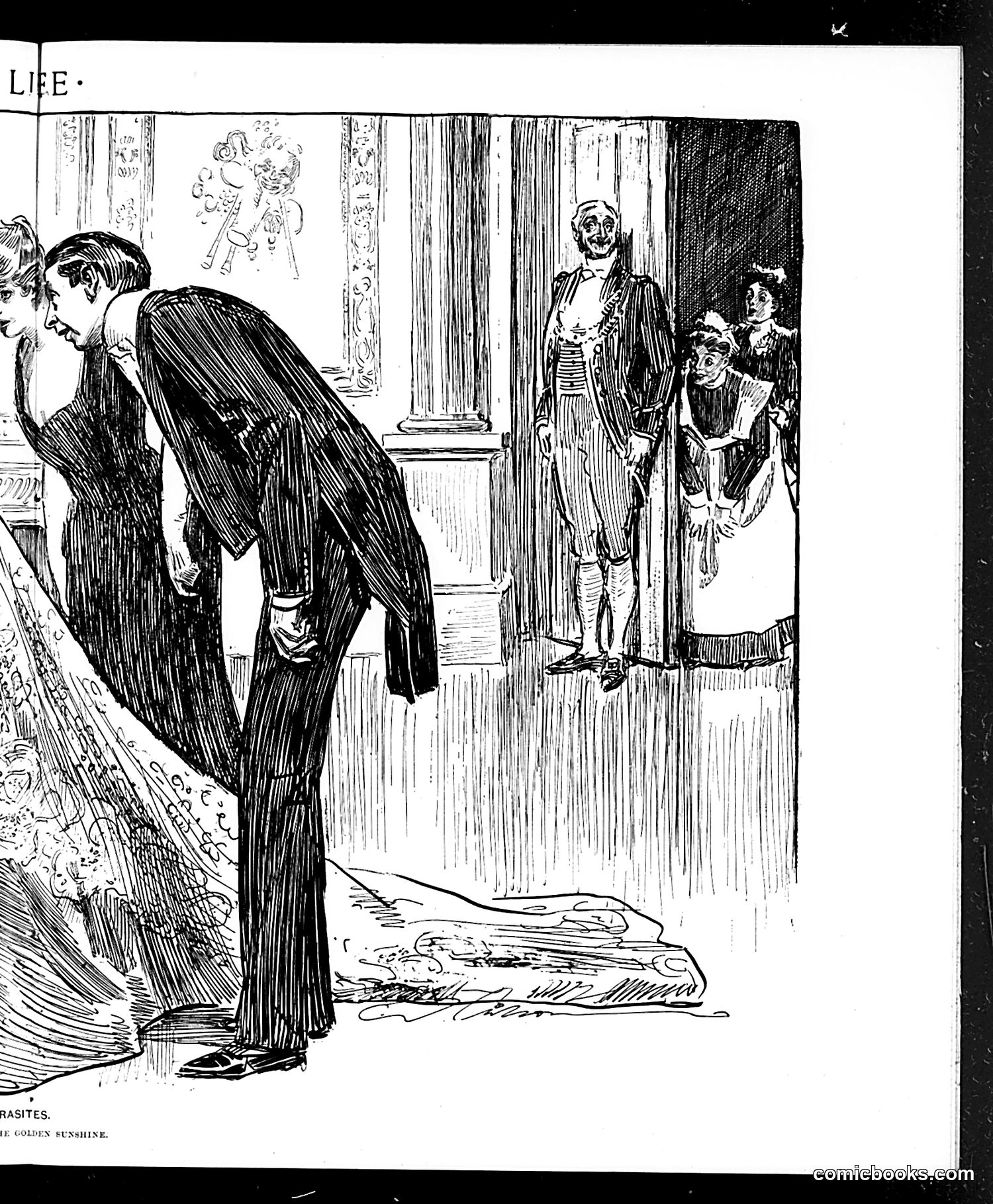
This appears to be a satirical cartoon from *Life* magazine depicting a social scene in an elegant interior. The visible text fragment "RASITES" and "THE GOLDEN SUNSHINE" suggests this relates to parasitism or social freeloading. The cartoon shows a well-dressed man in formal attire bowing deeply to a woman, while other figures observe from a doorway in the background. The exaggerated posture and the formal setting suggest mockery of excessive social deference or obsequiousness. The satire likely critiques wealthy socialites or those of privilege who exploit hospitality, or alternatively ridicules men who fawn excessively over wealthy women. Without the complete caption, the specific target remains unclear, but the composition emphasizes the contrast between the supplicant's degrading posture and the refined domestic setting.
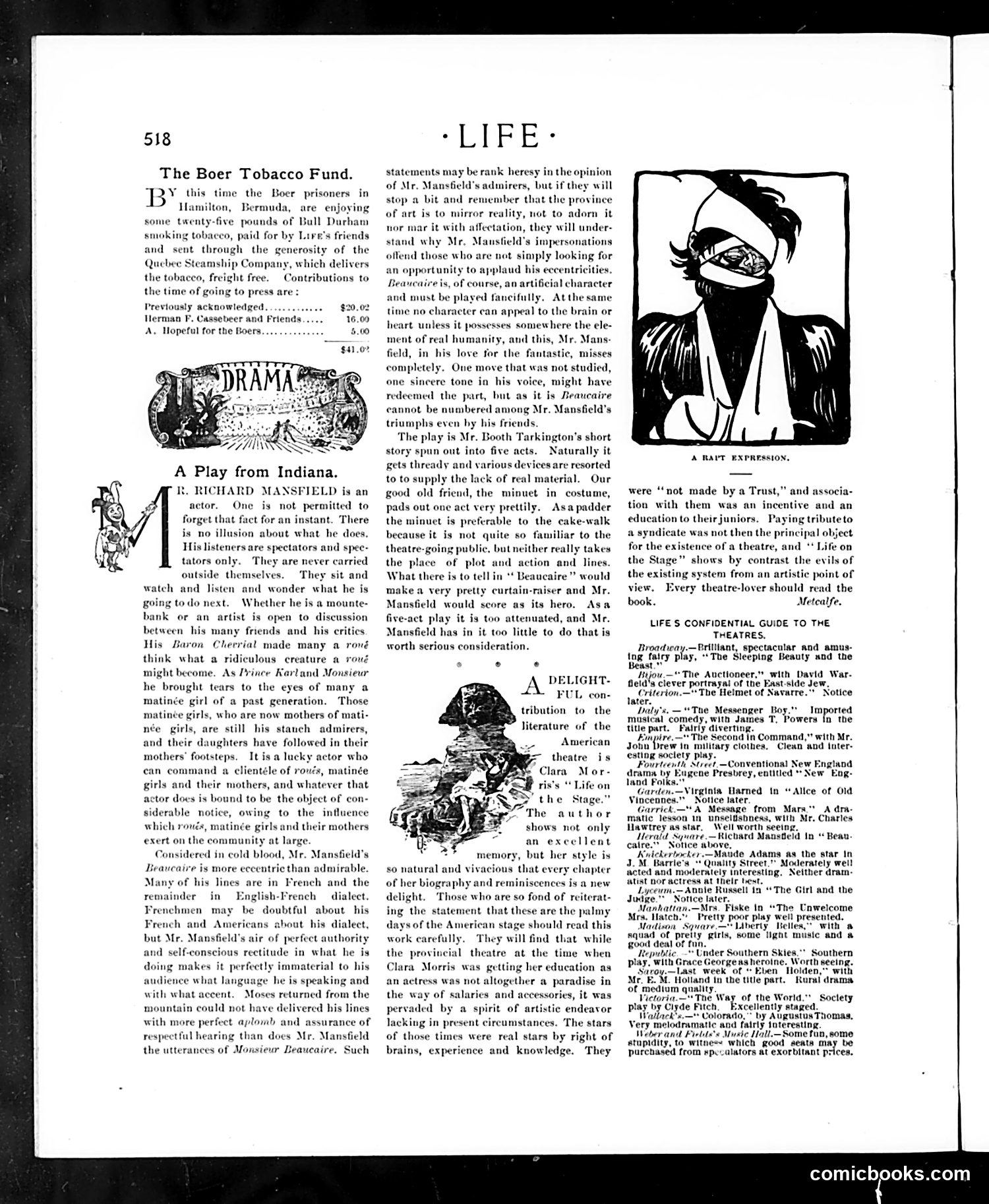
This page contains theater reviews and criticism rather than political cartoons. The main illustrated element is titled "A RANT EXPRESSION" — a woodcut-style portrait of what appears to be an angry or passionate theatrical figure. The text discusses a play called "A Play from Indiana" by Richard Mansfield, critiquing his performance in a play called "Beaucaire." The reviewer argues that Mansfield's theatrical style emphasizes eccentricity over genuine humanity, and that his performance in this particular role lacks sincerity and emotional depth. The page also includes a section on Clara Morris's book "Life on the Stage," praising its authentic insights into American theater history and working conditions for actors. This is primarily **literary/theater criticism**, not political satire.
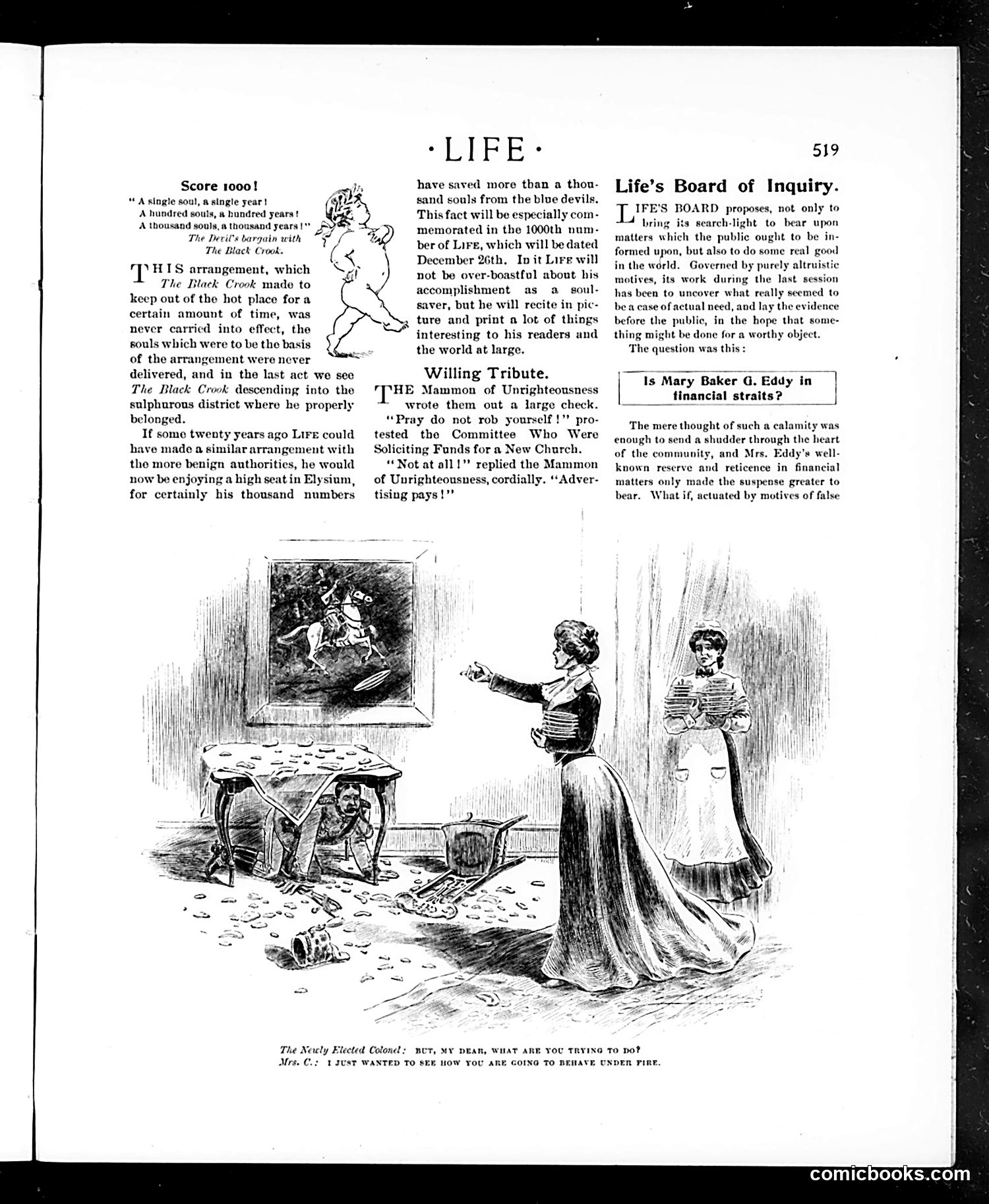
This page contains three satirical pieces from Life magazine (likely early 1900s): **"Score 1000!"** celebrates Life's approaching 1000th issue (dated December 26th), comparing the magazine's soul-saving moral influence to *The Black Crook* theatrical production. The joke: Life claims to have saved over 1,000 souls from "the blue devils" (depression/despair) through its work. **"Willing Tribute"** mocks wealthy industrialists' charitable donations as calculated publicity. A rich man (the "Mammon of Unrighteousness") donates to a church fundraiser, explaining his generosity as good advertising—exposing how the wealthy frame self-interested acts as benevolence. **"Life's Board of Inquiry"** questions whether Mary Baker G. Eddy (founder of Christian Science) faces financial hardship, sarcastically suggesting the community is anxious about her welfare. This appears to mock both Eddy's prominence and public concern about her financial status. The bottom cartoon depicts a newly elected colonel's wife, with dialogue about "behaving under fire"—likely political satire about women's roles or competence in public positions.
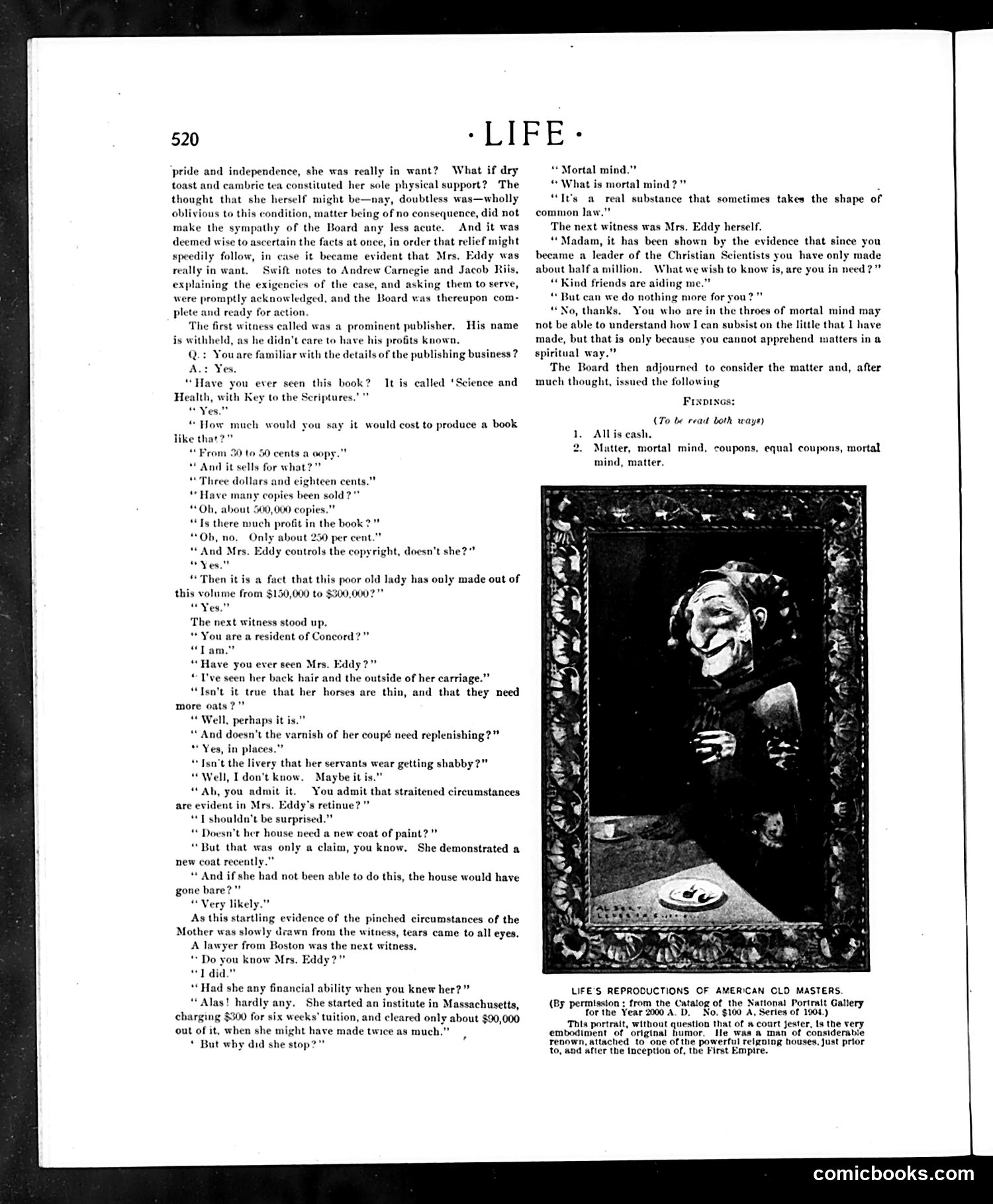
This page satirizes efforts to establish that Mary Baker Eddy, founder of Christian Science, was financially destitute and deserving of charity. The satire works through absurd testimony: a publisher admits her book *Science and Health* costs 50 cents to produce but sells for $3.18, yielding "only" 250% profit and earning her $150,000–$300,000. Subsequent witnesses describe her shabby servants, thin horses, and unpainted house—all presented as evidence of hardship. The joke exposes the contradiction: Eddy is simultaneously portrayed as poor while clearly wealthy. Her own testimony invoking "mortal mind" (Christian Science doctrine) as explanation is the final punch line. The "findings" at bottom—"All is cash" / "Matter, mortal mind, coupons, equal coupons"—mock both her wealth and her metaphysical claims. This reflects early 1900s skepticism toward Christian Science and its prosperous founder.
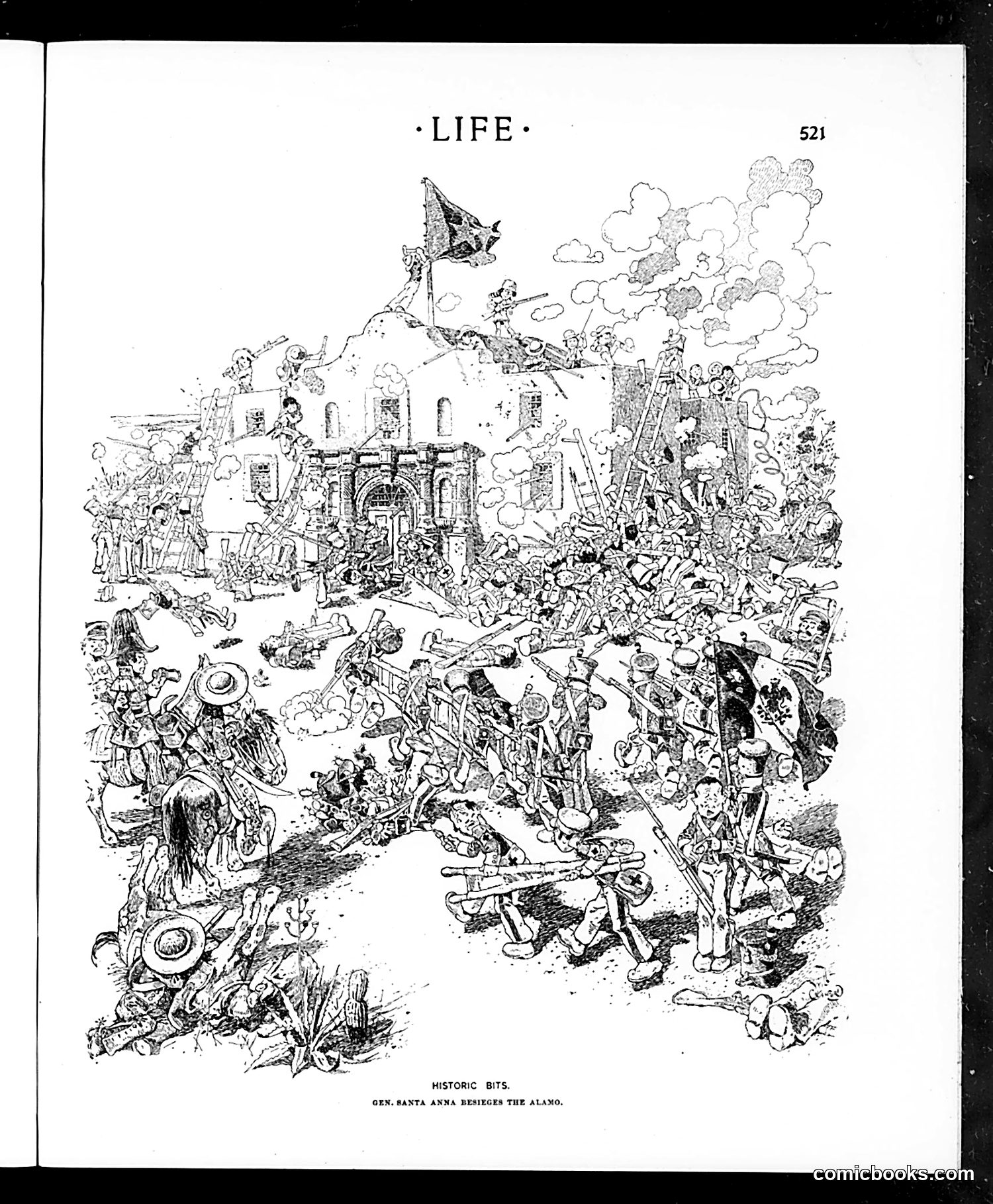
This is a satirical illustration labeled "Historic Bits" depicting General Santa Anna's siege of the Alamo. The drawing is a densely packed, chaotic scene showing a fortified mission building under attack, with numerous soldiers, cannons, and military equipment surrounding it. The satire likely comments on the famous 1836 historical event, though Life magazine's specific angle appears to be mockery through exaggerated, busy detail—a common visual comedic technique. The crowded composition emphasizes the tumultuous nature of the conflict. Without additional context from surrounding pages, the exact satirical target (whether political figures of Life's era or the historical event itself) remains unclear, but the illustration treats a serious historical siege with humorous, deliberately overwrought artistic treatment.
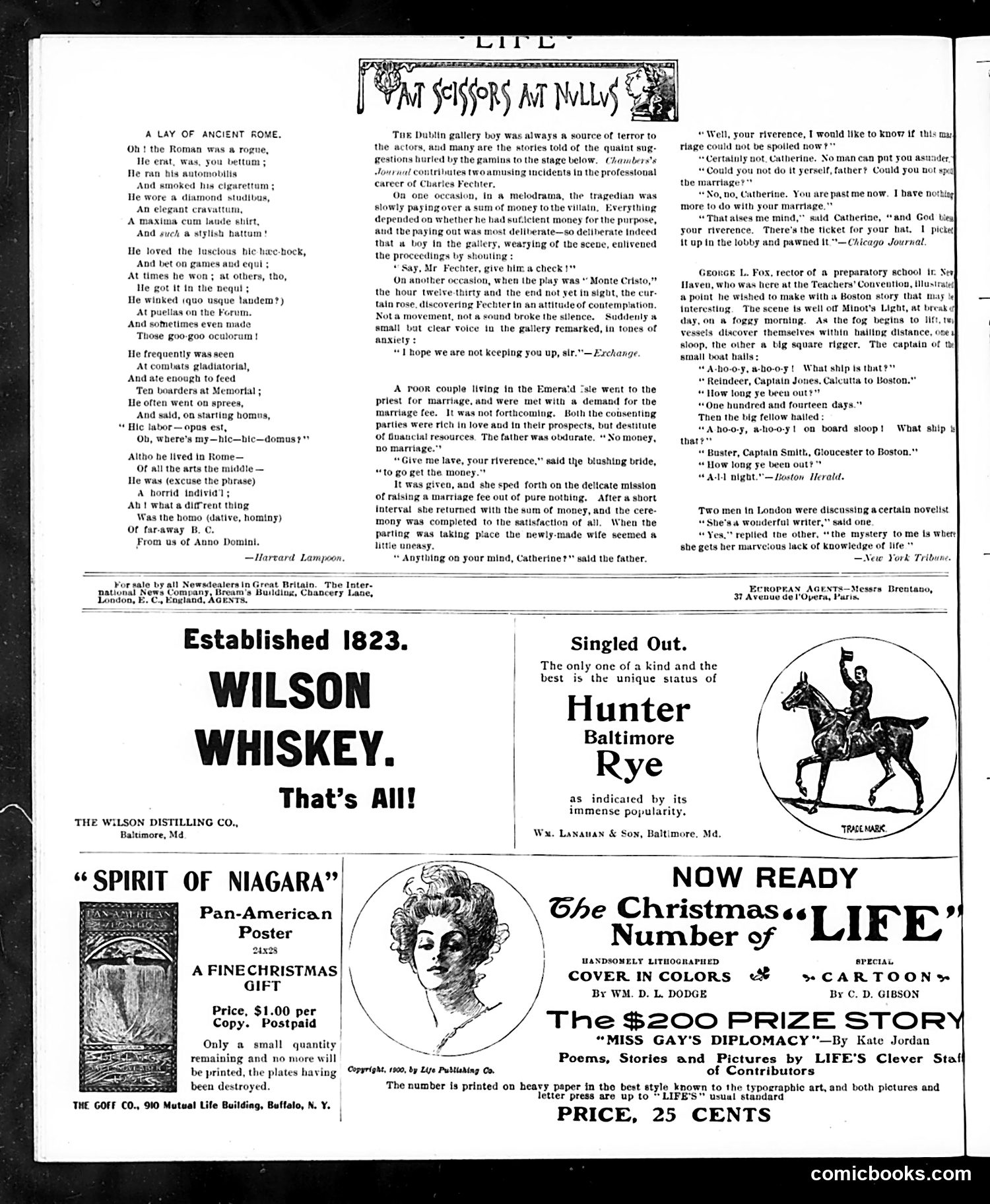
This page is primarily **advertising and miscellaneous content** rather than political satire. The notable items are: **"A Lay of Ancient Rome"** (top left): A humorous poem in mock-Latin that satirizes modern American life by describing contemporary habits (automobiles, cigarettes, diamond studs, betting) as if they were ancient Roman vices. The joke is anachronistic—attributing 20th-century behaviors to classical Rome to mock American excess and frivolity. **Anecdotes about theater and Irish priests**: Short humor pieces about hecklers in Dublin theaters and a couple deceiving a priest to marry without paying fees. These are genteel, non-political jokes. **Advertisements**: Wilson Whiskey, Hunter Baltimore Rye, Spirit of Niagara poster, and notably—**Life magazine's Christmas issue** (25 cents) featuring the "$200 Prize Story" and cover colors by W.D. Dodge. The page reflects Life's nature as a **satirical but family-friendly** publication mixing literary humor, social observation, and commercial advertising. No specific political figures or events are referenced.
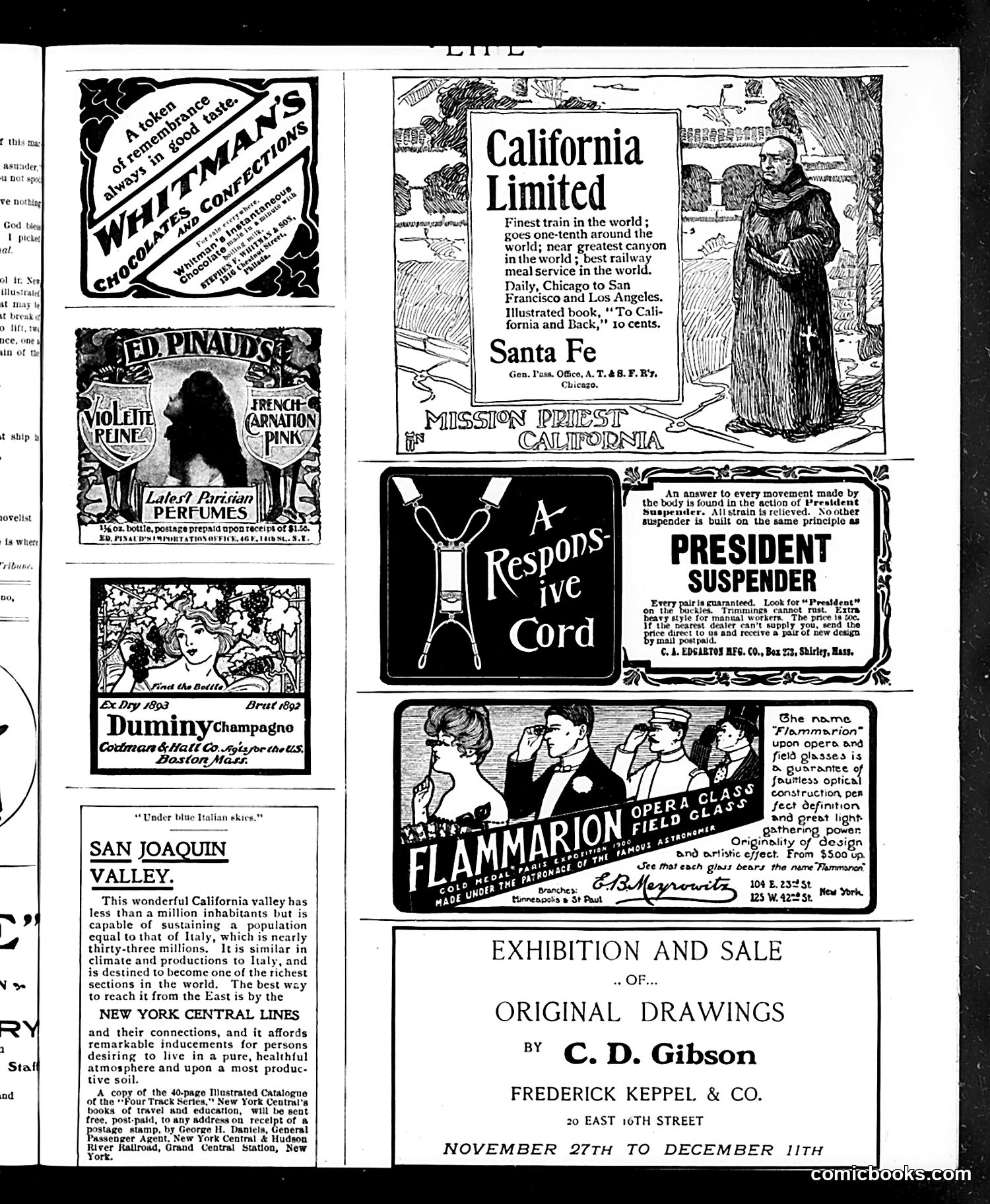
This page is primarily **advertising** for various products and services, with no political cartoons or satirical commentary. The ads promote: - **Whitman's Chocolates** and **Ed. Pinaud perfumes** (luxury goods) - **California Limited train service** (Santa Fe Railway) - **President Suspenders** (workwear accessory) - **Duminy Champagne** (French wine) - **San Joaquin Valley** real estate/settlement - **Flammarion opera glasses** (optical instruments) The final section announces an **exhibition of original drawings by C.D. Gibson** at Frederick Keppel & Co. gallery (November 27–December 11th). Gibson was Life's famous illustrator known for the "Gibson Girl" aesthetic. The ads reflect early 1900s consumer culture targeting affluent readers—combining European luxury goods with American travel and expansion themes (California settlement). There is **no satirical content** visible on this page.
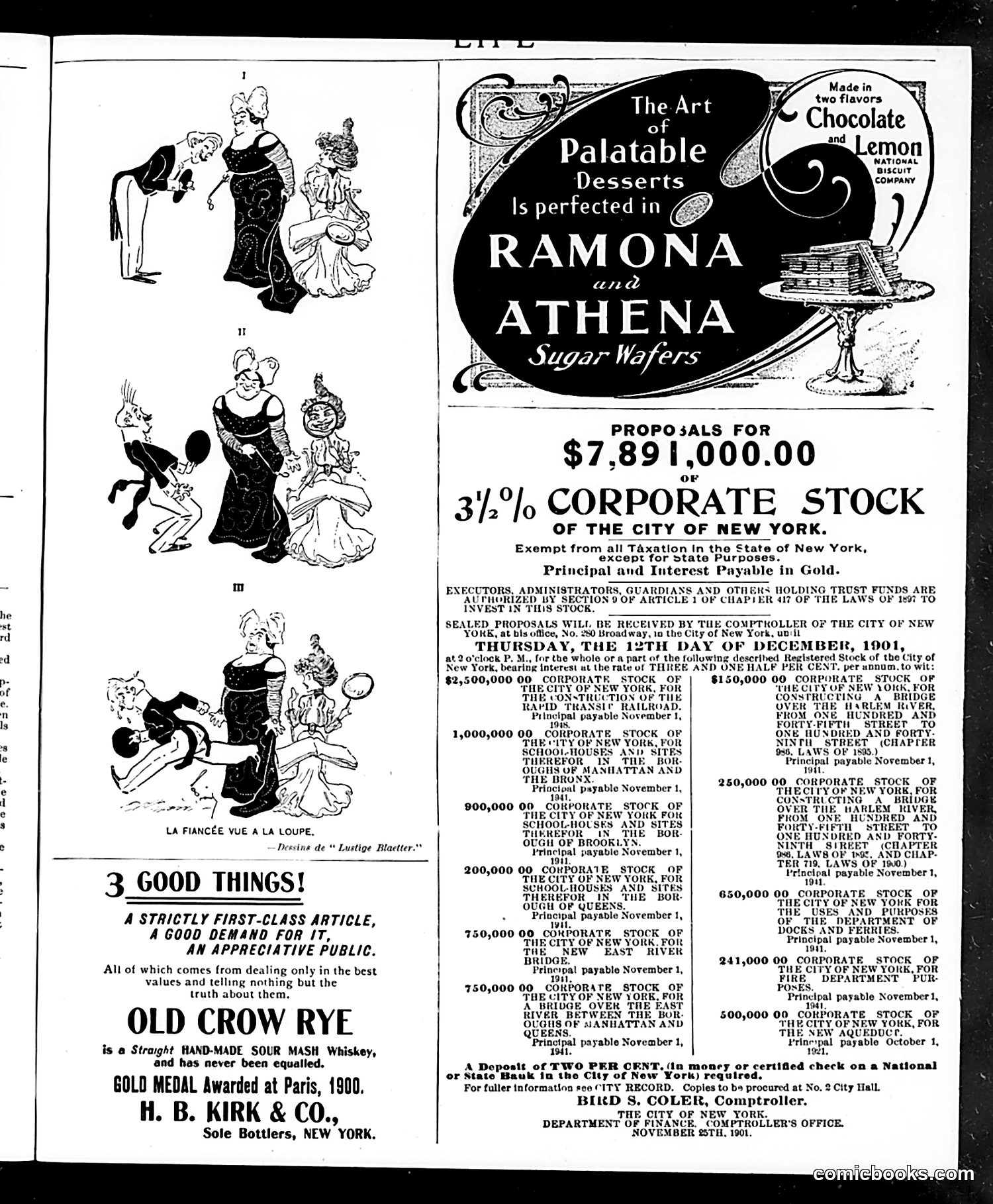
**The Cartoons (Left Side):** Three sequential cartoon panels labeled "La Fiancée Vue à la Loupe" (The Fiancée Examined Under Magnification), credited to *Lustige Blätter* (a German satirical publication). The jokes appear to depict a romantic scenario where a woman is examined or scrutinized, with the humor likely based on exaggerated facial expressions or physical comedy—classic early-20th-century satirical cartoon fare. **The Advertisements (Right Side):** The page is dominated by advertisements: a Ramona and Athena sugar wafers ad (emphasizing palatability), Old Crow Rye whiskey, and a massive New York City corporate stock offering ($7.89 million in bonds). **Overall Context:** This appears to be a standard Life magazine page from 1901, mixing light humor cartoons with commercial advertising—typical of the publication's format.
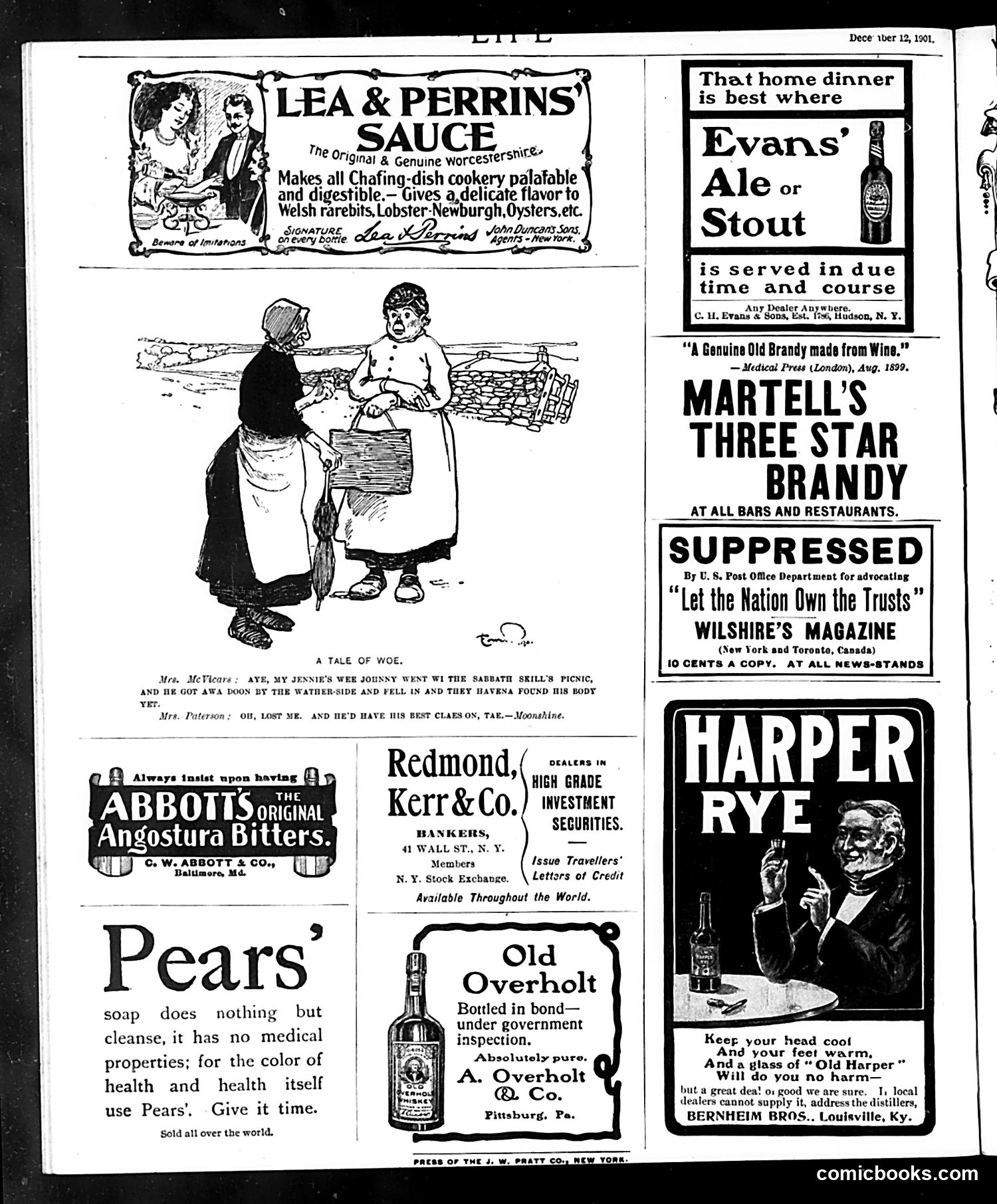
This page is primarily **advertisements** for consumer products and financial services typical of the Gilded Age era. The one cartoon ("A Tale of Woe") depicts two working-class Scottish women in heavy dialect discussing a tragedy: a child drowned at a church picnic while wearing his "best clothes." The humor is dark and class-conscious—the detail about the boy's good outfit suggests the family's modest means, while the thick Scottish brogue marks them as rural/working poor. This satirizes sentimental Victorian attitudes toward childhood and class. The ads reflect early 1900s commerce: food products (Lea & Perrins sauce, Pears' soap), alcohol (brandy, rye whiskey, bitters), and financial services (stock brokers). One notable item: **Wilshire's Magazine was "suppressed" by the U.S. Post Office** for advocating "Let the Nation Own the Trusts"—an anti-monopoly, possibly socialist message. This references genuine government censorship of radical publications during the Progressive Era. The page overall shows Life's mixed format of satire, humor, and paid advertising.