
Life, 1901-12-12 · page 4 of 20
Life — December 12, 1901 — page 4: what you’re looking at
What you’re looking at
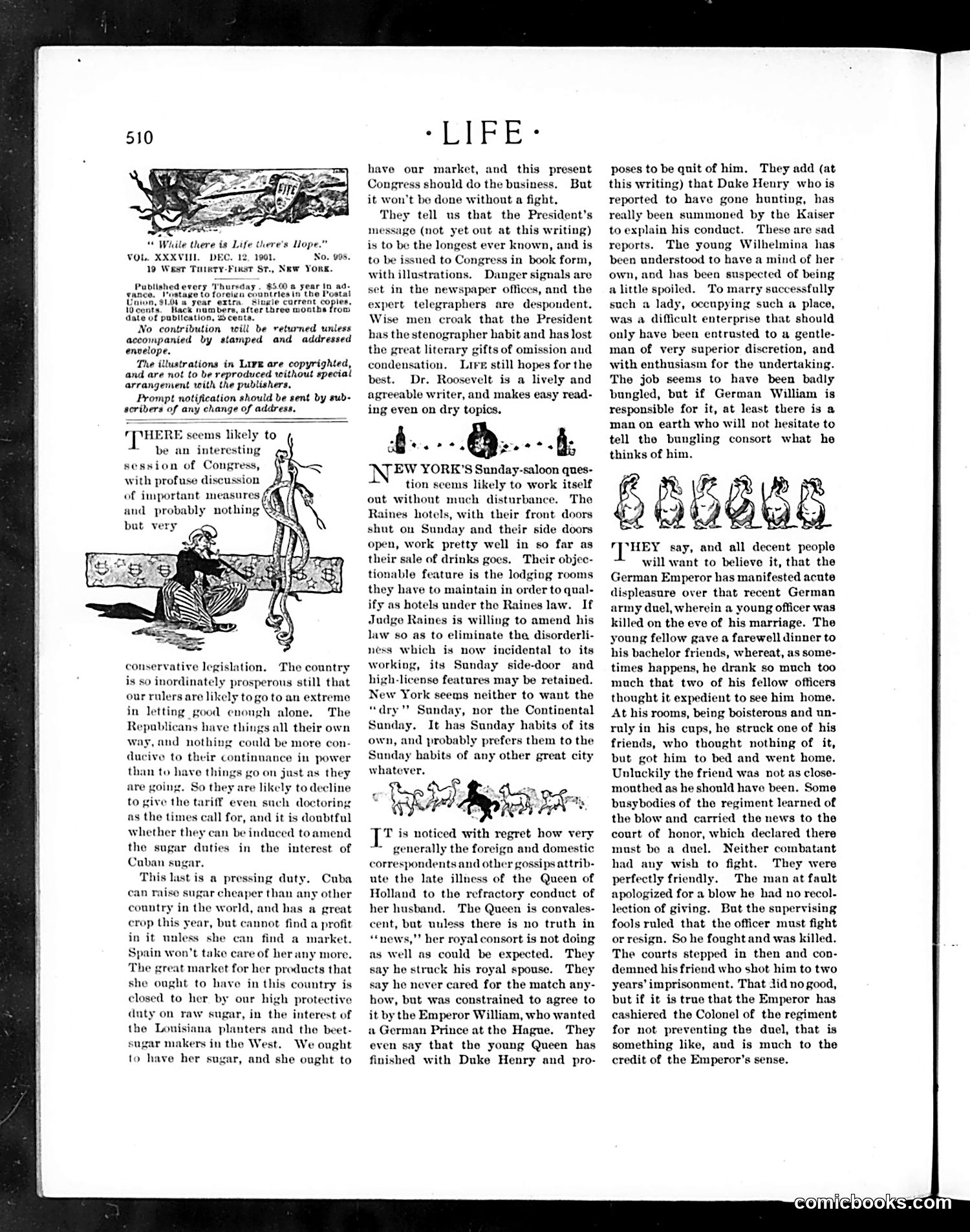
**Main Cartoon (left side):** This depicts a figure labeled "conservative legislation" as a tightrope walker, symbolizing the precarious balance Congress must maintain. The cartoonist suggests that conservative Republicans face pressure to either embrace extreme measures or lose political ground—implying they're walking a dangerous line between competing interests. **Right-side Commentary:** The text discusses Queen of Holland's recent marriage, criticizing her husband's conduct. It references a duel involving German officers and notes the Emperor's disapproval. The satirical point appears to be that old-world European protocols (like dueling) persist despite modern sensibilities, contrasting European tradition with American progressive values.
📄 Transcribed text from this page (OCR, searchable)
Machine-transcribed from the original scan — historical spelling and the odd misread are preserved.
VOL. XXXVIIL DI 19 West Tiety-Finst St., New Yous. Published every Thursday . $5.00 0 year tn ad. ance, Mostage to foreign countries in the Postal Union, suite year extra Wconts. Hack numbers, after three mon! Gate uf publication, scents. No contribution will be returned unless accompanied by stamped and addressed envelope. The illustrations in LrvE are copyrighted, and are not to be reproduced without special arrangement with the publishers, Prompt notification should be sent by sub- scribers of any change of address. Single current copies, 8 from ‘MHERE seems likely to be an interesting session of Congress, with profuse discussion of important measures and probably nothing but very conservative legislation, The country is so inordinately prosperous still that our rulers are likely to go to an extreme in letting good cnongh alone. The Republicans have things all their own way, and nothing could be more con- ducive to their continuance in power than to have things go on just as they are going. So they are likely to decline to give the tariff even such doctoring as the times call for, and it is doubtful whether they can be induced toamend the sugar duties in the interest of a pressing duty. Cuba can raise sugar cheaper than any other country in the world, and has a great crop this r, but cannot find a profit she can find a market. Spain won't take care of her any more. The great market for her products that she ought to have in this country is closed to her by our high protective duty on raw sugar, in the interest of the Louisiana planters and the beet- sugar makers in the West. We ought to have her sugar, and she ought to “LDPE - have our market, and this present Congress should do the business. But it won't be done without a fight. They tell us that the President's message (not yet out at this writing) is to be the longest ever known, and is to be issued to Congress in book form, with illustrations. Danger signals are set in the newspaper offices, and the expert telegraphers are despondent. Wise men croak that the President. has the stenographer habit and has lost the great literary gifts of omission and condensation. Lire still hopes for the best. Dr. Roosevelt is a lively and agreeable writer, and makes easy read- ing even on dry topics. NEW YORK’S Sunday-saloon ques- +N tion seems likely to work itself out without much disturbance. The Raines hotels, with their front doors shut on Sunday and their side doors open, work pretty well in so far as their sale of drinks goes. Their objec- tionable feature is the lodging rooms they have to maintain in order to qual- ify as hotels under the Raines law. If Judge Raines is willing to amend his law so as to eliminate the disorderli- ness which is now incidental to its working, its Sunday side-door and high-license features may be retained. New York seems neither to want the “dry” Sunday, nor the Continental Sunday. It has Sunday habits of its own, and probably prefers them to the Sunday habits of any other great city whatever, elders i os is noticed with regret how very ~ generally the foreign and domestic correspondents and other gossips attrib- ute the late illness of the Queen of Holland to the refractory conduct of her husband. The Queen is convales- cent, but uuless there is no truth in “news,’’ her royal consort is not doing as well as could be expected. They say he struck his royal spouse. They say he never cared for the match any- how, but was constrained to agree to it by the Emperor William, who wanted au German Prince at the Hague. They even say that the young Queen has finished with Duke Henry and pro- poses to be quit of him. They add (at this writing) that Dake Henry who is reported to have gone hunting, has really been summoned by the Kaiser to explain his conduct. These are sad reports. The young Wilhelmina has been understood to have a mind of her own, and has been suspected of being alittle spoiled. ‘To marry saccessfully such a lady, occupying such a place, was a difficult enterprise that should only have been entrusted to a gentle- man of very superior discretion, and with enthusiasm for the undertaking. The job seems to have been badly bungled, but if German William is responsible for it, at least there is a man on earth who will not hesitate to tell the bungling consort what he thinks of him. F[°HEY say, and all decent people will want to believe it, that the German Emperor has manifested acute displeasure over that recent German army duel, wherein a young officer was killed on the eve of his marriage. The young fellow gave a farewell dinner to his bachelor friends, whereat, as some- times happens, he drank so much too much that two of his fellow officers thought it expedient to see him home. At his rooms, being boisterous and un- ruly in his cups, he struck one of his friends, who thought nothing of it, but got him to bed and went home. Unlackily the friend was not as close- monthed as he should have been. Some busybodies of the regiment learned of the blow and carried the news to the court of honor, which declared there must be a duel. Neither combatant had any wish to fight. They were perfectly friendly. The man at fault apologized for a blow he had no recol- lection of giving. But the supervising fools ruled that the officer must fight or resign. So he fought and was killed. The courts stepped in then and con- demned his friend who shot him to two years’ imprisonment. That id no good, but if it is true that the Emperor has cashiered the Colonel of the regiment for not preventing the duel, that is something like, and is much to the credit of the Emperor's sense.