
Life, 1901-12-12 · page 12 of 20
Life — December 12, 1901 — page 12: what you’re looking at
What you’re looking at
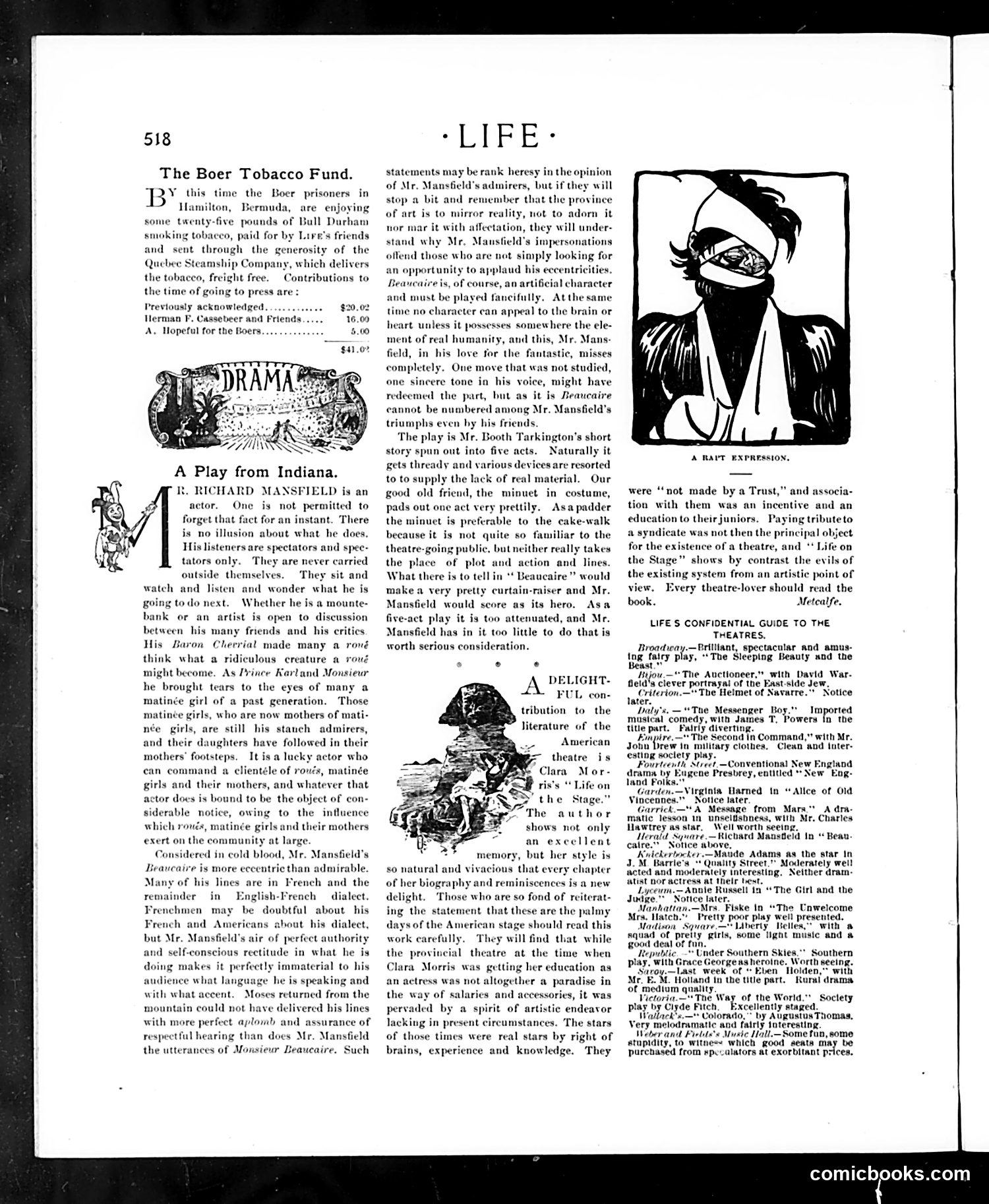
This page contains theater reviews and criticism rather than political cartoons. The main illustrated element is titled "A RANT EXPRESSION" — a woodcut-style portrait of what appears to be an angry or passionate theatrical figure. The text discusses a play called "A Play from Indiana" by Richard Mansfield, critiquing his performance in a play called "Beaucaire." The reviewer argues that Mansfield's theatrical style emphasizes eccentricity over genuine humanity, and that his performance in this particular role lacks sincerity and emotional depth. The page also includes a section on Clara Morris's book "Life on the Stage," praising its authentic insights into American theater history and working conditions for actors. This is primarily **literary/theater criticism**, not political satire.
📄 Transcribed text from this page (OCR, searchable)
Machine-transcribed from the original scan — historical spelling and the odd misread are preserved.
518 The Boer Tobacco Fund. ByX this time the Boer prisoners in Hamilton, some twent Bermuda, are enjoying five pounds of Bull Durham cco, paid for by Lire’s friends and sent through the generosity of the Quebec Steamship Company, which delivers the tobacco, freight free. Contributions to the time of going to press are: smoking tol Previously acknowledged. Herman F, Cassebeer and Friends... A. Hopeful for the Boers. A Play from Indiana. R. RICHARD MANSFIELD is an actor. One is not permitted to forget that fact for an instant. There is no illusion about what he does, His listeners are spectators and spec tators only. They are never carried out They sit and watch and listen and wonder what he is going todo next. Whether he is a mounte- bank or an artist is open to discussion between his many friends and his critics His Baron Cherriat made many ar think what a ridiculous creature a roué might become. As Prince Karland Monsieur he brought tears to the eyes of many a matinée girl of a past generation. Those matinée girls, who are now mothers of mati- rls, are still his stanch admirers, and their daughters have followed in their mothers’ footsteps. It is a lucky actor who can command a clientéle of roués, matinée girls and their mothers, and whatever th actor docs is bound to be the object of siderable not owing to the influence which roués, matinée girls and their mothers exert on the community at large. Considered in cold blood, Mr. M Beaucaire is more eccentric than admirable. Many of his lines are in French and the remainder in English-French dialect. Frenchmen may be doubtful about his French and Americans about his dialect, but Mr. Mansfield’s air of perfect and self-conscious rectitude in what he is doing makes it perfect! to his audience what language he is speaking and with what accent. Moses returned from the mountain could not have delivered his lines h more perfect aplomb and assurance of themselves. fits nsfield’s uthority immate: respectful hearing than does Mr. Mansfield the utterances of Monsieur Beaucaire. Such * LIVE - y be rank heresy in the opinion nsfield's admirers, but if they will and remember that the province statements ma of Mr. stop al t is to mirror reality, not to adorn it mar it with a stand why Mr, Mausfield’s imper: re not simply looking for an opportunity to applaud his eccentricities. Beaucaire is, of course, an artibcial character J must be played fancifully, Atthe same time no character can appeal to the brain or heart unless it possesses somewhere the ele- ment of real humanity, and this, Mr. Mans- field, his love for the fantastic, misses completely. One move that was not studied, ere tone in his voice, might have d the part, but as it is Beaucaire cannot be numbered among Mr. Mansfield’s triumphs eve Teetation, they will under- ‘ions offend those who one s redeet hy his friends The play is Mr. Booth Tarkington’s short story spun out into five acts. Naturally it gets thready and various devices are resorted to to supply the lack of real material. Our good old friend, the minuet in costume, pads out one act very prettily. Asa padder the minuet is preferable to the cake-walk because it is not quite so familiar to the theatre-going public, but neither really takes the place of plot and action and lines. What there is to tell in ‘* Beaucaire ” would make a very pretty curtain-raiser and Mr. Mansfield Asa five-act play it is too attenuated, and Mr. Mansfield has in it too little to do that is worth serious consideration. would score as its hero. DELIGHT- FUL con- tribution to the literature of the American = theatre is Clara Mor- ris’s ‘‘ Life on “the Stage.” author shows not only an excellent memory, but her style is so natural and vivacious that every chapter of her biography and reminiscences is a new delight. » fond of reiterat- ing the statement that these are the palmy days of the American stage should read this work carefully. They will find that while the provincial theatre at the time when Clara Morris was getting her education as an actress was not altogether a paradise in of salaries and accessories, it was aded by a spirit of artistic endeavor ug in present circumstances. ‘The stars of those times were real stars by right of brains, experience and knowledge. They ‘Those who are A RALT EXPRESSION, were “not made by a Trust,” and associa- tion with them was an incentive and an education to their juniors. Paying tributeto a syndicate was not then the principal object for the existence of a theatre, and ‘‘ Life on the Stage” shows by contrast the evils of the existing system from an artistic point of view. Every theatre-lover should read the book. Metcalfe. LIFE S CONFIDENTIAL GUIDE TO THE THEATRES. Broadiway.—Brilliant, spectacular and amus- tng fairy play, “The Sleeping Beauty and the Beast.” Bijou. —" The Auctioneer,” with David War- field's ciever portrayal of the East-sld Criterton.—" The Helmet of Navarre. later. Haly's. <The Messenger Log." Imported mustcal comedy, with James T, Powers In the tite part. Fairly diverting. Empire.—" The Second in Command,” with Mr. sobu brew in military clothes. Clean ‘and tnter- esting soclety play. Fourteenth Street.—Conventional drama by Eugene Presbrey, entitle land Folks. Garden ew England New Eng- Virginia Hamed in “Allce of Old Vincennes.” Notice later. Garrick." & Message from Mars." A dra- matic lesson in unselfishness, with Mr. Charles Hawtrey as star, Well worth seeing. Herald Square.—Richatd Mansfeld tn “ Beau. calre."* Notice above, Kuickertocker.—Maude Adams as the star tn J.M_ Barrie's “Quality Street,” Moderately well Acted and moderately interesting, Neither dram- AUist nor actress at thelr best, Lyceum.— Annie Russell 12 “The Gtrl and the Jurige."” Notice later, Manhatian.—Mrs. Fiske in “The Cawelcome Mra. Hatch." Pretly poor play weil presented. Madison Square.—" Laverty Belles,” with a squad of pretty girls, some light music and # good deal of fun. Republic Under Southern Skies." Southern play, with Grace George as heroine. Worth seeing. Siroy.—Last week of * Eben Holden, with Mr. E. M. Holland tn the tite part. Rural drama of medium quality. Vietoria.—*The Way of the World.”* play by Ciyde Fitch. Excellently staged. Wallack’s,—" Colorado,” by Abgustus Thomas, Very melodramatic and fatrly interesting. Weber and Field's Music Hall.—Some fan, some stupidity, to witness which good seats may be Purchased from spevalators at exorbitant prices, Soctety comicbooks.com