
A complete issue · 20 pages · 1901
Life — October 17, 1901
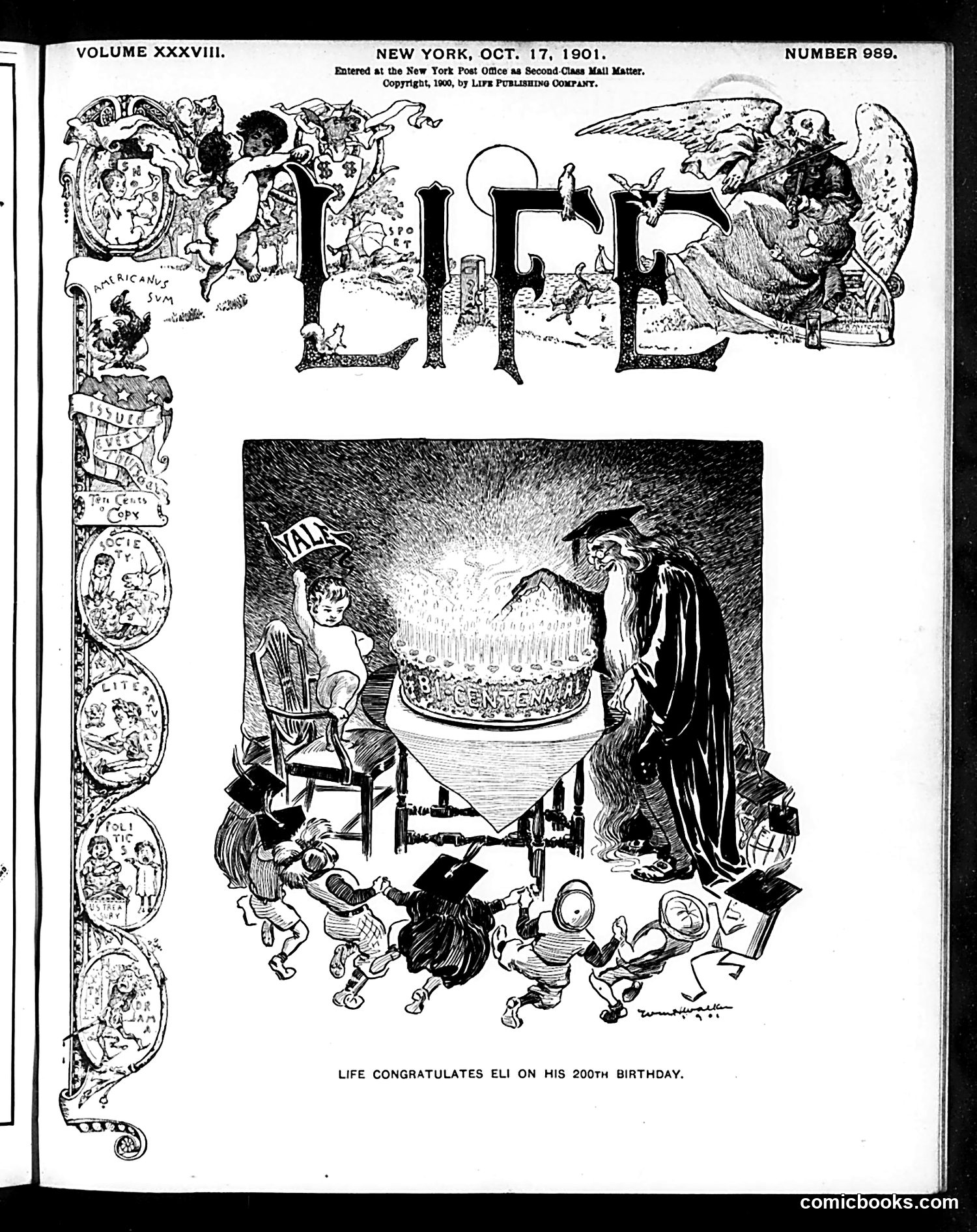
This is a congratulatory cartoon marking "Eli's 200th Birthday." The central image shows a massive birthday cake labeled "CENTENNIAL" being presented by two figures—one wearing a "WALL" cap (likely representing Wall Street), and another in dark robes (possibly representing age or tradition). Children and cherubs dance around celebrating. The left border contains decorative vignettes depicting various historical scenes, suggesting a retrospective of American life and history. "Eli" appears to reference Eli Whitney, the inventor of the cotton gin, whose invention was patented in 1793—making 1901 approximately his 200th birthday commemoration. However, without additional context, the exact figure or institution being celebrated remains unclear from the image alone.
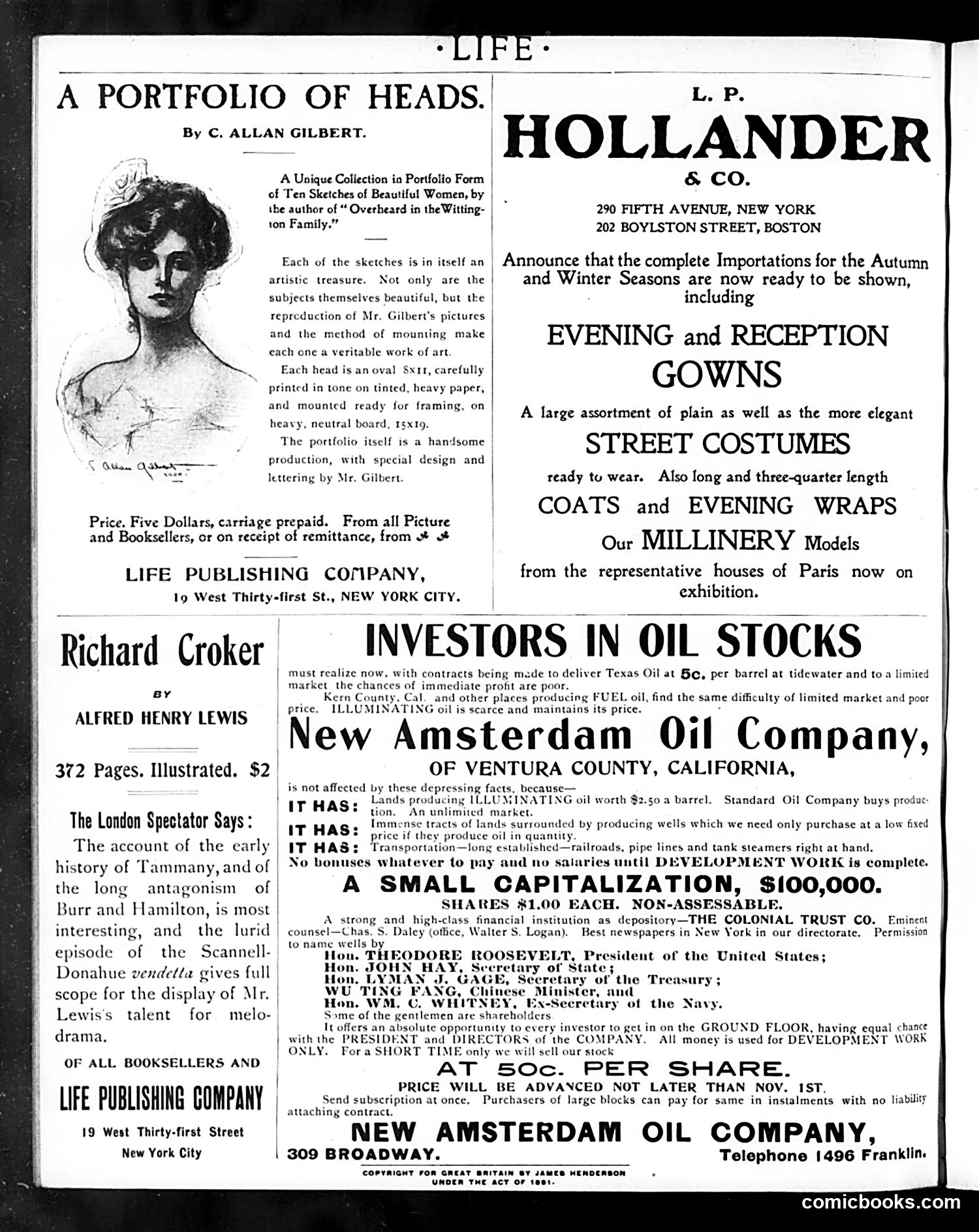
This page is primarily **advertising with minimal satirical content**. The left side features "A Portfolio of Heads" by C. Allan Gilbert—a collection of portrait sketches of women available for $5. The accompanying text describes them as artistic reproductions mounted for framing. The remainder of the page consists of commercial advertisements for: - Hollander & Co. (fashion importers) - Richard Croker biography by Alfred Henry Lewis - New Amsterdam Oil Company stock offering There is **no clear political cartoon or satire visible**. The portrait sketches, while artistically rendered, appear to be straightforward product promotion rather than commentary. This represents a typical early-20th-century magazine page mixing editorial content with paid advertising.
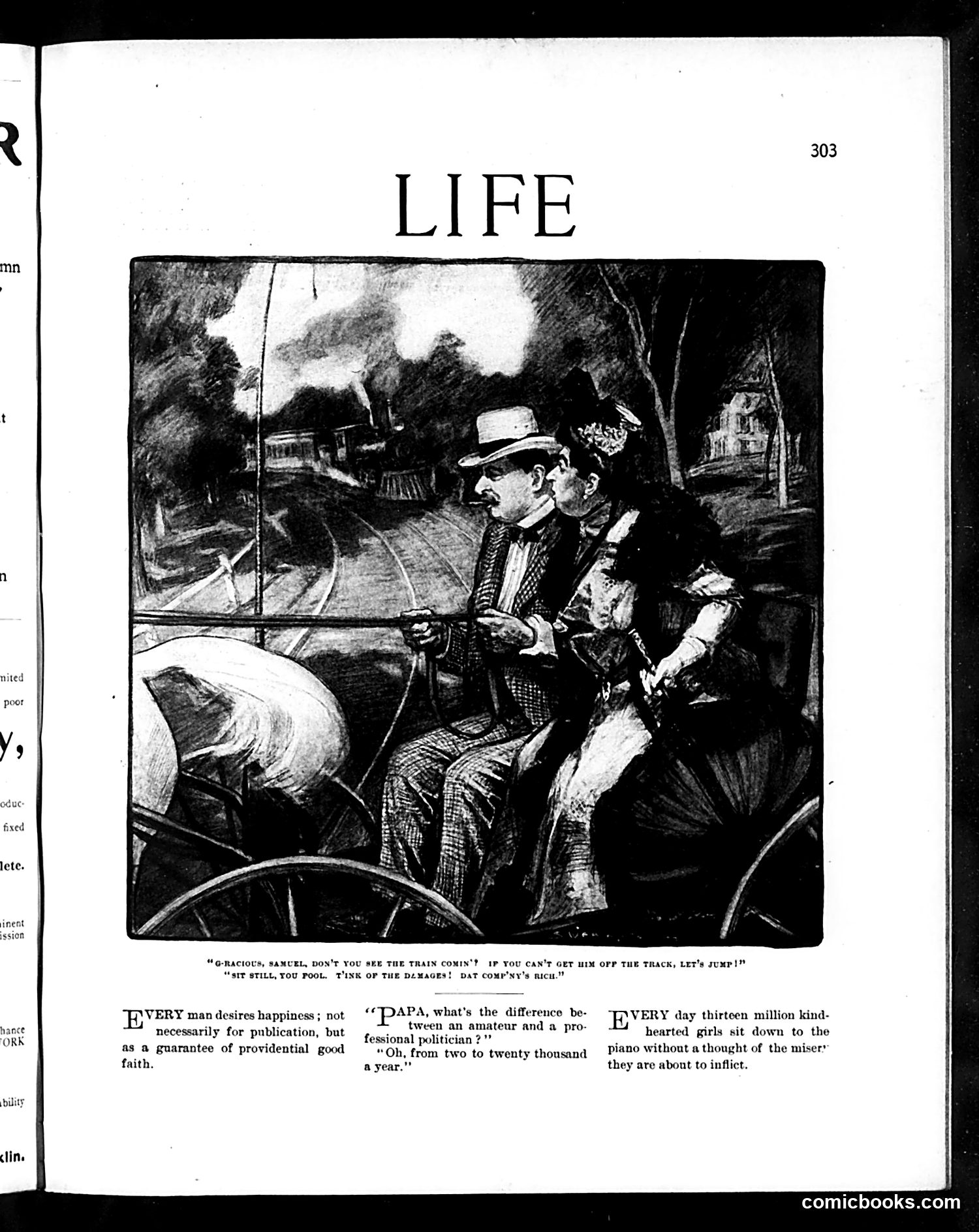
This page features a satirical cartoon about amateur versus professional politicians. The illustration shows two figures in a carriage on railroad tracks, with one character (wearing a straw hat) appearing to be an amateur, while the other represents a professional politician. The dialogue references a train approaching ("G-Bacchus, Samuel, don't you see the train coming?"), creating comedic danger. The accompanying text discusses how every man desires happiness, and includes a dialogue about the difference between amateur and professional politicians, with earnings ranging from "two to twenty thousand a year." The satire targets the incompetence or naivety of amateur politicians contrasted with seasoned professionals, suggesting amateurs are dangerously unfit for political office—literally risking disaster by ignoring obvious threats.
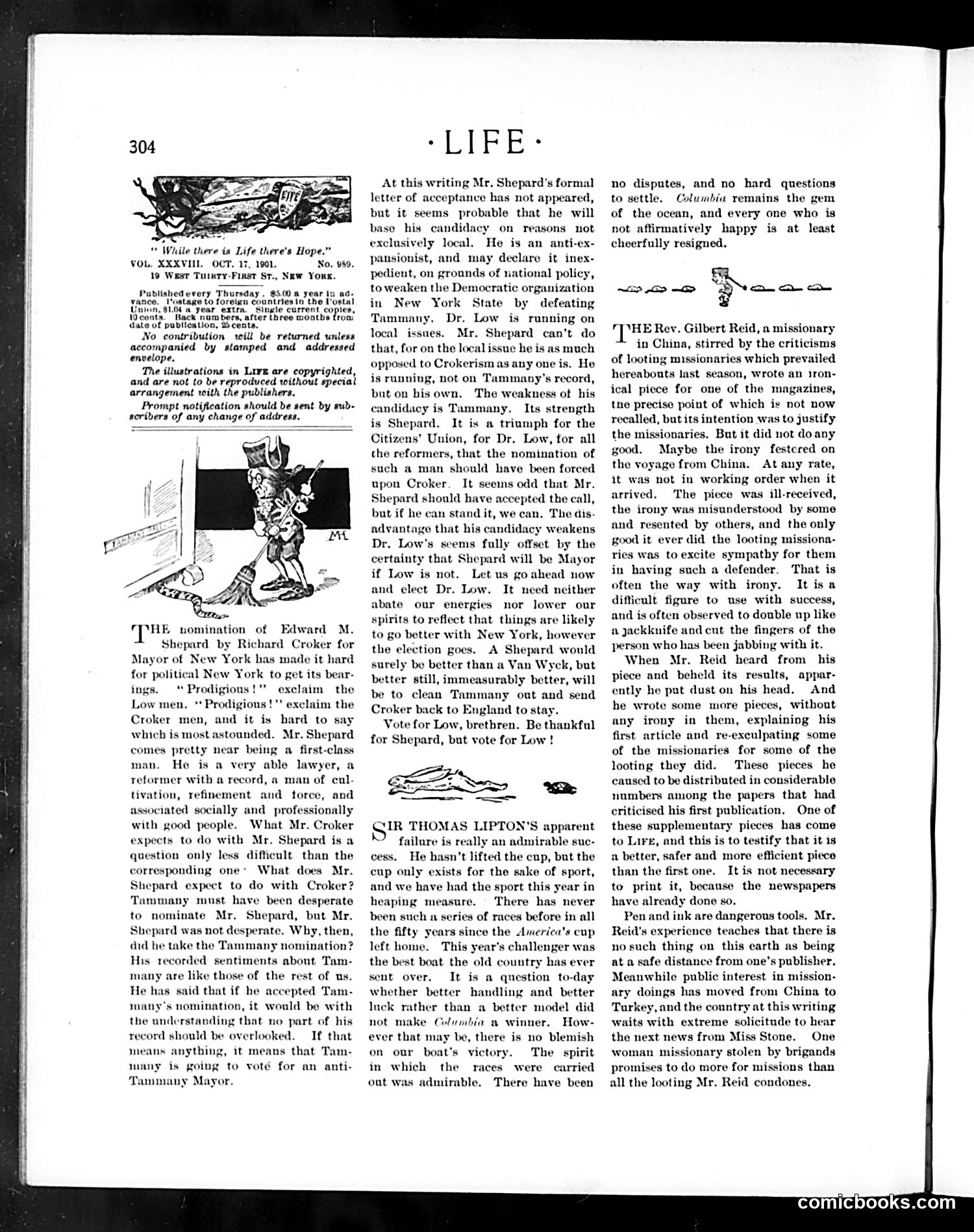
This page discusses the 1902 New York mayoral race. The text criticizes Edward M. Shepard's nomination by Republican reformers (Croker men) as their candidate against Tammany Hall Democrat Van Wyck. The cartoons mock the political calculations: the left illustration shows a figure (likely representing the reform movement or Shepard) as a weakened candidate, while depicting Tammany's strength. The commentary sarcastically notes that while Shepard is "a very able lawyer," his nomination seems strategically poor—the reformers would be "better still, immeasurably better" nominating Dr. Low instead to challenge both Van Wyck and send Croker "back to England to stay." The piece satirizes how factional disputes within the Republican/reform camp might hand victory to Tammany, New York's powerful Democratic machine.
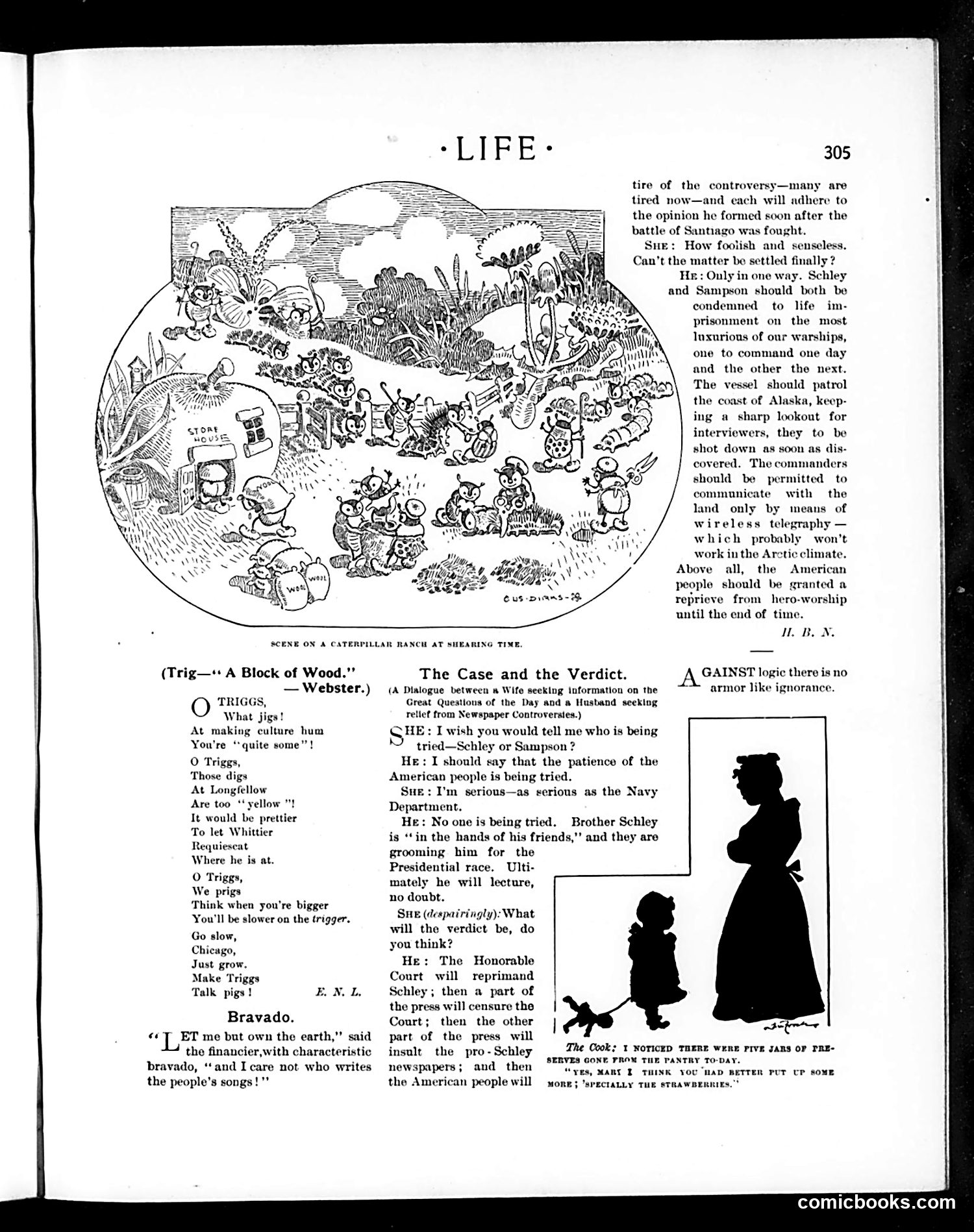
The page contains political commentary on the Schley-Sampson controversy—a heated dispute over credit for the Spanish-American War's naval victory at Santiago. The dialogue "The Case and the Verdict" presents opposing views: one speaker defends Schley while another argues the public is being manipulated by pro-Schley newspapers grooming him for a Presidential race. The cartoon "Scene on a Caterpillar Ranch at Shearing Time" (by E. Cussons) appears to satirize the controversy itself—depicting absurd, chaotic activity, likely mocking how the dispute has become ridiculous and out of proportion. "A Block of Wood" is a poem critical of Chicago's slow growth, and "Bravado" mocks a financier's boastful claim to own the earth. The silhouettes below show domestic humor unrelated to politics.
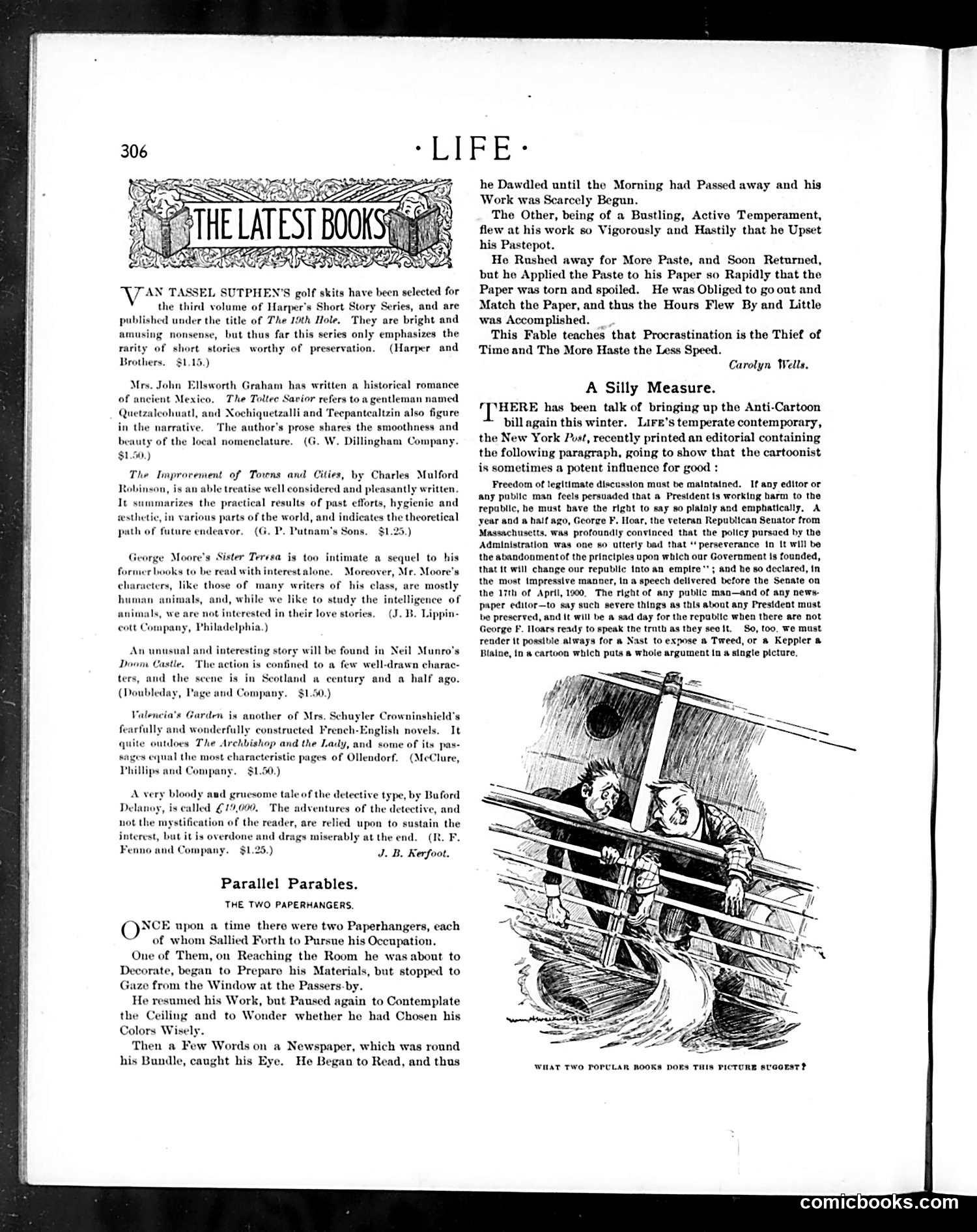
**The Main Cartoon:** The illustration titled "WHAT TWO POPULAR BOOKS DOES THIS PICTURE SUGGEST?" shows two figures sitting on a wooden beam or rafter, appearing to be in a precarious position. This is a visual riddle rather than political satire. The cartoon plays on the titles of contemporary popular books—likely referencing titles about danger, balance, or difficult situations. Without identifying the specific books referenced, the joke relies on readers recognizing how the visual scenario (two people perched precariously) connects to well-known book titles of the era. **The Surrounding Content:** The page primarily features book reviews under "THE LATEST BOOKS," discussing various contemporary novels and stories published by Harper and Brothers and other publishers. "A Silly Measure" discusses editorial freedom regarding cartoons.
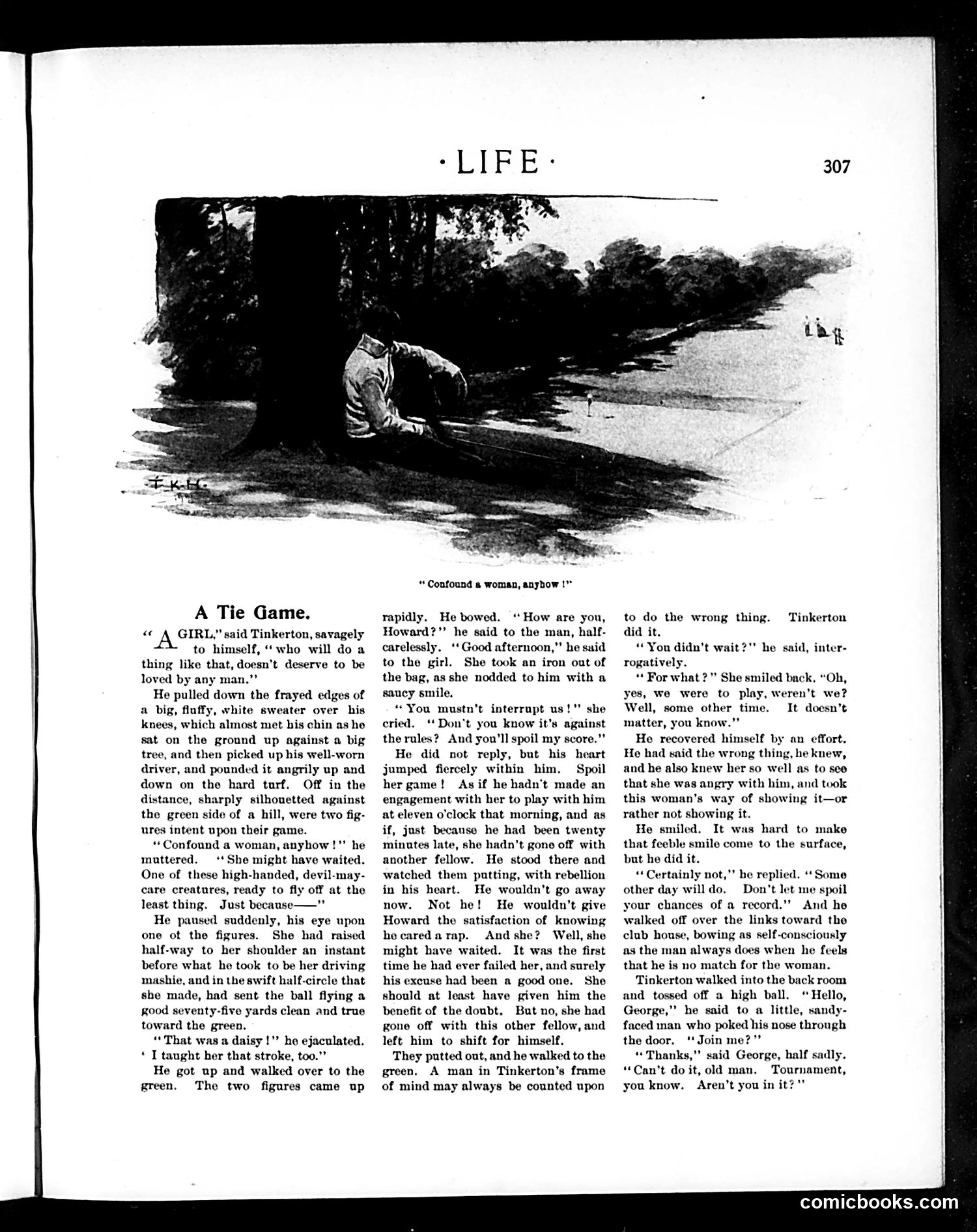
This is a short humorous story, not a political cartoon. The narrative depicts a domestic dispute between a man named Howard and a woman, illustrated by a sketch showing a man sitting alone by a tree near water while figures play in the distance. The plot concerns a golf game interrupted by relationship conflict: Howard is playing golf when the woman demands his attention, threatening to "spoil" his game. He refuses to leave, prioritizing golf over appeasing her. After he plays poorly anyway, he realizes he handled the situation badly and attempts reconciliation, admitting his mistake to the woman named Tinkerton. The satire gently mocks male stubbornness and the tension between marital obligations and recreational pursuits—a relatable domestic comedy for Life's early 20th-century readers.
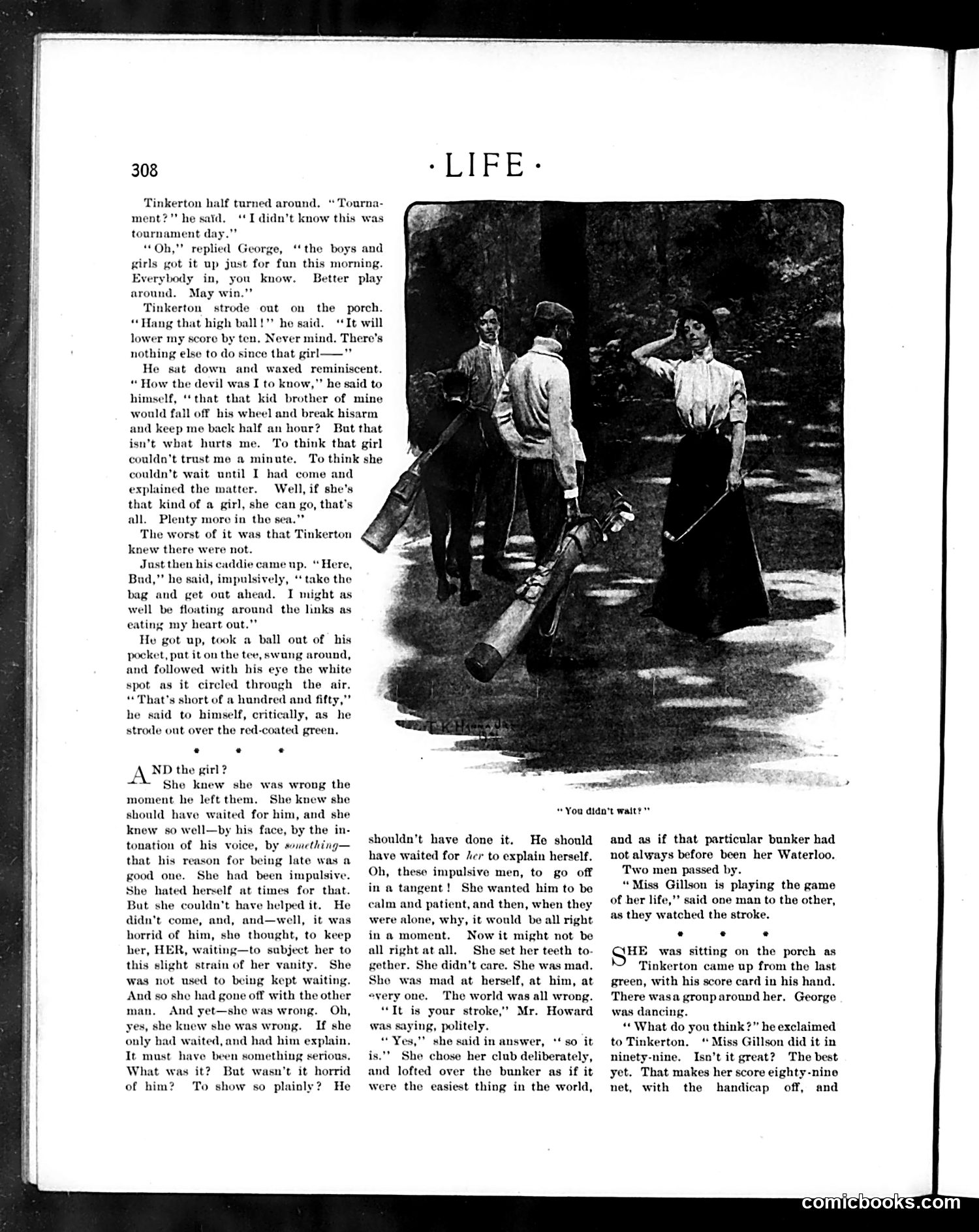
This page contains a story about golf, not political satire. The narrative describes a character named Tinkerton who has become upset during a golf tournament after losing to a girl. The accompanying photograph shows four men on a golf course in what appears to be an early 20th-century setting (based on clothing and image quality). The "satire" here is social rather than political: it's a humorous commentary on male pride and competitiveness. The humor centers on Tinkerton's wounded ego at being defeated by a female golfer—reflecting period attitudes about women's athletic capabilities. The story explores the tension between his irritation and his inability to openly blame her, highlighting contemporary gender dynamics and masculine insecurity regarding women's sports participation.
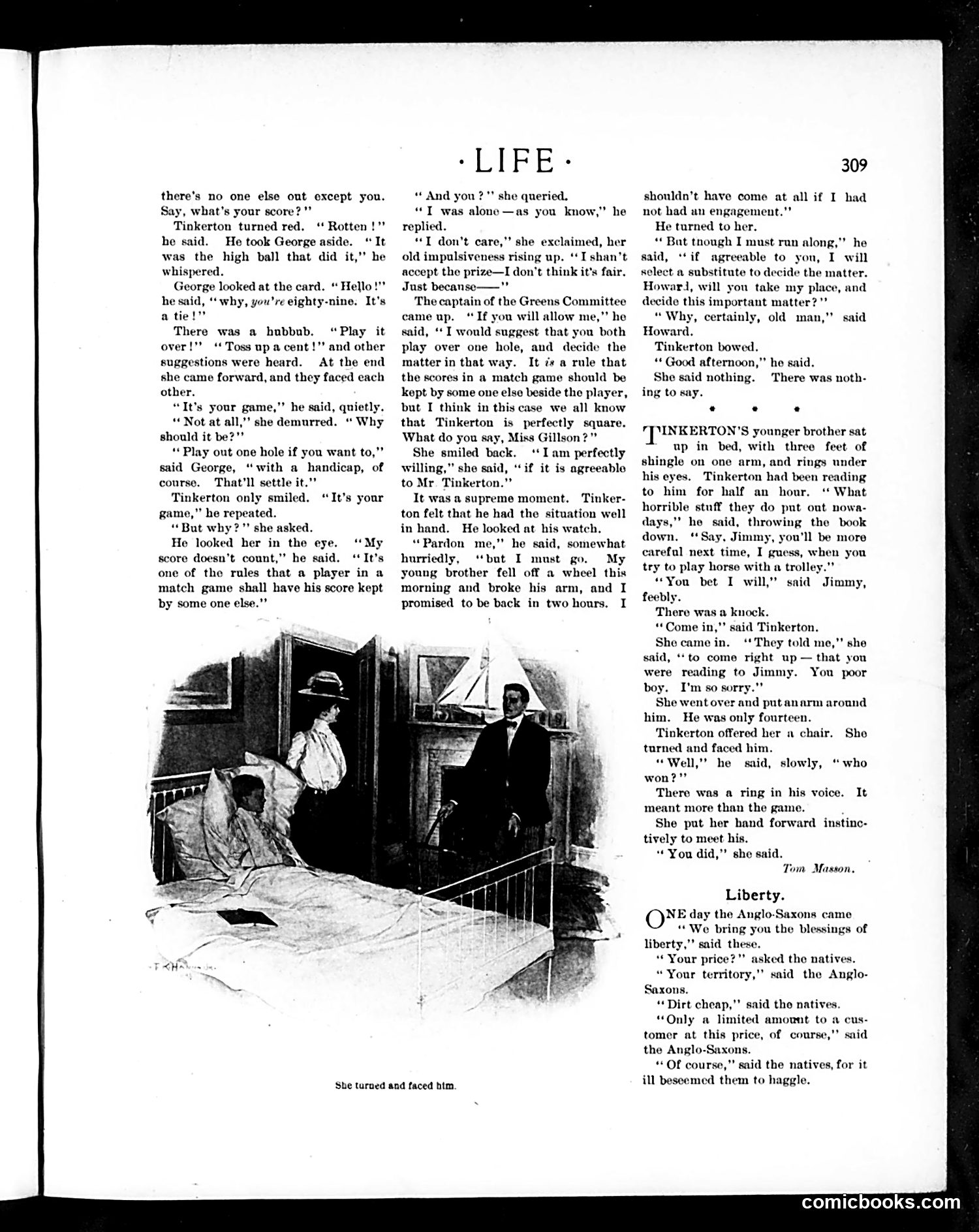
This page contains two separate fictional narratives rather than political cartoons. The main illustrated story depicts a domestic scene where a man and woman interact in a bedroom, with the caption "She turned and faced him." The accompanying text describes a romantic or dramatic confrontation between characters named Tinkerton and a female visitor regarding a card game and matters of honor. Below this is a separate short piece titled "Liberty," which appears to be satirical commentary on colonial encounter. It depicts Anglo-Saxons attempting to sell "liberty" to natives, who respond with skepticism about the price and territorial terms, ending with the natives' cynical observation that liberty "ill becomes them to haggle." The satire critiques Western imperial claims to bring civilization while engaging in commercial exploitation.
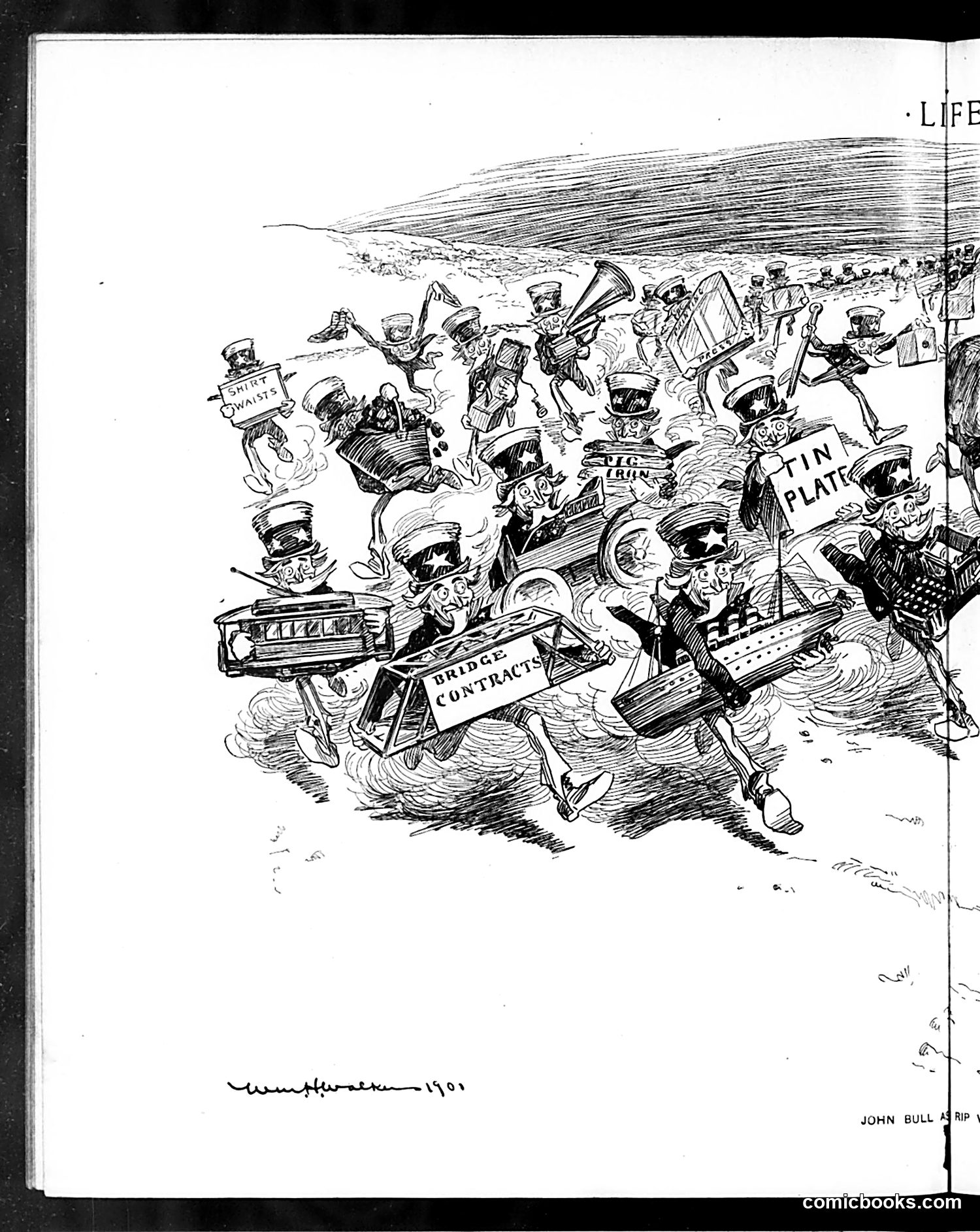
This is a satirical cartoon from Life magazine (dated 1901 based on visible marking) depicting what appears to be chaos among political or business figures during the early 20th century. The central image shows multiple caricatured figures in top hats and formal dress engaged in frantic activity, with visible labels including "BRIDGE CONTRACTS," "TIN PLATE," and what appears to be "SWIFT." The figures are drawn in exaggerated, comedic style, appearing to rush about with various implements and papers. The satire likely critiques **corporate corruption or political favoritism** regarding government contracts—particularly bridge construction contracts and industrial manufacturing deals. The chaotic composition suggests competitive bidding scandals or kickback schemes common to the Gilded Age/Progressive Era. The specific companies or politicians involved are difficult to identify with certainty from this image alone.
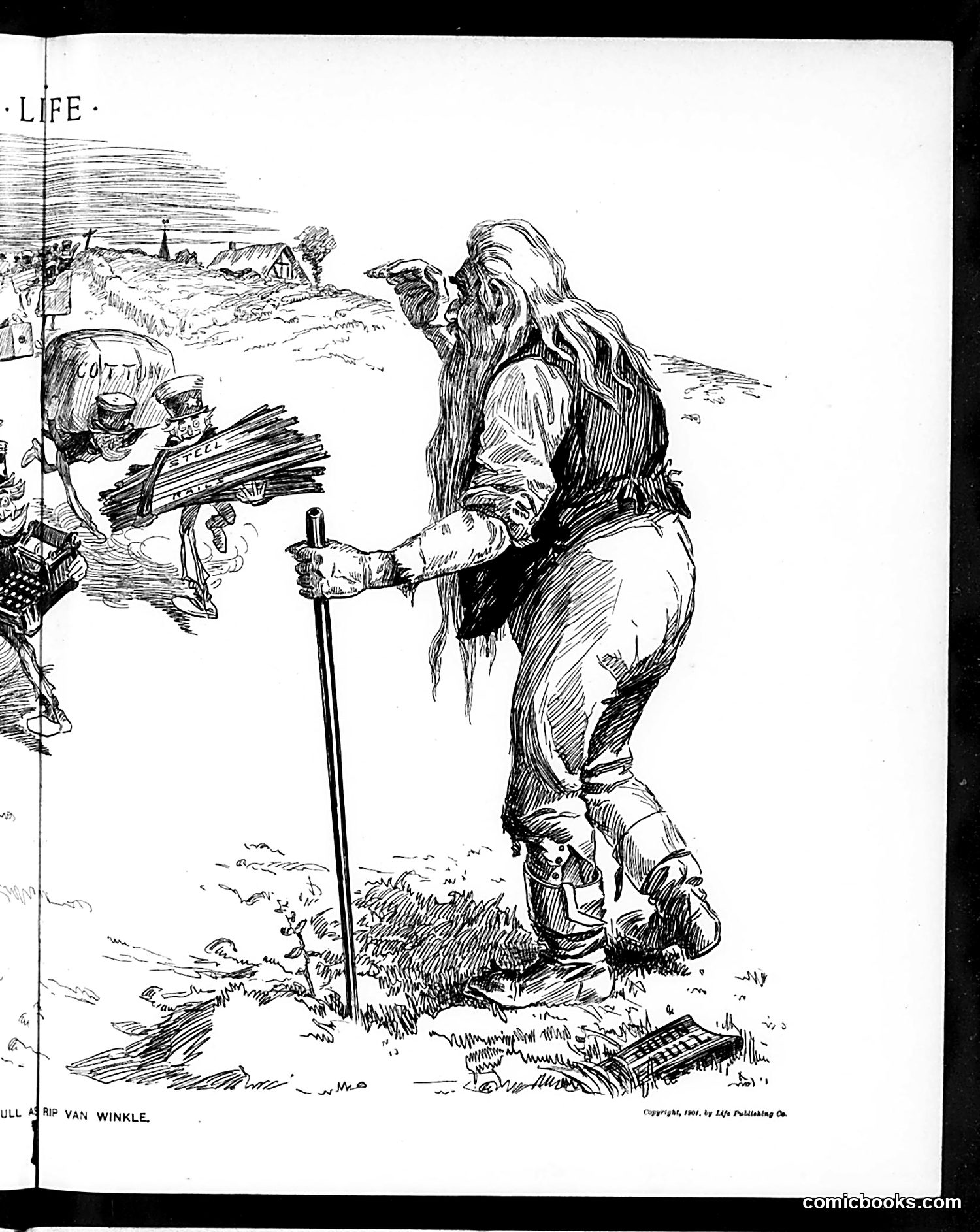
This satirical cartoon depicts a bearded figure labeled "RIP VAN WINKLE" awakening from a long sleep to find the landscape dramatically changed. The figure appears shocked or dismayed at the transformation around him—industrial/commercial development (visible cotton bales and industrial structures in the background) has replaced the rural pastoral setting he knew. The cartoon uses Washington Irving's famous tale of a man who slept through decades of change as an allegory for someone out of touch with modern American progress. The satire likely critiques those resistant to industrialization, urbanization, or social/political modernization happening in early 20th-century America. The figure's astonishment emphasizes how disconnected he is from contemporary developments.
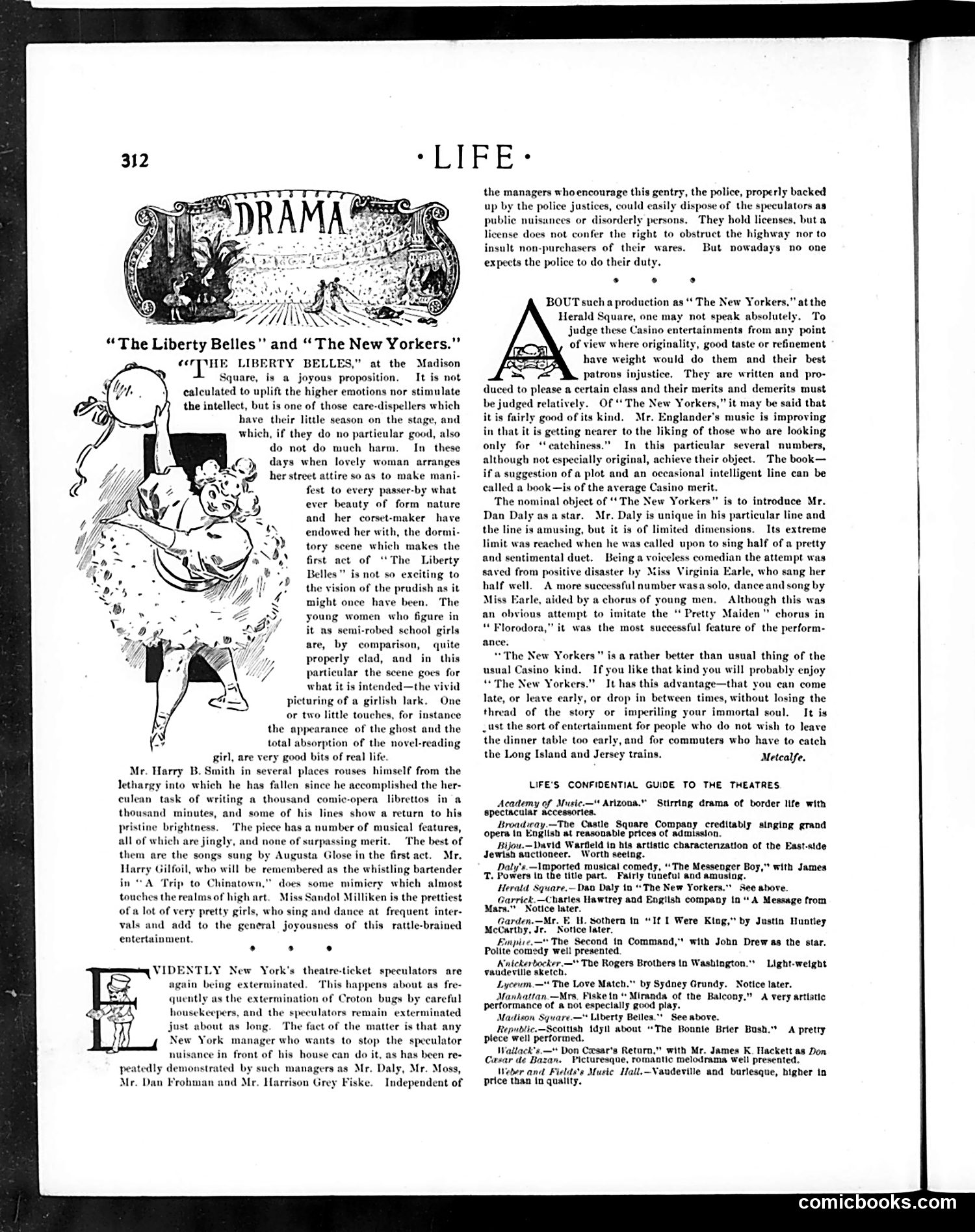
This page reviews theatrical productions including "The Liberty Belles" and "The New Yorkers." The cartoon illustration shows a woman in a bell-shaped costume (representing "Liberty Belles"), dancing with exaggerated theatrical flair. The text criticizes "The New Yorkers" as a Casino entertainment that, while amusing, lacks originality and refinement. The reviewer notes it features Dan Daly as a star and includes attempts to recreate the "Pretty Maiden" chorus from "Florodora," which the critic deems unsuccessful. The page also addresses a recurring problem: theater speculators buying tickets to resell them. The text mentions managers and police attempting to combat this nuisance, which apparently troubled New York theater-goers of this era.
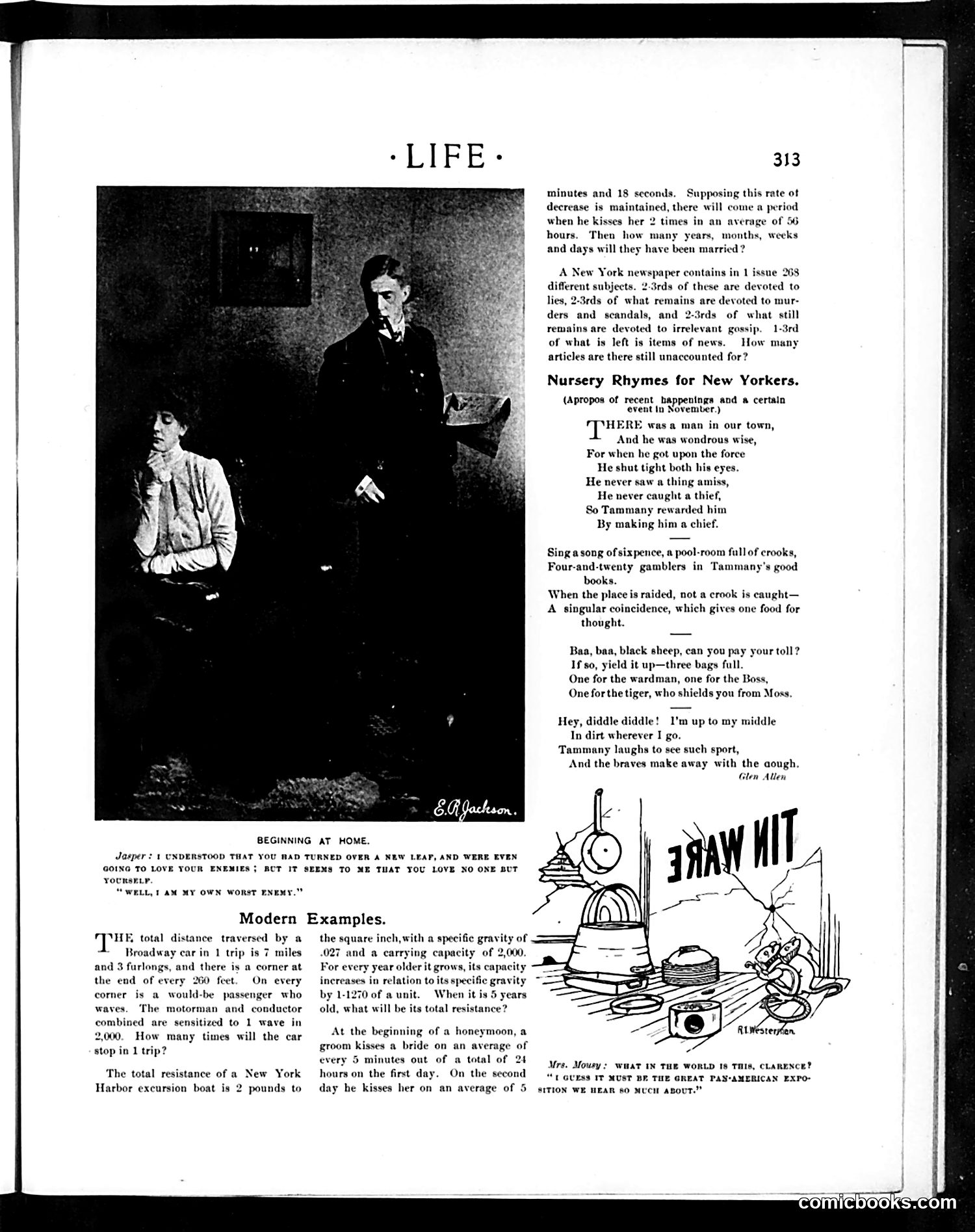
**"Beginning at Home" Cartoon:** This sketch depicts a domestic confrontation where a character named Jasper is accused of failing to live up to a moral reformation—specifically, his claimed intention to "love your enemies." The punchline, "I am my own worst enemy," is self-deprecating humor about personal hypocrisy. **"Nursery Rhymes for New Yorkers":** This section viciously satirizes **Tammany Hall**, New York's corrupt Democratic political machine. The rhymes mock: - Police corruption (officers who "shut tight both his eyes") - Gambling operations protected by officials - Bribery ("three bags full"—payoffs to wardmen, bosses, and "the tiger," likely a crime boss) - General municipal graft References to a "raid" with no arrests caught suggest satirizing police-corruption scandals of the period. **"Modern Examples":** Mathematical word problems satirizing American society—trains, boats, and newlyweds—offering social commentary wrapped in arithmetic. The page reflects turn-of-the-century Progressive-era criticism of urban political corruption and institutional failure.
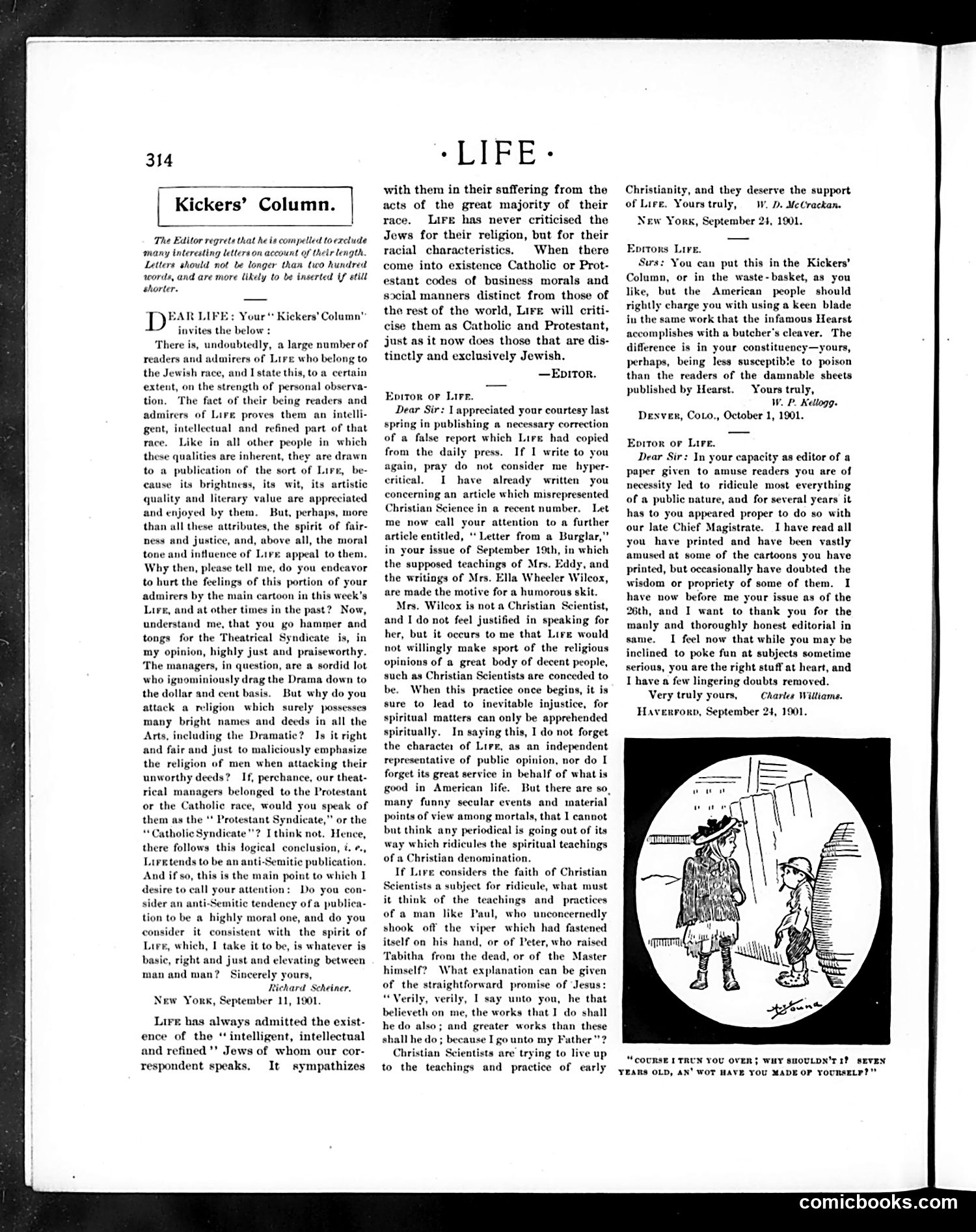
This page presents the magazine's "Kickers' Column"—a letters-to-the-editor section where readers critique Life's editorial choices. **Main Issue:** A Jewish reader (Richard Scheiner) accuses Life of anti-Semitism, arguing that the magazine attacked theatrical managers by labeling them a "Jewish Syndicate" rather than simply "Theatrical Syndicate." He contends Life wouldn't use religious identifiers for Catholic or Protestant wrongdoers, making this selectively prejudicial. **Life's Response:** The editor defends the magazine, claiming it critiques Jewish "racial characteristics" and business practices, not the Jewish religion itself. The editor argues Life would similarly identify distinct Catholic or Protestant moral codes if they existed. **Secondary Complaint:** Another reader objects to Life's September 19th satirical article mocking Christian Science teachings and Ella Wheeler Wilcox (a Christian Science supporter). **Context:** This reveals early 1900s American publication debates about religious prejudice and whether ethnic/religious identifiers in satire constituted unfair targeting—a tension Life apparently didn't fully acknowledge.
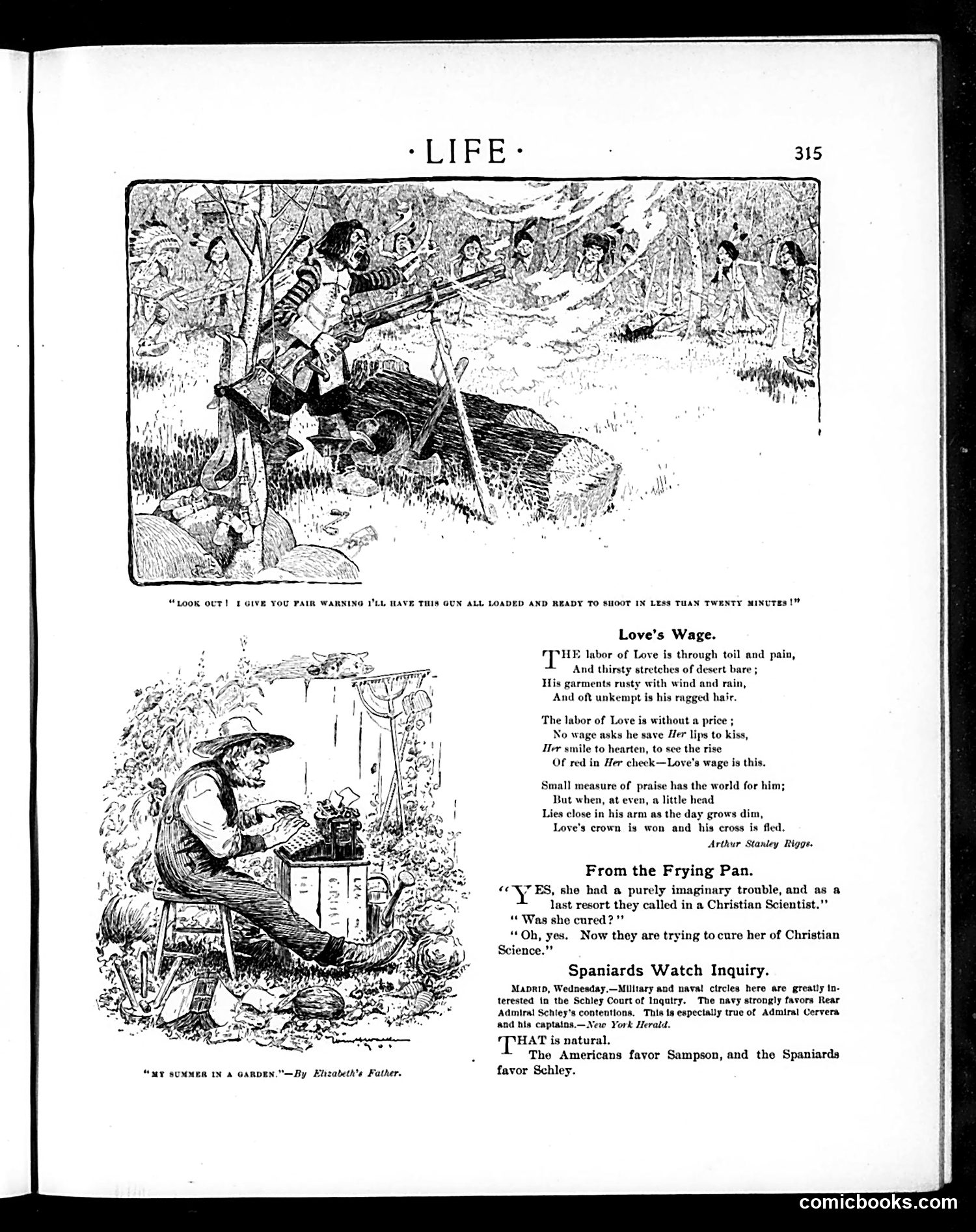
This page contains three distinct satirical pieces from an American magazine: **Top Cartoon**: A man threatens his wife with a loaded gun, claiming he'll shoot within twenty minutes. The caption attributes this to "Elizabeth's Father," suggesting domestic discord presented as dark humor. **"Love's Wage" Poem**: A sentimental poem by Arthur Stanley Riggs romanticizing love's non-monetary rewards—kisses, smiles, and family affection. **"From the Frying Pan"**: A joke about a woman with "imaginary trouble" treated by a Christian Scientist, who "cures" her of both the imaginary illness and her faith in Christian Science—mocking the sect's practices. **"Spaniards Watch Inquiry"**: Political satire referencing the Schley Court of Inquiry (appears related to the Spanish-American War). The joke: Americans support Admiral Sampson while Spanish admirals favor Schley—absurdly, each side backs their opponent's admiral, suggesting divided or confused loyalties.
This page contains three humorous anecdotes satirizing contemporary American society: 1. **"Scissors at Nullus"** (top): A drug clerk attempts to play a racist "joke" on a Black customer by deliberately handing her black court-plaster when she requests flesh-colored. The customer's witty response—noting she asked for "flesh cullan" but received "skin cullah"—turns the joke on him, suggesting her skin tone is the actual flesh color. The satire mocks the clerk's failed racism. 2. **Dental quackery anecdote**: A tooth-puller advertises painless extraction but deliberately causes agony, attributing screams to competitors' methods. The satire ridicules medical charlatans and their absurd rationalizations. 3. **Anonymous donation**: A caller requests anonymity for a charitable contribution, revealing contemporary anxieties about public perception of wealthy donors. The page also includes vintage advertisements for whiskey, theater performances, and women's clothing, typical of this era's Life magazine format.
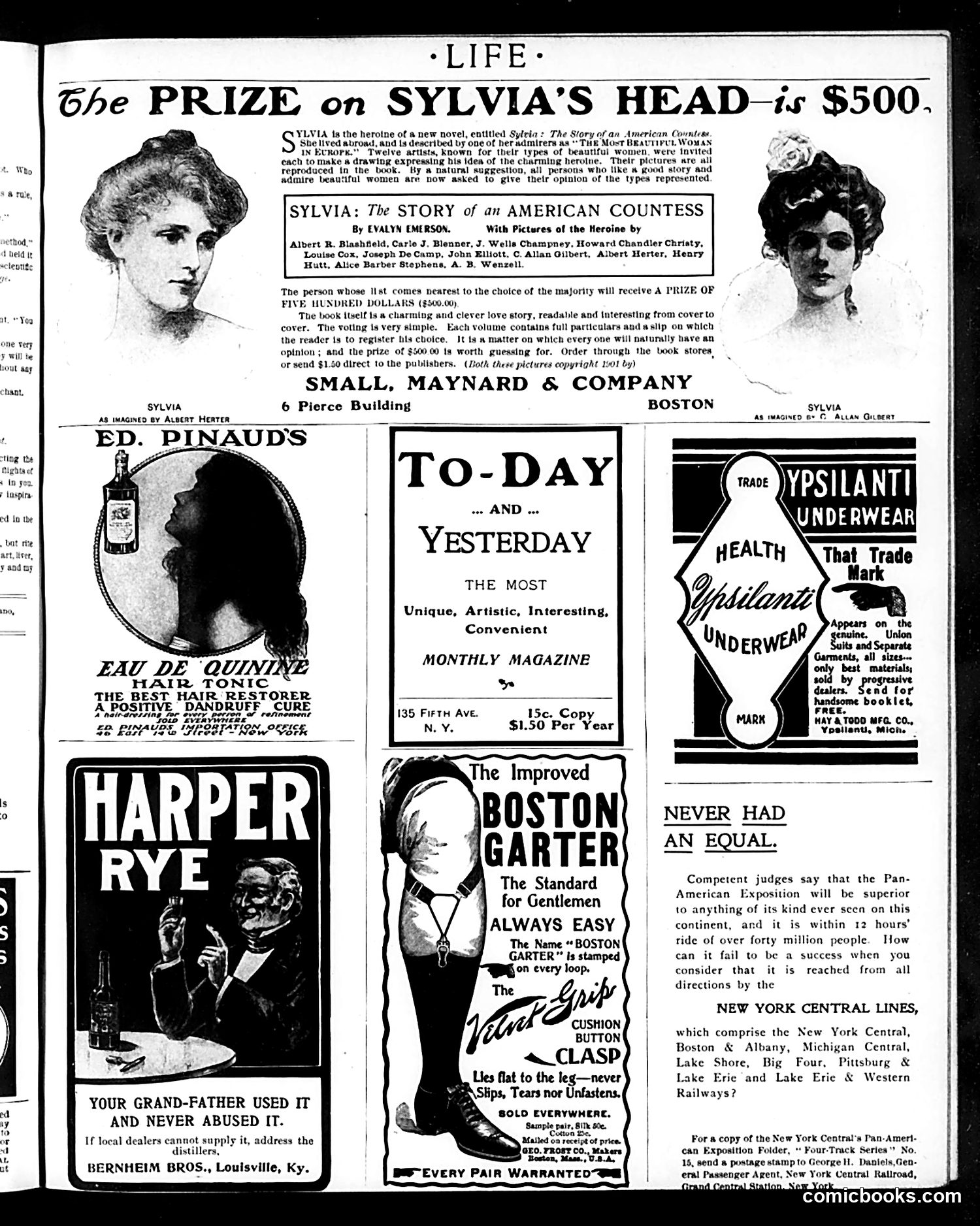
This page is primarily a **book promotional contest**, not a political cartoon. It announces a $500 prize for readers to vote on which of twelve famous illustrators best depicted "Sylvia," the heroine of a new novel titled *Sylvia: The Story of an American Countess*. The page includes portraits of the character as imagined by prominent artists like Howard Chandler Christy and Albert Herter. Readers could register their choice and potentially win money—a early form of interactive marketing. The remainder of the page contains **period advertisements**: hair tonic, whiskey, garters, and a magazine subscription. Notably, there's a railroads ad promoting the Pan-American Exposition, suggesting this is from around 1901. **No satire or political content is present.** This is essentially a commercial page using beauty and artistic reputation to drive book sales and reader engagement.
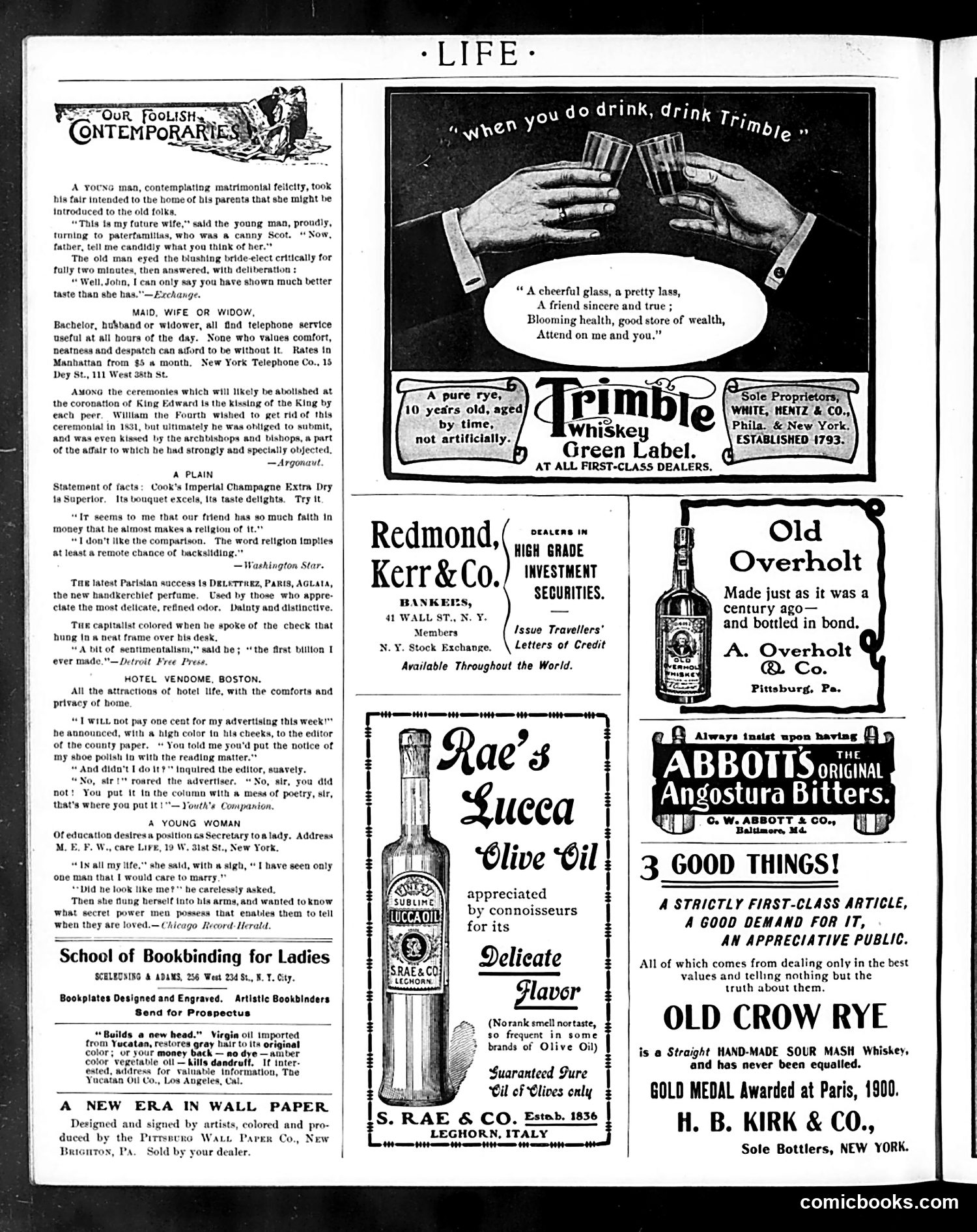
This page from *Life* magazine consists primarily of **short humorous anecdotes and advertisements** rather than political cartoons. The main satirical content includes jokes about contemporary social situations: a Scottish father's backhanded compliment to his son's fiancée; confusion over newspaper advertising placement (poetry mixed with a shoe polish ad); and various romantic misadventures. These reflect *Life*'s satirical focus on everyday American manners and absurdities. The advertisements—for whiskey, olive oil, banking services, and other products—use period marketing language emphasizing quality and gentlemanly refinement. The only illustrated cartoon appears to be "Our Foolish Contemporaries" header, but the specific image is not clearly legible in this reproduction. The humor throughout targets genteel middle-class pretensions, romantic courtship rituals, and commercial vanity—typical of *Life*'s satirical approach to turn-of-the-century American life.
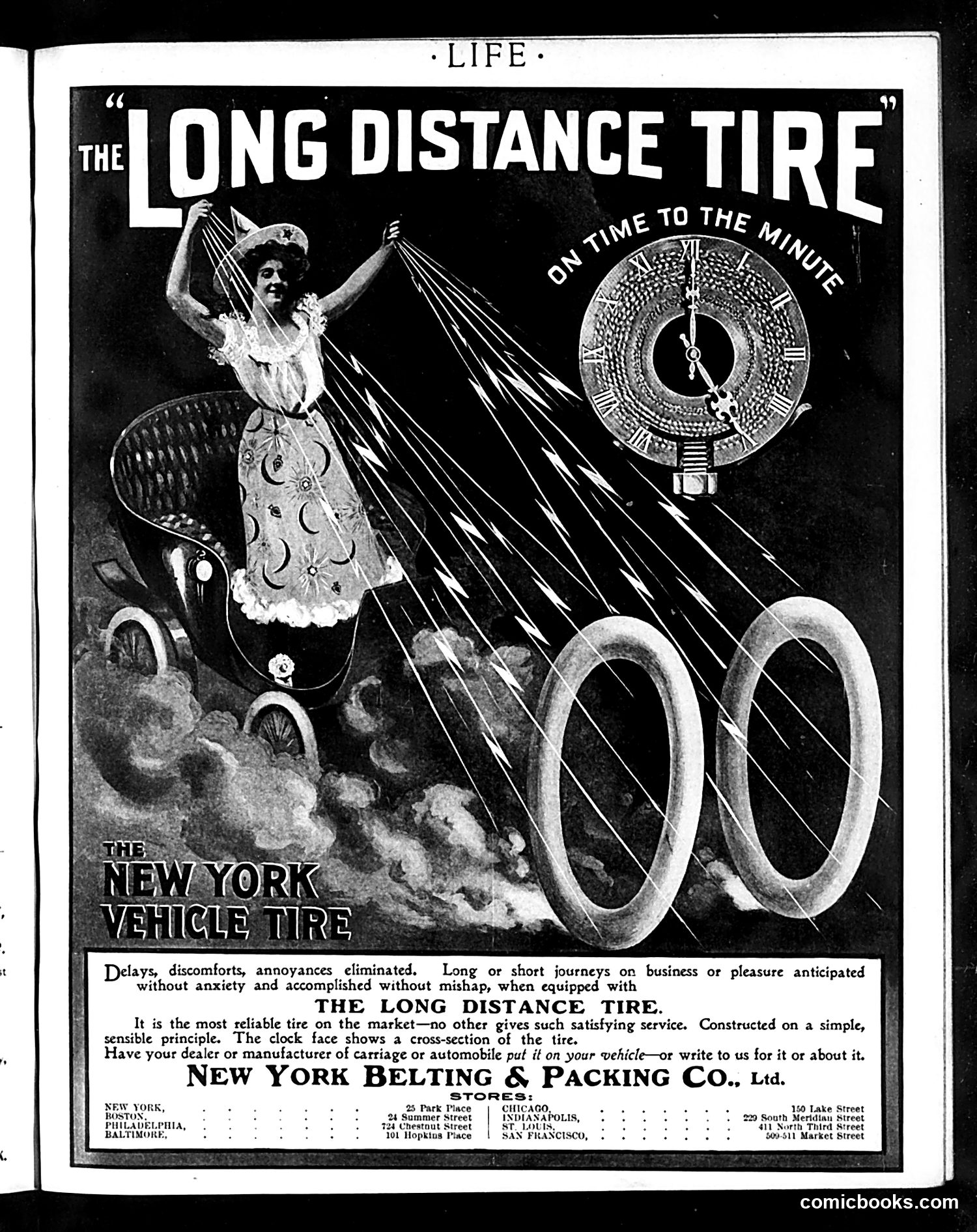
This is a **full-page advertisement** for the New York Belting & Packing Co.'s automobile tire, not political satire. The image depicts an allegorical female figure (likely representing reliability or progress) in a chariot pulled by two oversized tires, riding through clouds. A clock face showing tire cross-section appears above. The ad's appeal is straightforward: the tire eliminates travel "delays, discomforts, annoyances" for business and pleasure journeys. The fantastical imagery—goddess-like woman, cloud setting—presents tire ownership as transcendent, almost magical reliability. This reflects early automotive culture when tires were still novel and prone to failure. The "clock face" detail highlights engineering precision as a selling point. The ad lists multiple store locations, emphasizing the company's established presence across major American cities.
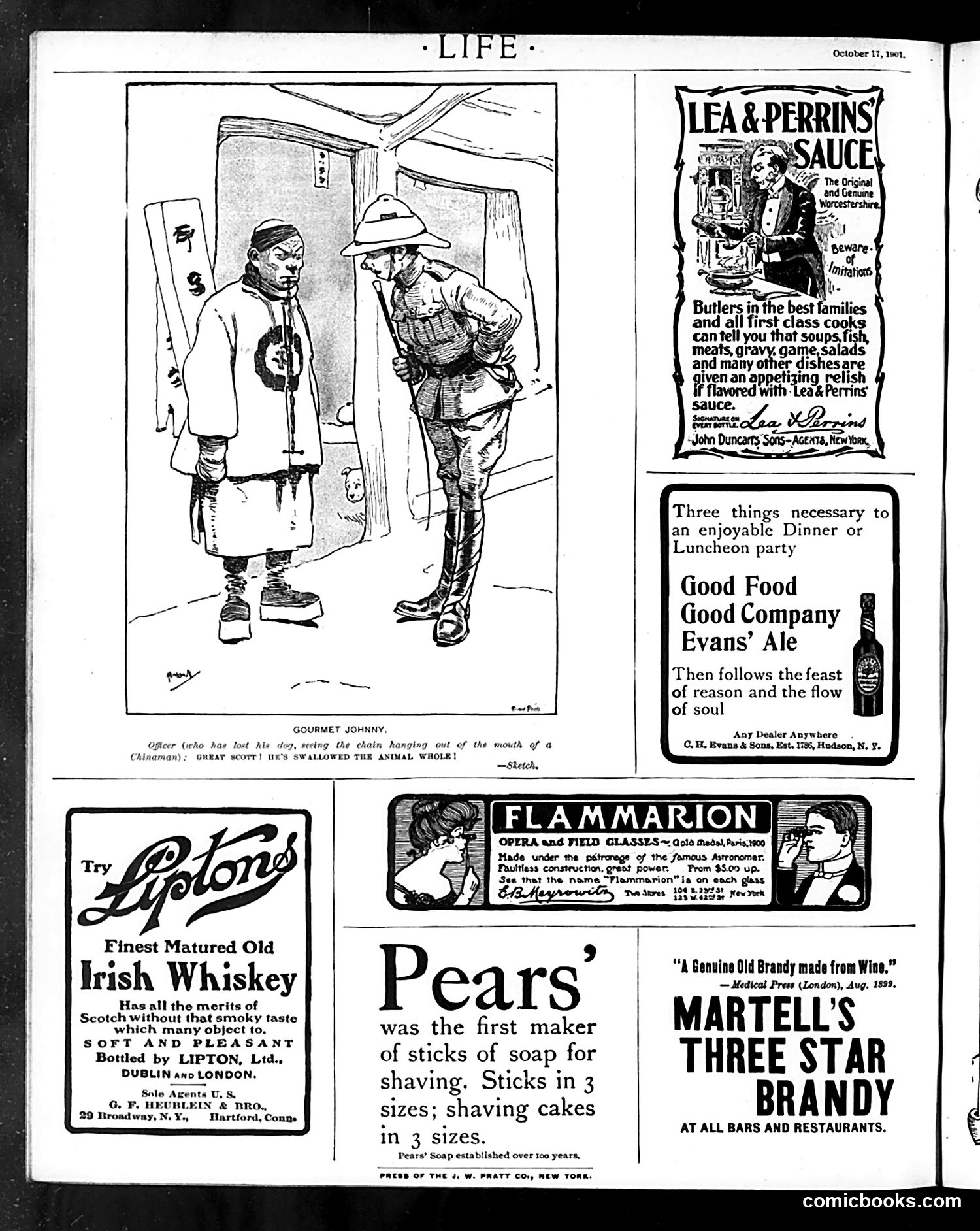
This October 1901 cartoon satirizes anti-Chinese racism prevalent in America at the time. The joke depicts a police officer discovering a dog's chain hanging from a Chinese man's mouth, leading the officer to conclude the man has "swallowed the animal whole." The humor relies on dehumanizing stereotypes: it plays on xenophobic fears and prejudices that portrayed Chinese immigrants as exotic, savage, or cannibalistic. The title "Gourmet Johnny" mocks Chinese cuisine and people through a racial slur. The cartoon reflects the exclusionary attitudes of the early 1900s, when Chinese laborers faced severe discrimination, legal restrictions (the Chinese Exclusion Act was in effect), and violent hostility. What appears as a "joke" in a major American magazine reveals how normalized and acceptable such racist caricature was in mainstream culture of this era. The remainder of the page consists of product advertisements common to *Life* magazine.