
Life, 1901-10-17 · page 4 of 20
Life — October 17, 1901 — page 4: what you’re looking at
What you’re looking at
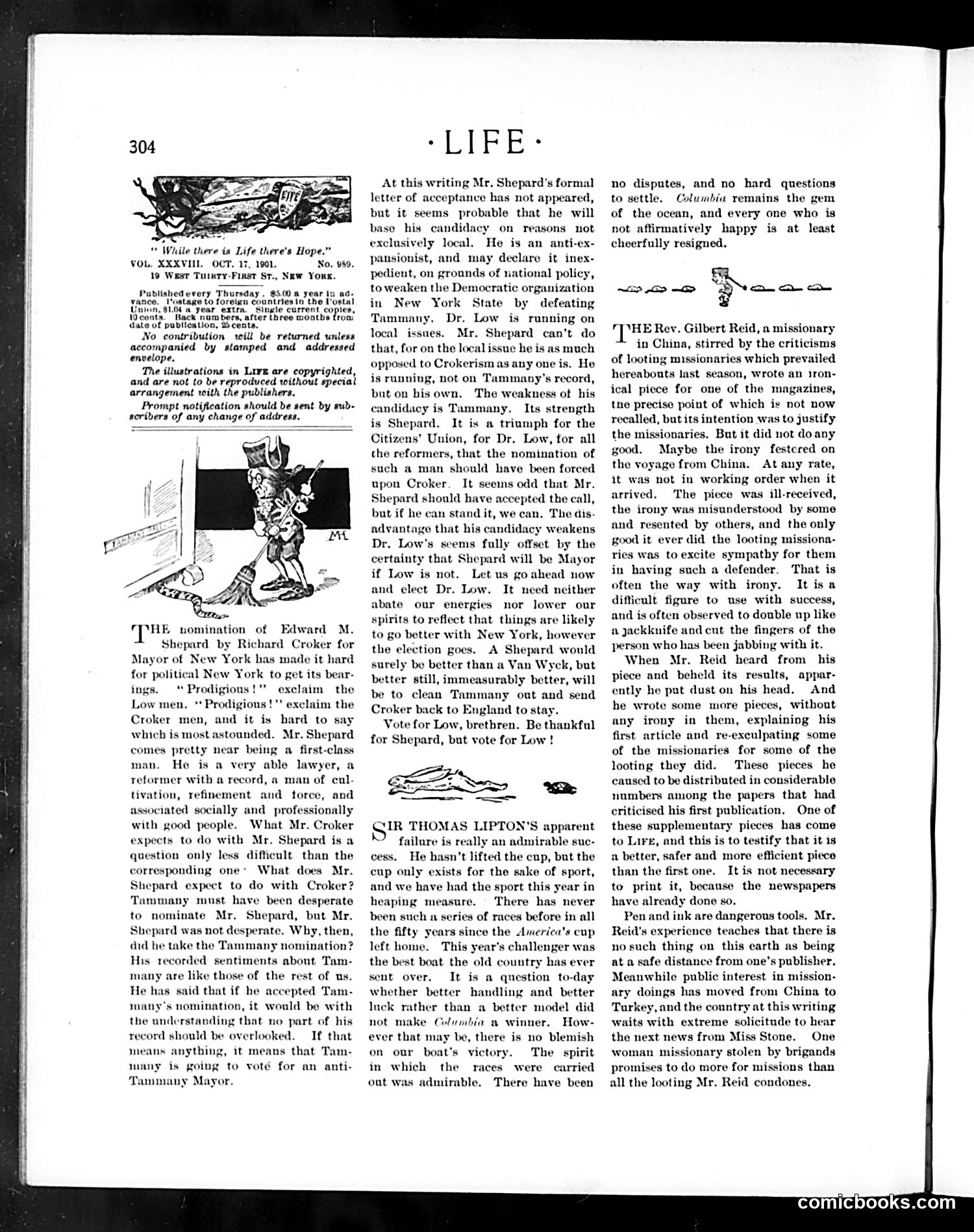
This page discusses the 1902 New York mayoral race. The text criticizes Edward M. Shepard's nomination by Republican reformers (Croker men) as their candidate against Tammany Hall Democrat Van Wyck. The cartoons mock the political calculations: the left illustration shows a figure (likely representing the reform movement or Shepard) as a weakened candidate, while depicting Tammany's strength. The commentary sarcastically notes that while Shepard is "a very able lawyer," his nomination seems strategically poor—the reformers would be "better still, immeasurably better" nominating Dr. Low instead to challenge both Van Wyck and send Croker "back to England to stay." The piece satirizes how factional disputes within the Republican/reform camp might hand victory to Tammany, New York's powerful Democratic machine.
📄 Transcribed text from this page (OCR, searchable)
Machine-transcribed from the original scan — historical spelling and the odd misread are preserved.
“ While there is Life there's Hope. VOL. XXXVI. OCT. 17, 1901, 19 Wast Tuixty-Finst St., New Yorx. Published every Thursday . $5.00 a year in ad. ance. Voatage to foreign countries in the Postal ft 1.04 a year extra. Single current copies, 1Oconts. “Rack numbers, after three moaths from’ date of publication, 2 centa. No contribution will be returned unless accompanied by stamped and addressed envelope. ‘The illustrations in Lure are copyrighted, and are not (o be reproduced without special arrangement with the publishers. Prompt notification should be sent by sub- soribers of any change of address. YHE nomination of Edward M. Shepard by Richard Croker for Mayor of New York has made it hard for political New York to get its bear- ings. ‘ Prodigious!" exclaim the Low men, * Prodigious!"' exclaim the Croker men, and it is hard to say whicb is most astounded. Mr. Shepard comes pretty near being a. first-class man. He is a very able lawyer, a reformer with a record, a man of cul- tivation, refinement and torce, and associated socially and professionally with good people. What Mr. Croker expects to do with Mr. Shepard is a question only less difficult than the corresponding one’ What does Mr. Shepard expect to do with Croker? Tammany must have been desperate to nominate Mr. Shepard, but Mr. Shepard was not desperate. Why, then, did he take the Tammany nomination? His recorded sentiments about Tam- many are like those of the rest of us. He has said that if he accepted Tam- many's nomination, it would be with the understanding that no part of his record should be overlooked. If that means anything, it means that Tam- any is going to voté for an anti- mmany Mayor. - LIFE + At this writing Mr, Shepard's formal letter of acceptance has not appeared, but it seems probable that he will base his candidacy on reasons not exclusively local. He is an anti-ex- pansionist, and may declare it inex- pedient, on grounds of national policy, to weaken the Democratic organization in New York State by defeating Tammany. Dr. Low is running on local issues. Mr. Shepard can't do that, for on the local issue he is as much opposed to Crokerism as any one is. He is running, not on Tammany’s record, but on his own, The weakness ot his candidacy is Tammany. Its strength is Shepard. It is a triumph for the Citizens’ Union, for Dr. Low, tor all the reformers, that the nomination of such a man should have been forced upon Croker. It seems odd that Mr. Shepard should have accepted the call, but if he can stand it, we can. The dis: advantage that his candidacy weakens Dr. Low's seems fully offset by the certainty that Shepard will be Mayor if Low is not. Let us go ahead now and elect Dr, Low. It need neither abate our energies nor lower our spirits to reflect that things are likely to go better with New York, however the election goes. A Shepard would surely be better than a Van Wyck, but better still, immeasurably better, will be to clean Tammany ont and send Croker back to England to stay. Vote for Low, brethren. Be thankful for Shepard, but vote for Low ! = ~IR THOMAS LIPTON’S apparent failure is really an admirable suc- cess. He hasn't lifted the cup, but the cup only exists for the sake of sport, and we have had the sport this year in heaping measure. There has never been such a series of races before in all the fifty years since the America’s cup left home. This year’s challenger was the best boat the old country has ever sent over. It is a question to-day whether better handling and better luck rather than a better model did not make Columbia a winner. How- ever that may be, there is no blemish on our boa The spirit in which the races were carried out was admirable. There have been tory. no disputes, and no hard questions to settle. Columbia remains the gem of the ocean, and every one who is not affirmatively happy is at least cheerfully resigned, ~~ > rece HE Rev. Gilbert Reid, a missionary in China, stirred by the criticisms of looting missionaries which prevailed hereabouts last season, wrote an iron- ical piece for one of the magazines, the precise point of which is not now recalled, but its intention was to justify the missionaries. But it did not do any good. Maybe the irony festcred on the voyage from China, At any rate, it was not in working order when it arrived. The piece was ill-received, the irony was misunderstood by some and resented by others, and the only good it ever did the looting missiona- ries was to excite sympathy for them in having such a defender. That is often the way with irony, It isa difficult figure to use with success, and is often observed to double up like a jackknife and cut the fingers of the person who has been jabbing with it. When Mr. Reid heard from his piece and beheld its results, appar- ently he pat dust on his head. And he wrote some more pieces, without any irony in them, explaining his first article and re-exculpating some of the missionaries for some of the looting they did. These pieces he caused to be distributed in considerable numbers among the papers that had criticised his first publication. One of these supplementary pieces has come to Lire, and this is to testify that it 1s a better, safer and more efficient piece than the first one. It is not necessary to print it, because the newspapers have already done so. Pen and ink are dangerous tools. Mr. Reid's experience teaches that there is no such thing on this earth as being at a safe distance from one’s publisher, Meanwhile public interest in mission- ary doings has moved from China to Turkey, and the country at this writing waits with extreme solicitude to hear the next news from Miss Stone. One woman missionary stolen by brigands promises to do more for missions than all the looting Mr. Reid condones. comicbooks.com