
Life, 1901-10-17 · page 6 of 20
Life — October 17, 1901 — page 6: what you’re looking at
What you’re looking at
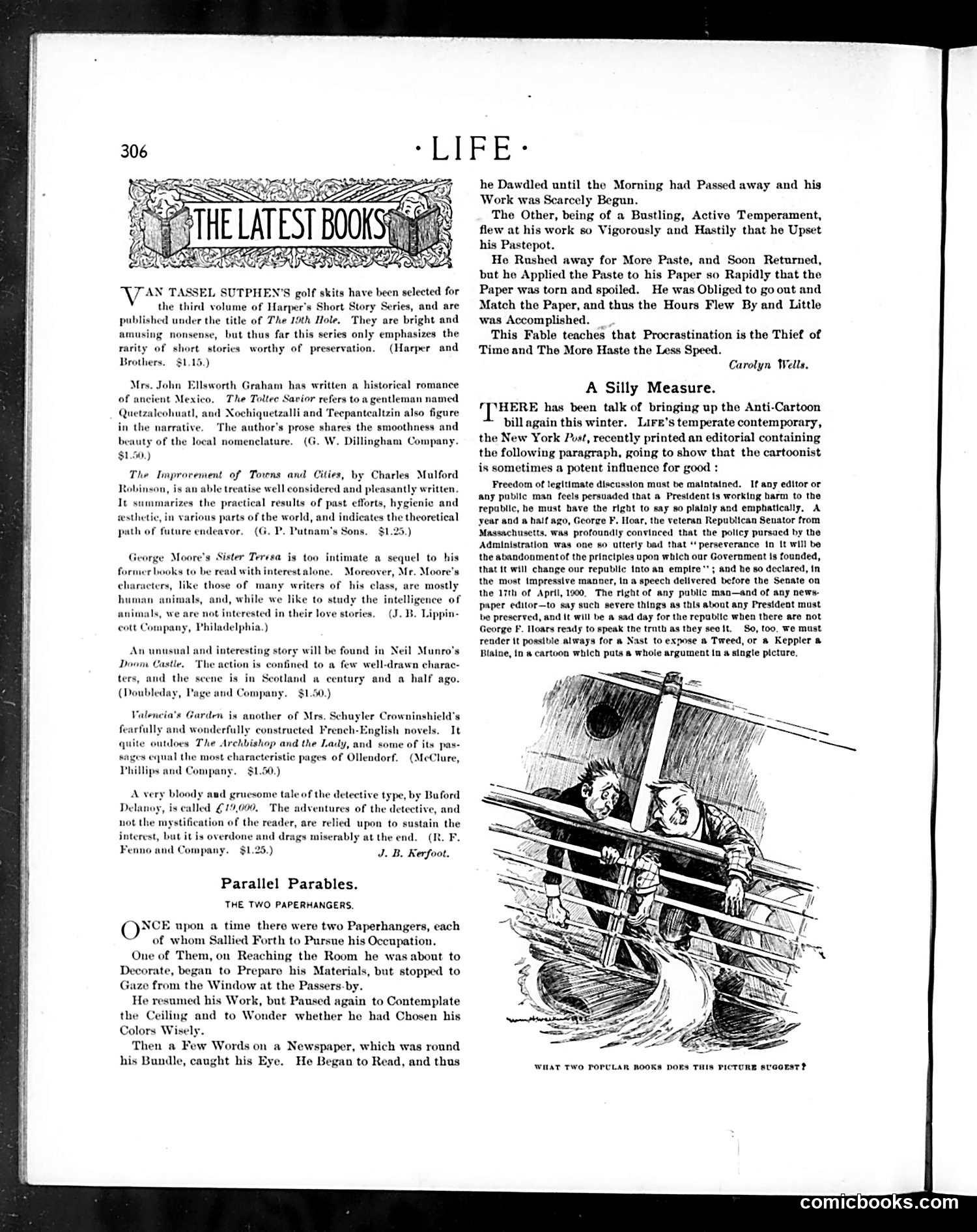
**The Main Cartoon:** The illustration titled "WHAT TWO POPULAR BOOKS DOES THIS PICTURE SUGGEST?" shows two figures sitting on a wooden beam or rafter, appearing to be in a precarious position. This is a visual riddle rather than political satire. The cartoon plays on the titles of contemporary popular books—likely referencing titles about danger, balance, or difficult situations. Without identifying the specific books referenced, the joke relies on readers recognizing how the visual scenario (two people perched precariously) connects to well-known book titles of the era. **The Surrounding Content:** The page primarily features book reviews under "THE LATEST BOOKS," discussing various contemporary novels and stories published by Harper and Brothers and other publishers. "A Silly Measure" discusses editorial freedom regarding cartoons.
📄 Transcribed text from this page (OCR, searchable)
Machine-transcribed from the original scan — historical spelling and the odd misread are preserved.
“VAN TASSEL SUTPHEN'S golf skits have been selected for the third volume of Harper's Short Story Series, and are published under the title of The 19th Hole, They are bright and amusing nonsense, but thus far this series only emphasizes the rarity of short stories worthy of preservation. (Harper and Brothers. $1.15.) Mrs. John Ellsworth Graham has written a historical romance of ancient Mexico. The Toltee Savior refers to a gentleman named Quetzalcohuatl, and Nochiquetzalli and Tecpantealtzin also figure in the narrative. ‘The author's prose shares the smoothness and beauty of the local nomenclature. (G. W. Dillingham Company. $1.50.) The Improvement of Towns and Cities, by Charles Mulford Robinson, is an able treatise well considered and pleasantly written. es the practical results of past efforts, hygienic and ts of the world, and indicates the theoretical path of future endeavor. (G.P. Putnam's Sons. $1 Tt summari arious p : Moore's Sister Teresa is too intimate a sequel to his chooks to be read with interest alone. Moreover, Mr. Moore's characters, like those of many writers of his class, are mostly n animals, and, while we like to study the intelligence of are not interested in their love stories, (J.B. Lippin- Philadelphia.) An unusual and interesting story will be found in Neil Munro's Doom Castle, The action is confined to a few well-drawn charac- ene is in Seotland a century and a half ago. ge aan $1.50.) ters, and the (Doubleday, Company. Valencia's Garden is another of Mrs. Schuyler Crowninshield’s fearfully and wonderfully constructed French-English novels. It utdoes The Archbishop and the Lady, and some of its pas- the most characteristic pages of Ollendorf. (McClure, Hips and Company, $1.50.) A very bloody aud gruesome tale of the detective type, by Buford is called £19,000, The adventures of the detective, and mystification of the reader, are relied upon to sustain the interest, but it is overdone and drags miserably at the end. (It. F. Fenno and pany. $1.25.) J.B. Kerfoot. Parallel Parables. THE TWO PAPERHANGERS. CSCE upon a time thero were two Paperhangers, cach of whom Sallied Forth to Pursue his Occupation. One of Them, on Reaching the Room he was about to Decorate, began to Prepare his Materials, but stopped to Gaze from the Window at the Passers-by. He resumed his Work, but Paused again to Contemplate the Ceiling and to Wonder whether he had Chosen his Colors Wi Then a Few Words on a Newspaper, which was round his Bundle, caught his Eye. He Began to Read, and thus he Dawdled until the Morning had Passed away and his Work was Scarcely Begun. The Other, being of a Bustling, Active Temperament, flew at his work so Vigorously and Hastily that he Upset his Pastepot. He Rushed away for More Paste, and Soon Returned, but he Applied the Paste to his Paper so Rapidly that the Paper was torn and spoiled. He was Obliged to go out and Match the Paper, and thus the Hours Flew By and Little was Accomplished. This Fable teaches that Procrastination is the Thief of Time and The More Haste the Less Speed. Carolyn Wells. A Silly Measure. [HERE has been talk of bringing up the Anti-Cartoon bill again this winter. Lire’s temperate contemporary, the New York Post, recently printed an editorial containing the following paragraph, going to show that the cartoonist is sometimes a potent influence for good : Freedom of tegitimate discussion must be matntatned. If any editor or Any pablic man feels persuaded that a President is working harm to the Tepablic, he must have the right to say so plalaly and emphatically. A year and a half ago, George F. Hoar, the veteran Republican Senator from Massachusetts, was profoundly convinced that the policy pursaed by the Administration was one so utterly bad that “perseverance in {t will be the abandonmentof the principles upon which our Government is founded, that ft will change our republic into an empire"; and he so declared, in the most Impressive manner, Ina speech delivered before the Senate on the 17th of April, 1900, The right of any public man—and of any news- Paper editor—to say such severe things as this about any President must be preserved, and It will be @ sad day for the republic when there are not George F. Hoars reads to speak the truth as they see ft, So, too. we must render tt possible always for a Nast to expose a Tweed, or a Keppler a Blaine, in # cartoon which puts ® whole argument In a single picture, WHAT TWO POPULAR BOOKS DORS THIS PICTURE SUGGEST? comicbooks.com