
A complete issue · 20 pages · 1901
Life — August 22, 1901
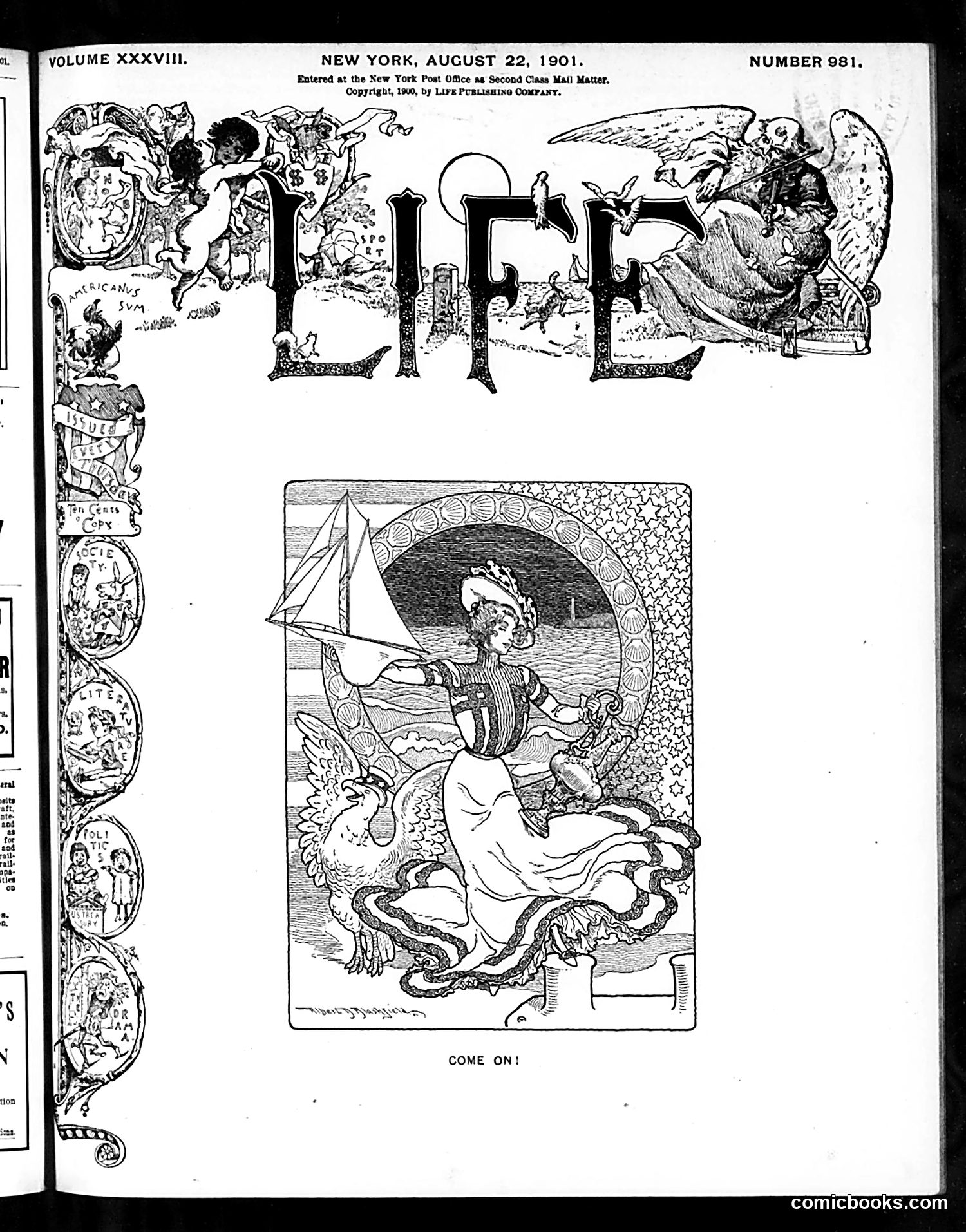
This is the cover of Life magazine (Volume XXXVIII, Number 981), featuring elaborate Art Nouveau decorative typography spelling "LIFE" with fantastical creatures and cherubs integrated into the letters. The main cartoon below depicts a classical female figure (likely representing a mythological or allegorical personification) surrounded by serpents, with a sailing ship in the background. The caption reads "COME ON!" The ornate left border contains a vertical strip of small circular vignettes showing various satirical scenes—typical of Life's format for social commentary. Without additional context about 1901 events, the specific satirical meaning remains unclear, though the image suggests commentary on contemporary social or political issues through classical allegory.
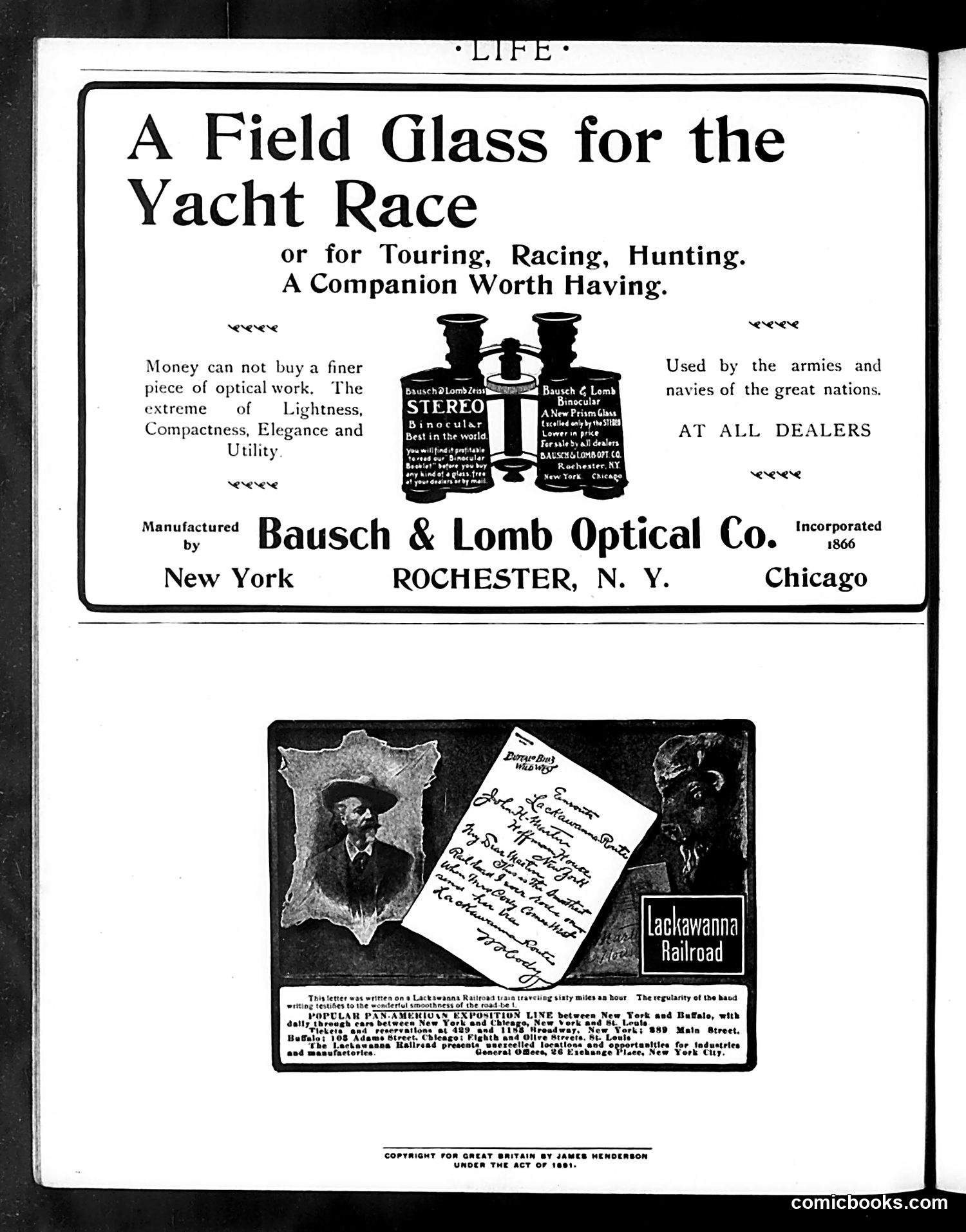
This page is primarily **advertising**, not satire or political content. The top two-thirds features a Bausch & Lomb optical company advertisement promoting field glasses (binoculars) for yacht racing, touring, hunting, and general use. The ad emphasizes the product's quality and notes it's "Used by the armies and navies of the great nations." The lower section contains a separate advertisement for the Lackawanna Railroad, featuring what appears to be a handwritten letter and portrait imagery, promoting their "Popular Pan-American Exposition Line" connecting New York and Buffalo with daily service. Neither advertisement contains political satire or social commentary—both are straightforward product promotions typical of early 20th-century magazine advertising.
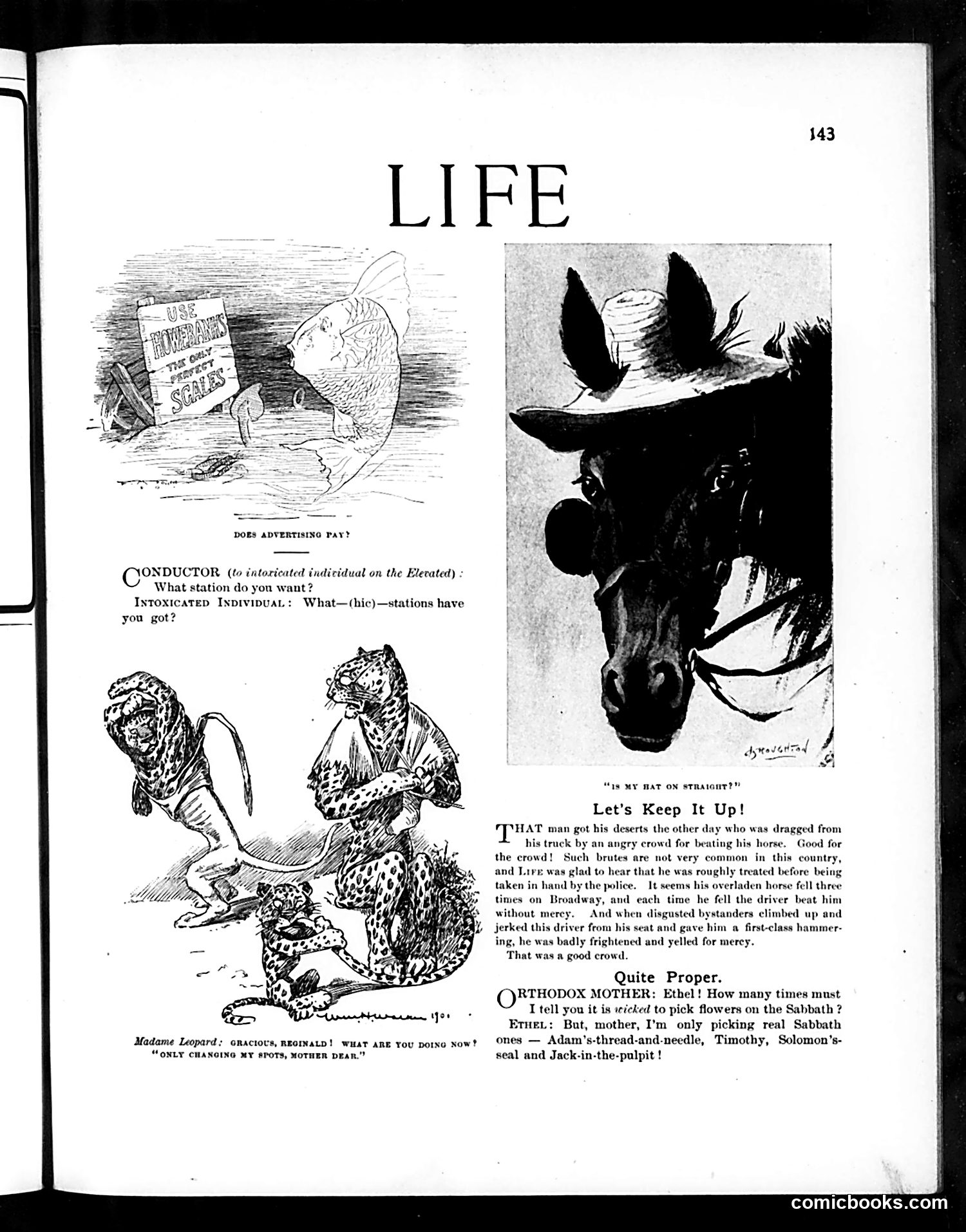
This page contains three separate satirical pieces: 1. **"Does Advertising Pay?"** - A sketch mocking an intoxicated person on the Elevated railway reading an advertisement, with a conductor asking their destination. The joke suggests advertising reaches even incapacitated audiences. 2. **"Let's Keep It Up!"** - A story about a truck driver beaten by an angry crowd for mistreating his horse. The narrative celebrates public intervention against animal cruelty, calling the crowd's response "good" and noting the driver was arrested. 3. **"Quite Proper"** - A humorous dialogue between Orthodox Mother Ethel and her daughter about picking flowers on the Sabbath, with the daughter naming various biblical plants as loopholes. The page reflects early 20th-century American concerns about public behavior, animal welfare, and religious observance.
This page contains social commentary and satirical illustrations typical of Life's editorial content. The main articles discuss labor unions, steel industry trusts, and wealth distribution—issues central to Progressive Era politics. One section mocks the "Steel Trust" and labor leaders' power, suggesting the industry has grown too concentrated. Another passage praises Andrew Carnegie's philanthropy but questions whether his wealth and influence truly benefit society, joking about a "loving-cup" controversy involving Admiral Cervera in Sydney, Australia. The cartoons are small decorative vignettes accompanying the text rather than primary illustrations. The overall tone critiques both monopolistic business practices and questions the genuine impact of wealthy industrialists' charitable gestures—reflecting 1901 anxieties about labor, capitalism, and inequality.
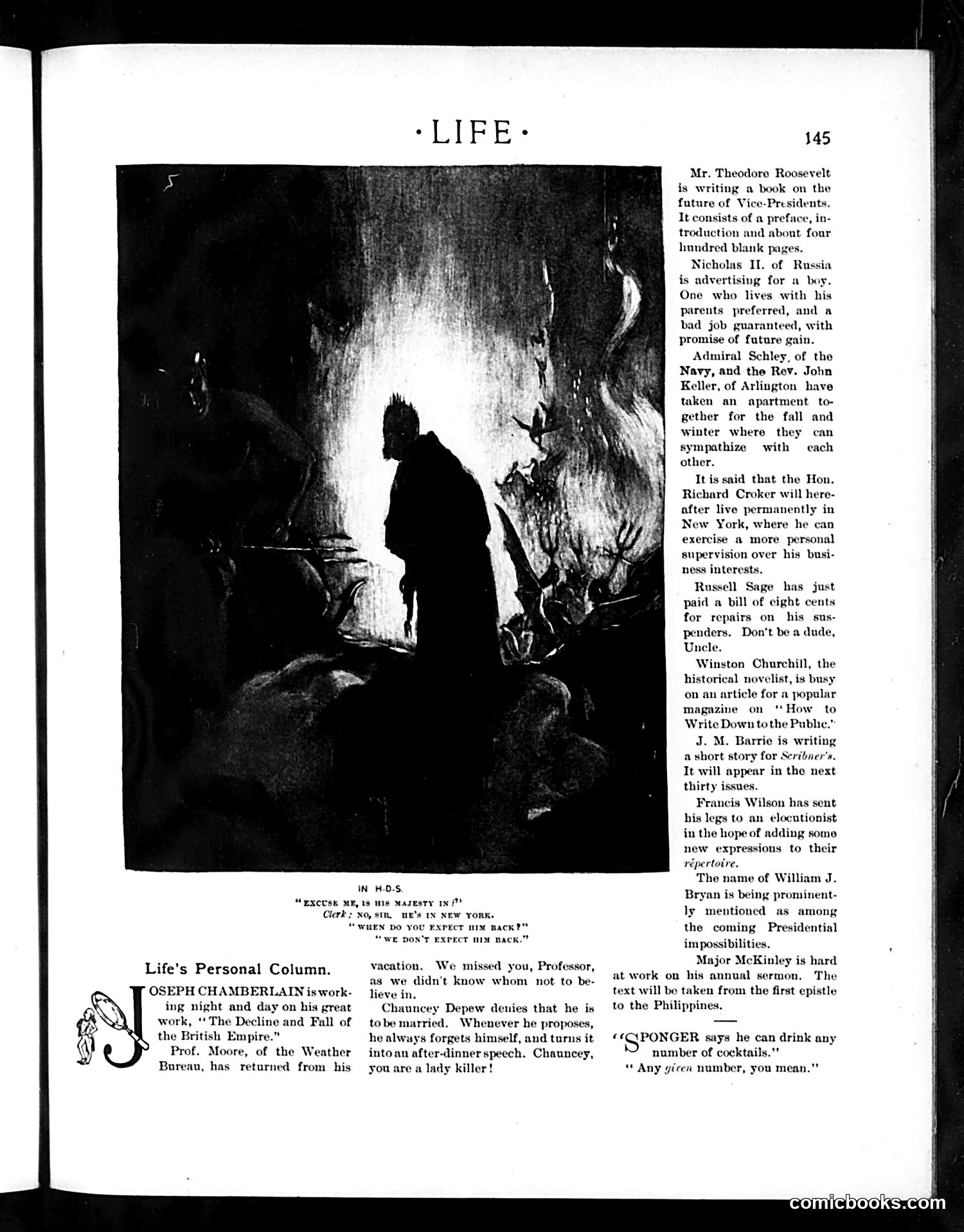
The large illustration depicts a silhouetted figure entering a bright cave or tunnel opening, captioned with dialogue from "H.D.S." The scene appears to be a dramatic theatrical or literary illustration rather than political satire. The right column contains "Life's Personal Column," a gossip section featuring brief items about public figures including Theodore Roosevelt (writing a book), Nicholas II of Russia, Admiral Schley, and others. These are light social commentary rather than satire—recording the activities and rumors of prominent people. The final joke about "Sponger" and drinking "cocktails" is a simple pun about numbers. This page blends theatrical illustration with celebrity gossip, typical of Life's mixed-content format—not primarily focused on political cartoons.
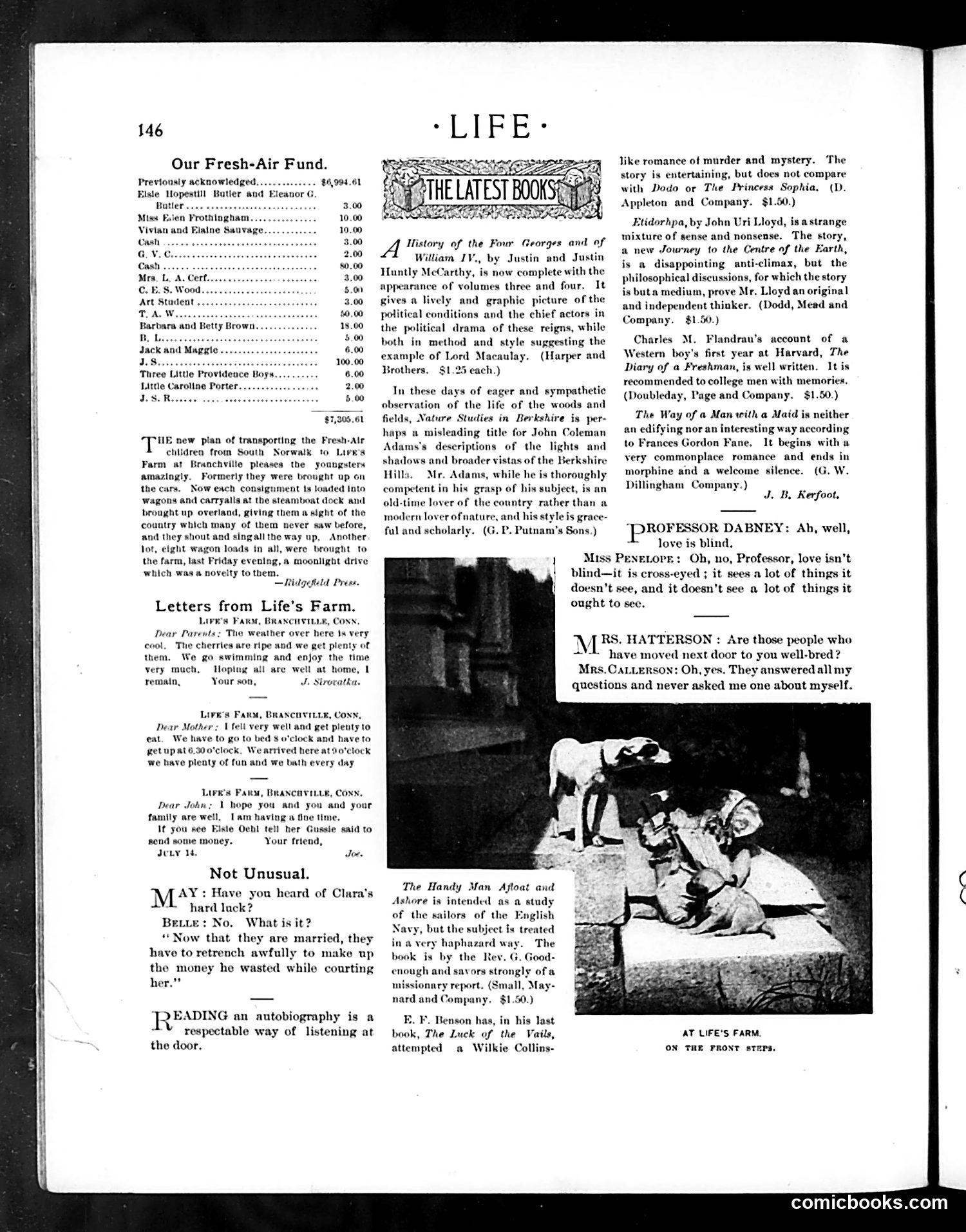
This page contains literary reviews and humor rather than political cartoons. The main illustrated content shows "At Life's Farm on the Front Steps"—a photograph of children playing outdoors, not a political cartoon. The humor section titled "Not Unusual" presents a dialogue joke about a woman named Clara whose "hard luck" requires her married friends to "retrench awfully to make up the money she wasted while courting her." This satirizes the social expectation that friends financially support an unmarried woman's courtship expenses—a satirical jab at both female dependency and social obligation. The page primarily reviews contemporary books about English history, sailors, and other subjects, with book prices and publishers listed. No specific political figures or events are identifiable in the visible content.
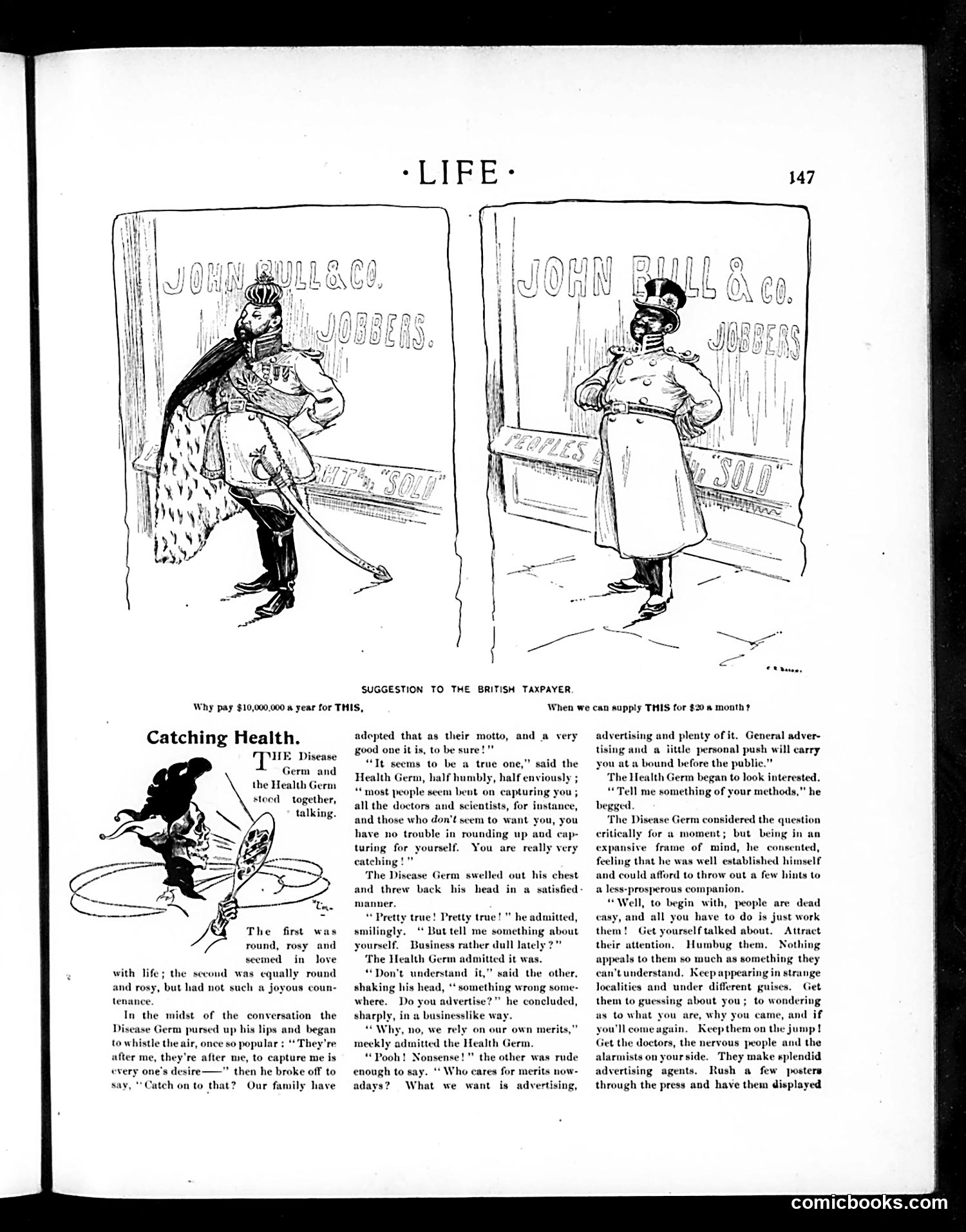
**Top Cartoons:** Two panels showing military/royal figures labeled "John Bull & Co. Jobbers" display merchandise marked "SOLD." The caption reads: "Suggestion to the British Taxpayer: Why pay $10,000,000 a year for THIS, When we can supply THIS for £20 a month?" This satirizes British military spending and procurement—specifically that expensive military positions or contracts could be replaced with cheaper alternatives. "John Bull" represents Britain itself. **Lower Section ("Catching Health"):** A conversation between a Disease Germ and a Health Germ debating advertising methods. The Disease Germ argues people readily seek out doctors and medicines (free advertising), while the Health Germ must pay for advertising. This critiques public health advertising strategy—the point being disease naturally attracts attention and medical business, while promoting wellness requires paid promotion.
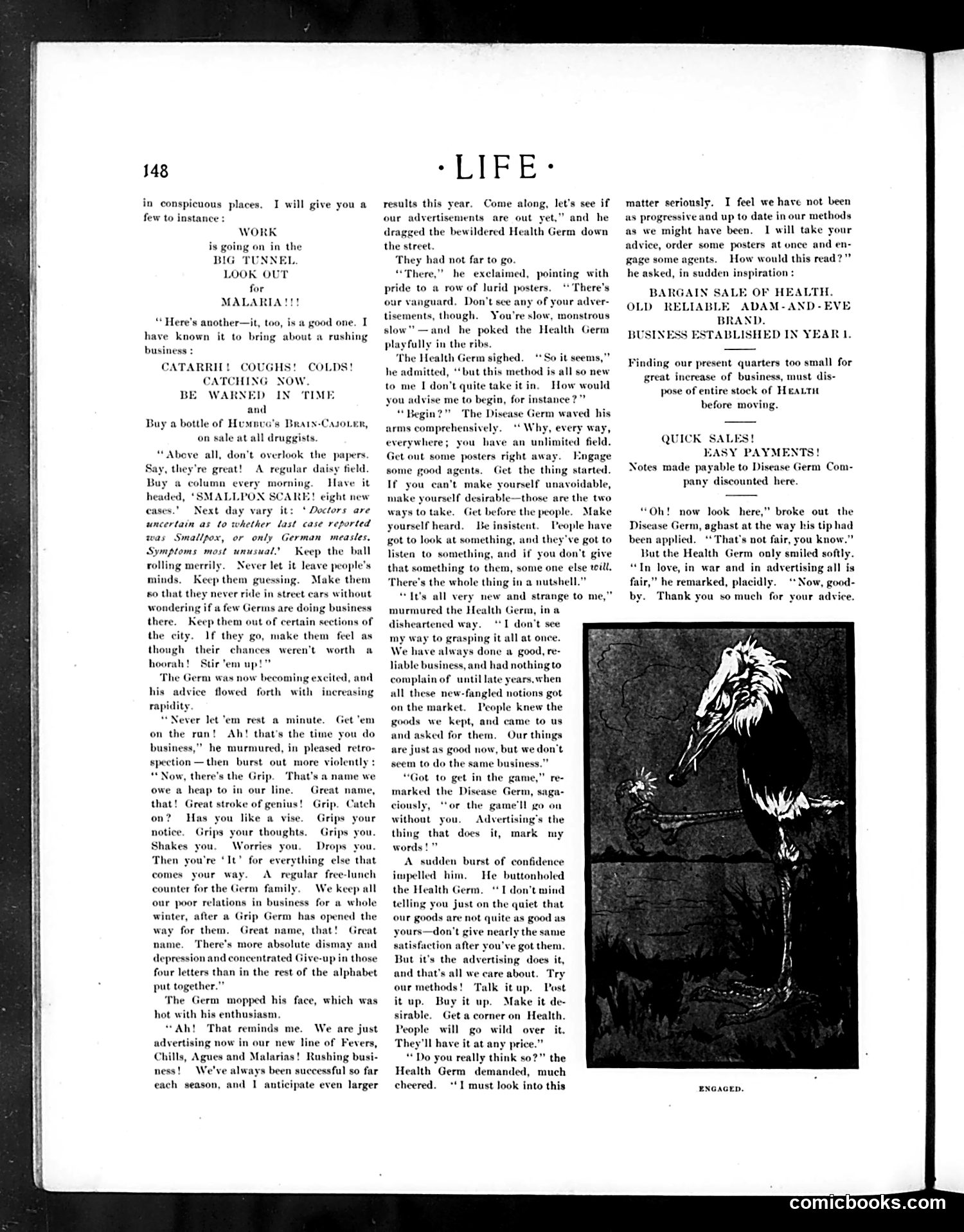
This page features a satirical dialogue between "the Health Germ" and "the Disease Germ"—personified microorganisms debating advertising strategies. The Disease Germ boasts of successful marketing tactics (posters, agents, visibility) that have made their products (fevers, chills, agues, malarias) profitable despite competition. The Health Germ counters that their reliable, established goods need better promotion to compete in an increasingly advertisement-driven marketplace. The cartoon (showing an "engaged" germ) alongside this text satirizes late-19th/early-20th-century advertising culture itself. The joke: diseases spread through effective marketing just as commercial products do. This mocks both the era's aggressive advertising boom and people's vulnerability to promotional manipulation—whether for patent medicines or actual illness.
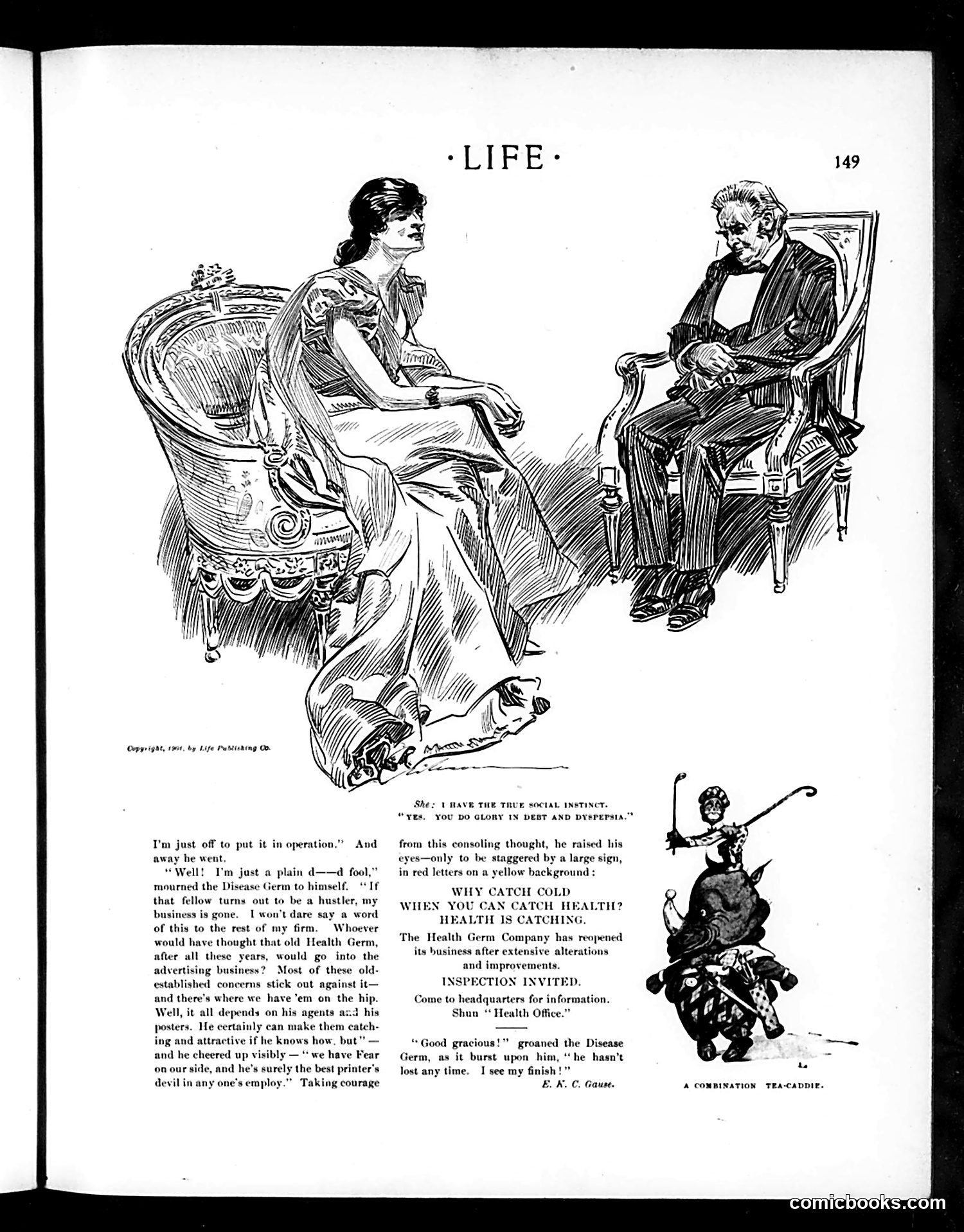
This page contains a satirical comic strip about business and advertising. The main illustration shows a woman with "true social instinct" and a man in conversation. The dialogue concerns a character planning to launch an advertising campaign, boasting he can make anything "catching and attractive" through proper marketing. The satire targets turn-of-the-century advertising hype and snake-oil salesmanship. A sign advertises "Why Catch Cold / When You Can Catch Health?"—mocking exaggerated health product claims. The accompanying illustration of a disease germ character ("A Combination Tea-Caddie") personifies germs as cartoon villains, satirizing the era's emerging germ-theory medicine and how companies exploited public health fears for profit through dubious products and inspection schemes.
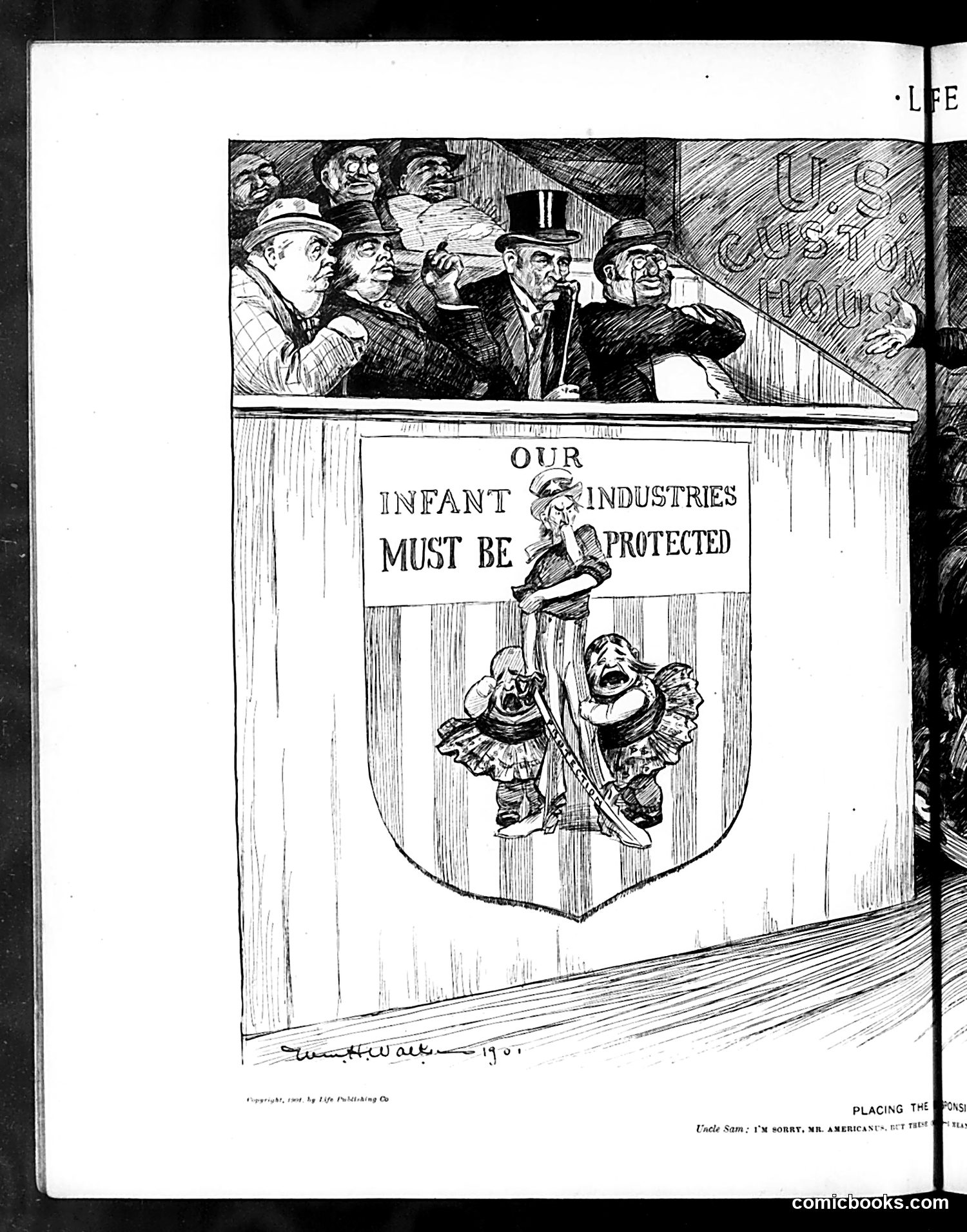
This satirical cartoon from Life magazine (dated 1901, per the signature) critiques protectionist trade policy. The upper panel shows businessmen observing a shield bearing text "OUR INFANT INDUSTRIES MUST BE PROTECTED," beneath which stand two caricatured figures (appearing to represent metaphorical "infant industries"). The satire's point: American industrialists were arguing their businesses needed protective tariffs because they were still "infant industries"—young and vulnerable to foreign competition. By 1901, however, many U.S. industries had grown quite large and mature, making continued claims of infancy absurd. The cartoon mocks this transparent excuse for maintaining high tariffs that benefited wealthy manufacturers while increasing costs for ordinary consumers. The "infants" depicted appear intentionally grotesque, emphasizing how ludicrous the protection argument had become.
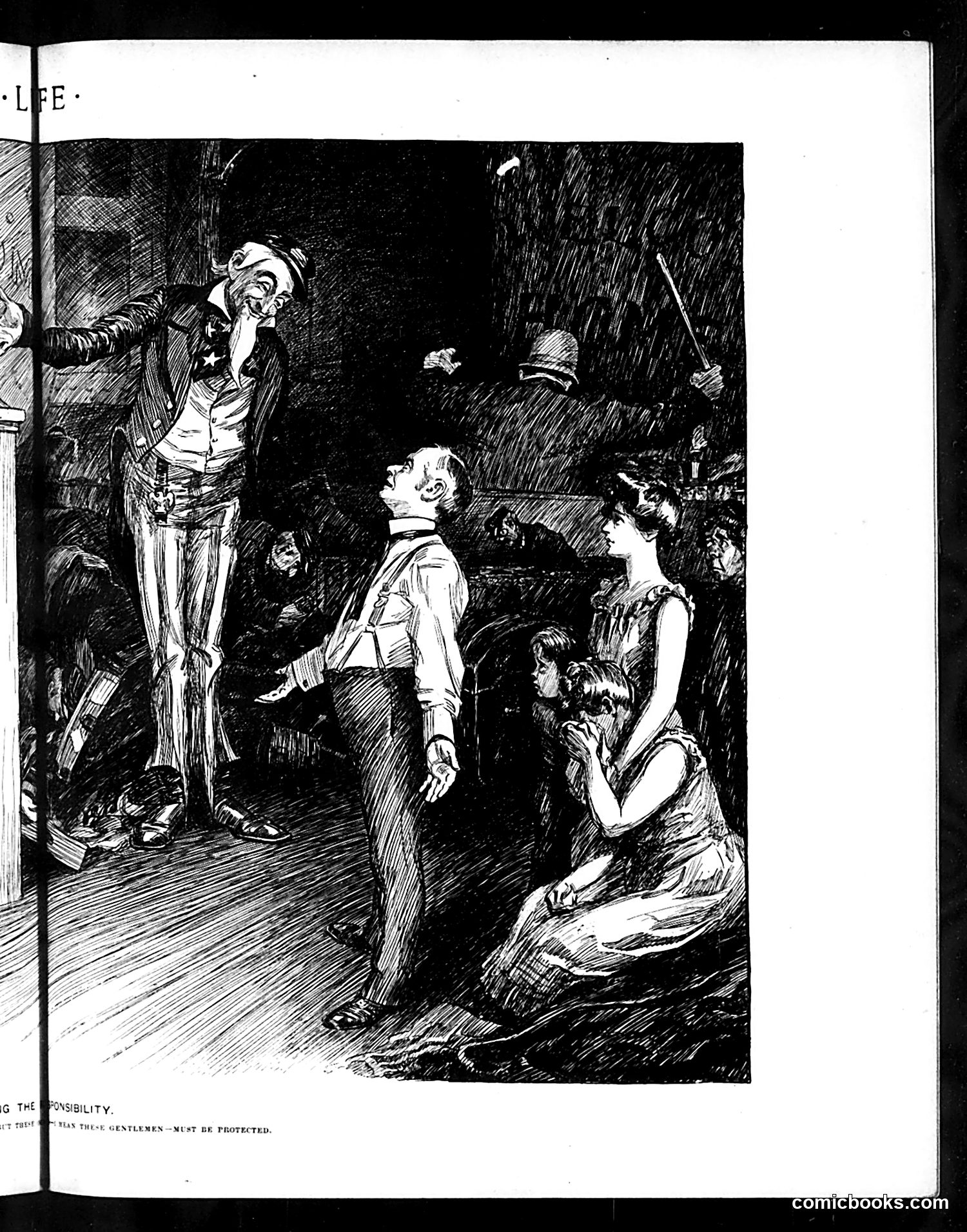
This political cartoon depicts a scene of social commentary, though the exact historical context requires caution. The image shows what appears to be a well-dressed man in formal attire (possibly a politician or authority figure) gesturing toward a group of kneeling or submissive figures, including women and children. The partially visible caption mentions "gentlemen" needing "protection," suggesting satire about paternalism or social inequality. The stark black-and-white illustration style and composition emphasize power dynamics. The "Life" magazine header indicates this is satirical social commentary typical of early-to-mid 20th century American periodicals. However, without clearer text or additional context, I cannot definitively identify the specific political figures or events being mocked. The satire appears to critique either authoritarian governance or hypocrisy in claims of "protection."
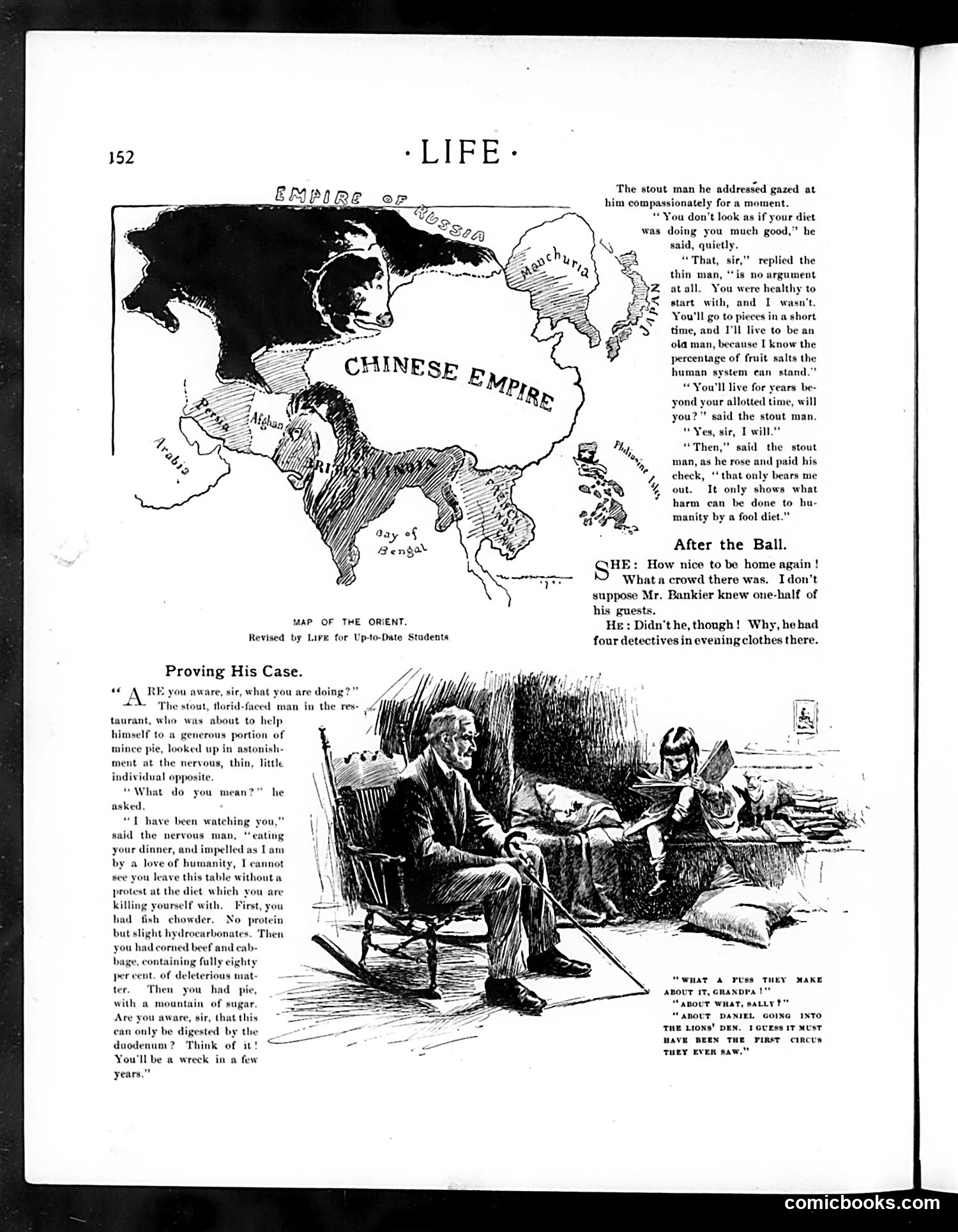
This page satirizes dietary faddism and health pseudoscience. A nervous man confronts a stout restaurant patron, claiming he's been watching the patron's diet and warning that rich foods will kill him. The stout man responds with sarcasm, listing the exact unhealthy foods he's consumed (chocolate, hydrogenates, beef and garlic, pie with sugar) and noting he's thrived for years. The satire targets dietary zealots who make unsolicited health pronouncements based on pseudoscientific claims about food digestion. The irony: the "healthy" nervous man appears sickly while the indulgent stout man remains robust, undermining the dietary moralist's argument. The accompanying map and "After the Ball" dialogue suggest broader commentary on Oriental affairs and social pretense.
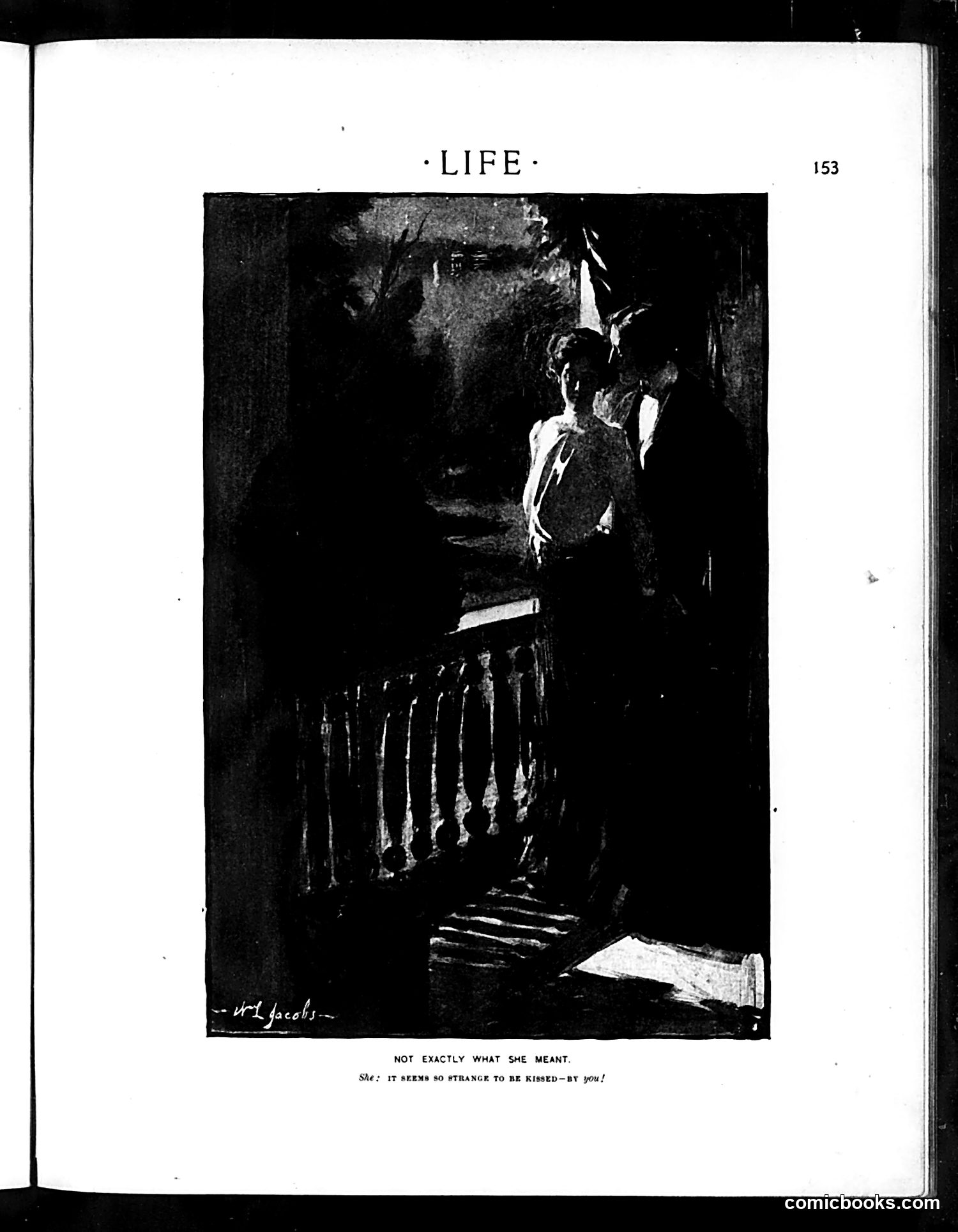
This is a single-panel comic illustration signed by Wm. Jacobs showing a romantic scene on what appears to be a balcony or terrace at night. A couple is depicted in an intimate moment near a decorative railing. The joke's humor derives from the woman's ambiguous statement: "It seems so strange to be kissed—by you!" This could mean either (1) she finds it odd/unexpected that *he* specifically is kissing her, implying doubt about their relationship, or (2) she meant to say something flattering but her phrasing came across as insulting instead—hence the caption "NOT EXACTLY WHAT SHE MEANT." The satire plays on miscommunication and unintended insults in romantic situations, a common theme in early 20th-century Life magazine humor about courtship and relationships. The dark, atmospheric illustration emphasizes the awkward romantic moment.
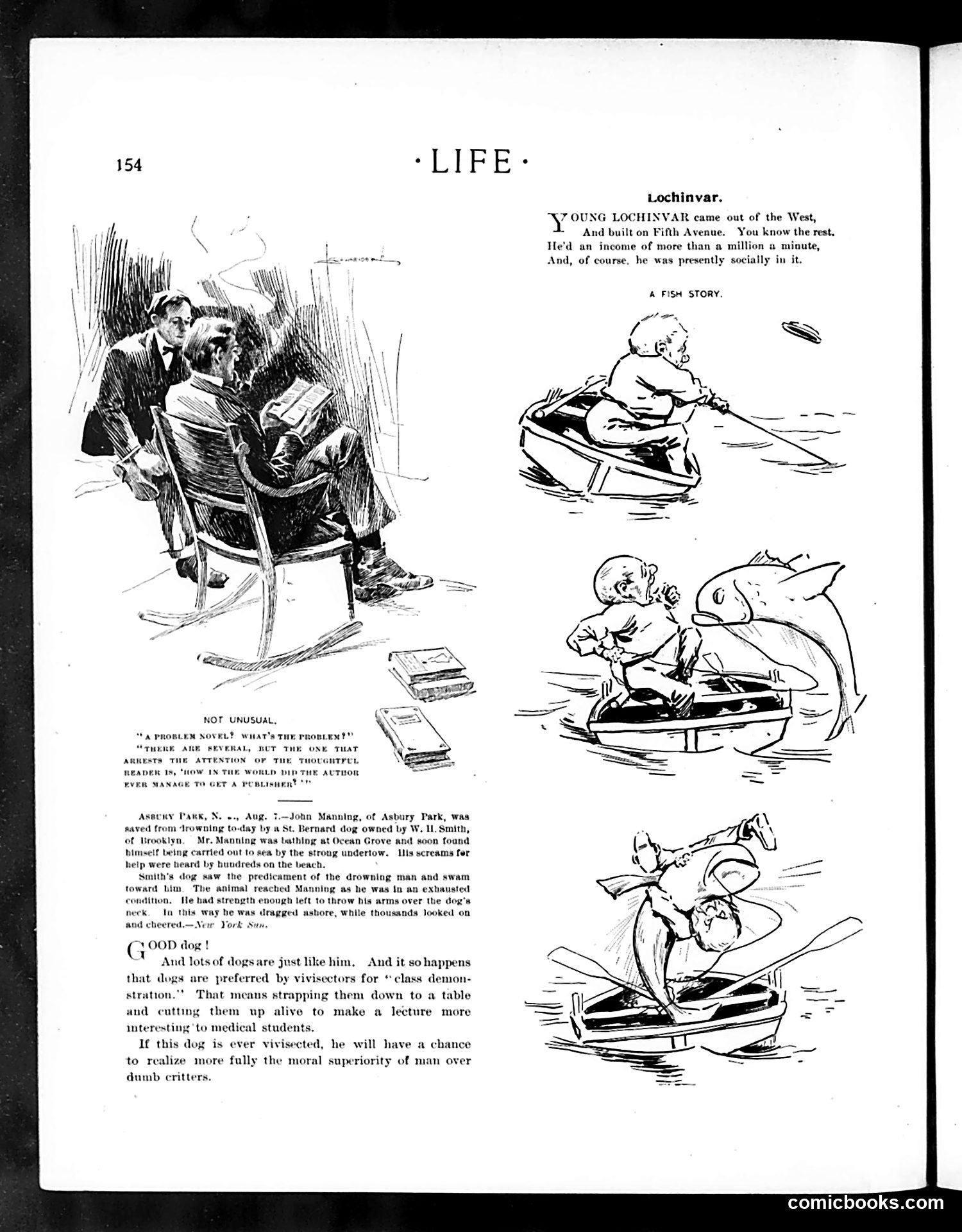
**The Main Cartoon (left):** Satirizes publishing industry gatekeeping. Two men discuss "a problem novel" with stacks of rejected manuscripts on the floor, mocking how difficult it is for authors to get published despite writing books that "arrest the attention of the thoughtful reader." **"A Fish Story" (right):** A series of sketches depicting a child's tall tale about catching increasingly enormous fish, satirizing children's exaggerated storytelling. **The Dog Commentary (center):** Uses a news story about a St. Bernard rescuing a drowning man to critique **vivisection**—the practice of cutting up live animals for medical education. The satire argues that if this heroic dog were later used in medical demonstrations (a common practice then), it would demonstrate humanity's moral hypocrisy: we praise animals for loyalty while abusing them in the name of science. **"Lochinvar" (top right):** A brief mockery of wealthy Western nouveaux riches who build mansions on Fifth Avenue and quickly gain social acceptance through money alone.
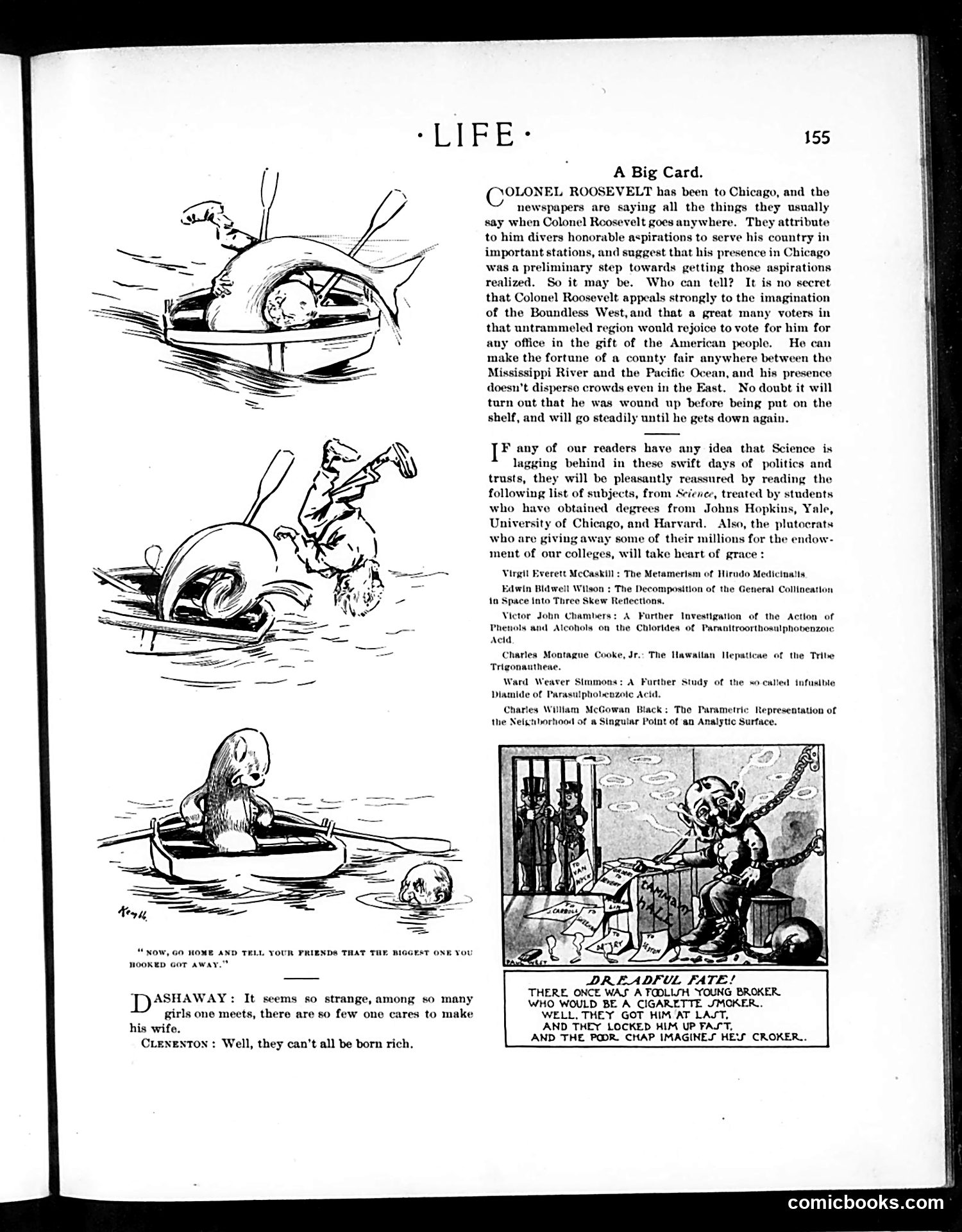
**"A Big Card" Article:** This piece satirizes Colonel Theodore Roosevelt's visit to Chicago. The text mocks how newspapers breathlessly report Roosevelt's movements, attributing grand political aspirations to him. Life suggests Roosevelt has such broad appeal—especially in the West—that he could win elected office to virtually any position. The satire implies Roosevelt is being "wound up" like a toy and will continue his political ascent inevitably. The article's tone is gently mocking of the press's Roosevelt obsession and voters' eagerness to promote him. **Fish Cartoons (left):** Three sequential cartoons show anthropomorphic fish in boats, appearing to depict fishermen's catches or escapes. The caption references "the biggest one you hooked got away," suggesting commentary on missed opportunities or elusive goals—likely a fishing metaphor for political ambitions. **"Dreadful Fate" Comic (bottom right):** A crude narrative comic shows a young broker caught and locked up, apparently by someone's family. The dialogue suggests vigilante justice against the broker—humorous social commentary on financial predators or seduction narratives common to period comics.
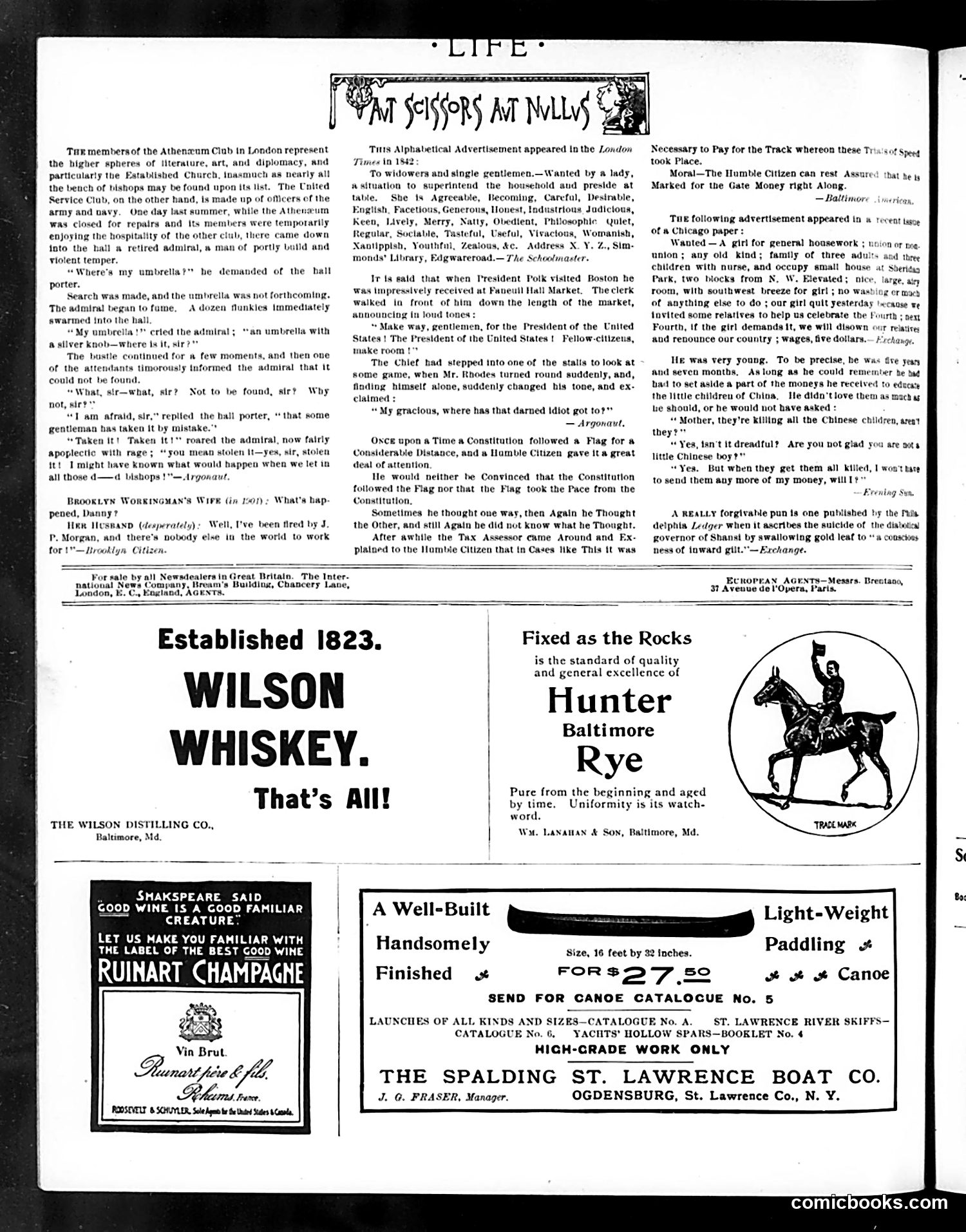
This is primarily an **advertising page** with three satirical anecdotes interspersed. The main cartoons/jokes are: 1. **The Admiral's Umbrella**: A retired British naval officer demands his lost umbrella at a club, then erupts when told it's missing—blaming the "bishops" (educated, refined clergy members). The satire mocks both the admiral's violent temper and class prejudices, stereotyping clergy as thieves. 2. **Brooklyn Workman**: A man fired by J.P. Morgan (the famous industrialist/banker) despairs that no one else exists to employ him—satirizing Morgan's monopolistic power over American business. 3. **The Humble Citizen**: An allegorical tale where a citizen confused about whether the Constitution or Flag has priority must pay taxes regardless—satirizing government indifference to citizens' philosophical concerns. The advertisements promote Wilson Whiskey (established 1823), Hunter Baltimore Rye, Ruinart Champagne, and Spalding canoes. The page reflects early-20th-century American satirical humor targeting class distinctions, corporate power, and bureaucratic absurdity.
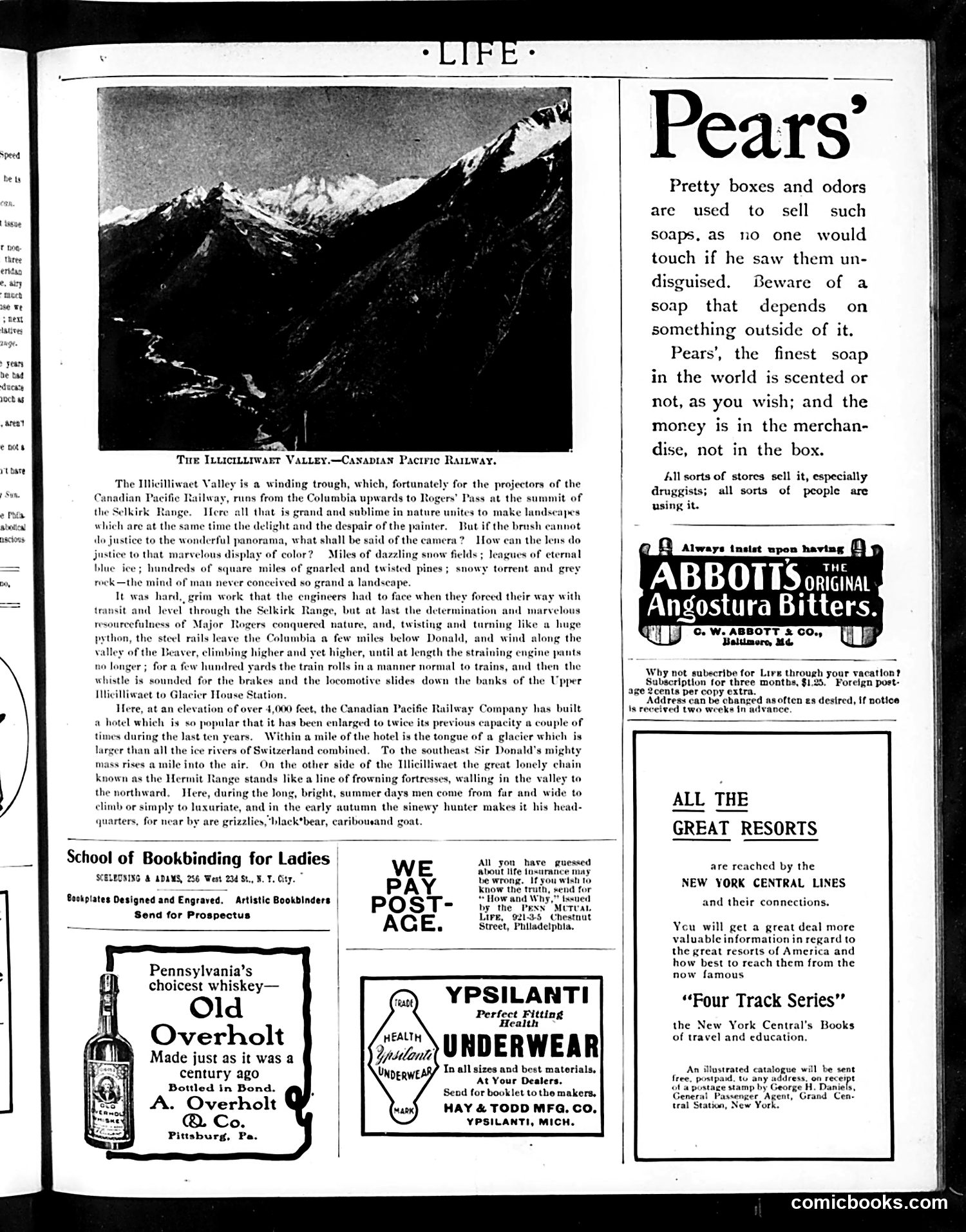
This is primarily an **advertising and travel feature page**, not a political cartoon. The main content is a travel article about the **Illicilliwaet Valley** on the Canadian Pacific Railway, celebrating the dramatic mountain scenery of the Selkirk Range in British Columbia. It emphasizes the engineering achievement of routing train tracks through this landscape and promotes Glacier House, a luxury hotel built by the railroad. The surrounding advertisements are typical of the era: **Pears' soap** mockingly boasts that its quality speaks for itself (not relying on fancy packaging); **Old Overholt whiskey** advertises Pennsylvania craftsmanship; **Ypsilanti underwear** promotes practical clothing; and the **New York Central Lines** advertises resort access. There is **no political satire** on this page. It represents straightforward commercial promotion and promotional travel journalism—common Life magazine content showcasing American business expansion and leisure culture in the early 1900s.
This page is primarily **advertising and miscellaneous content** rather than political satire. The main elements are: **"Our Foolish Contemporaries" section** (top left): Brief satirical anecdotes mocking social pretension—including a woman claiming actresses didn't exist in Shakespeare's era, and a joke about a failed novelist unable to hold office work. **Advertisements**: The page features multiple liquor ads (Trimble Whiskey, Lipton's Irish Whiskey) and a hotel advertisement for The Inn in Ridgefield, Connecticut. These ads use period marketing language emphasizing quality and exclusivity. **The cartoon itself** is minimal—mostly the anecdotes lack visual illustration beyond small vignettes. The satire targets everyday social foolishness rather than specific political figures or events. **Context for modern readers**: This reflects early 1900s Life magazine's mix of light social humor and advertising, targeting middle-class readers with disposable income. The "foolish contemporaries" format was typical satirical commentary on affectation and pretense in polite society.
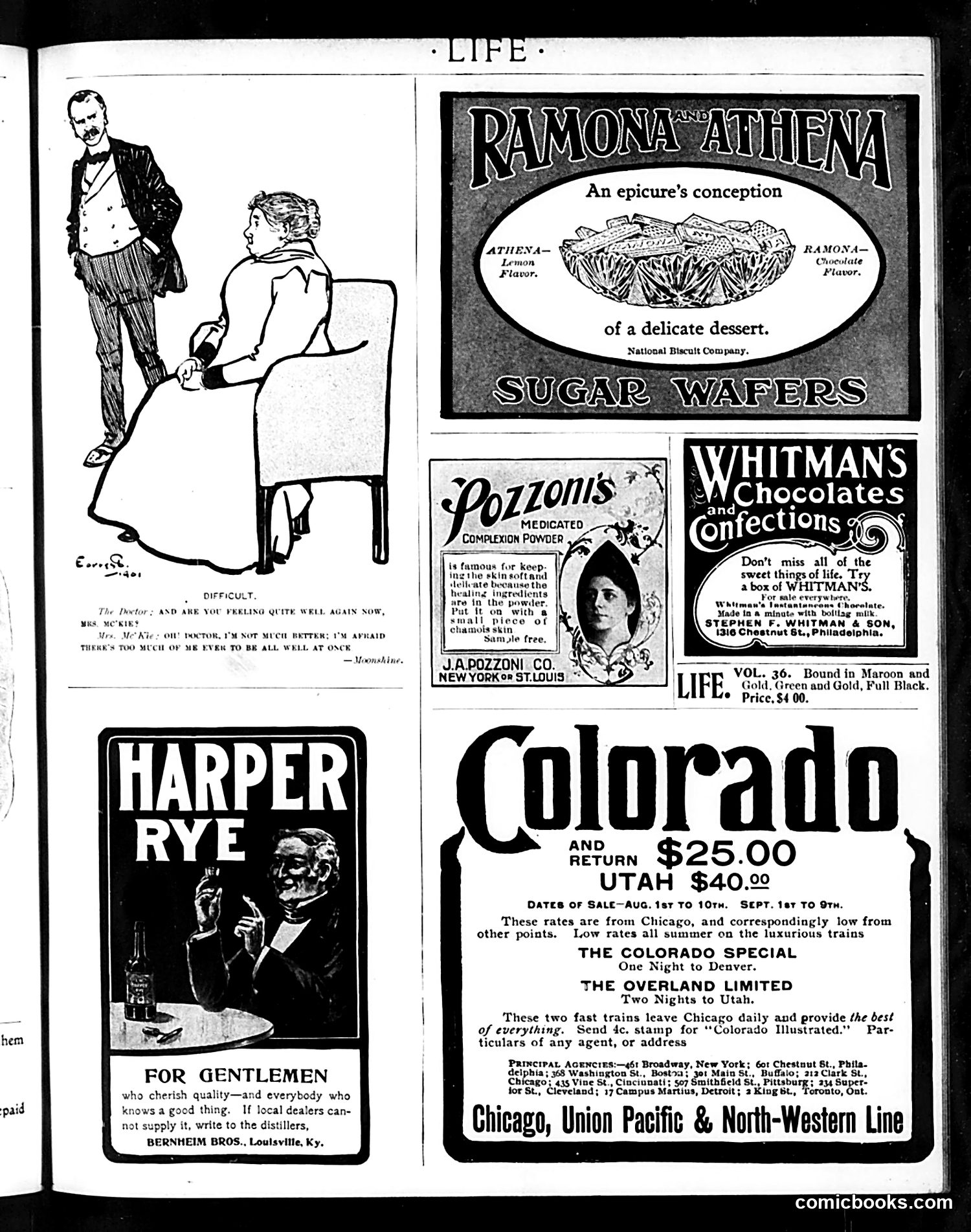
This page is primarily **advertising** from an early 20th-century *Life* magazine, with one small cartoon. The cartoon (upper left) depicts a doctor and patient. The patient complains he's "not much better" and fears "there's too much of me ever to be all well at once"—a joke about a portly, overweight man whose bulk makes complete health impossible. The humor relies on body-shaming and the stereotype that obesity is inherently ridiculous. The rest of the page contains period advertisements: Ramona Athena sugar wafers, Pozzoni complexion powder, Whitman's chocolates, Harper Rye whiskey, and railroad travel ads to Colorado and Utah. These ads reflect early 1900s consumer culture and marketing tactics targeting gentlemen (whiskey) and women (complexion products, chocolates). The magazine itself cost $4.00 bound annually.
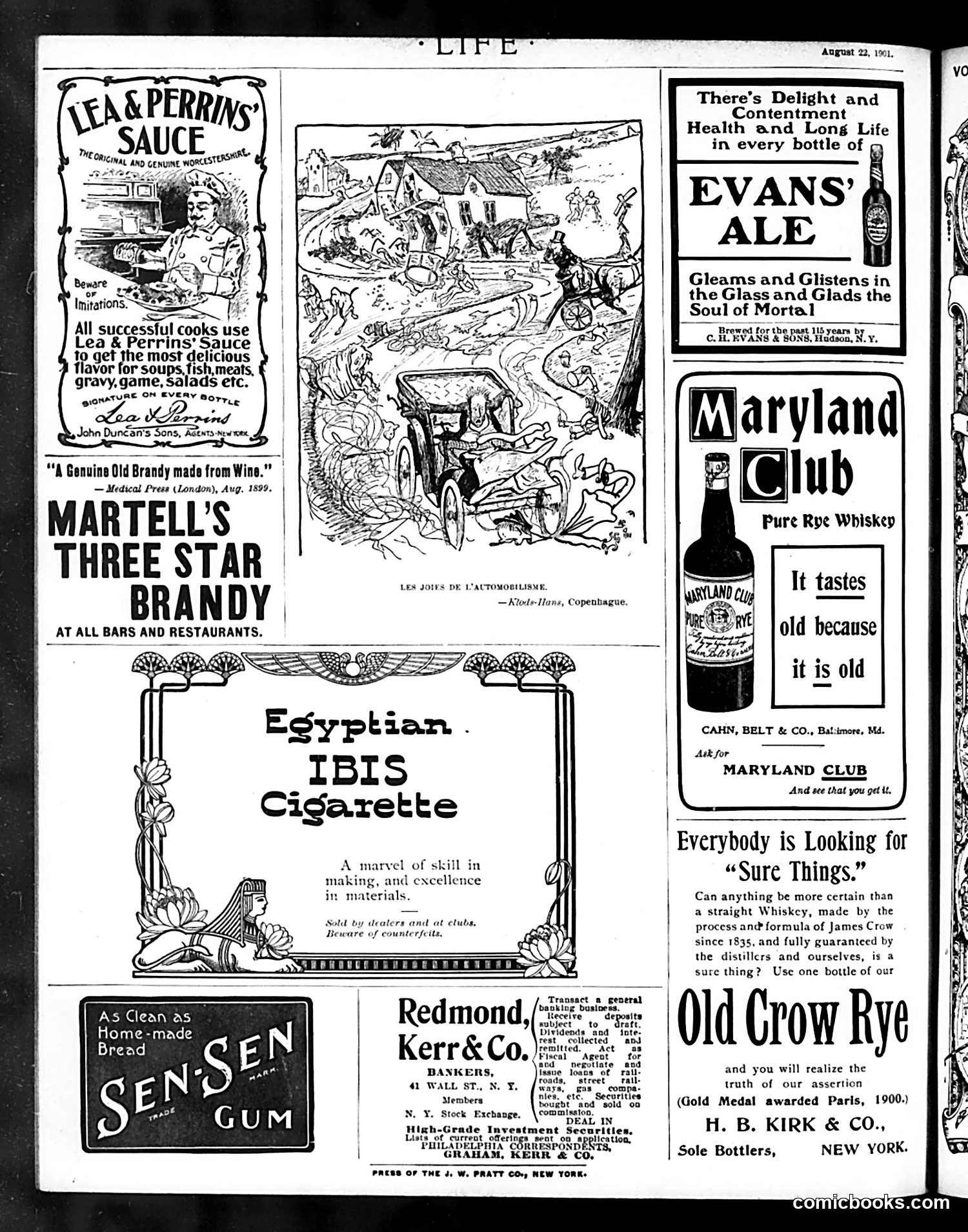
This page is primarily **advertising**, not political satire. The central image—a detailed sketch titled "Les Joins de l'Automobilisme" (The Joys of Automobiling) from Copenhagen—depicts early motorcar chaos: vehicles colliding, pedestrians fleeing, horses startled. It satirizes the **novelty and danger of automobiles** in this era, when motor vehicles were still rare and caused public alarm. The surrounding advertisements promote period products: Lea & Perrins' Sauce, Martell's Brandy, Egyptian Ibis cigarettes, Sen-Sen gum, and various whiskeys (Evans' Ale, Maryland Club, Old Crow Rye). These ads emphasize quality, tradition, and health benefits—typical marketing claims of 1901. The banking advertisement for Redmond, Kerr & Co. represents standard financial services messaging. **The automobile cartoon is the page's only satirical content**, mocking the disruption caused by this emerging technology to Victorian urban life.