
Life, 1901-08-22 · page 4 of 20
Life — August 22, 1901 — page 4: what you’re looking at
What you’re looking at
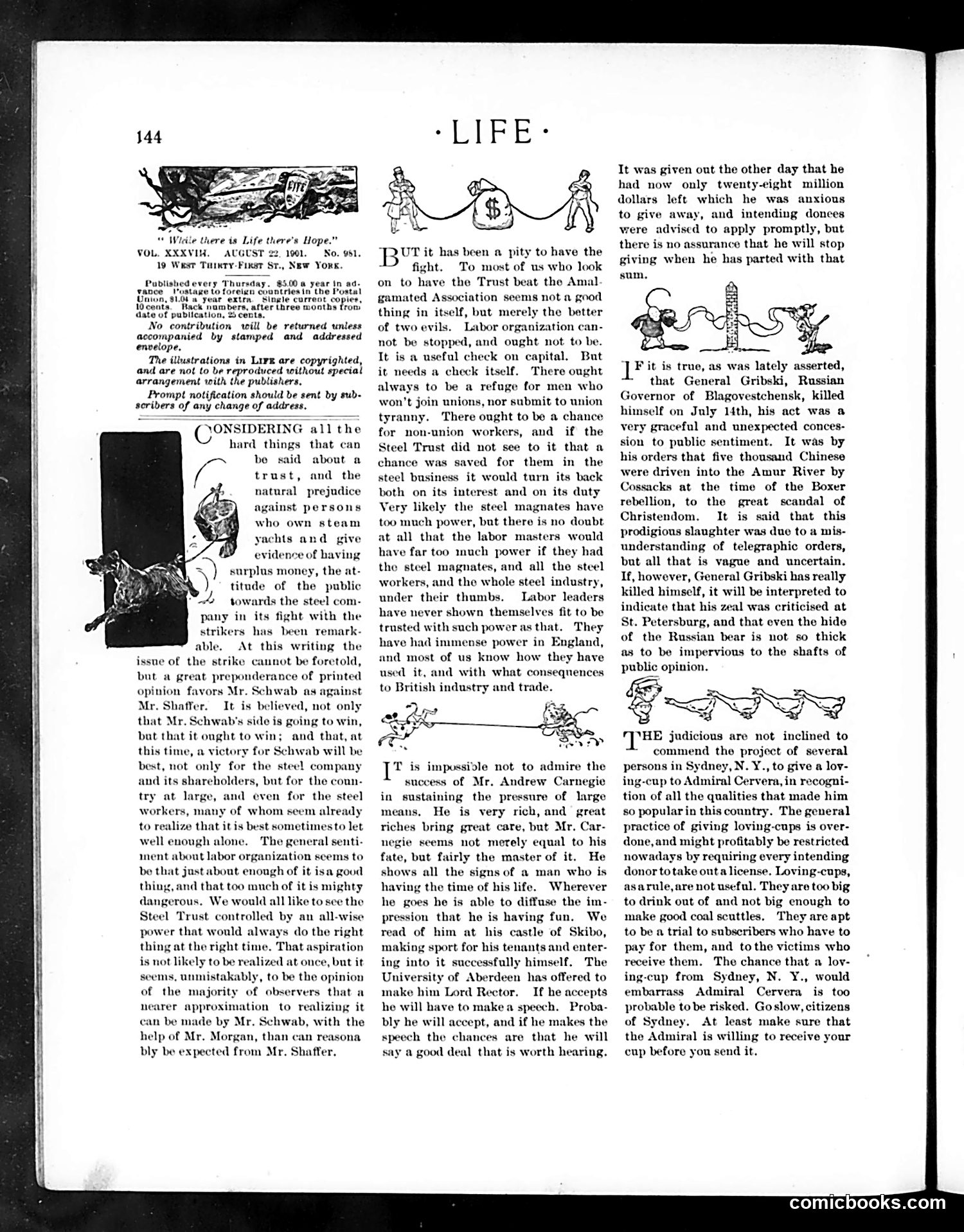
This page contains social commentary and satirical illustrations typical of Life's editorial content. The main articles discuss labor unions, steel industry trusts, and wealth distribution—issues central to Progressive Era politics. One section mocks the "Steel Trust" and labor leaders' power, suggesting the industry has grown too concentrated. Another passage praises Andrew Carnegie's philanthropy but questions whether his wealth and influence truly benefit society, joking about a "loving-cup" controversy involving Admiral Cervera in Sydney, Australia. The cartoons are small decorative vignettes accompanying the text rather than primary illustrations. The overall tone critiques both monopolistic business practices and questions the genuine impact of wealthy industrialists' charitable gestures—reflecting 1901 anxieties about labor, capitalism, and inequality.
📄 Transcribed text from this page (OCR, searchable)
Machine-transcribed from the original scan — historical spelling and the odd misread are preserved.
VOL. XXXVIH. AU! 19 West Tuixry- edevery Thursday. $5.00 a year in ad- vance ustage to foreign countries in the Postal Union, 81.0 a year extra. Single curreot copies, lO cents. “Rack nambers, after three months from date of publication, 3 cents, No contribution will be returned unless accompanied by stamped and addressed envelope. The illustrations in Lire are copyrighted, and are not to be reproduced without special arrangement with the publishers. Prompt notification should be sent by sub- scribers of any change of address, (CONSIDERING allthe hard things that can be said about a trust, and the natural prejudice against persons who own steam chis and give evidence of having surplus money, the at- titude of the public towards the steel com- pany in its fight with the strikers has been remark- able. At this writing the issue of the str cannot be foretold, but a great preponderance of printed opinion favors Mr. Schwab as against Mr. Shaffer. It is believed, not only that Mr. hwab's side is going to win, butt it ought to win; and that, at this time, a victory for Schwab will be best, not only for the steel company and its shareholders, but for the coun- try at large, and even for the steel workers, many of whom seem already to realize that itis best sometimesto let well enough alone. The general senti- ment about labor organization scems to be that just about enough of it isa good thing, and that too much of it is mighty dangerous. We would all like to see the Steel Trust controlled by an all-wise power that would always do the right thing at the right time. That aspiration is not likely to be realized at once, but it seems, unmistakably, to be the opinion of the majority of observers that a nearer approximation to realizing it can be made by Mr. Schwab, with the help of Mr. Morgan, than can reasona bly be expected from Mr. Shaffer. wae Bw it has been a pity to have the - fight. To most of us who look on to have the Trust beat the Amal gamated Association seems not a good thing in itself, but merely the better of two evils. Labor organization can- not be stopped, and ought not to be. It is a useful check on capital, But it needs a check itself. There ought al to be a refuge for men who won't join unions, nor submit to union tyranny. There ought to be a chance for non-union workers, and if the Steel Trust did not see to it that a chance was d for them in the steel busin: it would turn its back both on its interest and on its duty Very likely the steel magnates have too much power, but there is no doubt at all that the labor masters would have far too much power if they had the steel magnates, and all the steel workers, and the whole steel industry, under their thumbs. Labor leaders have never shown themselves fit to be trusted with such power as that. They have had immense power in England, and most of us know how they have used it, and with what consequences to British industry and trade. aw ‘Sry Sey T is impossivle not to admire the success of Mr. Andrew Carnegie in sustaining the pressure of large means, He is very rich, and g riches bring great care, but Mr. Car- negie seems not merely equal to his fate, but fairly the master of it. He shows all the signs of a man who is having the time of his life. Wherever he goes he is able to diffuse the im- pression that he is having fun. We read of him at his castle of Skibo, making sport for his tenants and enter- ing into it successfully himself, The University of Aberdeen has offered to make him Lord Rector. If he accepts he will have to make a speech. Proba- bly he will accept, and if he makes the speech the chances are that he will good deal that is worth hearing. It was given out the other day that he had now only twenty-eight million dollars left which he was anxious to give away, and intending donces were advised to apply promptly, but there is no assurance that he will stop giving when he has parted with that sum, ip* it is true, as was lately asserted, that General Gribski, Russian Governor of Blagovestchensk, killed himself on July 1th, his act was a very graceful and unexpected conces- sion to public sentiment. It was by his orders that five thousand Chinese were driven into the Amur River by Cossacks at the time of the Boxer rebellion, to the great scandal of Christendom. It is said that this prodigious slaughter was due to a mis- understanding of telegraphic orders, but all that is vague and uncertain. If, however, General Gribski has really killed himself, it will be interpreted to indicate that his zeal was criticised at St. Petersburg, and that even the hide of the Russian bear is not so thick as to be impervious to the shafts of public opinion. ipHE judicious are not inclined to commend the project of several persons in Sydney, N. Y., to give a lov- ing-cup to Admiral Cervet n recogni- tion of all the qualities that made him so popular in this country. The general practice of giving loving-cups is over- done, and might profitably be restricted nowadays by requiring every intending donor totake onta license. Loving-cups, asarule,are not useful. They are too big to drink out of and not big enough to make good coal scuttles. They are apt to be a trial to subscribers who have to pay for them, and tothe victims who receive them. The chance that a lov- ing-cup from Sydney, N. Y., would embarrass Admiral Cervera is too probable tobe risked. Goslow, citizens of Sydney. At least make sure that the Admiral is willing to receive your cup before you send it. comicbooks.com