
A complete issue · 20 pages · 1901
Life — August 1, 1901
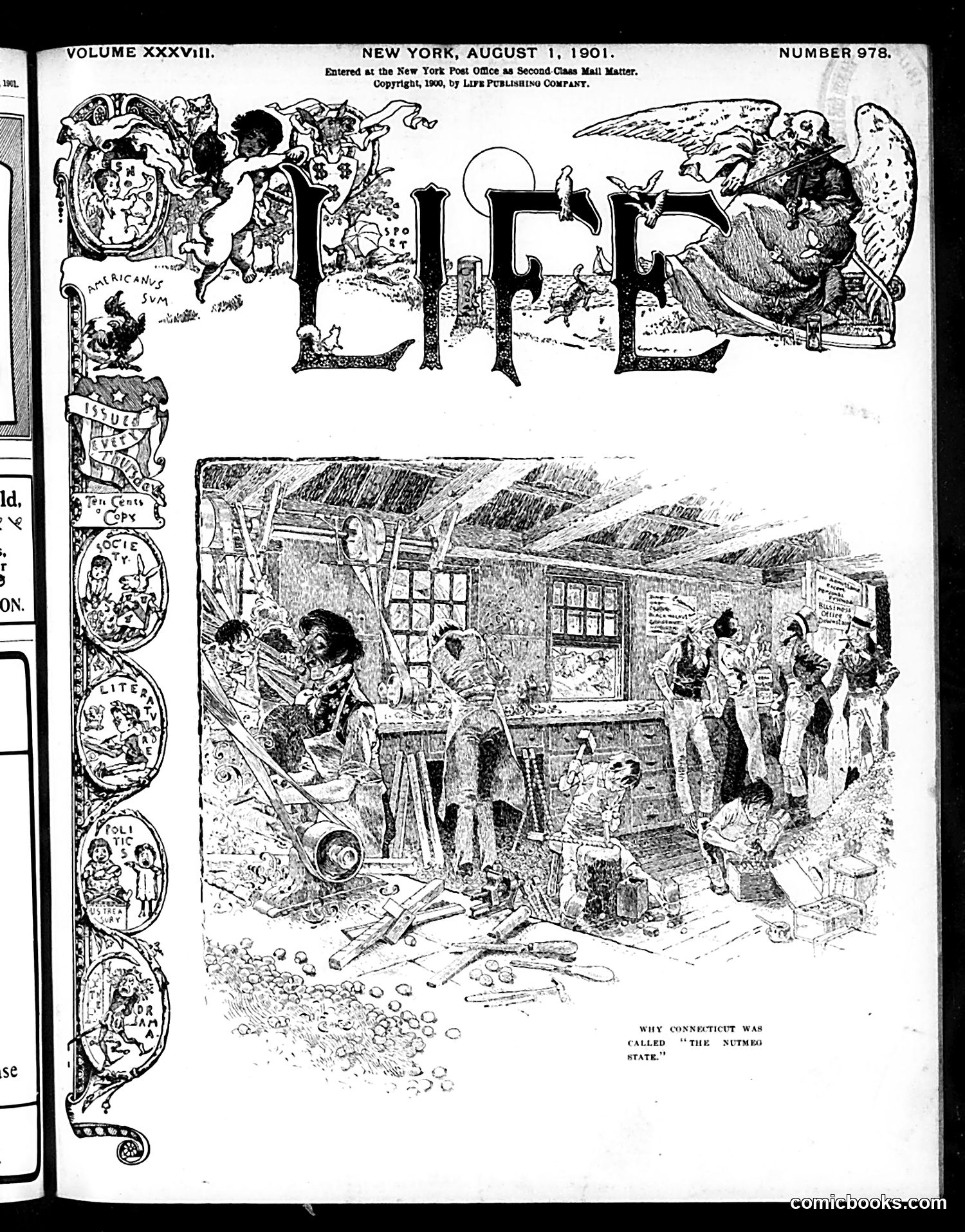
The main illustration depicts a chaotic workshop or factory scene titled "Why Connecticut Was Called 'The Nutmeg State.'" The satire references Connecticut's historical reputation for producing nutmeg—though the image shows what appears to be a workshop full of workers and tools in disarray, suggesting the manufacture of counterfeit or fraudulent goods rather than legitimate spice production. The caption's humor likely plays on Connecticut's actual nickname, derived from the spice trade, while the visual chaos suggests either poor working conditions, fraudulent manufacturing practices, or general industrial disorder. The decorative header and side panels are typical of Life's ornamental design conventions. The specific historical or political context of this particular criticism remains unclear without additional contemporary sources.
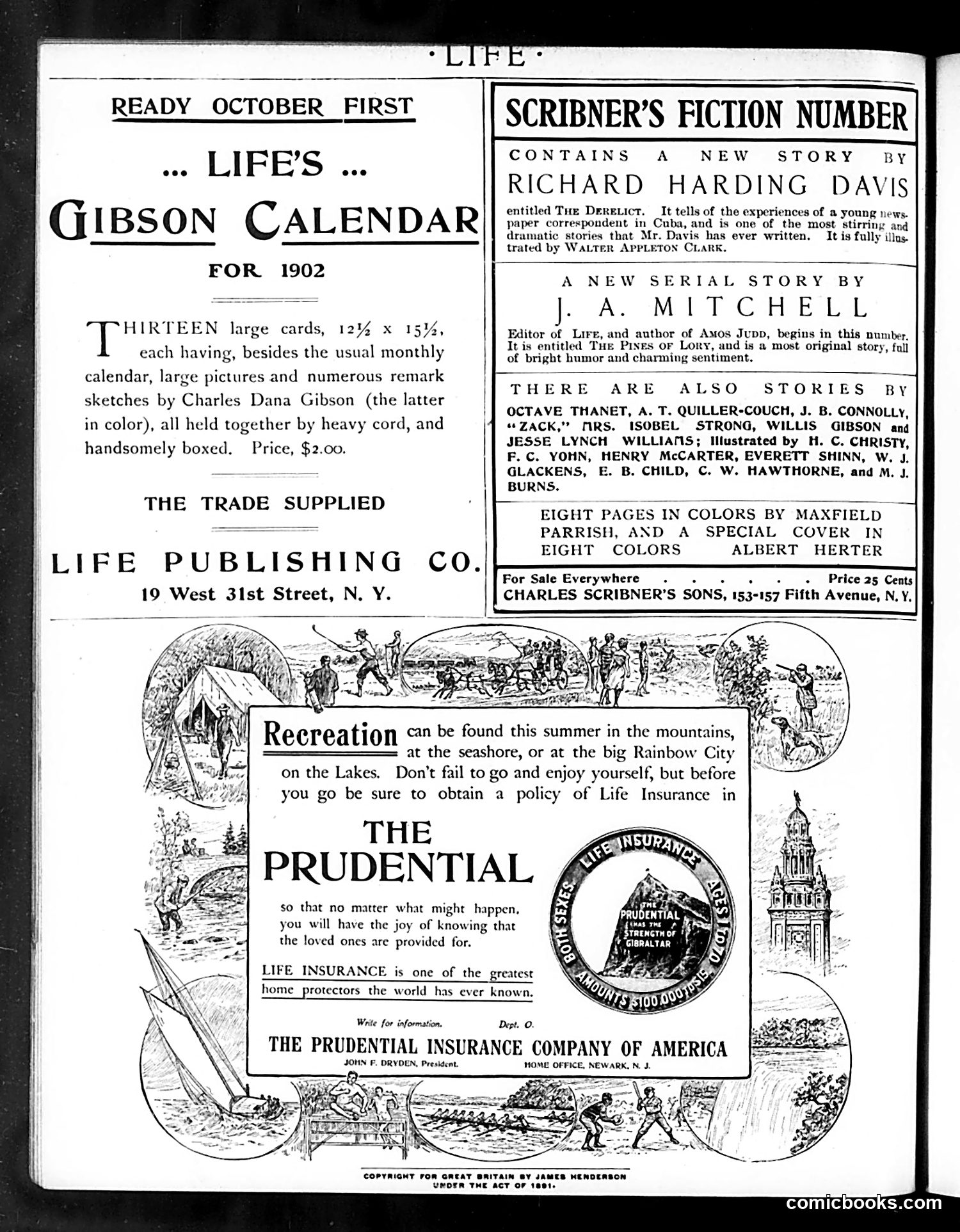
This page is primarily **advertising**, not political satire. The top left advertises Life Publishing Company's **Gibson Calendar for 1902**—thirteen illustrated cards by Charles Dana Gibson (famous for his "Gibson Girl" drawings). The middle right promotes **Scribner's Fiction Number**, a literary magazine issue featuring stories by Richard Harding Davis and J.A. Mitchell. The bottom half is a large advertisement for **The Prudential Insurance Company of America**, using summer recreation imagery (mountains, lakes, boating, waterfalls) to suggest carefree enjoyment. The pitch: obtain life insurance so loved ones are protected, allowing you to vacation worry-free. The company's logo appears in a circular seal. No political commentary or satirical figures are present—this is a straightforward commercial page from an entertainment/literary magazine.
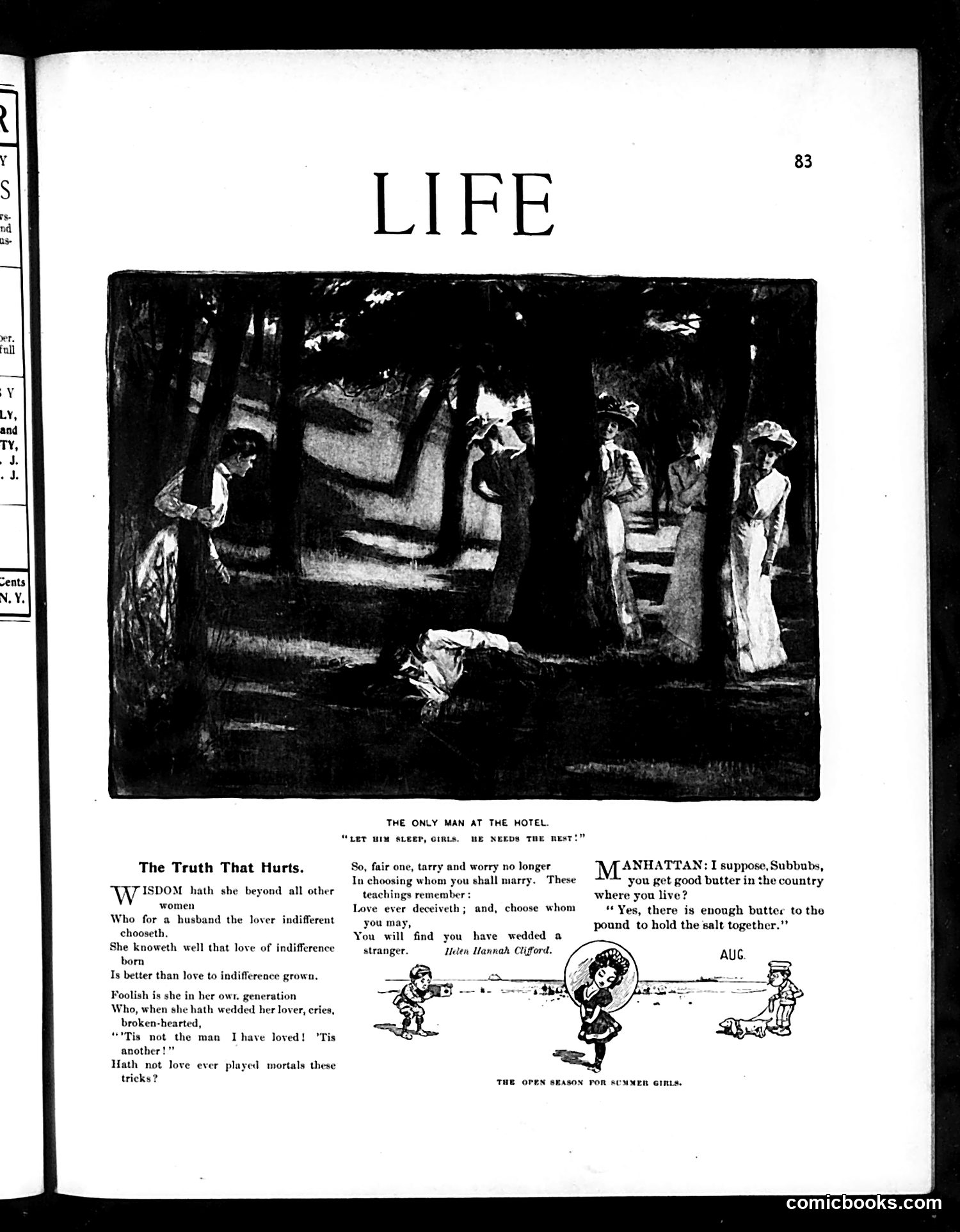
This page contains literary and humorous content rather than political cartoons. "The Truth That Hurts" is a poem about romantic disillusionment—specifically, a woman's realization that her husband loves her indifferently rather than passionately. The verse cynically explores how women often marry "strangers" and must accept loveless marriages. Below is a hotel scene illustration titled "The Only Man at the Hotel," depicting summer leisure activities. A separate Manhattan joke mocks urban butter quality ("enough butter to the pound to hold the salt together"). The bottom cartoon, "The Open Season for Summer Girls," appears to be a satirical commentary on courtship rituals, likely poking fun at summertime dating conventions of the era.
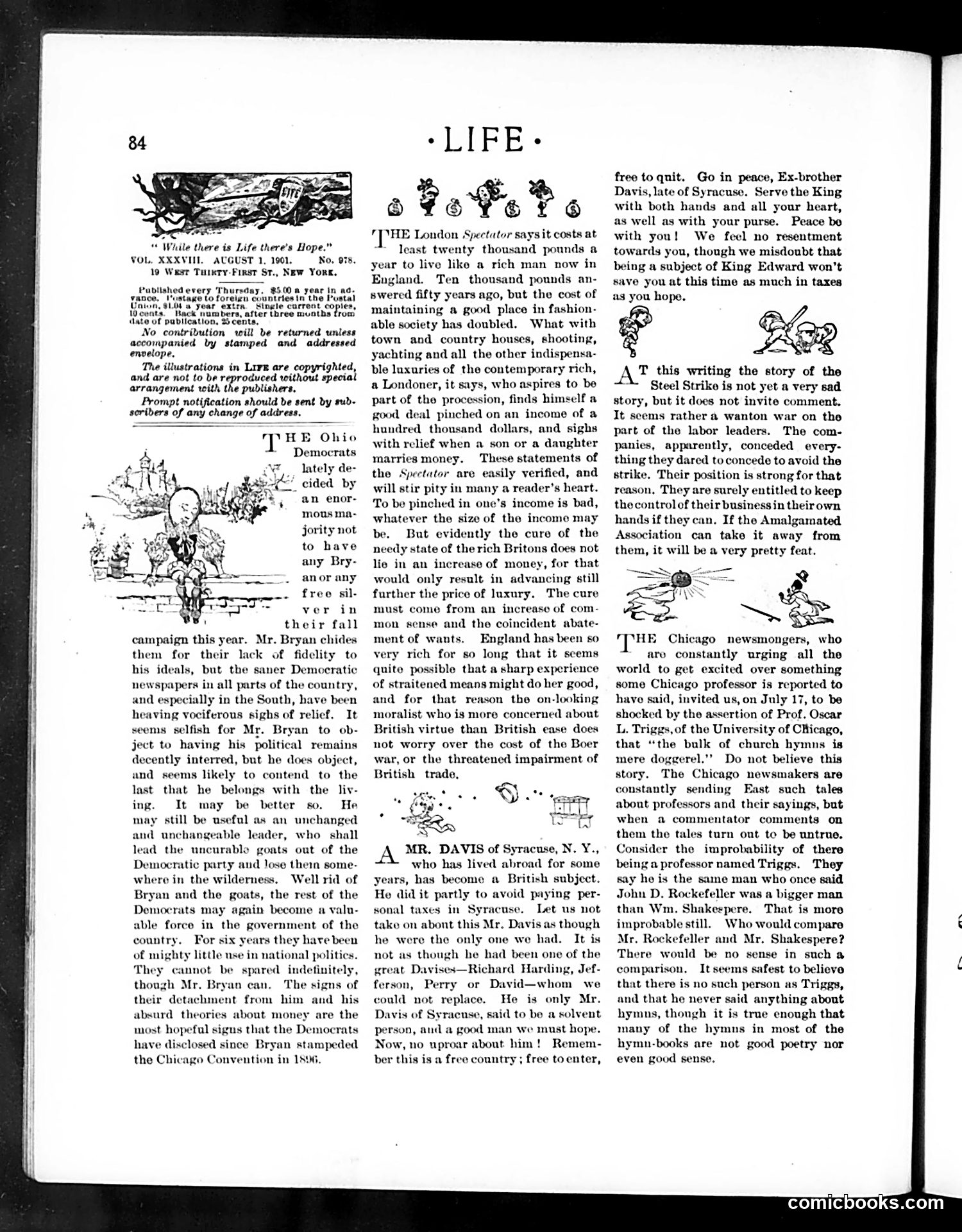
The page contains two main political cartoons satirizing wealth inequality and the cost of living in England. The left cartoon criticizes Democratic Party leadership, particularly William Jennings Bryan, for abandoning their principles. The text references Bryan's "fall campaign" and suggests Democratic newspapers have lost credibility, especially in the South. The right section discusses a *London Spectator* article about the enormous expense of maintaining a wealthy lifestyle in Britain—twenty thousand pounds annually. The satire mocks how the rich complain about costs while ordinary people struggle. A separate item ridicules Chicago newspaper stories exaggerating minor university incidents, suggesting journalists sensationalize trivial events involving professors. Overall, the page critiques political hypocrisy, wealth disparity, and irresponsible journalism—issues resonating across the American political landscape of 1901.
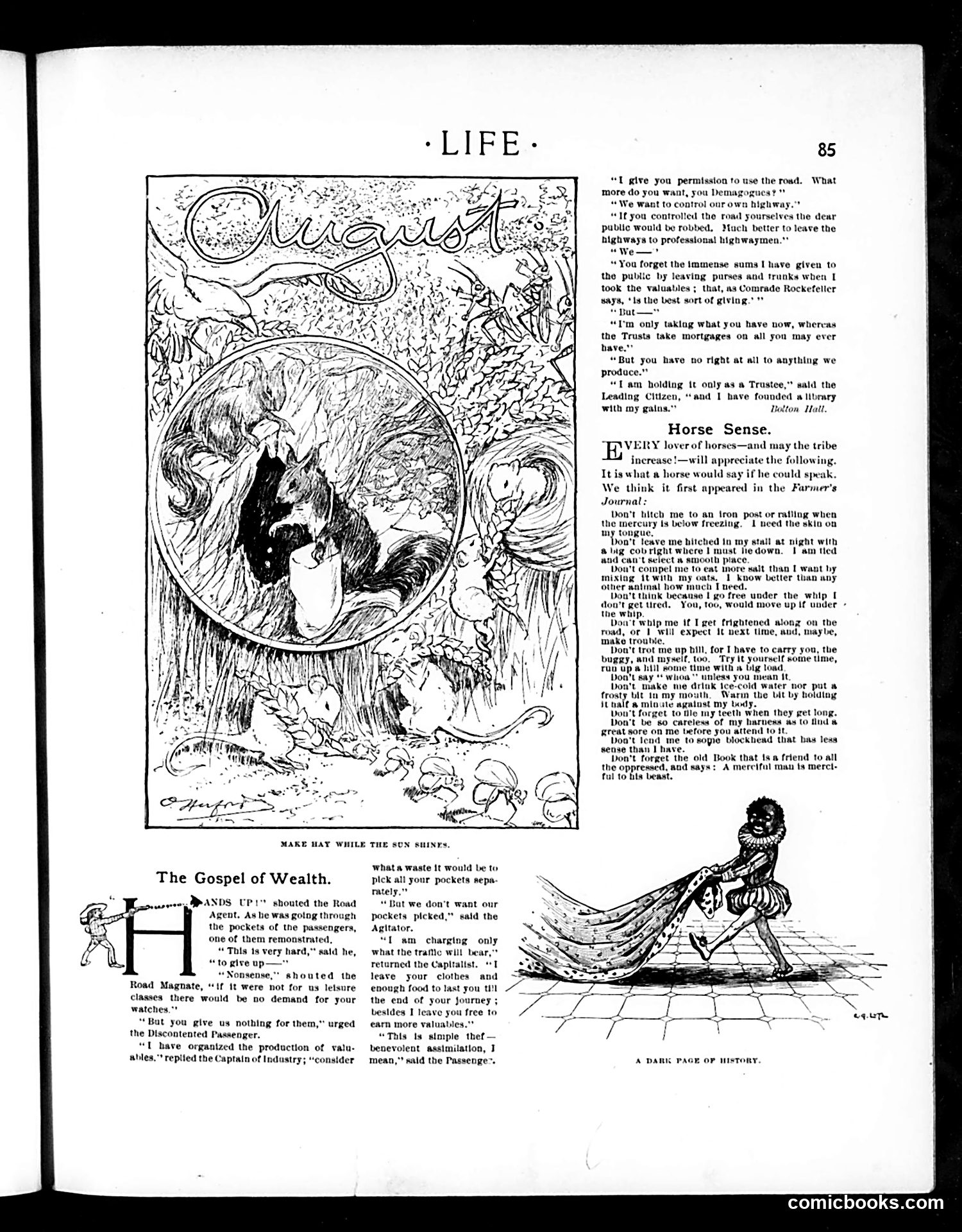
The page contains three satirical pieces: **"August" (top left):** An ornate illustration captioned "Make Hay While the Sun Shines"—likely a seasonal commentary on seizing opportunities. **"Horse Sense" (top right):** A humorous monologue supposedly from a horse's perspective, listing complaints about human treatment (hitching posts, inadequate food, heavy loads, etc.). This is anthropomorphic satire mocking how poorly horses were treated. **"The Gospel of Wealth" (bottom):** Depicts a Road Agent robbing passengers while a Capitalist and Road Magnate debate economic philosophy. The Agent argues theft is justified; the Capitalist responds that organized production of valuables is superior to robbery. This satirizes Gilded Age wealth accumulation and robber baron economics by equating capitalist practices with highway robbery. **"A Dark Page of History" (bottom right):** A small illustration, unclear in purpose from this image alone.
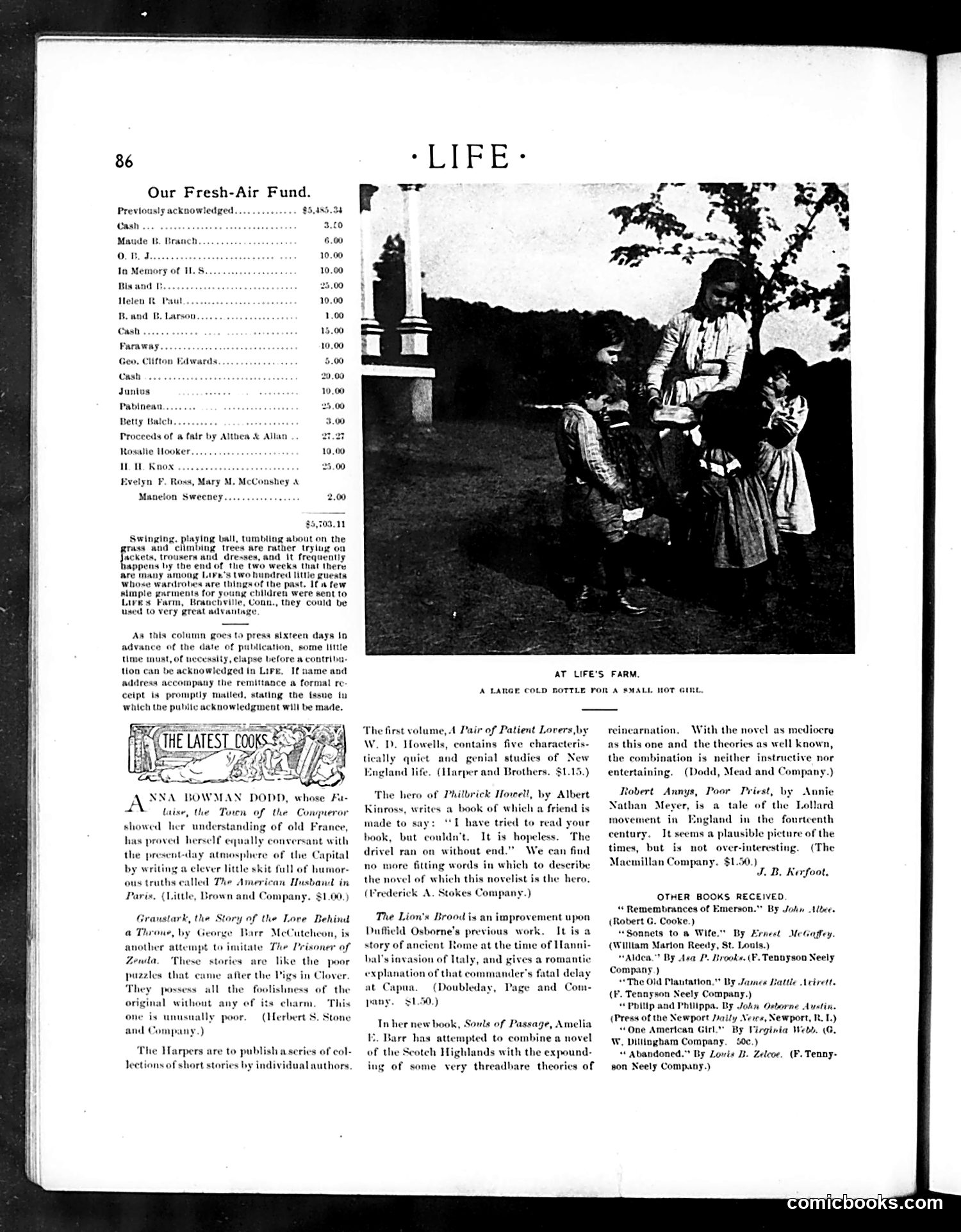
This page is primarily **book reviews and literary content**, not political satire. The main image shows "At Life's Farm" — a photograph of children and an adult outdoors sharing a cold bottle, illustrating Life Magazine's "Fresh-Air Fund," a charitable program providing outdoor recreation for urban children. The left column reviews several books, including works by Anna Bowman Dodd and others. These are straightforward literary critiques without political commentary. The "Fresh-Air Fund" donation list at top shows contributors' names and amounts — a common feature in magazines of this era, acknowledging charitable support. **No political cartoon or satire appears on this page.** It's a standard magazine section combining charitable fundraising, book reviews, and wholesome imagery of children's welfare activities.
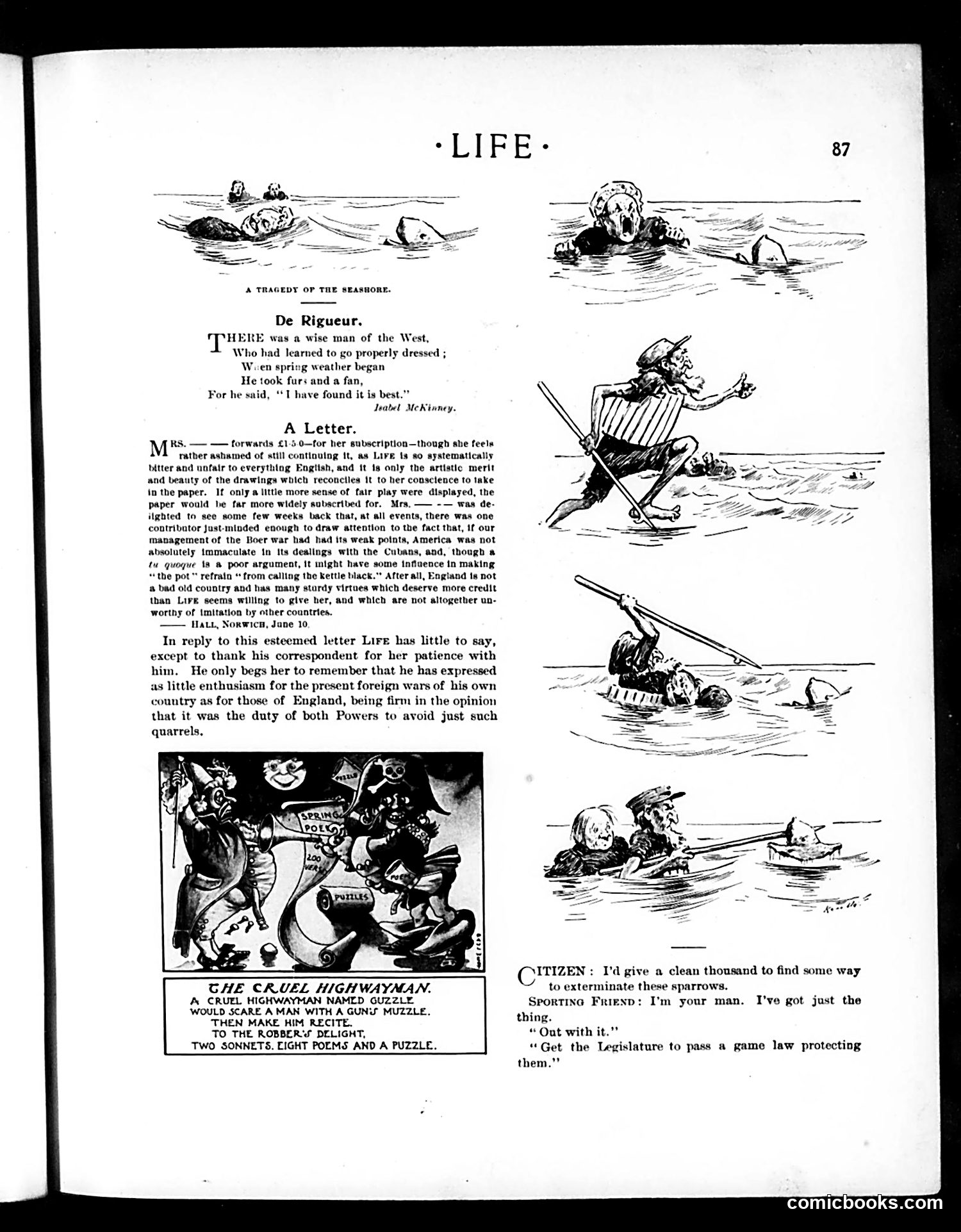
This page contains humorous sketches depicting drowning victims and rescuers at sea, captioned "A Tragedy of the Seashore." The sketches show various stages of water distress with darkly comic treatment. Below is a separate political cartoon titled "The Cruel Highwayman," depicting what appears to be a caricatured figure (likely representing a political or social entity) menacing another character. The caption reads it as a riddle about a "cruel highwayman" who would "scare a man with a gung muzzle" and "make him recite / Two sonnets, eight poems and a puzzle." The page also includes brief prose commentary and a dialogue between a "Citizen" and "Sporting Friend" debating whether to exterminate sparrows, with a suggestion to "get the Legislature to pass a game law protecting them." The exact political targets remain unclear without additional historical context.
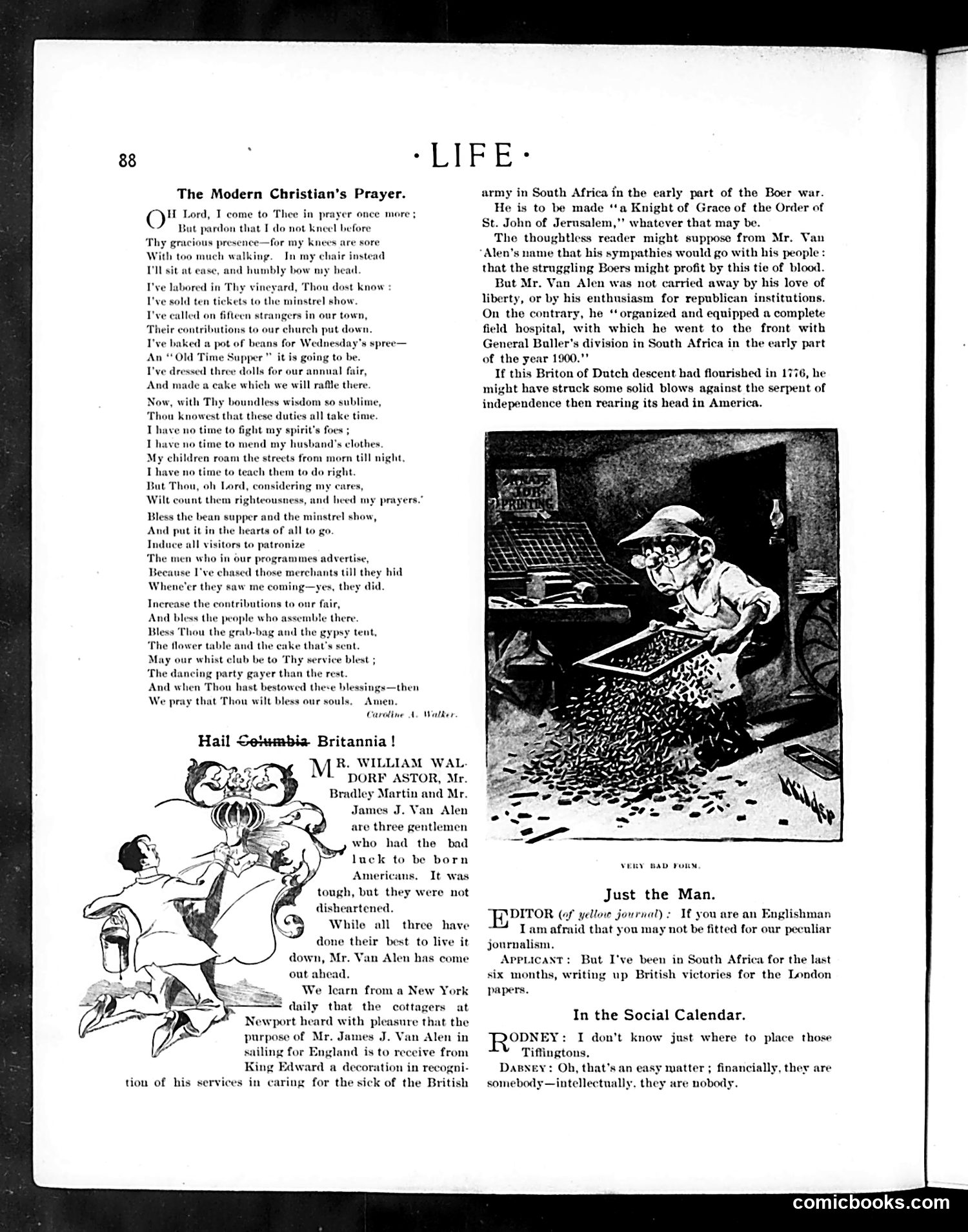
This page satirizes three American-born men who fought for the British Empire. The cartoon shows them as traitors to American identity, depicted riding on Britannia (the British Empire personified as a woman), with one figure appearing distressed or being cast out. The text identifies William Waldorf Astor, Bradley Martin, and James J. Van Alen as men "who had the bad luck to be born Americans" yet chose to serve British interests, particularly during the Boer War in South Africa (early 1900s). The satire mocks their decision to seek honors and recognition from Britain rather than their native country. The cartoon's tone suggests American indignation at wealthy citizens abandoning their nationality for foreign prestige and imperial service.
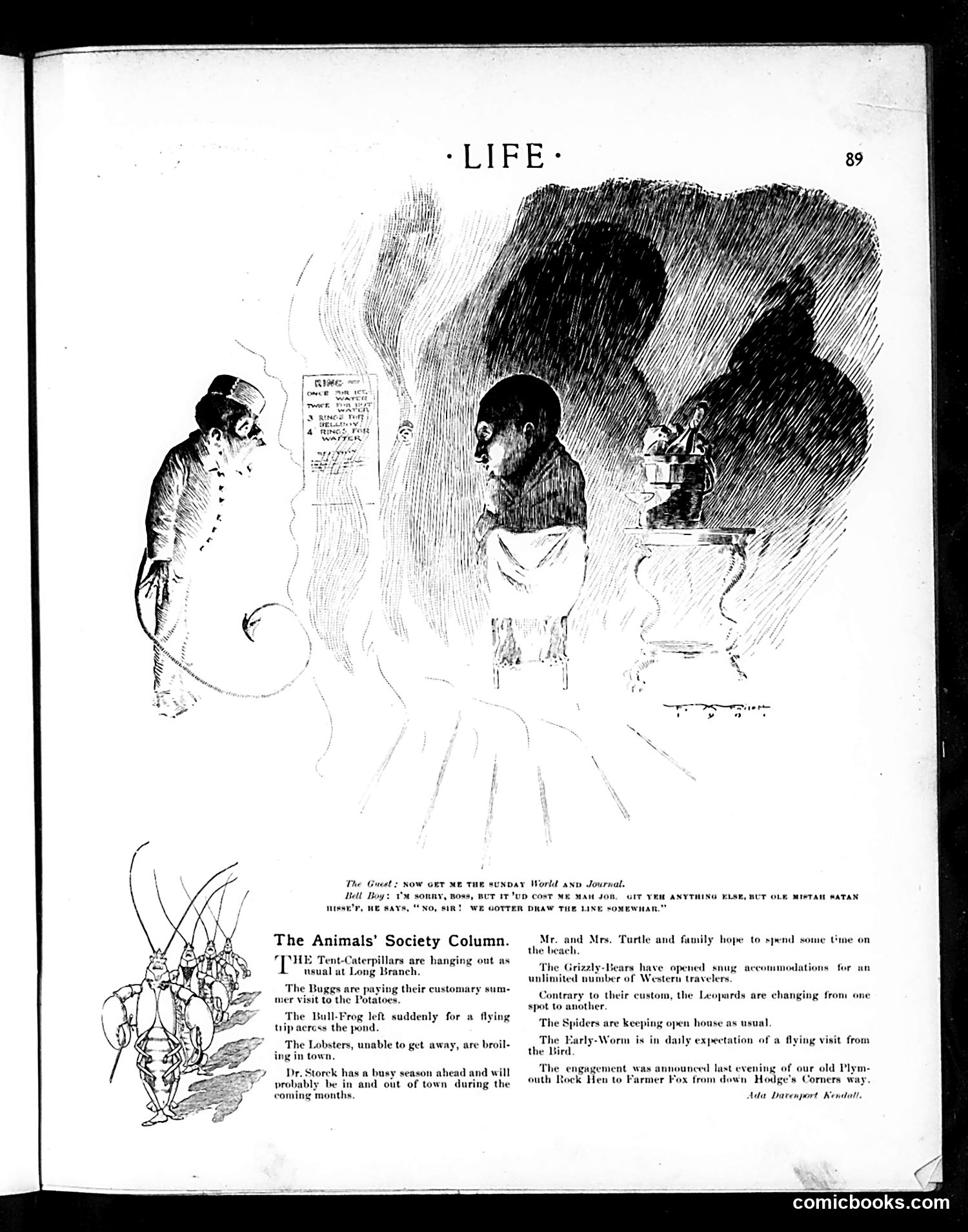
This page from *Life* magazine features a satirical cartoon about workplace dynamics. The main cartoon shows a man (left) presenting what appears to be a complaint or grievance to two seated figures in an office setting, with shadowy authority figures looming in the background. The caption references "the Sunday World and Journal" and includes dialogue about a man losing his job, with someone saying he should "draw the line somewhere." Below is "The Animals' Society Column," a humorous section anthropomorphizing animals—tent caterpillars, bugs, bull-frogs, and lobsters—with brief satirical observations about their activities and seasonal movements. The overall tone mocks both workplace power dynamics and society's trivial concerns, using animal metaphors to comment on human behavior. The specific political context remains unclear without dating information.
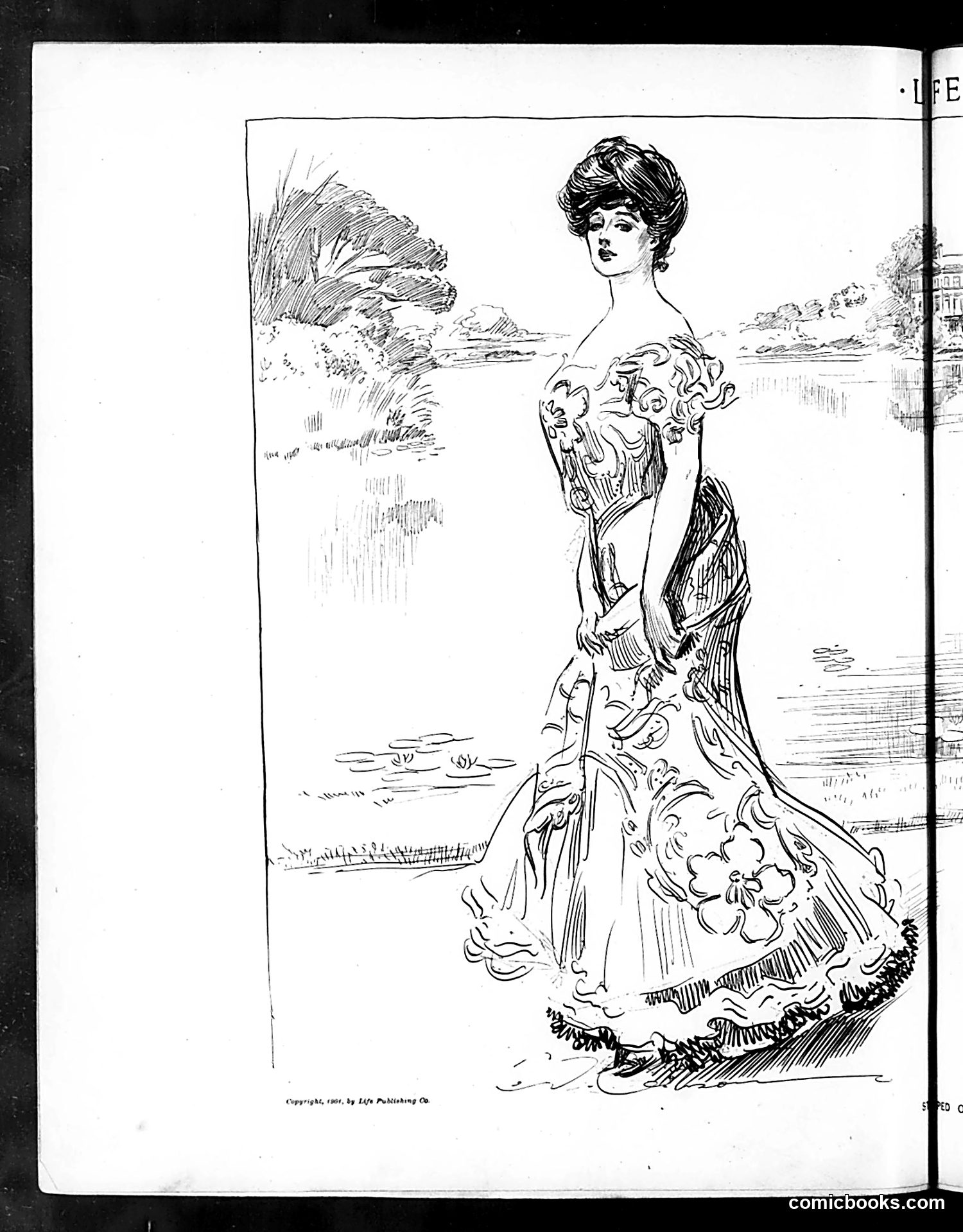
This appears to be a fashion illustration rather than political satire. The image shows an elegantly dressed woman in early 1900s attire, wearing an ornate gown with elaborate floral embroidery or appliqué details and a shawl or wrap. Her hairstyle is the fashionable "Gibson Girl" style popular during that era. The background depicts a pastoral landscape with water and vegetation, suggesting a leisurely outdoor setting. The copyright notice indicates this is from Life Publishing Co., dated 1907. Without additional visible text identifying specific commentary or captions making satirical points, this appears to be a straightforward fashion or society illustration typical of Life magazine's content during the Edwardian period—documenting contemporary women's fashion and lifestyle rather than offering political or social satire.
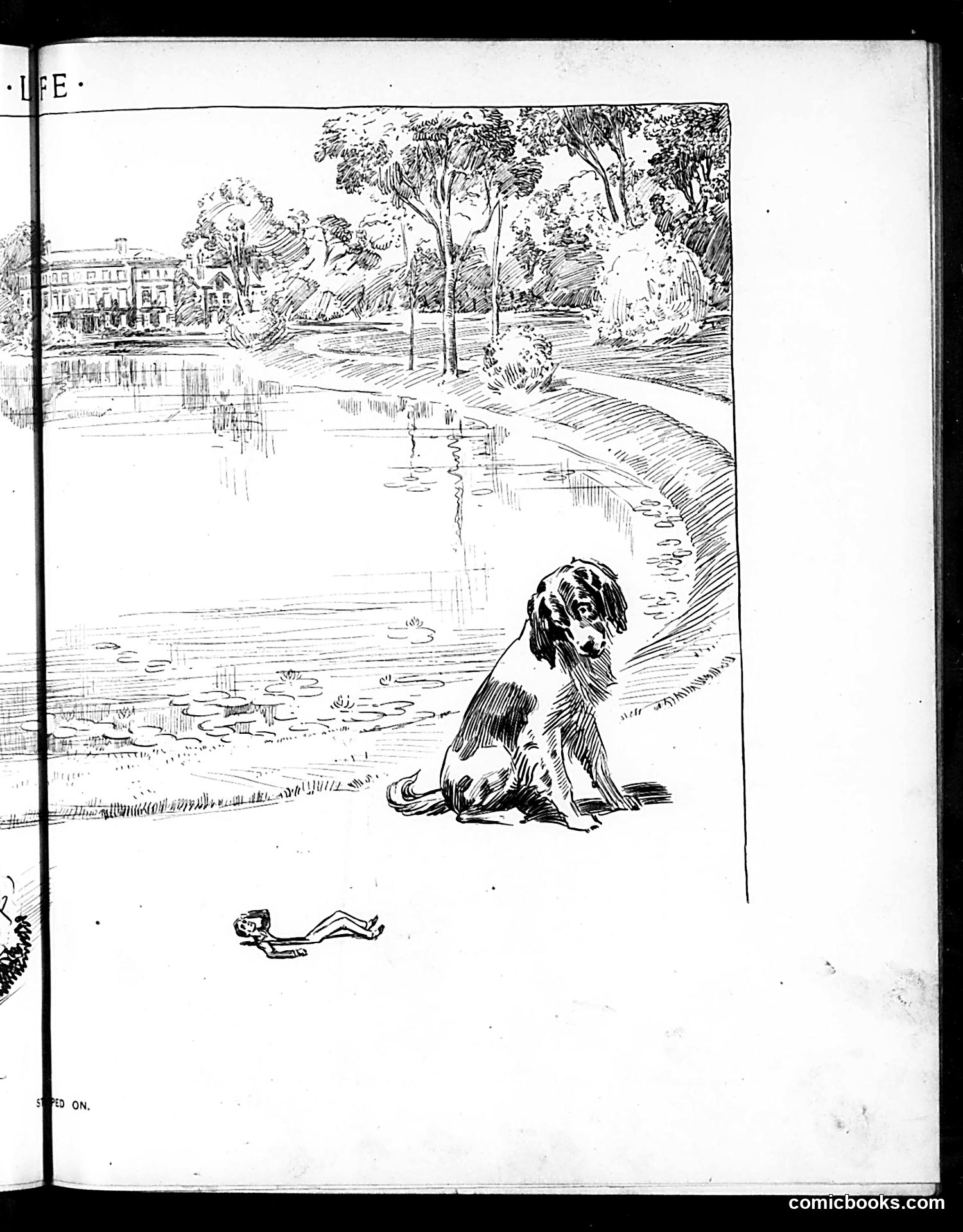
This page from *Life* magazine features a pen-and-ink illustration showing a dog sitting by a pond or water's edge in a pastoral landscape, with a small human figure lying on the ground in the lower left corner. The image appears to be a visual joke playing on scale and perspective. The tiny human figure dwarfed by the ordinary-sized dog creates absurdist humor—possibly satirizing human insignificance or poking fun at someone's small stature or importance. Without visible text explaining the cartoon's specific reference, the exact target of the satire remains unclear, though it likely commented on a contemporary public figure or social situation that *Life*'s readers would have recognized in the early-to-mid 20th century.
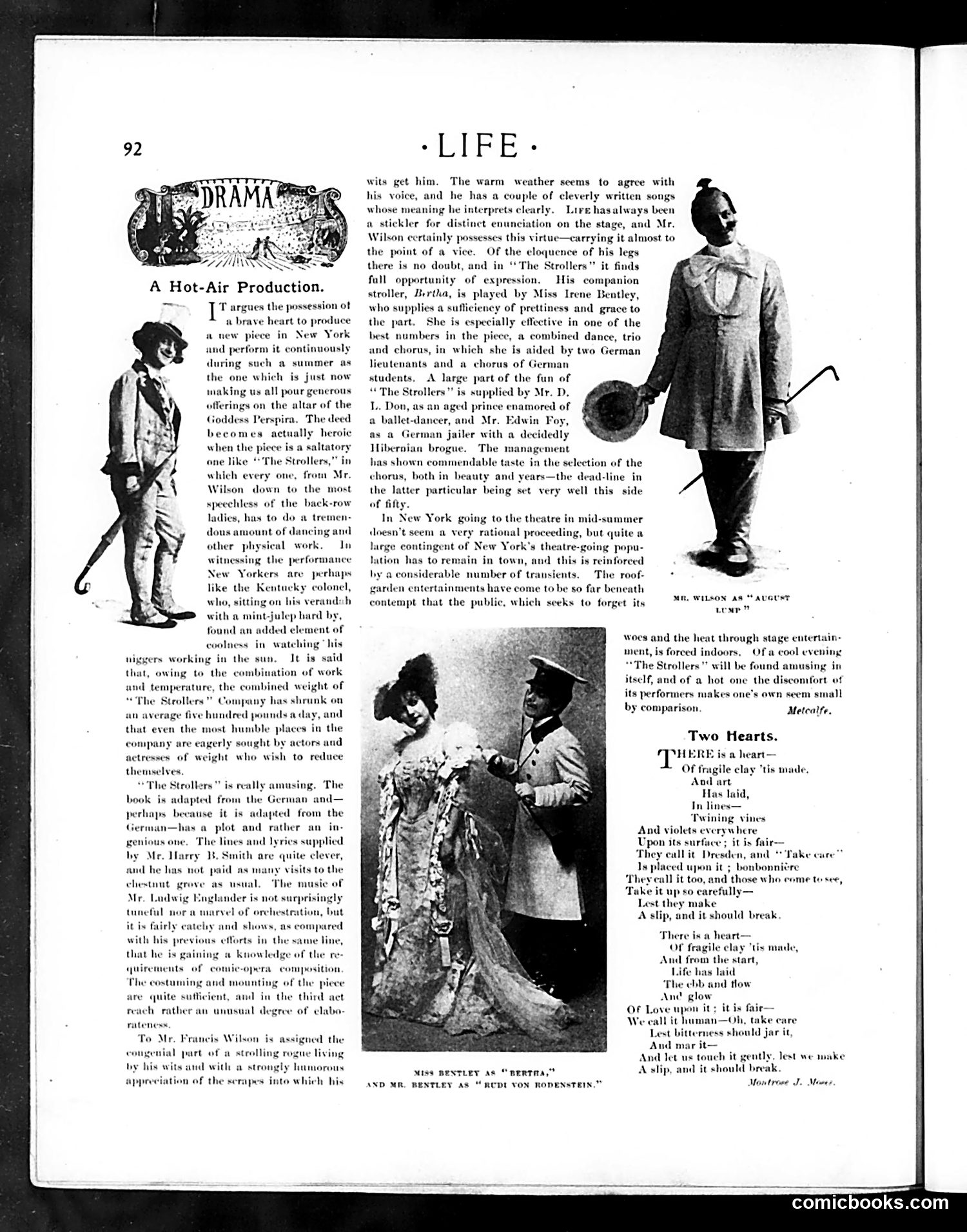
This page contains theater criticism rather than political satire. It reviews "The Strollers," a musical comedy production opening in New York during summer. The review praises lead actor Francis Wilson for his comedic timing and distinct enunciation, and notes supporting actress Irene Bentley's "prettiness and grace." The piece discusses the production's German-themed elements and choreography. A secondary review titled "Two Hearts" appears to critique another theatrical work, featuring a poem about fragile love. The photographs show performers in costume—Miss Bentley as "Bertha" and Mr. Bentley as "Rudi von Rodenstein"—likely from the production being reviewed. This is entertainment journalism rather than political commentary.
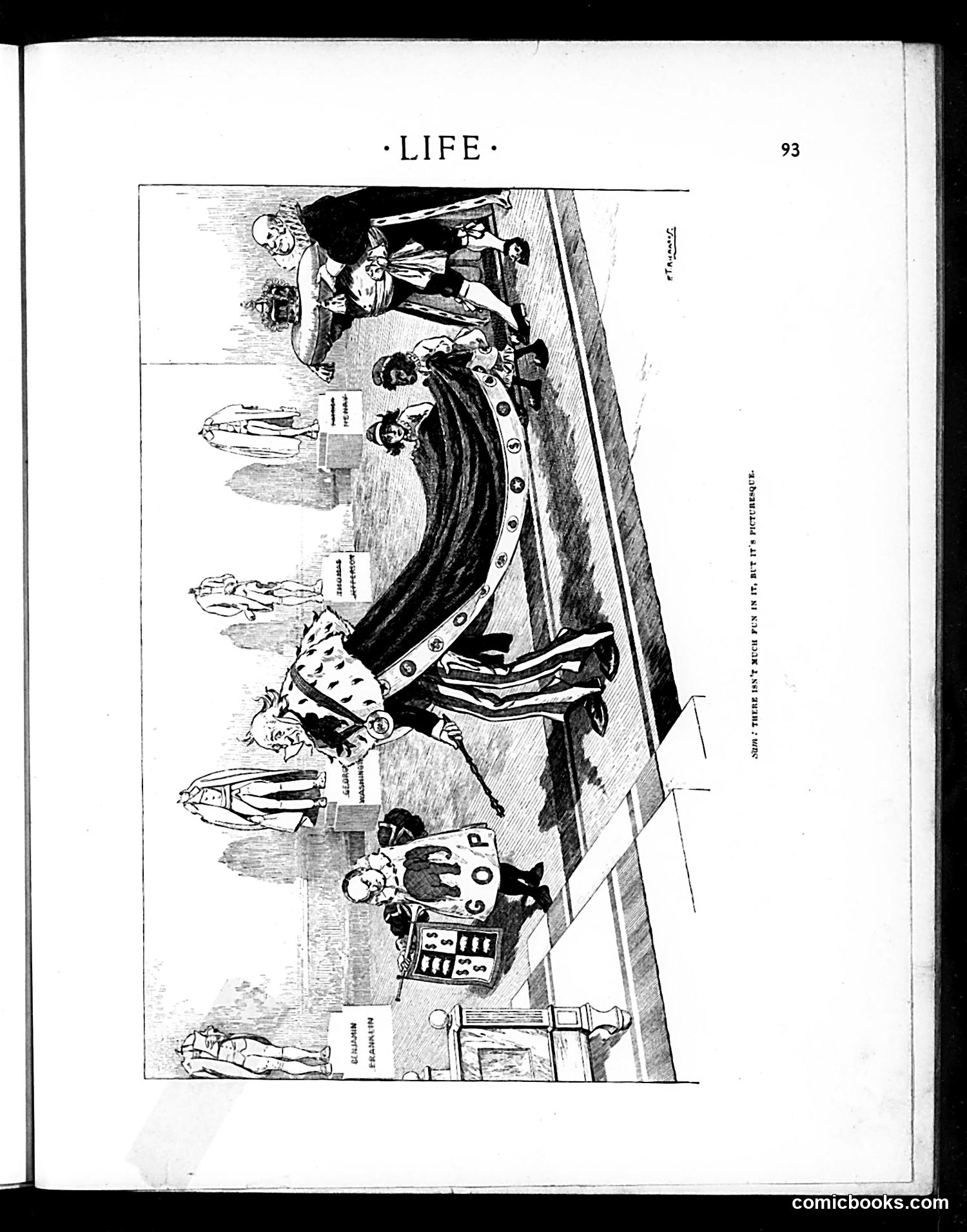
This appears to be a satirical illustration depicting a formal procession or parade scene, shown sideways on the page. The image shows multiple figures in period dress arranged in a line, including what appears to be nobility or dignitaries in elaborate clothing with decorative elements. However, the OCR text is too corrupted to reliably identify the specific historical event, figures, or political references being satirized. The artistic style and formal arrangement suggest commentary on aristocratic pretension or ceremonial absurdity, but without legible text or clear date context, I cannot definitively explain which historical figures or events are being lampooned or what specific social critique the cartoonist intended. A clearer source image or text would be needed for accurate interpretation.
This page contains two distinct pieces of social commentary: **"The Child in the House"** (main article with illustration) satirizes competing child-rearing philosophies. The text contrasts Victorian-era parenting—which pushed children hard intellectually—with modern "progressive" approaches that now *restrict* stimulation excessively. Parents hide books from bright children like "Tommy" and "Sylvia," fearing their precocious minds will overtax delicate constitutions. The author (Agnes Repplier) mocks this pendulum swing, suggesting modern parents treat children like cabbages requiring minimal stimulation. The illustration shows a child wielding an oversized scythe—visualizing the agricultural metaphor. **"The Revenge of an Army"** discusses the British military's retribution against Boer forces in South Africa, presumably during or after the Boer Wars. The cartoon (captioned "Carrying Out the Law") depicts soldiers enforcing discipline, likely referencing harsh military responses to civilian resistance. Both pieces use humor to critique contemporary attitudes—parenting anxiety and military brutality respectively—through exaggeration and visual wit typical of *Life* magazine's satirical approach.
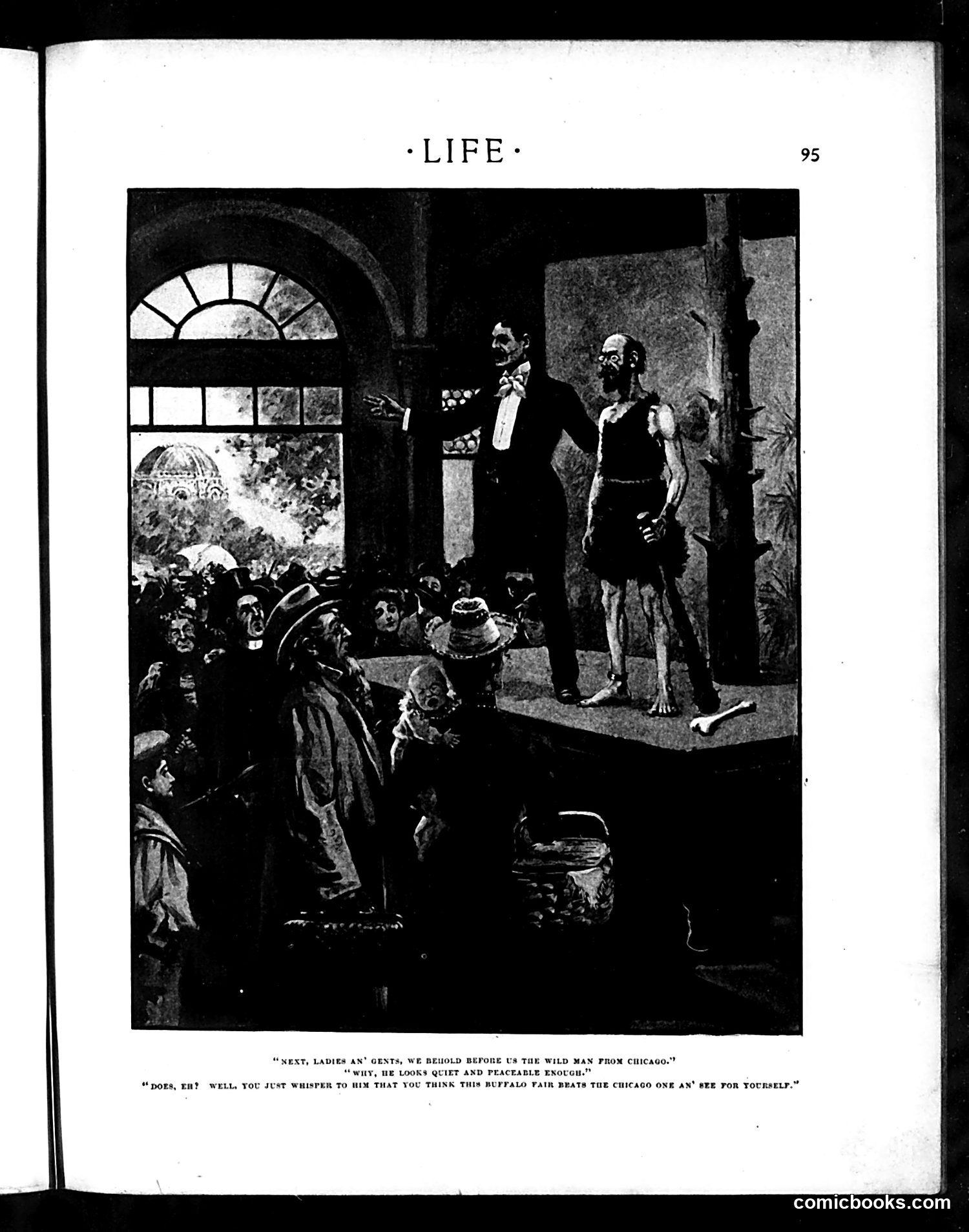
This is a satirical cartoon depicting a circus or exhibition-style scene where a "Wild Man from Chicago" is being presented to an audience. The barker (showman in formal dress) presents the figure as a curiosity, while claiming he appears docile. The joke hinges on the suggestion that mentioning Buffalo's "Buffalo Fair" favorably compared to Chicago's would provoke the man to violent anger—implying Chicagoans are touchy and combative about civic pride and competition with rival cities. This reflects early 20th-century American inter-city rivalries, where boasting about local fairs, exhibitions, and accomplishments was a marker of civic prestige. The satire mocks both Chicago's aggressive competitiveness and the absurdity of treating a person as a "wild" exhibit—a common racist trope of the era that Life magazine occasionally critiqued through satire.
This page contains primarily **humorous anecdotes and satirical verse** rather than political cartoons. The main piece, "The Health-Food Man," is a **satirical poem mocking health-food enthusiasts**—people obsessed with dietary restrictions and supplement pills. The exaggerated language depicts such a man as physically and emotionally depleted: his body reduced to mechanical parts (steel eyes, leather veins), his diet reduced to capsules and canned "concentrated" meals. The satire targets the early 20th-century health-food movement as both ridiculous and dehumanizing. The surrounding brief anecdotes are **humorous stories**: one about a man who sold Illinois land cheaply, only to have a city (Peoria) grow on it; another about a boy unwilling to work after his father's death; and an anecdote about a traveler's missing honey at a hotel. The **advertising** (Wilson Whiskey, Esterbrook Steel Pens, etc.) is typical period filler. No specific political figures or dated events are referenced. The satire targets general social trends and human nature rather than current events.
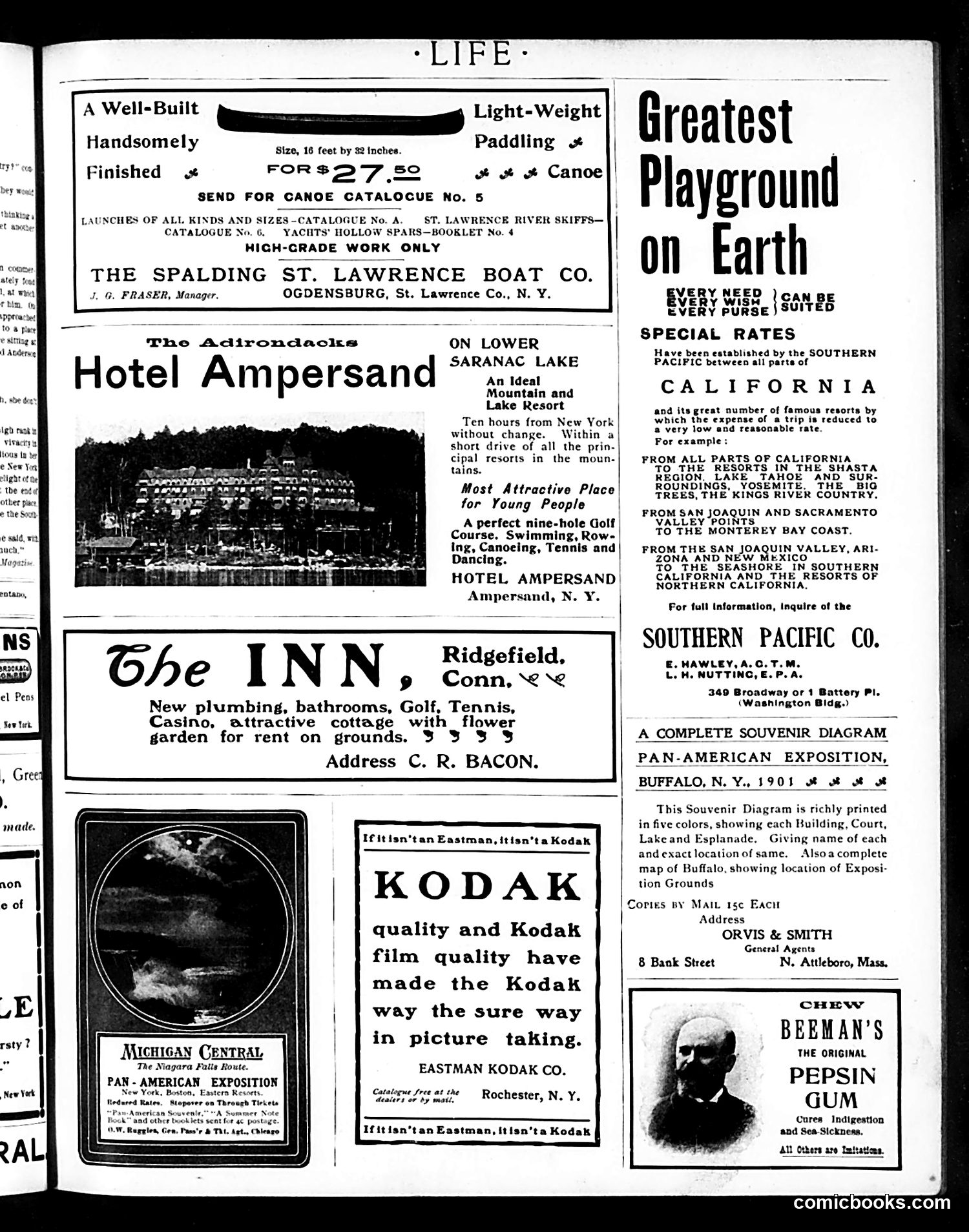
This page is primarily **advertising**, not editorial or satirical content. It contains commercial promotions for early-1900s leisure and tourism destinations. The ads reflect what affluent Americans valued around 1901: - **Sporting goods** (canoes, boats from Spalding-St. Lawrence) - **Mountain resorts** (Hotel Ampersand in Adirondacks, promoting golf, tennis, and dancing for "young people") - **Photography** (Kodak emphasizes reliability: "If it isn't an Eastman, it isn't a Kodak") - **Travel** (Southern Pacific Railway advertising California resorts; Michigan Central promoting the Pan-American Exposition in Buffalo, NY) - **Patent medicines** (Beeman's Pepsin Gum claiming to cure indigestion and seasickness) The overall theme is **leisure and consumption**—the page targets middle-to-upper-class readers with disposable income for vacations and modern conveniences. There is no apparent political satire; this reflects Life's shift toward general-interest advertising by the early 1900s.
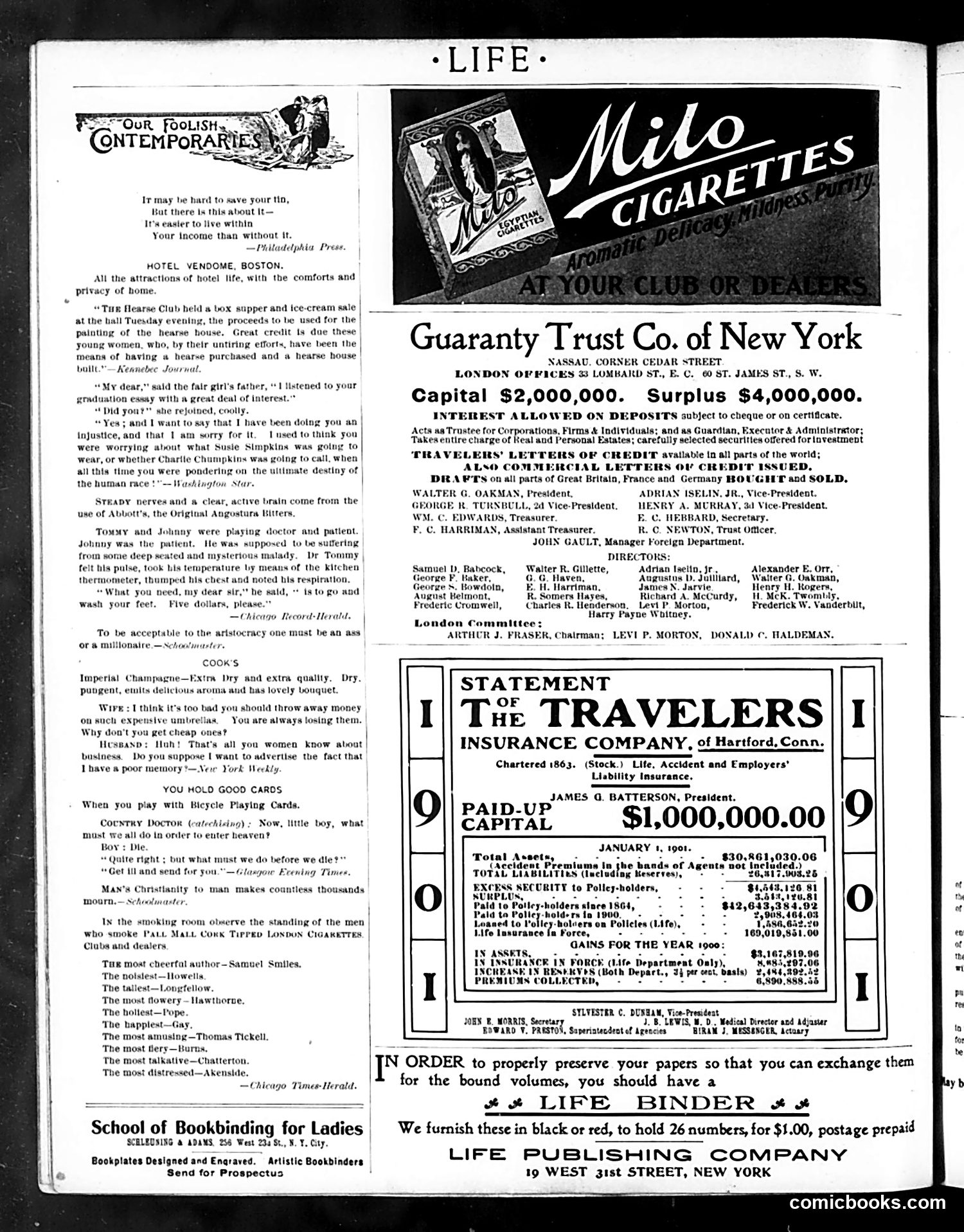
This page is primarily **advertisements and filler content** rather than coherent satirical cartoons. The masthead "Our Foolish Contemporaries" frames brief, disconnected jokes and quotes from other publications—a common Life magazine feature. The visible sections include: **Social humor**: A father congratulates his daughter on her graduation essay about "the ultimate destiny of the human race," assuming she's been intellectually serious rather than gossiping about boys and dates—the joke being on men's misunderstanding of women's actual interests. **Medical satire**: A children's play-doctor scene where the "doctor" prescribes washing feet and charges five dollars, mocking medical pretension. **Class commentary**: One line reads "To be acceptable to the aristocracy one must be an ass"—fairly blunt social criticism about wealth and status. The rest consists of various **period advertisements** (hotels, cigarettes, banking services, bookbinding schools) with embedded small jokes. There are no identifiable political figures or cartoons—just scattered satirical observations typical of Life's "contemporary follies" format.
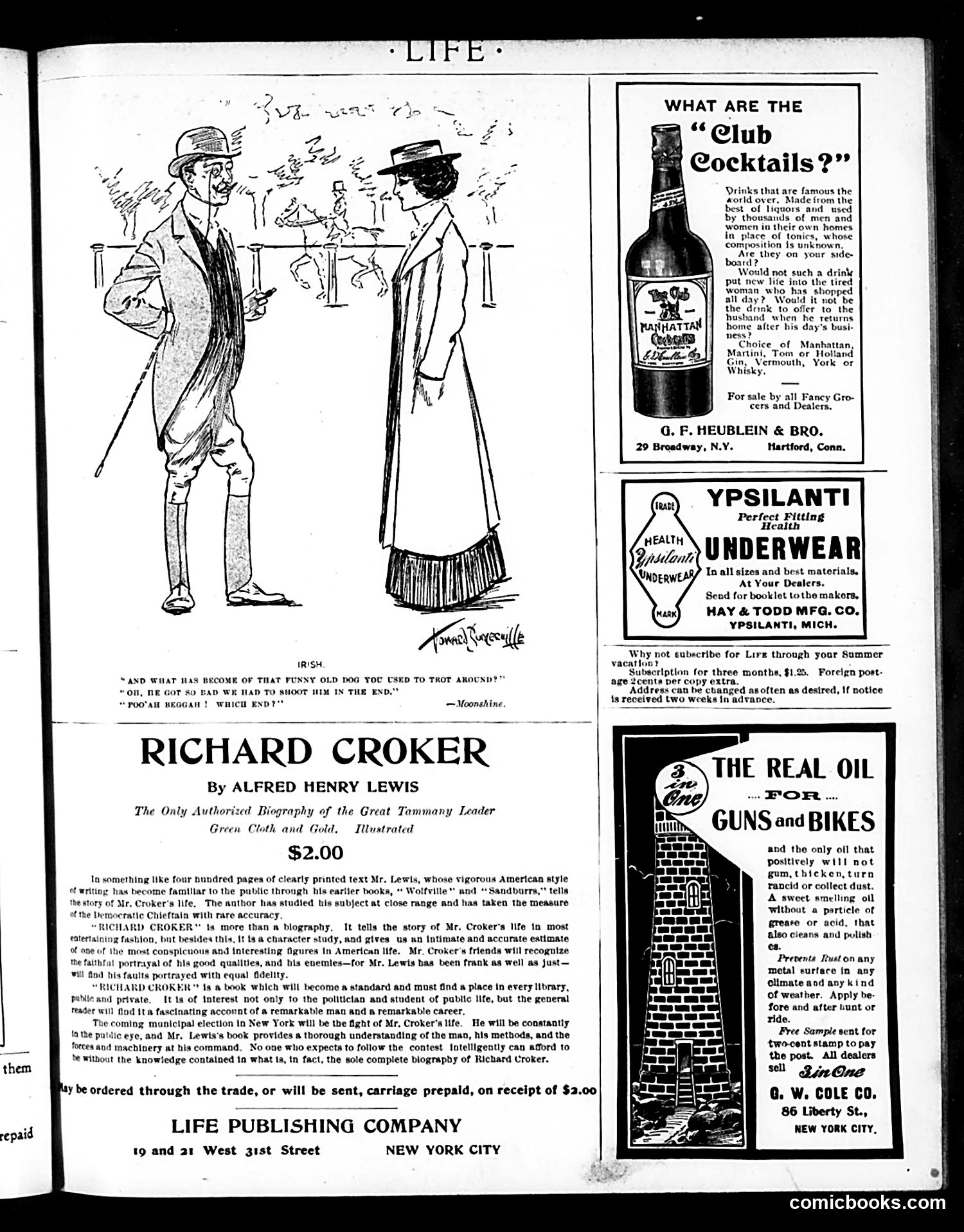
The main cartoon depicts two well-dressed men in conversation at what appears to be a social gathering. One asks the other about a dog he used to walk around town. The reply: they had to shoot it because it got so bad. The humor is dark and topical—this is satirical commentary on **Richard Croker**, the infamous Tammany Hall political boss, whose biography is advertised below. The joke works on multiple levels: the "dog" represents Croker's political machine, which was becoming "so bad" (corrupt, decrepit) that it needed elimination. For readers of the era, Croker was synonymous with New York machine politics and graft. The cartoon mocks both Croker's declining power and the embarrassment his associates felt about being connected to him. The page is primarily advertising—the Croker biography, cocktails, underwear, and gun oil dominate the space—with this single satirical cartoon as its main editorial content.
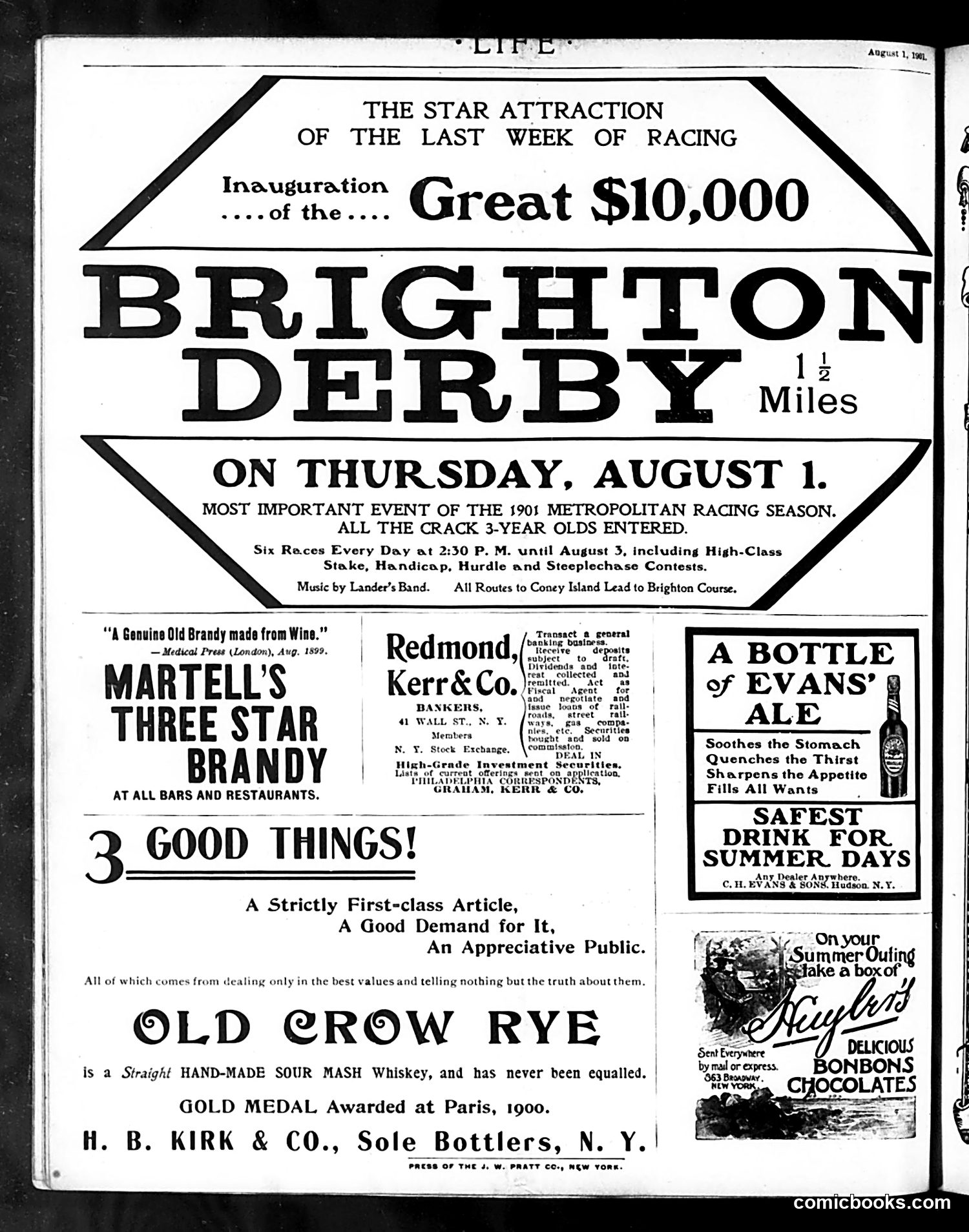
This page is **primarily advertising**, not satirical content. It announces the inaugural Great $10,000 Brighton Derby—a major horse racing event scheduled for Thursday, August 1, 1901, at Brighton Beach Course on Coney Island, featuring six races daily through August 3. The page showcases period advertisements for luxury goods targeting affluent racing enthusiasts: Martell's Three Star Brandy, Old Crow Rye whiskey (awarded a Gold Medal at Paris 1900), Evans' Ale, and Saylor's chocolates. A financial services ad for Redmond, Kerr & Co. (bankers and investment brokers) also appears. The "3 Good Things!" section is a marketing claim asserting these products represent quality, demand, and public appreciation—though the sardonic framing ("telling nothing but the truth") suggests mild irony about advertising hyperbole. No political figures or cartoon satire are present on this page.