
Life, 1901-08-01 · page 4 of 20
Life — August 1, 1901 — page 4: what you’re looking at
What you’re looking at
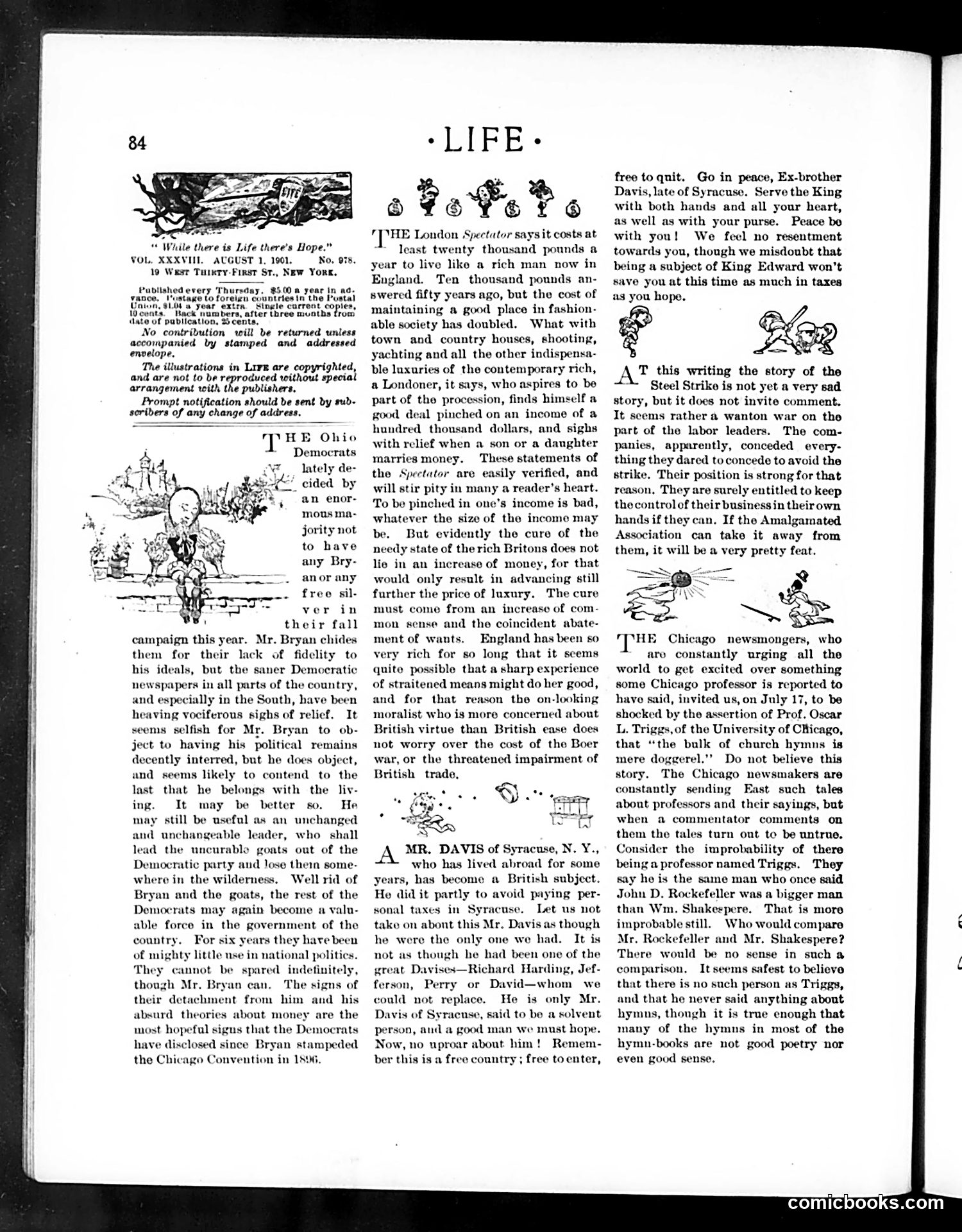
The page contains two main political cartoons satirizing wealth inequality and the cost of living in England. The left cartoon criticizes Democratic Party leadership, particularly William Jennings Bryan, for abandoning their principles. The text references Bryan's "fall campaign" and suggests Democratic newspapers have lost credibility, especially in the South. The right section discusses a *London Spectator* article about the enormous expense of maintaining a wealthy lifestyle in Britain—twenty thousand pounds annually. The satire mocks how the rich complain about costs while ordinary people struggle. A separate item ridicules Chicago newspaper stories exaggerating minor university incidents, suggesting journalists sensationalize trivial events involving professors. Overall, the page critiques political hypocrisy, wealth disparity, and irresponsible journalism—issues resonating across the American political landscape of 1901.
📄 Transcribed text from this page (OCR, searchable)
Machine-transcribed from the original scan — historical spelling and the odd misread are preserved.
“ While there is Life there's Hope.” XXXVI. AUGUST 1, 1901, No. 978. 19 West Turxry-First St., New Yorn. VOL. Published every Thursday. $5.00 a year in ad. stage to foreign countries in the Postal it Lb a year extra. Single current copies, WOconts. “Mack numbers, after three mnths from date of pablication, 2 cents. No contribution will be returned unless accompanied by stamped and addressed envelope. The illustrations in Lire are copyrighted, and are not to be reproduced without special arrangement with the publishers. Prompt notification should be sent by sub- soribers of any change of address. ‘PY HE Ohio Democrats lately de- cided by an enor- mous ma- jority not to have any Bry- anor any free sil- ver in their fall campaign this year. Mr. Bryan chides them for their lack of fidelity to his ideals, but the saner Democratic newspapers in all parts of the country, and especially in the South, have been heaving vociferous sighs of relief. It seems selfish for Mr. Bryan to ob- ject to having his political remains decently interred, but he does object, and seems likely to contend to the last that he belongs with the liv- ing. It may be better so. He may still be useful as an unchanged and unchangeable leader, who shall lead the uncurablo goats out of the Democratic party and lose them some- where in the wilderness, Well rid of Bryan and the goats, the rest of the Democrats may again become a valu- able force in the government of the country. For six years they have been of mighty little nse in national politics They cannot be spared indetin! though Mr. Bryan can. The signs of their detachment from him and his absurd theories about money are the most hopeful sigus that the Democrats have disclosed since Bryan stampeded Convention in 1 “LIFE * a FoF? « "DHE London Spectator says it costs at least twenty thousand pounds a year to live like a rich man now in England. Ten thousand pounds an- swered fifty years ago, but the cost of maintaining a good place in fashion- able society has doubled. What with town and country houses, shooting, yachting and all the other indispensa- ble luxuries of the contemporary rich, a Londoner, it says, who aspires to be part of the procession, finds himself a good deal pinched on an income of a hundred thousand dollars, and sighs with relief when a son or a danghter marries money. These statements of the Spectator are easily verified, and will stir pity in many a reader’s heart. To be pinched in one’s income is bad, whatever the size of the income may be. But evidently the cure of the needy state of the rich Britons does not lie in an increase of money, for that would only result in advancing still further the price of luxury. The cure must come from an increase of com- mon sense and the coincident abate- ment of wants. England has been so very rich for so long that it seems quite possible that a sharp experience of straitened means might do her good, and for that reason the on-looking moralist who is more concerned about British virtue than British ease does not worry over the cost of the Boer war, or the threatened impairment of British trade, fe A MR. DAVIS of Syracuse, who has lived abroad for some years, has become a British subject. He did it partly to avoid paying per- sonal taxes in Syracuse. Let us not take on abont this Mr. Davis as though he were the only one we had. It is not as though he had been one of the great Davises—Richard Harding, Jef- ferson, Perry or David—whom we could not replace. He is only Mr. Davis of Syracuse, said to be a solvent person, and a good man we must hope. Now, no uproar about him! Remem- ber this is a free country ; free toenter, free to quit. Go in peace, Ex-brother Davis, late of Syracuse. Serve the King with both hands and all your heart, as well as with your purse. Peace bo with you! We feel no resentment towards you, though we misdoubt that being a subject of King Edward won’t save you at this time as much in taxes as you hope. AT this writing the story of the ~~ Steel Strike is not yet a very sad story, but it does not invite comment. It scems rather a wanton war on tho part of the labor leaders. The com- panies, apparently, conceded every- thing they dared to concede to avoid the strike. Their position is strong for that reason, They are surely entitled to keep thecontrol of their business in theirown. hands if they can. If the Amalgamated. Association can take it away from them, it will be a very pretty feat. “HE Chicago newsmongers, who are constantly urging all the world to get excited over something some Chicago professor is reported to have said, invited us,on July 17, to be shocked by the assertion of Prof. Oscar L. Triggs,of the University of CHicago, that “the balk of church hymns is mere doggerel.’’ Do not believe this story. The Chicago newsmakers are constantly sending East such tales about professors and their sayings, but when a commentator comments on them the tales turn out te be untrue. Consider the improbability of there being a professor named Triggs. They say he is the same man who once said John D. Rockefeller was a bigger man than Wm. Shakespere. That is more improbable still. Who would comparo Mr. Rockefeller and Mr, Shakespere? There would be no sense in such a comparison, It seems safest to believe that there is no such person as Triggs, and that he never said anything about hymns, though it is true enough that many of the hymns in most of the hymn-books are not good poetry nor even good sense. ———o —= comicbooks.com