
Life, 1901-08-01 · page 14 of 20
Life — August 1, 1901 — page 14: what you’re looking at
What you’re looking at
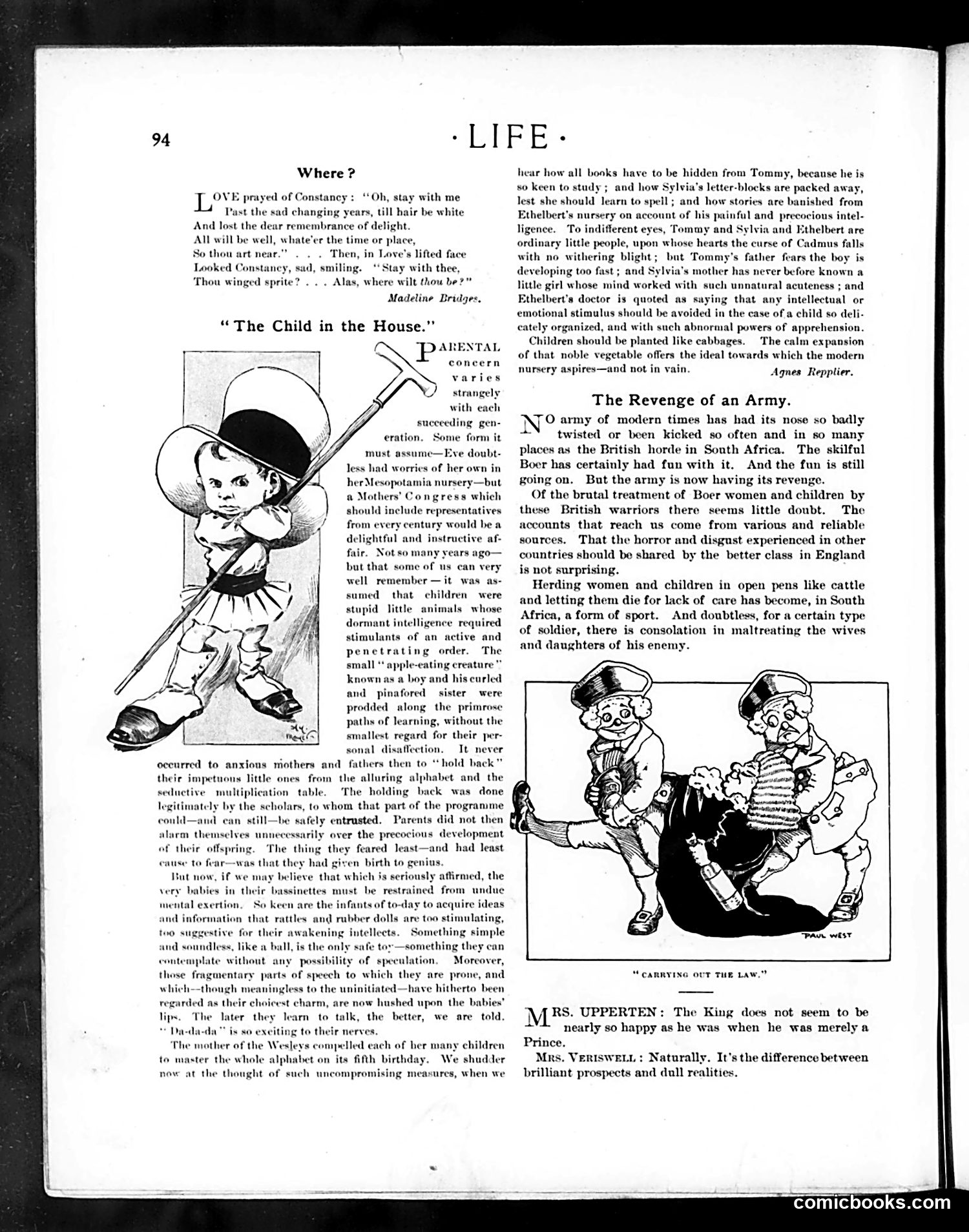
This page contains two distinct pieces of social commentary: **"The Child in the House"** (main article with illustration) satirizes competing child-rearing philosophies. The text contrasts Victorian-era parenting—which pushed children hard intellectually—with modern "progressive" approaches that now *restrict* stimulation excessively. Parents hide books from bright children like "Tommy" and "Sylvia," fearing their precocious minds will overtax delicate constitutions. The author (Agnes Repplier) mocks this pendulum swing, suggesting modern parents treat children like cabbages requiring minimal stimulation. The illustration shows a child wielding an oversized scythe—visualizing the agricultural metaphor. **"The Revenge of an Army"** discusses the British military's retribution against Boer forces in South Africa, presumably during or after the Boer Wars. The cartoon (captioned "Carrying Out the Law") depicts soldiers enforcing discipline, likely referencing harsh military responses to civilian resistance. Both pieces use humor to critique contemporary attitudes—parenting anxiety and military brutality respectively—through exaggeration and visual wit typical of *Life* magazine's satirical approach.
📄 Transcribed text from this page (OCR, searchable)
Machine-transcribed from the original scan — historical spelling and the odd misread are preserved.
LUPE = Where ? OVE prayed of Constancy : ‘Oh, stay with me Past the sad changing years, till hair be white And lost the dear remembrance of delight. All will be well, whate'er the time or plac So thou art near.” . . . en, in Love's lifted face Looked Constaney, sad, smiling. with thee, ‘Thou winged sprite? . . . Alas, where wilt thou be?" Madeline Bridges, “The Child in the House.” ——————— Pp" cone varies D strangely with each succeeding gen- eration, Some form it must assume—Eve doubt- less had worries of her own in her Mesopotamia nursery—but a Mothers’ Congress which should include representatives from every century would be a delightful structive af- fair. » ny years ago— but that some of us can very well remember — it was as- sumed that children were stupid little animals whose dormant intelligence required stimulants of an active and penetrating order. The small“ apple-eating creature” known as a boy and his curled and pinafored sister were prodded along the primrose paths of learning, without the smallest regard for their per- sonal disaffection. It never occurred to anxious mothers and fathers then to “hold back” their impetuons little ones from the alluring alphabet and the table. The holding back was done the scholars, to whom that part of the programme could—and can still—be saf . Parents did not then alarm themselves unn uirily over the precocious development of their offspring. ‘The thing they feared least—and had least cause to fear—was that they had given birth to genius, Kut now, if we may believe that which is seriously afirmed, the very babies in their bassinettes must be restrained from undue exertion. So keen are the infants of to-day to acquire ideas on that rattles and rubber dolls are too stimulatin; tive for their aw ts. Something simple + —something they can y possibility of speculation. Moreover, rts of speech to which they are prone, and which—though meaningless to the uninitiated—have hitherto bee egarded as th icest charm, are now hushed upon the babie The late y learn to talk, the better, we are told. other of the Wesleys compelled each of her many children rv the whole alphabet on its fifth birthday. We shudder now at the thought of such uncompromising measures, when we hear how all bonks have to be hidden from Tommy, because he is so keen to study ; and how Sylvia's letter-blocks are packed awa; lest she should learn to spell; and how stories are banished from Ethelbert’s nursery on account of his painful and precocious intel- ligence. To indifferent eyes, Tommy and Sylvia and Ethelbert are ordinary little people, upon whose hearts the curse of Cadmus falls with no withering blight; bat Tommy's father fears the boy is developing too fast ; and Sylvia's mother has never before known a little girl whose mind worked with such unnatural acuteness ; and Ethelbert’s doctor is quoted as saying that any intellectual or emotional stimulus should be avoided in the case of a child so deli- cately organized, and with such abnormal powers of apprehension. Children should be planted like cabbages. The calm expansion of that noble vegetable offers the ideal towards which the modern nursery aspires—and not in y Agnes Repplier. The Revenge of an Army. N°? army of modern times has had its nose so badly = twisted or been kicked so often and in so many places as the British horde in South Africa. The skilful Boer has certainly had fun with it. And the fun is still going on. But the army is now having its revenge. Of the brutal treatment of Boer women and children by these British warriors there seems little doubt. The accounts that reach us come from various and reliable sources. That the horror and disgust experienced in other countries should be shared by the better class in England is not surprising. Herding women and children in open pens like cattle and letting them die for lack of care has become, in South Africa, a form of sport. And doubtless, for a certain type of soldier, there is consolation in maltreating the wives and daughters of his enemy. “CARRYING OUT TUR LAW.” RS. UPPERTEN: The King does not seem to be nearly so happy as he was when he was merely a Prince. Mrs. VERISWELL: Naturally. It's the difference between. brilliant prospects and dull realities. “comicbooks.com