
A complete issue · 20 pages · 1901
Life — July 18, 1901
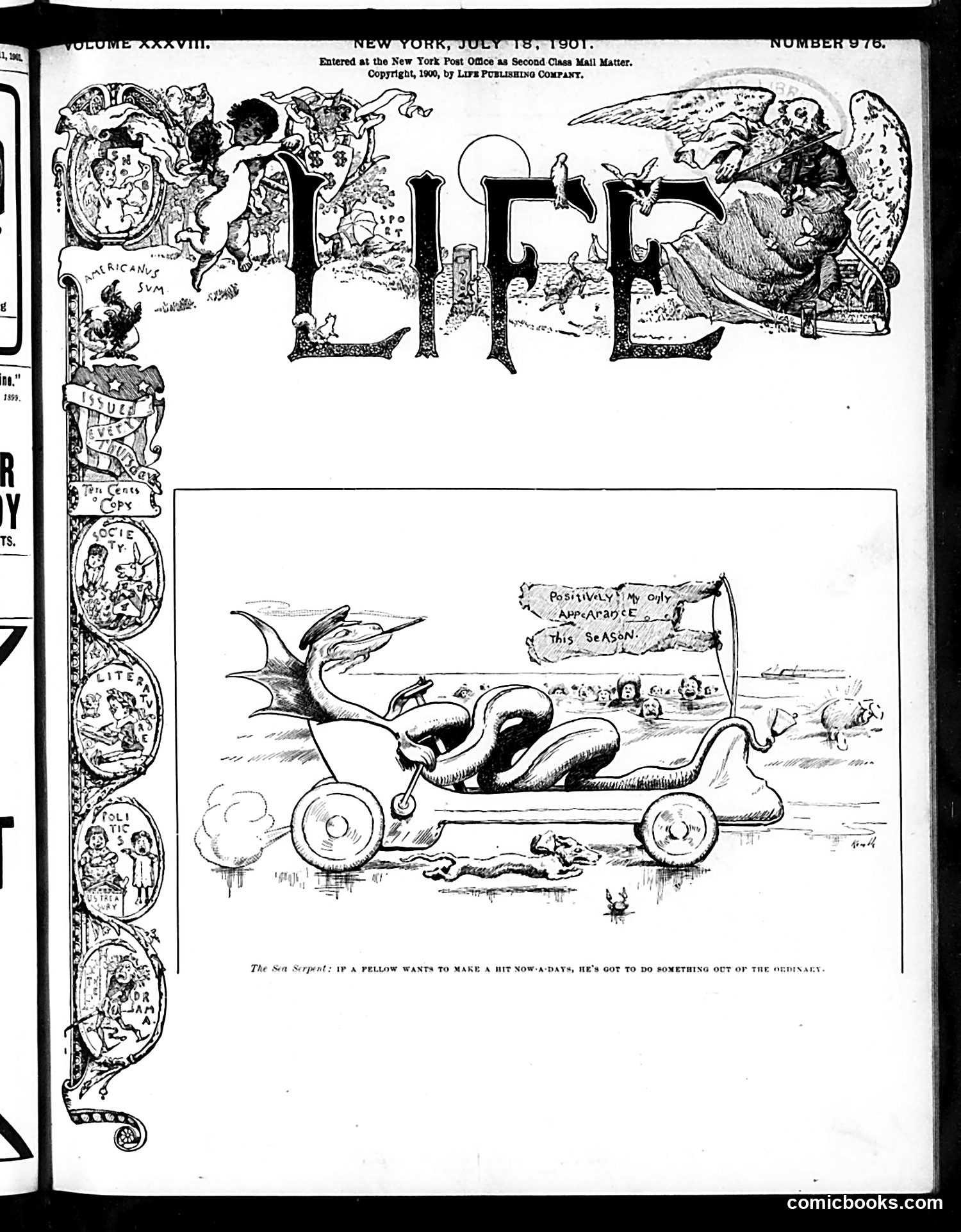
This page features a single cartoon titled "The Sea Serpent," captioned: "IF A FELLOW WANTS TO MAKE A BIT NOW-A-DAYS, HE'S GOT TO DO SOMETHING OUT OF THE ORDINARY." The cartoon depicts a fantastical vehicle—a wheeled contraption powered by a mechanical sea serpent rather than horses. The satire appears to target commercial excess and the era's obsession with novelty and sensationalism. The "sea serpent" references the creature's legendary status in popular imagination; using it as power suggests mocking contemporary business schemes relying on outlandish gimmicks to attract attention and profit. The caption's sardonic tone implies criticism of the competitive marketplace demanding increasingly absurd innovations to succeed financially. This reflects early-1900s industrial-age anxieties about commercialism and manufactured spectacle.
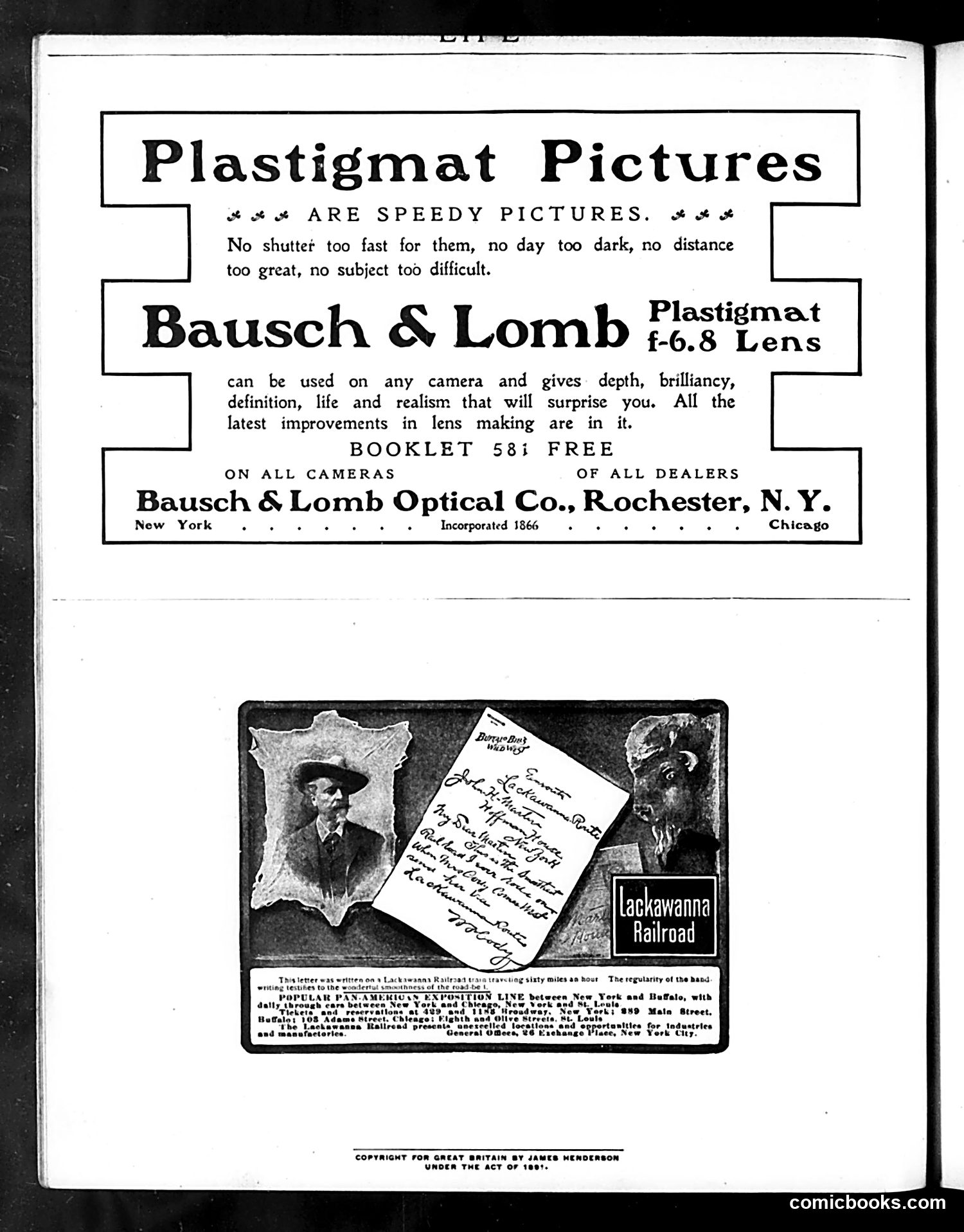
This page is primarily **advertising**, not editorial content or satire. The top half contains two ads for Bausch & Lomb optical products—specifically their Plastigmat f-6.8 camera lens, marketed as enabling fast photography in difficult conditions. The bottom half shows an advertisement for the Lackawanna Railroad. The image depicts two men (one wearing a cowboy hat, one in formal dress) flanking a handwritten letter, with small portraits in decorative frames. The ad emphasizes the railroad's role in facilitating "wonderful journeys" and business opportunities, promoting the "Popular Pan-American Exposition Line" between New York and Buffalo. There is **no political satire or cartoon here**—this is a vintage magazine page dedicated to commercial advertisements from the early 1900s era.
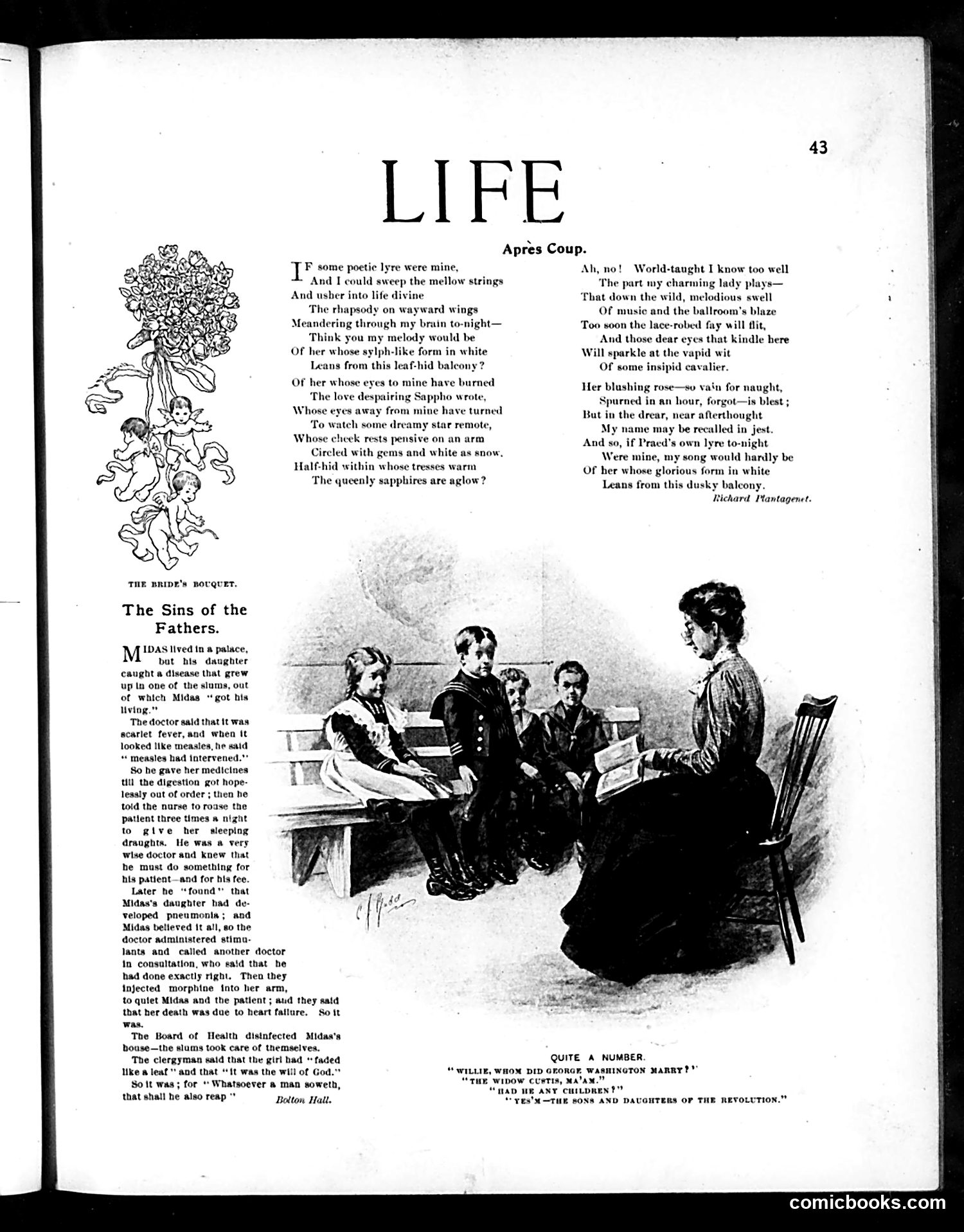
This page contains two distinct pieces: **"Après Coup"** (top): A poem by Richard Hovey about romantic regret—a man reflecting on a woman he failed to appreciate, imagining how his poetry might have moved her had he possessed greater talent. **"The Sins of the Fathers"** (bottom): A medical cautionary tale about Midas, whose daughter contracts pneumonia. A doctor administers morphine to ease her suffering, but this contributes to her death from heart failure. The story warns that parental sins (Midas's greed) produce consequences in children, and that even well-intentioned medical treatment can prove fatal. The accompanying illustration shows a doctor attending to a young patient while family members observe anxiously—a common Victorian-era theme exploring medicine's limitations and moral consequences.
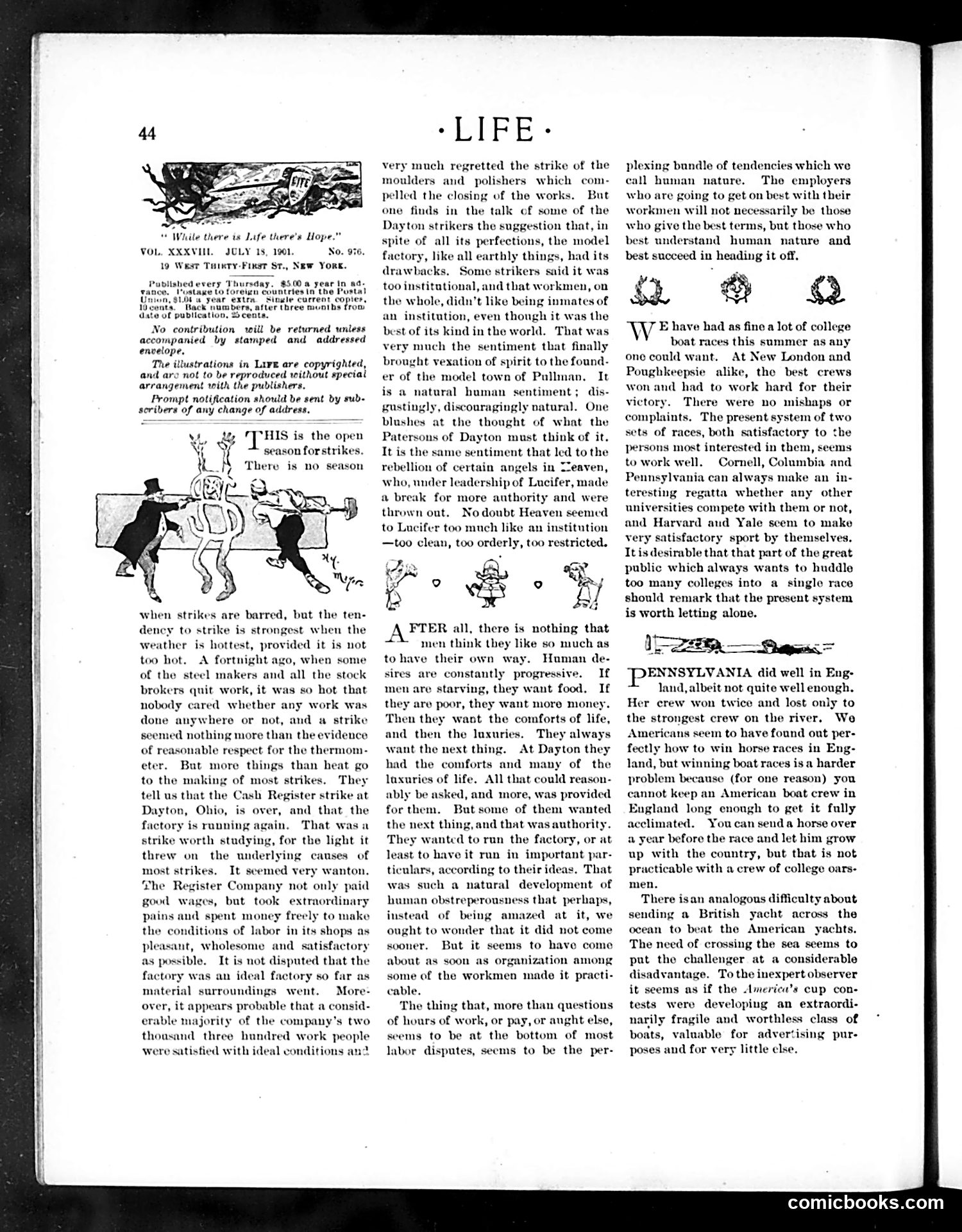
The page contains two editorial cartoons about labor strikes. The upper cartoon depicts what appears to be workers or strikers in conflict, illustrating the article's discussion of the Dayton, Ohio factory strike. The lower cartoon shows a figure riding a bucking horse or donkey, labeled with text suggesting labor unrest and the tension between workers demanding better conditions and factory management. The articles discuss strikes as natural human expression of desires for better wages, working conditions, and authority—comparing strikers' sentiment to historical religious rebellion. The piece argues that factory owners should recognize these demands as reasonable rather than viewing strikes as purely destructive. The satire critiques rigid institutional resistance to worker autonomy and progressive change.
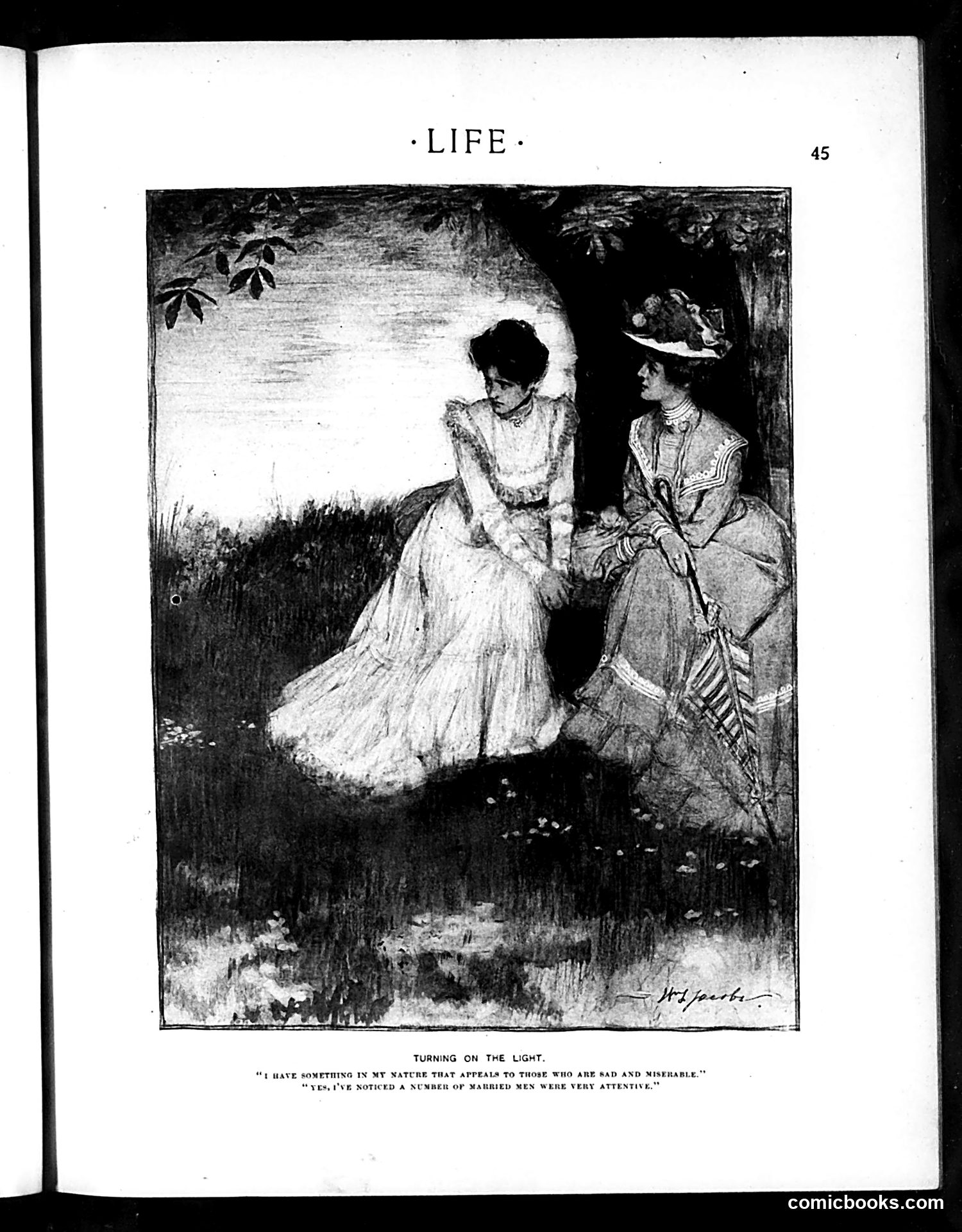
This illustration depicts two elegantly dressed women in an outdoor setting, with the caption referencing a conversation about an attractive quality that appeals to "sad and miserable" people. One woman notes she's observed married men being "very attentive." The satire appears to target **infidelity and marital behavior**. The title "Turning on the Light" suggests revealing hidden truths—here, the observation that married men display particular attentiveness to women outside marriage, presumably because they're unhappy at home. The sophisticated drawing style and witty dialogue reflect *Life* magazine's typical approach: using elegant compositions and understated humor to critique upper-class social behavior and relationship dynamics. The work satirizes both male infidelity and the social awareness women maintained regarding such conduct in early 20th-century American society.
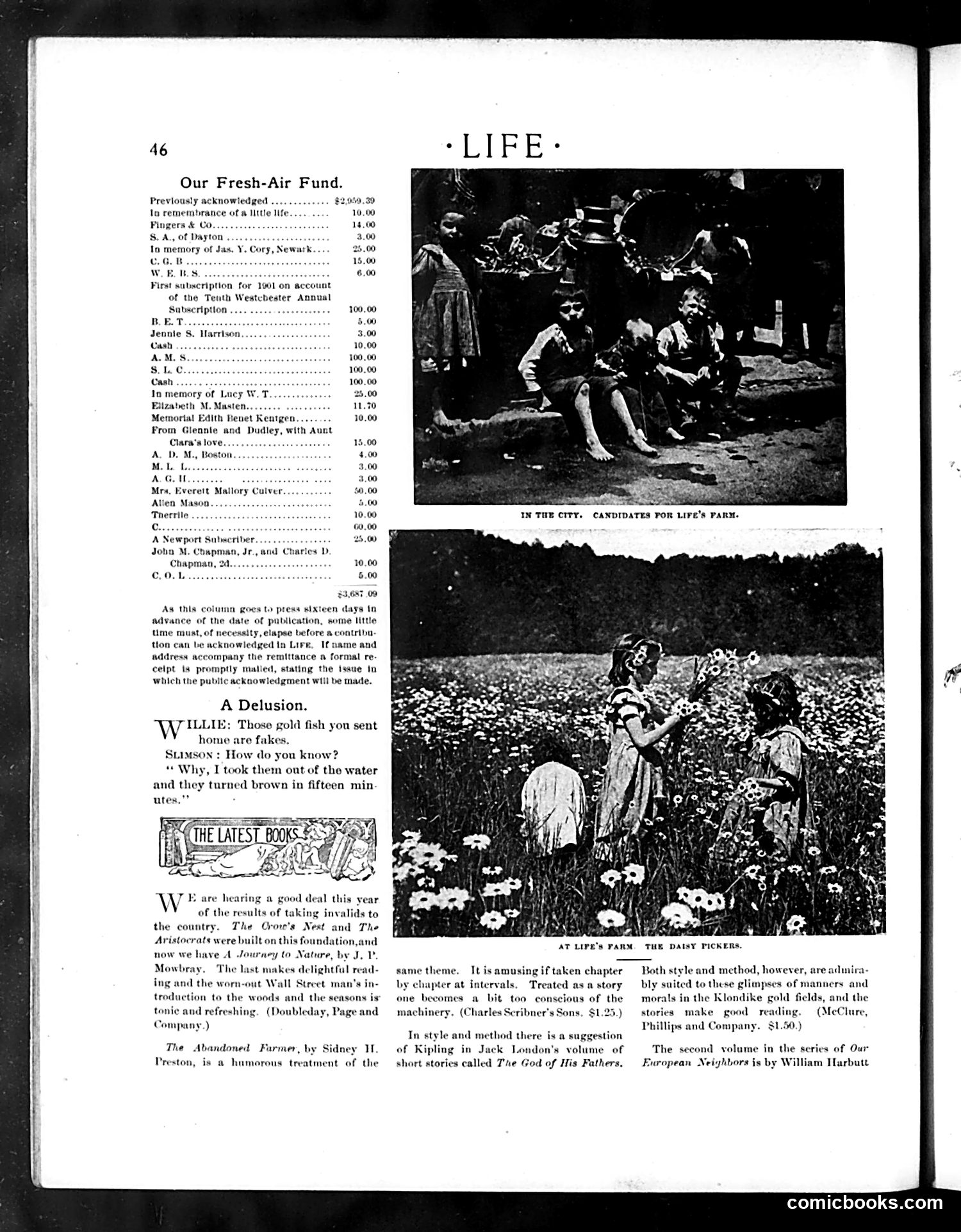
This page contains two photographs rather than traditional political cartoons. The top image, captioned "IN THE CITY: CANDIDATES FOR LIFE'S PARK," shows urban children in what appears to be a crowded city setting. The bottom photograph, "AT LIFE'S PARK: THE DAISY PICKERS," depicts children in a pastoral field of flowers. The implicit satire contrasts urban childhood deprivation with rural idyll—a common Progressive Era theme. "Life's Park" appears to be a charitable initiative (referenced in the "Fresh-Air Fund" list on the left) providing country experiences for city children. The juxtaposition critiques industrial urban conditions while celebrating nature's restorative benefits for poor youth. This reflects early 20th-century reformist attitudes about fresh air, nature, and children's welfare.
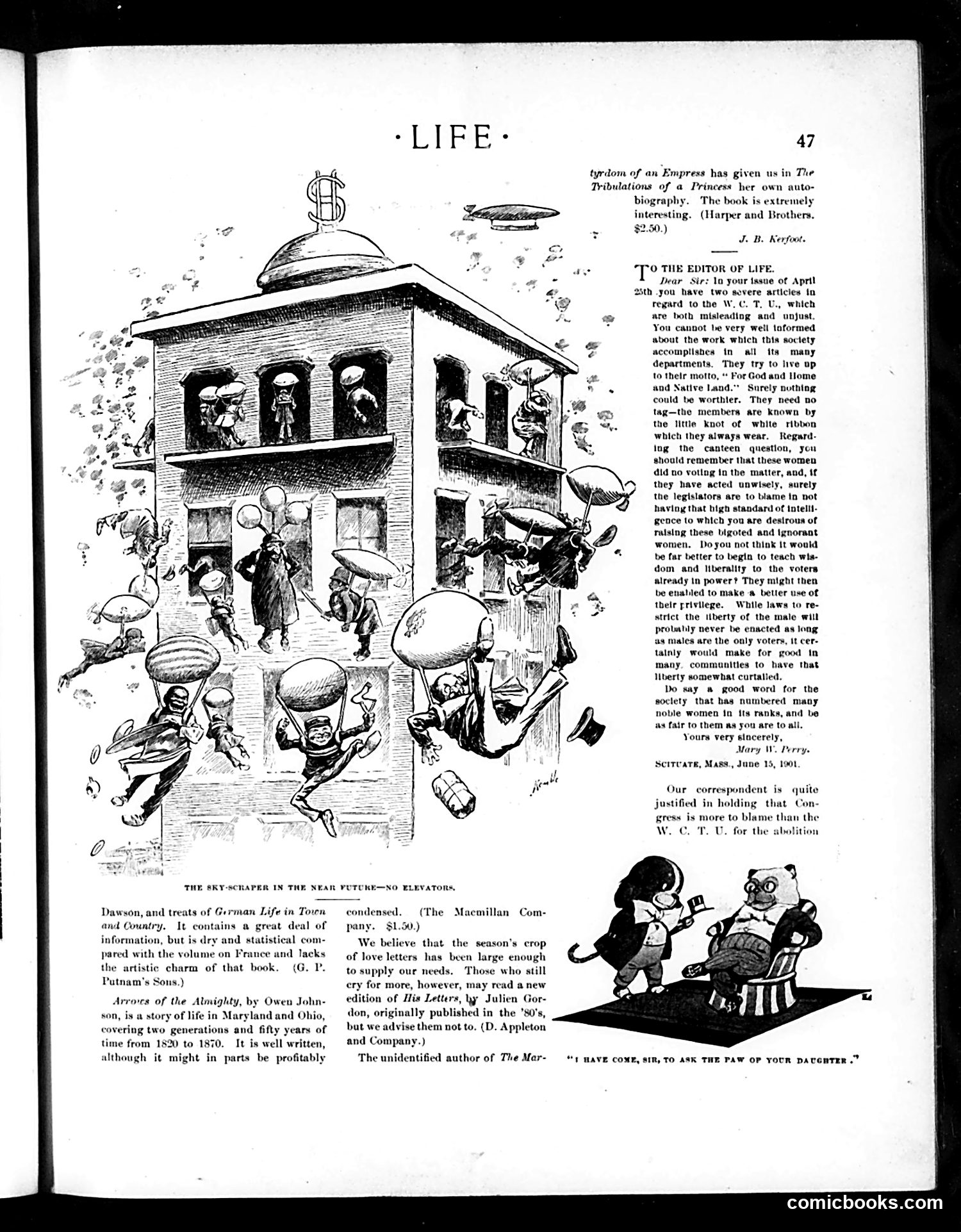
This cartoon satirizes the growing women's suffrage movement of early 1900s America. The image depicts a fantastical tall building where women—identifiable by their dress and appearance—are shown working at various levels, apparently without elevators for transport. The satire appears to mock anti-suffrage arguments: opponents claimed granting women voting rights would disrupt social order and workplace efficiency. By showing a building that functions chaotically without proper infrastructure (elevators), the cartoonist likely ridicules such fears as absurd. The accompanying letter from a suffragist responds to critics, defending women's capability and intelligence, and arguing that restricting women's rights contradicts democratic principles. The cartoon thus presents both the satirical anti-suffrage perspective and its rebuttal.
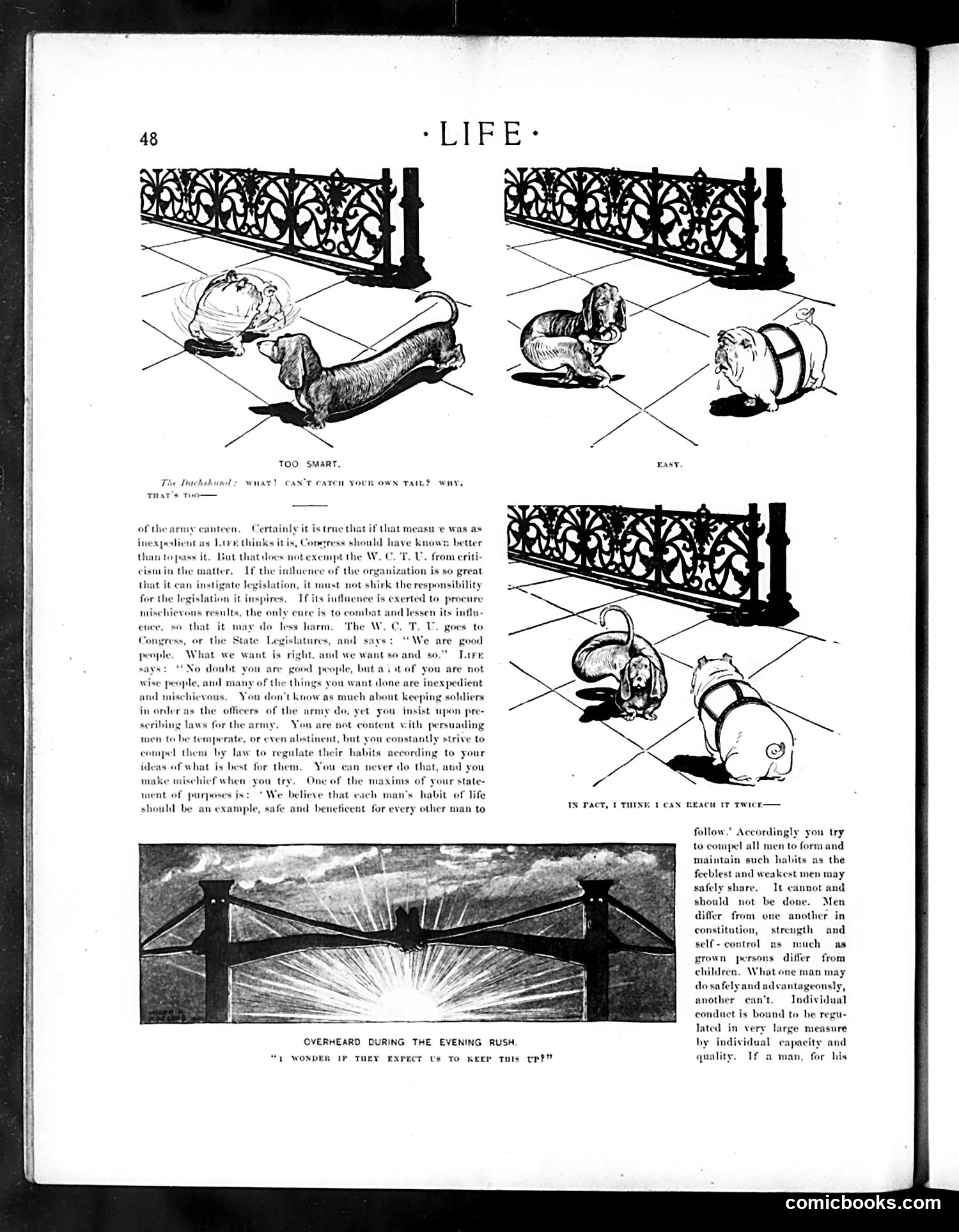
This page contains satirical cartoons about a dachshund attempting to catch its own tail—a futile, self-defeating pursuit. The caption "Too Smart" introduces the joke: the dog asks "Why can't I catch your own tail? Why, that's too—" The subsequent panels ("Easy" and "In Fact, I Think I Can Reach It Twice") show the dachshund's persistent failure despite varying approaches and confidence levels. The accompanying text critiques labor organizations (specifically referencing the W.C.T.U. and army cantee disputes), arguing that leaders who prescribe rigid behavioral codes to workers contradict claims of respecting individual liberty and judgment. **The satire**: Just as the dachshund cannot catch what it pursues, organizations pursuing contradictory goals—demanding conformity while claiming to champion freedom—chase futility.
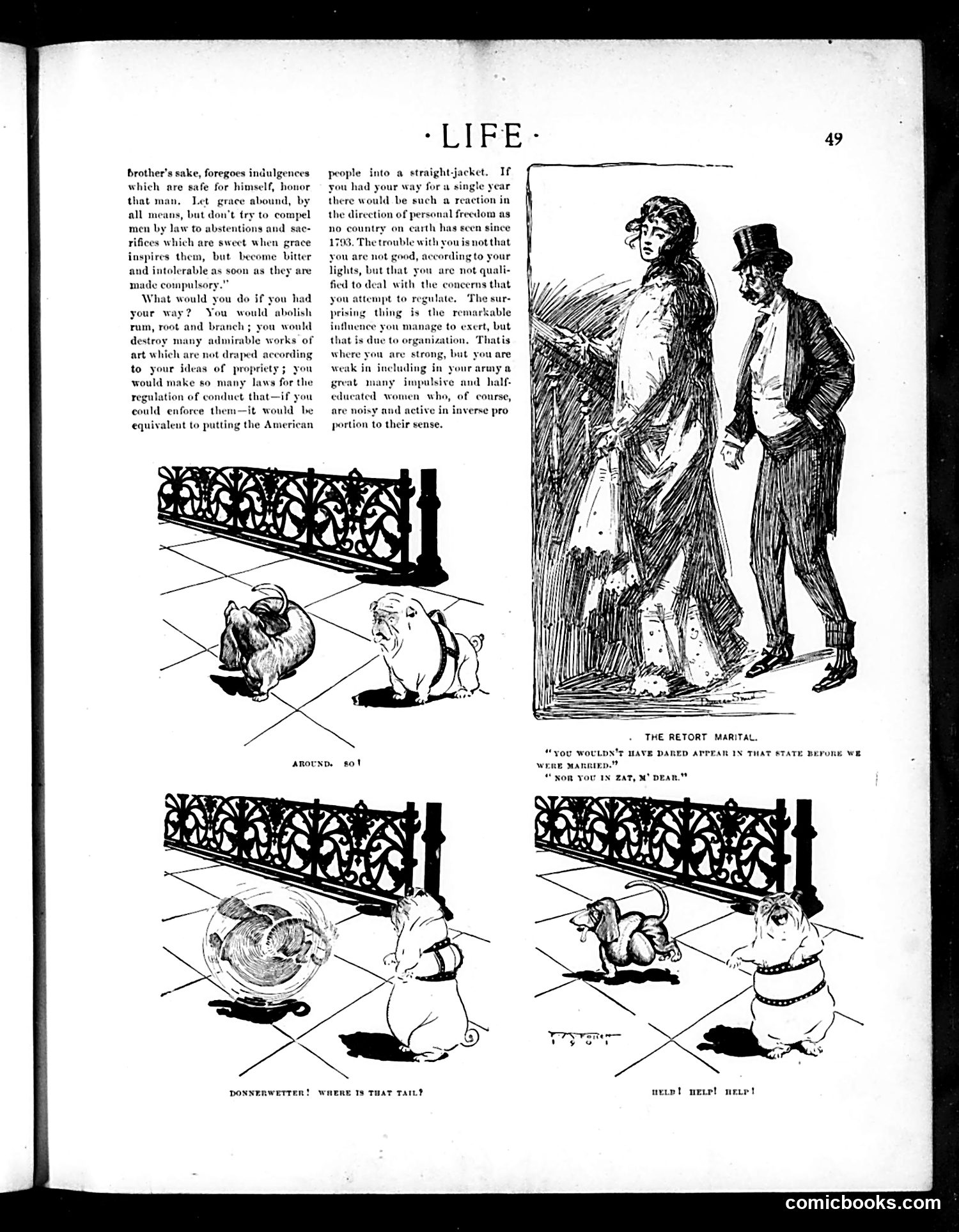
The page contains a satirical article about personal freedom and government regulation, paired with an unrelated comic strip about dogs. The main text argues against excessive state control, warning that compulsory laws destroy personal liberty and art. It criticizes those who would regulate conduct—calling such regulation "equivalent to putting the American people into a straight-jacket." **"The Retort Marital"** is a separate four-panel comic strip showing dogs in increasingly absurd situations: first fighting, then one spinning, then chasing, finally seeking help. The dialogue captions ("Around, no!", "Donnerwetter! Where is that tail?", "Help! Help! Help!") suggest marital discord played for humor through animal antics—a common Victorian-era joke format. The two items appear unrelated, likely from different contributors to this satirical magazine.
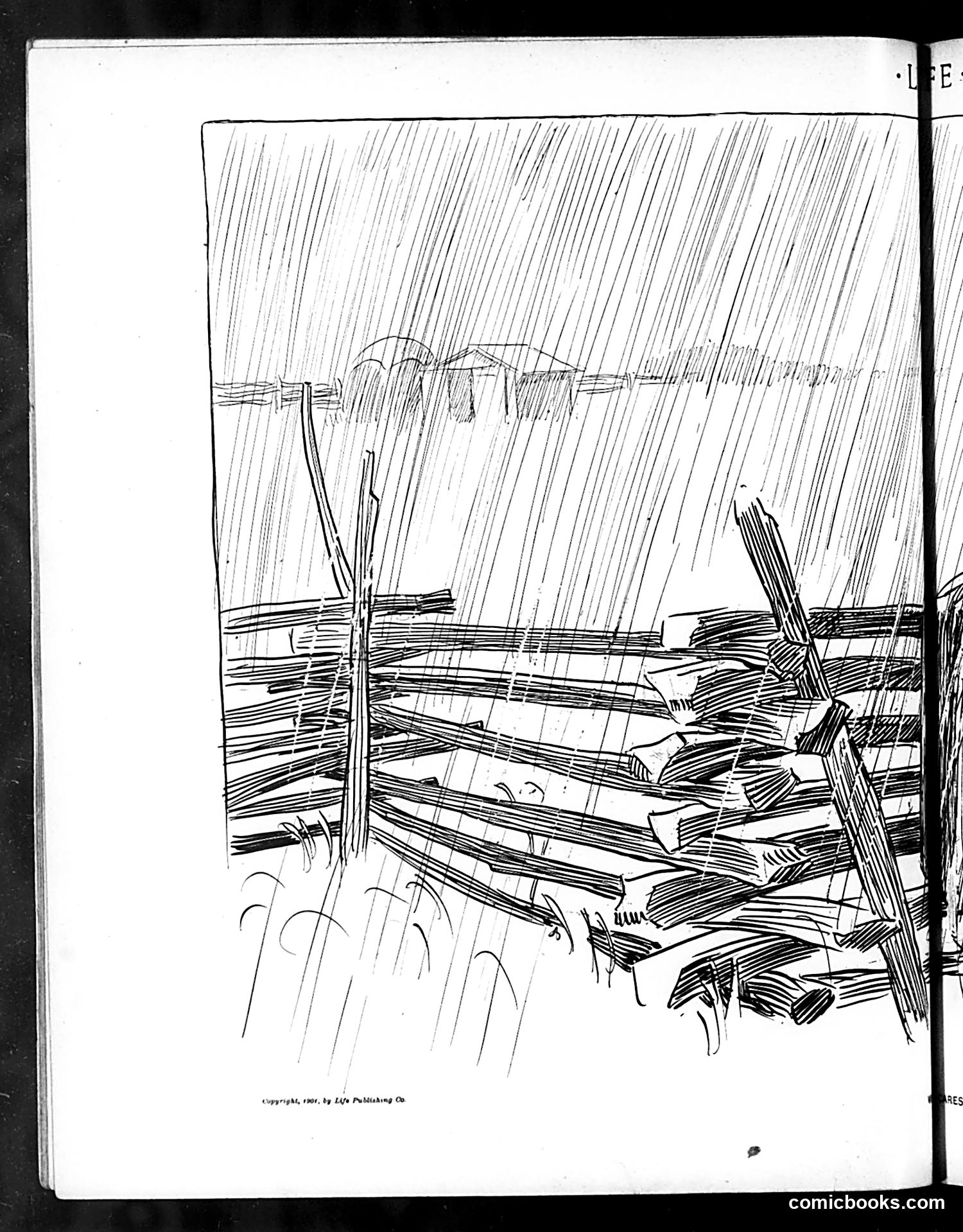
This is a black and white sketch depicting a rural wooden fence in heavy rain. The drawing shows detailed cross-hatching to convey falling rain and wet conditions, with a split-rail or post-and-rail fence in the foreground. The style is characteristic of early-to-mid 20th century editorial illustration. However, **I cannot identify any political figures, caricatures, or satirical message** from the image alone. There is no visible text on the cartoon itself that would indicate its satirical purpose or target. The copyright line at the bottom credits "Life Publishing Co." but provides no date or artist attribution visible in this reproduction. Without additional context or caption text from the original Life magazine page, I cannot explain what political or social commentary this illustration was intended to convey.
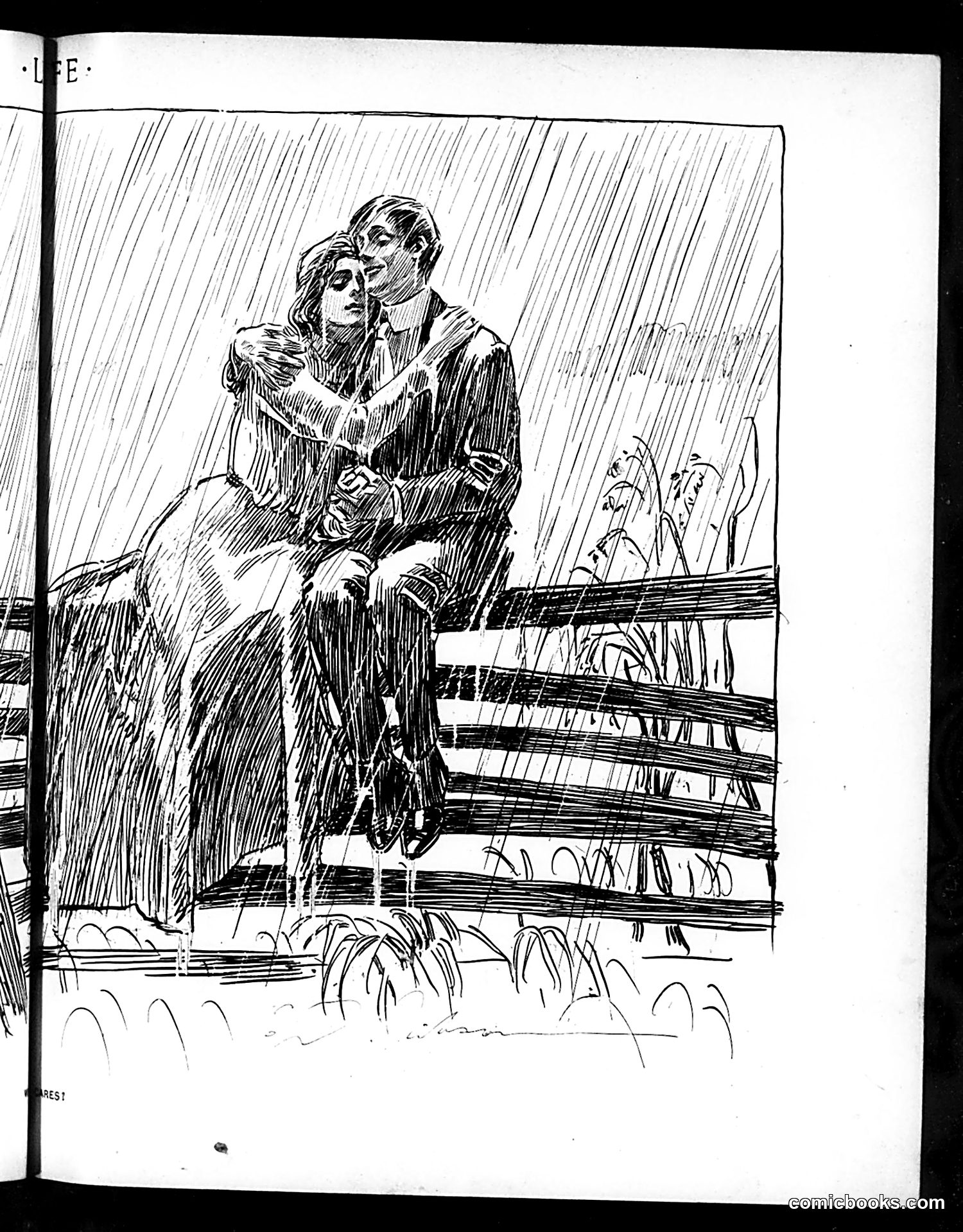
This illustration depicts a romantic scene from what appears to be early 20th-century American literature or drama. A man and woman sit together on a wooden fence during heavy rain, gazing upward together. The woman wears a long dress typical of the period, while the man is in a suit jacket. The image appears to be a sentimental illustration rather than political satire. It romanticizes a moment of shared vulnerability and intimacy between two figures during inclement weather. The dramatic rain (indicated by heavy cross-hatching) and their upward gaze suggest they're sharing an emotional connection despite—or perhaps heightened by—difficult circumstances. Without additional context from the magazine's accompanying text or title, I cannot identify the specific literary or theatrical reference this may illustrate, nor can I determine if there's intended social commentary beyond the romantic narrative presented.
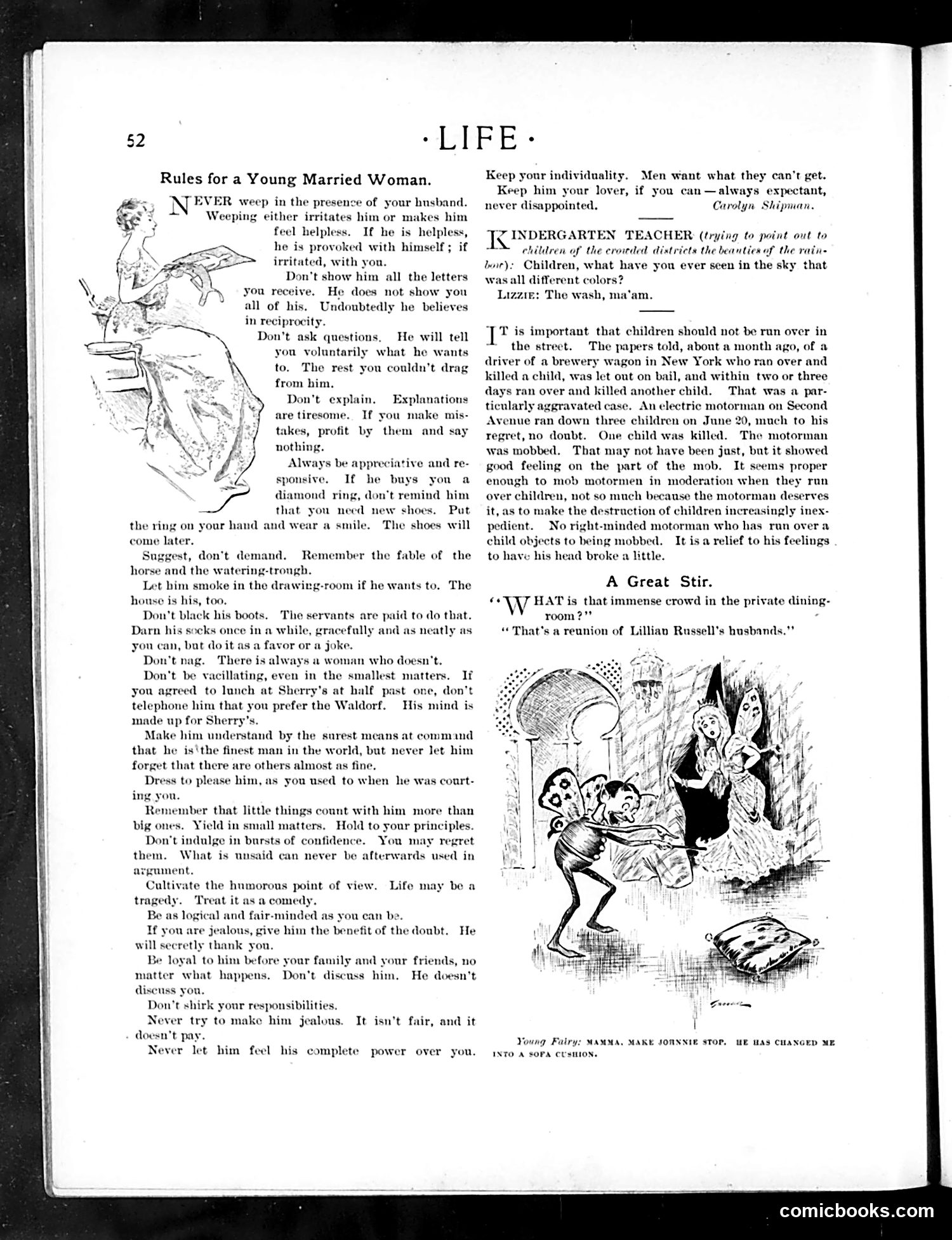
This page contains two distinct pieces of satirical content: **"Rules for a Young Married Woman"** (left): A tongue-in-cheek advice column offering exaggerated marital guidance. It mocks contemporary expectations of subservient wives—advising women never to weep before husbands, avoid asking questions, don't explain themselves, and essentially accept male dominance without complaint. The satire critiques these oppressive social norms by presenting them as absurdly extreme. **"A Great Stir"** (right): A cartoon showing what appears to be a chaotic domestic scene with multiple figures in a dining room. The caption references "Lillian Russell's husbands," suggesting it satirizes the famous actress's multiple marriages. The cartoon ridicules either her marital history or the social spectacle surrounding celebrity relationships. Both pieces mock rigid gender roles and marriage expectations of the era through exaggeration and humor.
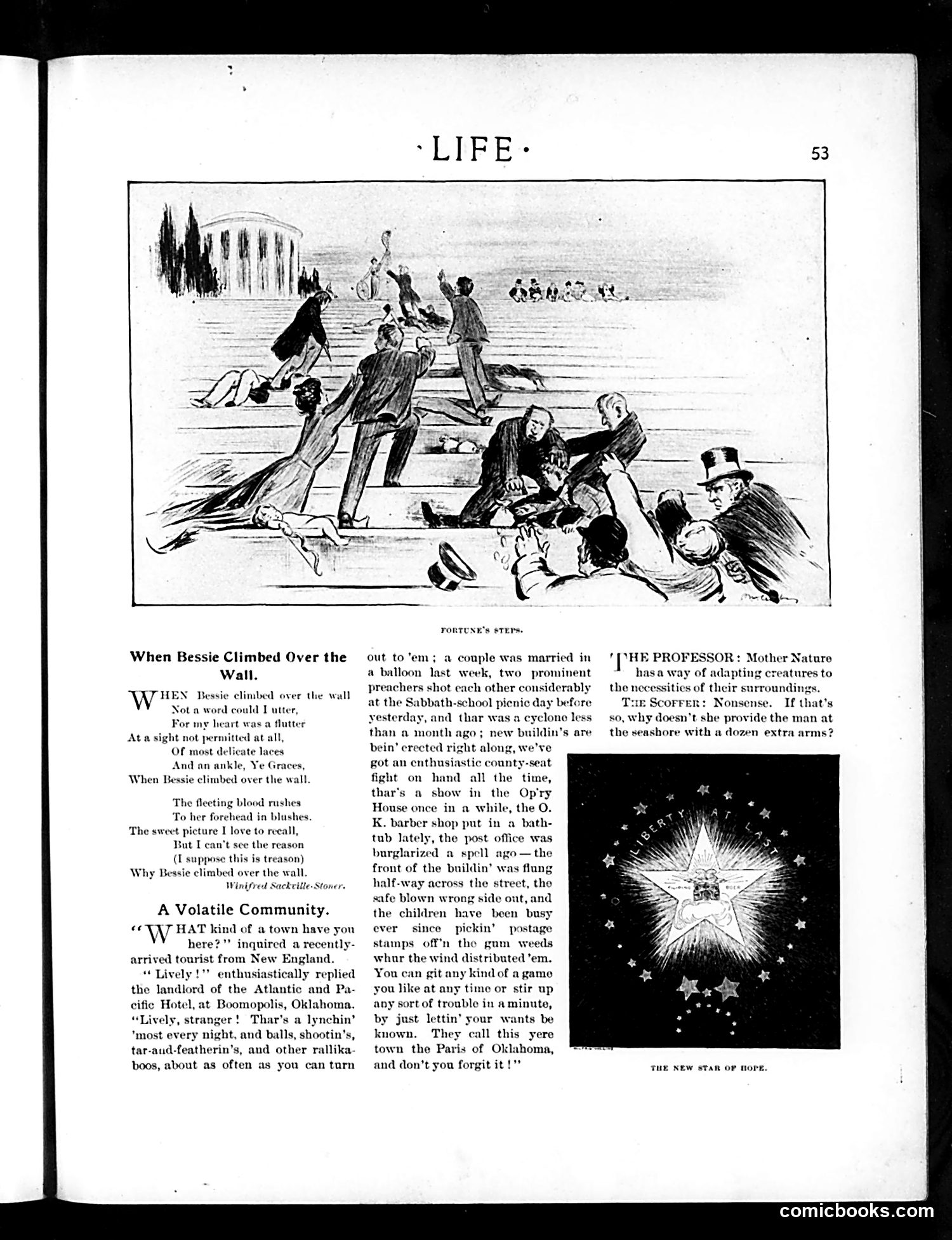
This page contains three separate satirical pieces typical of Life magazine's humor: 1. **"When Bessie Climbed Over the Wall"**: A romantic poem by Winifred Sackville-Stoner about a young woman climbing a wall, suggestively implying glimpses of undergarments ("delicate laces"). The satire targets Victorian prudishness and the speaker's simultaneous shock and fascination. 2. **"A Volatile Community"**: A humorous dialogue where an Oklahoma hotel landlord boasts of his town's chaotic, violent character—lynchings, shootings, tar-and-feathering, cyclones—presented as signs of "liveliness." This satirizes frontier lawlessness and the braggadocio of boom towns, while implying social disorder masquerades as progress. 3. **"Fortune's Steps"**: A brief philosophical joke where "The Professor" claims nature adapts creatures to their environment, and "The Scoffer" retorts that seashore men lack extra arms despite needing them—mocking pseudo-scientific evolutionary arguments through absurdist logic. The top illustration depicts chaotic social scenes, reinforcing themes of disorder and impropriety throughout the page.
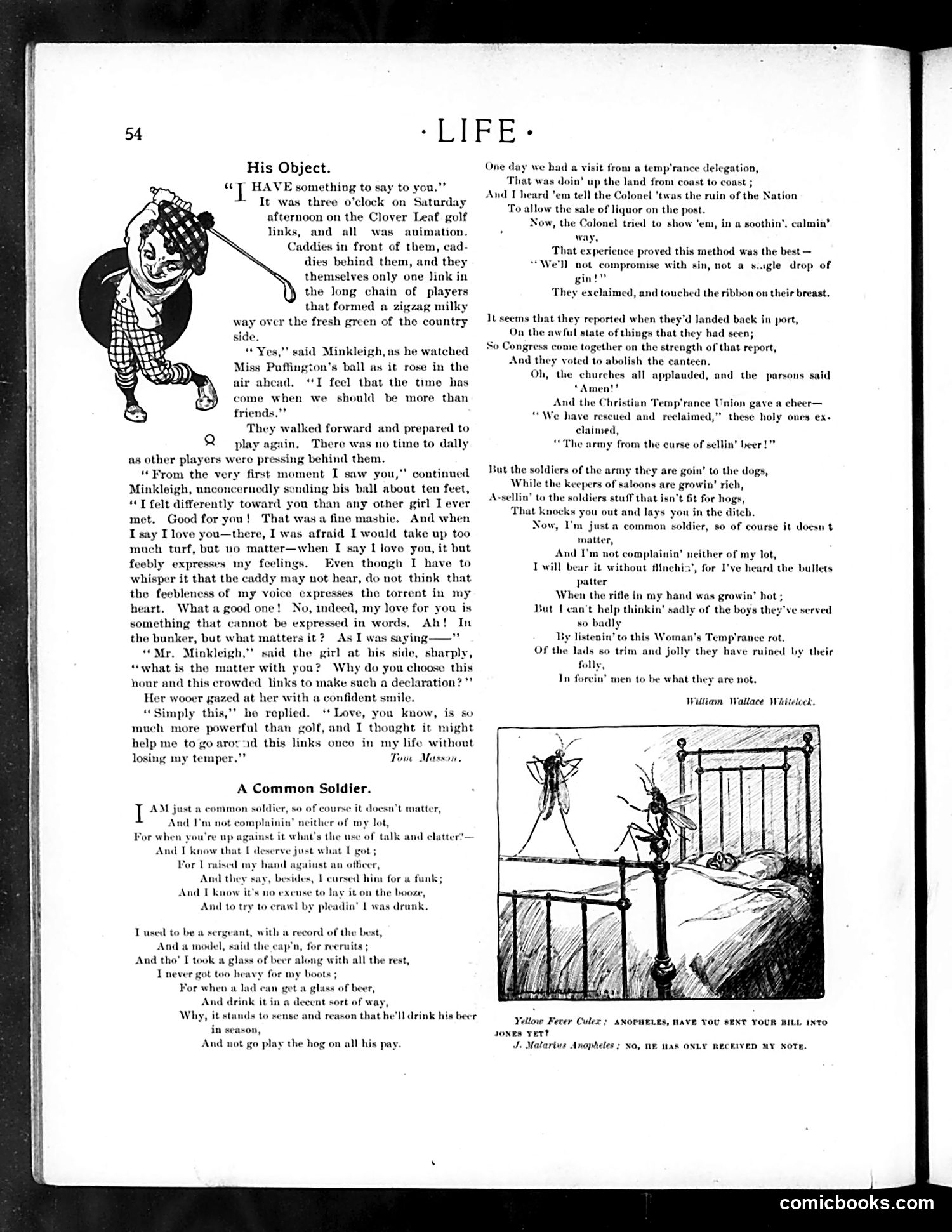
This page contains two satirical pieces from *Life* magazine: **"His Object"** mocks romantic ineptitude. A man named Minkleigh attempts to propose marriage to Miss Puffington during a golf game, awkwardly declaring his love while simultaneously playing poorly and worrying about disturbing other golfers. The humor lies in the contrast between grand romantic sentiments and the absurd, mundane setting—he can't focus on either golf or romance, constantly apologizing for bad shots mid-declaration. **"A Common Soldier"** is a poem criticizing Prohibition's unintended consequences. A sergeant recounts how temperance activists convinced Congress to abolish the army canteen (where soldiers could buy regulated alcohol). The result: soldiers now purchase dangerous bootleg liquor from civilian saloons instead. The soldier's resigned tone ("I'm just a common soldier, so of course it doesn't matter") underscores the irony—well-intentioned moral reform actually worsens the problem it aimed to solve. Both pieces use humor to critique social pretension and misguided earnestness.
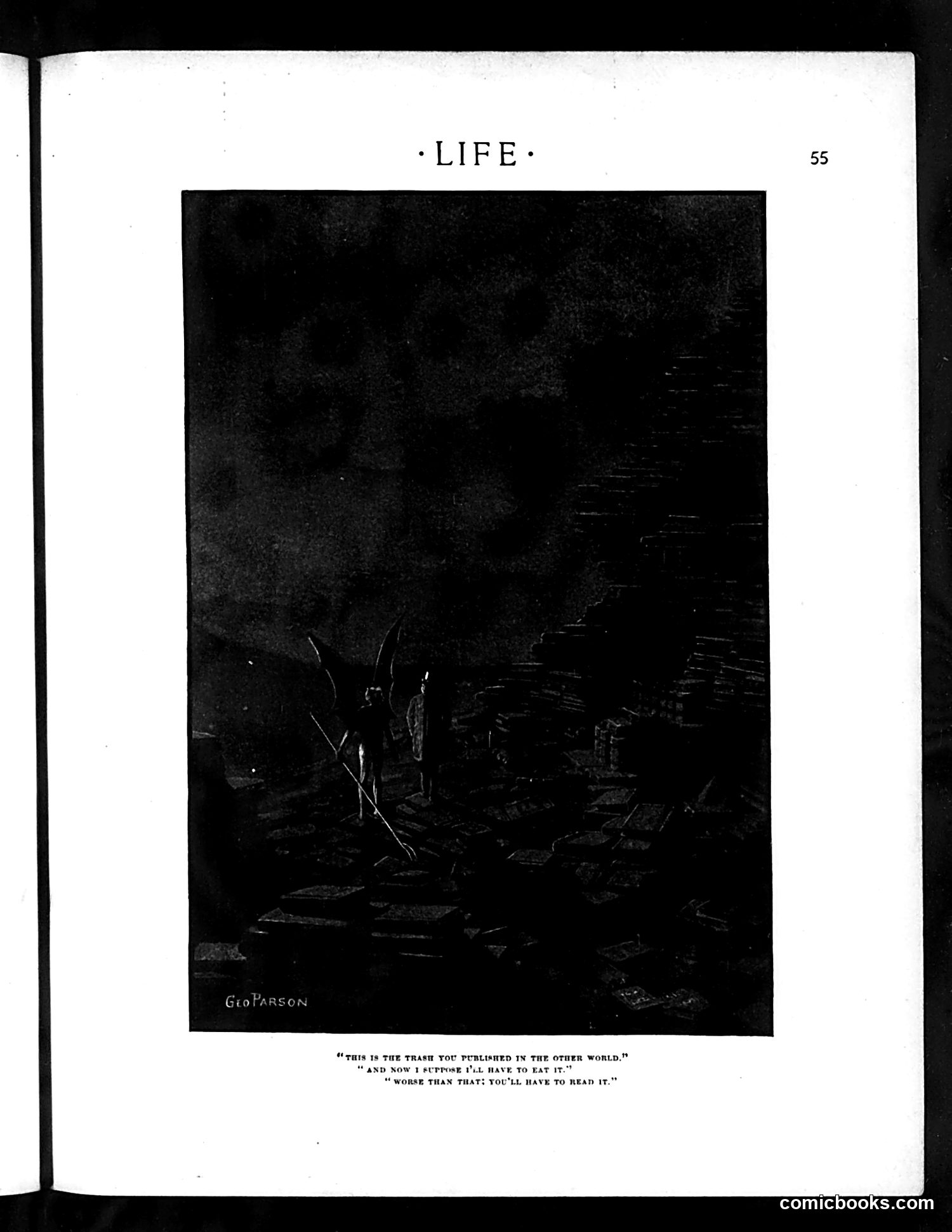
This appears to be a satirical cartoon about publishing and literary criticism. The image shows a dark, somewhat grim scene with a figure confronting what seems to be a published work or manuscript. The dialogue suggests a publisher or editor is being confronted about a "trash" publication from "the other world"—likely a humorous reference to a poorly-received book. The joke escalates: first the character must eat the trash, then worse, they must *read* it—implying that actually perusing bad writing is the greatest punishment of all. This is a common early-20th-century satire trope mocking both poor literary output and the torment of mandatory reading. The cartoonist is credited as "Geo Parson." The humor relies on exaggeration of the suffering involved in encountering bad literature.
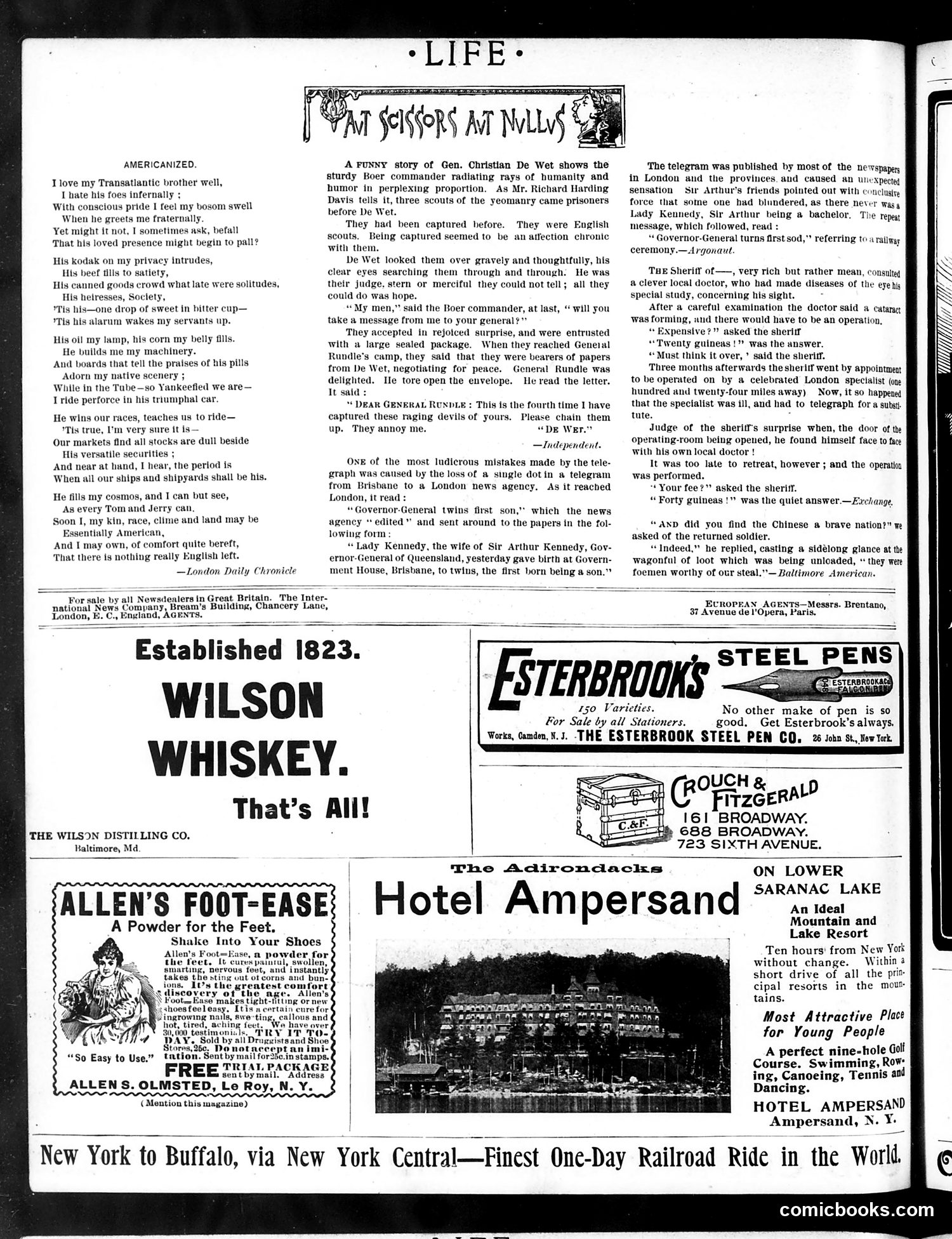
This page primarily contains **humorous anecdotes and satirical poetry** rather than editorial cartoons. The main feature is a poem titled "AMERICANIZED" from the *London Daily Chronicle*, which satirizes British anxiety about American economic and cultural dominance. The poet complains that American technology, products, wealth, and heiresses are overwhelming British life—from kodaks invading privacy to canned goods, oil lamps, machinery, and railroad cars. The joke is that Britain is becoming "Essentially American," stripping away English identity. This reflects real early-1900s anxieties about American industrial and economic power. Below are humorous stories, including one about Boer General De Wet repeatedly capturing the same English scouts and sending them back with a message calling them annoying—satirizing their repeated incompetence. Another jokes about a telegraph error that invented a fictional Lady Kennedy. The page is primarily **advertisements** (Wilson Whiskey, Esterbrook Pens, Hotel Ampersand), indicating this is a typical commercial magazine layout of the era.
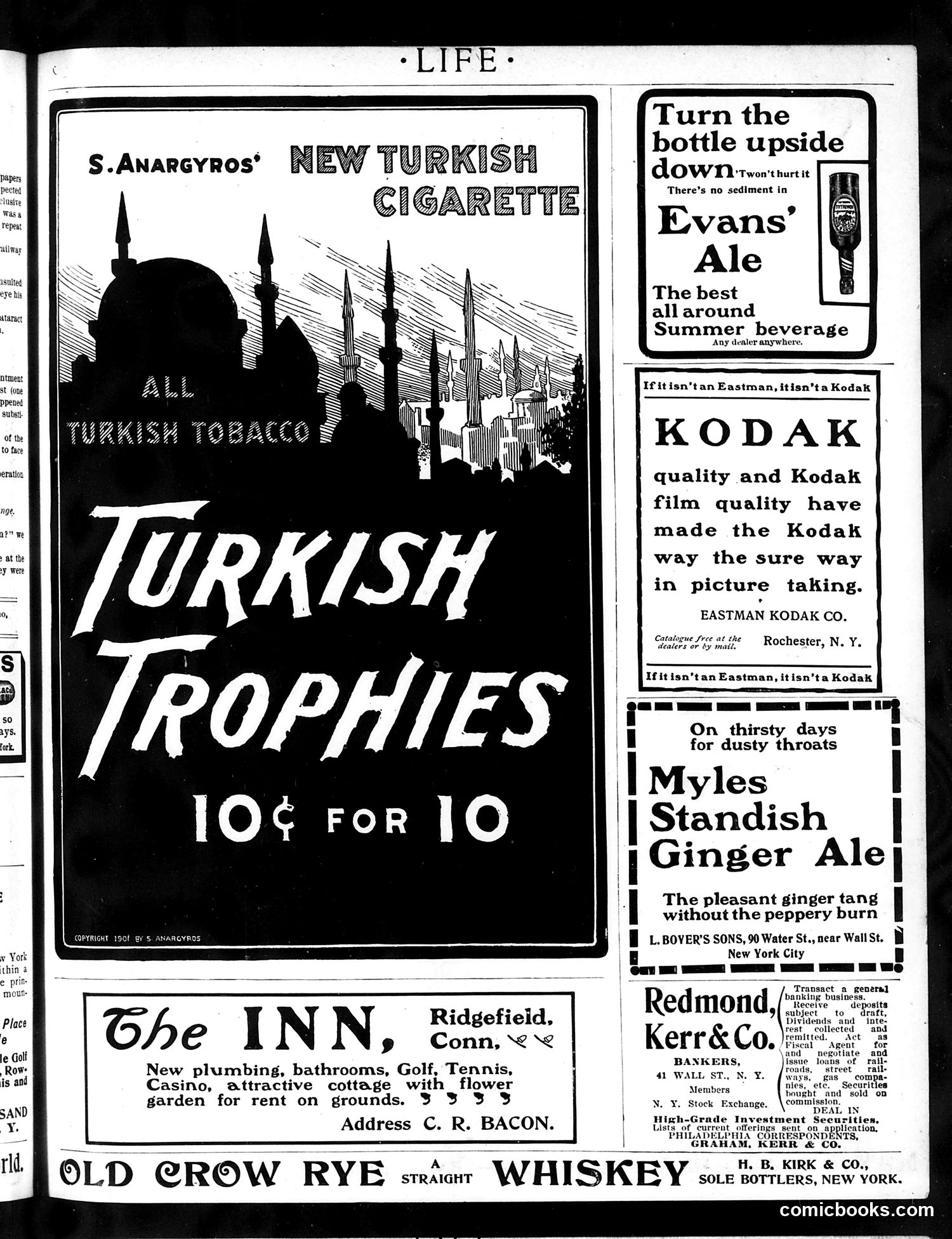
This page is primarily **advertising**, not editorial cartoon content. The dominant feature is S. Anargyros's advertisement for "Turkish Trophies" cigarettes (10¢ for 10), featuring a silhouette of a mosque or Middle Eastern cityscape—a marketing appeal to exotic "Turkish tobacco" that was fashionable among American smokers in this era. The surrounding advertisements promote various consumer products: Evans' Ale, Kodak film, Myles Standish Ginger Ale, and Old Crow Rye whiskey. There's also a resort listing for The Inn in Ridgefield, Connecticut, and a banking/securities firm advertisement. **No political satire is evident.** This appears to be a typical early-20th-century Life magazine page mixing light editorial content with period advertisements. The "Turkish" branding reflects contemporary consumer marketing rather than any commentary on Ottoman politics or international affairs. The page documents early American advertising aesthetics and consumer culture of the era.
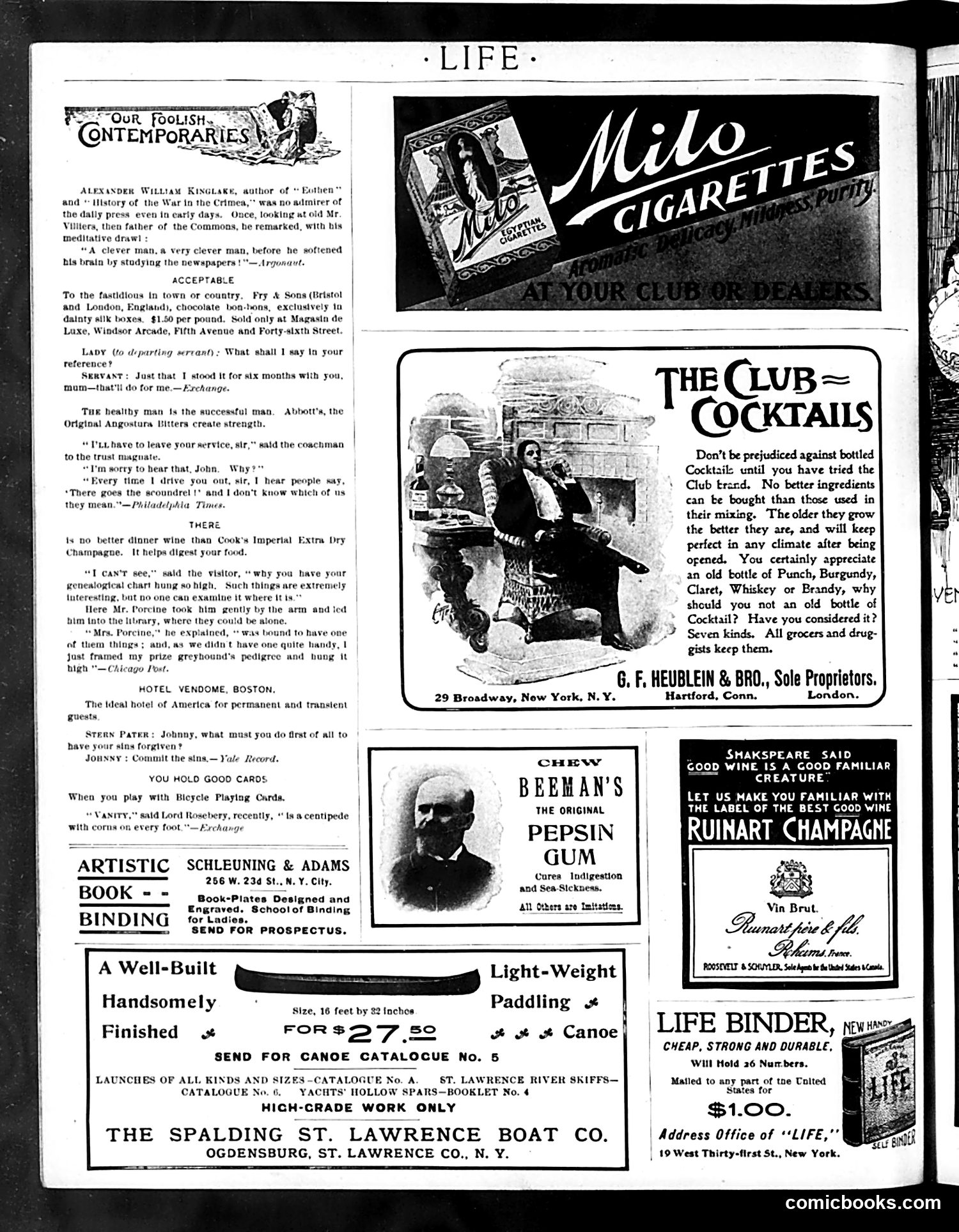
This page is primarily **advertising with minimal editorial content**. The small satirical pieces are era-typical humor: **"Our Foolish Contemporaries"** contains brief anecdotes mocking newspaper reading, servant employment, and social pretense—standard turn-of-the-century magazine filler jokes with no specific political target. **The illustrations** appear to be decorative vignettes accompanying product ads rather than political cartoons. The central image shows what appears to be a generic Victorian-era domestic or street scene, unrelated to current events. **The advertisements dominate**: champagne, cigars, chocolate, boat manufacturers, and cocktail mixers reflect Gilded Age luxury consumption. The Beeman's Pepsin Gum ad and references to digestive aids were common remedies of the period. **No identifiable political figures or events** are depicted or referenced on this page. This is a commercial publication page, not a satirical commentary on contemporary politics or society.
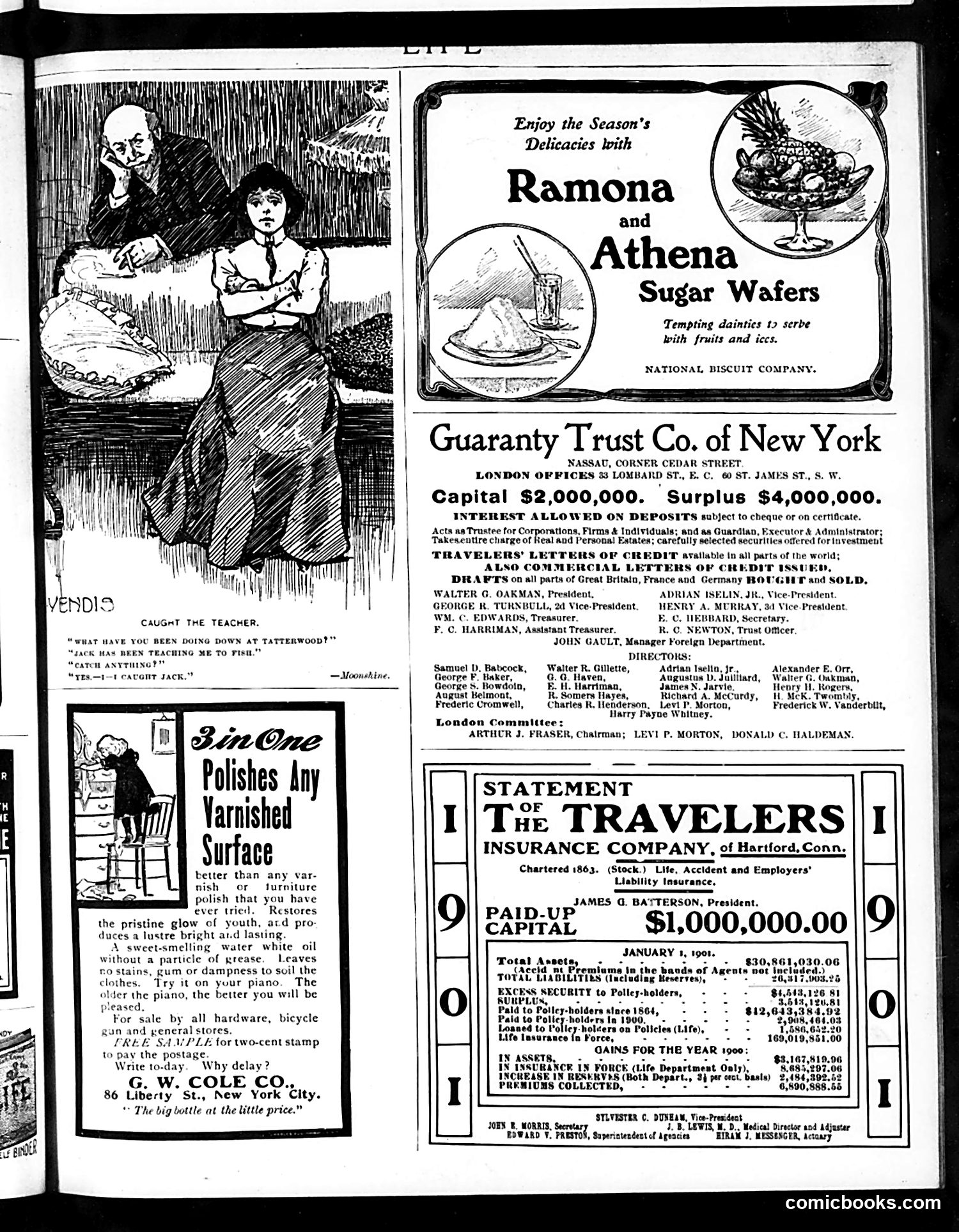
This cartoon depicts a domestic scene where a father questions his son about activities "down at Tatterwood" (likely a local spot or establishment). The boy admits that "Jack has been teaching me to fish," and when asked if he caught anything, replies "Yes—I—I caught Jack." The joke's humor relies on a double meaning: the boy is reporting that while learning to fish from Jack, he actually "caught" Jack himself—likely meaning he caught Jack in some mischief or embarrassing situation, or possibly that Jack fell in the water. The implication is that the lesson didn't go as intended, with humorous consequences for the instructor. The cartoon satirizes the gap between adult expectations and children's actual experiences, and the unpredictable outcomes of informal instruction.
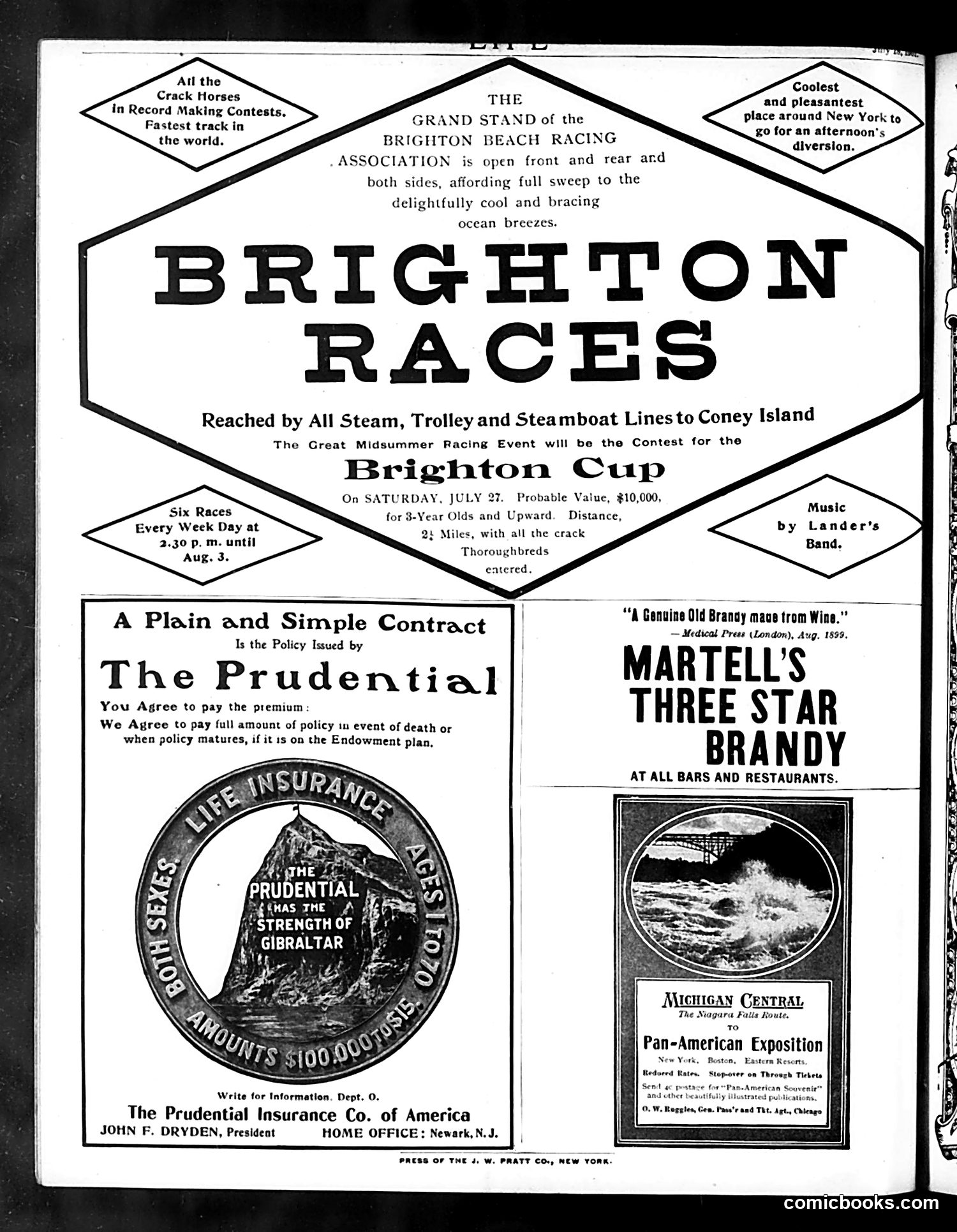
This page is primarily **advertising**, not satirical content. It features three main commercial advertisements from early 1900s America: 1. **Brighton Beach Races** (top): Promotes horse racing at Brighton Beach, Coney Island—a popular New York leisure destination. The copy emphasizes accessibility via public transit and the cooling ocean breezes, marketing it as an affordable summer diversion for working-class New Yorkers. 2. **The Prudential Insurance** (bottom left): Advertises life insurance with their Gibraltar logo, emphasizing simplicity and reliable payouts. 3. **Martell's Three Star Brandy** and **Michigan Central Railway** (right side): Promote luxury goods and travel to the Pan-American Exposition. The page reflects early-1900s consumer culture—mixing entertainment, insurance products, and luxury imports. There is **no political satire or cartoon commentary visible**. This appears to be a standard advertising section of *Life* magazine, which relied heavily on commercial revenue.