
Life, 1901-07-18 · page 3 of 20
Life — July 18, 1901 — page 3: what you’re looking at
What you’re looking at
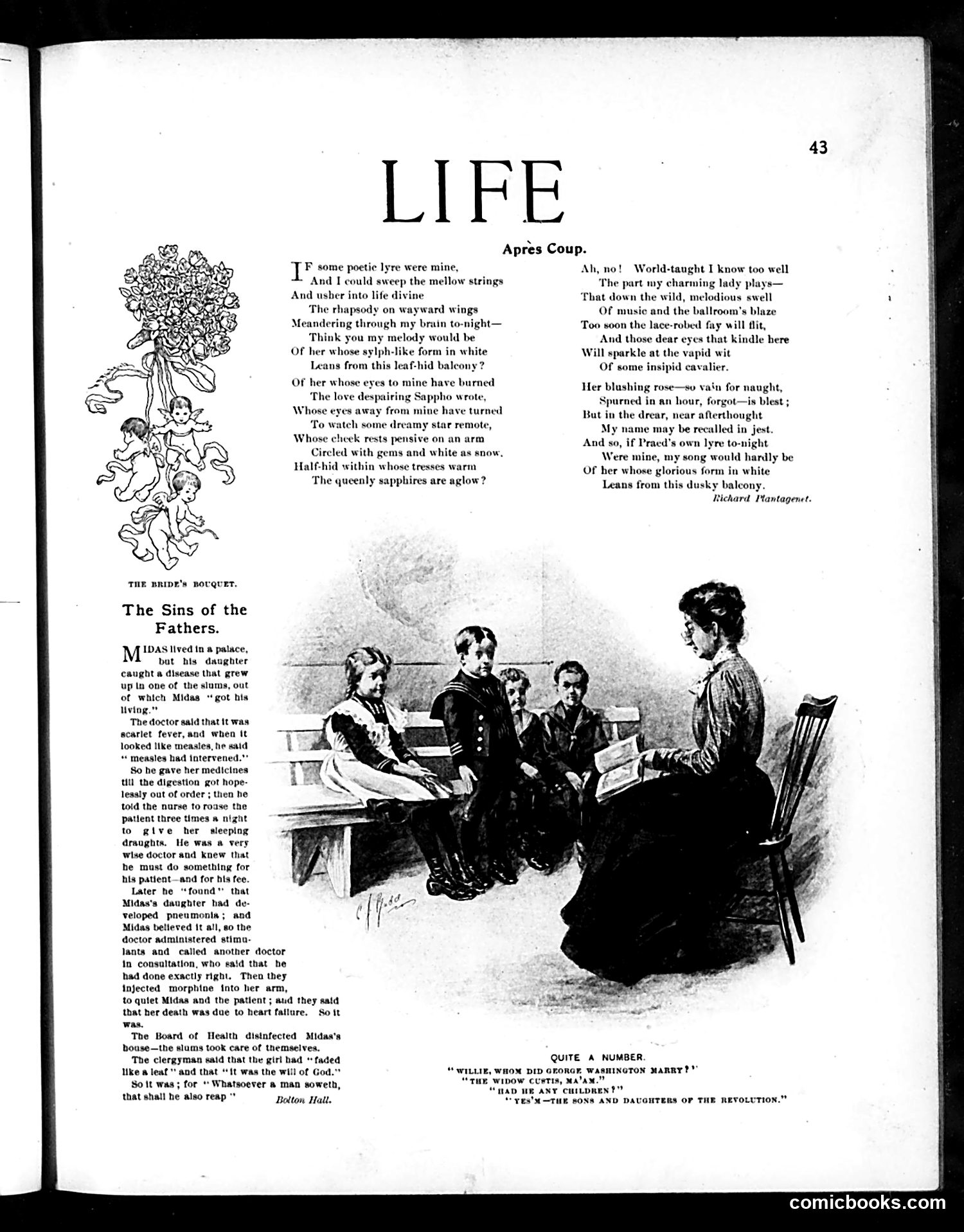
This page contains two distinct pieces: **"Après Coup"** (top): A poem by Richard Hovey about romantic regret—a man reflecting on a woman he failed to appreciate, imagining how his poetry might have moved her had he possessed greater talent. **"The Sins of the Fathers"** (bottom): A medical cautionary tale about Midas, whose daughter contracts pneumonia. A doctor administers morphine to ease her suffering, but this contributes to her death from heart failure. The story warns that parental sins (Midas's greed) produce consequences in children, and that even well-intentioned medical treatment can prove fatal. The accompanying illustration shows a doctor attending to a young patient while family members observe anxiously—a common Victorian-era theme exploring medicine's limitations and moral consequences.
📄 Transcribed text from this page (OCR, searchable)
Machine-transcribed from the original scan — historical spelling and the odd misread are preserved.
LIFE Apres Coup. LF some poetic lyre were mine, And I could sweep the mellow strings And usher into life divine The rhapsody on wayward wings Meandering through my brain to-night— Ah, no! World-taught I know too well ‘The part my charming lady plays— That down the wild, melodious swell Of music and the ballroom’s blaze Too soon the lace-robed fay will fit, Think you my melody would be Of her whose sylph-like form in white Leans from this leaf-hid balcony? And those dear eyes that kindle here Will sparkle at the vapid wit Of some insipid cavalier. Of her whose eyes to mine have burned Her blushing rose—so vain for naught, __ The love despairing Sappho wrote, Spurned in an hour, forgot—is blest ; Whose eyes away from mine have turned Bat in the drear, near afterthought To watch some dreamy star remote, My may be recalled in jest Whose check rests pensive on an arm And $0, if Pracd’s own lyre to-night Circled with gems and white as snow, Were tulue, uiy soog would hanlly be Half-hid within whose tresses warm Of lier whose plorions form in white The queenly sapphires are aglow? Leans from this dusky balcony. Richard Plantagenet. THE BRIDE'S BOUQUET. The Sins of the Fathers. IDAS lived in a palace, but his daughter caught a disease that grew up In one of the slums, out of which Midas “got bis living.” The doctor said that it was scarlet fever, and when it looked tke measles, he said + measles had intervene: So he gave her medicines Ul the digestion got hope- lessly out of order ; then he told the nurse to roase the patient three times a night to give her sleeping draughts, He was a very wise doctor and knew that he must do something for his patient—and for his fee. Later he ‘found" that Midas‘s daughter had de- veloped pneumonia; and Midas believed {t all, 80 the doctor administered stima- lants and called another doctor in consultation, who said that he had done exactly right, Then they injected morphine into her arm, to quiet Midas and the patient ; aud they sald that her death was due to heart fatlure. So it was, The Board of Health disinfected Midas's house—the slums took care of themselves. ‘The clergyman said that the girl had “faded like a leaf" and that “{t was the will of God.” So It was; for “ Whatsoever @ man soweth, that shall he also reap * Bolton Halt. QUITE A NUMBER. WHOM DID GEORGE WASHINGTON MARRY?" “THR WIDOW CURTIS, MATAM.” MAD HE ANY CHILDREN t” ‘Yes’ —THE SONS AND DAUGHTERS OF THE REVOLUTION.” comicbooks.com