
Life, 1901-07-18 · page 4 of 20
Life — July 18, 1901 — page 4: what you’re looking at
What you’re looking at
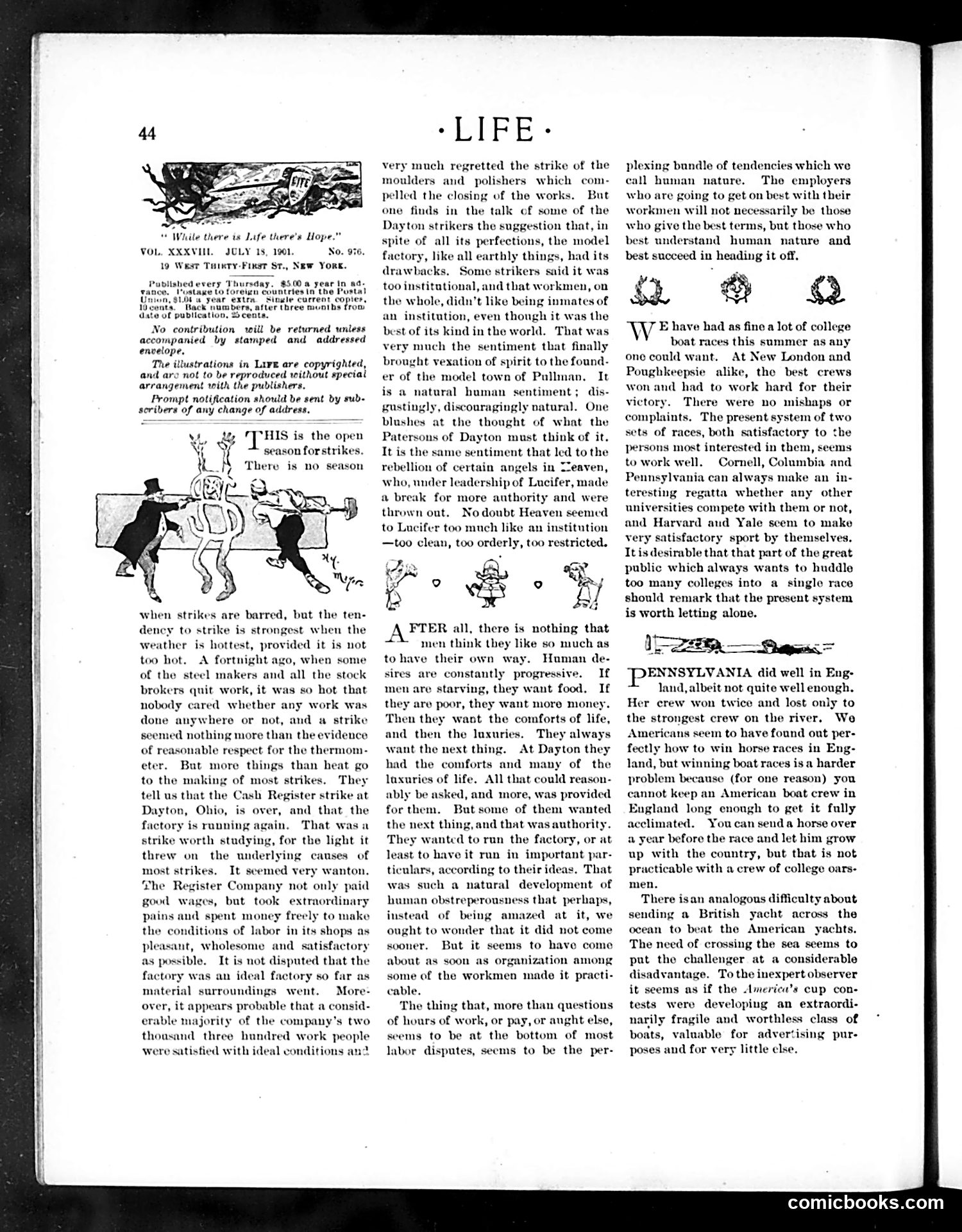
The page contains two editorial cartoons about labor strikes. The upper cartoon depicts what appears to be workers or strikers in conflict, illustrating the article's discussion of the Dayton, Ohio factory strike. The lower cartoon shows a figure riding a bucking horse or donkey, labeled with text suggesting labor unrest and the tension between workers demanding better conditions and factory management. The articles discuss strikes as natural human expression of desires for better wages, working conditions, and authority—comparing strikers' sentiment to historical religious rebellion. The piece argues that factory owners should recognize these demands as reasonable rather than viewing strikes as purely destructive. The satire critiques rigid institutional resistance to worker autonomy and progressive change.
📄 Transcribed text from this page (OCR, searchable)
Machine-transcribed from the original scan — historical spelling and the odd misread are preserved.
«While there is Life there's Hope.” XXXVIIL. JOLY 15, 1901. No. 976. 19 West Taixty-Finst 81 ‘ew YORK. VOL. sday. $500 a year in aa. n countries ta the SLDb a year extra je current copies Back numbers, a ree muntbs fro dato of publication, cent No contribution will be returned unless accompanied by stamped and addressed envelope. The illustrations in Lire are copyrighted, and aro not to be reproduced without special arrangement with the publishers. Prompt notification should be sent by sub- soribers of any change of address. THIS is the open season forstriki There is no season Ww & ‘4 Ath when strikes are barred, but the ten- to strike is strongest when the weather is hottest, provided it is not too hot. A fortnight ago, when some of the steel makers and all the stock brokers quit work, it was so hot that nobody cared whether any work was done anywhere or not, and a strike seemed nothing more than the evidence of reasonable respect for the thermom- eter. But more things than heat go to the making of most strikes. They tell us that the Cash Register strike at Dayton, Ohio, is over, and that the factory is running again. That was a strike worth studying, for the light it threw on the underlying causes of most strikes. It seemed very wanton, ‘The Register Company not only paid good wages, but took extraordinary pains and spent money freely to make the conditions of labor in its shops as pleasant, wholesome and satisfactory as possible. It is not disputed that the was an ideal factory so far as ul surroundings went. More- over, it appears probable that a consid- erable majority of the company’s two thousand three hundred work people were satistied with ideal conditions an? denc LIPE y much regretted the strike of the moulders and polishers which com- pelled the closing of the works. But one finds in the talk of some of the Dayton strikers the suggestion that, in spite of all its perfections, the model factory, like all earthly things, had its drawbacks. Some strikers said it was too institutional, and that workmen, on the whole, didn’t like being inmates of an institution, even though it was the best of its kind in the world. That was very much the sentiment that finally brought vexation of spirit to the found- er of the model town of Pullman, It is a natural human sentiment; dis- gustingly, discouragingly natural. One blushes at the thought of what the Patersons of Dayton must think of it. It is the same sentiment that led to the rebellion of certain angels in Zeaven, who, under leadership of Lucifer, made a break for more authority and were thre out. Nodoubt Heaven seemed to Lucifer too much like an institution —too clean, too orderly, too restricted. ‘a ° an) my Ip 5d FTER all, there is nothing that men think they like so much as tohave their own way. Human de- sires are constantly progressi If men are starving, they want food. If they are poor, they want more money. Then they want the comforts of life, and then the luxuries. want the next thing. At Dayton they had the comforts and many of the laxuries of life. All that could reason- ably be asked, and more, was provided for them. Butsome of them wanted the next thing, and that was authority. They wanted to ran the factory, or at least to have it run in important par- ticulars, according to their ideas, That was such a natural development of human obstreperousness that perhaps, instead of being amazed at it, we ought to wonder that it did not come sooner. But it seems to yo come about as soon as organization among some of the workmen made it practi- cable. The thing that, more than questions of hours of work, or pay, or aught else, seems to be at the bottom of most labor disputes, seems to be the per- i plexing bundle of tendencies which we call human nature. The employers who are going to get on best with their workmen will not necessarily be those who give the best terms, but those who best understand human nature and best succeed in heading it off. 2% @ Q W E have had as fine a lot of college boat races this summer as any one could want. At New London and Poughkeepsie alike, the best crews won and had to work hard for their victory. There were no mishaps or complaints. The present system of two sets of races, both satisfactory to the persons most interested in them, seems to work well. Cornell, Columbia and Pennsylvania can always make an in- teresting regatta whether any other universities compete with them or not, and Harvard aud Yale scem to make very satisfactory sport by themselves. Itis desirable that that part of the great public which always wants to huddle too many colleges into a single race should remark that the present system is worth letting alone. DEE —Preaprsc = P ENNSYLVANIA did well in Eng- land, albeit not quite well enough. Her crew won twice and lost only to the strongest crew on the river. We Americans seem to have found out per- fectly how to win horse races in Eng- Jand, but winning boat races is a harder problem because (for one reason) you cannot keep an American boat crew in England long enongh to get it fully acclimated. You can senda horse over a year before the race and let him grow up with the country, but that is not practicable with a crew of college oars- men. There isan analogous difficulty about sending a British yacht across the ocean to beat the American yachts. The need of crossing the sea seems to put the challenger at a considerable disadvantage. To the inexpert observer it seems as if the America’s cup con- tests were developing an extraordi- narily fragile and worthless class of boats, valuable for advertising pur- poses and for very little else. comicbooks.com