
Life, 1901-07-18 · page 7 of 20
Life — July 18, 1901 — page 7: what you’re looking at
What you’re looking at
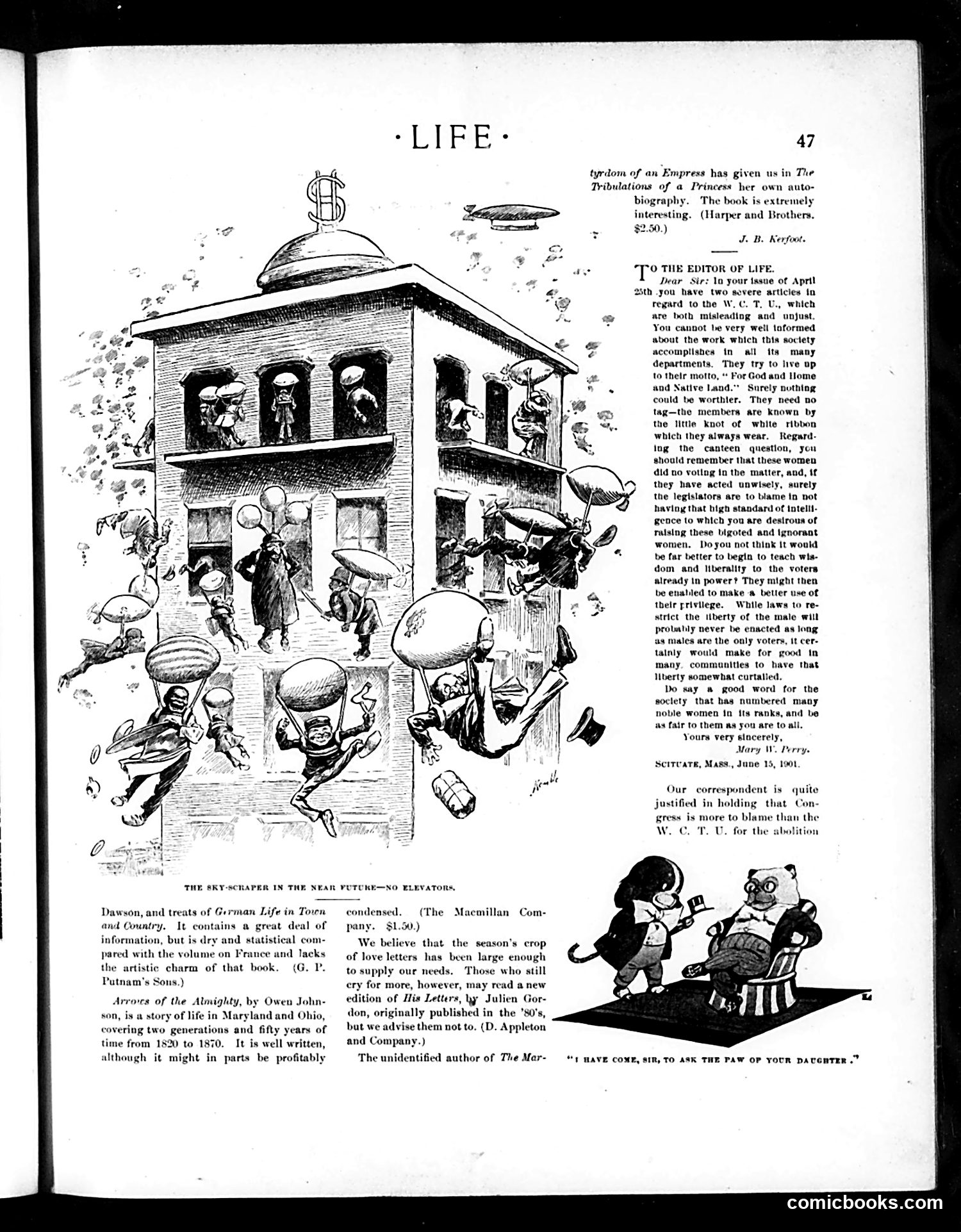
This cartoon satirizes the growing women's suffrage movement of early 1900s America. The image depicts a fantastical tall building where women—identifiable by their dress and appearance—are shown working at various levels, apparently without elevators for transport. The satire appears to mock anti-suffrage arguments: opponents claimed granting women voting rights would disrupt social order and workplace efficiency. By showing a building that functions chaotically without proper infrastructure (elevators), the cartoonist likely ridicules such fears as absurd. The accompanying letter from a suffragist responds to critics, defending women's capability and intelligence, and arguing that restricting women's rights contradicts democratic principles. The cartoon thus presents both the satirical anti-suffrage perspective and its rebuttal.
📄 Transcribed text from this page (OCR, searchable)
Machine-transcribed from the original scan — historical spelling and the odd misread are preserved.
THE SKY-SCRAPER IN THE NEAR YUTCKE—NO ELEVATORS. Dawson, and treats of German Life in Town and Country, It contains a great deal of information, but is dry and statistical com- pared with the volume on France and lacks the artistic charm of that book. (G. P. Putnam's Sons.) Arroves of the Almighty, by Owen John- , iy a story of life in Maryland and Ohio, overing two generations and fifty years of time from 1820 to 1870. It is well written, although it might in parts be profitably condensed. pany. $1.50.) (The Macmillan Com- We believe that the season's crop of love letters has been large enough to supply our needs. Those who still cry for more, however, may read a new edition of His Letters, yy Julien Gor- don, originally published in th but we advise them not to. (D. Appleton and Company.) The unidentified author of The Mar- 47 tyrdom of an Empress has given us in The Tribulations of a Princess her own auto- y.. The book is extremely (Harper and Brothers. J.B. Kerfoot. 0 THE EDITOR OF LIFE. Dear Sir: Vo your issue of April 25th you have two sovere articles in regard to the W,C. T, U., which are both misleading and unjust. You cannot be very well toformed about the work which this soctety accomplishes in all its many departments. They try to live up to thelr motto, God and Home and Native Land.” Surely nothing could be worthler. They need no tag—the members are known by the litte knot of white ribbon which they always wear. Regard. tng the canteen question, you should remember that these women did no voting tn the matter, and, if they have acted unwisely, surely the legislators are to blame in not having that bigh standard of tntellt- gence to which you are desirous of raising these bigoted and (gnorant women. Do sou not think It would be far better to begin to teach wis- dom and Iberality to the voters already in power? They might then be enabled to make @ betler use of thelr privilege. While laws to re- strict the iberty of the male wilt probably never be enacted as long as males are the only voters, It cer- talnly would make for good in many. communities to have that liberty somewhat curtalied, Do say ® good word for the soclety that bas numbered many noble women in its ranks, and be as fair to them as you are to all, Yours very sincerely, Mary W. Perry. Scituate, Mass., June 15, 1901. Our correspondent is quite justified in holding that Con- gress is more to blame than the W. CC, T. U. for the abolition “1 WAVE COME, SIR, TO ASK THE PAW OP YOUR DAUGHTER.” comicbooks.com