
A complete issue · 20 pages · 1901
Life — July 4, 1901
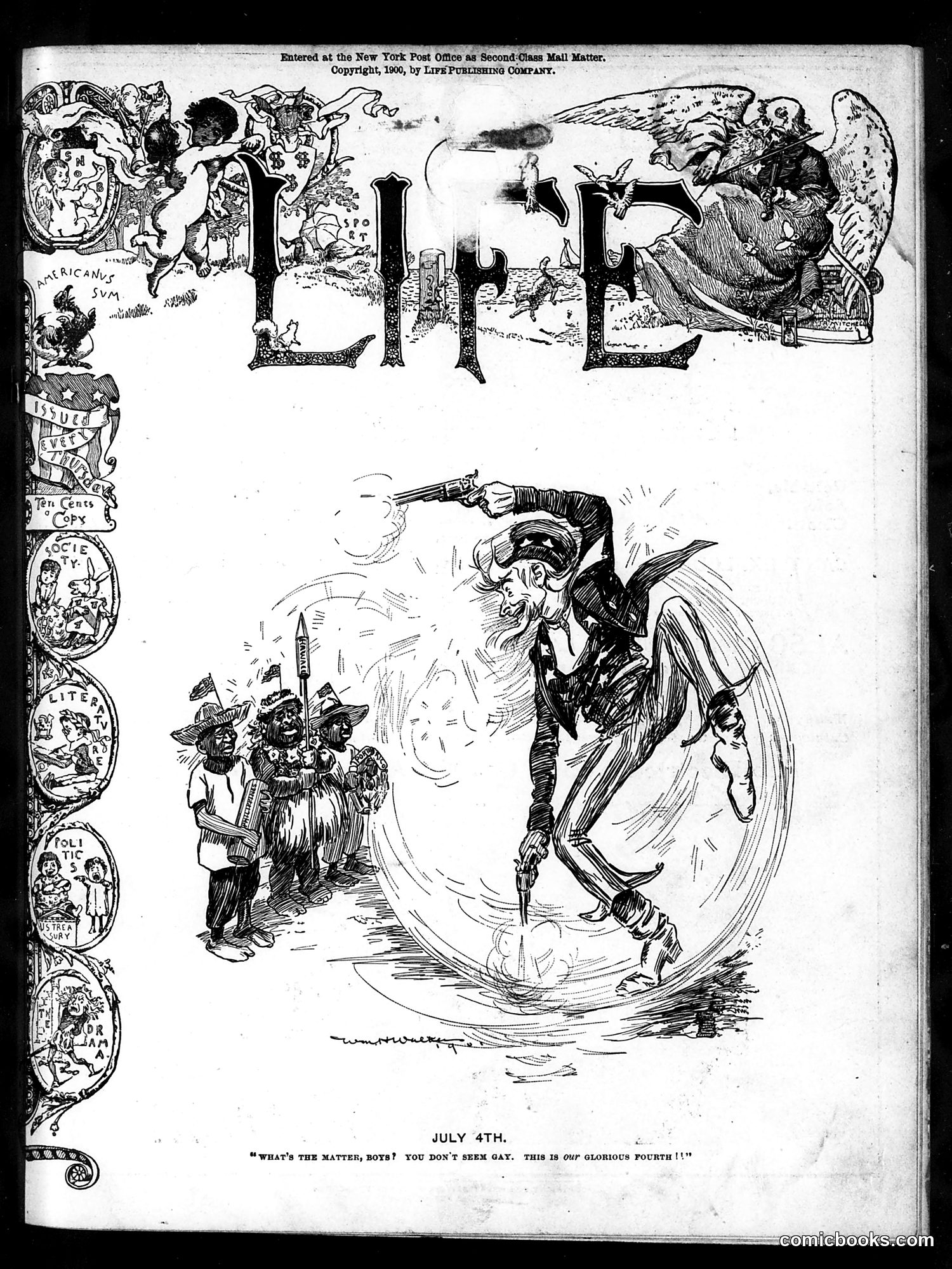
This July 4th cartoon satirizes American patriotism and national pride. A wizened, demonic figure (likely representing a cynical or corrupt perspective on America) fires a cannon at three young boys representing American youth or idealism. The figure's exaggerated features and aggressive posture suggest mockery of forced or hollow patriotism. The caption—"What's the matter, boys? You don't seem gay. This is our glorious fourth!"—implies bitter irony about Fourth of July celebrations. The artist suggests that despite official cheerfulness about American independence and freedom, something darker or more troubling underlies the nation's self-image. The ornate left border containing various emblems likely represents different American institutions or values being questioned. The overall tone critiques nationalistic fervor as potentially destructive rather than genuine.
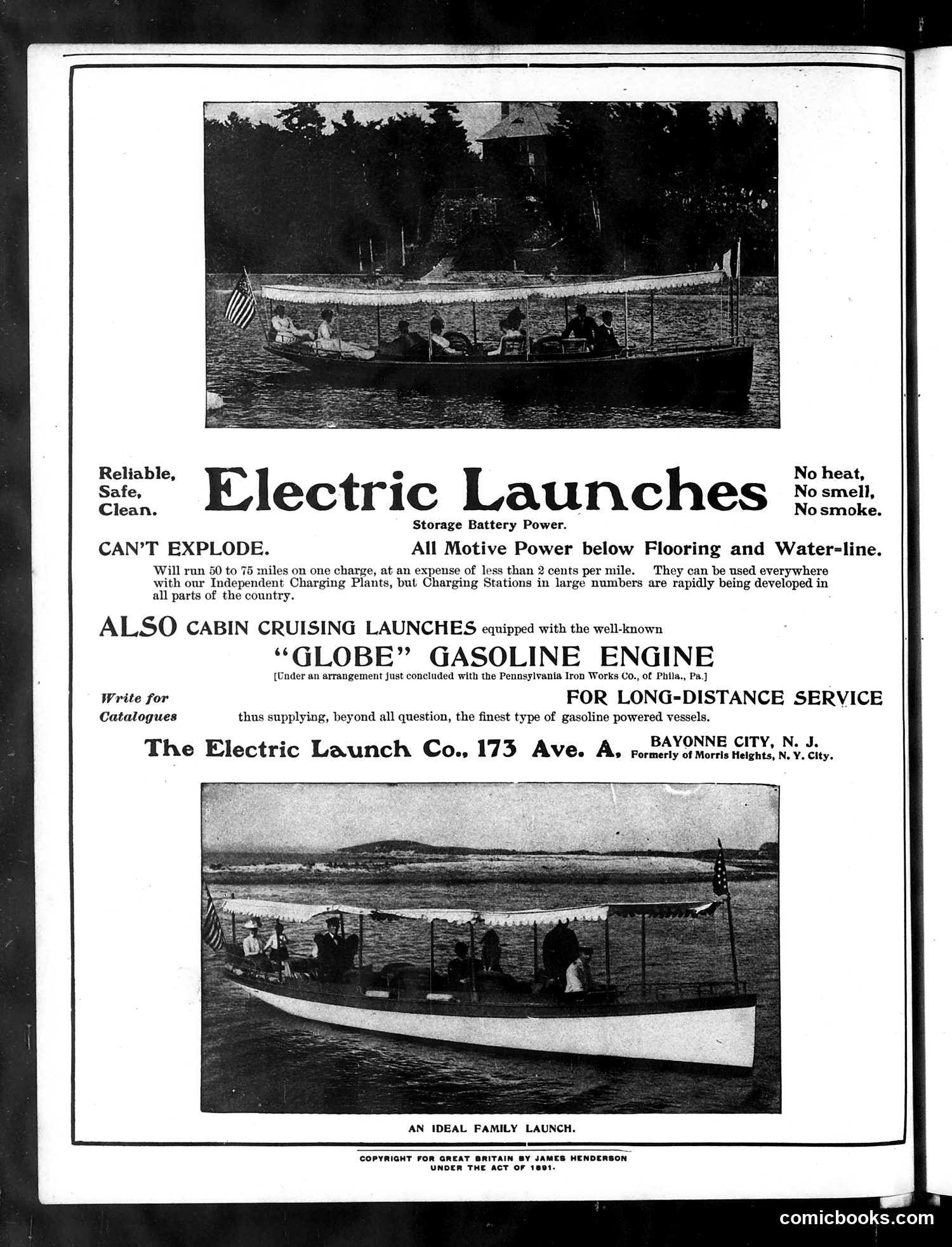
This page is **not a cartoon or satire** — it's a straightforward advertisement for The Electric Launch Company of Bayonne, New Jersey. The ad promotes two boat types: electric launches powered by storage batteries, and gasoline-powered cabin cruising launches using "Globe" engines. The electric boats are marketed with appeals to safety ("can't explode"), cleanliness (no heat, smoke, or smell), and economy (less than 3 cents per mile). Two photographs show the launches in use as family recreational boats. The ad reflects early-20th-century competition between electric and gasoline technologies for small vessels, positioning electric power as the safer, cleaner alternative — a pitch that ironically echoes modern electric vehicle marketing over a century later.
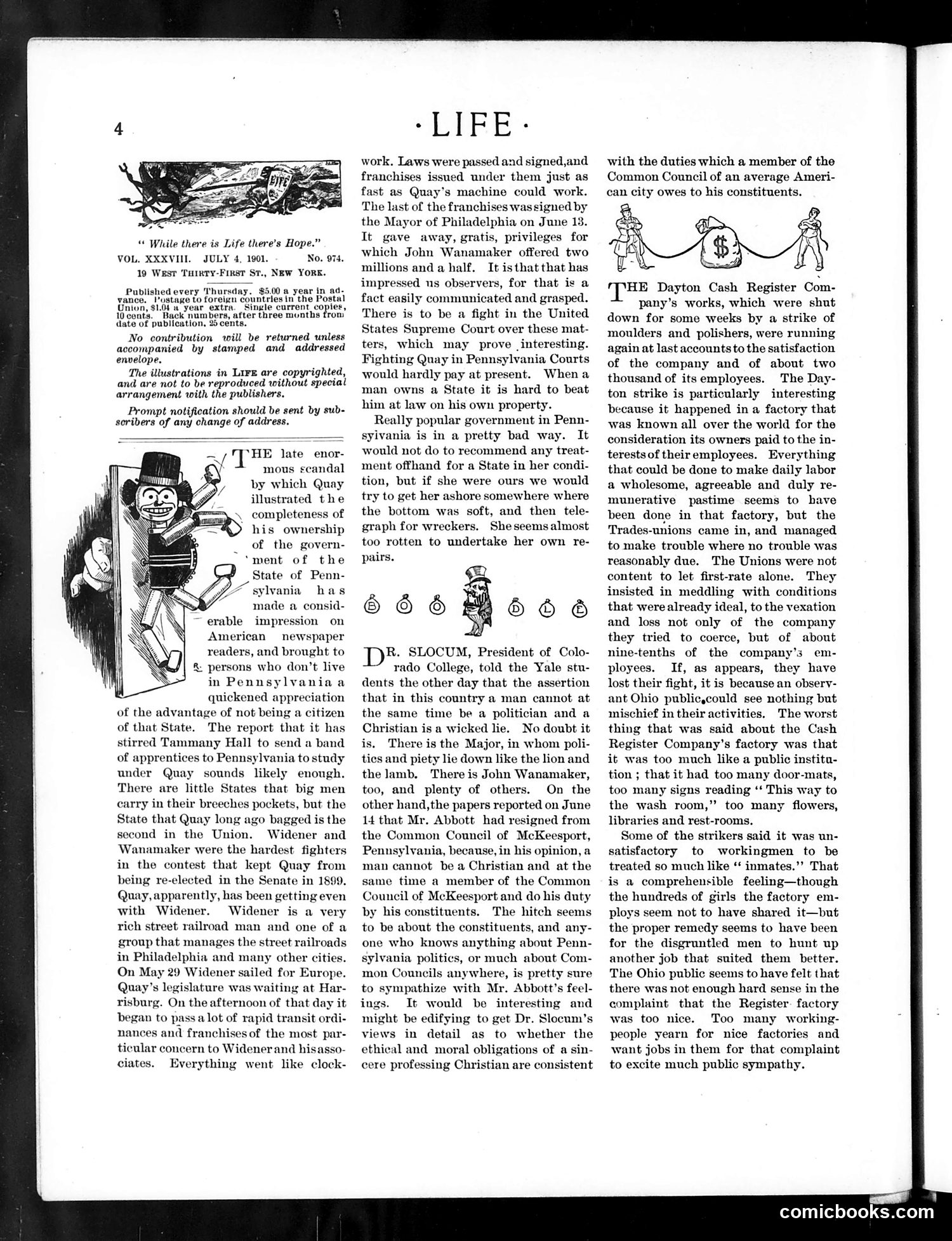
The main cartoon depicts a caricatured figure emerging from or associated with Pennsylvania, labeled with text about state politics and governance. The image appears to satirize Pennsylvania's political corruption or mismanagement during this period. The accompanying text discusses John Wanamaker (a prominent Philadelphia businessman and politician), Dr. Slocum of Colorado College, and criticisms of Pennsylvania's government. The satire targets politicians who claim Christian morality while engaging in corrupt practices—specifically referencing arguments that "a man cannot at the same time be a politician and a Christian" is "a wicked lie." The cartoon seems to mock hypocrisy in Pennsylvania politics, contrasting public moral claims with actual governmental conduct.
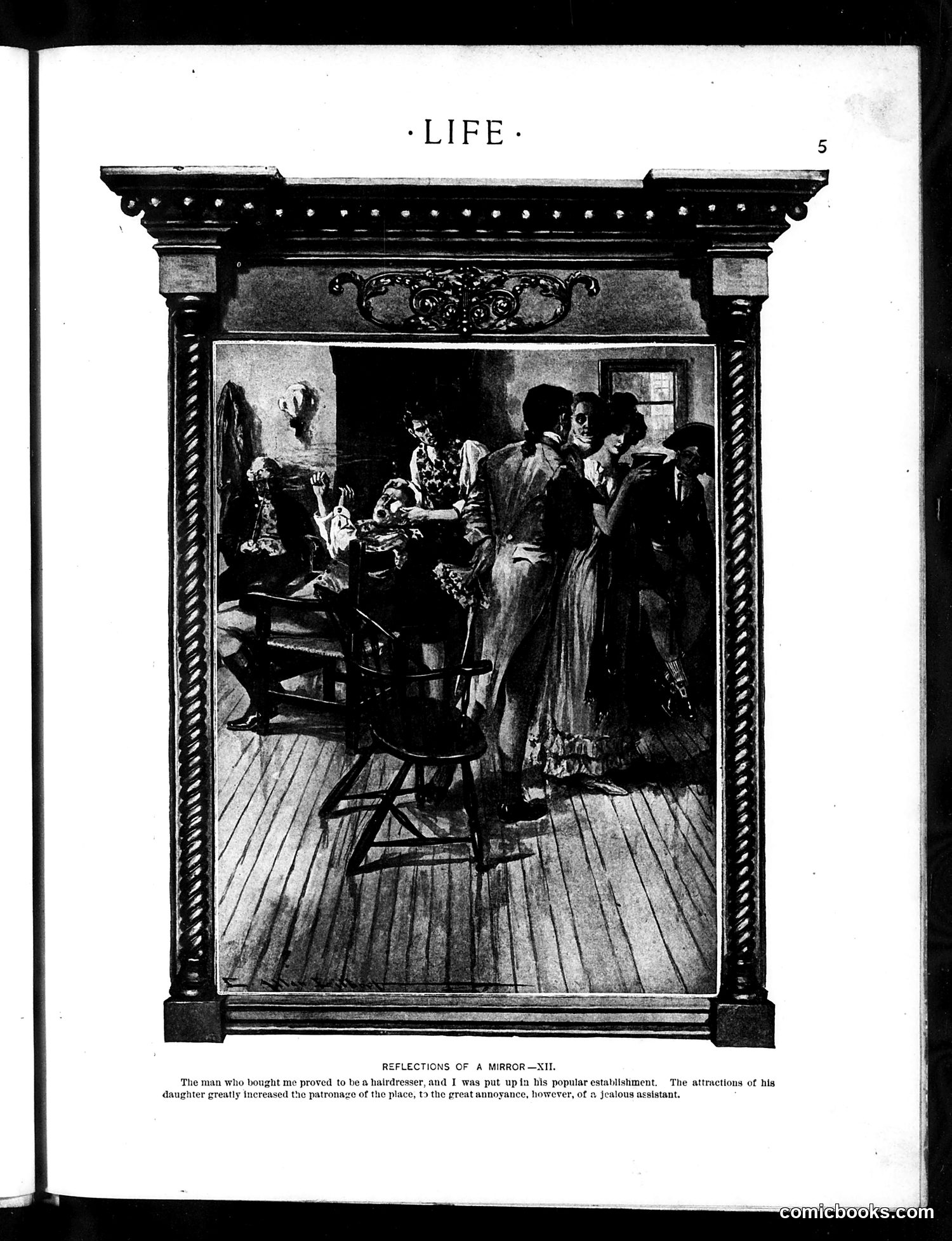
This satirical illustration depicts a barbershop scene where a hairdresser's attractive daughter has become a major draw for customers, much to the annoyance of a jealous assistant. The caption explains that the man who purchased this barbershop business hired the daughter as staff, and her presence greatly increased the establishment's patronage—but irritated a competing employee. The satire targets small-business dynamics and workplace jealousy, showing how personal attractiveness could be exploited (intentionally or not) as a business asset in the early 20th century. The crowded shop and formal dress suggest this is an upscale establishment, mocking both the owner's transparent marketing strategy and the assistant's evident resentment of being eclipsed by a colleague's popularity.
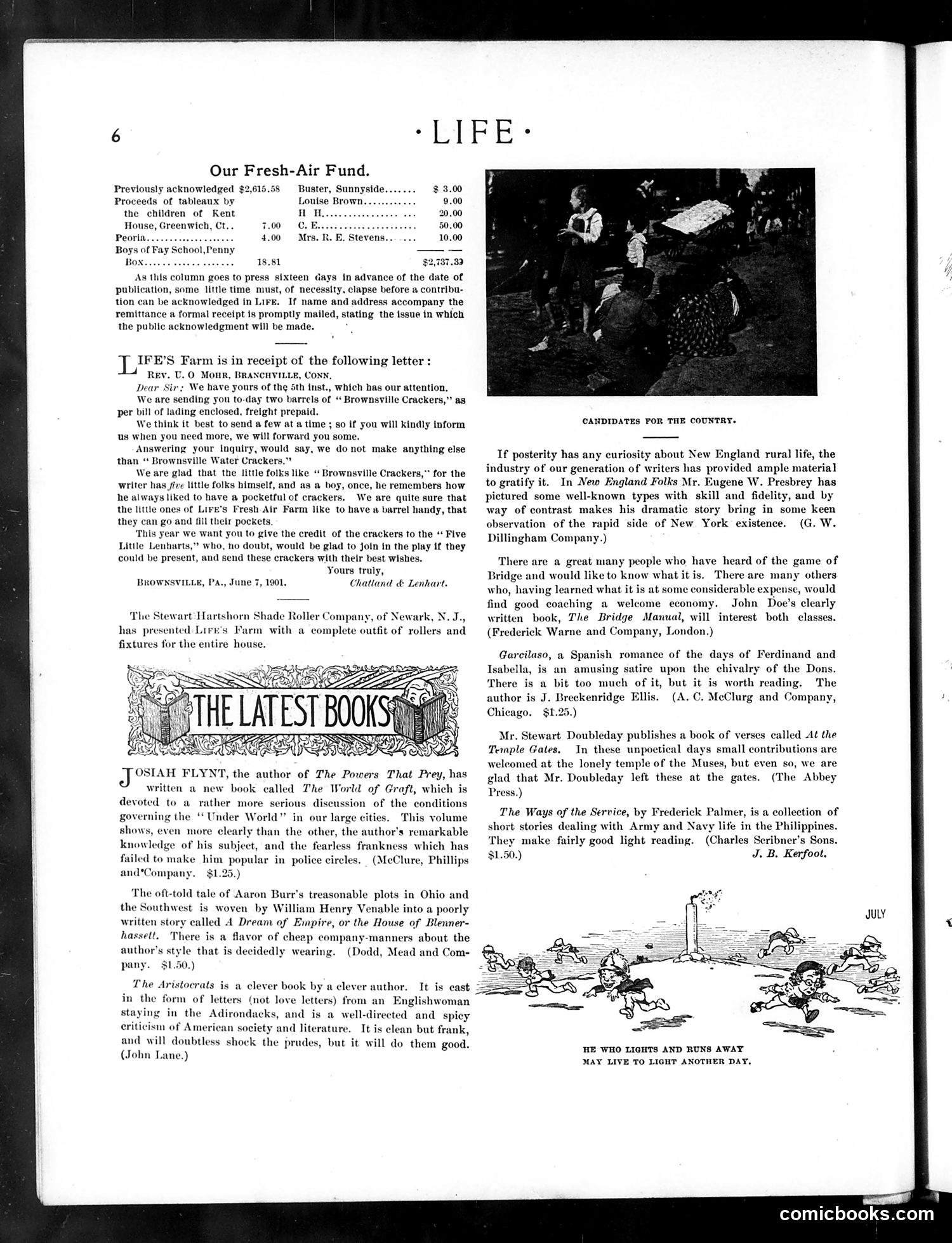
This page contains book reviews and a small illustration rather than political satire. The main content discusses recent literary publications, including works by Josiah Flynt on urban poverty ("Under World"), William Henry Venable's Ohio frontier story, and a book of letters called *The Aristocrats* critiquing American society. The modest illustration at bottom shows figures lying in grass under a July sun, with the caption "HE WHO FIGHTS AND RUNS AWAY / MAY LIVE TO FIGHT ANOTHER DAY." This appears to be general commentary on cowardice or tactical retreat rather than specific political satire. The page's primary function is literary criticism and book promotion, not political cartooning.
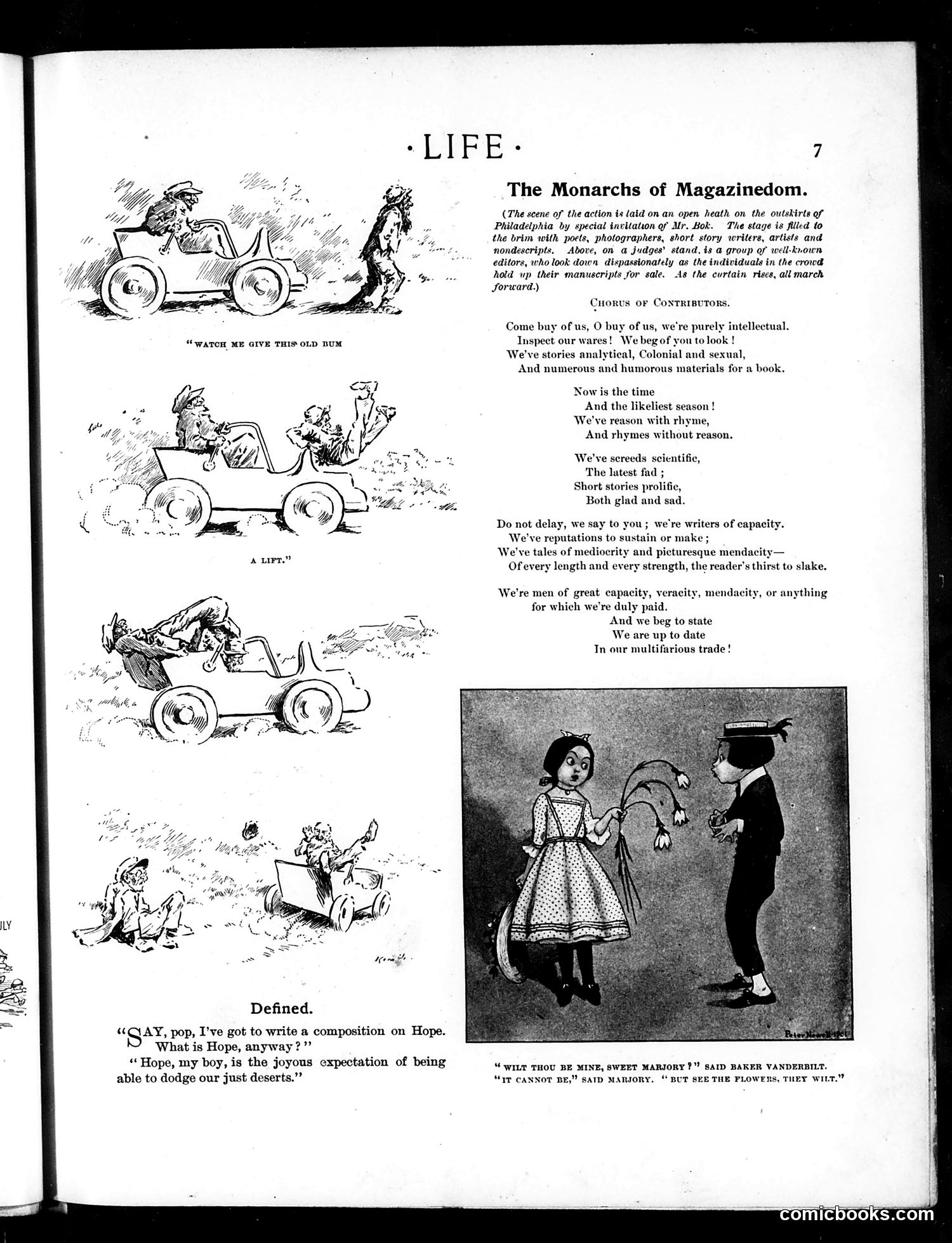
This page satirizes magazine editors and contributors circa early 1900s. The left side shows four cartoon panels of figures in an automobile, labeled "Watch me give this old bum a life" and "A life"—wordplay on *Life* magazine itself. The right side features a "Chorus of Contributors" poem where magazine writers boast of their intellectual credentials, promising "analytical, Colonial and sexual" stories and "humorous materials for a book." They claim capacity, versatility, and being "up to date / In our multifarious trade." Below is a photograph captioned with dialogue about writing a composition on "Hope"—apparently mocking pretentious literary aspirations. The satire targets the self-importance and grandiose claims of magazine editors and freelance writers competing for publication.
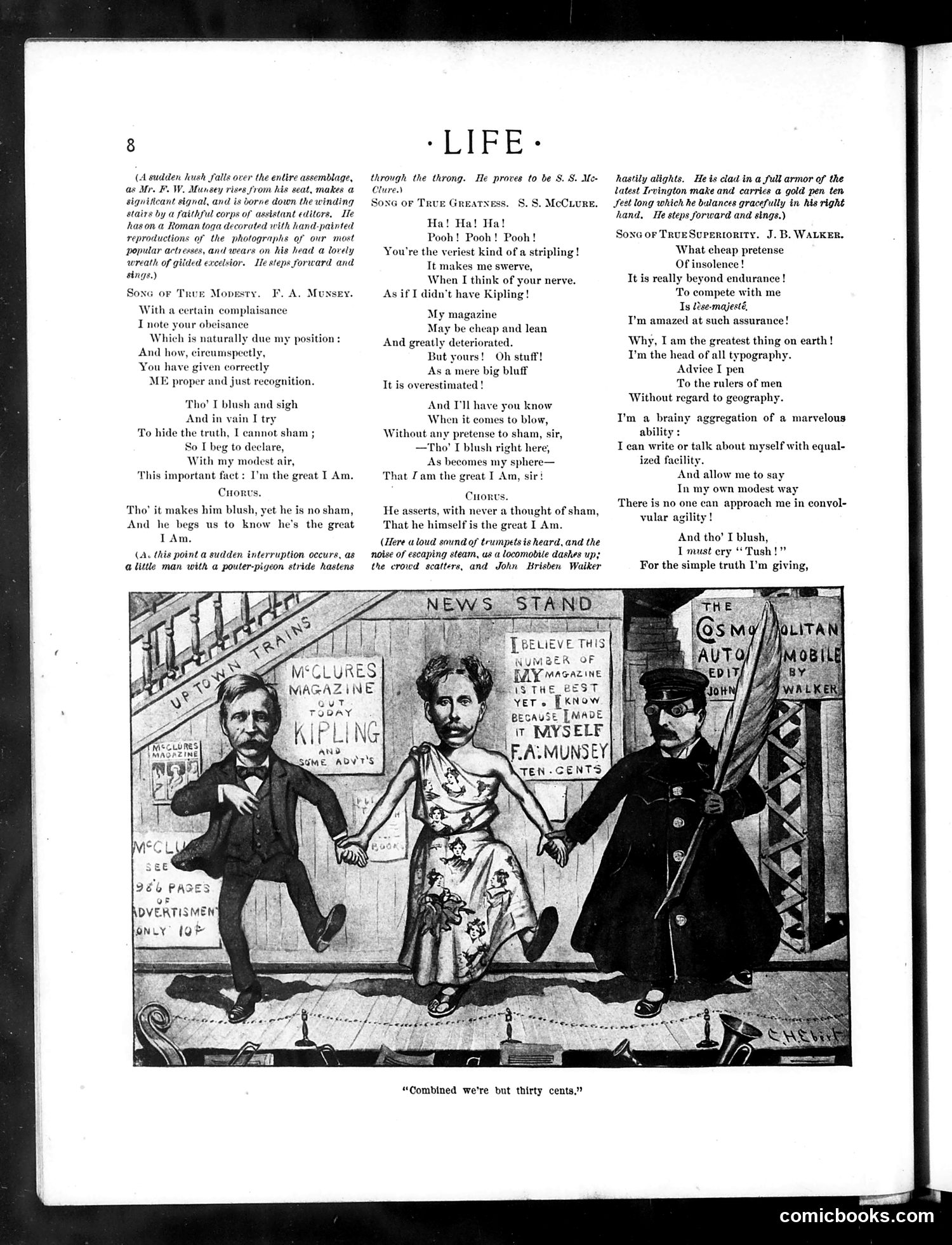
This page features poetry mocking self-important literary and public figures of the era. The poems ridicule pompous attitudes—particularly one titled "Song of True Majesty" by F.A. Mussey, attacking someone's overblown ego and false grandeur. The cartoon below depicts three figures at a news stand: two caricatured men in suits flanking a woman in a floral dress. The signs advertise magazines and publications. The caption reads "Combined we're but thirty cents," suggesting satire about the cheap cost of magazines or the minimal value/worth of the three figures combined—likely mocking specific contemporary personalities or types (publishers, editors, or celebrities) by reducing their importance to a trivial monetary value.
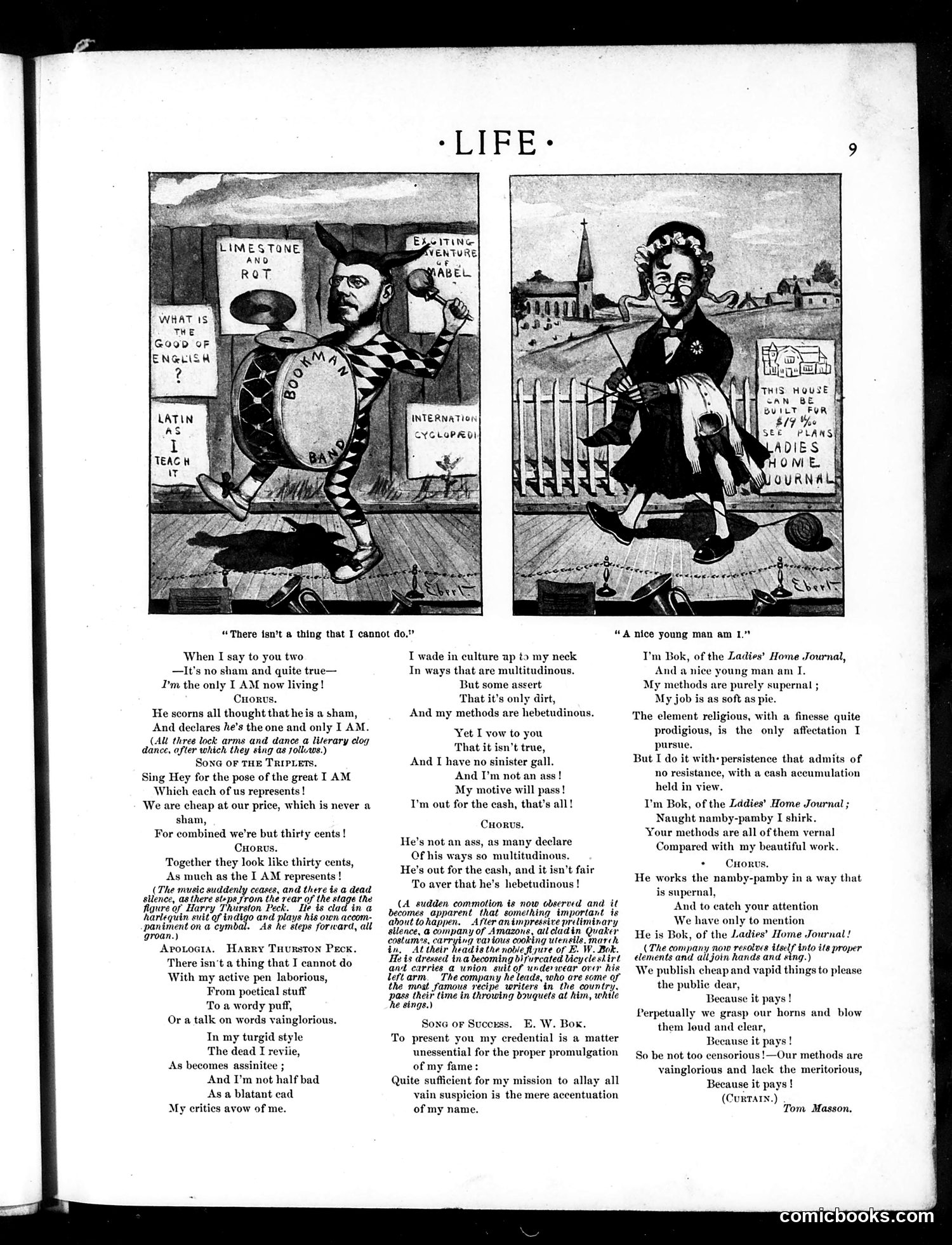
This page contains two satirical cartoons mocking specific contemporary figures, likely from the early 1900s. **Left cartoon**: Depicts a man juggling various books and publications ("Limestone and Rot," "Exciting Adventure of Mabel," "International Cyclopaedia," "Body & Mind"). The accompanying poem ridicules someone claiming to be "the only I AM" and a universal expert ("there isn't a thing that I cannot do"), while actually being a charlatan and fraud. This appears to target a self-proclaimed intellectual or spiritual authority figure. **Right cartoon**: Shows a man labeled as editor of the *Ladies' Home Journal* boasting about his domestic accomplishments. The satire mocks his pretensions to expertise in household matters while actually pursuing commercial success ("because it pays!"). Both cartoons satirize male arrogance, false expertise, and mercenary motives disguised as intellectual or moral authority.
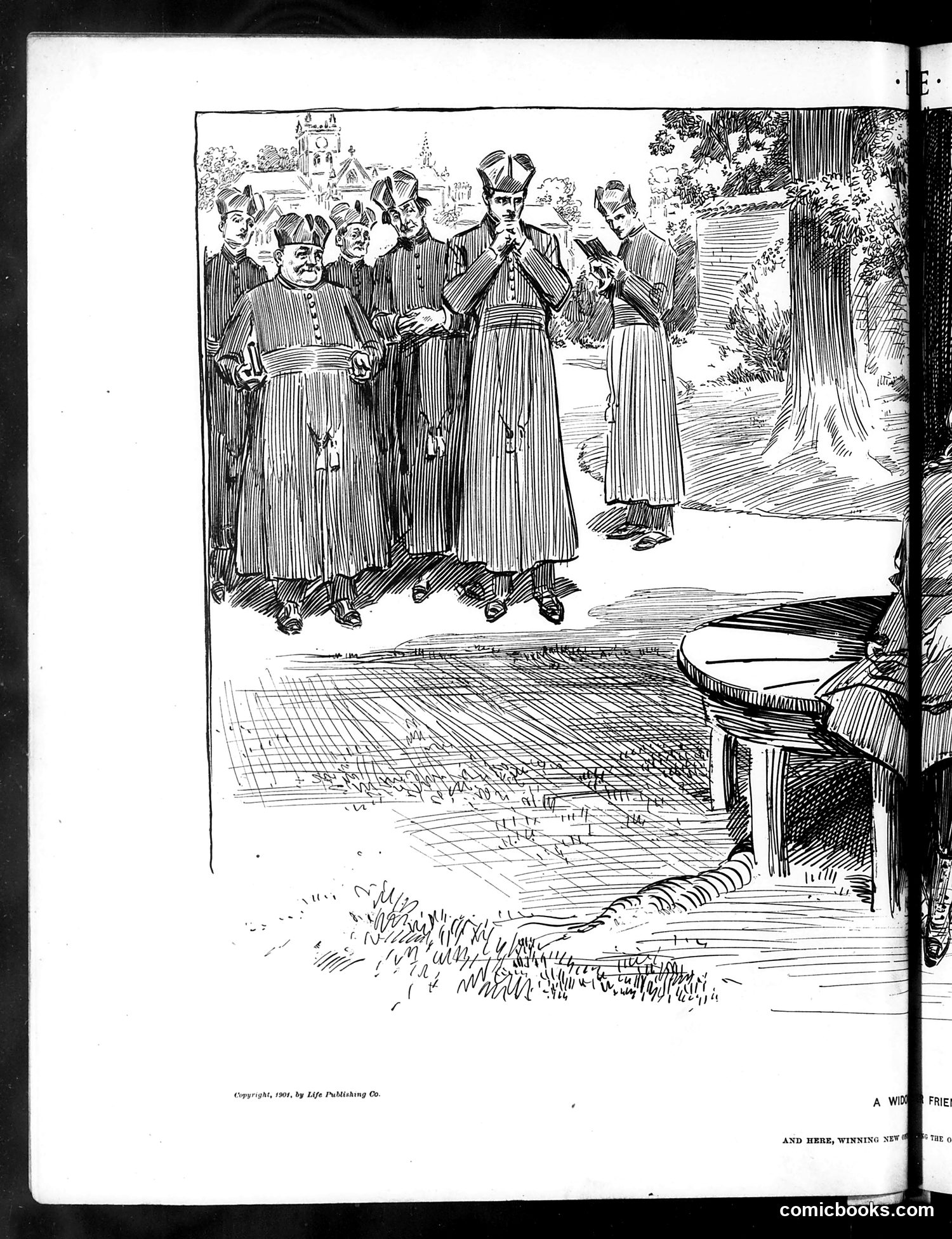
This page from *Life* magazine (copyright 1901) shows a satirical illustration of religious figures in formal vestments gathered outdoors. The caption references "A WIDE FRIEND" and mentions "WINNING NEW..." (text cuts off). The cartoon appears to satirize religious leadership or church authority of the Gilded Age period. The figures wear elaborate robes and ecclesiastical dress, suggesting high-ranking clergy or bishops. Their formal poses and the garden setting suggest a ceremonial gathering. Without the complete caption text, the specific target of satire remains unclear—it could be addressing clergy influence on politics, interfaith relations, or institutional pomposity. The style and composition are typical of *Life*'s satirical religious commentary from this era. The image's point requires the full caption to determine with certainty.
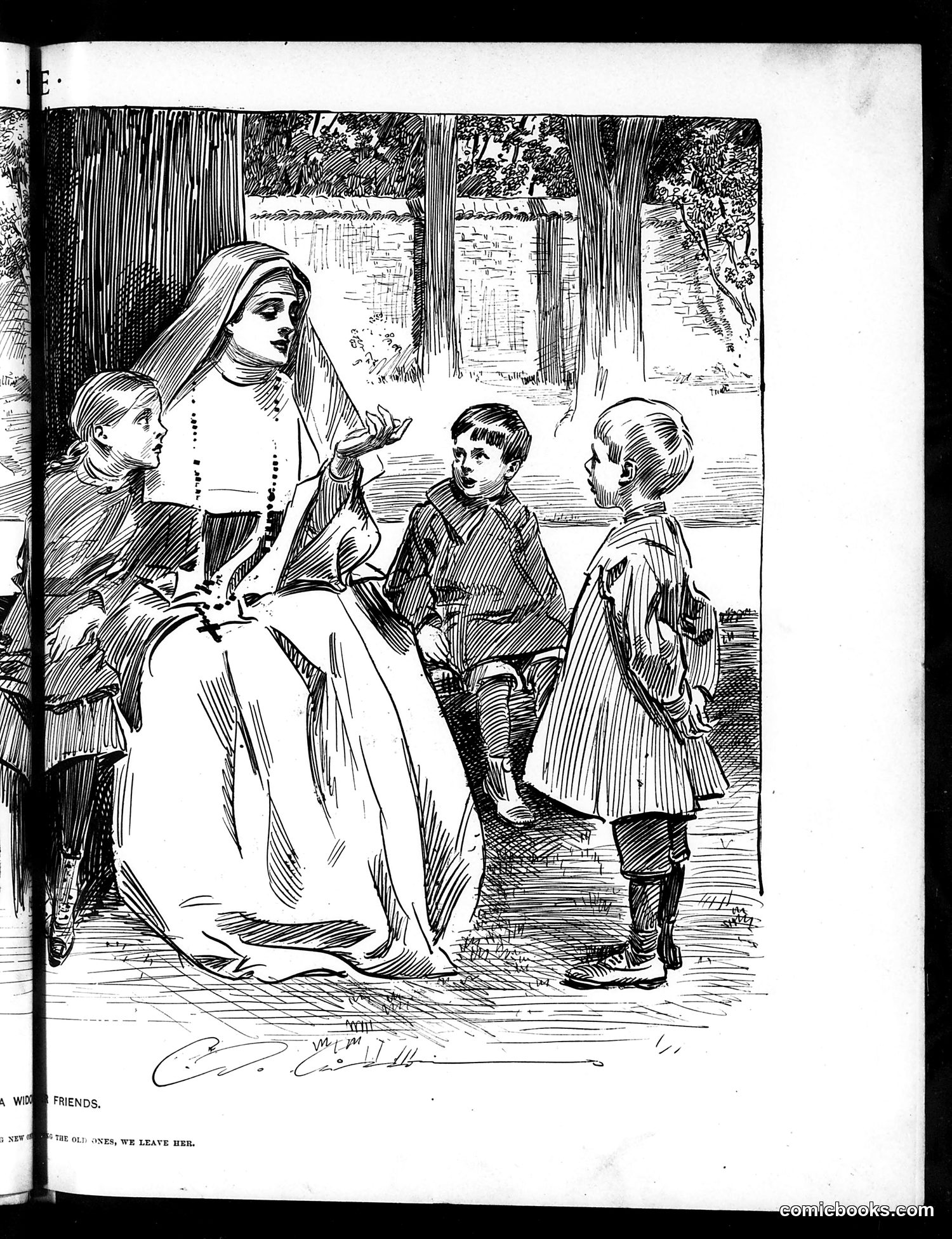
This is a Victorian-era engraving showing a woman with three children in what appears to be a parlor or indoor setting. The caption reads "A WIDOW'S FRIENDS" with partial text visible below: "IN THE OLD ONES, WE LEAVE HER." The satire likely critiques the hypocrisy of Victorian society regarding widow care. The "friends" appear to be visiting the widow, but the caption suggests they abandon her to the elderly (the "old ones"). This comments on how supposedly charitable Victorian society claimed to support widows and orphans, yet actually left their care to the poorest, oldest members of the community rather than providing genuine assistance. The image presents a pointed social critique of class-based welfare attitudes during the period.
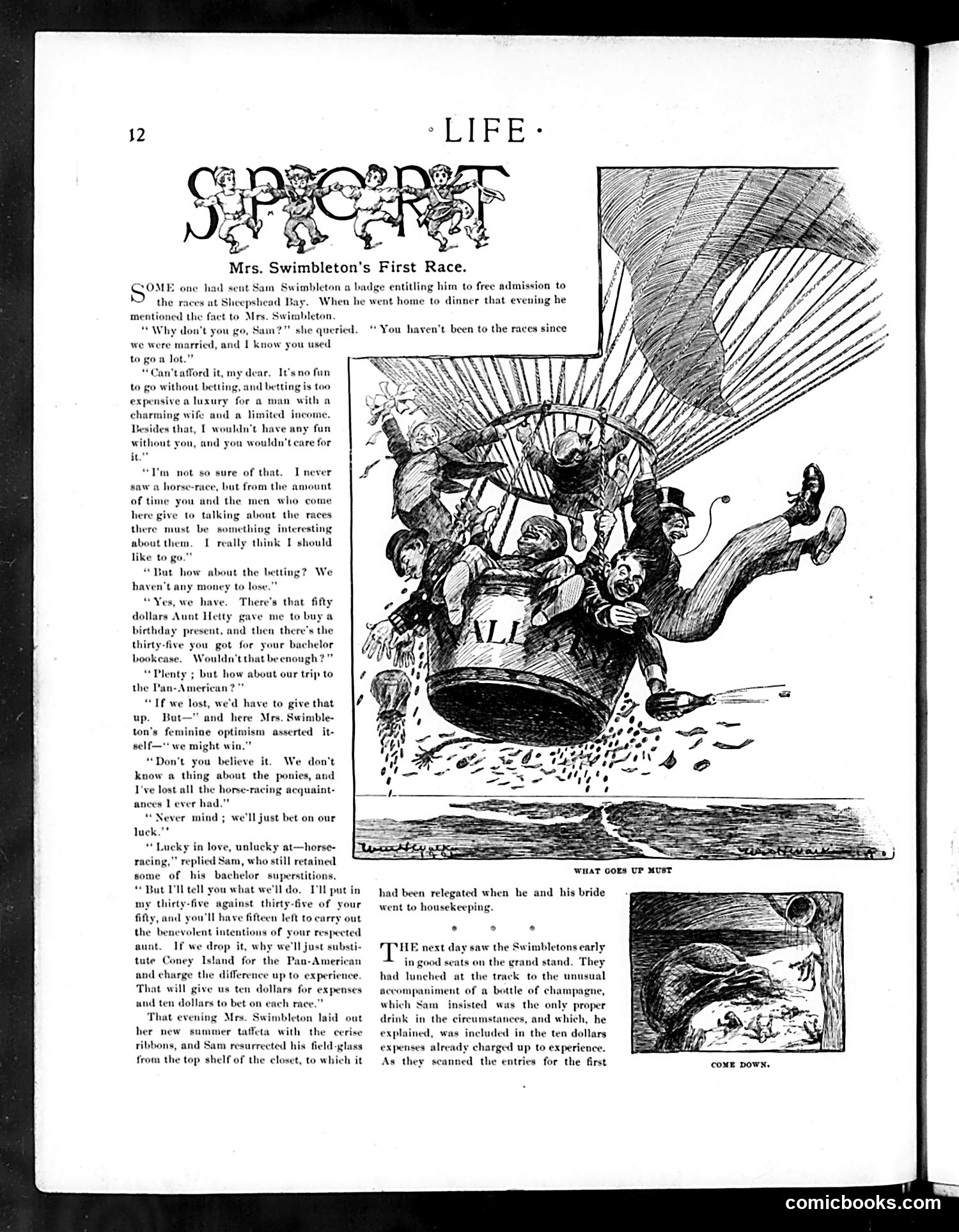
This is a humorous domestic story about a married couple's disagreement over attending horse races. Mrs. Swinbleton wants to go to the races at Sheepshead Bay, but her husband Sam objects—claiming it's too expensive for their limited income and that he disapproves of betting. The main cartoon shows a comical accident at the racetrack, labeled "WHAT GOES UP MUST COME DOWN," depicting spectators being thrown from what appears to be a viewing stand or grandstand structure. The satire targets both gender roles (the wife's desire for entertainment versus the husband's financial caution) and the social dangers of the racetrack itself. The visual humor emphasizes the chaotic, potentially hazardous nature of attending such events—making Mrs. Swinbleton's husband's concerns ironically validated by the illustrated accident.
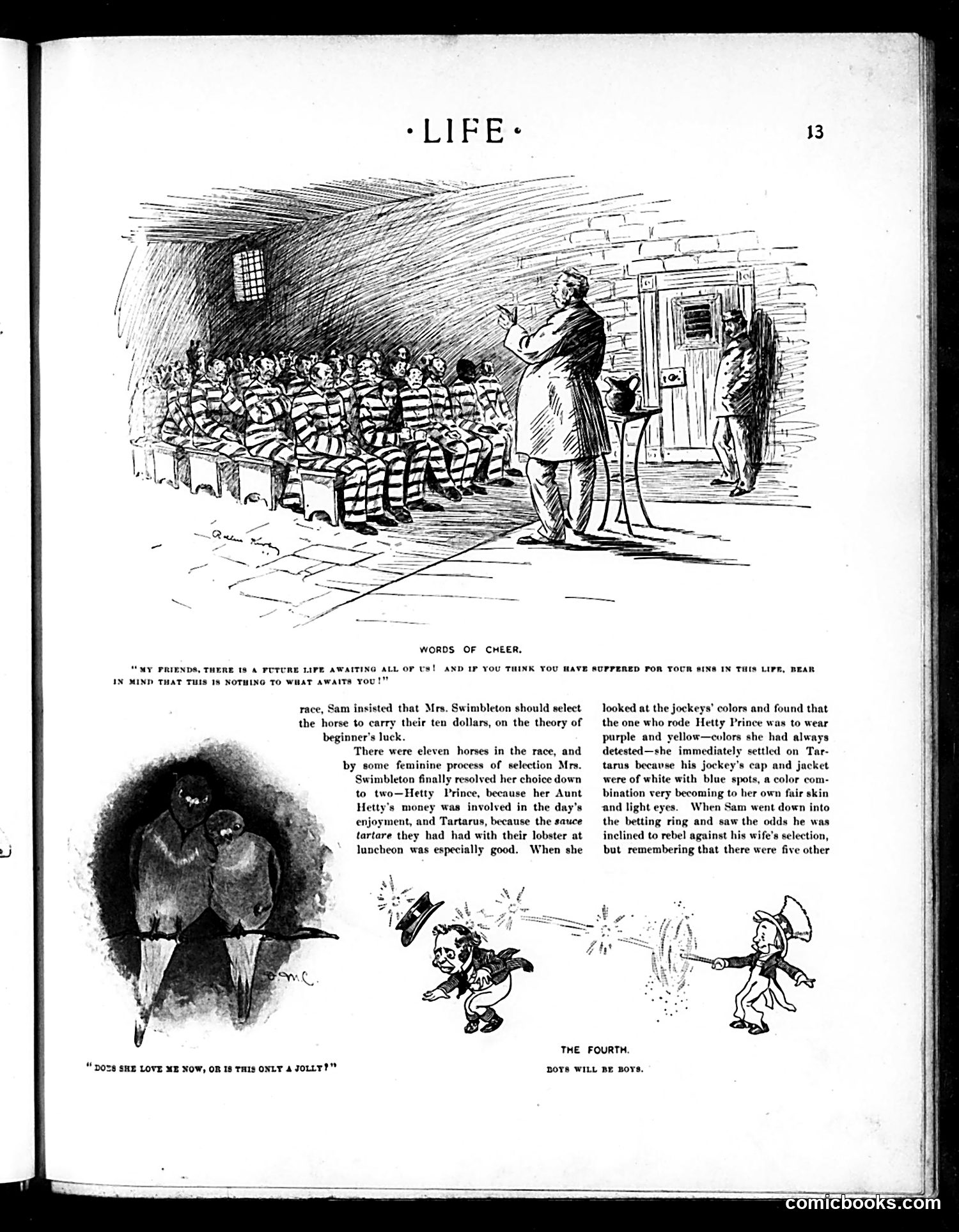
This page satirizes upper-class leisure and irrationality through a horse-racing narrative. The main cartoon depicts a prison chaplain delivering pious words to inmates (shown in striped uniforms)—a visual joke contrasting the preacher's sanctimonious message about suffering and redemption with the captive, trapped audience forced to listen. The accompanying story mocks Mrs. Swimbleton's frivolous decision-making: she selects a racehorse based entirely on whimsical logic—her aunt's involvement, a luncheon sauce, and the jockey's outfit colors—rather than the horse's actual merit. Sam's initial resistance to her absurd reasoning becomes resignation. The smaller cartoon vignettes ("Does she love me now, or is this only a jolly?" and "The Fourth. Boys will be boys") use comic exaggeration to comment on human behavior and courtship. The satire targets the pretensions and illogical choices of the wealthy leisure class, suggesting their decisions are no more rational than children's play.
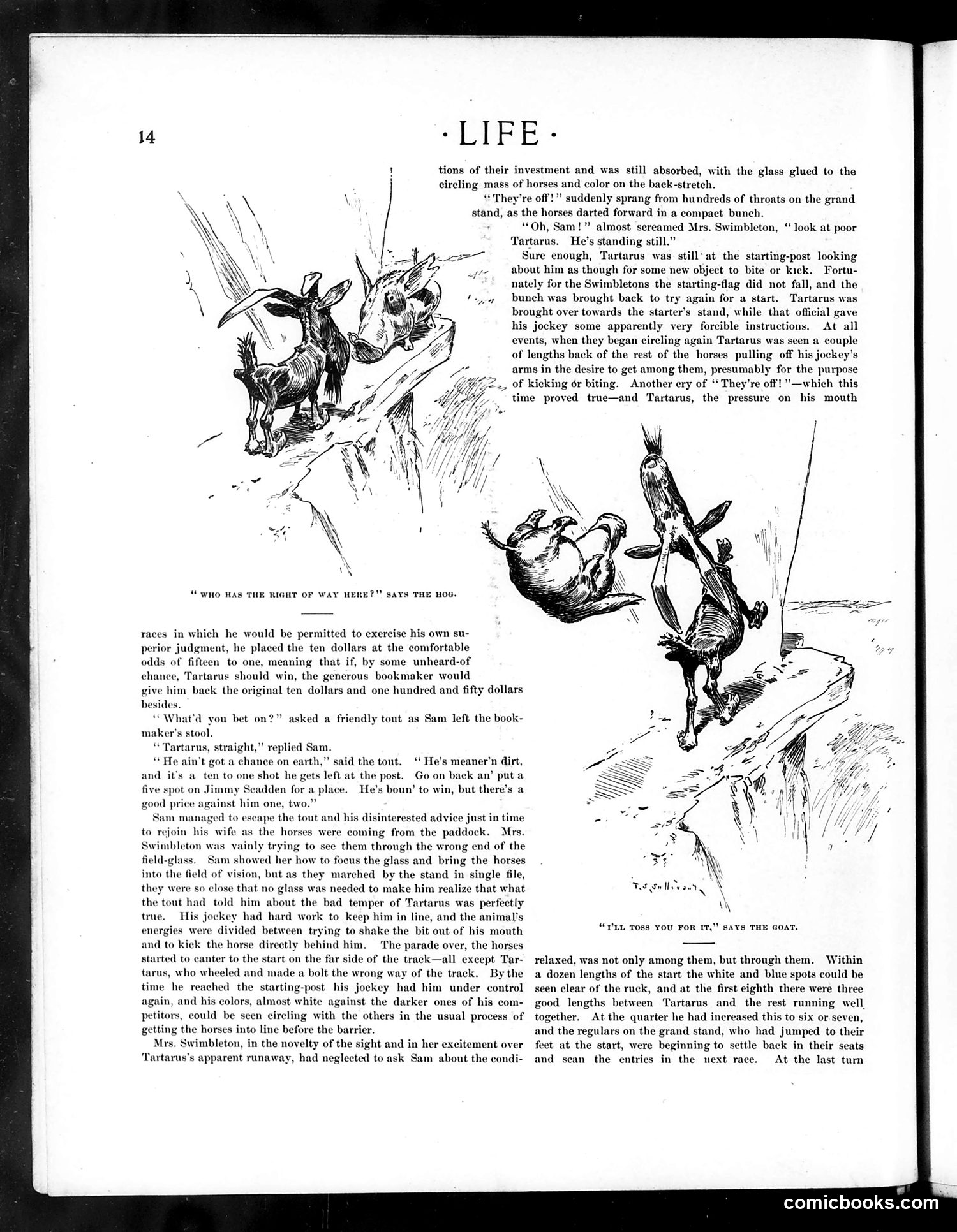
This page illustrates a narrative about horse racing, not primarily political satire. The story follows Sam and Mrs. Swimbleton betting on a horse named Tartarus at what appears to be an American racetrack in the early 1900s. **The Plot:** Tartarus is a notoriously bad-tempered horse ("meaner'n dirt") that nearly breaks away at the starting line. A friendly tout warns Sam against betting on him, but Sam places $10 at 15-to-1 odds anyway. Despite early difficulties and a false start, Tartarus performs unexpectedly well, pulling ahead significantly by the final quarter-mile. **The Illustrations:** Two pen-and-ink drawings show Tartarus rearing and bucking, emphasizing his wild temperament and the chaos he creates. **The Satire:** The humor lies in the common racing story—the unpredictable underdog, the overconfident "expert" tout giving bad advice, and the unlikely victory. This appears to be entertainment rather than political commentary.
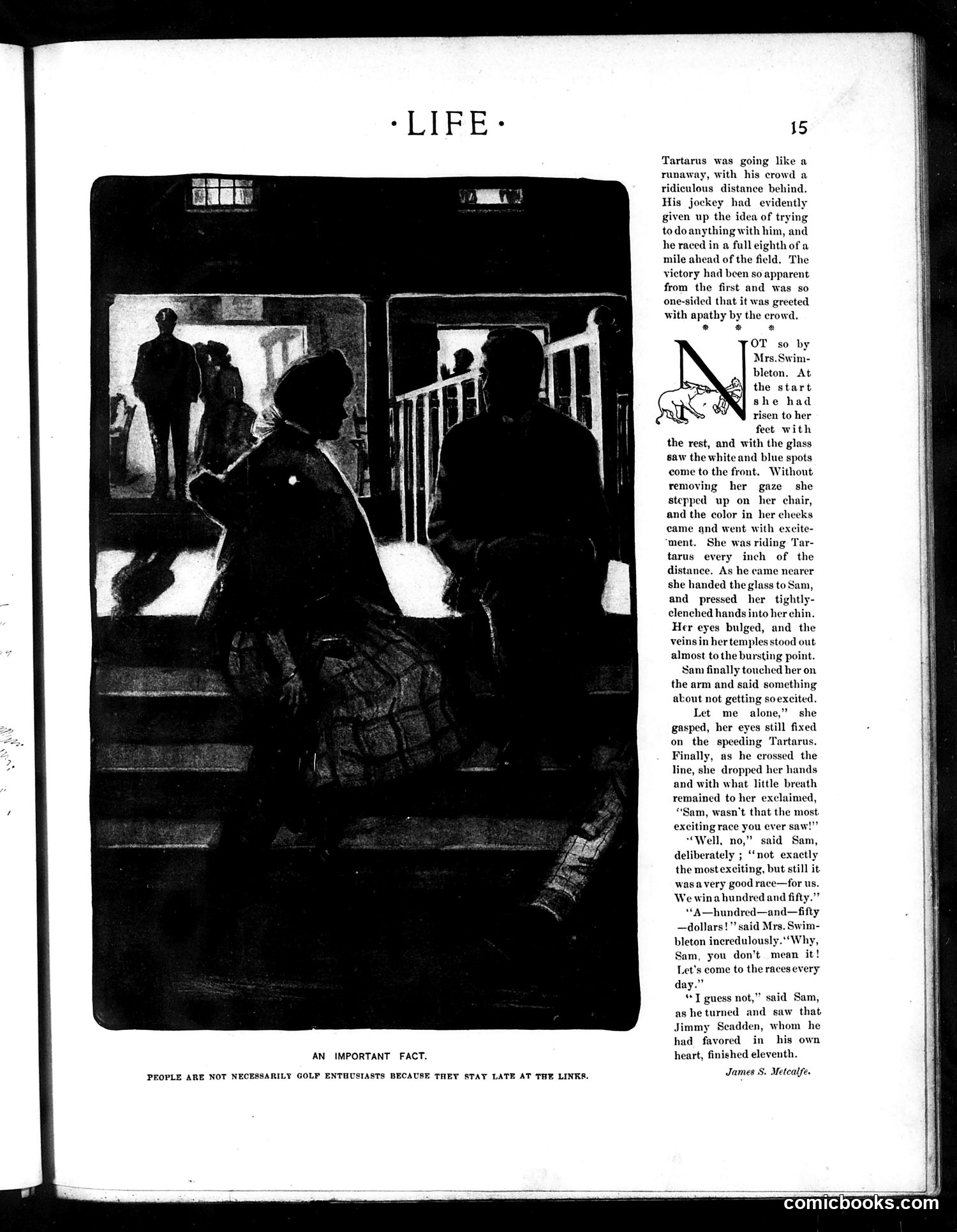
This page satirizes the contradiction between stated and actual reasons for attending horse races. The caption's joke is that people claim to stay late at the racetrack for golf (implying wholesome sporting interest), when they're actually there gambling. The accompanying story illustrates this hypocrisy through Mrs. Swimbleton, who becomes wildly emotional watching her horse "Tartarus" win—clearly invested financially rather than athletically. Her husband Sam reveals they've won "a hundred and fifty dollars," and she immediately suggests attending races daily. The irony: she was excited about *winning money*, not sporting excellence. The illustration shows spectators in formal dress at what appears to be the racetrack, capturing the era's horse-racing culture and gambling obsession among the upper classes. The satire mocks the pretense of respectability—people publicly justify their racing attendance through sports enthusiasm while privately motivated by wagering and profit.
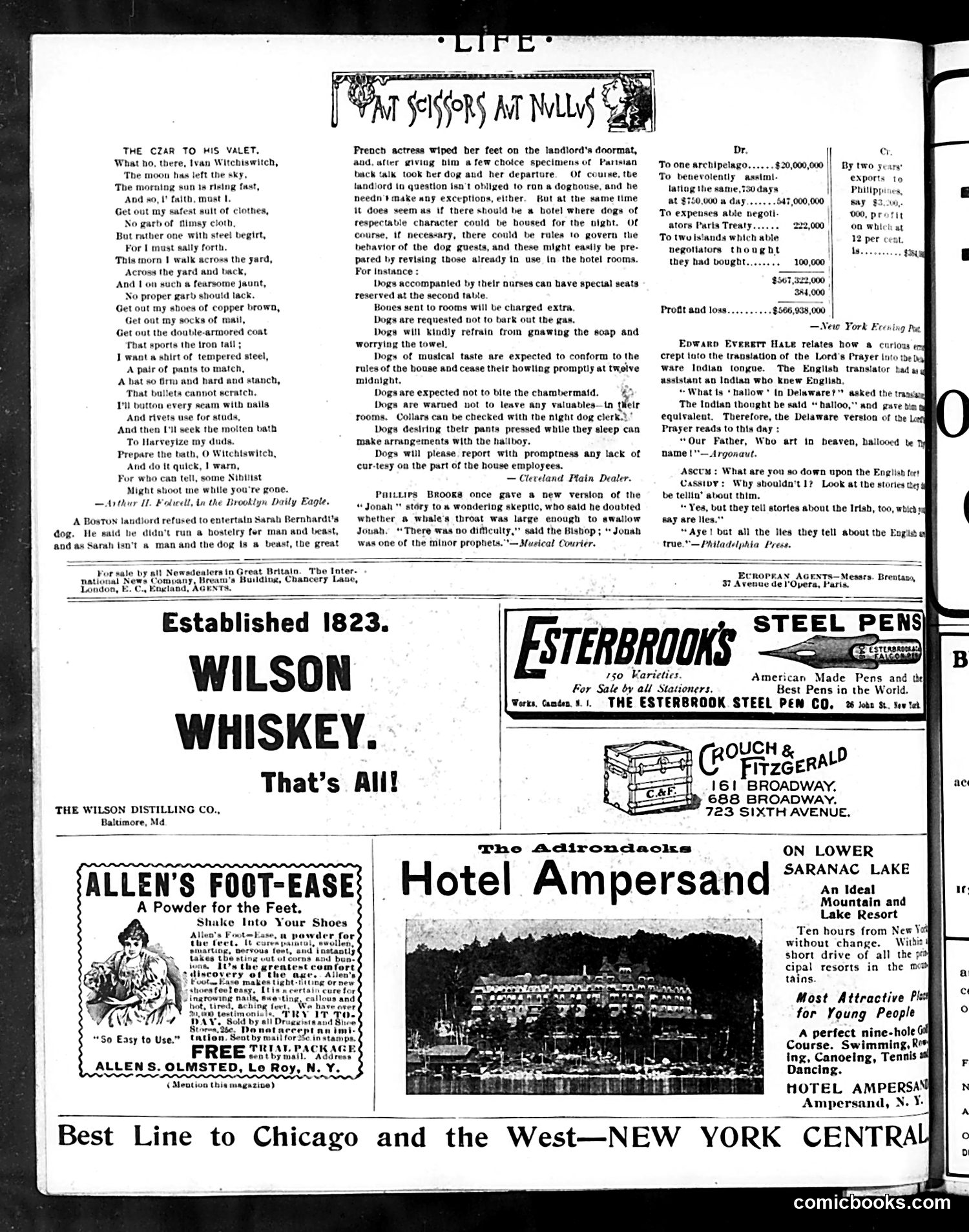
This page contains **primarily poetry and humor pieces** rather than political cartoons proper. The lead poem, "The Czar to His Valet," is a satire on **Czar Nicholas II of Russia**, mocking his paranoia about assassination attempts. The Czar obsessively demands armor—copper shoes, steel shirts, riveted clothing—because he fears "Nihilist" assassins might shoot him simply while crossing his yard. This references the **Russian anarchist/nihilist movements** of the late 19th-early 20th century that genuinely threatened the Czar's life. The humor lies in the exaggerated cowardice: a simple yard-crossing requires full military-grade protection, revealing both the real danger the Czar faced and the satirical suggestion that his paranoia was justified—or absurd. Secondary humor pieces mock **Sarah Bernhardt's famous incident** with a Boston landlord (real event), suggest rules for hotel-staying dogs, and include a pun about Biblical "minor prophets." The page is primarily **advertising below** the editorial content.
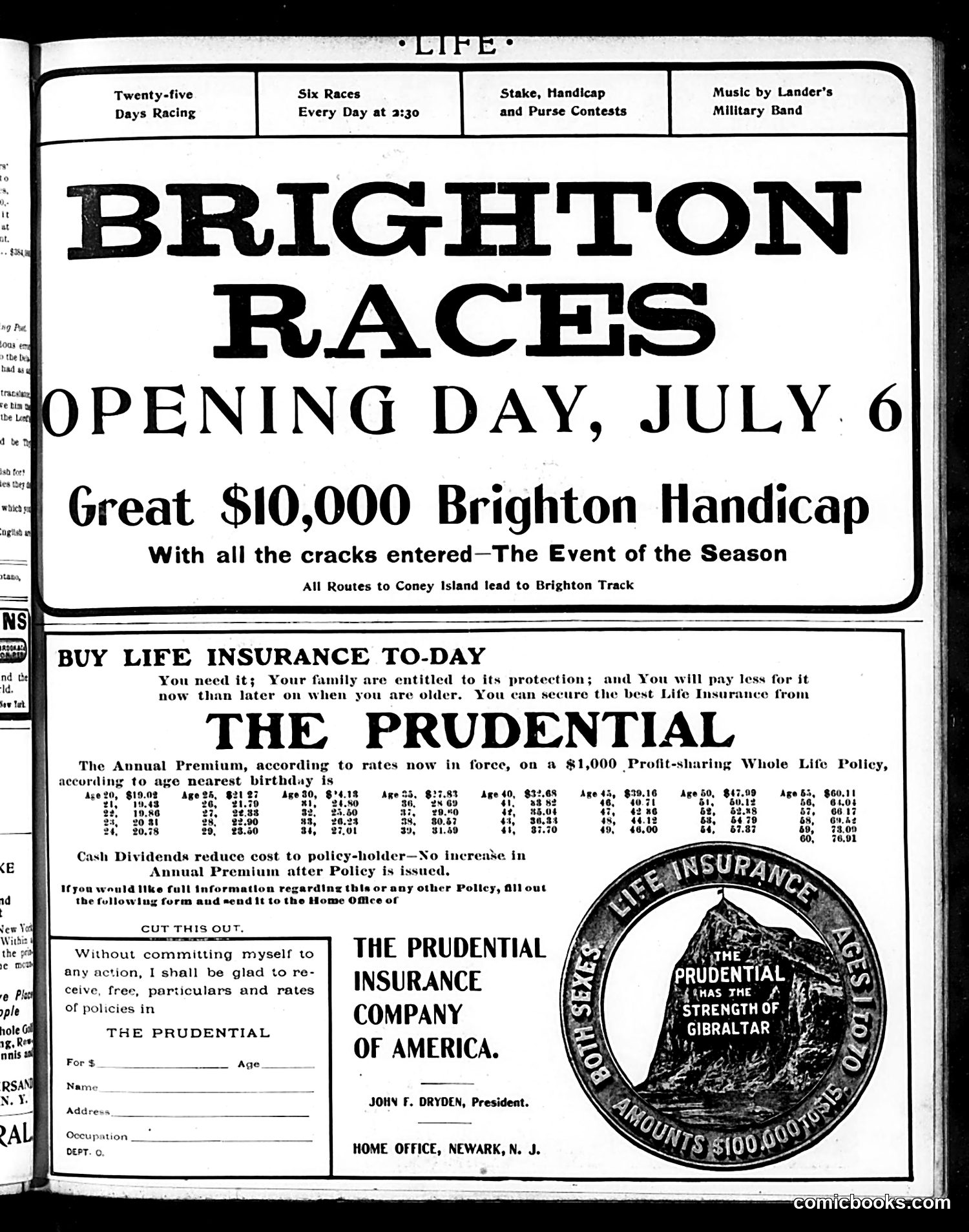
This page is almost entirely **advertising**, not editorial content or satire. The top quarter promotes **Brighton Races**, a horse-racing venue opening July 6, advertising twenty-five days of racing, six daily races at 2:30, and a featured $10,000 handicap event. It targets affluent leisure audiences, mentioning Coney Island access and music by a military band. The remainder is a **full-page advertisement for The Prudential Insurance Company of America**, headed by President John F. Dryden. It promotes whole-life insurance policies with detailed premium tables by age (starting at $19.02 annually for 20-year-olds) and emphasizes cash dividends reducing policy costs. A cut-out coupon invites readers to request information without obligation. The circular company seal claims Prudential's "strength of Gibraltar" and assets of $100 million—rhetorical assurance-building typical of early 20th-century insurance marketing, when life insurance was still relatively new and trust-building was essential.
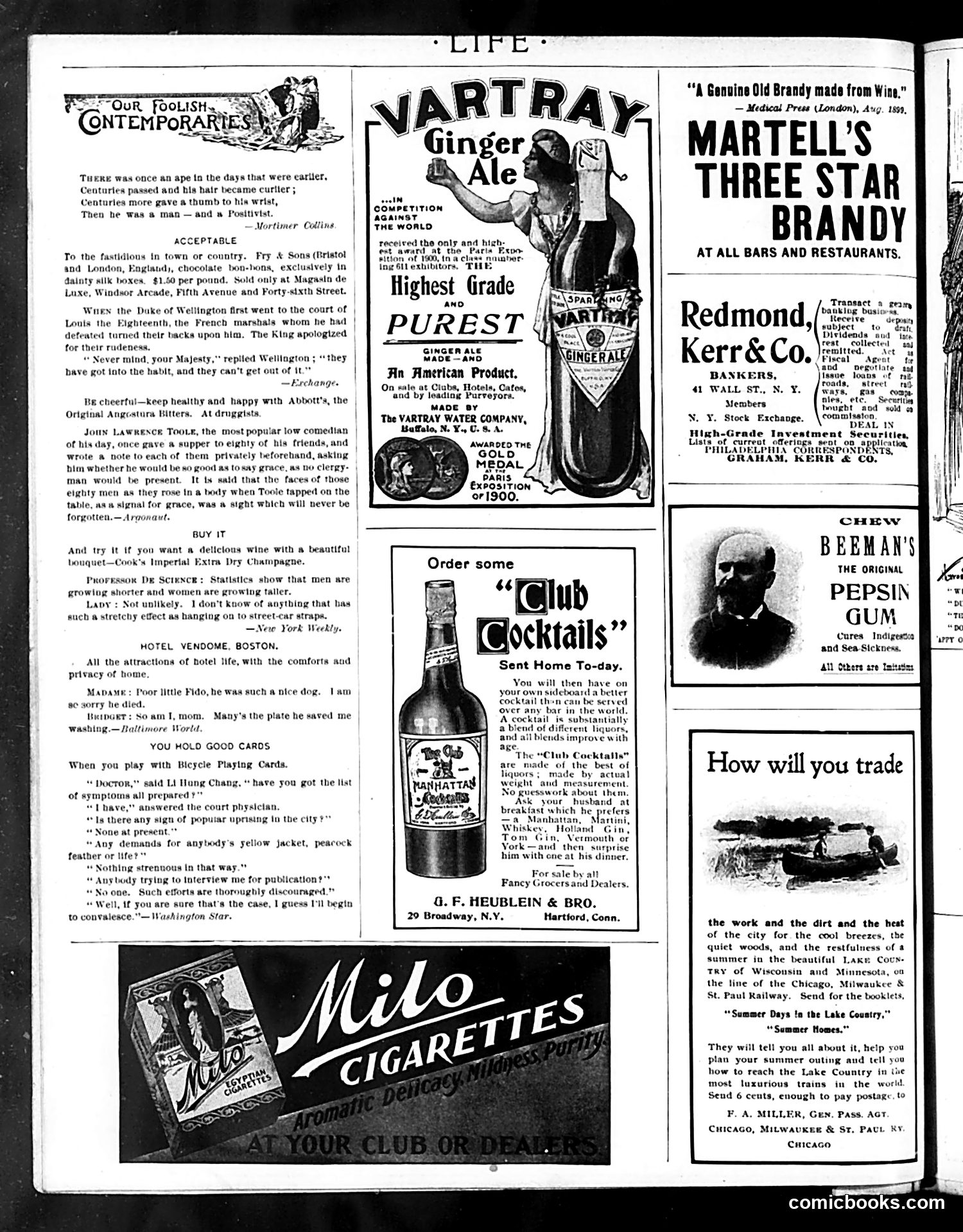
This page is primarily **advertising**, featuring products like Martell's brandy, Nartray ginger ale, Beeman's gum, and Club cocktails—typical of early-1900s magazines. The editorial content includes brief **humorous anecdotes** rather than political cartoons: - A verse about human evolution (ape to man) attributed to Mortimer Collins - A story about the Duke of Wellington at the French court, illustrating stoic dignity - Anecdotes about comedian John Lawrence Toole and a dog named Fido - A satirical dialogue between "Doctor" and "Li Hung Chang" (the Chinese statesman), mocking concerns about popular uprisings and media interference—suggesting bemused skepticism toward foreign political anxieties The Li Hung Chang piece appears to reference contemporary Boxer Rebellion tensions (ca. 1900) but treats them dismissively as fodder for nervous conversation rather than serious threat. Overall, this is a **society/lifestyle page** mixing light humor with commercial messaging, typical of Life's genteel satirical approach.
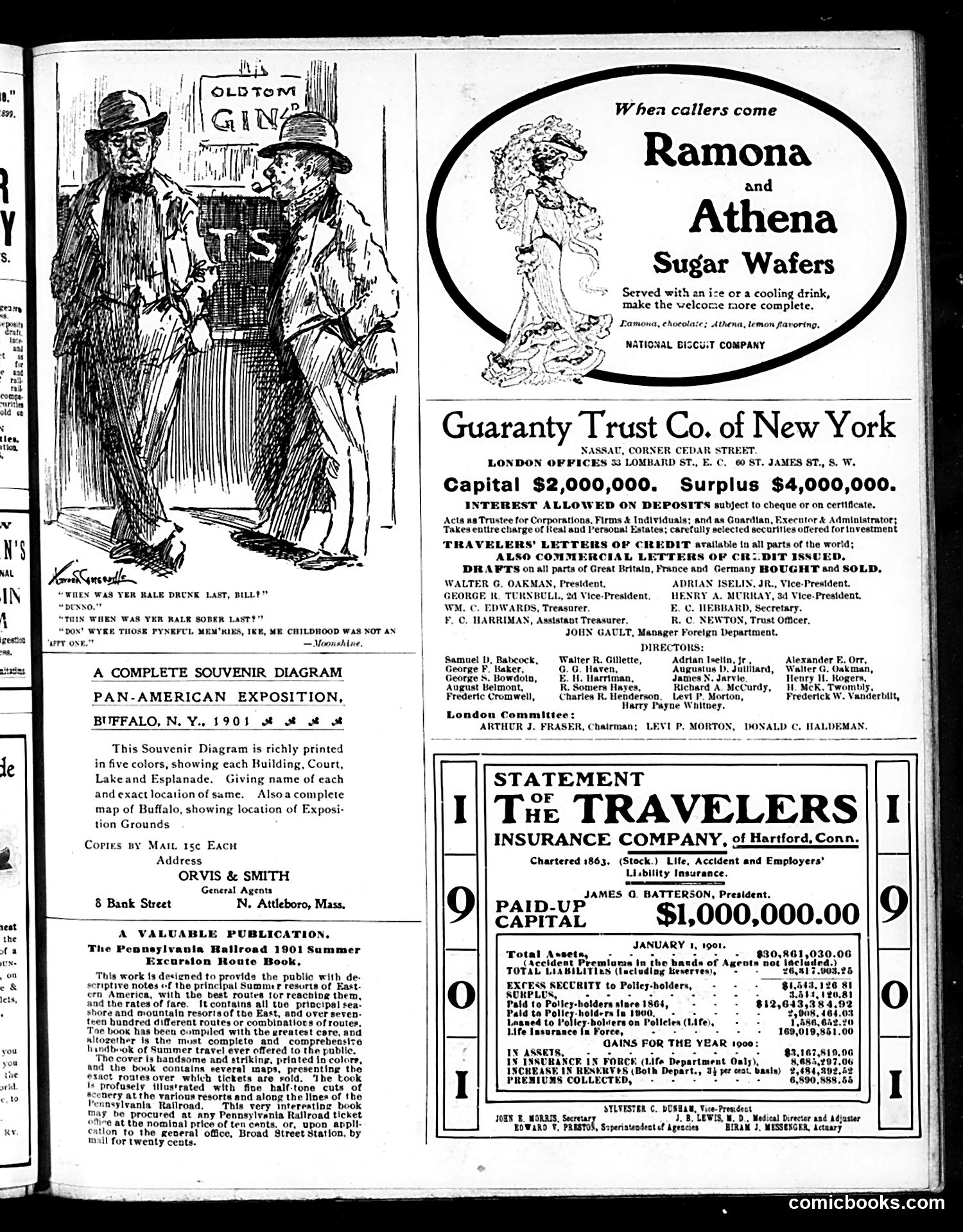
This page, from *Life* magazine (circa 1901), is primarily **advertising with one political/social cartoon**. ## The Cartoon The single cartoon depicts two working-class Irish men (indicated by stereotypical dialect and caricatured features). They discuss drinking habits in mock-Irish dialect: "When was yer rail drunk last, Bill?" The satire targets: - **Irish-American stereotypes** about alcoholism - **Poverty and hardship** (one recalls a grim childhood) - The joke relies on the era's common, derisive stereotyping of Irish immigrants as perpetually intoxicated The credit reads "Moonshine," suggesting commentary on illegal distilling or drinking culture. ## Advertisements The rest consists of **period financial/commercial ads**: banking services (Guaranty Trust), insurance (Travelers Insurance Company), food products (National Biscuit sugar wafers), and railroad excursion guides—typical early-1900s magazine content. The cartoon's crude ethnic humor reflects mainstream media acceptance of such caricatures in that era.
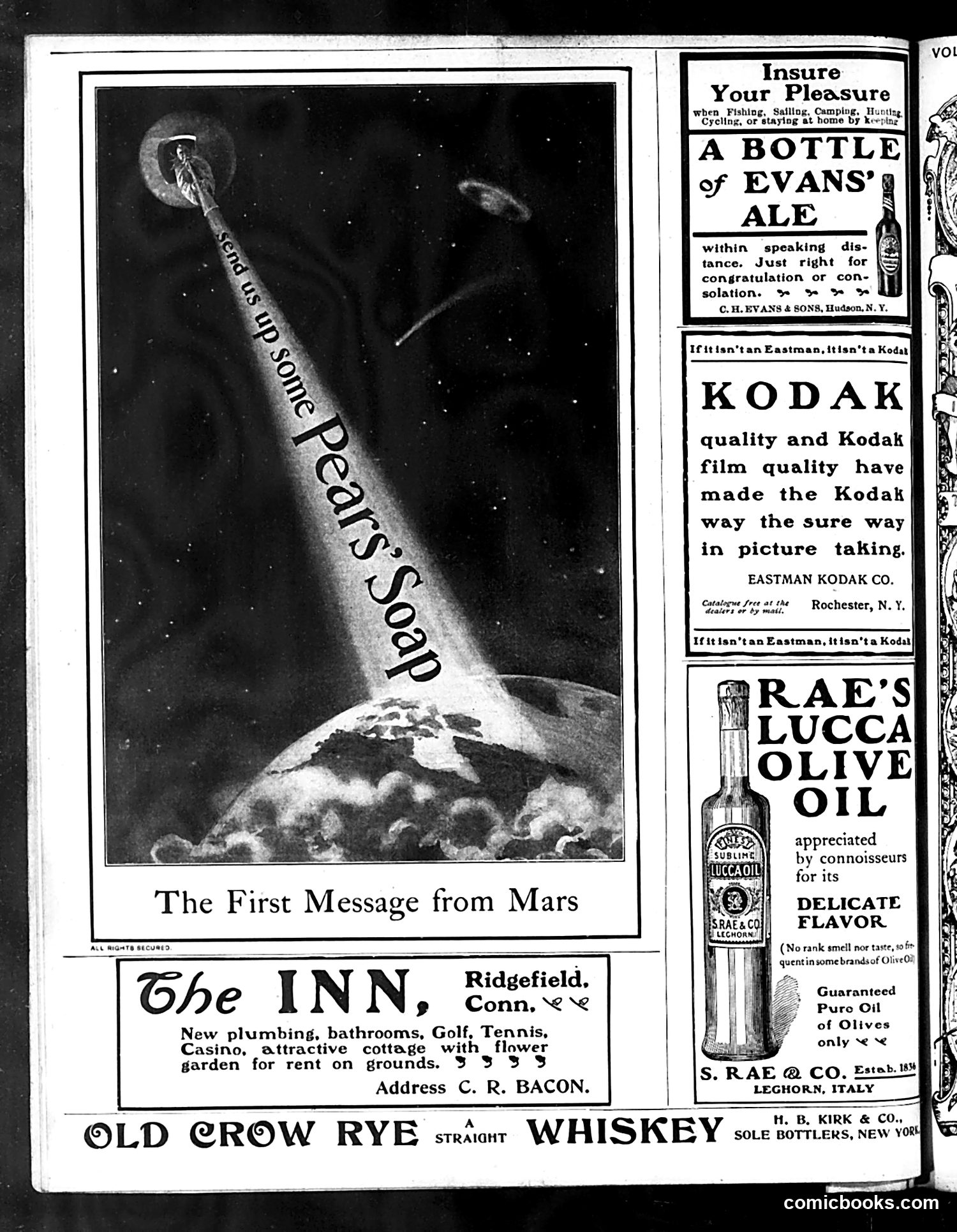
This page is primarily **advertising**, not satire. The central image—titled "The First Message from Mars"—depicts a beam of light emanating from Mars toward Earth, with text reading "Pears' Sonic Pear's Soap" spiraling down the beam. The joke plays on **early-20th-century fascination with Mars and potential alien contact**. Rather than receiving a profound extraterrestrial message, Earth receives a commercial advertisement for soap. This is gentle satire of **aggressive advertising and commercialism**—the implication being that even cosmic communication would be colonized by marketing. The surrounding advertisements (Evans' Ale, Kodak film, olive oil, whiskey, and a Connecticut inn rental) reinforce the page's true purpose: selling products to Life magazine's readers. The Mars cartoon serves as an attention-grabbing wrapper around the commercial content. This reflects the era's anxieties about **unchecked commercialism** infiltrating all aspects of culture, presented here with lighthearted irony rather than sharp political critique.