
Life, 1901-07-04 · page 6 of 20
Life — July 4, 1901 — page 6: what you’re looking at
What you’re looking at
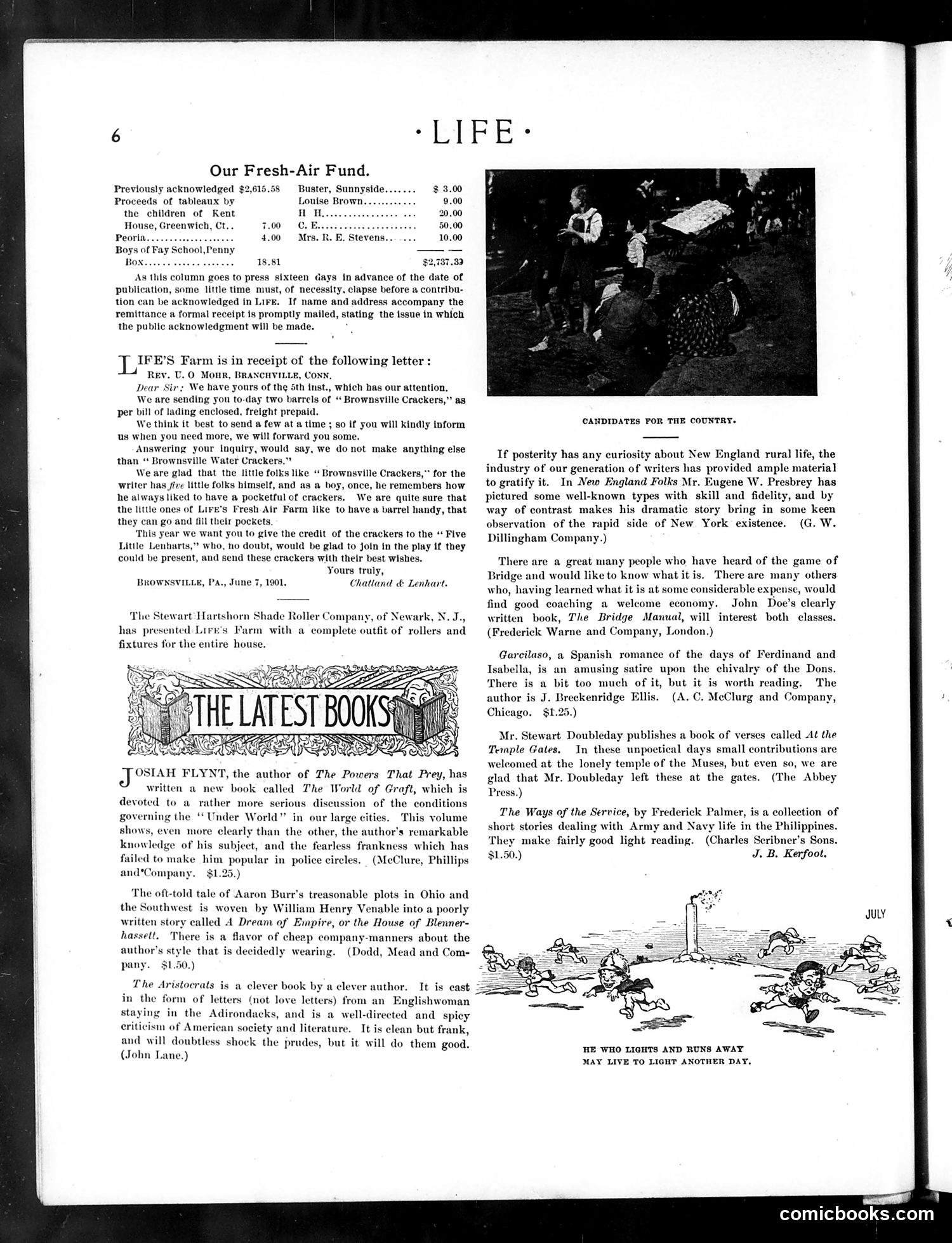
This page contains book reviews and a small illustration rather than political satire. The main content discusses recent literary publications, including works by Josiah Flynt on urban poverty ("Under World"), William Henry Venable's Ohio frontier story, and a book of letters called *The Aristocrats* critiquing American society. The modest illustration at bottom shows figures lying in grass under a July sun, with the caption "HE WHO FIGHTS AND RUNS AWAY / MAY LIVE TO FIGHT ANOTHER DAY." This appears to be general commentary on cowardice or tactical retreat rather than specific political satire. The page's primary function is literary criticism and book promotion, not political cartooning.
📄 Transcribed text from this page (OCR, searchable)
Machine-transcribed from the original scan — historical spelling and the odd misread are preserved.
Our Fresh-Air Fund. Previously acknowledged $2,615.58 Buster, Sunnyside. Proceeds of tableaux by Louise Brown. the children of Kent HOH. eenwich, Ct.. 7.00 G Mrs. R. E, Stevens... ‘ay School, Penn) As this column goes to press sixteen Gays in advance of the date of publication, some little time must, of necessity, clapse before a contribu- tion can be acknowledged in Lirg, If name and address accompany the remittance a formal receipt is promptly mailed, stating the issue in which the public acknowledgment will be made. Les Farm is in receipt of the following letter : Rev. U. 0 Mour, BRANCHVILLE, CONN, Dear Sir; We have yours of the 5th inst., which has our attention, We are sending you to-day two barrels of “ Brownsville Crackers,” as per bill of lading enclosed, freight prepaid. We think it best to send a few at a time ; so if you will kindly inform us when you need more, we will forward you some. Answering your Inquiry, would say, we do not make anything else than “ Brownsville Water Crackers.” Weare glad that the little folks like “ Brownsville Crackers, writer has five little folks himself, and as a boy, once, he remembers how he always liked to have a pocketful of crackers. We are quite sure that the little ones of Live's Fresh Air Farm like to have # barrel handy, that they can go and fill their pockets. ‘This year we want you to give the credit of the crackers to the “ Five Little Lenharts,” who, ho doubt, would be glad to Join in the play if they could be present, and send these crackers with their best wishes. Yours truly, BROWNSVI Chatland & Lenhart. Pa., June 7, 1901, The Stewart Ha Shade has presented Lirk’s Farm with a complete fixtures for the entire house. Roller Com Jostan ve FLYNT, the author of The Powers That Prey, has written a new book called The World of Graft, which is devoted to a rather more serious discussion of the conditions governing the “Under World” in our lar This volume shows, even more clearly than the other, the author's remarkable knowledge of his subject, and the fearless frankness which has failed tomake him popular in police circles. (MeClure, Phillips and*Company. $1. ‘ities. The oft-told tale of Aaron Burr's treasonable plots in Ohio and the Southwest is woven by William Henry Venable into a poorly written story called A Dream of Empire, or the House of Blenner- hasselt. There is a flavor of cheap company-manners about the author's style that is decidedly wearing. (Dodd, Mead and Com- pany. $1.50.) The Aristocrats is a clever book by a clever author. It is cast in the form of letters (not love letters) from an Englishwoman staying in the Adirondacks, and is a well-dir a »d-and spicy criticism of American society and literature. It is clean but frank, and will doubtless shock the prudes, but it will do them good. (John Lane.) CANDIDATES FOR THE COUNTRY. If posterity has any curiosity about New England rural life, the industry of our generation of writers has provided ample material to gratify it. In New England Folks Mr. Eugene W. Presbrey has pictured some well-known types with skill and fidelity, and by way of contrast makes his dramatic story bring in some keen observation of the rapid side of New Dillingham Company.) York existence. (G. W. There are a great many people who have heard of the game of Bridge and would like to know what it is. There are many others who, having learned what it is at some considerable expense, would find good coaching a welcome economy. John Doe's clearly written book, The Bridge Manual, will interest both classes. (Frederick Warne and Company, London.) Garcilaso, a Spanish romance of the days of Ferdinand and Isabella, is an amusing satire upon the chivalry of the Dons. There is a bit too much of it, but it is worth reading. The author is J. Breckenridge Ellis. (A.C. McClurg and Company, Chicago. $1.25.) Mr. Stewart Doubleday publishes a book of verses called At the Temple Gates. In these unpoetical days small contributions are welcomed at the lonely temple of the Muses, but even so, we are glad that Mr. Doubleday left these at the gates. (The Abbey Press.) The Ways of the Service, by Frederi Palmer, is a collection of short stories dealing with Army and Navy life in the Philippines. They make fairly good light reading. (Charles Scribner's Sons. 50.) J.B, Kerfoot. HE WHO LIGHTS AND RUNS AWAY MAY LIVE TO LIGHT ANOTHER DAY, —a_ 7 comicbooks.com