
Life, 1901-07-04 · page 4 of 20
Life — July 4, 1901 — page 4: what you’re looking at
What you’re looking at
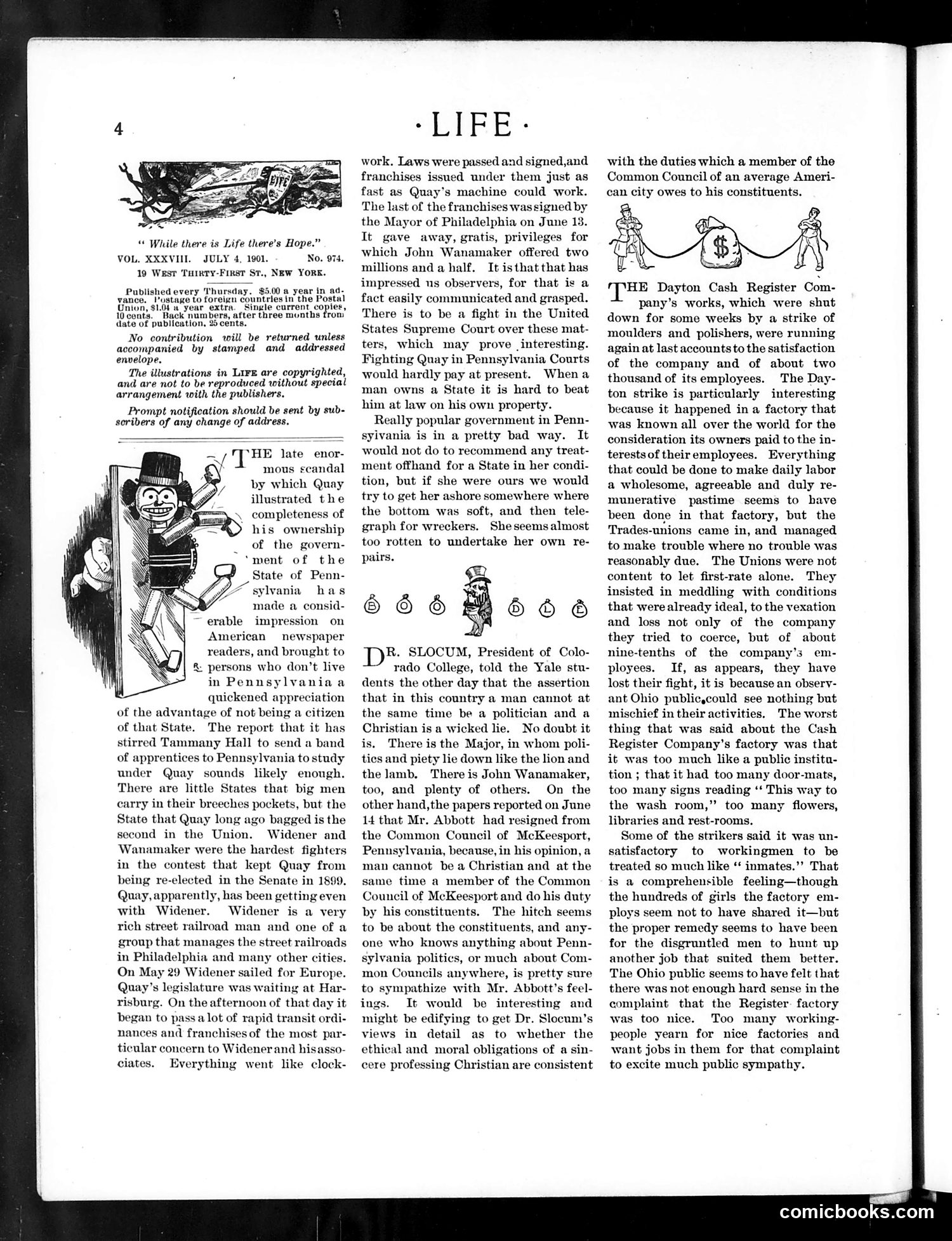
The main cartoon depicts a caricatured figure emerging from or associated with Pennsylvania, labeled with text about state politics and governance. The image appears to satirize Pennsylvania's political corruption or mismanagement during this period. The accompanying text discusses John Wanamaker (a prominent Philadelphia businessman and politician), Dr. Slocum of Colorado College, and criticisms of Pennsylvania's government. The satire targets politicians who claim Christian morality while engaging in corrupt practices—specifically referencing arguments that "a man cannot at the same time be a politician and a Christian" is "a wicked lie." The cartoon seems to mock hypocrisy in Pennsylvania politics, contrasting public moral claims with actual governmental conduct.
📄 Transcribed text from this page (OCR, searchable)
Machine-transcribed from the original scan — historical spelling and the odd misread are preserved.
“ While there is Life there’s Hope. VOL. XXXVIII. JULY 4, 1901. No. 974. 19 Wesr ‘Tuinty-First St., NEw YORK. Published every ‘Thursday. $5.00 year in ad. vance. lostage to foreign countries in the Postal Union, $1.04 a year extra. Single current copies, 10 cents. “Back numbers, after three months fron’ date of publication, 2% cents. No contribution will be returned unless accompanied by stamped and addressed envelope. The illustrations in Lr¥E are copyrighted, and are not to be reproduced without special arrangement with the publishers. Prompt notification should be sent by sub- soribers of any change of address. = (THE late enor- ARN mous scandal 2 by which Quay illustrated the completeness of his ownership of the govern- ‘ment of the State of Penn- “ sylvania has made a consid- ~ erable impression on American newspaper readers, and brought to & persons who don’t live in Pennsylyaniaa quickened appreciation of the advantage of not being a citizen of that State. The report that it has stirred Tammany Hall to send a band of apprentices to Pennsylvania to study under Quay sounds likely enough. There are little States that big men carry in their breeches pockets, but the State that Quay long ago bagged is the second in the Union. Widener and Wanamaker were the hardest fighters in the contest that kept Quay from being re-elected in the Senate in 1899. Quay, apparently, has been getting even with Widener. Widener is a very rich street railroad man and one of a group that manages the street railroads in Philadelphia and many other cities. On May 29 Widener sailed for Europe. Quay’s legislature was waiting at Har- risburg. On the afternoon of that day it began to passa lot of rapid transit ordi- nances and franchises of the most par- ticular concern to Widener and hisasso- ciates. Everything went like clock- “LRP work. Laws were passed and signed,and franchises issued under them just as fast as Quay’s machine could work. The last of the franchises wassigned by the Mayor of Philadelphia on June 13. It gave away, gratis, privileges for which John Wanamaker offered two millions and a half. It isthat that has impressed us observers, for that is a fact easily communicated and grasped. There is to be a fight in the United States Supreme Court over these mat- ters, which may prove interesting. Fighting Quay in Pennsylvania Courts would hardly pay at present. Whena man owns a State it is hard to beat him at law on his own property. Really popular government in Penn- syivania is in a pretty bad way. It would not do to recommend any treat- ment offhand for a State in her condi- tion, but if she were ours we would try to get her ashore somewhere where the bottom was soft, and then tele- graph for wreckers. Sheseems almost too rotten to undertake her own re- pairs. R. SLOCUM, President of Colo- rado College, told the Yale stu- dents the other day that the assertion that in this country a man cannot at the same time be a politician and a Christian is a wicked lie. No doubt it is. There is the Major, in whom poli- tics and piety lie down like the lion and the lamb, There is John Wanamaker, too, and plenty of others. On the other hand,the papers reported on June 14 that Mr. Abbott had resigned from. the Common Council of McKeesport, Pennsylvania, because, in his opinion, a man cannot be a Christian and at the same time a member of the Common Council of McKeesport and do his duty by his constituents. The hitch seems to be about the constituents, and any- one who knows anything about Penn- sylvania politics, or much about Com- mon Councils anywhere, is pretty sure to sympathize with Mr. Abbott's feel- ings. It would be interesting and might be edifying to get Dr. Slocum’s views in detail as to whether the ethical and moral obligations of a sin- cere professing Christian are consistent with the duties which a member of the Common Council of an average Ameri- can city owes to his constituents. pee Dayton Cash Register Com- pany’s works, which were shut down for some weeks by a strike of moulders and polishers, were running again at last accounts to the satisfaction of the company and of about two thousand of its employees. The Day- ton strike is particularly interesting because it happened in a factory that was known all over the world for the consideration its owners paid to the in- terests of theiremployees. Everything that could be done to make daily labor a wholesome, agreeable and duly re- munerative pastime seems to have been done in that factory, but the Trades-unions came in, and managed to make trouble where no trouble was reasonably due. The Unions were not content to let first-rate alone. They insisted in meddling with conditions that were already ideal, to the vexation and loss not only of the company they tried to coerce, but of about nine-tenths of the company’s em- ployees. If, as appears, they have lost their fight, it is because an observ- ant Ohio public,could see nothing but mischief in their activities, The worst thing that was said about the Cash Register Company’s factory was that it was too much like a public instita- tion ; that it had too many door-mats, too many signs reading ‘‘ This way to the wash room,” too many flowers, libraries and rest-rooms. Some of the strikers said it was un- satisfactory to workingmen to be treated so much like “ inmates.”’ That is a comprehensible feeling—though the hundreds of girls the factory em- ploys seem not to have shared it—but the proper remedy seems to have been for the disgruntled men to hunt up another job that suited them better. The Ohio public seems to have felt that there was not enough hard sense in the complaint that the Register. factory was too nice. Too many working- people yearn for nice factories and want jobs in them for that complaint to excite much public sympathy. comicbooks.com