
A complete issue · 21 pages · 1901
Life — June 27, 1901
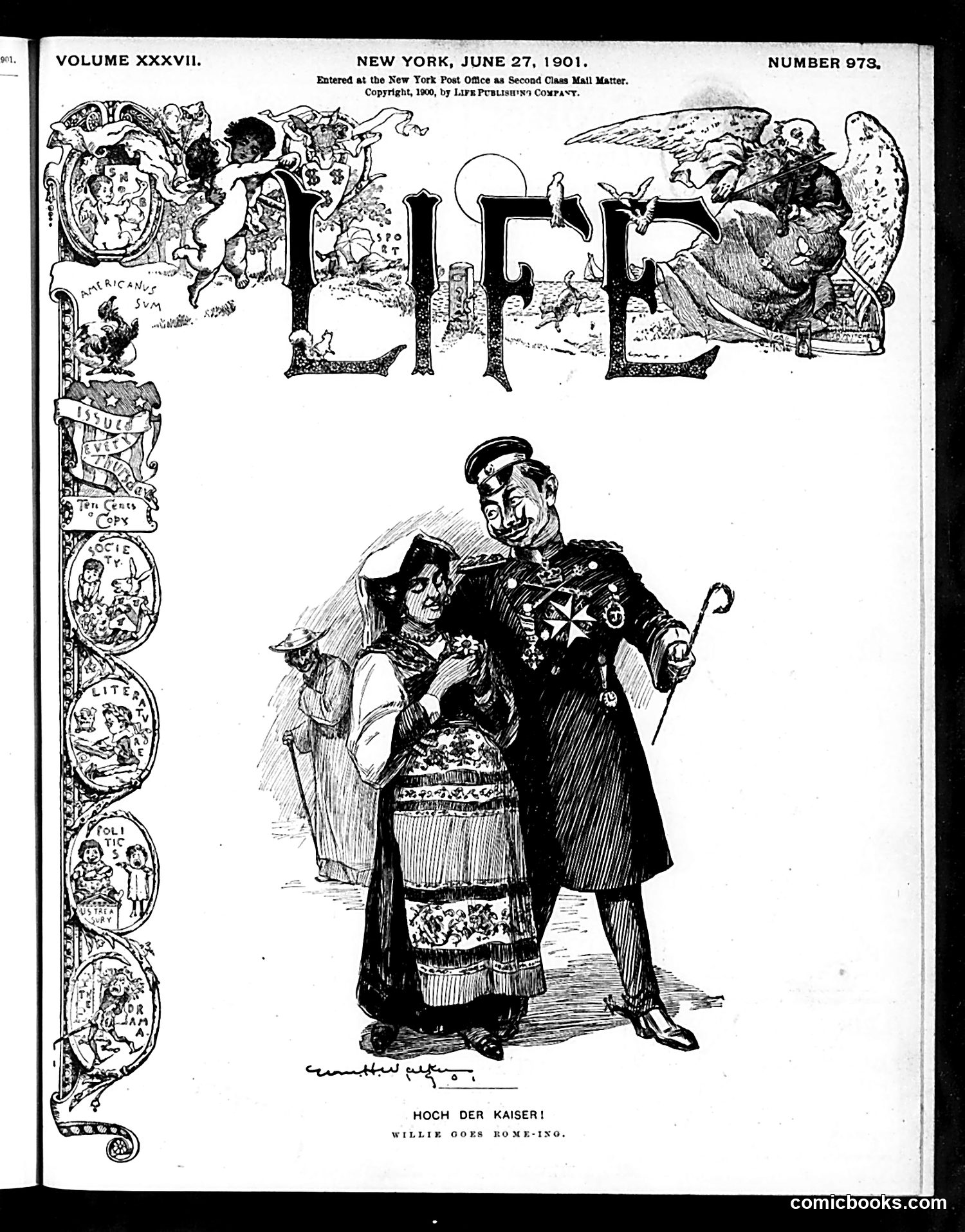
This satirical cover depicts "Hoch der Kaiser! Willie Goes Home-ing," featuring a military figure in Prussian uniform (identifiable by decorations and formal dress) with a woman in traditional German folk costume. The caption "Willie Goes Home-ing" is a pun—suggesting German Emperor Wilhelm II is returning home, while also implying courtship or romantic intentions. The ornate military regalia and exaggerated facial features are typical of Life's caricature style for foreign dignitaries. The elaborate decorative border contains smaller vignettes, possibly referencing classical or mythological themes common to fin-de-siècle satirical publications. The cartoon likely references Wilhelm II's diplomatic travels or social activities during this period, mocking his pretensions through the juxtaposition of imperial military grandeur with domestic domesticity.
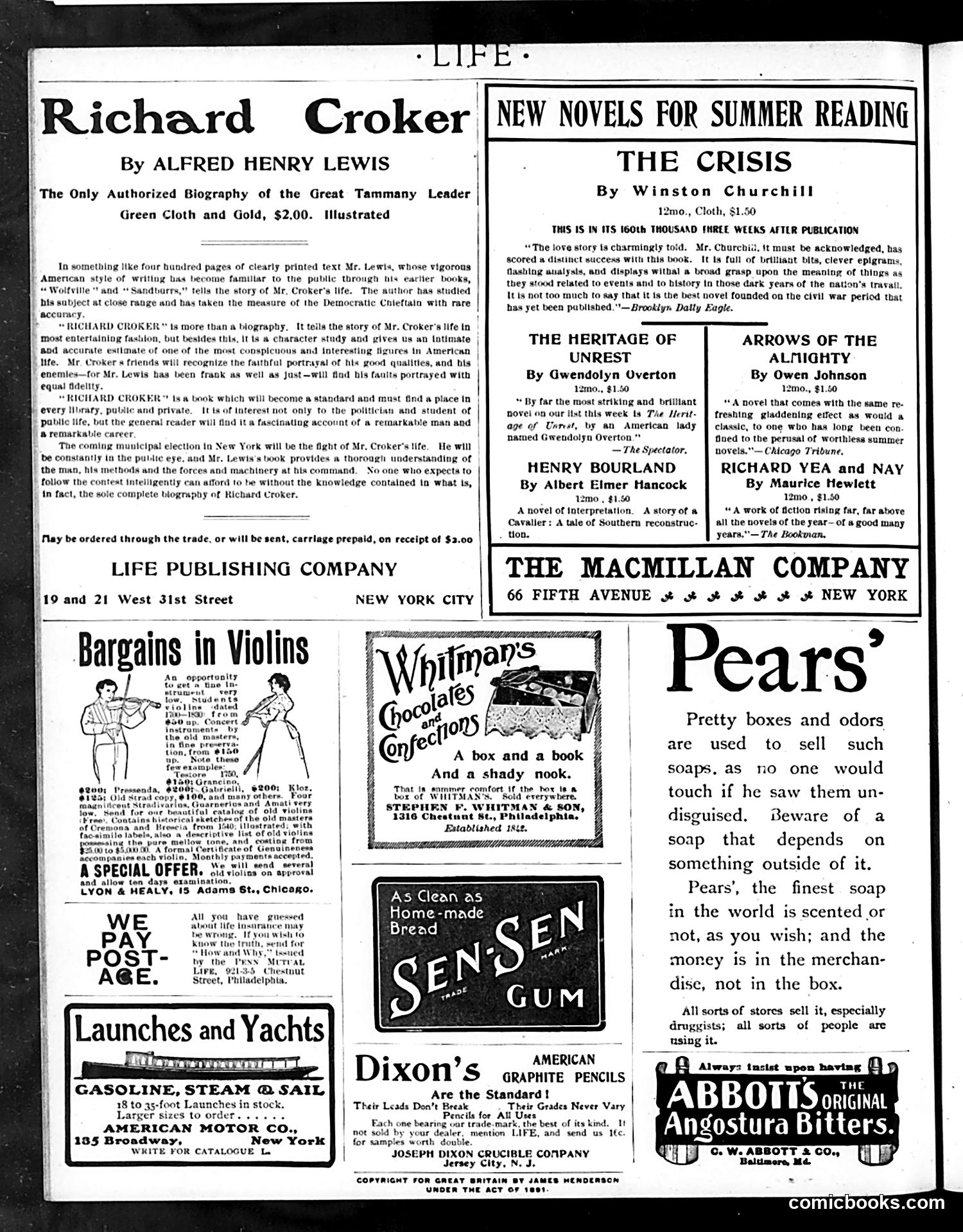
This page is primarily **advertising and book promotion** rather than political satire or cartoons. The main content includes: - A biography advertisement for "Richard Croker" by Alfred Henry Lewis, described as "The Only Authorized Biography of the Great Tammany Leader" - Multiple book advertisements for summer reading (novels by Winston Churchill, Gwendolyn Overton, and others) - Commercial ads for violins, chocolates, soap, bread, pencils, gum, and bitters The only potentially satirical element is the **Pears' Soap advertisement**, which uses social commentary to mock deceptive advertising practices—warning readers that pretty packaging shouldn't fool them into buying inferior products. This reflects turn-of-the-century consumer skepticism. The page reflects early 20th-century Life magazine's mixed editorial-advertising format rather than focused political commentary.
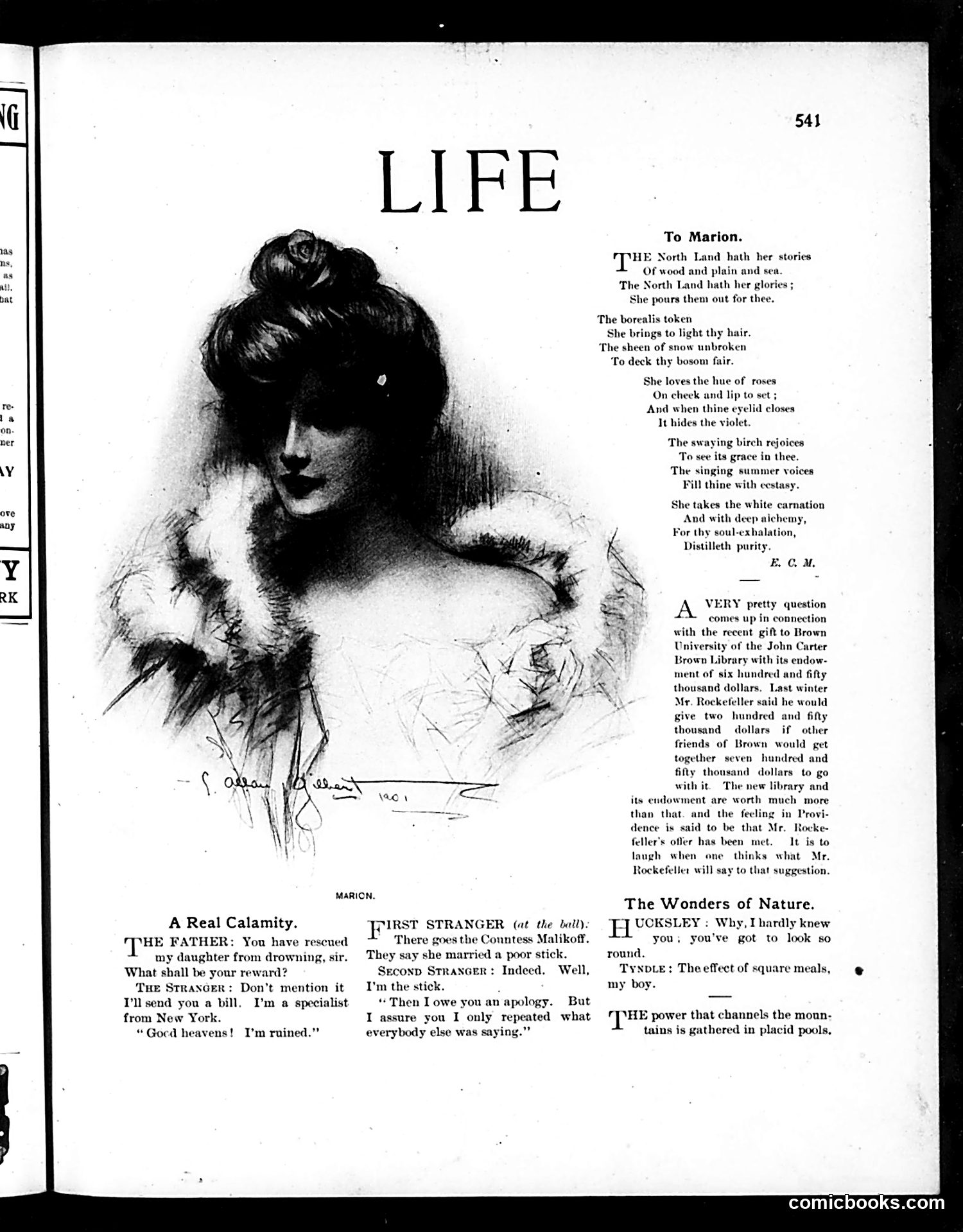
This page features three distinct pieces: 1. **"Life" Poem to Marion**: A romantic verse by E.C.M. celebrating a woman's natural beauty, comparing her to northern landscapes and flowers. 2. **"A Real Calamity"**: A brief comedic dialogue where a Father rescued his drowning daughter, but a Stranger from New York sent a bill for the rescue, claiming to be a "specialist." The joke satirizes American commercialism and the tendency to charge fees for everything, even life-saving acts. 3. **"The Wonders of Nature"**: A short exchange about square meals and mountain water—likely a nature-themed joke or observation piece. The page reflects typical Life magazine content: combining sentimental poetry with satirical commentary on American society and commerce.
This page contains editorial text discussing Major McKinley's potential return to public life, with two decorative illustrations rather than political cartoons. The left illustration shows an eagle with shield and laurel wreath—a patriotic emblem symbolizing American authority and prestige. The top vignette depicts classical figures in a landscape, likely representing idealized civic virtue. The text argues McKinley remains popular and suggests his service as an Ex-President could benefit the country through public influence. It discusses establishing a unified Fine Arts organization in New York with proper gallery space—essentially advocating for greater institutional support of American artists and cultural institutions. The page reflects turn-of-the-century debates about presidential legacies and cultural infrastructure rather than partisan political satire.
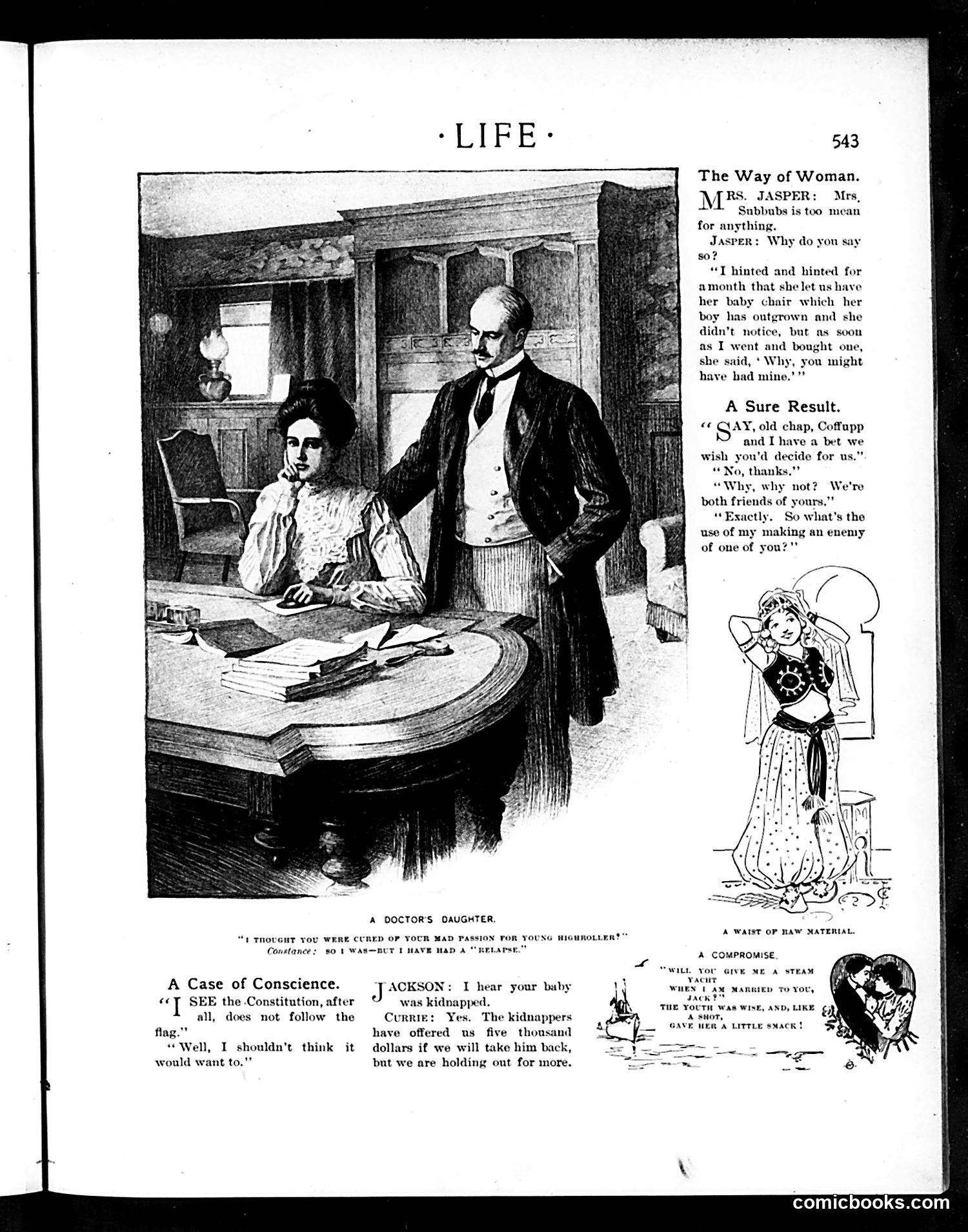
This page contains three separate humor pieces satirizing early 20th-century domestic and social conventions: **"A Doctor's Daughter"** depicts a man confronting a woman about her "mad passion for young highwaylers" (likely "highrollers"—wealthy men). The joke plays on class anxiety and parental concern over daughters' romantic choices. **"A Case of Conscience"** features a kidnapping ransom negotiation where parents refuse a $5,000 offer, holding out for more—satirizing both parental greed and the absurdity of kidnapping scenarios. **"The Way of Woman"** and other titled sections present brief domestic comedies about marriage negotiations, material desires ("a steam engine"), and romantic compromises—all poking fun at women's supposed materialism and manipulation within courtship and marriage. The overall tone mocks both genders' marital and romantic behaviors.
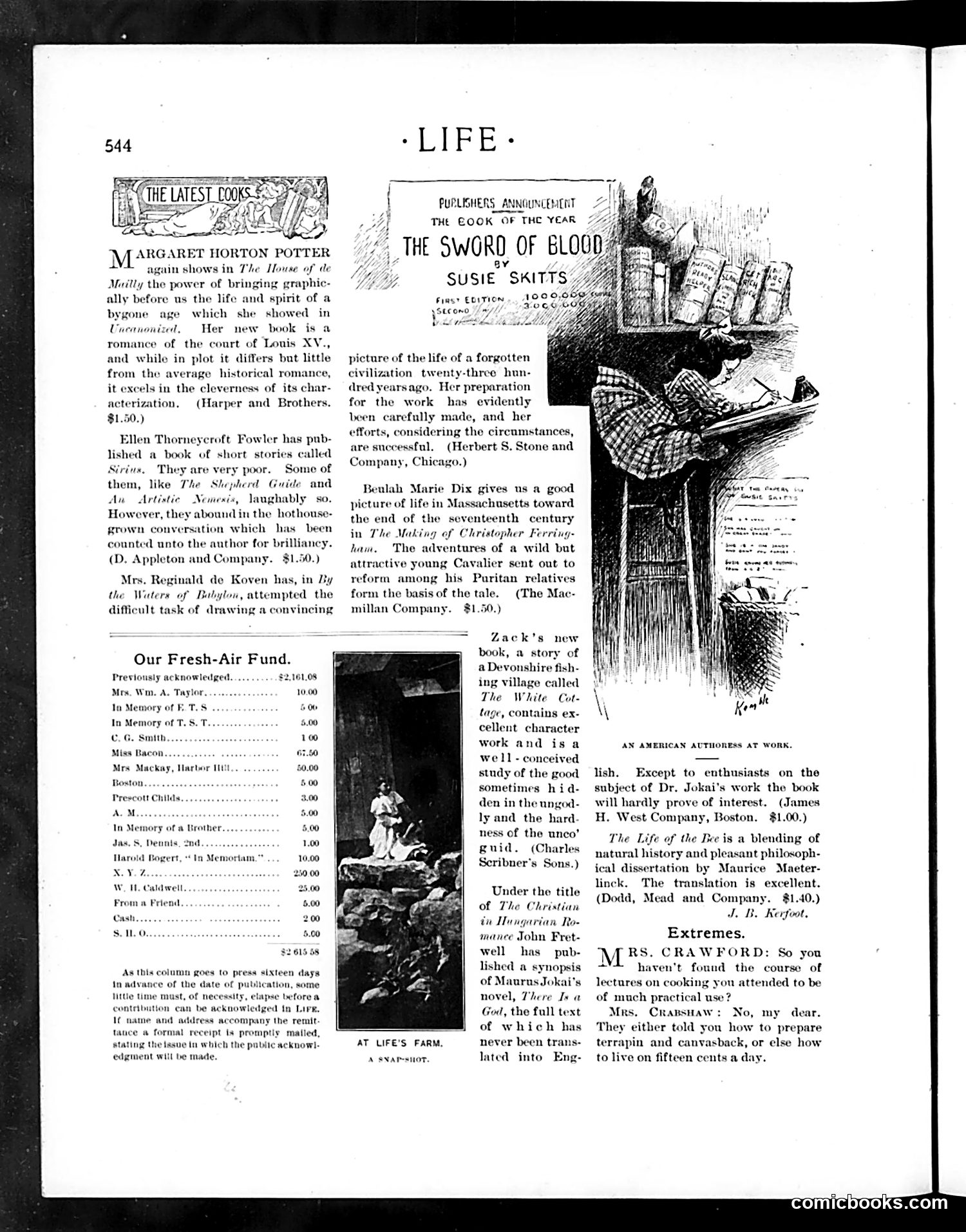
This page is primarily **book reviews and literary criticism**, not political satire. "The Latest Looks" section reviews new publications including works by Margaret Horton Potter, Ellen Thorneycroft Fowler, and Beulah Marie Dix. The only illustration labeled "AN AMERICAN AUTHORESS AT WORK" shows a woman writer at her desk—likely meant humorously to depict the romantic notion of female authorship versus reality. Below is a section titled "Our Fresh-Air Fund" listing monetary contributions, followed by "Extremes," a brief humorous dialogue between Mrs. Crawford and Mrs. Charshaw about cooking lectures and practical domestic economy. The page contains **no political cartoons or caricatures**—it's a standard literary and humor column typical of Life magazine's content during this period.
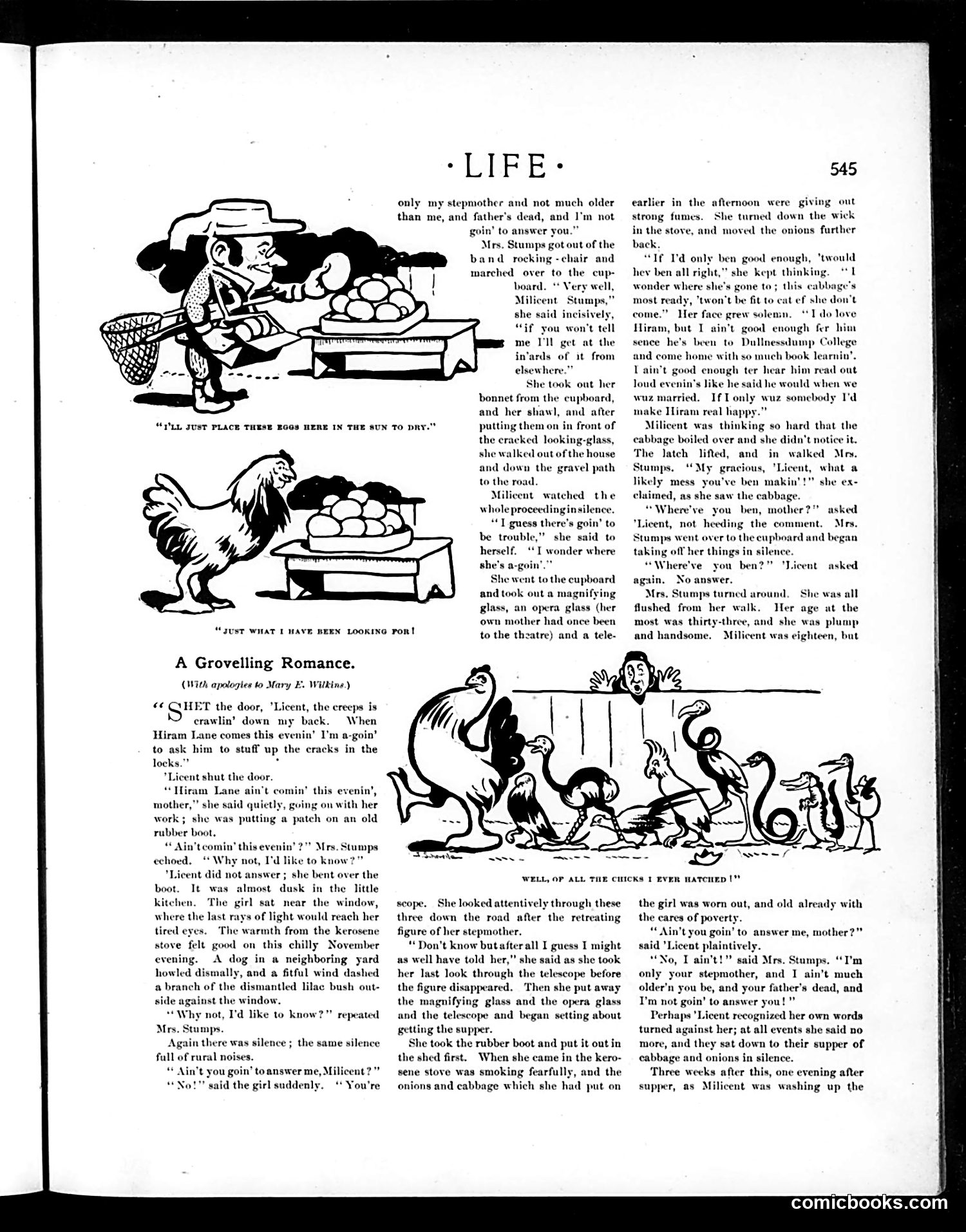
This page contains a short story titled "A Grovelling Romance" (with apologies to Mary E. Wilkins) rather than political cartoons. The illustrations are humorous vignettes accompanying the narrative. The story depicts rural/small-town life, featuring characters named Lilient, Mrs. Stumps, and Hiram Lane. The plot involves domestic drama—a stepmother-stepdaughter conflict, mysterious comings and goings, and romantic complications. The accompanying cartoons show exaggerated character types: a woman handling eggs, a hen with chicks, and country folk engaged in mundane activities. The humor derives from satirizing rural manners, speech patterns ("ain't comin'"), and domestic predictability rather than political commentary. This represents Life magazine's tradition of gentle social satire about American provincial life and domestic relations.
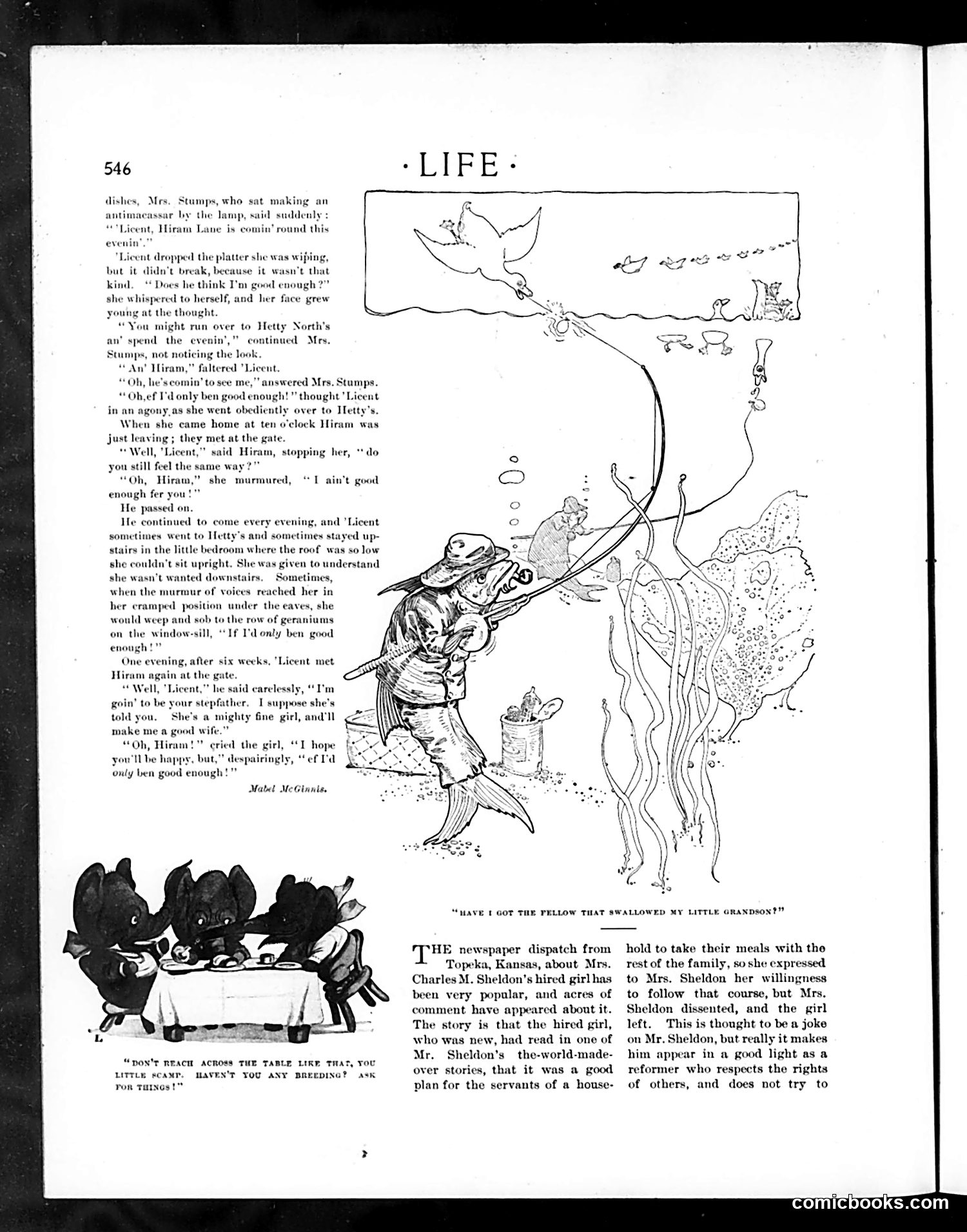
This page contains a short story by Mabel McGlasis rather than political satire. The narrative concerns "Licent," a woman of questionable moral character, and her interactions with men named Hiram and Hetty North. The illustrated vignette shows a mermaid-like figure underwater, apparently part of the story's fantastical or allegorical elements. The bottom cartoon depicts three crows or ravens seated at a table, captioned with dialogue about breeding—a likely reference to human reproduction or social commentary on unmarried women, though the specific satirical target remains unclear from the visible text alone. This appears to be social/domestic humor rather than political commentary, typical of Life magazine's satirical fiction content from this era.
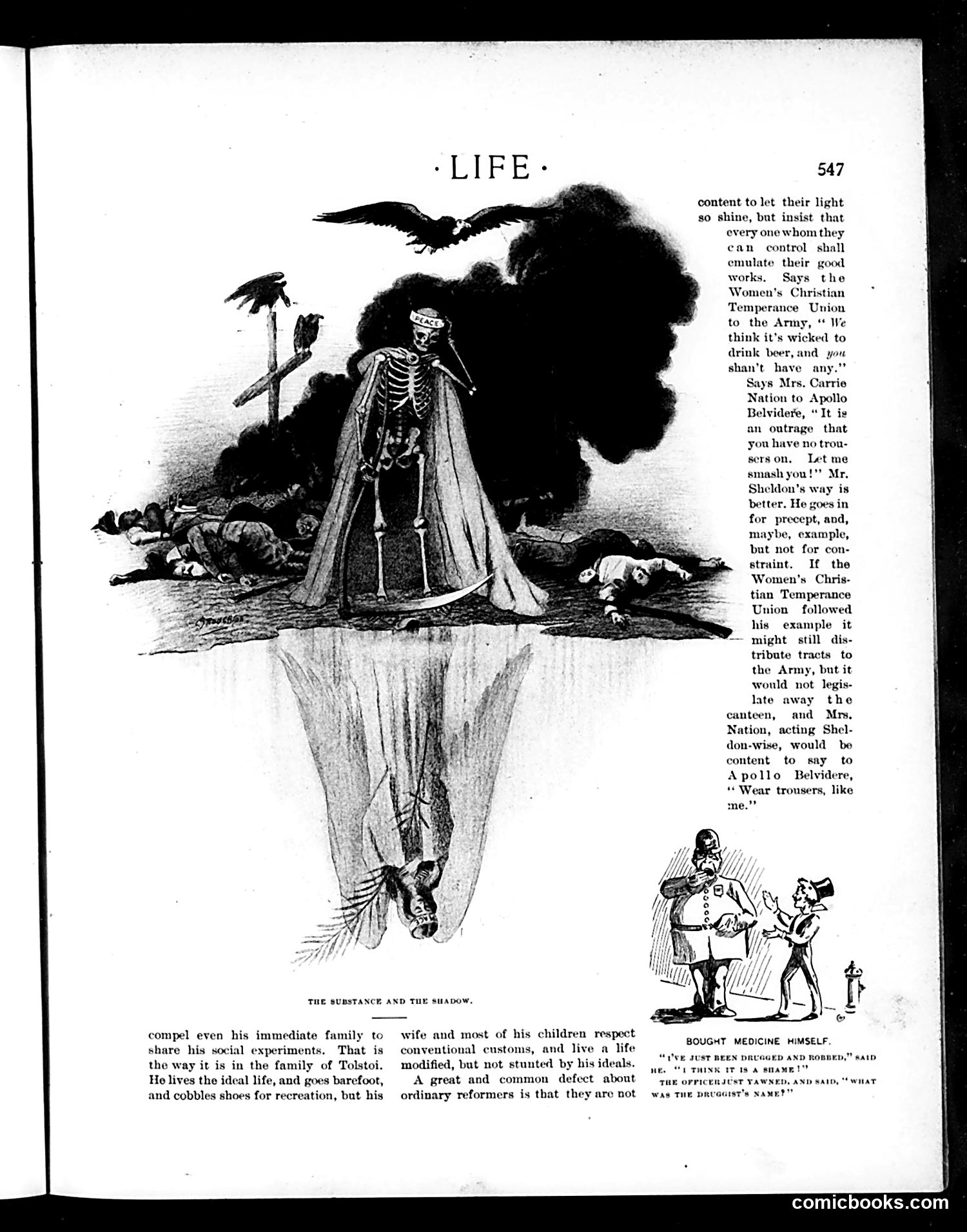
This satirical cartoon depicts **Death** (skeleton in robes) standing over fallen bodies, with a large shadow looming behind—representing the abstract consequences of social policies. The accompanying text discusses **temperance reform movements**, specifically the Women's Christian Temperance Union's advocacy against alcohol consumption. The satire critiques reformers who impose strict moral standards yet fail to address deeper societal problems. A smaller cartoon below titled "Bought Medicine Himself" mocks someone who purchased dubious patent medicine, with characters discussing whether it's a "shame." Together, these images satirize **late 19th-century reformers** who focused on surface-level moral crusades (drinking, medicine) while ignoring substantive causes of poverty and suffering—the "shadow" being the real, unseen societal harms they overlook.
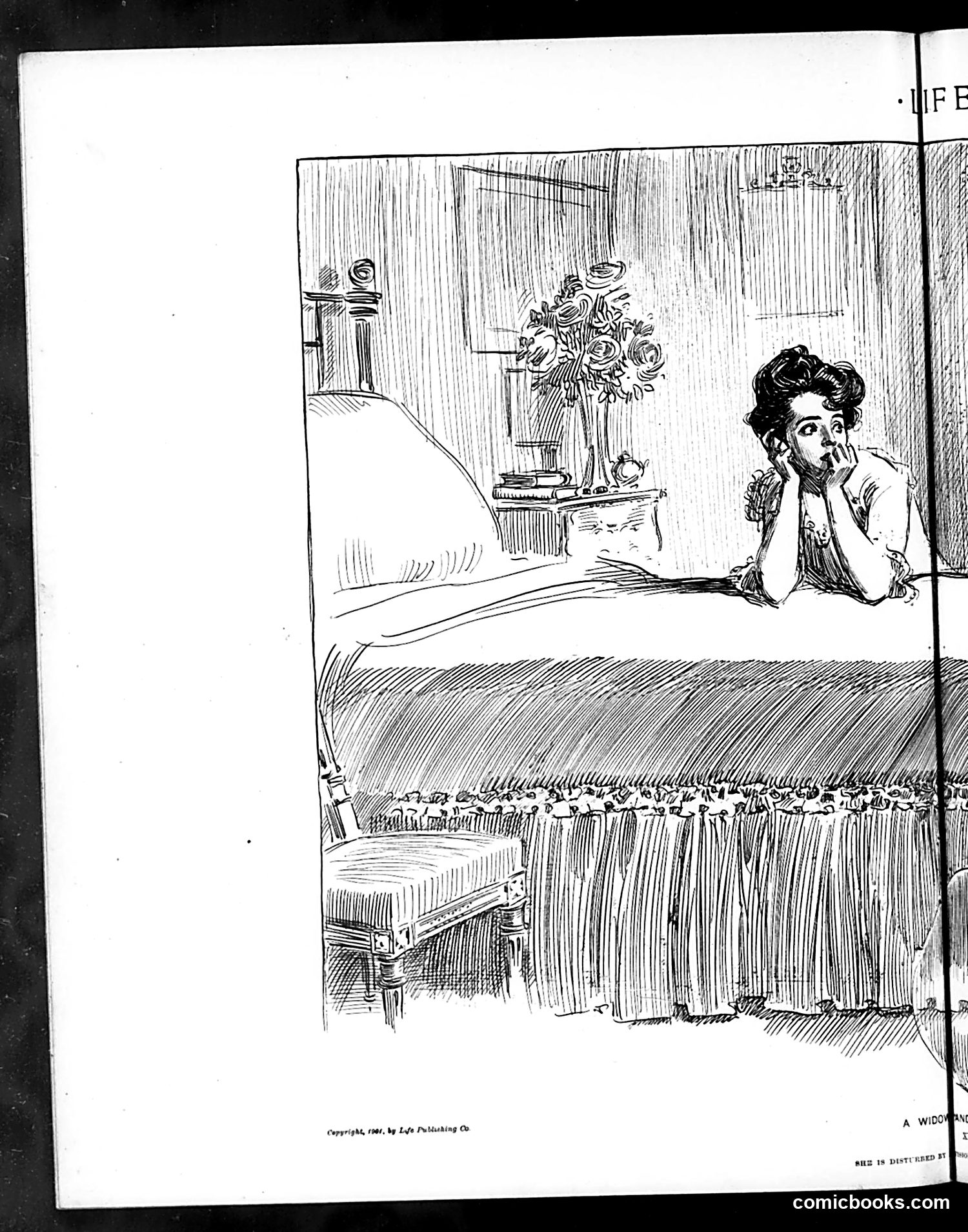
This is a sketch-style cartoon showing a woman in bed in an early 20th-century bedroom setting. She appears to be in a contemplative or worried pose, resting her head on her hand. The room includes period details like a window with curtains, a small table with flowers, and a chair. The caption and context are not clearly visible in this image, making it difficult to identify the specific satirical point or social commentary intended. Without readable text explaining the cartoon's premise, I cannot accurately determine what political or social situation is being referenced or which figure (if any) is being caricatured. To properly explain this cartoon's meaning to a modern reader, the accompanying caption or article text would be necessary.
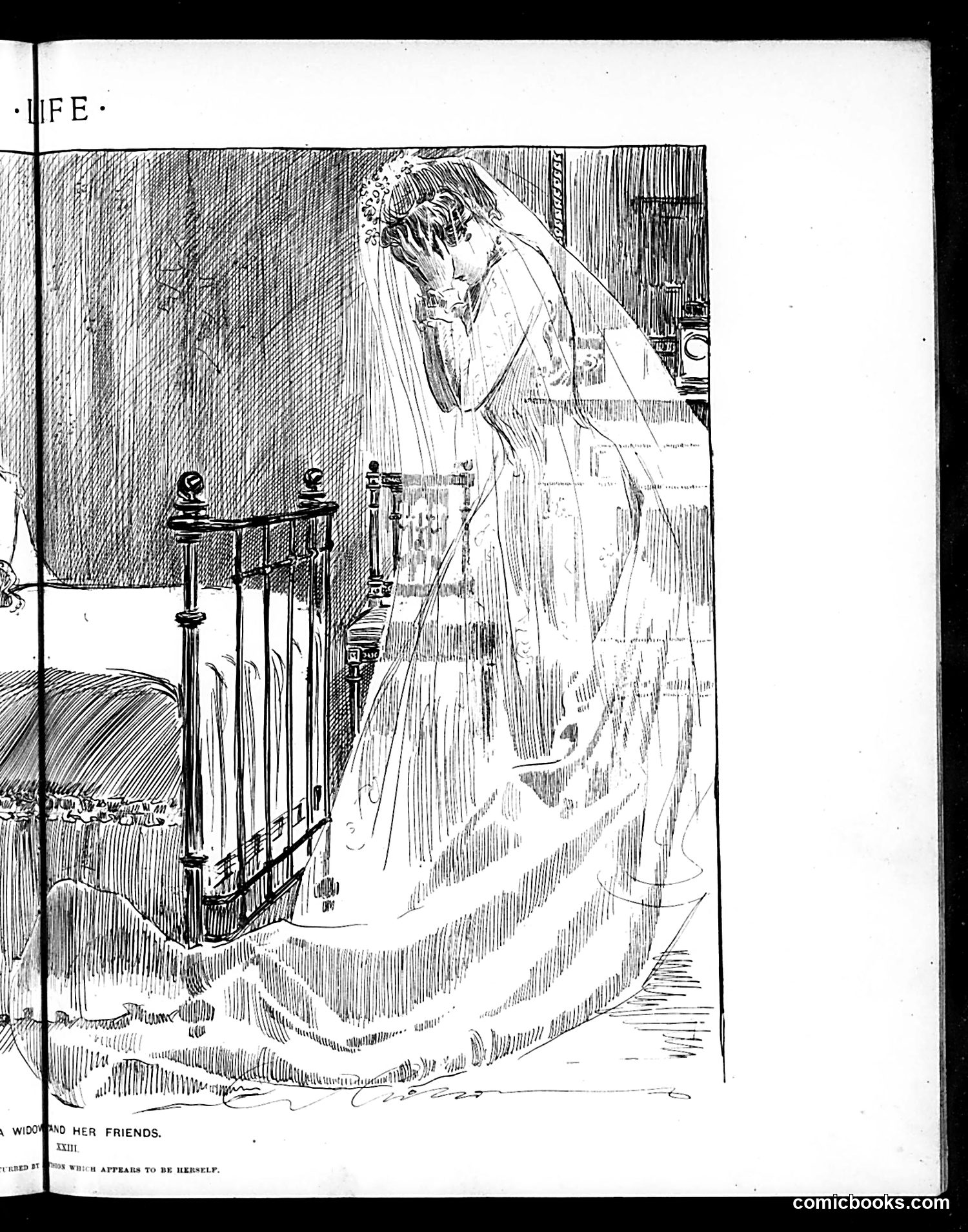
This appears to be an illustration from Life magazine's satirical section. The image shows a woman in an elaborate wedding dress with a long train, positioned near a bed with ornate metal railings. The woman appears distressed or contemplative, gazing downward. The partial caption reads "A WIDOW AND HER FRIENDS" and "WHO IT APPEARS TO BE HERSELF," though the full text is cut off at the page edge. Based on the visual composition—the wedding attire contrasted with the bedroom setting and the "widow" reference—this likely satirizes marriage, widowhood, or contemporary attitudes toward women's domestic roles. The exact satirical point remains unclear without the complete caption, but the juxtaposition suggests commentary on marriage, loss, or women's social expectations in the era when Life was publishing.
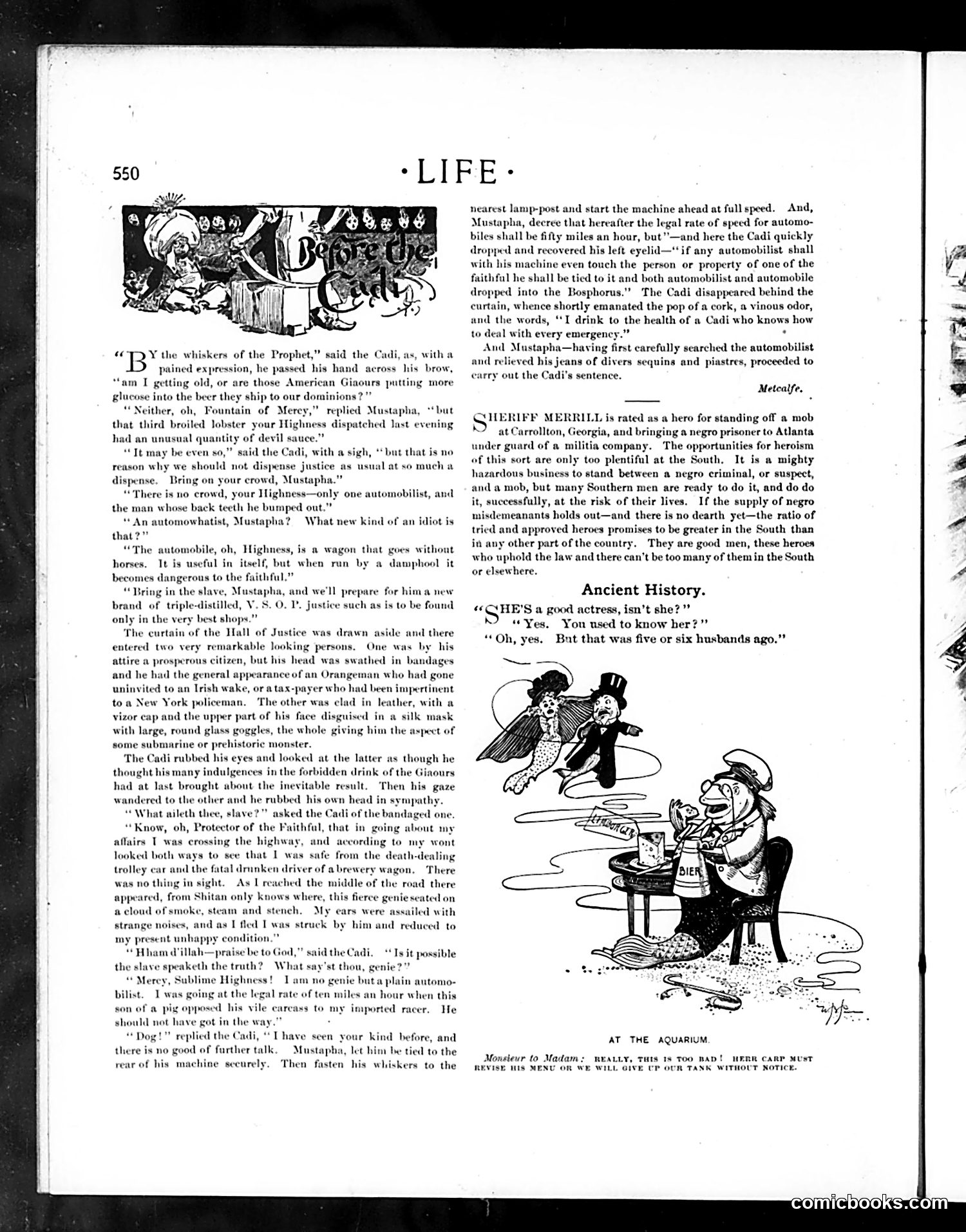
This page contains a satirical story about an automobile and a cartoon titled "At the Aquarium." **The main narrative** mocks early automobiles as dangerous and ridiculous contraptions, with characters debating whether they're useful innovations or foolish inventions. The Cadi (an Ottoman judge) dismisses automobiles as dangerous "wagons without horses," while Mustapha defends them. The humor targets contemporary anxieties about this new technology. **The cartoon** shows a well-dressed couple at an aquarium viewing fish, with a waiter presenting a menu. The caption reads: "Monster to Madam: Really, this is too bad! Herb carp must revise his menu or we will give up our tank without notice." This jokes about fish as demanding customers with standards, anthropomorphizing them as temperamental diners—likely satirizing both pretentious restaurant culture and the absurdity of treating animals as paying guests.
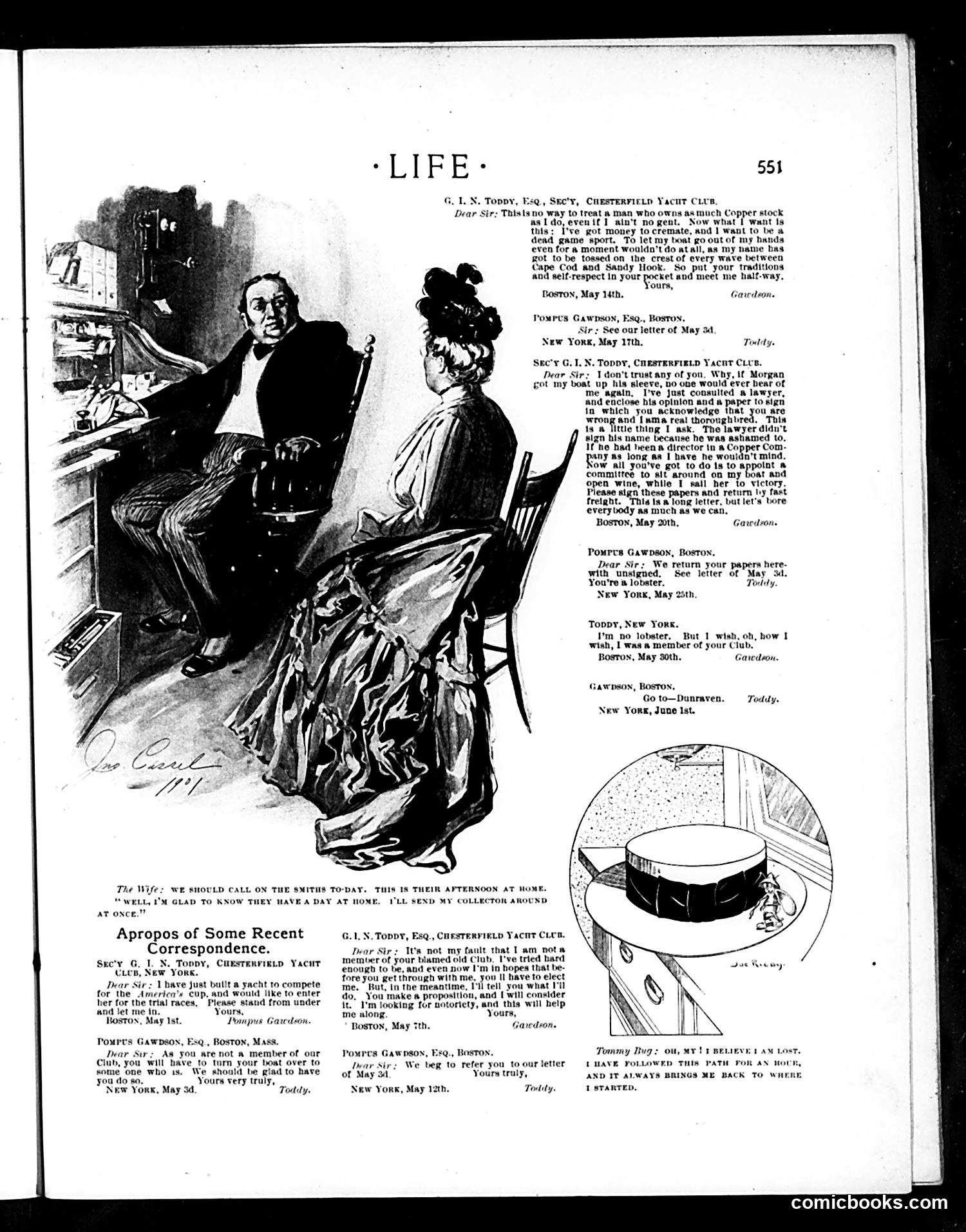
This page satirizes the social exclusivity of elite yacht clubs and the nouveau riche attempting to gain entry. The main cartoon depicts a wealthy businessman (Pompus Gawdson) consulting with a yacht club official (G.I.N. Toppy) about entering his yacht in America's Cup trials. The accompanying correspondence mockingly documents Gawdson's escalating frustration at being denied membership solely because he's not a club member—a circular exclusion. Despite owning substantial copper stock wealth, he's rebuffed by the established elite. His attempts grow increasingly desperate: hiring lawyers, demanding committees, and offering to sail the boat himself if permitted. The satire targets both groups: the pretentious club officials rigidly enforcing tradition regardless of merit or wealth, and the social-climbing millionaire whose desperation for acceptance reveals the arbitrary nature of upper-class gatekeeping. The smaller cartoon at bottom mocks similar class pretensions—a wife wants to visit neighbors "at home" while her husband cynically sends his bill collector instead, suggesting wealth doesn't automatically grant social acceptance.
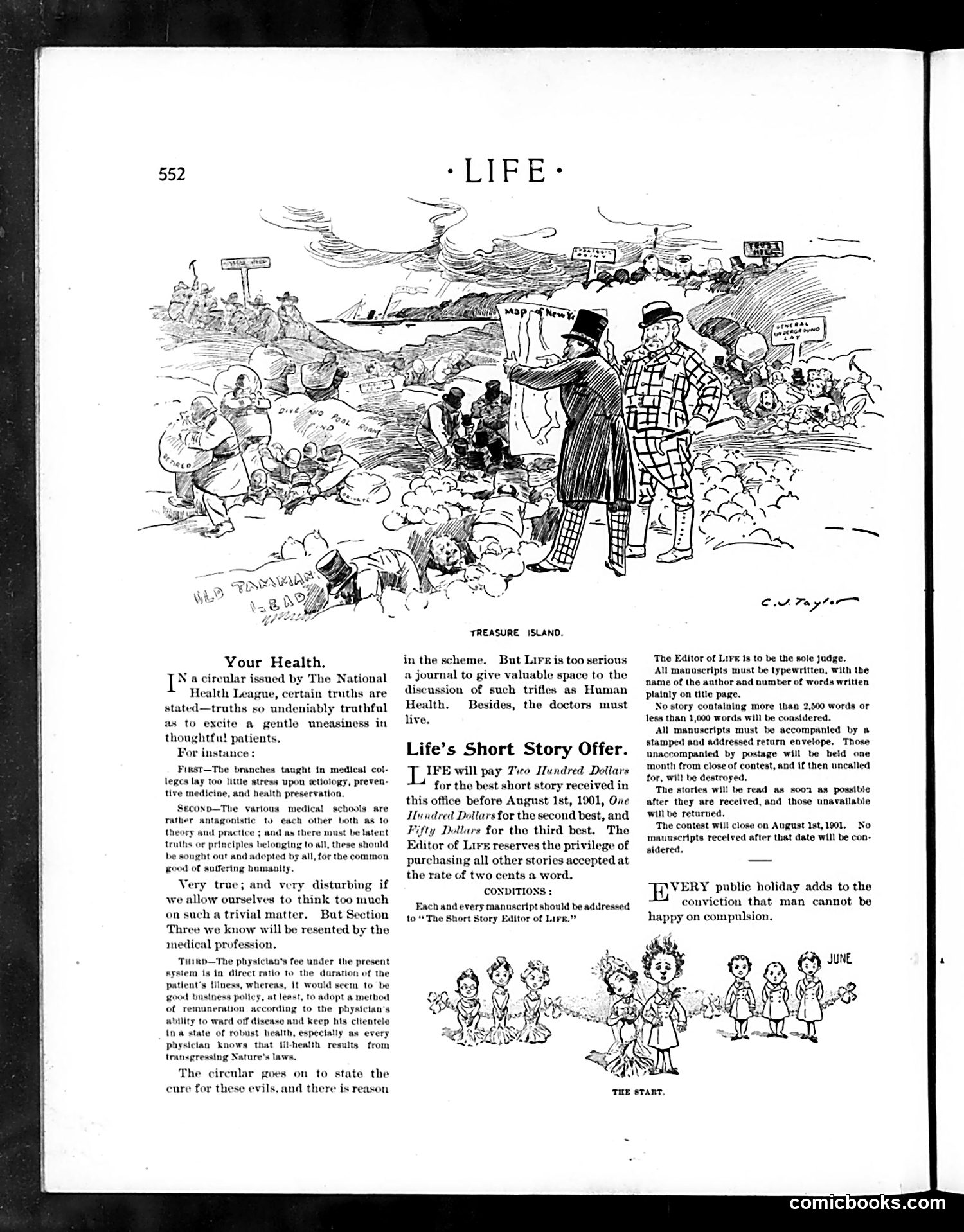
The main cartoon, titled "Treasure Island," depicts a chaotic scene satirizing medical incompetence and quackery. It shows various dubious "doctors" and charlatan practitioners among crowds of sick or confused patients, suggesting that medical practice in this era was rife with ineffective treatments and profit-driven practitioners. The accompanying article mocks a National Health League circular that criticizes medical education and, especially, physicians' fee structure—doctors profit when patients stay sick longer. Life's editor sarcastically dismisses these valid critiques as "trifles," declaring the magazine won't waste space on "Human Health" because "the doctors must live"—meaning the medical profession's financial interests supersede patient welfare. The piece exposes how early 1900s medicine prioritized physician income over actual health outcomes, a system Life found absurdly corrupt. The tone is biting: even while acknowledging obvious truths about medical failures, the magazine ironically refuses to engage seriously with reform.
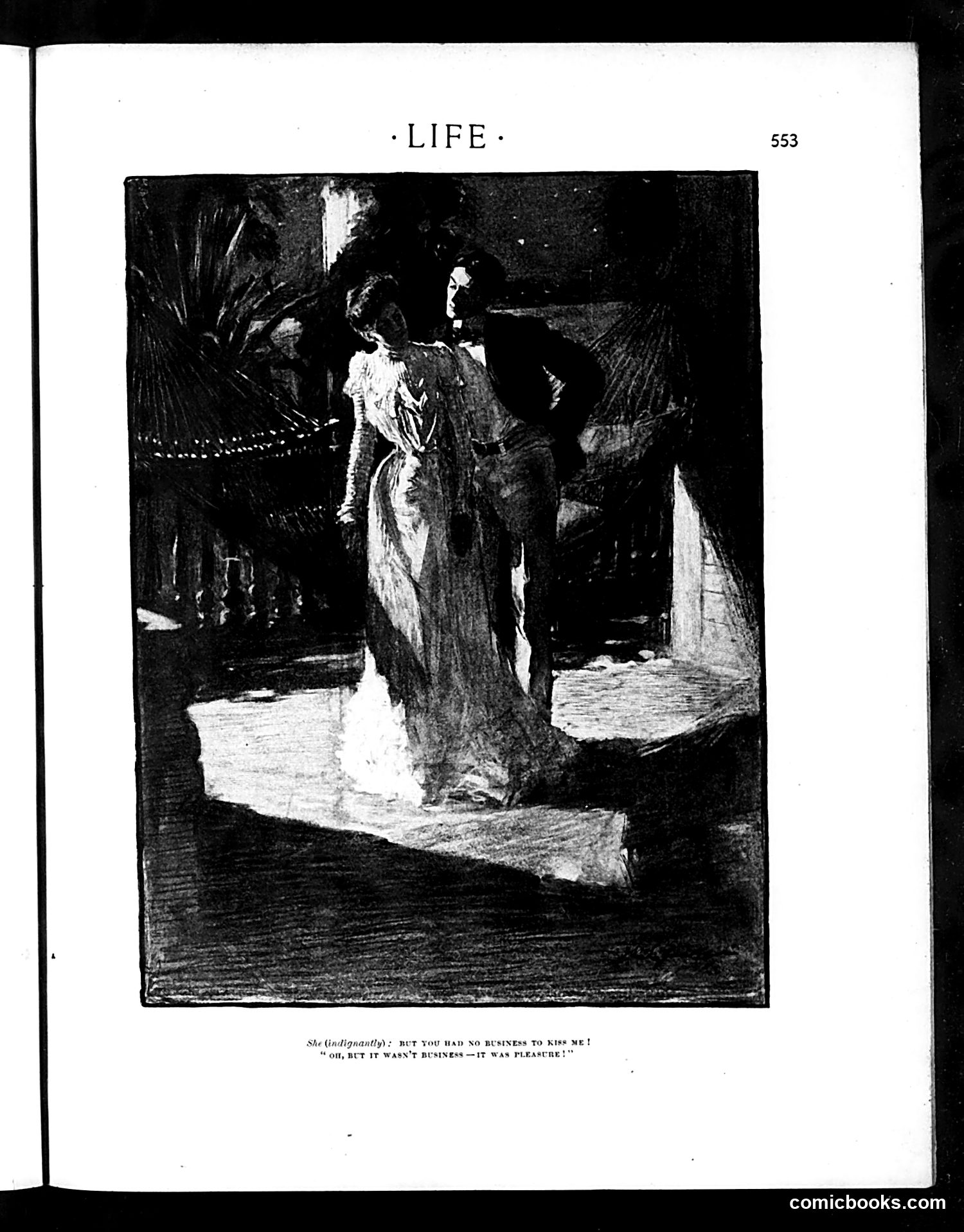
This appears to be a romantic or domestic comedy cartoon rather than political satire. The image shows two figures in an intimate moment within what seems to be a luxurious interior (note the palm plants and draped fabrics suggesting wealth). The caption presents a flirtatious exchange: a woman indignantly protests a man's kiss as "no business," to which he responds that it wasn't business but rather "pleasure." This is classic early-20th-century magazine humor playing on: - Tension between propriety and desire - Gender dynamics and romantic pursuit - Wordplay distinguishing "business" from "pleasure" The cartoon satirizes social conventions around courtship and physical affection among the leisure class. Without identifying the specific figures, it's clearly meant as light, sophisticated humor for Life magazine's educated audience.
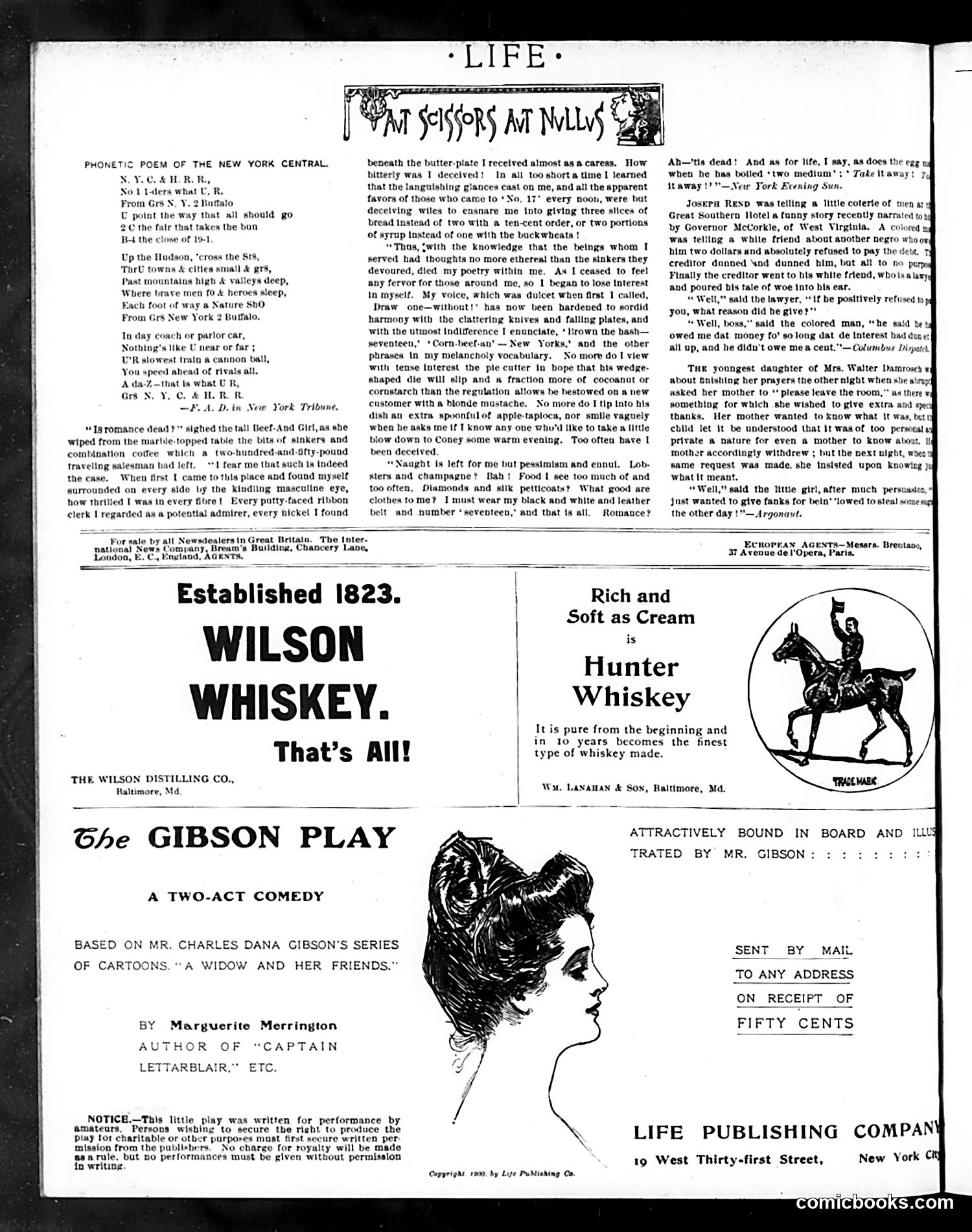
This page from *Life* magazine contains three separate pieces of satirical content: **1. The "Phonetic Poem"** mocks the New York Central Railroad by rendering its name phonetically as railroad conductor calls ("U point the way"). It's a lighthearted jab at railroad culture. **2. The main story** features a waitress ("Beef-And Girl") who has become cynical after working in what appears to be a railroad dining car. She once romanticized the traveling salesmen and regular customers who passed through, but now sees them as crude, cheap ("two portions of syrup instead of one"), and unworthy of her affection. The satire targets both the degradation of service work and the collision between youthful idealism and workplace reality. **3. A brief anecdote** about a Southern Black man claiming compound interest has eliminated his debt—a joke playing on racial stereotypes about both financial ignorance and clever wordplay. The advertisements (Wilson Whiskey, Hunter Whiskey, and *The Gibson Play*) are period commercial content, not satirical commentary.
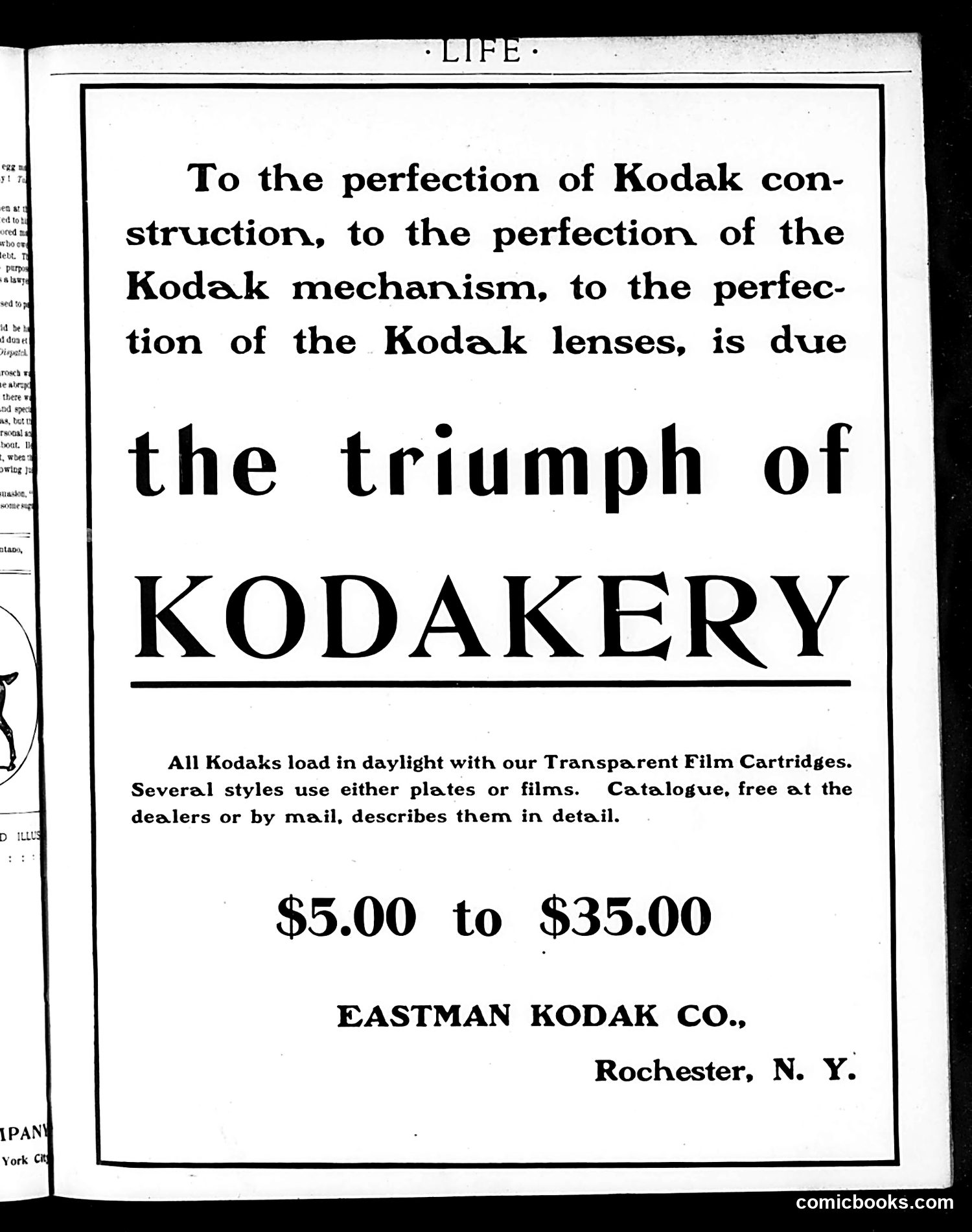
This is a **full-page advertisement**, not political satire or a cartoon. It's a Kodak camera advertisement from *Life* magazine promoting Eastman Kodak Company's products. The ad uses superlative language—"triumph of KODAKERY"—to praise Kodak's manufacturing excellence in construction, mechanics, and lenses. It emphasizes a practical selling point: cameras load in daylight using transparent film cartridges, eliminating the need for a darkroom. The price range ($5.00 to $35.00) indicates multiple camera models for different budgets. The ad invites readers to request a free catalogue from dealers or by mail for detailed product information. This represents early 20th-century advertising that emphasizes technological achievement and consumer choice rather than hard-sell tactics.
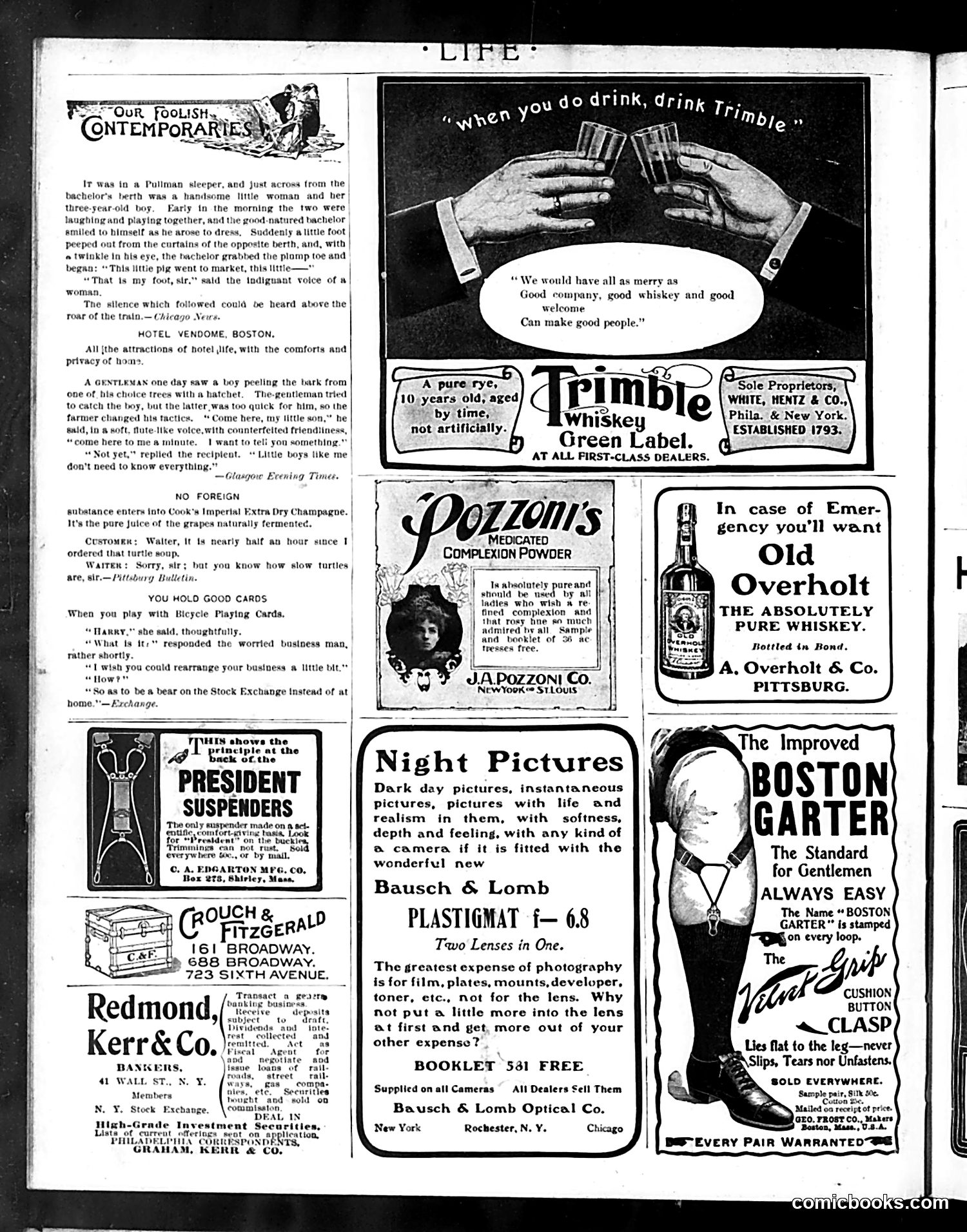
This page is primarily **advertising** with some brief comedic anecdotes in the left column—not political cartoons. The three short jokes ("Our Foolish Contemporaries") exemplify early 20th-century humor: a bachelor accidentally tickles a sleeping woman's foot on a train; a farmer uses psychology on a mischievous boy; a waiter quips that turtles are slow. These target everyday social embarrassments and minor life frustrations familiar to the magazine's readers. The remaining content is **product advertisements** for luxury goods: Trimble Whiskey, Pozzoni's face powder, Old Overholt Whiskey, camera lenses, President Suspenders, a Boston Garter (men's garter), and investment banking services. These ads reveal the magazine's audience: middle-to-upper-class Americans with disposable income. No political figures or satire appear. This is a standard Life magazine page mixing light humor with period advertising.
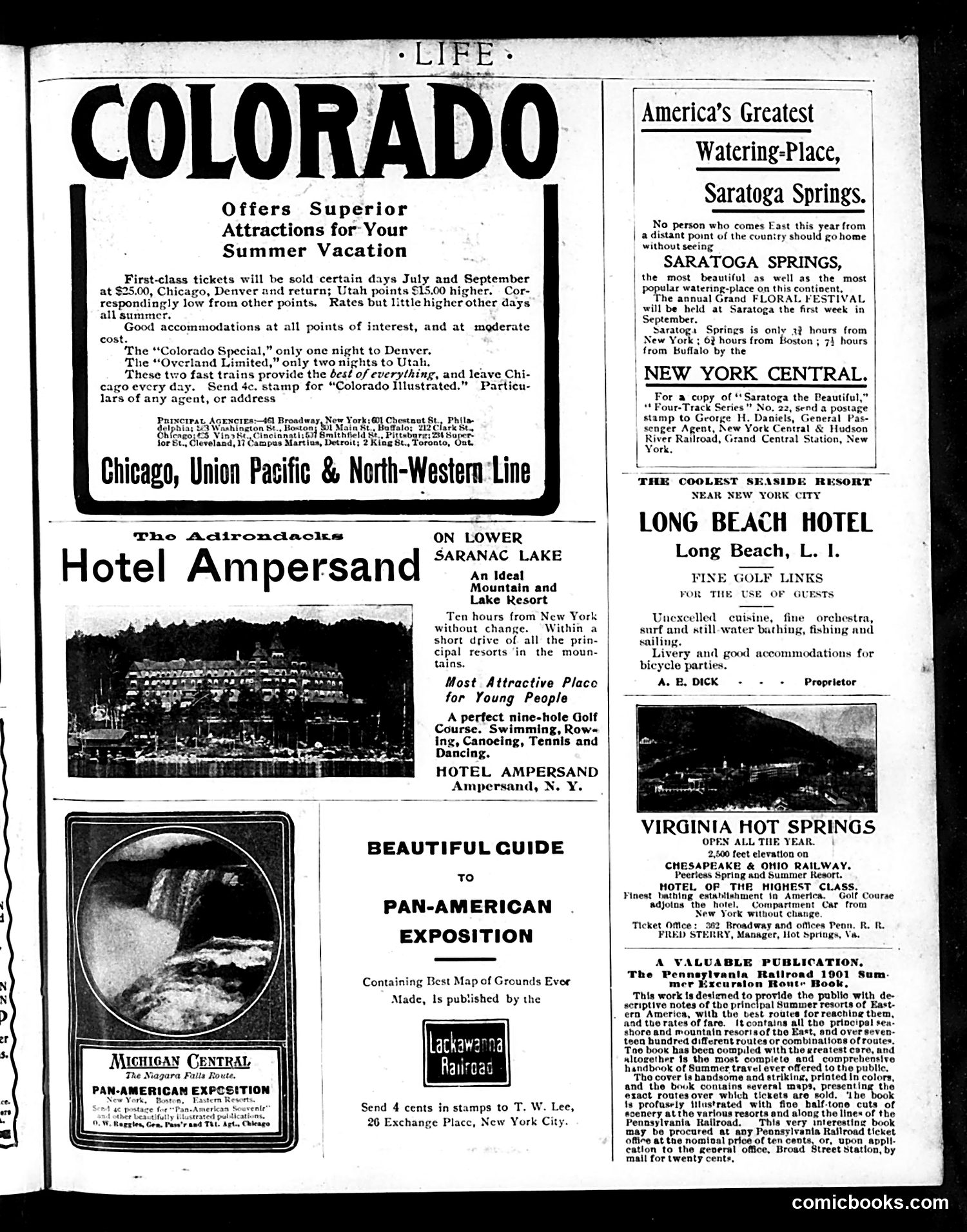
This is primarily an **advertising page** from Life magazine, not a political cartoon. It features travel and hospitality advertisements from the early 1900s. The page showcases vacation destinations popular with wealthy Americans of that era: Colorado (via railroad), Saratoga Springs (upstate New York's famous spa town), the Adirondacks' Hotel Ampersand, Long Beach on Long Island, and Virginia Hot Springs. These were exclusive resorts catering to the affluent. The advertisements emphasize **luxury amenities**—golf courses, fine dining, theatrical entertainment, and rail access—reflecting the Gilded Age leisure culture. The inclusion of detailed railroad schedules and agents' addresses shows how essential rail travel was for accessing these distant resorts. The only quasi-editorial content is a promotional guide to the 1901 Pan-American Exposition (Buffalo), presented as a "valuable publication." **The implicit message**: Summer vacationing at distant, expensive resorts was a marker of social status and leisure time—luxuries available only to the prosperous classes.
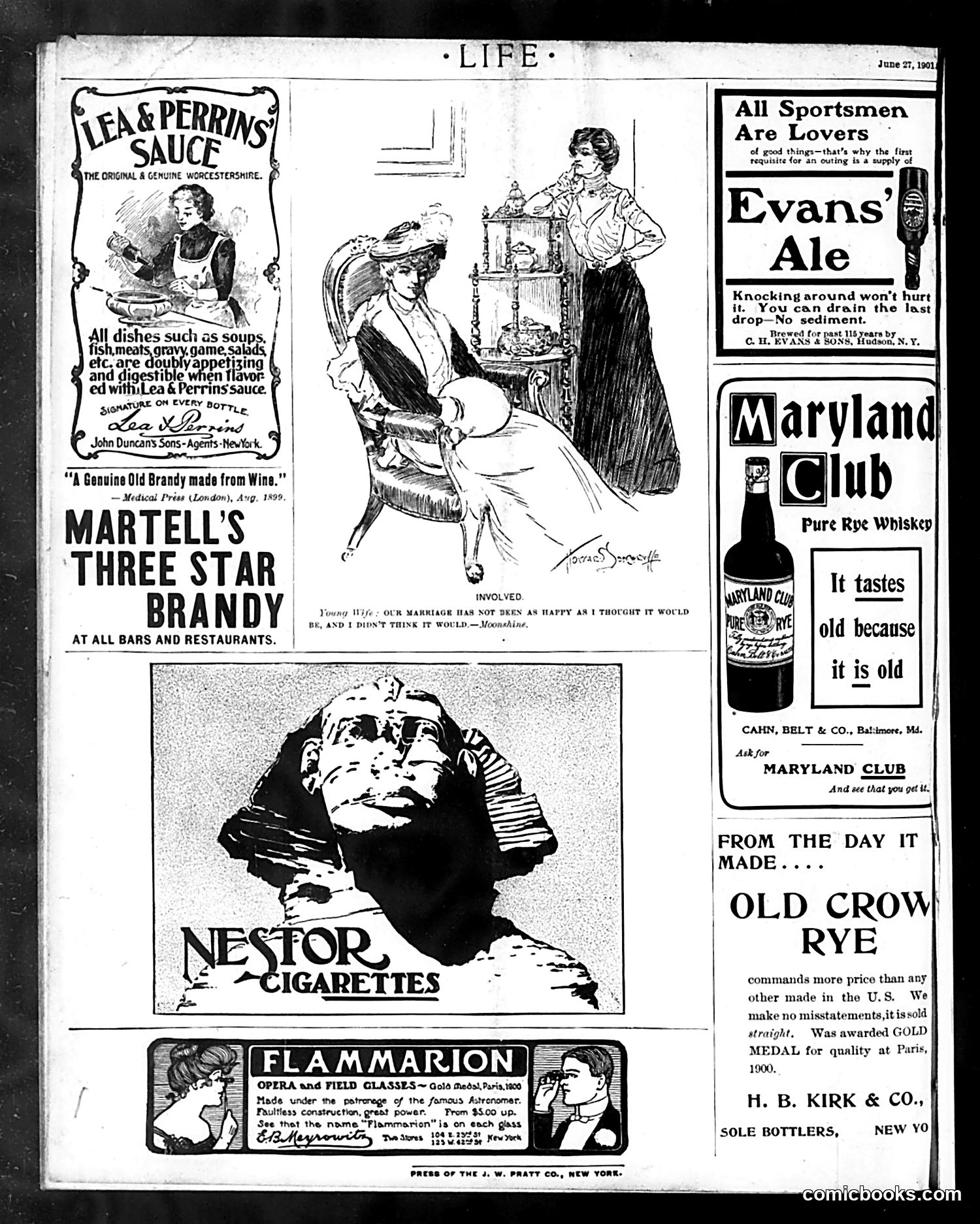
This page is primarily **advertising**, not political satire. It features liquor and consumer product ads typical of the era. The central cartoon shows a couple in an intimate domestic scene with the caption "INVOLVED — Johnny Wife: 'OUR MARRIAGE HAS BEEN AS HAPPY AS I THOUGHT IT WOULD BE, AND I DIDN'T THINK IT WOULD.'" This is a gentle joke about lowered marital expectations—the wife expected unhappiness but found contentment instead. It's social humor about marriage rather than political commentary. The ads promote alcohol (Lea & Perrin's Sauce, Martell's Brandy, Evans' Ale, Maryland Club Rye), Nestor Cigarettes, and Flammarion opera glasses—products marketed to affluent sportsmen and gentlemen. The "Old Crow Rye" ad emphasizes its superiority and Paris Gold Medal award. There is **no political cartoon or satire** on this page—it's a commercial publication mixing household humor with luxury goods advertising aimed at upper-class readers.
I can see this is a page from Life magazine, but the image is almost entirely black or heavily degraded, making it impossible to discern any cartoon content, illustrations, or readable text beyond the "comicbooks.com" watermark at the bottom. The left margin shows some fragmentary text remnants (partial words like "urt," "ast," "skp," etc.), but these are too incomplete to identify any specific article, cartoon, or advertisement. Without being able to see the actual content clearly, I cannot identify figures, explain satirical references, or determine the historical or political context of whatever appears on this page. The source material is too deteriorated for accurate analysis.