
Life, 1901-06-27 · page 4 of 21
Life — June 27, 1901 — page 4: what you’re looking at
What you’re looking at
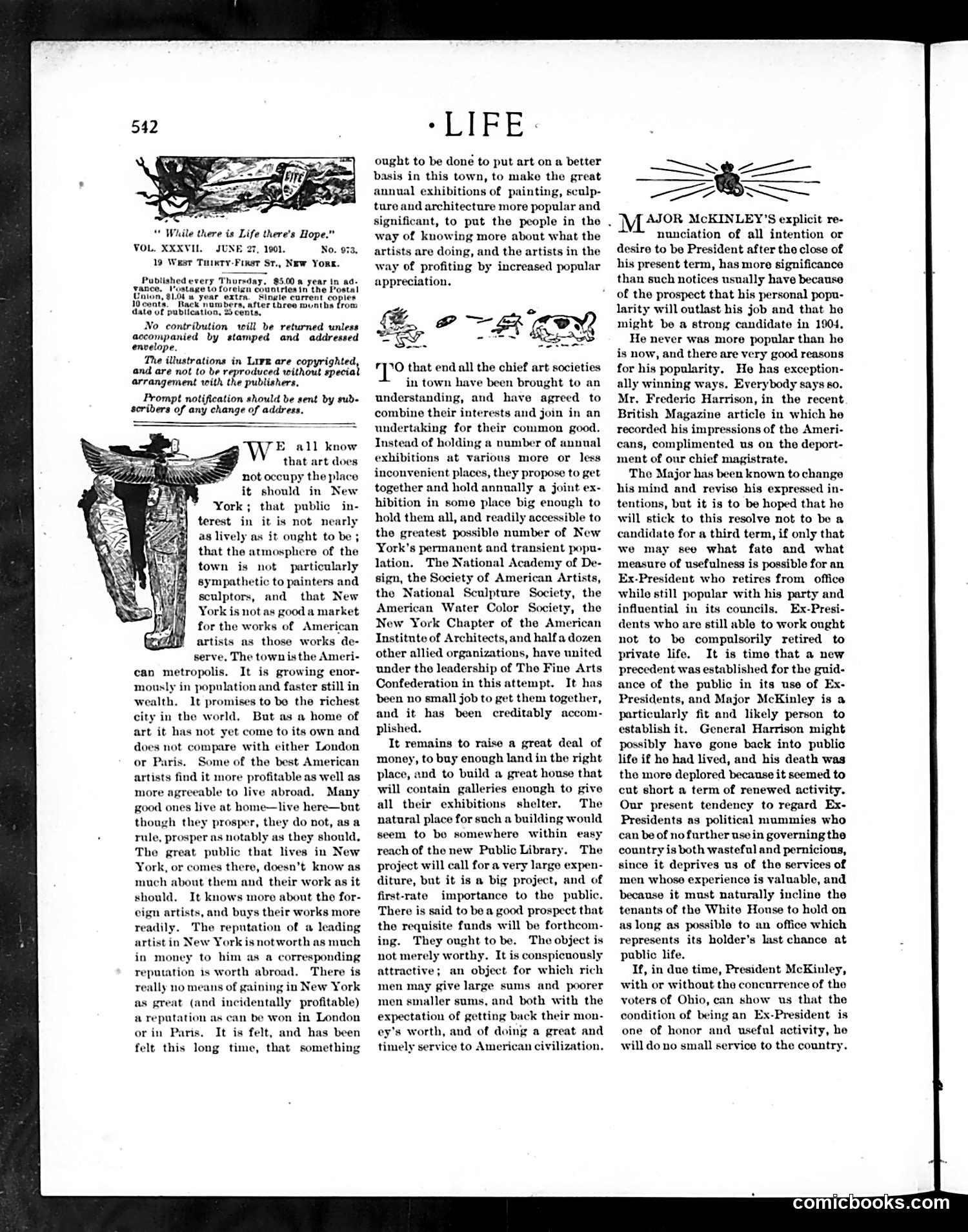
This page contains editorial text discussing Major McKinley's potential return to public life, with two decorative illustrations rather than political cartoons. The left illustration shows an eagle with shield and laurel wreath—a patriotic emblem symbolizing American authority and prestige. The top vignette depicts classical figures in a landscape, likely representing idealized civic virtue. The text argues McKinley remains popular and suggests his service as an Ex-President could benefit the country through public influence. It discusses establishing a unified Fine Arts organization in New York with proper gallery space—essentially advocating for greater institutional support of American artists and cultural institutions. The page reflects turn-of-the-century debates about presidential legacies and cultural infrastructure rather than partisan political satire.
📄 Transcribed text from this page (OCR, searchable)
Machine-transcribed from the original scan — historical spelling and the odd misread are preserved.
“ While there is Life there's Hope.” VOL. XXXVI. JU 19 West Tuiety-First St., New YORE. Published every Thu: iy. $5.00 8 year in ad. Lage Lo foreign countries in the Pe Ola year extrn. Single current copies Rack nom s, after three munths from date of publication, 2 cents, No contribution twill be returned unless accompanied by stamped and addressed envelope. The illustrations in Lurk are copyrighted, and are not to be reproduced without special arrangement with the publishers, Prompt notification should be sent by sub- scribers of any change of address. 7E all know that art does not occupy the place it should in New York; that public in- terest in it is not nearly as lively as it ought to be ; that the atmosphere of the town is not particularly sympathetic to painters and sculptors, and that New York is not as good a market for the works of American artists as those works de- serve, The town isthe Ameri- It is growing enor- mously in population and faster still in wealth. It promises to be the richest city in the world, But as a home of art it has not yet come to its own and does not compare with either London or Paris. Some of the best American artists find it more profitable as well as more agreeable to live abroad. Many good ones live at home—live here—but though they prosper, they do not, as a rule, prosper as notably as they should. The great public that lives in New York, or comes there, doesn’t know as much about them and their work as it should. It knows more about the for- eign artists, and buys their works more readily. The reputation of a leading artist in New York is notworth as much in money to him as a corresponding reputation is worth abroad. There is really no means of gaining in New York as great (and incidentally profitable) a reputation as can be won in London orin Paris, It is felt, and has been felt this long time, that something «LIFE « ought to be doné to put art on a better basis in this town, to make the great annual exhibitions of painting, sculp- ture and architecture more popular and significant, to put the people in the way of knowing more about what the artists are doing, and the artists in the way of profiting by increased popular appreciation. & ]%0 that end all the chief art societies in town have been brought to an understanding, and have agreed to combine their interests and join in an undertaking for their common good. Instead of holding a number of annual exhibitions at various more or less inconvenient places, they propose to get together and hold annually a joint ex- hibition in some place big enough to hold them all, and readily accessible to the greatest possible number of New York's permanent and transient popu- lation. The National Academy of De- sign, the Society of American Artists, the National Sculpture Society, the American Water Color Society, the New York Chapter of the American Institute of Architects, and half a dozen other allied organizations, have united under the leadership of The Fine Arts Confederation in this attempt. It has been no small job to get them together, and it has been creditably accom- plished. It remains to raise a great deal of money, to buy enough land in the right place, and to build a great house that will contain galleries enough to give all their exhibitions shelter. The natural place for such a building would seem to bo somewhere within easy reach of the new Public Library. The project will call for a very large expen- diture, but it is a big project, and of first-rate importance to the public. There is said to be a good prospect that the requisite funds will be forthcom- ing. They ought to be. The object is not merely worthy. It is conspicuous attractive; an object for which rich men may give large sums and poorer men smaller sums, and both with the expectation of getting back their mon- ey’s worth, and of doing a great and timely service to American civilization. F = —/_ . M AJOR McKINLEY’S explicit re- nunciation of all intention or desire to be President after the close of his present term, has more significance than such notices usually have because of the prospect that his personal popu- larity will outlast his job and that he might be a strong candidate in 1904, He never was more popular than he is now, and there are very good reasons for his popularity. He has exception- ally winning ways, Everybody says so. Mr. Frederic Harrison, in the recent British Magazine article in which he recorded his impressions of the Ameri- cans, complimented us on the deport- ment of our chief magistrate. The Major has been known to change his mind and revise his expressed in- tentions, but it is to be hoped that he will stick to this resolve not to be a candidate for a third term, if only that we may see what fate and what measure of usefulness is possible for an Ex-President who retires from office while still popular with his party and influential in its councils, Ex-Presi- dents who are still able to work ought not to be compulsorily retired to private life. It is time that a new precedent was established for the guid- ance of the public in its use of Ex- Presidents, and Major McKinley is a particularly fit and likely person to establish it. General Harrison might possibly have gone back into public life if ho had lived, and his death was the more deplored because it seemed to cut short a term of renewed activity. Our present tendency to regard Ex- Presidents as political mummies who can be of no further usein governing the country is both wasteful and pernicious, since it deprives us of the services of men whose experience is valuable, and because it must naturally incline the tenants of the White House to hold on as long as possible to an office which represents its holder's last chance at public life. If, in due time, President McKinley, with or without the concurrence of the voters of Ohio, can show us that the condition of being an Ex-President is one of honor and usefal activity, he will do no small service to the country. comicbooks.com