
Life, 1901-06-27 · page 7 of 21
Life — June 27, 1901 — page 7: what you’re looking at
What you’re looking at
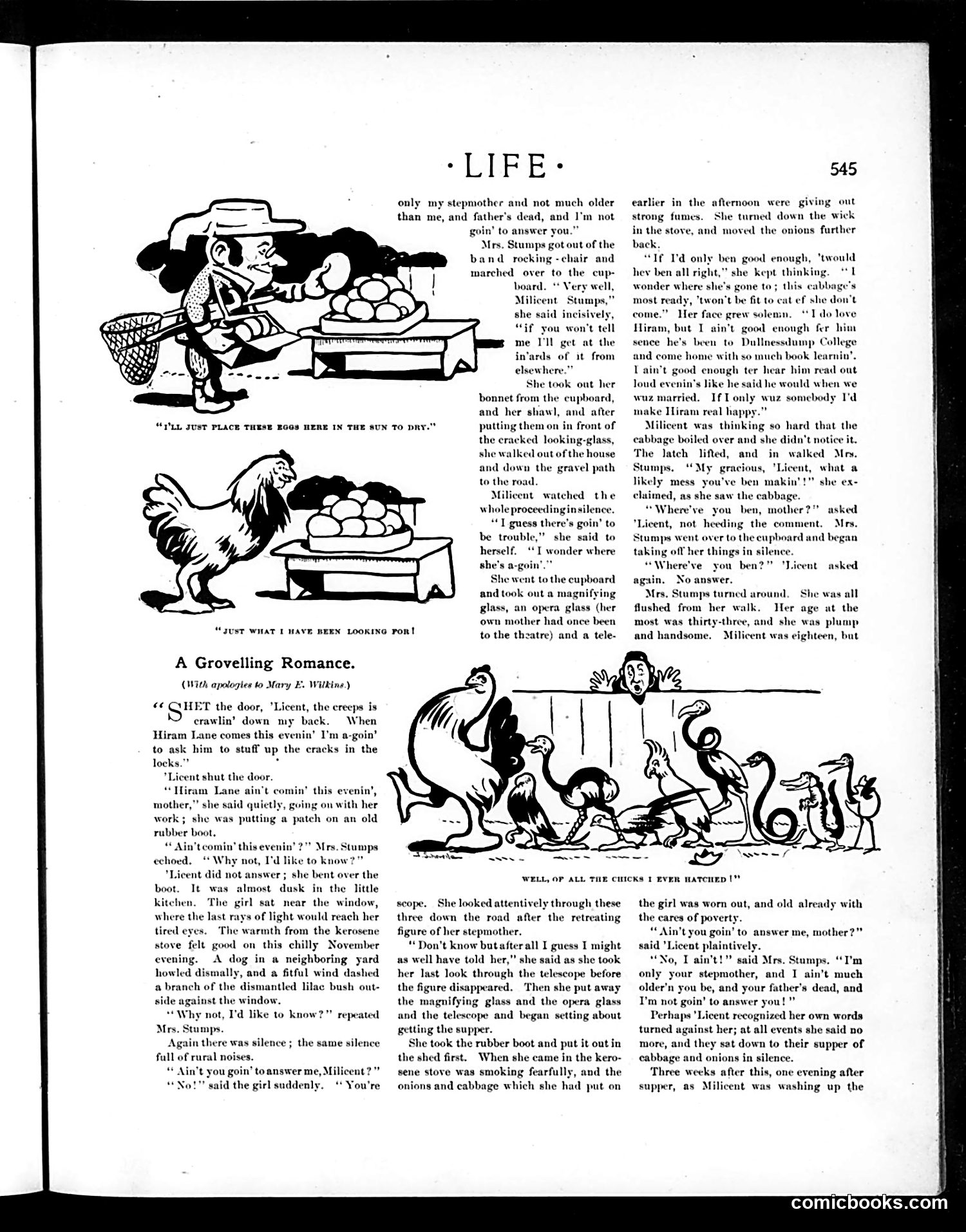
This page contains a short story titled "A Grovelling Romance" (with apologies to Mary E. Wilkins) rather than political cartoons. The illustrations are humorous vignettes accompanying the narrative. The story depicts rural/small-town life, featuring characters named Lilient, Mrs. Stumps, and Hiram Lane. The plot involves domestic drama—a stepmother-stepdaughter conflict, mysterious comings and goings, and romantic complications. The accompanying cartoons show exaggerated character types: a woman handling eggs, a hen with chicks, and country folk engaged in mundane activities. The humor derives from satirizing rural manners, speech patterns ("ain't comin'"), and domestic predictability rather than political commentary. This represents Life magazine's tradition of gentle social satire about American provincial life and domestic relations.
📄 Transcribed text from this page (OCR, searchable)
Machine-transcribed from the original scan — historical spelling and the odd misread are preserved.
“JUST WHAT I MAY BEEN LOOKING PoR! A Grovelling Romance. (With apologies to Mary E. Wilkins.) «€ QHET the door, *Licent, the creeps is crawlin? down my back. When Hiram Lane comes this evenin’ I'm a-goin’ to ask him to stuff up the cracks in the locks.” . "Licent shut the door. “Tiram Lane ain't mother,” she said qu wor nin’ this evenin’, tly, going on with her she was putting a patch on an old rubber boot. “Ain'tcomin’ this evenin’ 2?" Mrs. Stumps. “Why not, I'd like to know?” ‘Licent did not answer ; she bent over the boot. It was almost dusk in the little kitchen. The girl sat near the window, where the of light would reach her armth from the kerosene stove felt good on this chilly November evening. A dog in a neighboring yard howled dismally, and a fitful wind dashed a branch of the dismantled lilac bush out- side against the window. “Why not, I'd like to know?" repeated Mrs. Stumps. echoed. Again there was silence ; the same silence fall of rural noises. Ain't you goin’ to answer me, Mili “Not'"s irl suddenly. ent?” “You're ‘LIFE only my stepmother and not much older than me, and father’s dead, and I'm not goin’ to answer you Mrs. Stumps got out of the band rocking -chair and marched over to the cup- Very well, pu won't tell me I'll get at the in’ards of it from elsewhere,” She took out her bonnet from the cupboard, and her shawl, and after putting them on in front of the cracked looking-glass, she walked out of the house own the gravel path to the road. Milicent’ watched the whole proceedinginsilence. “T guess there's goin’ to be trouble,” she said to herself. ‘I wonder where she's a-goin’.” She went tothe cupboard and took out a magnifying glass, an opera glass (her own mother had once been to the theatre) and a tele- and 545 earlier in the afternoon were giving ont strong fumes. She tamed down the wick in the stove, and moved the onions further back. “If I'd only ben good enough, 'twould hey ben all right,” she kept thinking. wonder where she’s gone to; this most ready, ‘twon't be fit come.” Her face grew solemn. ‘1 do love Hiram, but I ain't good enongh fer him sence he's been to Dullnessduimp Coll and come home with so much book learniu’. Lain’t good enough ter hear him read ont loud evenin’s like he said he would when we ly wuz somebody I'd wuz married. If Tc make Hiram real hi Milicent was thinking so hard that the cabbage boiled over and she didn't notice it. The latch lifted, and in walked Mrs. Stumps. ‘My gracious, "Licent, what a likely mess you've ben makin'!" she ex- claimed, as she saw the cabbage. “Where've you ben, mother?" asked *Licent, not heeding the comment. Mrs. Stumps went over to the cupboard and began her things in silence. ben?” ‘Licent asked Mrs, Stumps turned around, She was all flushed from her walk. Her age at the most was thirty-three, and she was plu and handsome. Milicent was eighteen, but WELL, OF ALL THE CHICKS I EVER WATCHED I"? scope. She looked attentively through these three down the road after the retreating figure of her stepmother. “Don't know but afterall I guess I might as well have told her,” she said as she took her last look through the telescope before the figure disappeared. Then she put away the magnifying glass and the opera glass and the telescope and began setting about getting the supper. She took the rubber boot and put it out in the shed first. When she came in the kero- sene stove was smoking fearfully, and the onions and cabbage which she had put on the girl was worn out, and old already with the cares of poverty. “ Ain'tyou goin’ to answer me, mother?” ! Mrs. Stumps. “I'm ‘our stepmother, and I ain’t much you be, and your father's dead, and I'm not goin’ to answer you!” Perhaps *Licent recognized her own words turned against her; at all events she said no more, and they sat down to their supper of cabbage and onions in silence. Three weeks after this, one ning after supper, as Milicent was washing up the comicbooks.com