
A complete issue · 22 pages · 1901
Life — April 25, 1901
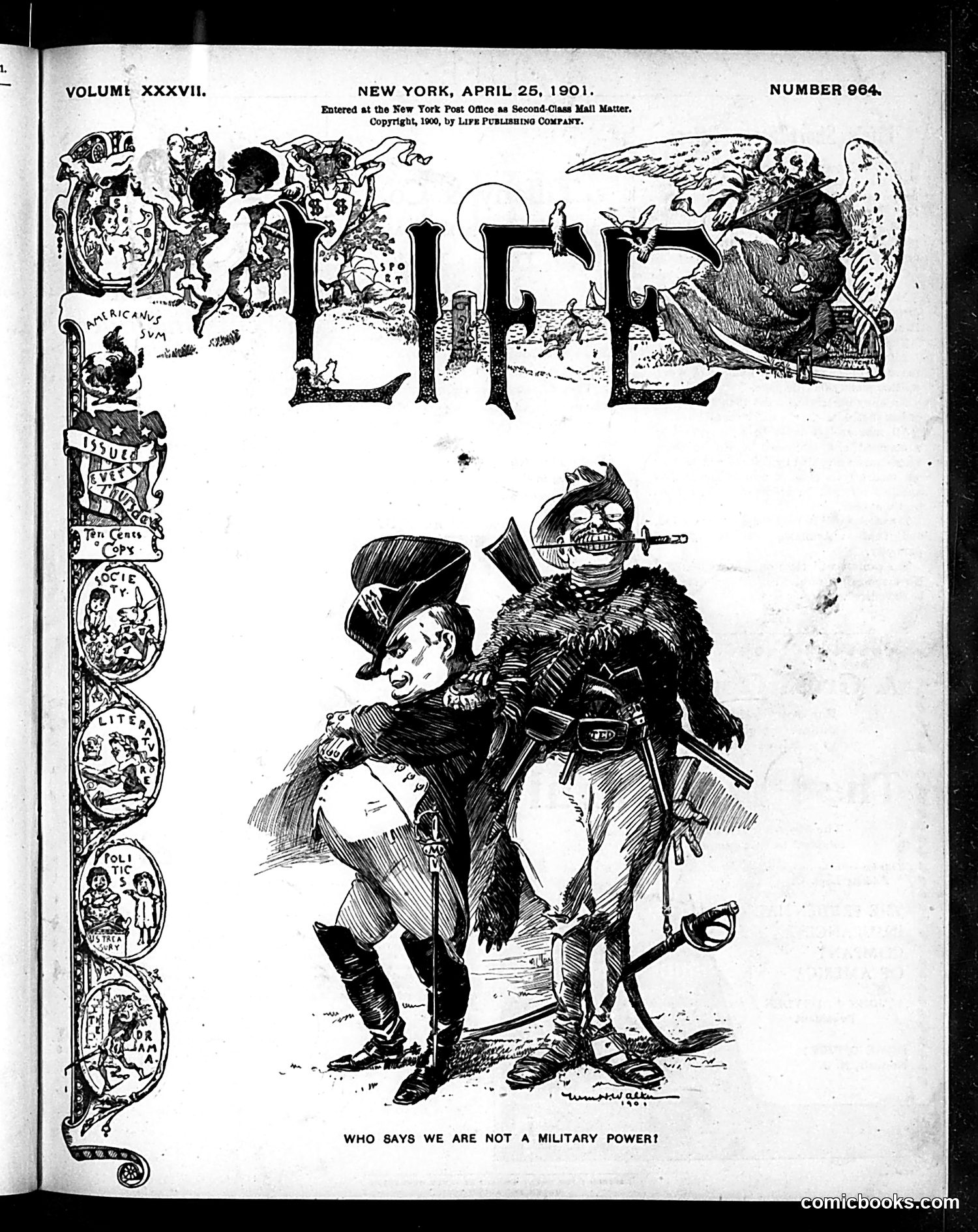
This satirical cover depicts two military figures in elaborate uniforms with exaggerated, skull-like caricatured faces. The caption reads "WHO SAYS WE ARE NOT A MILITARY POWER!" The cartoon appears to mock American militarism around 1901, likely referencing U.S. involvement in the Philippines during the Philippine-American War (1899-1902) or broader imperial expansion. The grotesque, death's-head imagery suggests the publication's criticism of military adventurism and the cost of war. The ornate left border contains decorative vignettes, typical of Life's design style. The overall tone is sardonic—the exaggerated military regalia and frightening appearance imply the magazine viewed American military posturing as absurd or morally troubling rather than something to celebrate.
This page is primarily **advertising**, not satirical content. It contains commercial notices for: - **Life's Short Story Contest** (offering cash prizes) - **Tiffany & Co.** safe deposit vaults - **James McCutcheon & Co.** underwear and linen store - **The Prudential Insurance Company** The only visual element with potential satirical intent is The Prudential's advertisement, which features the **Rock of Gibraltar** with the slogan "Has the Strength of Gibraltar." This is a straightforward corporate metaphor—not political satire—meant to convey the insurance company's reliability and permanence to potential customers. The page reflects early 1900s commercial messaging rather than social or political commentary. There are no identifiable caricatures or satirical figures present.
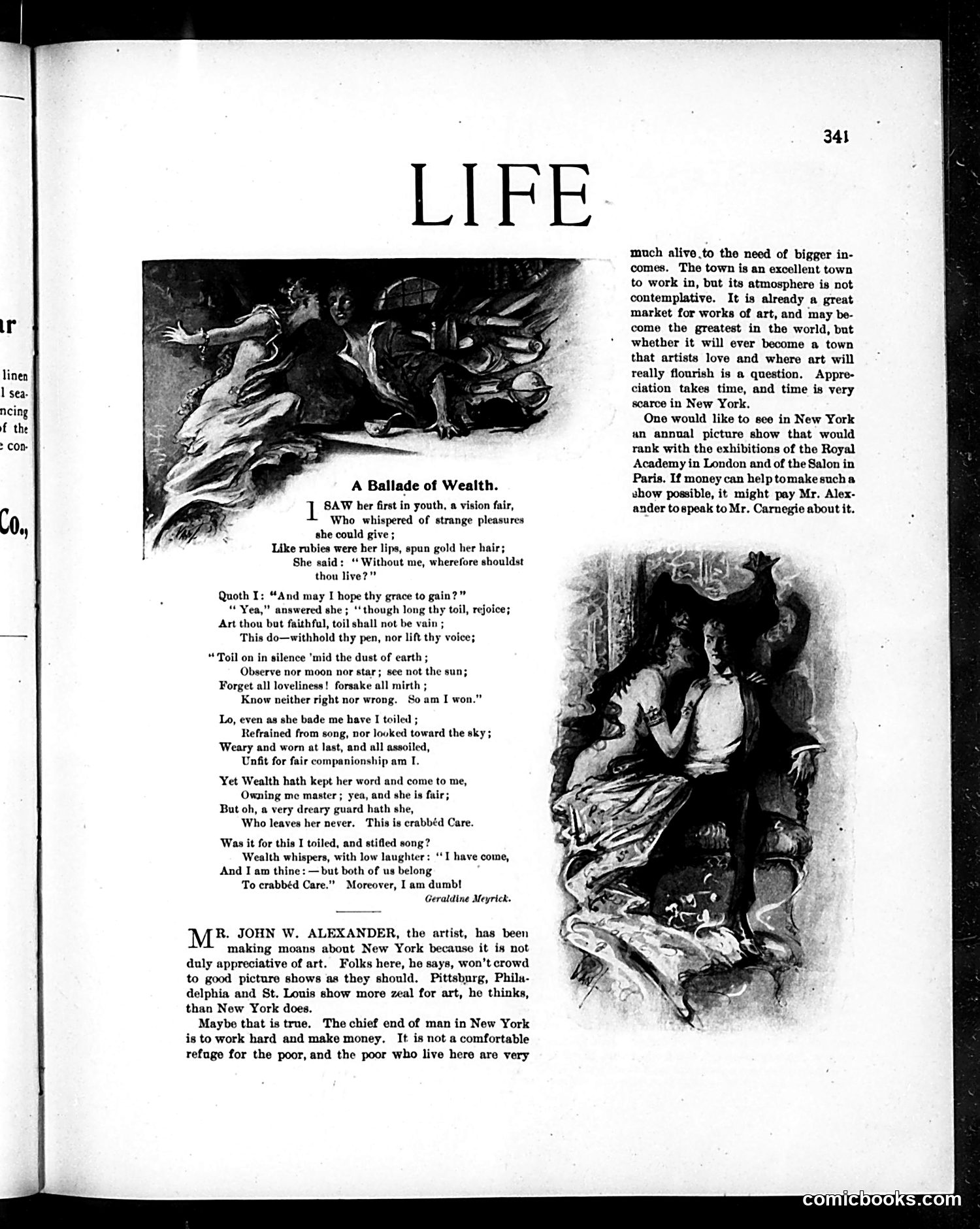
This page from *Life* magazine presents "A Ballad of Wealth," a poem by Geraldine Meyrick satirizing wealth inequality and class divisions. The verses depict a wealthy woman addressing a poor person, dismissing their suffering with callous indifference ("Without me, wherefore shouldst thou live?"). The woman demands the poor person work silently without complaint while she enjoys luxury. Below, the text discusses artist John W. Alexander's criticisms of New York's lack of appreciation for art compared to other cities like Pittsburgh and Philadelphia. Alexander argues New York prioritizes money-making over cultural enrichment, making it inhospitable to artists and the poor alike. Together, the poem and commentary critique Gilded Age materialism and New York's failure as a cultural center—attacking both wealth's moral bankruptcy and the city's misplaced values.
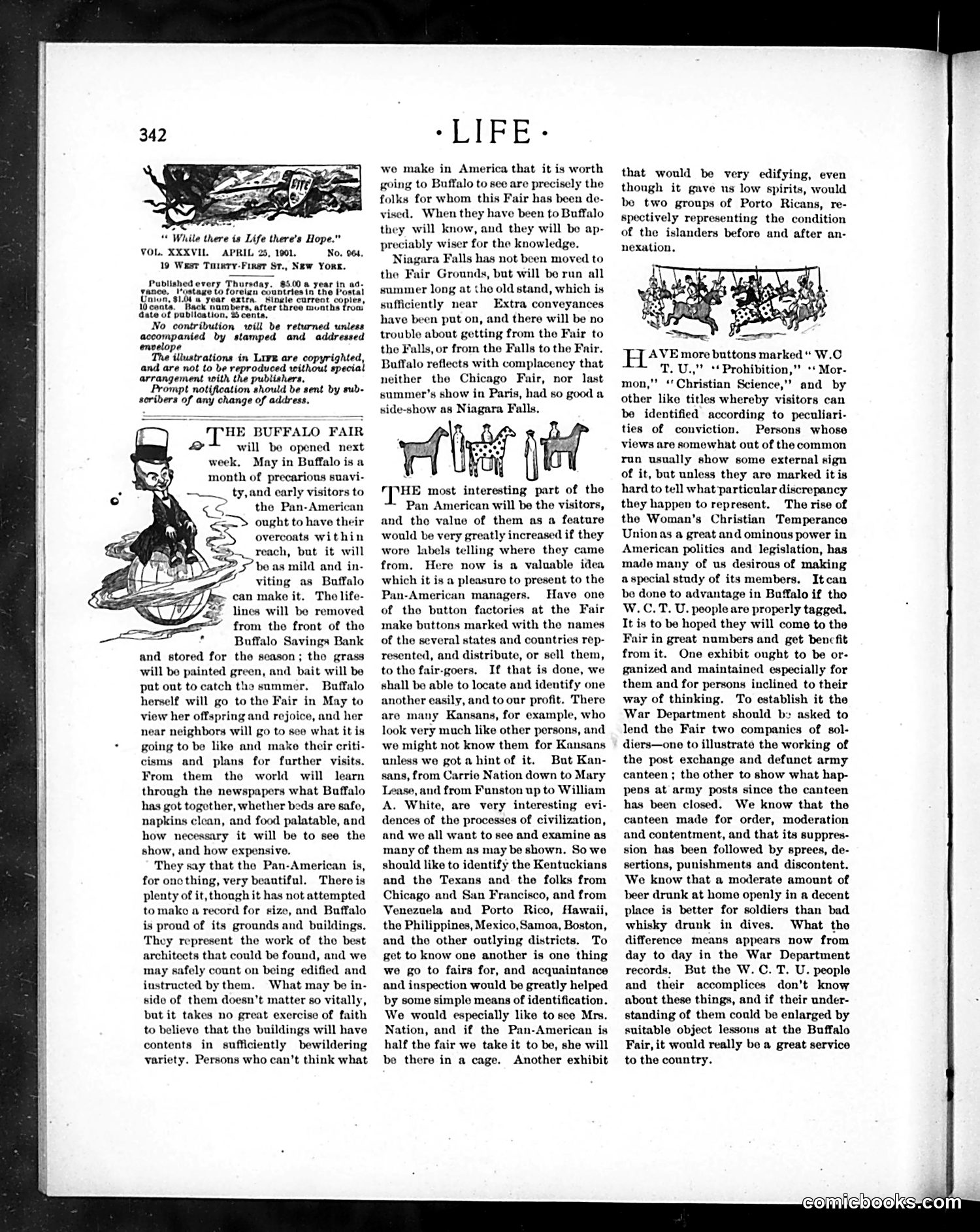
This page features editorial content about the 1901 Buffalo Pan-American Exposition. The main illustration shows **Uncle Sam as a jovial host** presenting Buffalo to visitors, reflecting the fair's purpose of showcasing American achievement and civilization to international attendees. The text discusses buttons marked with state/country names as identification tools for fair visitors—a practical solution for the massive Pan-American crowds. The article advocates for additional exhibits, particularly requesting **Mrs. Nation** (likely Carrie Nation, the temperance activist) to demonstrate her anti-alcohol crusade in a "cage," satirizing her extremism. The satire targets both the fair's promotional ambitions and contemporary social reform movements, using gentle ridicule to comment on American society's contradictions and spectacle-driven culture.
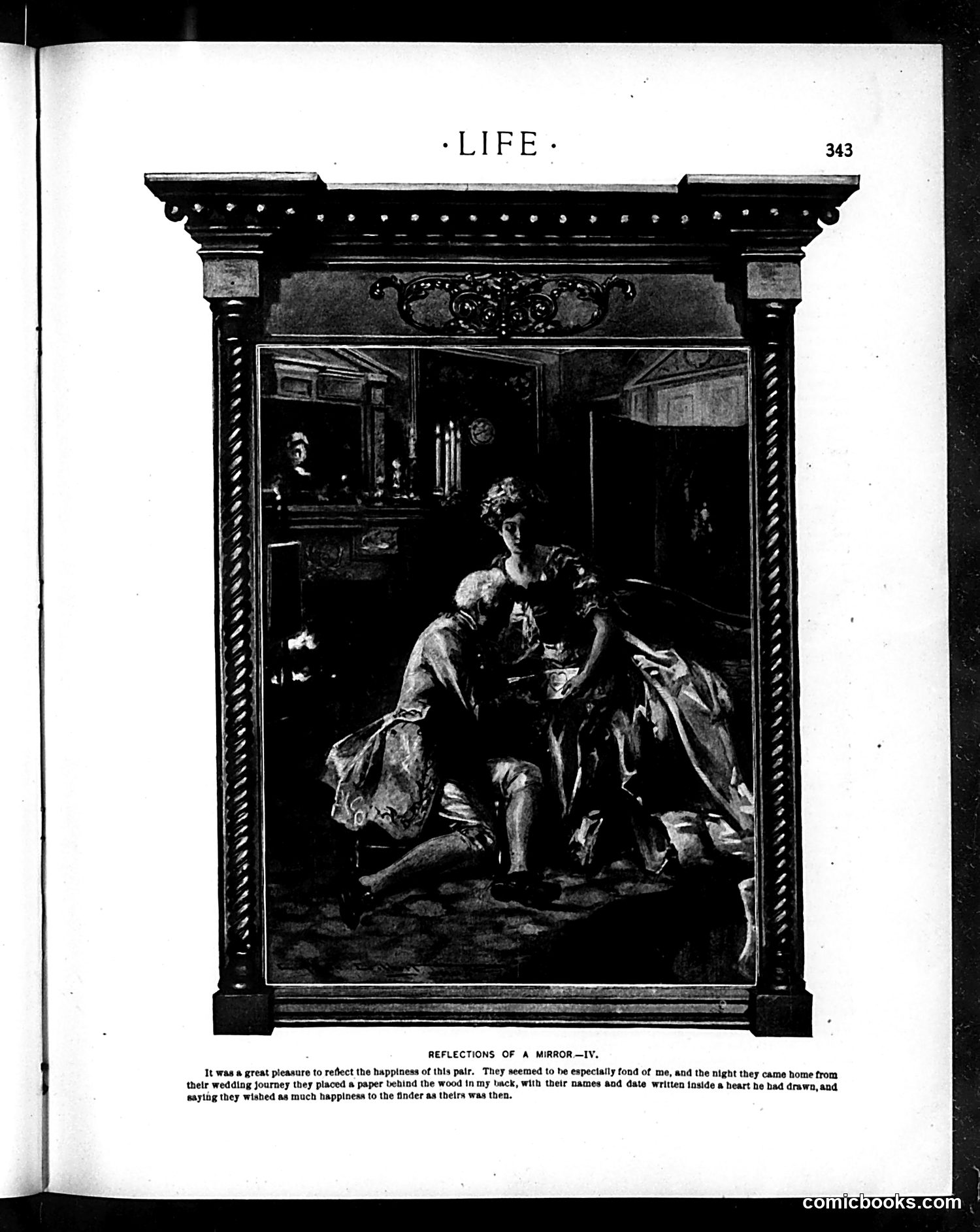
This appears to be an illustration from Life magazine's serialized series "Reflections of a Mirror." The engraving depicts an intimate domestic scene: a couple exchanging affection, likely newlyweds based on the caption's reference to "their wedding journey." The satirical point seems to center on marital happiness and romantic sentiment. The caption mentions the couple placing a paper with their names behind wood in the narrator's room, inscribing wishes for future happiness "as theirs was then"—suggesting nostalgia for newlywed bliss. Rather than harsh political satire, this appears to be gentler social commentary on domestic life and sentimentality in marriage, typical of Life's mix of sophisticated humor and cultural observation during this era.
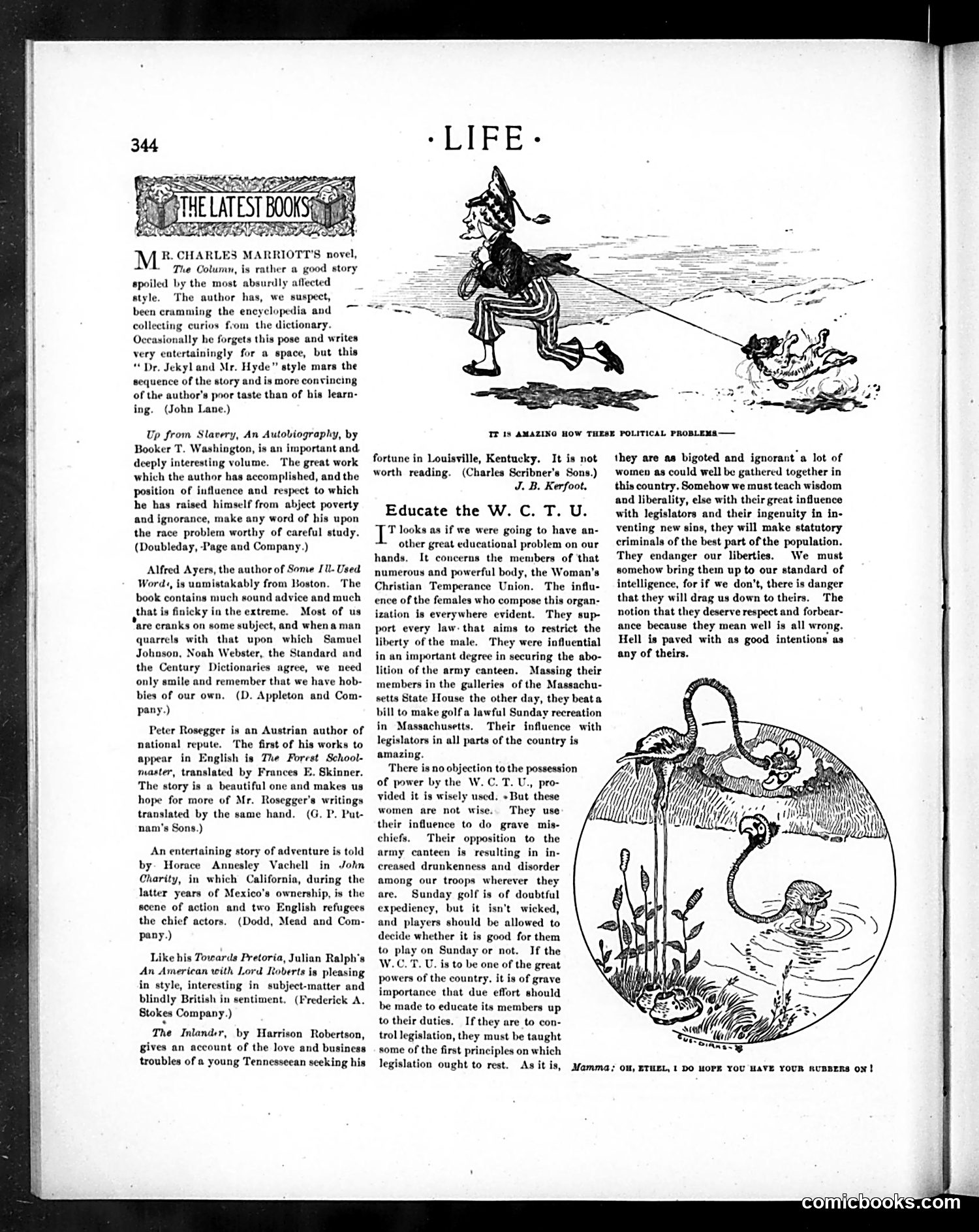
The main cartoon satirizes the **Woman's Christian Temperance Union (W.C.T.U.)**, a prominent early 20th-century organization advocating alcohol prohibition and moral reform. The text criticizes the W.C.T.U.'s political influence, calling their members "bigoted and ignorant." It argues they misuse their power—pushing prohibition legislation, opposing Sunday recreation like golf, and causing "drunkenness and disorder among our troops" through their policies. The illustration depicts chaotic underwater creatures, likely symbolizing the disorder and confusion the author believes W.C.T.U. activism produces. The caption's reference to "rubbers" suggests concerns about practical consequences of their rigid moral stance. The piece represents anti-prohibition sentiment and criticism of women's political activism in this era.
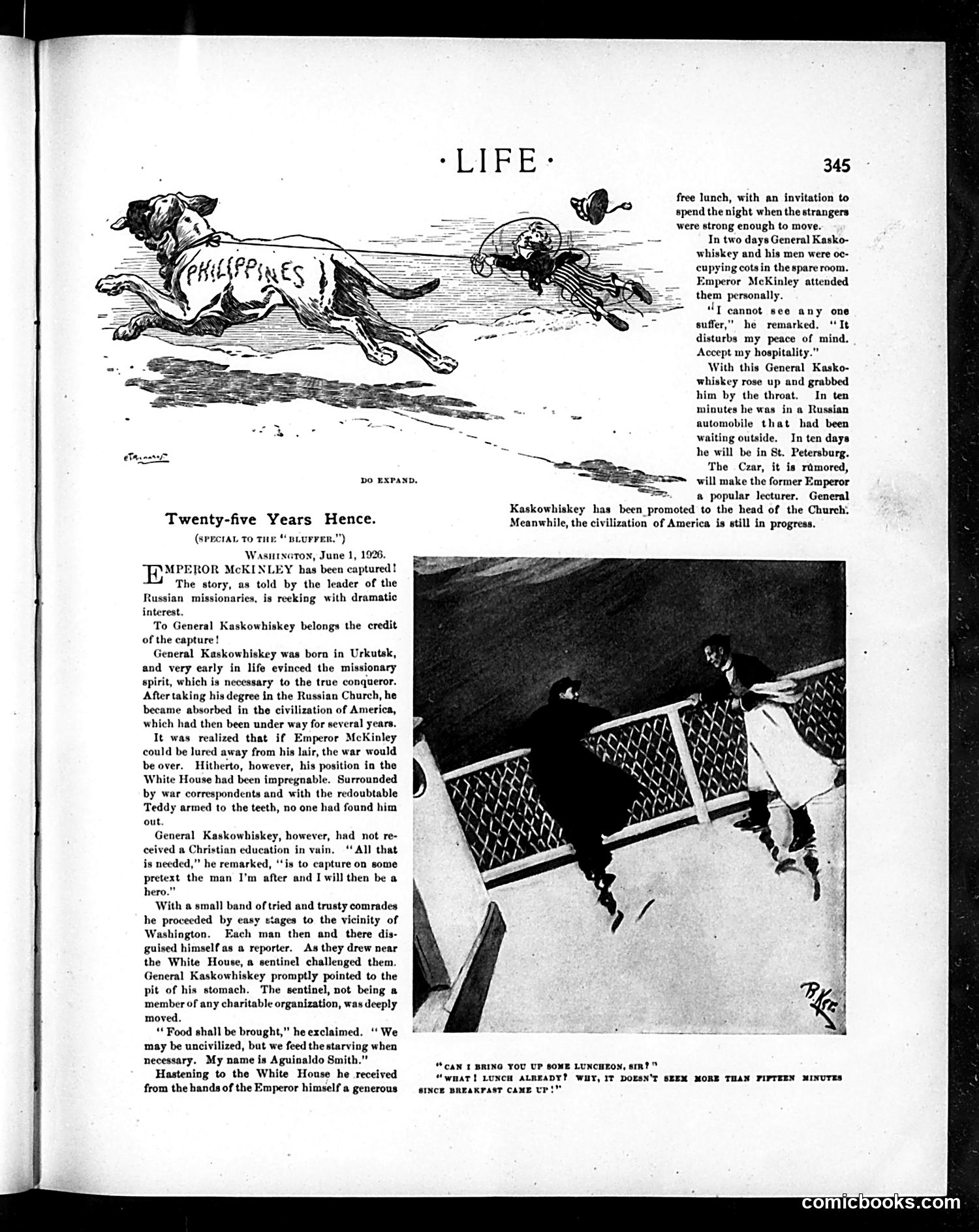
This satirical piece imagines a future (1953) where Emperor McKinley has been captured by Russian missionaries. The cartoon depicts "the Philippines" as an exhausted dog, suggesting American imperial overreach in that territory. The narrative mocks the then-current situation: General Kaskowhiskey supposedly captured McKinley, though the actual credit belongs to American forces. The satire critiques both American imperialism in the Philippines and the absurdity of crediting Russian involvement. The photograph below shows what appears to be a diplomatic or military scene, likely illustrating the fictional scenario. The joke hinges on American readers recognizing McKinley's presidency and the Philippines conflict as contemporary political issues, treating serious imperial ambitions with comedic exaggeration about future consequences.
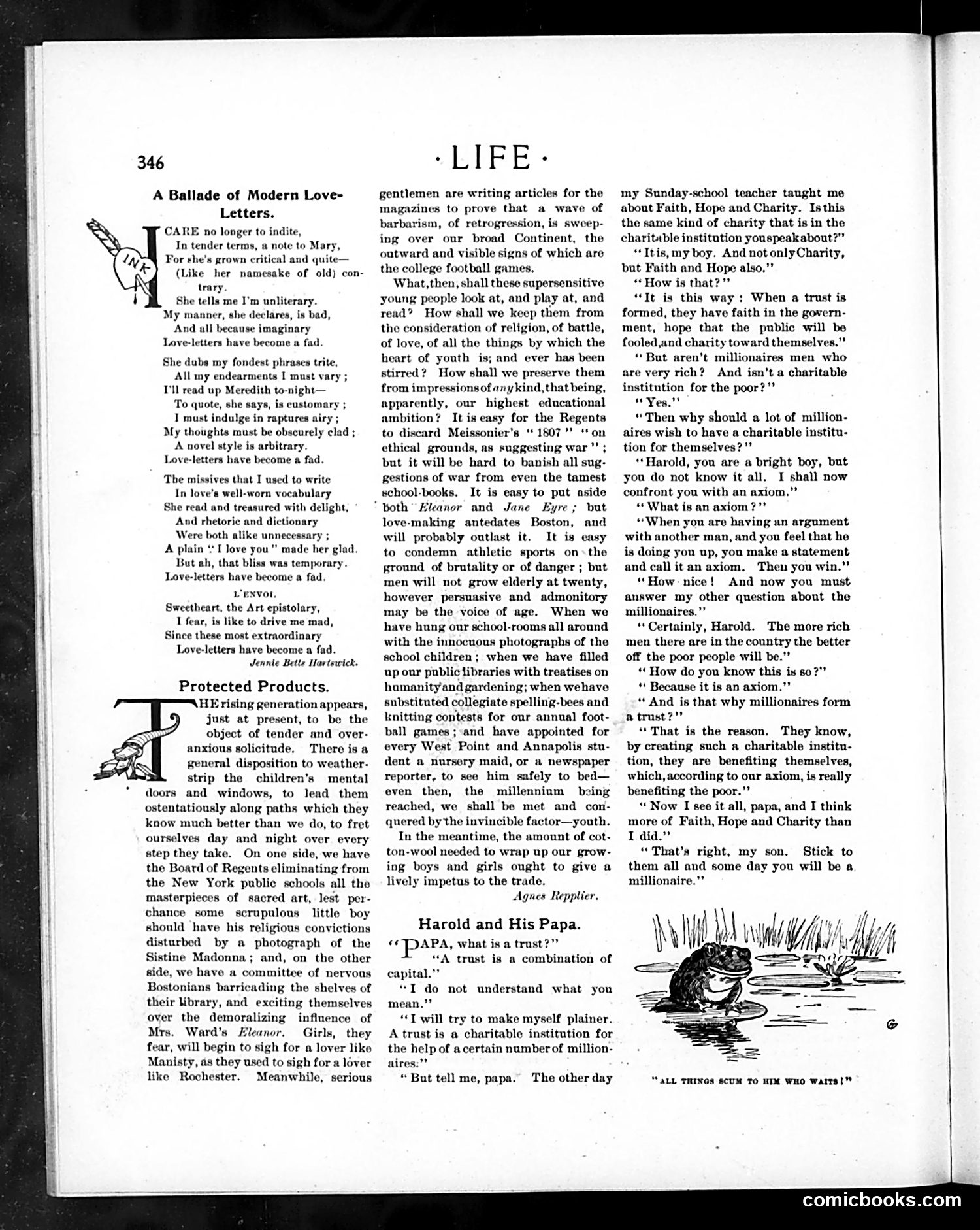
This page contains three separate pieces: 1. **"A Ballad of Modern Love-Letters"** — A satirical poem mocking how love letters have become formulaic and insincere ("Love-letters have become a fad"), reflecting turn-of-century concerns about authentic romance amid modernization. 2. **"Protected Products"** — A section criticizing how the rising generation is overprotected by institutions. It mocks the Board of Regents' removal of "masterpieces of sacred art" from schools due to moral concerns, suggesting excessive censorship weakens children's character development. 3. **"Harold and His Papa"** — A dialogue explaining "trusts" (monopolistic business combinations) to a child, defining them as "charitable institutions for the help of a certain number of millionaires." This is sharp satire of wealthy industrialists claiming philanthropy justifies their monopolistic practices. The small illustration shows a duck or waterfowl in water, captioned "All things seem to him who waits!"
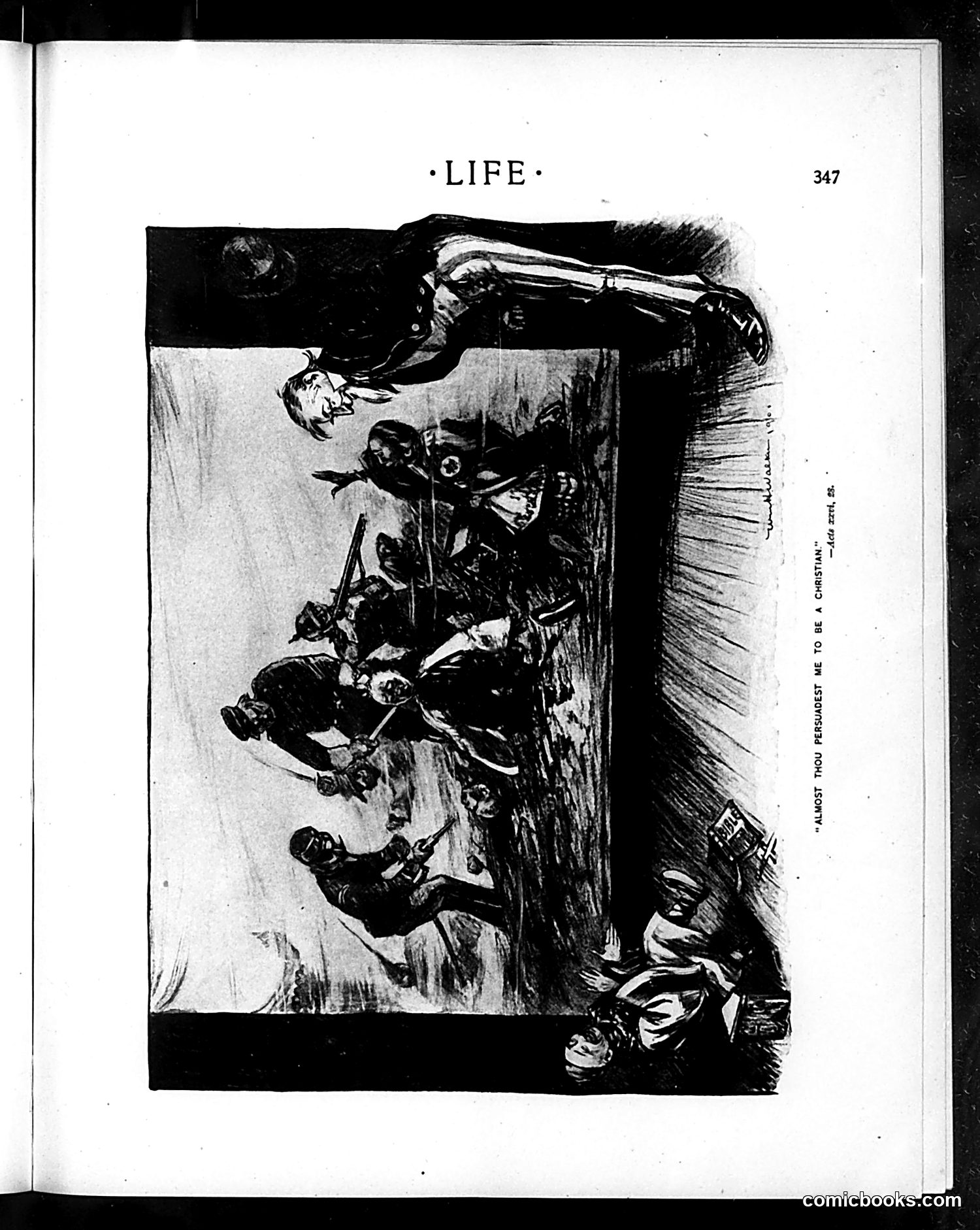
This page from *Life* magazine (page 347) contains a political cartoon titled "Almost Too Christian" — the caption appears on the right edge. The image shows a figure at the top looking down at a chaotic scene below with multiple figures engaged in what appears to be violent or aggressive behavior. The composition suggests a moral judgment: the observer is positioned to witness apparent brutality or misconduct below. The caption's ironic phrase "Almost Too Christian" suggests satire about hypocrisy—likely criticizing someone in power for claiming Christian virtue while tolerating or ignoring violence or injustice occurring beneath their authority. The cartoon appears to critique a gap between professed moral principles and actual conduct or oversight. Without clearer identification of the figures or specific historical context visible on this page, precise details remain unclear.
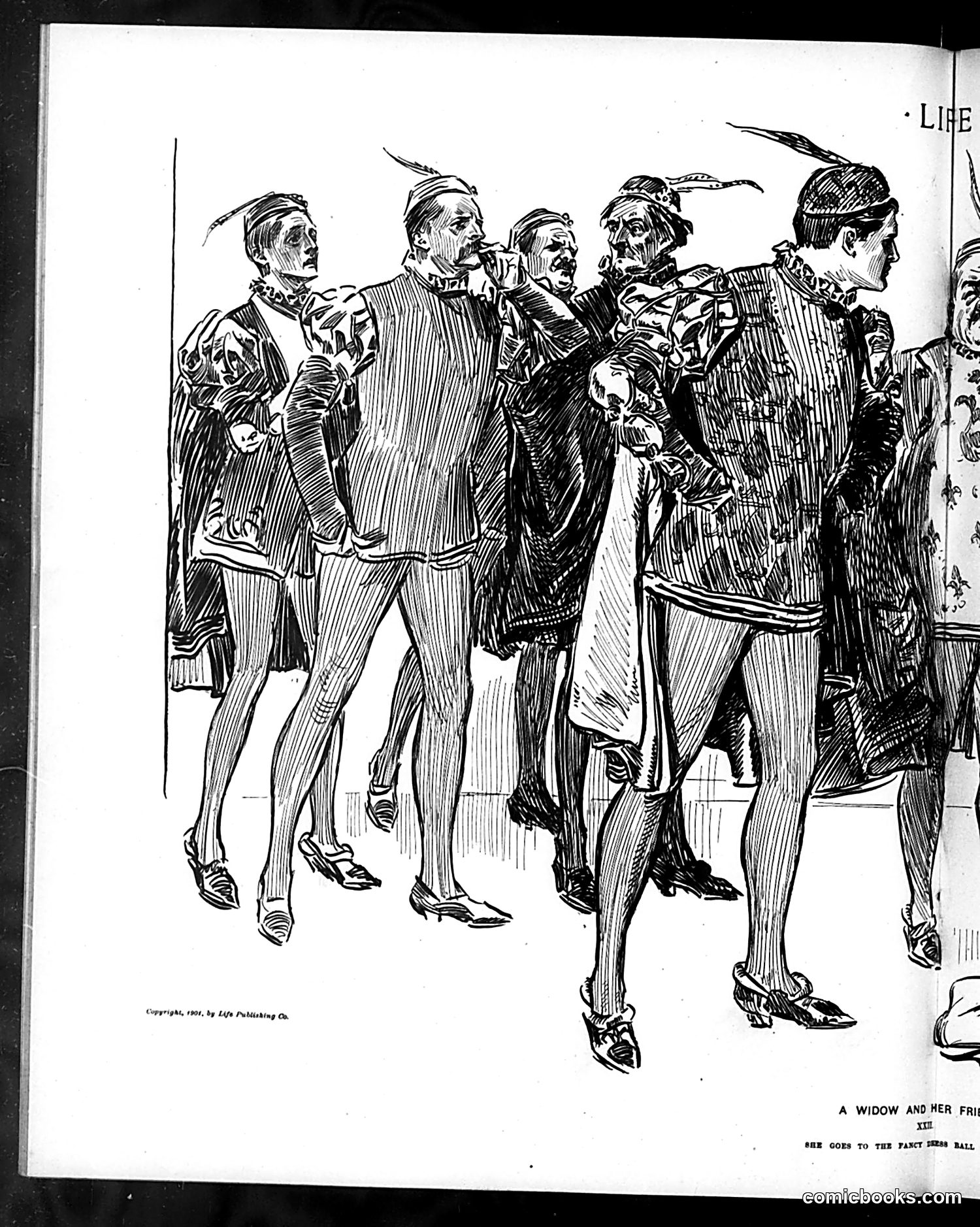
This page shows a satirical illustration from *Life* magazine (copyright 1907, per the visible text) titled "A Widow and Her Friends" with a subtitle referencing "The Fancy Dress Ball." The drawing depicts five well-dressed men in elaborate period costumes at what appears to be a formal social event. The style suggests these are caricatures of prominent society figures or politicians of the Edwardian era, though specific identities aren't labeled on the visible portion. The satire likely mocks either the pretentiousness of high-society fancy dress balls or the subjects' public personas—a common target of *Life* magazine's satirical humor. Without additional context or labels, the precise targets and joke remain unclear, though the exaggerated facial features and postures suggest ridicule of vanity or social climbing.
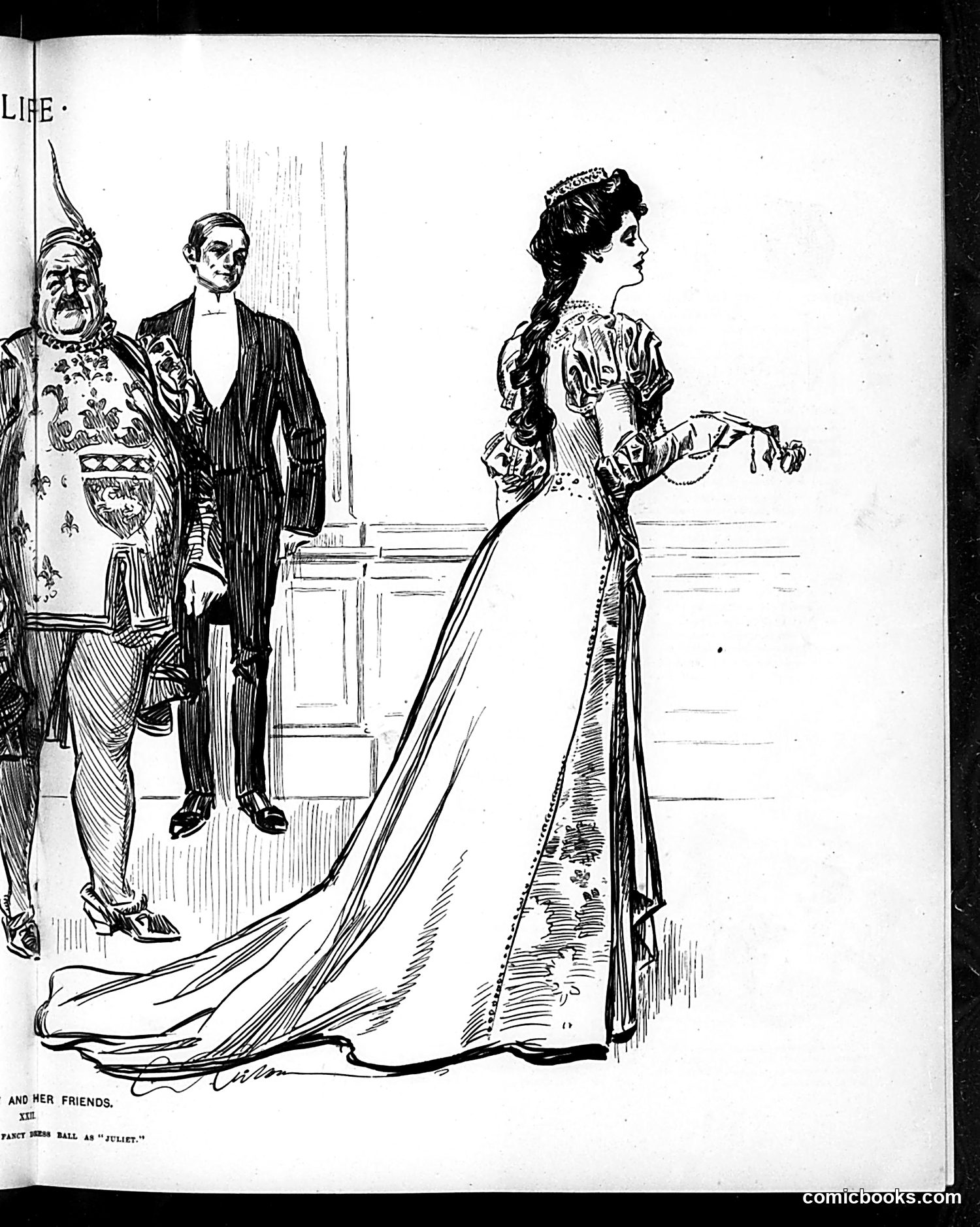
This appears to be a satirical illustration titled "Life: And Her Friends" depicting a formal social scene. A woman in an elaborate gown with a long train is shown in profile, wearing a tiara. Behind her stand two men—one in ornate ceremonial or military dress with decorative embroidery, and another in formal evening wear. The caption references "The Fancy Dress Ball as 'Juliet,'" suggesting this depicts someone attending a costume ball dressed as Shakespeare's Juliet. The satire likely mocks either pretentious high-society costume balls or a specific person's ostentatious choice of costume and companions. The woman's elaborate, formal presentation contrasts humorously with the claim of wearing a "fancy dress" costume. The ornately dressed male figure may represent a foreign dignitary or exaggerated courtly character, adding to the social satire.
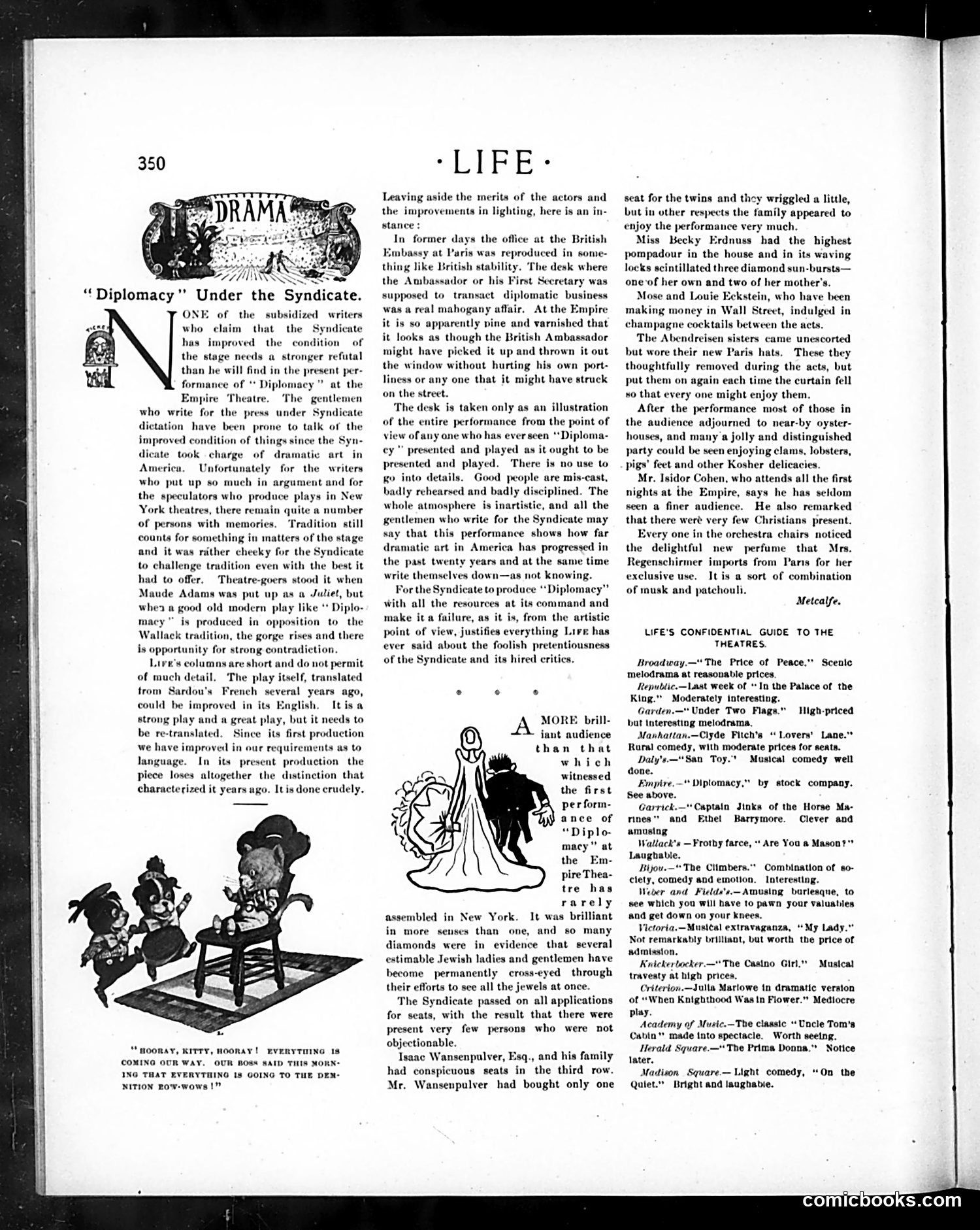
This page contains a theater review section ("Life's Confidential Guide to the Theatres") and a drama critique titled "Diplomacy" Under the Syndicate. The main cartoon depicts three figures in theatrical costume/caricature style, likely representing theater critics or personalities associated with the Syndicate's production of "Diplomacy" at the Empire Theatre. The text criticizes the Syndicate's staging of this play, arguing it represents improved production values but raises concerns about artistic control. The author suggests the Syndicate prioritizes commercial viability over dramatic integrity, noting the performance "shows how far dramatic art in America has progressed in the past twenty years." The cartoon's exact satirical point remains somewhat unclear without additional context about specific Syndicate figures or theatrical controversies of the era.
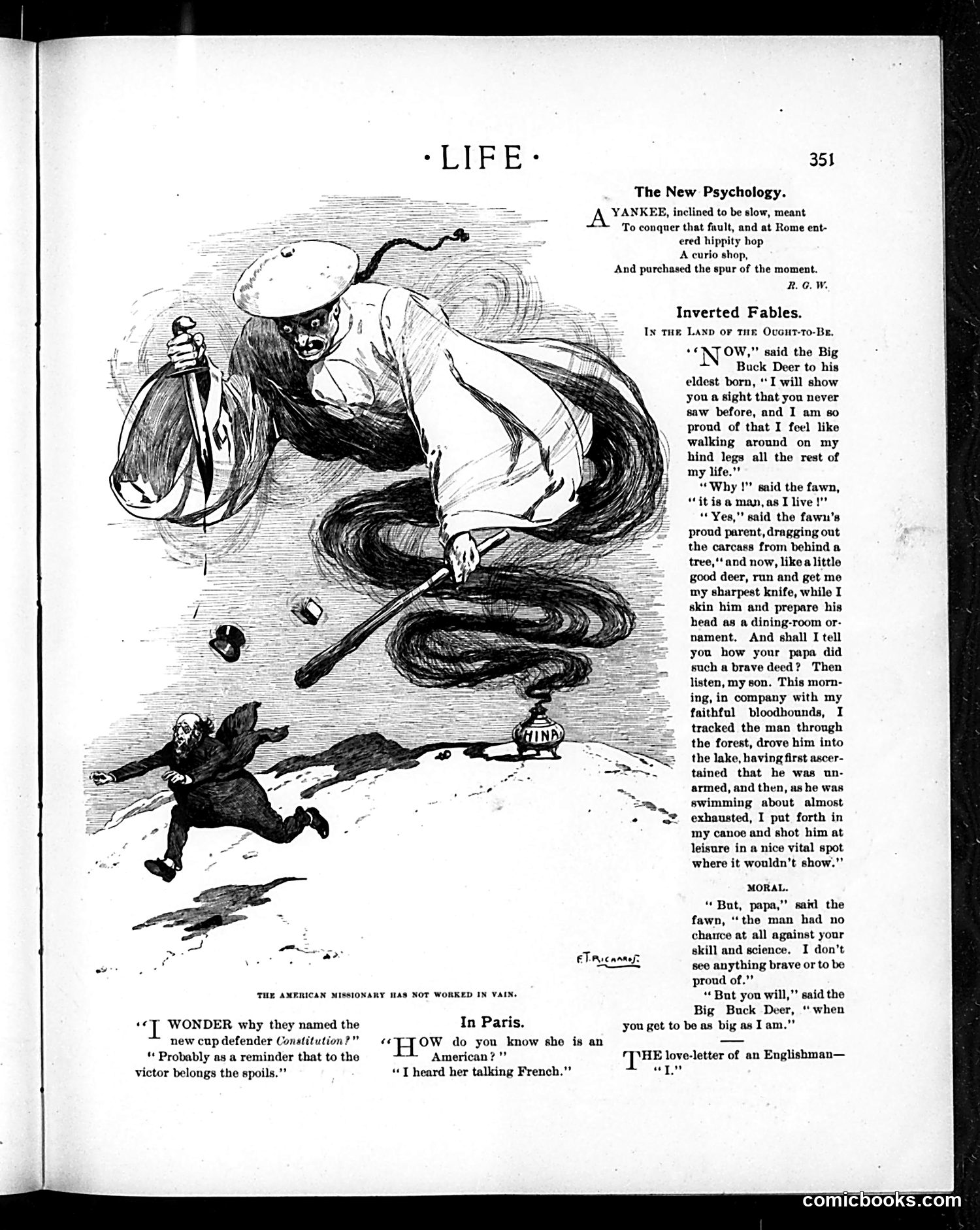
This page contains several satirical pieces targeting American attitudes and behavior: **"In Paris"** mocks American tourists abroad, suggesting they're identifiable by speaking French poorly or with an American accent—implying Americans abroad are culturally awkward or pretentious. **"Constitution" joke** references the America's Cup yacht defender, sardonically suggesting it was named "Constitution" as a reminder that "to the victor belongs the spoils"—criticizing American competitive ruthlessness and materialism disguised as patriotism. **"Inverted Fables"** inverts traditional moral hierarchy: a deer hunts a defenseless, unarmed man and boasts about it, then tells his fawn the deed will seem brave once he's older. The moral critiques this reversal—what appears cowardly (hunting an exhausted, unarmed opponent) gets rebranded as courage through power and perspective. This likely satirizes American imperialist or colonial attitudes of the early 20th century, where dominant nations justified conquest as heroic despite overwhelming advantages. The artwork shows the deer, weapons, and hunting scene in Victorian satirical style.
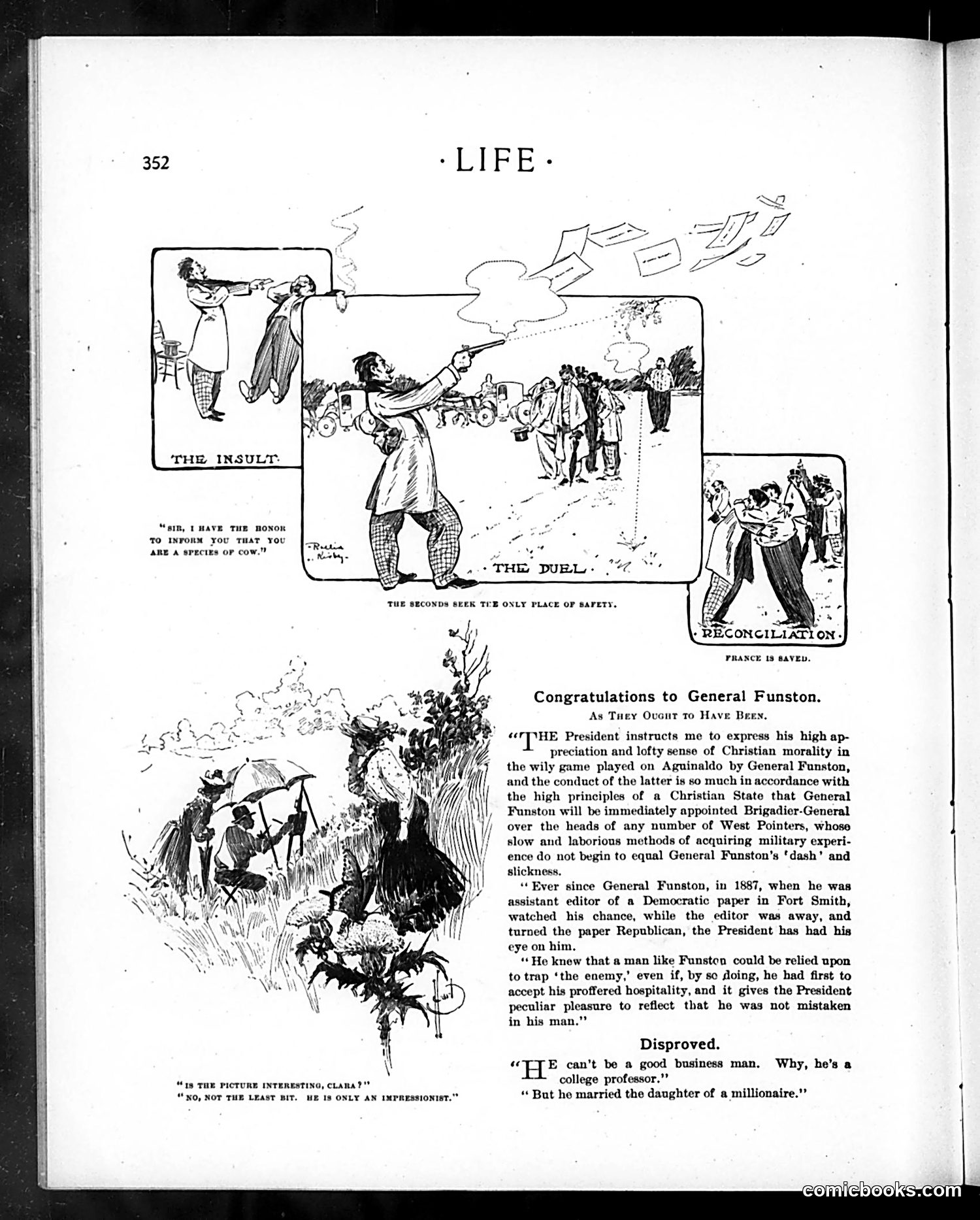
This page contains satirical commentary on General Funston's capture of Filipino insurgent leader Aguinaldo during the Philippine-American War. **The Main Cartoon (top):** Shows three scenarios—"The Insult," "The Duel," and "Reconciliation"—depicting how honor disputes were historically resolved. This frames Funston's deceptive capture (accepting Aguinaldo's hospitality before arresting him) as dishonorable by 19th-century standards. **The Article:** Sarcastically "congratulates" President Theodore Roosevelt for promoting Funston despite his unethical tactics. It mocks Roosevelt's admiration for Funston's "dash" and "slickness" over proper military procedure, referencing Funston's 1887 incident switching a newspaper's political allegiance. **Minor Jokes:** Include mockery of Impressionist art and a dig at college professors marrying into wealth. The satire critiques both Funston's deceptive methods and Roosevelt's celebration of them as acceptable strategy, questioning whether such tactics align with claimed American Christian morality.
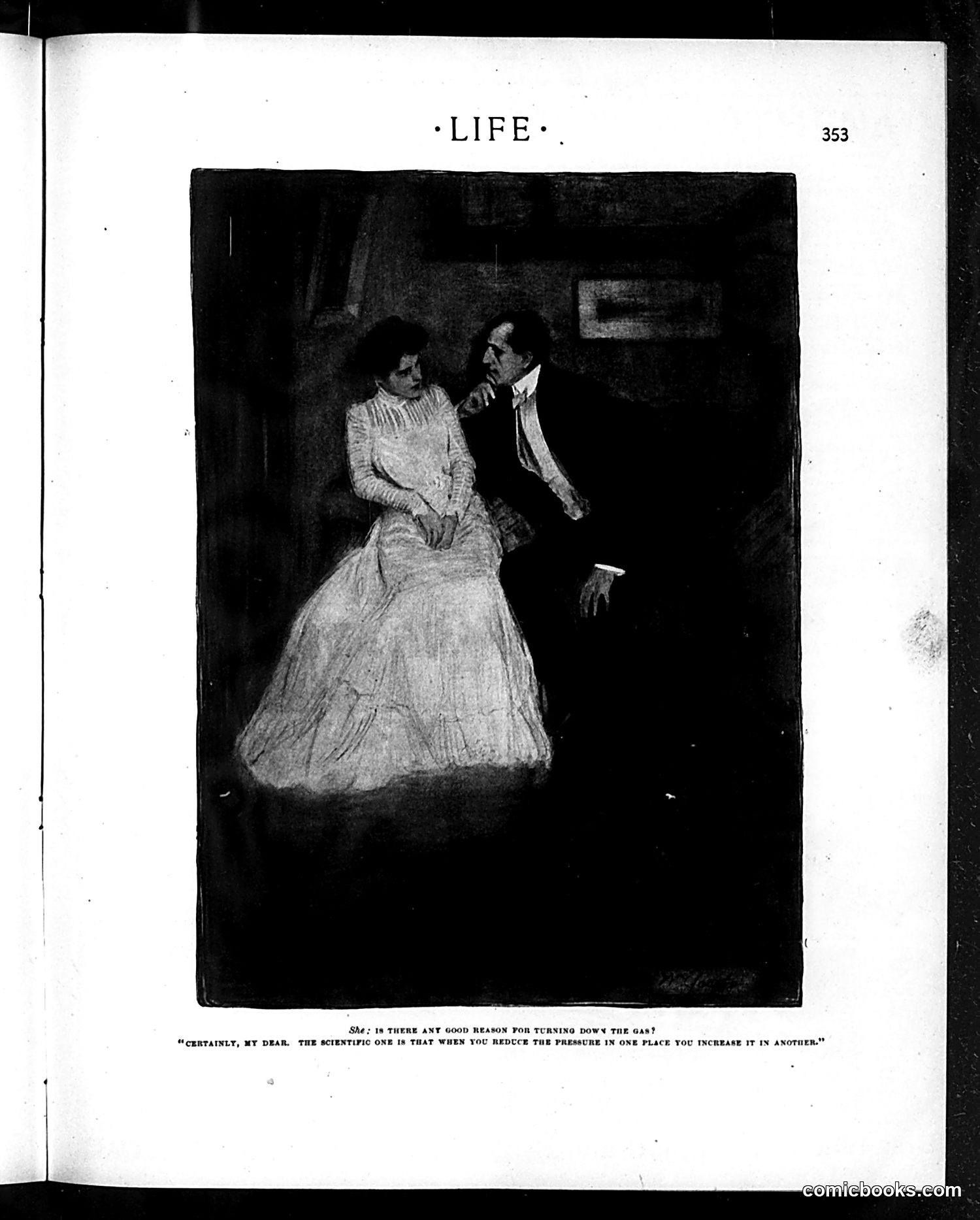
This is a domestic comedy scene depicting a couple in an interior setting. The woman asks about reducing the gas (likely referring to a gas lamp or heating), and the man responds with pseudo-scientific jargon about pressure reduction and increase. The satire targets pedantic husbands who use elaborate scientific explanations to justify trivial domestic decisions or avoid simple requests. The humor lies in the absurdity: he's essentially saying nothing changes when you reduce pressure elsewhere—a meaningless answer dressed in scientific language to dodge her practical question. This reflects early 20th-century humor about gender dynamics and male intellectualism used as a deflection tactic in marriage. The "scientific one" phrasing mockingly suggests he's being clever when he's actually being evasive.
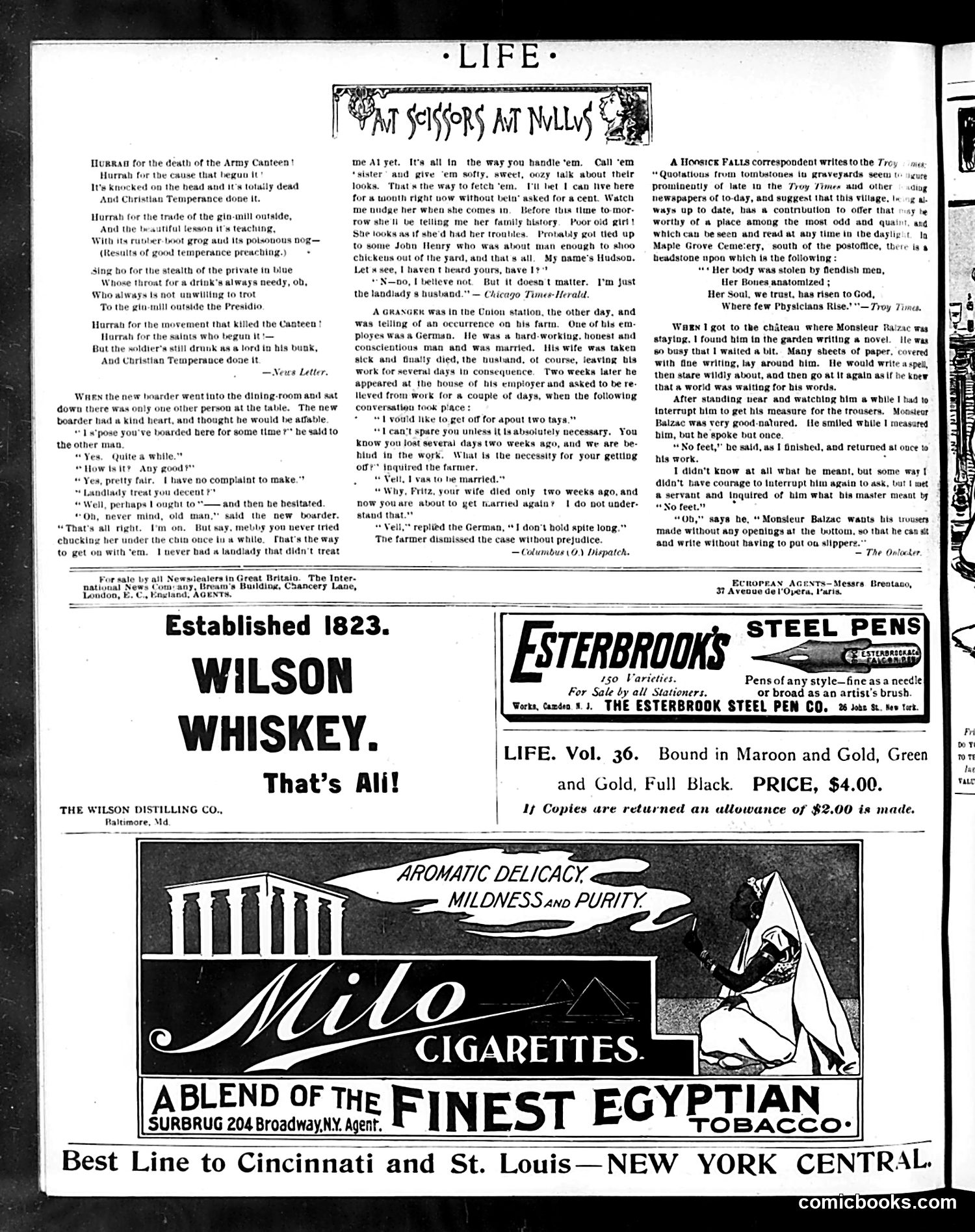
This page contains three separate humorous anecdotes rather than a single cartoon. The first piece satirizes the **Army Canteen closure**, likely resulting from Christian temperance movements of the era. The satire is ironic: while reformers celebrated shutting down the canteen where soldiers could drink, enlisted men simply patronized civilian gin mills instead—defeating the temperance goal entirely. The joke exposes the ineffectiveness of prohibition-era policies. The second anecdote mocks a boarding-house resident's manipulative tactics toward his landlady, using flattery and false sympathy to avoid paying rent. The third describes a German farmer's employee requesting time off to remarry—only two weeks after his wife's death. The humor relies on ethnic stereotyping (the German accent and bluntness) and the absurdity of remarrying so quickly, with the German's closing line, "I don't hold spite long," delivering the punchline. All three pieces target working-class life and social pretense common to early 20th-century American humor.
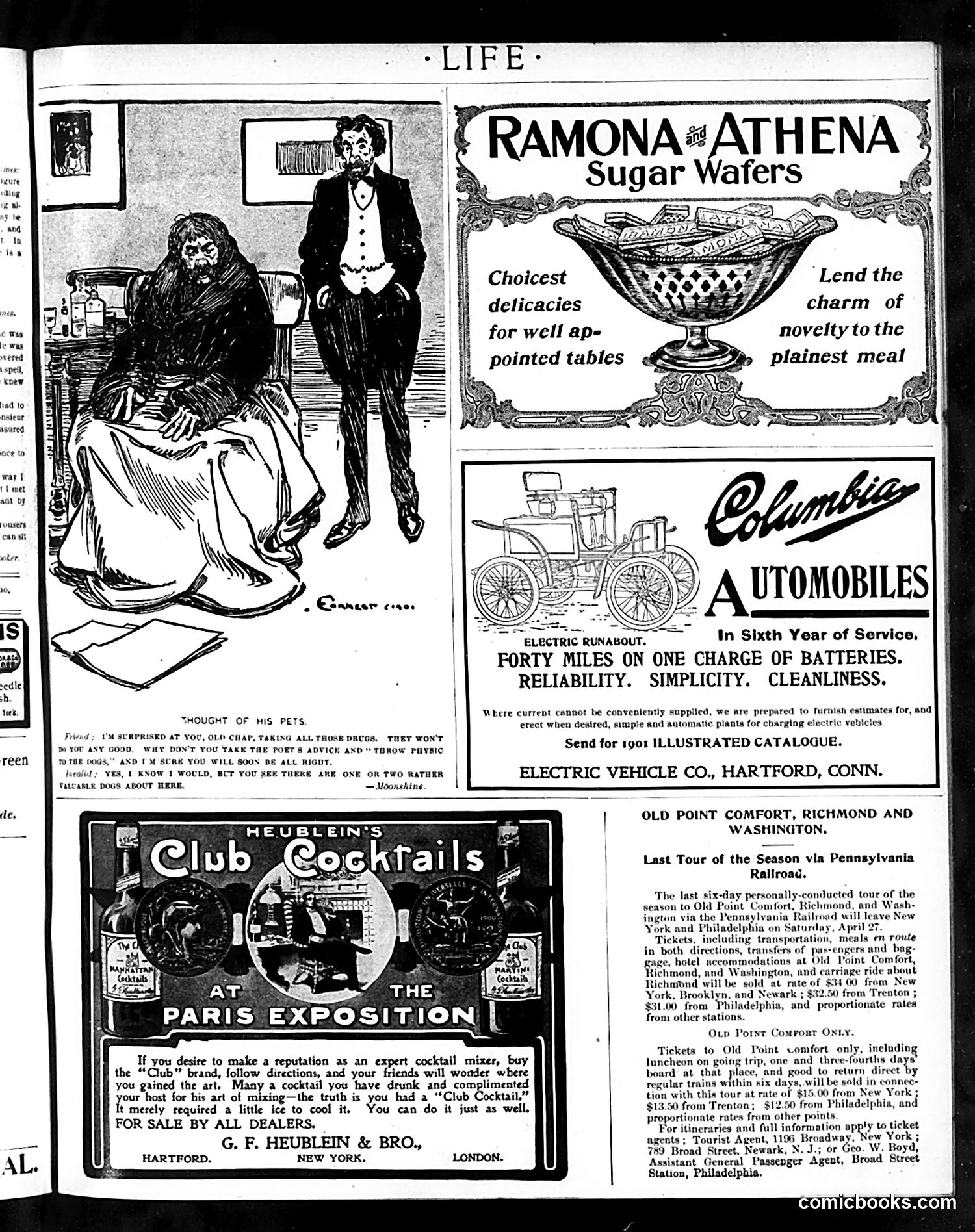
The main cartoon on the left, titled "Thought of His Pets," depicts a satirical social scene. A man sits disheveled in an armchair while a well-dressed gentleman stands nearby offering pharmaceutical advice. The joke—credited to "Moonshine"—plays on the absurdity of a man refusing to take medicine because he's convinced his *dogs* won't eat it, fearing the drugs might poison them. This satirizes misplaced priorities: the man cares more for his pets' wellbeing than his own health, accepting his deterioration to protect animals who likely wouldn't consume the medicine anyway. The page is primarily filled with period advertisements: Ramona and Athena Sugar Wafers, Columbia Automobiles (with electric vehicles), Heublein's Club Cocktails, and railroad tourism packages. These reflect early 1900s consumer culture and emerging technologies like electric cars.
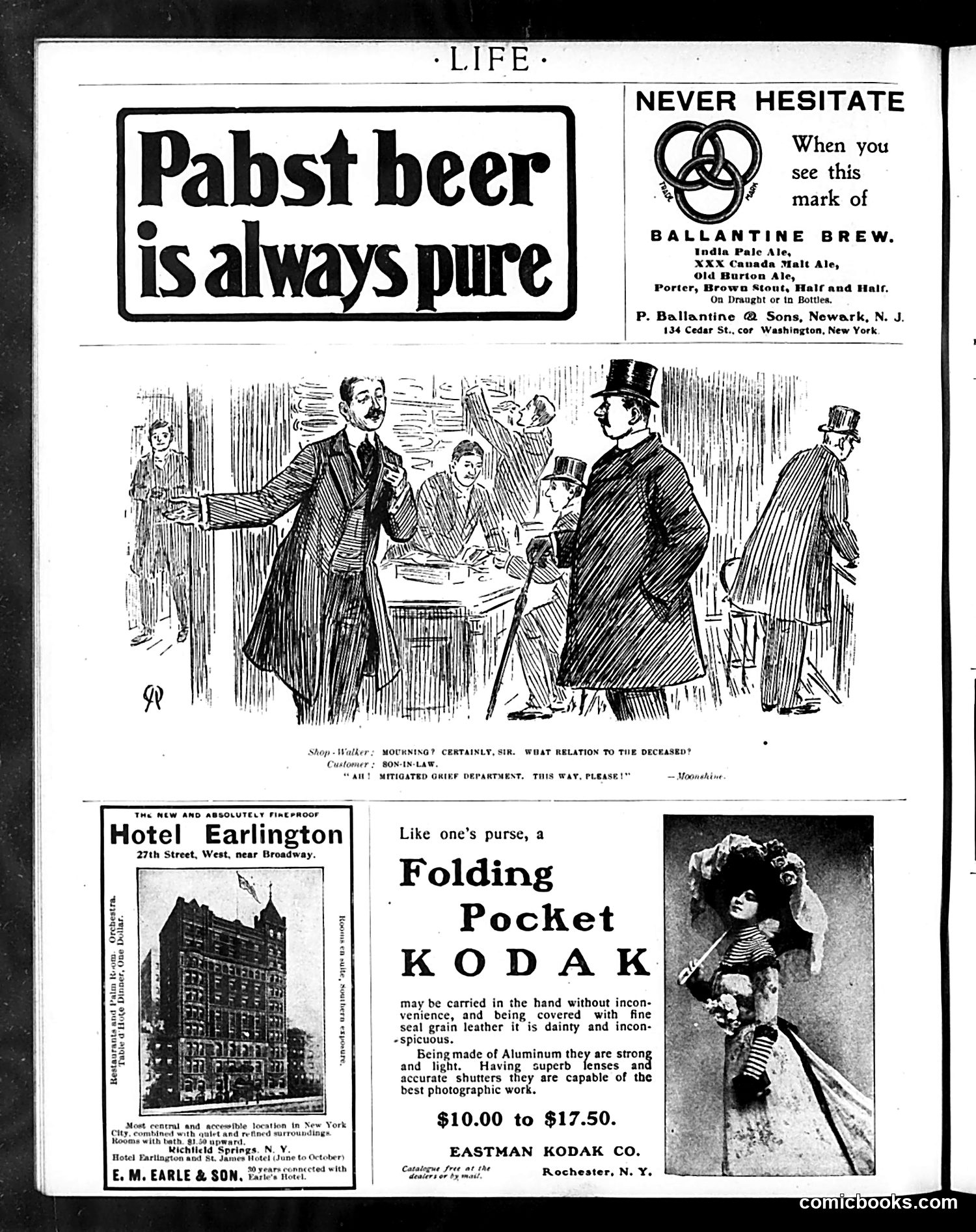
This page consists primarily of **advertisements** interspersed with one cartoon. The main cartoon depicts a **shop-walker (store employee) addressing a grieving customer** at what appears to be a department store's "Mitigation Grief Department." The customer, wearing mourning clothes, asks about the deceased's relation to him. The joke satirizes the **commercialization of grief**—even in their sorrow, customers are directed to a specialized department, suggesting retailers exploit every human emotion for profit. The advertisements feature Pabst beer ("always pure"), Hotel Earlington, and Eastman Kodak's folding pocket camera. These ads represent typical early-20th-century consumer products marketed to middle and upper-class readers. The satire critiques how **American commerce infiltrates even intimate, solemn moments** like mourning, reducing human experience to consumer transactions.
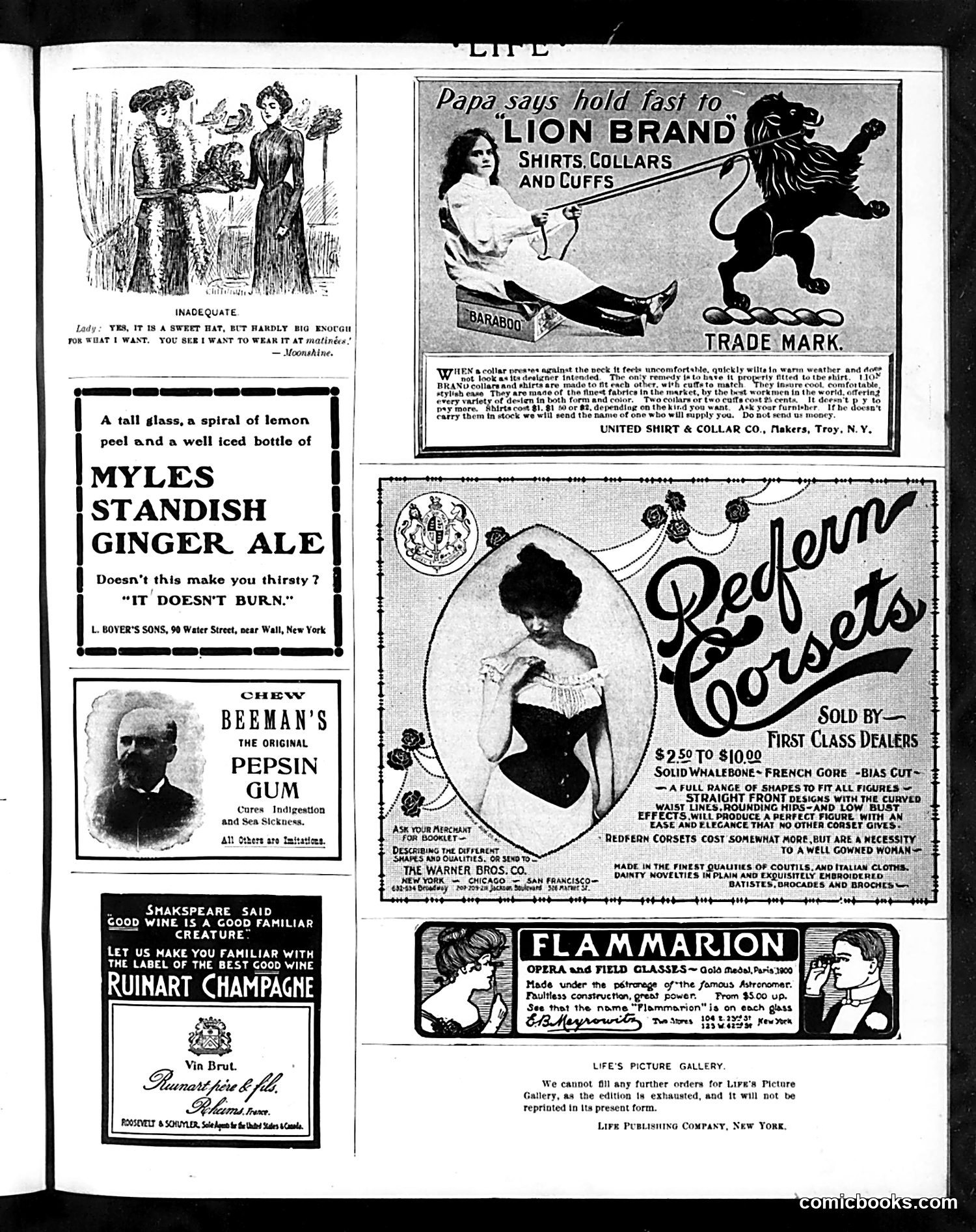
This page is primarily **advertising**, not political satire. It contains multiple product advertisements from the early 20th century aimed at middle and upper-class consumers. The lone **cartoon** ("Inadequate") appears at top-left: a woman complains to a milliner that her hat, while "sweet," is insufficient for her needs—a visual pun on understatement. The caption references "Moonshine" (likely the publication source). The advertisements promote: - **Lion Brand** shirts/collars (emphasizing proper fit) - **Myles Standish** ginger ale - **Beeman's** pepsin gum (for digestion) - **Redfern Corsets** (luxury women's undergarments) - **Flammarion** opera glasses - **Ruinart** champagne These reflect period consumer anxieties about propriety, health, and class status. The corset ad notably promises to create an idealized female figure. No political content is evident; this is a commercial publication page typical of the era.
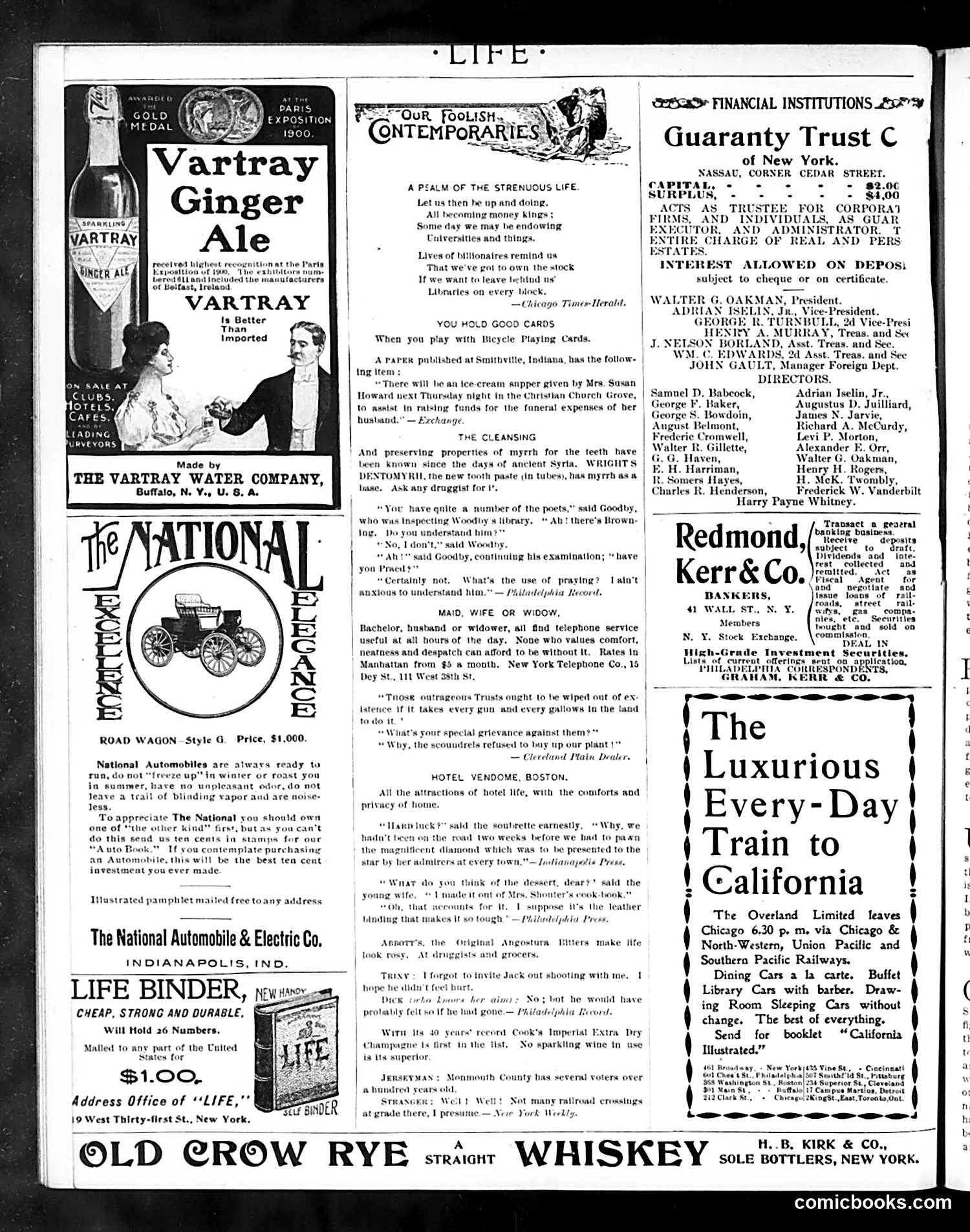
This page is primarily **advertising and humor content**, not political cartooning in the modern sense. The central satirical section, "Our Foolish Contemporaries," mocks newspaper editorial pretensions. It includes a parody "Psalm of the Strenuous Life" criticizing billionaires who accumulate wealth to endow libraries—a jab at the wealthy self-aggrandizement trend of the era (likely referencing figures like Carnegie). The accompanying jokes lampoon small-town life and newspaper clippings. The rest of the page consists of advertisements for period products: Vartray Ginger Ale (claiming superiority to imports), National automobiles, Bicycle Playing Cards, and Wright's Dentomyrrh toothpaste. Several brief humor items mock contemporary attitudes toward telephones, trusts (monopolies), and marriage. **No specific political figures are caricatured.** The satire targets general types and social trends rather than individuals—particularly the pretensions of the wealthy and foolish editorial positions of contemporary newspapers.
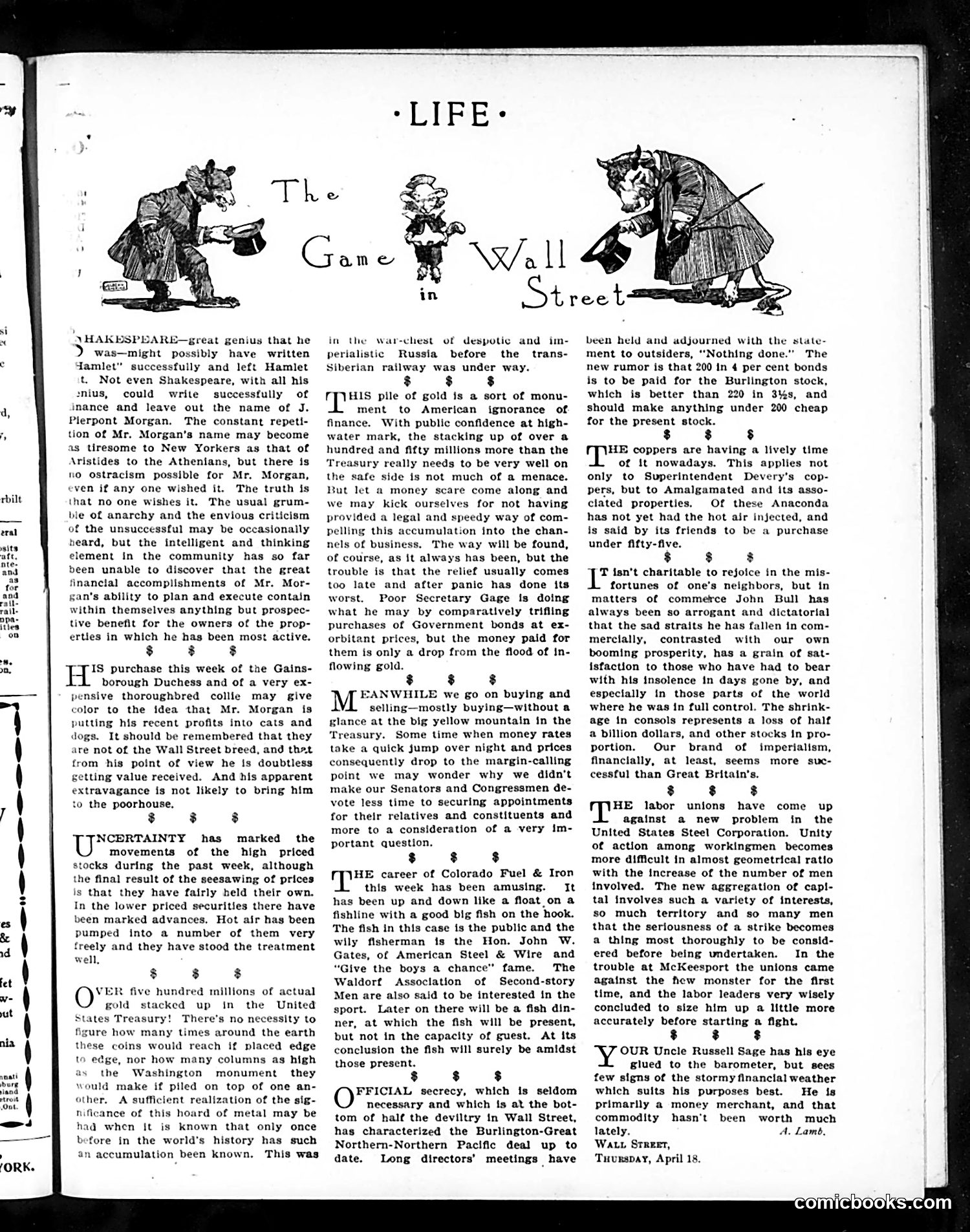
This satirical page critiques American capitalism and financial markets of the era (dated April 18). **The Main Cartoon** ("The Game Wall Street") depicts financial figures as adversaries playing a game, with a small figure (likely representing ordinary citizens) caught between them—suggesting the public is pawned in elite financial transactions. **Key Satirical Points:** The page defends **J.P. Morgan** against criticism, ironically noting his ubiquity rivals Shakespeare's Hamlet—he's so financially dominant that criticism is futile. His recent purchase of expensive horses and art receives gentle mockery. More pointedly, the article criticizes the **$500 million gold reserve** in the U.S. Treasury as evidence of "American ignorance of finance." It warns this creates instability: when market crises hit, the government will be forced to suddenly inject this money into circulation, causing panic rather than preventing it. The piece sardonically blames Congress for wasting time on patronage appointments rather than addressing this serious financial vulnerability. The overall message: America's financial system is controlled by a few elite figures (Morgan), while policymakers ignore systemic risks.
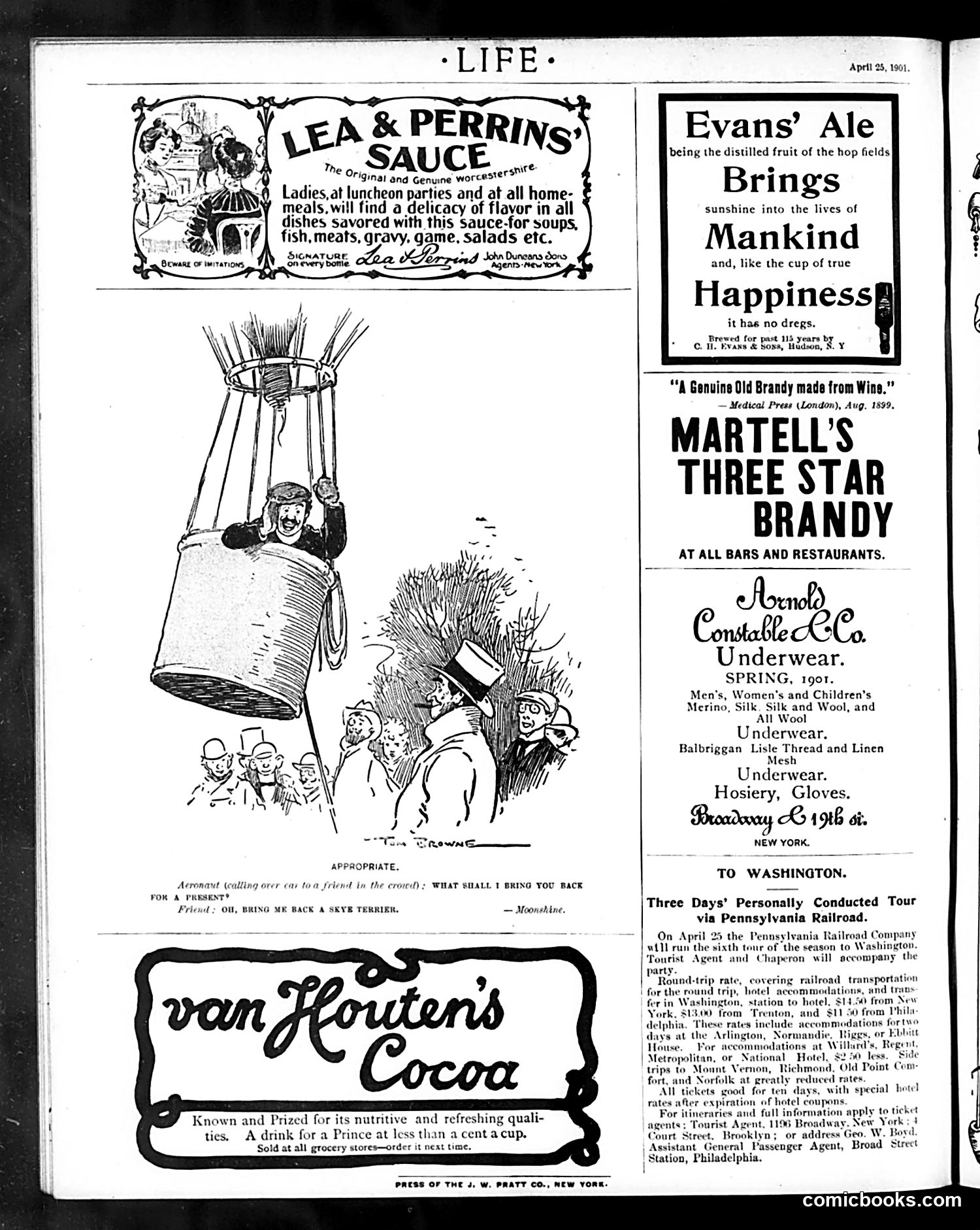
This page is primarily **advertisements with one cartoon**. The main comic features an aeronaut (hot air balloon pilot) descending toward a crowd, asking what souvenir they'd like him to bring back. The friend replies: "Bring me back a Skye Terrier"—a Scottish dog breed. The joke plays on the absurdity of the request: a hot air balloon passenger cannot realistically acquire and transport a dog during flight. It's a nonsense humor piece typical of *Life* magazine's "Moonshine" column (credited here), which featured absurdist comedy. The surrounding content is period advertising for Lea & Perrins sauce, Evans' Ale, Martell's brandy, Arnold Constable underwear, van Houten's cocoa, and a Pennsylvania Railroad tour to Washington—all standard commercial promotions from this Gilded Age publication.