
Life, 1901-04-25 · page 12 of 22
Life — April 25, 1901 — page 12: what you’re looking at
What you’re looking at
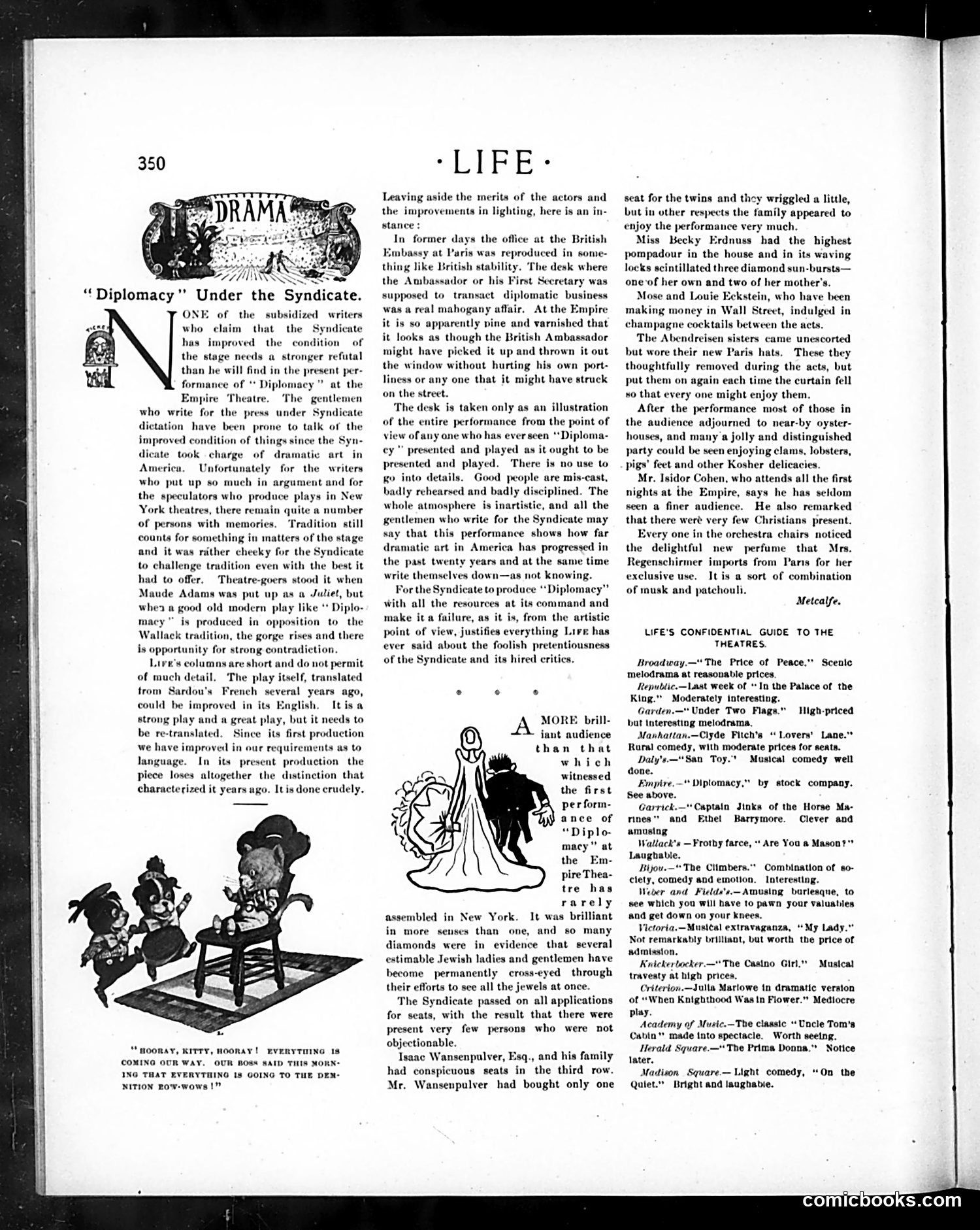
This page contains a theater review section ("Life's Confidential Guide to the Theatres") and a drama critique titled "Diplomacy" Under the Syndicate. The main cartoon depicts three figures in theatrical costume/caricature style, likely representing theater critics or personalities associated with the Syndicate's production of "Diplomacy" at the Empire Theatre. The text criticizes the Syndicate's staging of this play, arguing it represents improved production values but raises concerns about artistic control. The author suggests the Syndicate prioritizes commercial viability over dramatic integrity, noting the performance "shows how far dramatic art in America has progressed in the past twenty years." The cartoon's exact satirical point remains somewhat unclear without additional context about specific Syndicate figures or theatrical controversies of the era.
📄 Transcribed text from this page (OCR, searchable)
Machine-transcribed from the original scan — historical spelling and the odd misread are preserved.
Sie “Diplomacy"’ Under the Syndicate. ite weil ONE of who the subsidized writers that the nd has improved the the stage needs a stronger refutal than he will find in the present per- formance of * Diplomacy” at the Empire Theatre. The gentlemen who write for the press under Syndicate dictation have been prone to talk of the improved condition of things since the Sy dicate took charge of dramatic art in Am Unfortunately for the who put up so much in argument and for the speculators who produce plays in New York theatres, there remain quite a number of persons with memories. Tradition still counts for something in matters of the stage and it was rither cheeky for the Syndicate to challenge tra ith the best it had to offer. Theatre-goers stood it when Maude Adams was put up as a Juliet, but whea a good old modern play like " Diplo- macy" is produced in opposition to. the Wallack tradition, the gorge rises and there is opportunity for strong contradiction. Live's columns are short and do not permit of much detail. ‘The play itself, translated trom Sardou's French eral years ago, could be improved in its English. It isa strong play and a great play, but it needs to be re-translated. Since its first production we have improved in our requirements as to language. In its present production the piece loses altogether the distincti characterized it years ago. Itis don claim writers “HOORAY, KITTY, HOORAY! EVERYTHING 18 COMING OUR WAY. OUR Hoss SAID THIS MOR! 1NG THAT EVERYTHING 18 GOING TO TUE DEM- NITION Row-wows !”” ondition of ‘LUPE ving aside the merits of the actors and the improvements in lighting, here is an in- stance : In former days the office at the British mbassy at Paris was reproduced in some- thing like British stability. The desk where the Ambassador or his First Secretary was supposed to transact diplomatic business was a real mahogany affair. At the Empire it is so apparently pine and varnished that it looks as though the British Ambassador might have picked it up and thrown it out the window without hurting his own port- liness or any one that it might have struck on the street. The desk is taken only as an illustration of the entire performance from the point of view ofany ane who has ever seen “Diploma- cy" presented and played as it ought to be presented and played. ‘There is no use to go into details. Good people are mis-cast, badly rehearsed and badly disciplined. The whole atmosphere is inartistic, and all the gentlemen who write for the Syndicate may say that this performance shows how far dramatic art in America has progressed in the past twenty years and at the same time write themselves down—as not knowing. For the Syndicate to produce “Diplomacy” p all the resources at its command and make ita failure, as it is, from the artistic point of view, justifies everything Lire has r said about the foolish pretentiousness of the Syndicate and its hired crities. Leas MORE brill- jiant audience than that which witnessed the first perform- ance of “Diplo- macy" at the Em- pire Thea- tre has rarely assembled in New York. It was brilliant in more senses than one, and so many diamonds were in evidence that several estimable Jewish ladies and gentlemen have become permanently cross-eyed through their efforts to see all the jewels at once. The Syndicate passed on all applications for seats, with the result that there were present very few persons who were not objectionable. Isaac Wansenpulver, Esq., and his family had conspicuous seats in the third row. Mr. Wansenpulver had bought only one seat for the twins and thoy wriggled a little, but in other respects the family appeared to enjoy the performance very much, Miss Becky Erdnuss had the highest pompadour in the house and in its waving locks scintillated three diamond sun-bursts— one of her own and two of her mother's. Mose and Louie Eckstein, who have been making money in Wall Street, indulged in champagne cocktails between the acts. The Abendreisen sisters came unescorted but wore their new Paris hats. These they thoughtfully removed during the acts, but put them on again each time the curtain fell so that every one might enjoy them, After the performance most of those in the audience adjourned to near-by oyster- houses, and many’a jolly and distinguished party could be seen enjoying clams, lobsters, pigs’ feet and other Kosher delicacies. Mr. Isidor Cohen, who attends all the first nights at the Empire, says he has seldom seen a finer audience. He also remarked that there wert very few Christians present. Every one in the orchestra chairs noticed the delightful perfume that Mrs. Regenschirmer imports from Paris for her exclusive use. It is a sort of combination of musk and patchouli, new Metcalfe, LIFE'S CONFIDENTIAL GUIDE TO THE THEATRES. Broadway.—"The Price of Peace."* Scente melodrama at reasonable prices. Republic.—Last week of “In the Palace of the King.” Moderately interesting. Garden.—" Under Two Flags.” bat Interesting melodrama. Manhattan.—Ciyde Fitch's “ Lovers’ Lane." Rural comedy, with moderate prices for seats. Daly's—"San Toy.* Musical comedy well done. Empire. See above. Garrick.—" Captain Jinks of the Horse Ma- mines and Ethel Barrymore. Clever and amusing Watlack's —Frothy far: Laughable. Biyou.—" The Climbers.” Combination of s0- clety, comedy and emotion. Interesting. Weber and Fields Amusing burlesque, to see which you will have to pawn your valuables ‘and get down on your knees. Victoria,—Musieal extravaganza, “My Lady." Not remarkably brilliant, but worth the price of admisston. Knickertocker—"The Casino Girl," travesty at high prices, Criterion.—Julta Marlowe tn dramatic version of “When Knighthood Was In Flower.” Mediocre play. Academy of Music.—The classic “Uncle Tom's Cabin” made tnto spectacle. Worth seeing. Herald Square.—* The Prima Donna.” Notice later. Madison Square.— Light comedy, “On the Quiet.” Bright and laughabie. High-priced “Diplomacy.” by stock company. Are You a Mason?”* Mustcal comicbooks.com