
Life, 1901-04-25 · page 3 of 22
Life — April 25, 1901 — page 3: what you’re looking at
What you’re looking at
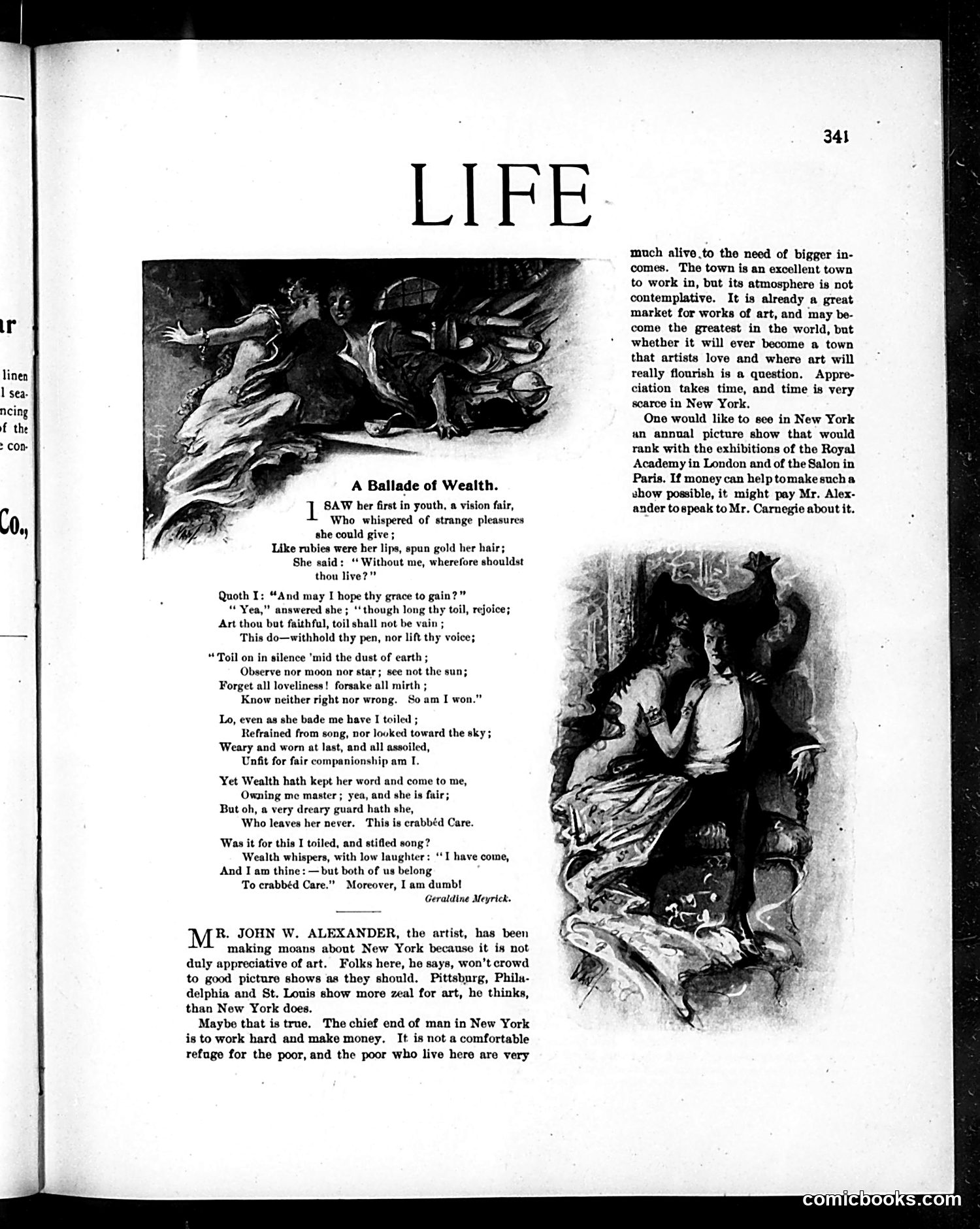
This page from *Life* magazine presents "A Ballad of Wealth," a poem by Geraldine Meyrick satirizing wealth inequality and class divisions. The verses depict a wealthy woman addressing a poor person, dismissing their suffering with callous indifference ("Without me, wherefore shouldst thou live?"). The woman demands the poor person work silently without complaint while she enjoys luxury. Below, the text discusses artist John W. Alexander's criticisms of New York's lack of appreciation for art compared to other cities like Pittsburgh and Philadelphia. Alexander argues New York prioritizes money-making over cultural enrichment, making it inhospitable to artists and the poor alike. Together, the poem and commentary critique Gilded Age materialism and New York's failure as a cultural center—attacking both wealth's moral bankruptcy and the city's misplaced values.
📄 Transcribed text from this page (OCR, searchable)
Machine-transcribed from the original scan — historical spelling and the odd misread are preserved.
A Ballade of Wealth. _ SAW ber first in youth, a vision fair, Who whispered of strange pleasures she could give ; Like rubies were her lips, spun gold her hair; She said: ‘Without me, wherefore shouldst thou live?” Quoth I: “And may I hope thy grace to gain?” “ Yea,” answered she ; “though long thy toil, rejoice; Art thou but faithful, toil shall not be vain ; This do—withhold thy pen, nor lift thy voice; “Toil on in silence 'mid the dust of earth ; Observe nor moon nor star; see not the sun; Forget all loveliness! forsake all mirth ; Know neither right nor wrong. So am I won.” Lo, even as she bade me have I toiled ; Refrained from song, nor lovked toward the sky; Weary and worn at last, and all assoiled, Unfit for fair companionship am I. Yet Wealth hath kept her word and come to me, Oxning me master; yea, and she is fair; But oh, a very dreary guard hath she, Who leaves her never. This is crabbéd Care. ‘Was it for this I toiled, and stifled song? Wealth whispers, with low laughter: ‘I have come, And I am thine: —but both of us belong To crabbéd Care.” Moreover, I am dumb! Geraldine Meyrick. R. JOHN W. ALEXANDER, the artist, has been making moans about New York because it is not duly appreciative of art. Folks here, he says, won't crowd to good picture shows as they should. Pittsburg, Phila- delphia and St. Louis show more zeal for art, he thinks, than New York does. Maybe that is true. The chief end of man in New York is to work hard and make money. It is not a comfortable refuge for the poor, and the poor who live here are very much alive to the need of bigger in- comes. The town is an excellent town to work in, but its atmosphere is not contemplative. It is already a great market for works of art, and may be- come the greatest in the world, but whether it will ever become a town that artists love and where art will really flourish is a question. Appre- ciation takes time, and time is very scarce in New York. One would like to see in New York an annual picture show that would rank with the exhibitions of the Royal Academy in London and of the Salon in Paris. If money can help tomake such a show possible, it might pay Mr. Alex- ander tospeak to Mr. Carnegie about it.