
Life, 1901-04-25 · page 6 of 22
Life — April 25, 1901 — page 6: what you’re looking at
What you’re looking at
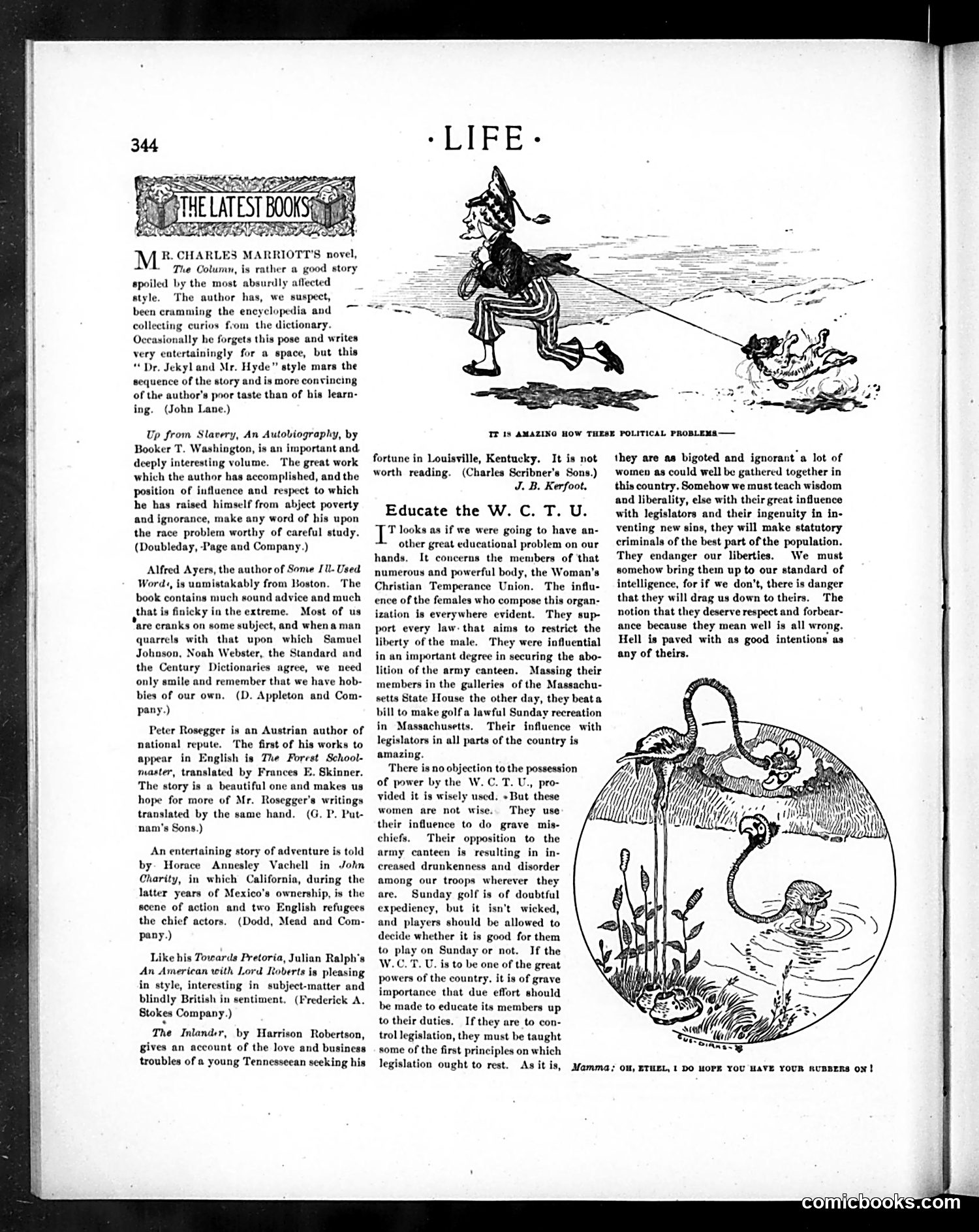
The main cartoon satirizes the **Woman's Christian Temperance Union (W.C.T.U.)**, a prominent early 20th-century organization advocating alcohol prohibition and moral reform. The text criticizes the W.C.T.U.'s political influence, calling their members "bigoted and ignorant." It argues they misuse their power—pushing prohibition legislation, opposing Sunday recreation like golf, and causing "drunkenness and disorder among our troops" through their policies. The illustration depicts chaotic underwater creatures, likely symbolizing the disorder and confusion the author believes W.C.T.U. activism produces. The caption's reference to "rubbers" suggests concerns about practical consequences of their rigid moral stance. The piece represents anti-prohibition sentiment and criticism of women's political activism in this era.
📄 Transcribed text from this page (OCR, searchable)
Machine-transcribed from the original scan — historical spelling and the odd misread are preserved.
THE LATEST BOO IK R. CHARLES MARRIOTT'S novel, The Column, is rather a good story spoiled by the most absurdly affected style. The author has, we suspect, been cramming the encyclopedia and collecting curios fom the dictionary. Occasionally he forgets this pose and writes very entertainingly for a space, but this “Dr. Jekyland Mr. Hyde” style mars the sequence of the story and is more convincing of the author's poor taste than of his learn- ing. (John Lane.) Up from Slavery, An Autobiography, by Booker T. Washington, is an important and deeply interesting volume. ‘The great work which the author has accomplished, and the position of influence and respect to which he has raised himself from abject poverty and ignorance, make any word of his upon the race problem worthy of careful study. (Doubleday, Page and Company.) Alfred Ayers, the author of Some Ill. Used Word,, is uamistakably from Boston. The book contains much sound advice and much that is finicky in the extreme. Most of us ‘are cranks on some subject, and when a man quarrels with that upon which Samuel Johnson, Noah Webster, the Standard and the Century Dictionaries agree, we need only smile and remember that we have hob- bies of our own. (D. Appleton and Com- pany.) Peter Rosegger is an Austrian author of national repute. The first of his works to appear in English is The Forest School- master, translated by Frances E. Skinner. The story is a beautiful one and makes us hope for more of Mr. Rosegger’s writings translated by the same hand. (G. P. Put- nam's Sons.) An entertaining story of adventure is told by. Horace Annesley Vachell in John Charity, in which California, during the latter years of Mexico's ownership, is the scene of action and two English refugees the chief actors. (Dodd, Mead and Com- pany.) Like his Towards Pretoria, Julian Ralph's An American with Lord Roberts is pleasing in style, interesting in subject-matter and blindly British in sentiment. (Frederick A. Stokes Company.) The Inlander, by Harrison Robertson, gives an account of the love and business troubles of a young Tennesseean seeking his Tr 1s AMAZING HOW THESE POLITICAL PROBLEMS— fortune in Louisville, Kentucky. It is not worth reading. (Charles Scribner's Sons.) J. B. Kerfoot, Educate the W. C. T. U. T looks as if we were going to have an- other great educational problem on our hands, It concerns the members of that numerous and powerful body, the Woman's Christian Temperance Union. The influ- ence of the females who compose this organ- ization is everywhere evident. They sup- port every law-that aims to restrict the liberty of the male. They were influential in an important degree in securing the abo- lition of the army canteen. Massing their members in the gulleries of the Massachu- setts State House the other day, they beata bill to make golf a lawful Sunday recreation in Massachusetts. Their influence with legislators in all parts of the country is amazing. ‘There is no objection to the possession of power by the W.C.T. U., pro- vided it is wisely used. +But these women are not wise. They use their influence to do grave mis- chiefs. Their opposition to the army canteen is resulting in in- creased drunkenness and disorder among our troops wherever they are. Sunday golf is of doubtful expediency, but it isn't’ wicked, and players should be allowed to decide whether it is good for them yon Sunday or not. If the T. U. is to be one of the great powers of the country, it is of grave importance that due effort should be made to educate its members up to their duties. If they are to con- trol legislation, they must be taught some of the first principles on which legislation ought to rest. As it is, they are as bigoted and ignorant a lot of women as could well be gathered together in this country. Somehow we must teach wisdom and liberality, else with their great influence with legislators and their ingenuity in in- venting new sins, they will make statutory criminals of the best part of the population. They endanger our liberties. We must somehow bring them up to our standard of intelligence, for if we don’t, there is danger that they will drag us down to theirs. The notion that they deserve respect and forbear- ance because they mean well is all wrong. Hell is paved with as good intentions as any of theirs. Mamma; Ou, ETUEL, 1 DO MOPE YOU HAVE YOUR RUBBERS ON!