
Life, 1901-04-25 · page 8 of 22
Life — April 25, 1901 — page 8: what you’re looking at
What you’re looking at
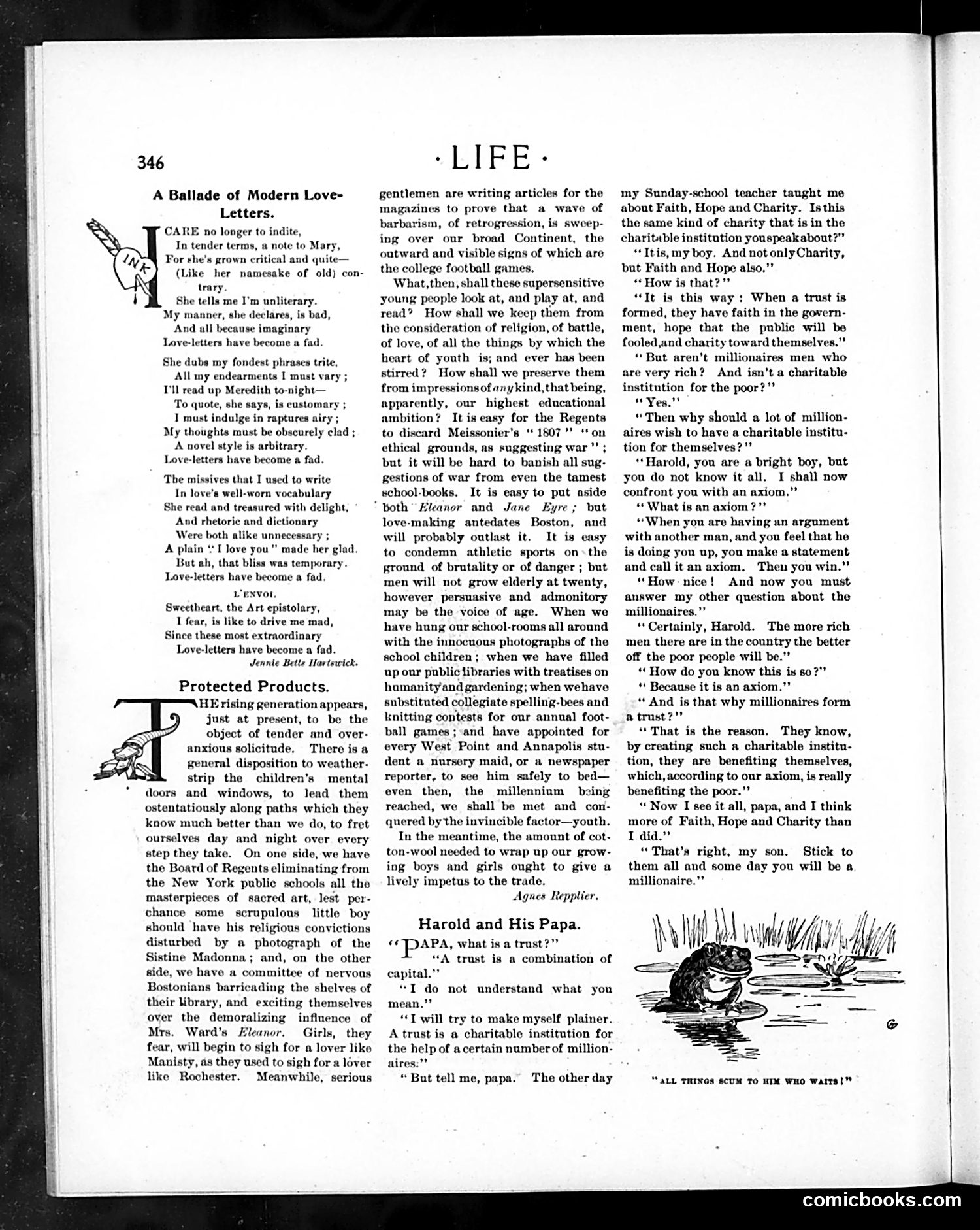
This page contains three separate pieces: 1. **"A Ballad of Modern Love-Letters"** — A satirical poem mocking how love letters have become formulaic and insincere ("Love-letters have become a fad"), reflecting turn-of-century concerns about authentic romance amid modernization. 2. **"Protected Products"** — A section criticizing how the rising generation is overprotected by institutions. It mocks the Board of Regents' removal of "masterpieces of sacred art" from schools due to moral concerns, suggesting excessive censorship weakens children's character development. 3. **"Harold and His Papa"** — A dialogue explaining "trusts" (monopolistic business combinations) to a child, defining them as "charitable institutions for the help of a certain number of millionaires." This is sharp satire of wealthy industrialists claiming philanthropy justifies their monopolistic practices. The small illustration shows a duck or waterfowl in water, captioned "All things seem to him who waits!"
📄 Transcribed text from this page (OCR, searchable)
Machine-transcribed from the original scan — historical spelling and the odd misread are preserved.
Be Eee 346 A Ballade of Modern Love- Letters. CARE no longer to indite, In tender terms, a note to Mary, For she’s grown critical and quite— (Like her namesake of old) con- trary. She tells me I'm unliterary. My manner, she declares, is bad, And all because imaginary Love-letters have become a fad She dubs my fondest phrases trite, All my endearments I must vary ; T'll read up Meredith to-night— To quote, she says, is customary ; I must indulge in raptures airy ; My thoughts must be obscurely clad ; ‘A novel style is arbitrary. Love-letters have become a fad. ‘The missives that I used to write In love's well-worn vocabulary She read and treasured with delight, And rhetoric and dictionary Were both alike unnecessary ; A plain ¢ [love you” made her glad. But ab, that bliss was temporary. Love-letters have become a fad. NVOI. Sweetheart, the Art epistolary, I fear, is like to drive me mad, Since these most extraordinary Love-letters have become a fad. Jennie Betts Hartawick. Protected Products. HE rising generation appears, just at present, to be the object of tender and over- anxious solicitude. There isa general disposition to weather- strip the children’s mental doors and windows, to lead them ostentatiously along paths which they know much better than we do, to fret ourselves day and night over every step they take. On one side, we have the Board of Regents eliminating from the New York public schools all the masterpieces of sacred art, lest per- chance some scrupulous little boy should have his religious convictions disturbed by a photograph of the ine Madonna; and, on the other side, we have a committee of nervous Bostonians barricading the shelves of their library, and exciting themselves over the demoralizing influence of Mrs. Ward’s Eleanor. Girls, they fear, will begin to sigh for a lover like Manisty, as they used to sigh for a lover like Rochester. Meanwhile, serious eS TPE « gentlemen are writing articles for the magazines to prove that a wave of barbarism, of retrogression, is sweep- ing over our broad Continent, the outward and visible signs of which are the college football games. What, then, shall these supersensitive young people look at, and play at, and read? How shall we keep them from the consideration of religion, of battle, of love, of all the things by which the heart of youth is; and ever has been stirred? How shall we preserve them from impressions of any kind, that being, apparently, our highest educational ambition? It is easy for the Regents to discard Meissonier’s ‘ 1807" ‘on ethical grounds, as suggesting war "’ ; but it will be hard to banish all sug- gestions of war from even the tamest school-books. It is easy to put aside ‘Poth Kleanor and Jane Eyre; but love-making antedates Boston, and will probably outlast it. It is easy to condemn athletic sports on» the ground of brutality or of danger ; but men will not grow elderly at twenty, however persuasive and admonitory may be the voice of age. When we have hung our school-rooms all around with the innocuous photographs of the school children ; when we have filled up our public libraries with treatises on humanity and gardening; when wehave substituted collegiate spelling-bees and knitting contests for our annual foot- ball games; and have appointed for every West Point and Annapolis stu- dent a nursery maid, or a newspaper reporter, to see him safely to bed— even then, the millennium being reached, we shall be met and con- quered by the invincible factor—youth. In the meantime, the amount of cot- ton-wool needed to wrap up our grow- ing boys and girls ought to give a lively impetus to the trade. Agnes Repplier. Harold and His Papa. “PAPA, what is a trust?” - “A trust is a combination of capital.’ “I do not understand what you mean,”’ “T will try to make myself plainer. A trust is a charitable institution for the help of acertain numberof million: aires:”” “ But tell me, papa. The other day my Sunday-school teacher taught me about Faith, Hope and Charity. Isthis the same kind of charity that is in the charitable institution youspeakabout?” “TItis, my boy. And not onlyCharity, but Faith and Hope also,” “* How is that?"’ “It is this way : When a trust is formed, they have faith in the govern- ment, hope that the public will be fooled,and charity toward themselves.”" “ But aren’t millionaires men who are very rich? And isn’t a charitable institution for the poor?’’ “Yes.”” “Then why should a lot of million- aires wish to have a charitable institu- tion for themselves?” “Harold, you are a bright boy, but you do not know it all. I shall now confront you with an axiom.’’ “« What is an axiom ?’’ «When you are having un argument with another man, and you feel that he is doing you up, you make a statement and call it an axiom, Then you win.’’ “How nice! And now you must answer my other question about the millionaires.”’ “Certainly, Harold. The more rich men there are in the country the better off the poor people will be.” “How do you know this is so?" ** Because it is an axiom.”’ “And is that why millionaires form a trust?’ “That is the reason. They know, by creating such a charitable institu- tion, they are benefiting themselves, which, according to our axiom, is really benefiting the poor.’” “ Now I see it all, papa, and I think more of Faith, Hope and Charity than I did.” “‘That’s right, my son. Stick to them all and some day you will be a millionaire.” “ALL THINGS SCUM TO HIM WHO warrs!” comicbooks.com