
A complete issue · 22 pages · 1901
Life — April 11, 1901
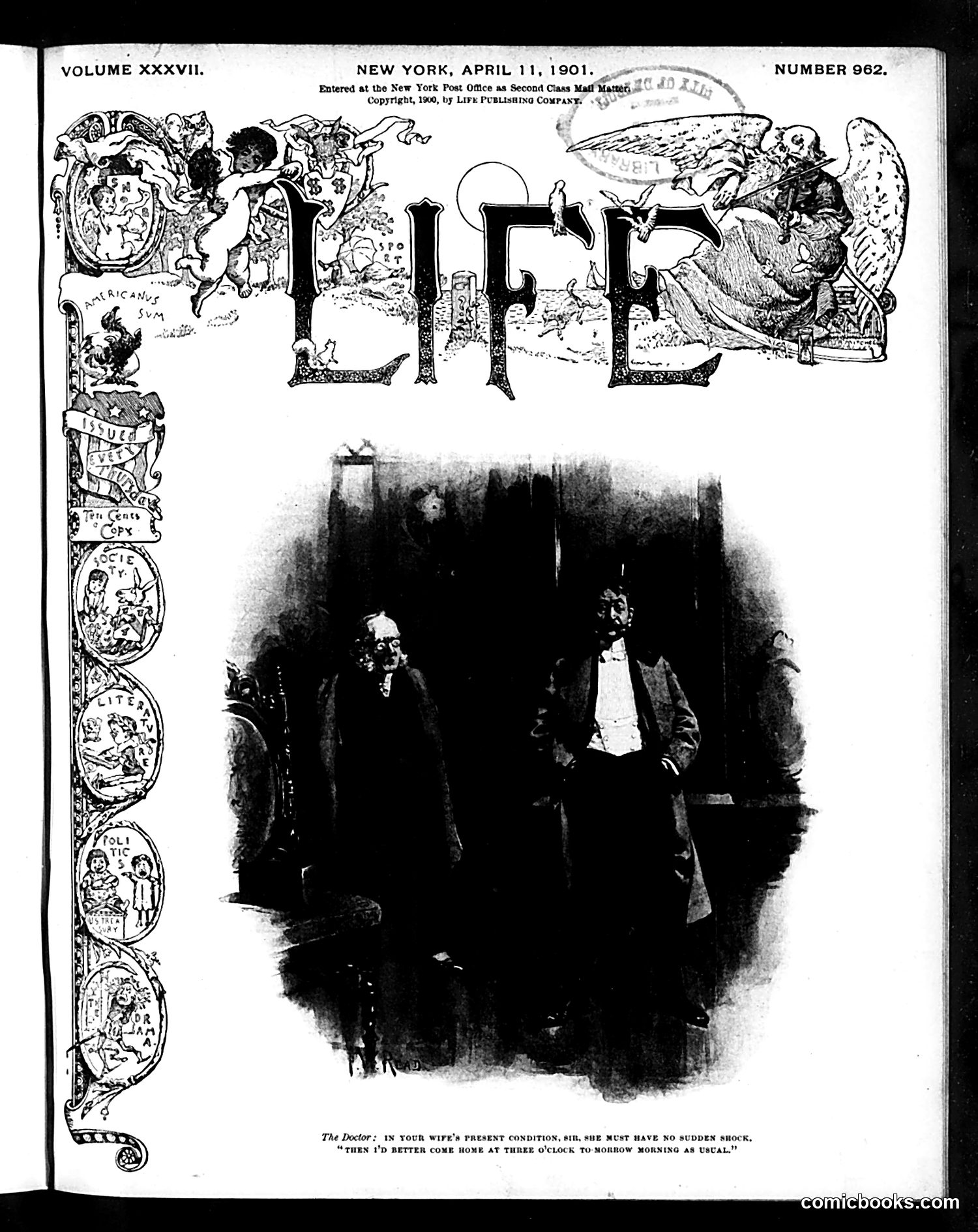
This page features a satirical cartoon titled "The Doctor" with accompanying dialogue: "In your wife's present condition, sir, she must have no sudden shock. Then I'd better come home at three o'clock to-morrow morning as usual." The joke satirizes infidelity and marital discord. A doctor advises a husband that his wife needs calm and no shocks during her illness. The husband's response—that he'll continue his habit of arriving home at 3 AM (implying he's been out carousing or with another woman)—reveals his obliviousness or callousness to her condition. The humor targets the husband's selfishness and the era's presumed acceptance of such marital indiscretions among certain men. The ornate border and decorative header are typical of Life's design aesthetic.
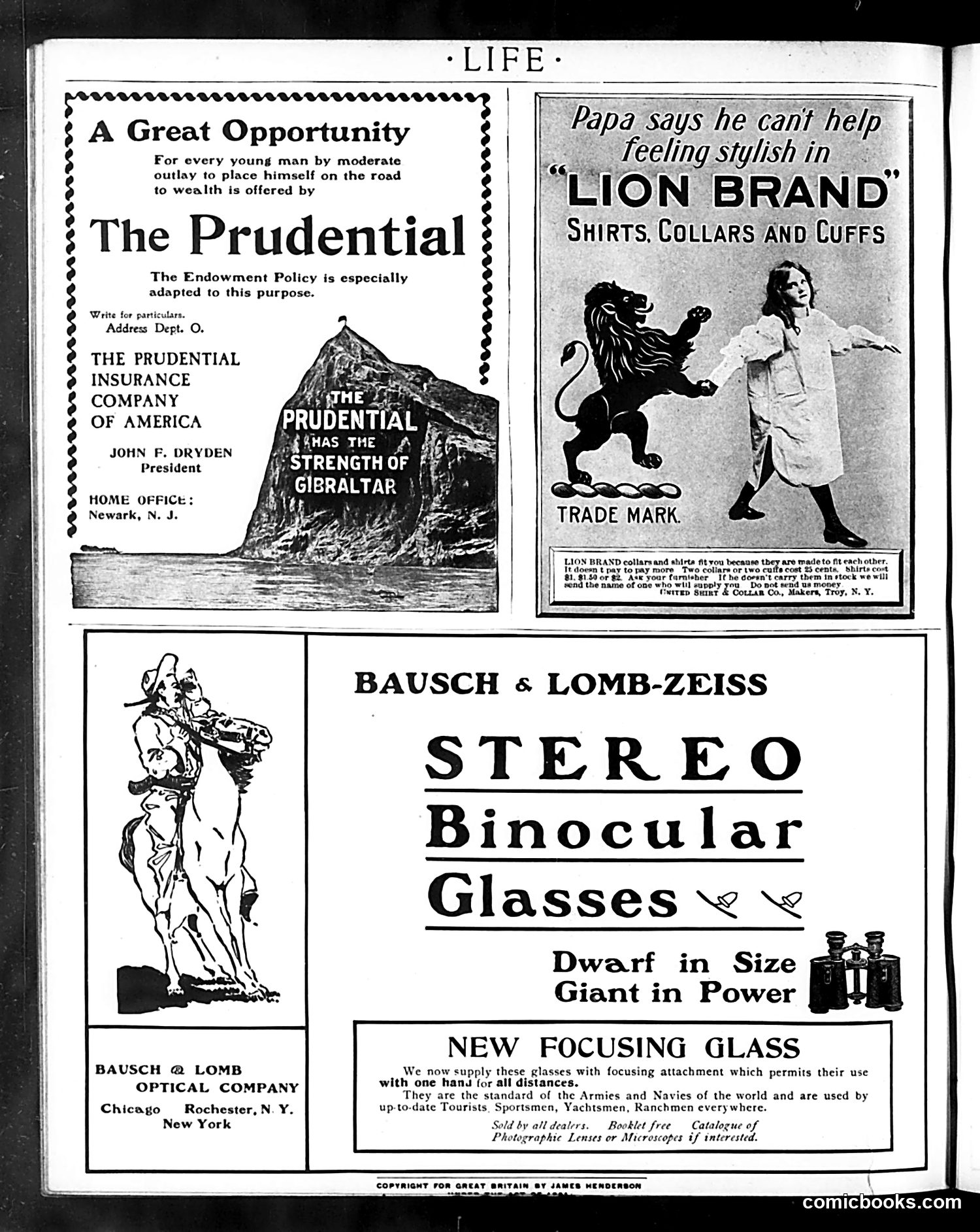
This page is primarily **advertising**, not editorial content or satire. It contains three distinct ads: 1. **Prudential Insurance**: Appeals to young men seeking wealth, using Gibraltar's strength as a metaphor for financial security. 2. **Lion Brand Shirts**: Features a man posing stylishly while a lion figure gestures approvingly—a straightforward product endorsement playing on the brand name and masculine appeal. 3. **Bausch & Lomb Binoculars**: Emphasizes compact design paired with powerful magnification ("Dwarf in Size / Giant in Power"), marketed to tourists, sportsmen, and military users. These ads reflect early-20th-century marketing conventions: masculine imagery, aspirational messaging, and appeals to specific consumer demographics. The page demonstrates how Life magazine monetized through advertising rather than primarily containing satirical editorial cartoons.
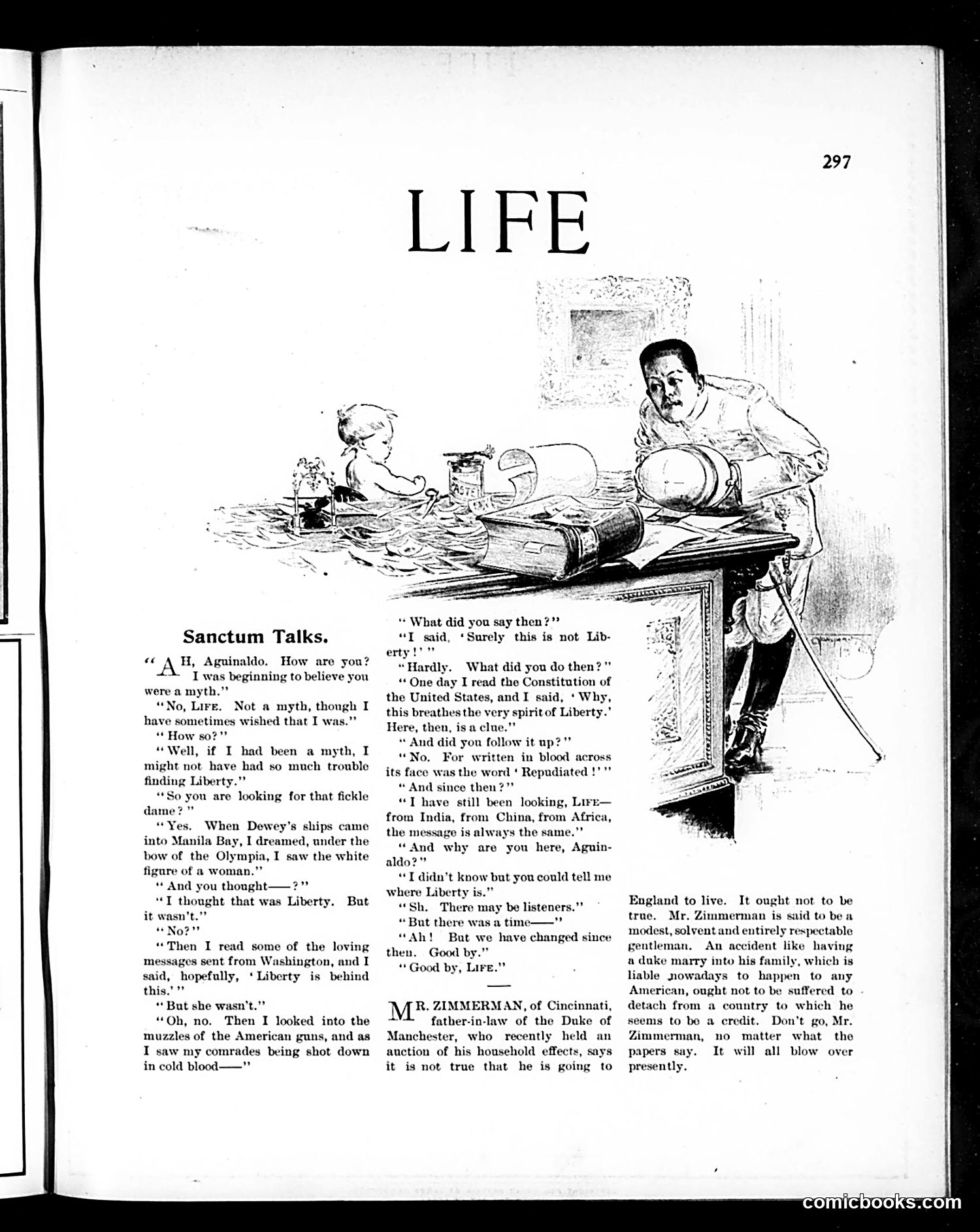
This page features "Sanctum Talks," a satirical dialogue between two figures discussing American liberty and patriotism. The conversation references the Constitution, Dewey's ships in Manila Bay (likely Admiral Dewey's 1898 Spanish-American War victory), and Liberty as an ideal versus reality. The illustration shows a man at a desk speaking with a child, suggesting an instructional or conscience-testing moment. The satire critiques how Americans invoke liberty rhetorically while questioning whether they truly understand or practice it. The text also includes commentary about Mr. Zimmerman of Cincinnati, whose father-in-law (a Duke of Manchester) is allegedly leaving England. This appears to satirize wealthy Americans' social pretensions and their entanglement with European aristocracy—a common target of American satirical publications in this era.
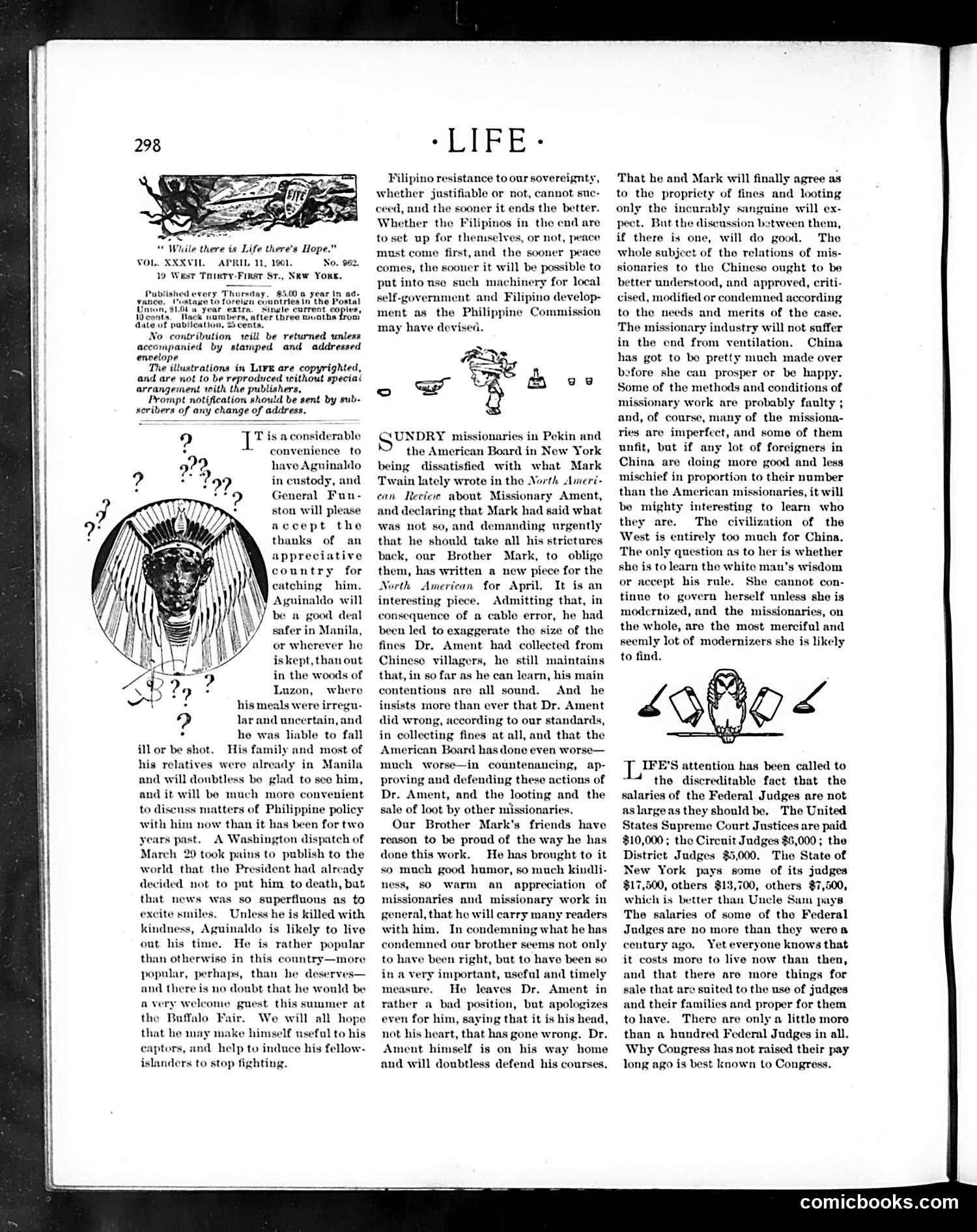
The left cartoon depicts a confused figure surrounded by question marks, appearing to illustrate bewilderment over Philippine policy. The accompanying article discusses tensions between missionary work and American colonial governance in the Philippines during the post-Spanish-American War period. The text critiques contradictions in American policy, particularly regarding Dr. Ament, a missionary accused of collecting excessive fines from Chinese villages. The piece argues that while missionaries are imperfect, China's modernization requires respecting sovereignty—a position seemingly at odds with American imperial expansion. The right section addresses Federal Judges' inadequate salaries, noting that roughly 100 judges earned $10,000-$17,500 annually while costs to live decently were higher. Both items reflect Progressive-era debates about American power abroad and domestic governance fairness.
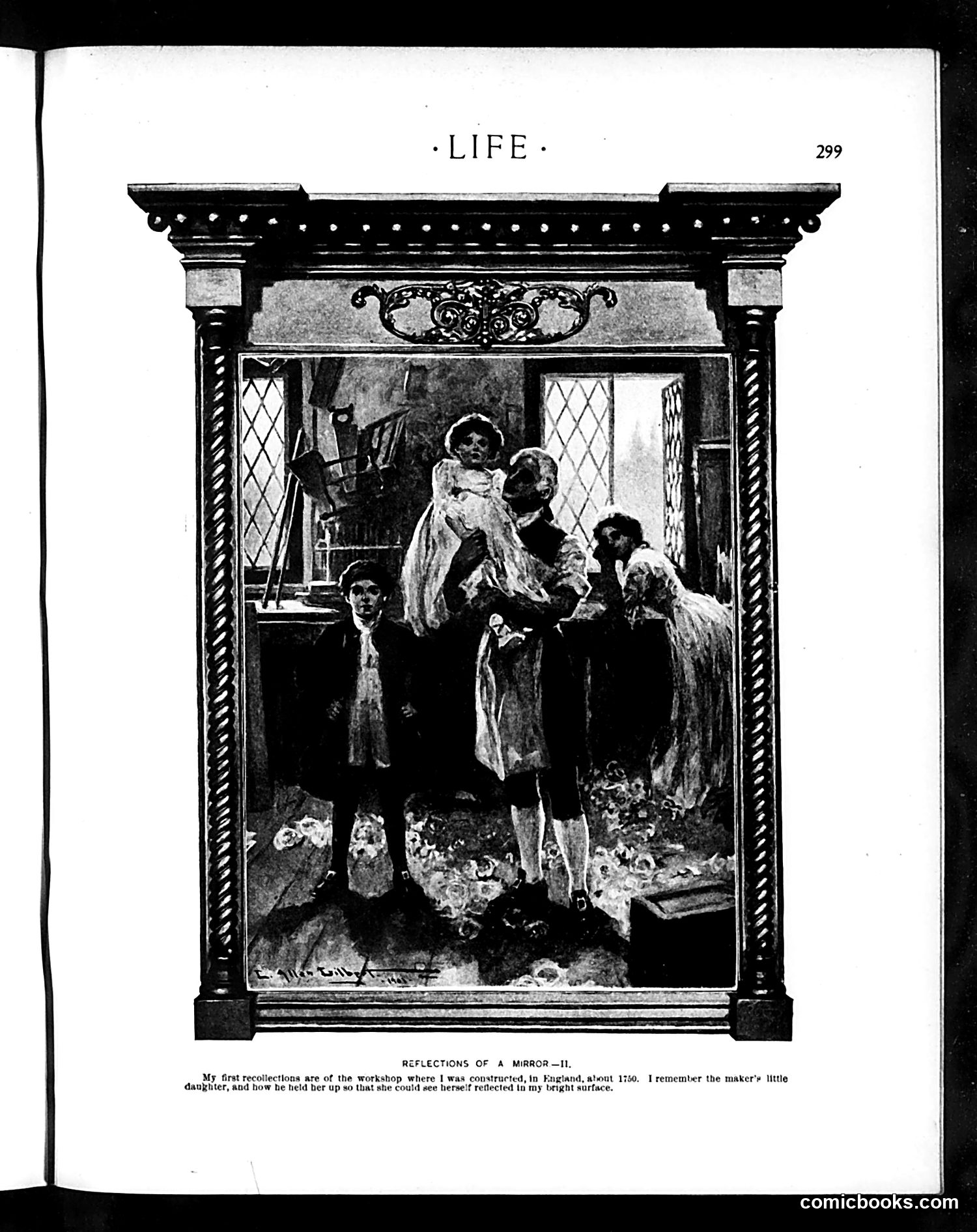
This page from *Life* magazine presents an illustration titled "Reflections of a Mirror—II," depicting a domestic scene where a woman holds up a large mirror to show children their reflections. The accompanying text references "the workshop where I was constructed in England, about 1750" and mentions a "maker's little daughter" being held up to see herself in the mirror's surface. This appears to be a nostalgic or sentimental piece about childhood memory and self-perception, using the mirror as a metaphor. The ornate frame and domestic Victorian-era setting suggest this is likely commentary on vanity, self-awareness, or the innocence of childhood discovery. Without additional context about the specific issue date, the precise satirical target remains unclear.
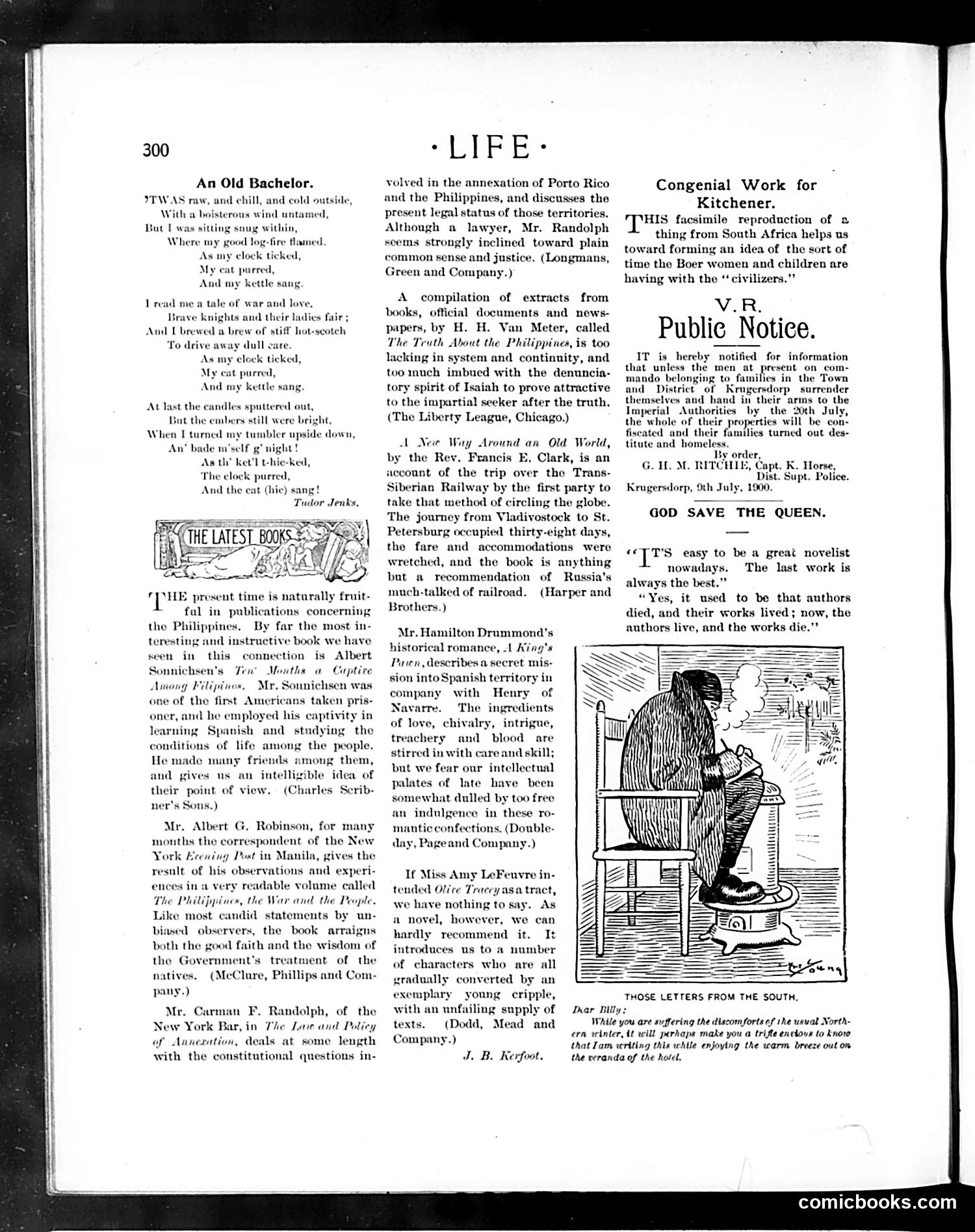
This cartoon depicts a woman at a writing desk, apparently a Northern visitor to the South during the post-Reconstruction era. The caption reads: "Dear Diary: While you are enduring the discomforts of the usual Northern winter, I am writing this while enjoying the warm breeze out on the veranda of the hotel." The satire targets Northern tourists who visited the South and wrote back home with romanticized accounts of Southern comfort and hospitality, contrasting it favorably with harsh Northern winters. The cartoon mocks this perspective as naive or self-deceiving—suggesting such visitors were either gullible or deliberately ignoring the South's actual post-war hardships and social conditions to enjoy leisure travel.
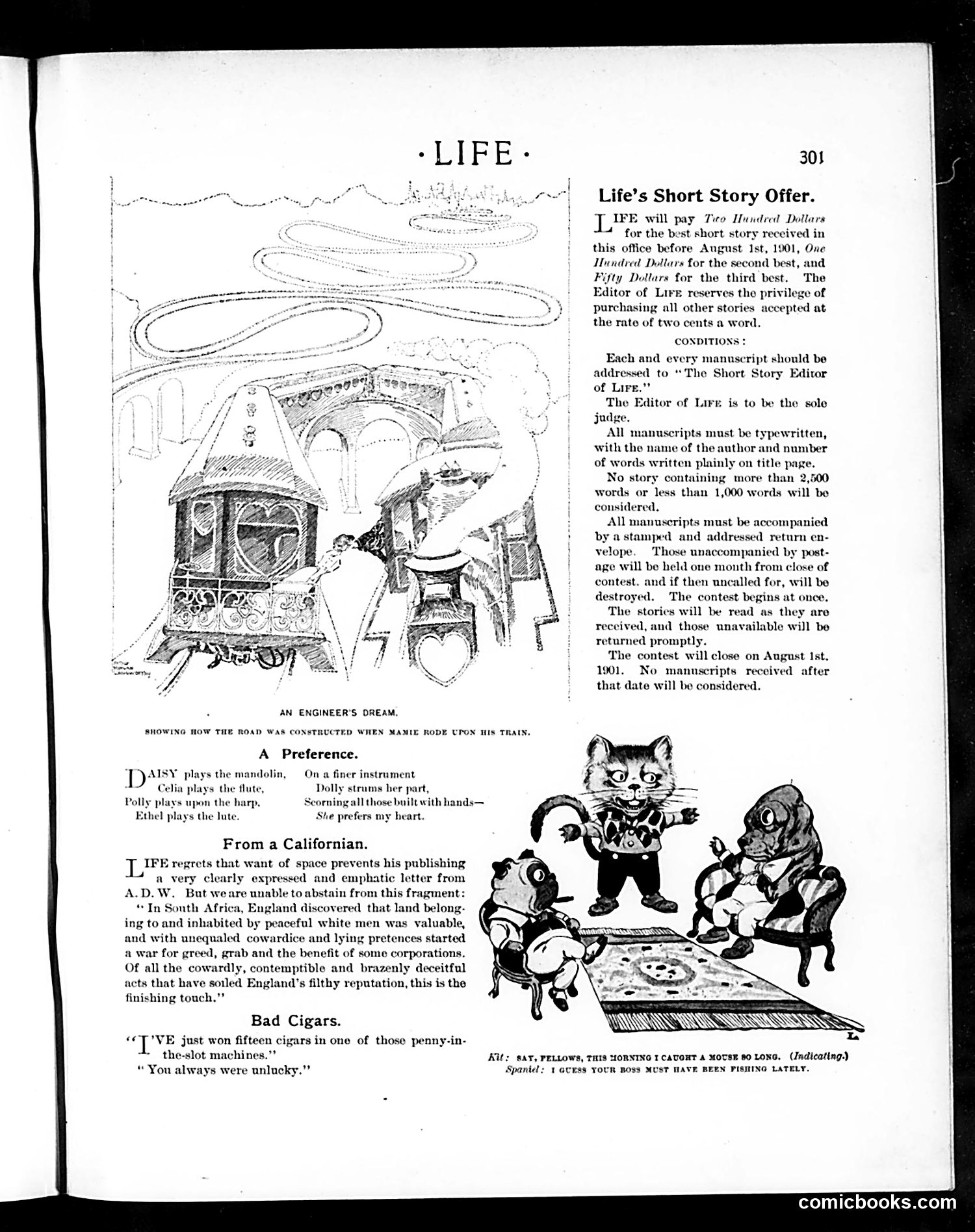
This page contains several unrelated short humor pieces rather than a coherent political cartoon. **"An Engineer's Dream"** depicts an imaginative railway scene showing how a road might be constructed when "Mamie rode upon his train"—likely a romantic fantasy. **"A Preference"** is a brief verse about musical instrument preferences, with no apparent satire. **"From a Californian"** quotes a critical letter about British imperialism and corporate greed in South Africa, suggesting Life published reader correspondence on contemporary political issues. **"Bad Cigars"** is a simple joke about unlucky gambling. **The cat illustration** shows anthropomorphic animals at a table with a caption about catching a mouse—purely whimsical humor. The page primarily showcases Life's miscellaneous humor content rather than sustained satire or political commentary.
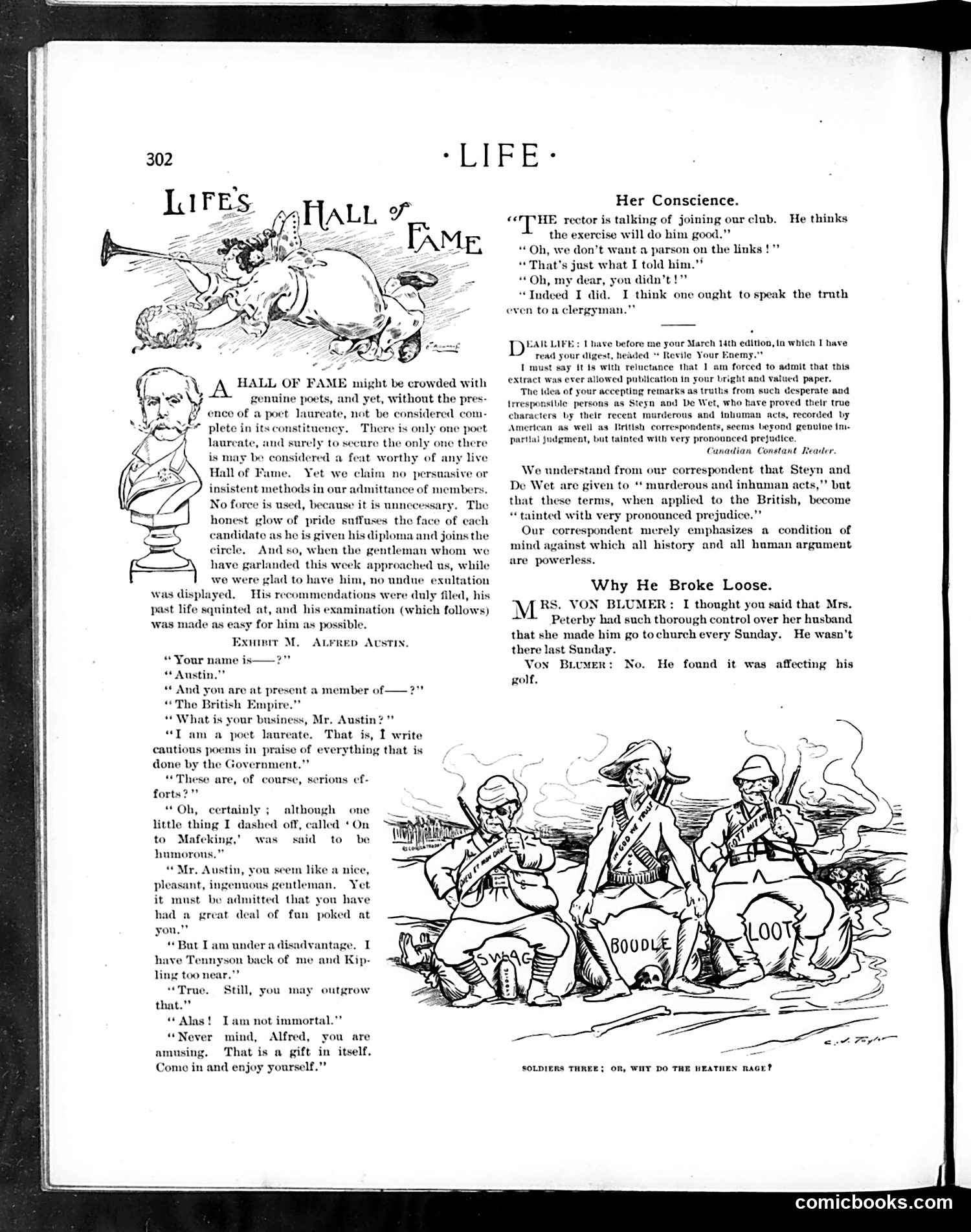
**Left Section - "Life's Hall of Fame":** A humorous piece about poet laureates. The text discusses Alfred Austin, a poet laureate, in a mock-serious interview format. The joke centers on Austin's modest accomplishments—he admits to writing "cantatas...in praise of everything" done by the government, and has Tennyson and Kipling "back of me." The satire mocks the artificiality of the poet laureate position itself: someone honored officially despite limited genuine merit. **Right Section - "Why He Broke Loose":** A cartoon depicting three soldiers labeled "Boodle" and "Loot," titled "Soldiers Three; Or, Why Do the Heathens Rage?" The illustration likely satirizes British military conduct during colonial campaigns, suggesting soldiers engaged in plundering ("boodle," "loot") rather than honorable service, explaining local resistance to occupation.
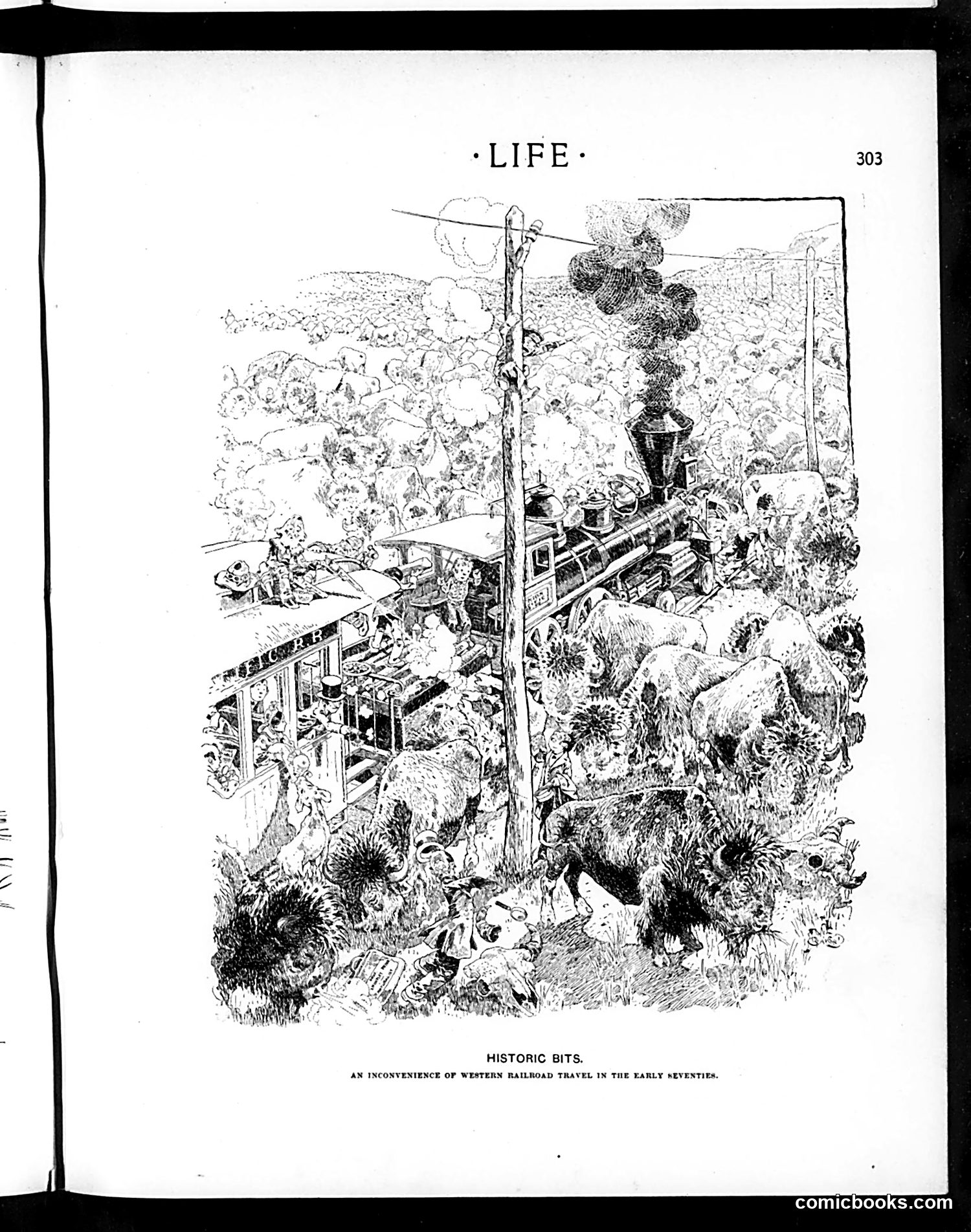
This satirical illustration depicts the chaotic reality of early western railroad travel. The detailed engraving shows a steam locomotive surrounded by wild animals (including what appears to be buffalo and other frontier fauna) and Native Americans, all seemingly interfering with the train's operation. The caption labels this "An Inconvenience of Western Railroad Travel in the Early Seventies," treating dangerous encounters as mere minor irritations. The satire mocks both the romanticized vision of western expansion and the actual hazards faced by early railroad passengers—suggesting that railways had to contend with both natural obstacles and indigenous resistance to their expansion across unsettled territories. The tone is darkly humorous about genuine historical conflicts and dangers.
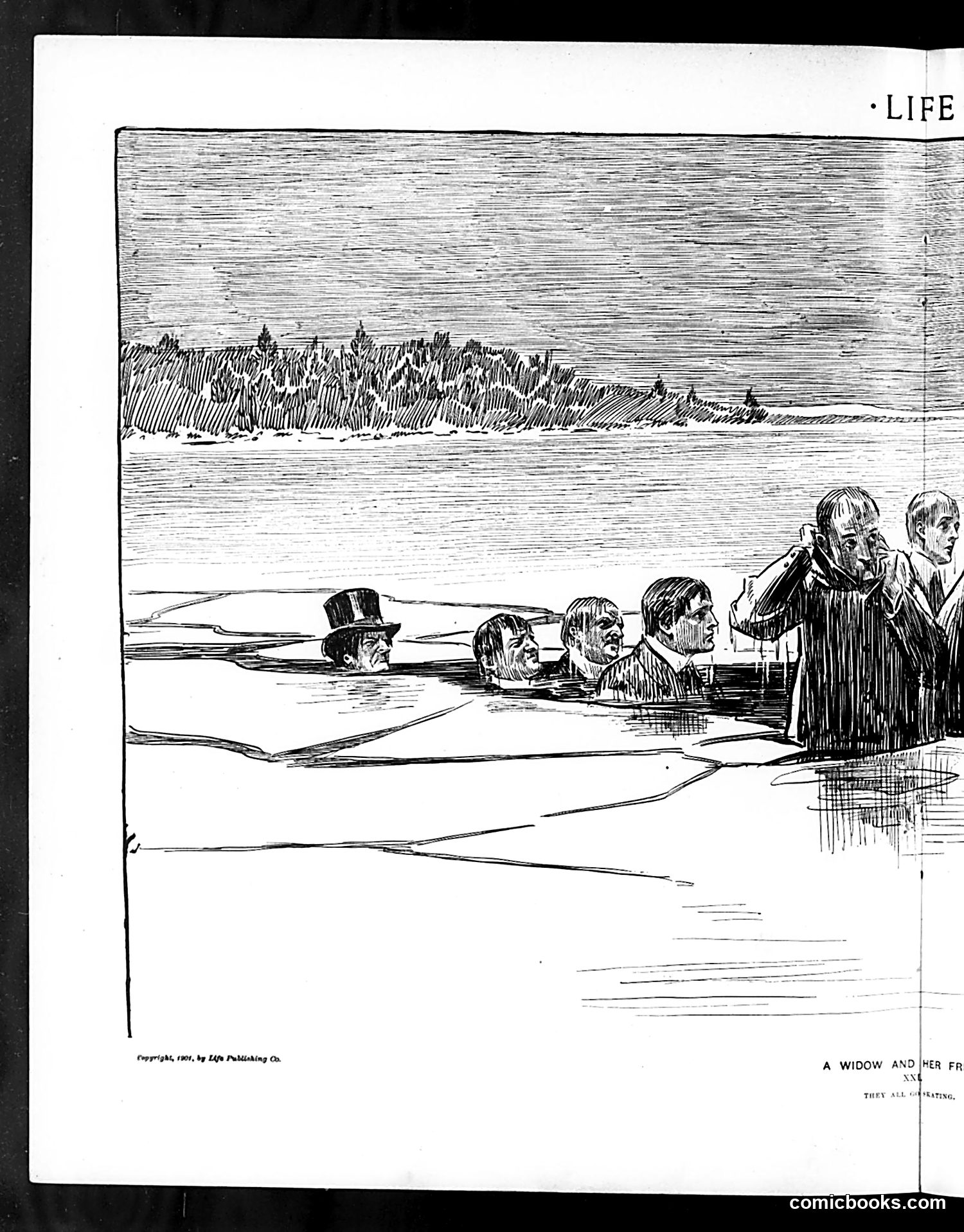
This is a satirical cartoon from *Life* magazine (copyright 1901, by Life Publishing Co.). The image shows several well-dressed men in water up to their necks, appearing to be drowning or struggling. On the right stand observers on shore, watching passively. The partially visible caption reads "A WIDOW AND HER FR[IENDS]... THEY ALL [?]ATING" (text is cut off). Without the complete caption, the specific satire is unclear, but the composition suggests commentary on either political or social misfortune—possibly mocking indifference to others' suffering, or satirizing a particular scandal or crisis involving wealthy figures. The contrast between the drowning men and the clothed observers implies commentary on class, responsibility, or moral failure. The exact target remains uncertain without the full text.
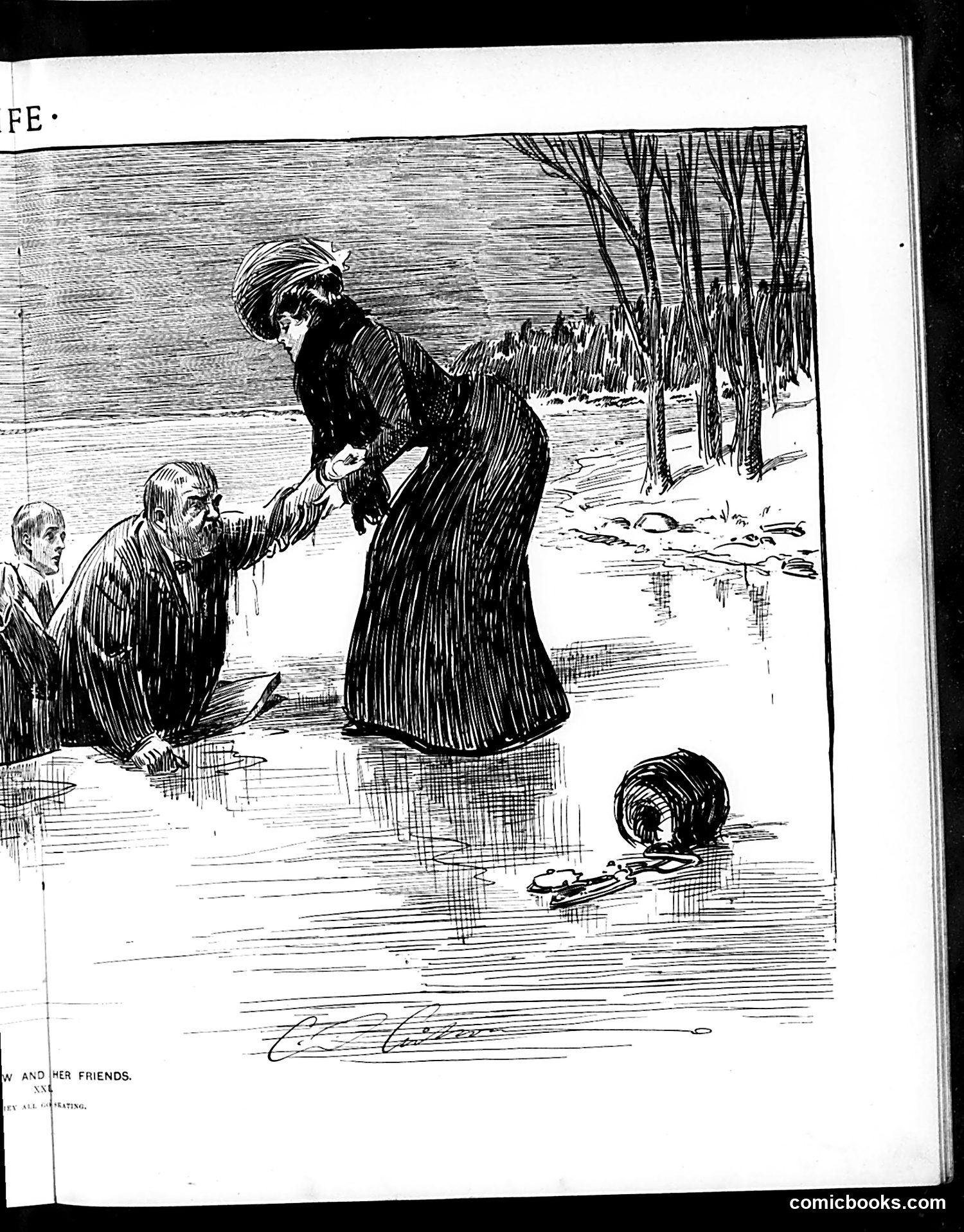
This appears to be a satirical illustration from *Life* magazine depicting a winter scene by a frozen pond or stream. An adult figure in dark clothing is helping or supporting what appears to be a child or smaller person who has fallen on the ice. Two other figures observe from the left side of the composition. The visible text fragment references "AND HER FRIENDS," suggesting this may be part of a series or narrative. Without more complete text or caption visible on this page, I cannot definitively identify the specific political or social satire intended. The scene could be commenting on class dynamics, social responsibility, or a contemporary event, but the OCR text is too fragmentary to establish the cartoon's actual subject or point with confidence.
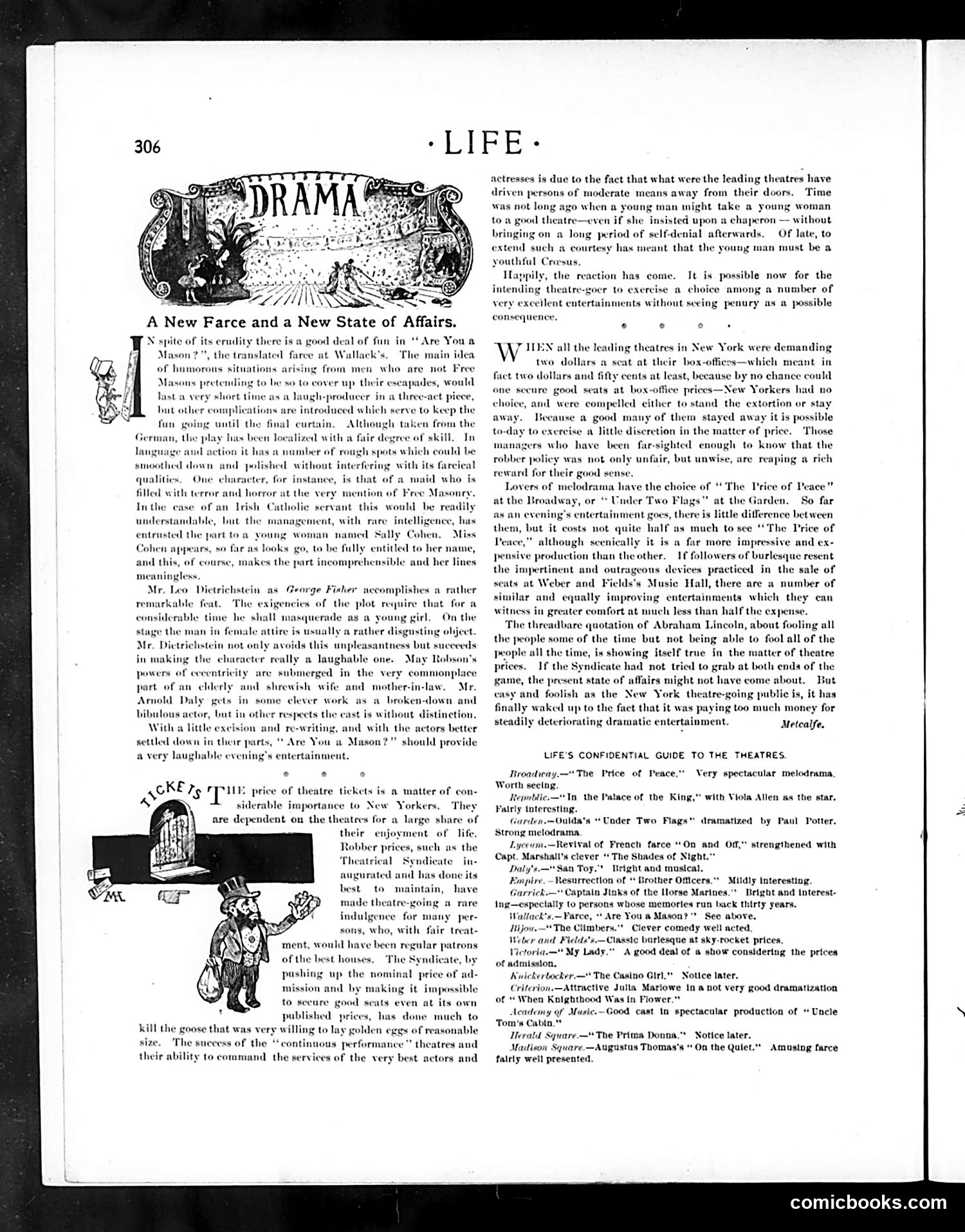
This page discusses New York theater in the early 1900s, focusing on ticket prices and theater management. The main article criticizes the "Theatrical Syndicate"—a monopoly controlling major theaters that raised admission prices substantially, making theater-going inaccessible to many New Yorkers. The illustrated figures (a ticket seller and patron) represent the conflict between theater operators and the public. The satire targets the Syndicate's practice of inflating prices while claiming to offer "reasonable" rates, thereby excluding working-class audiences from entertainment. The "Life's Confidential Guide to the Theatres" section reviews current Broadway productions, noting which shows justify their ticket costs and which don't—reinforcing the page's central complaint about affordability versus quality.
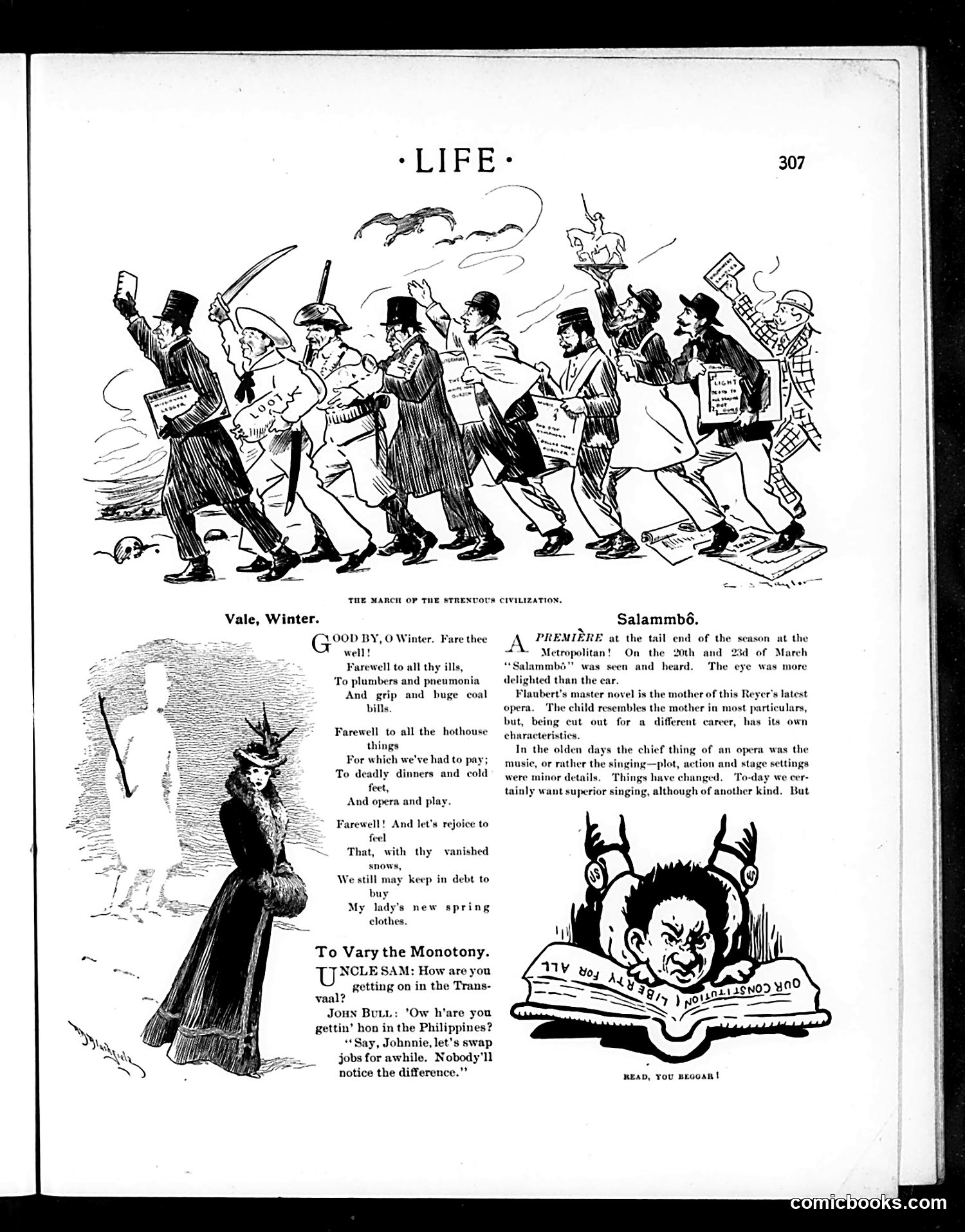
**Top cartoon ("The March of the Strenuous Civilization"):** A procession of men in formal dress marches forward carrying signs and weapons. This appears to satirize Theodore Roosevelt's "strenuous life" philosophy—mocking the period's aggressive masculinity, militarism, and jingoism as supposed markers of civilization. **Middle section ("Vale, Winter"):** A poem humorously bidding winter goodbye while acknowledging winter debt persists into spring fashion season—gentle social satire about consumer spending habits. **Bottom cartoon ("To Vary the Monotony"):** Uncle Sam and "John Bull" (Britain) joke about swapping jobs in the Transvaal (South Africa) and Philippines. This references contemporaneous imperial conflicts—the Boer War and Philippine-American War—sarcastically suggesting America and Britain face identical colonial problems. The "Read, You Beggar!" illustration appears unrelated to surrounding content.
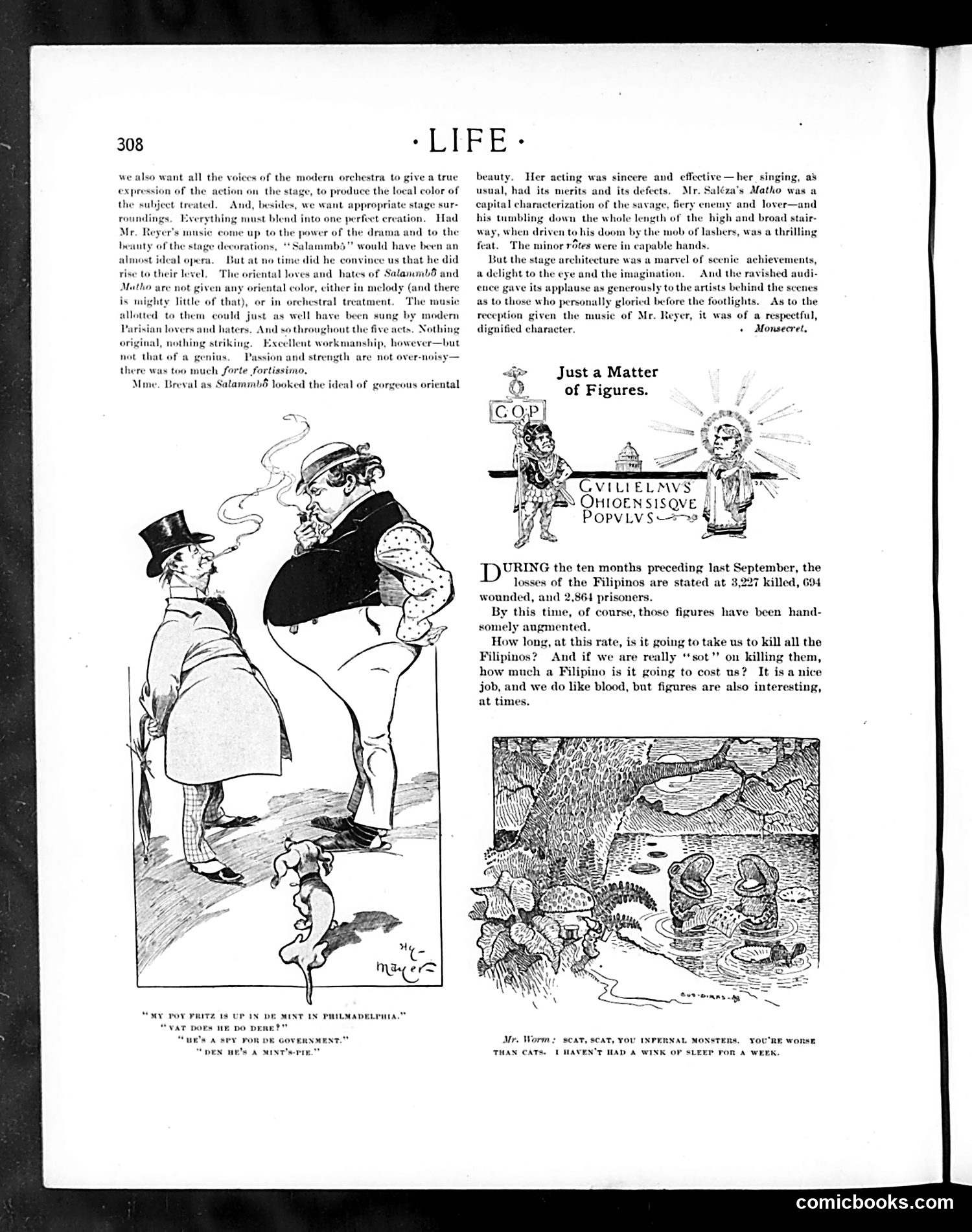
This page contains two satirical pieces: **Left cartoon**: A caricatured figure (appearing to represent a political figure, likely from the McKinley administration) is shown with an inflated belly labeled "MY POY PRITZ IS UP IN DE MINT IN PHILADELPHIA" and related phrases mocking government spending and corruption. The exaggerated physique suggests bloated government waste. **"Just a Matter of Figures"**: This section mocks American conduct in the Philippine-American War (circa 1899-1902). It sarcastically presents casualty figures—3,227 Filipino killed, 694 wounded, 2,864 prisoners—then cynically notes these figures have "handsomely augmented" since. The piece questions the cost and duration of the conflict, using dark humor ("we do like blood") to criticize American imperial expansion and the brutality of the colonial campaign. The bottom cartoon about a worm and cats appears unrelated commentary. Both pieces exemplify *Life*'s satirical critique of contemporary American political and military policies.
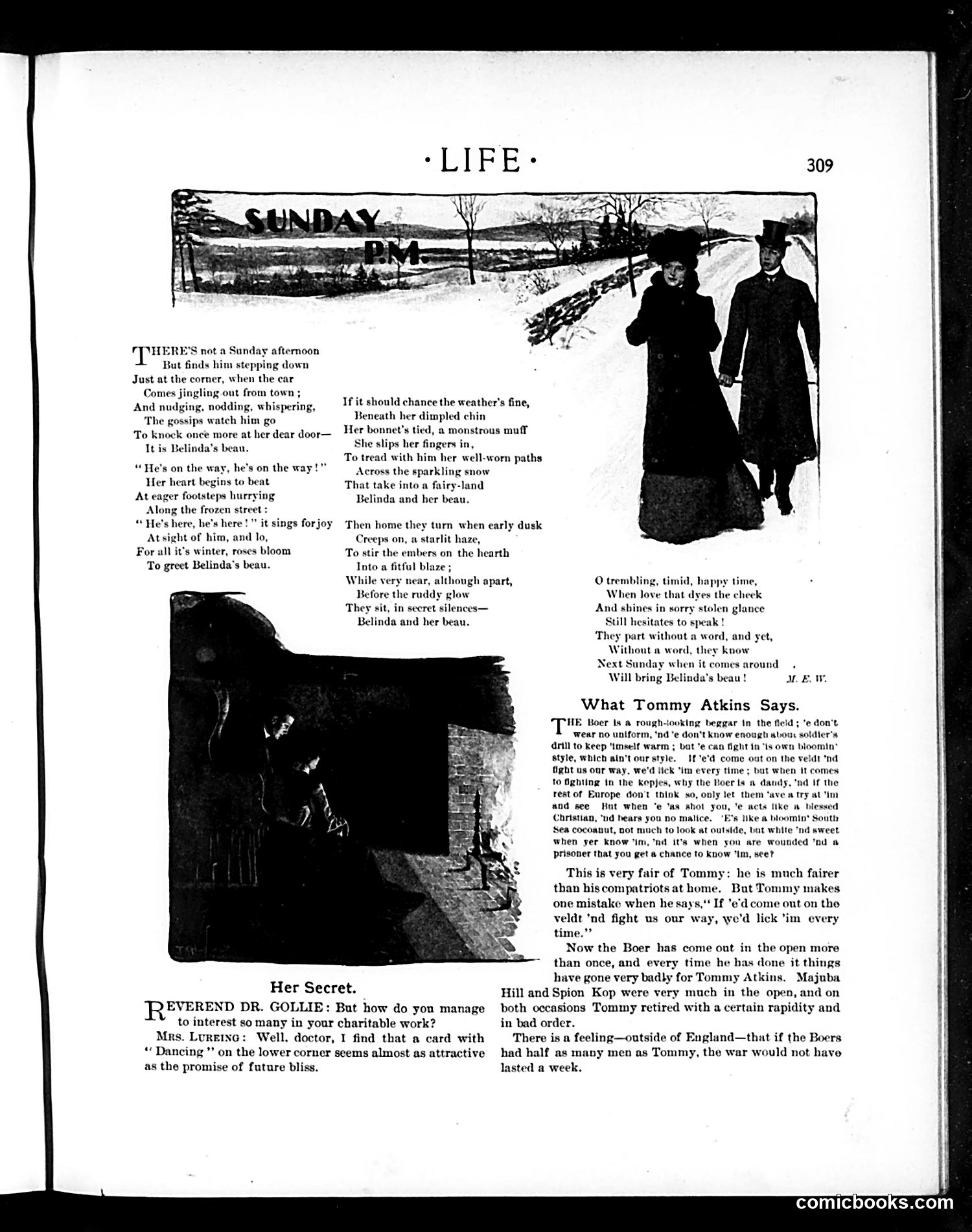
This Life magazine page contains three distinct pieces of social commentary from the Boer War era (early 1900s): **"Sunday" (top):** A romantic poem illustrated with silhouettes of a young couple on a winter walk. It celebrates innocent Victorian courtship—Belinda eagerly awaits her "beau's" Sunday visit, they walk in snowy landscapes, sit by the hearth. The satire is gentle, poking fun at the melodramatic earnestness of young romance. **"Her Secret" (bottom left):** A brief joke where a reverend asks Mrs. Lureino how she attracts charitable donors. Her answer: advertising "Dancing" on invitation cards works nearly as well as promises of heaven—satirizing how secular entertainment competes with religious devotion for attention. **"What Tommy Atkins Says" (right):** Commentary on the Boer War (1899-1902), where "Tommy Atkins" (British soldier slang) praises Boer fighters as skilled guerrilla warriors but claims British troops would win in open combat. The editorial rebuttal notes this is false: British forces actually suffered defeats in open terrain (Majuba Hill, Spion Kop), suggesting the war dragged on because Boers avoided British strengths.
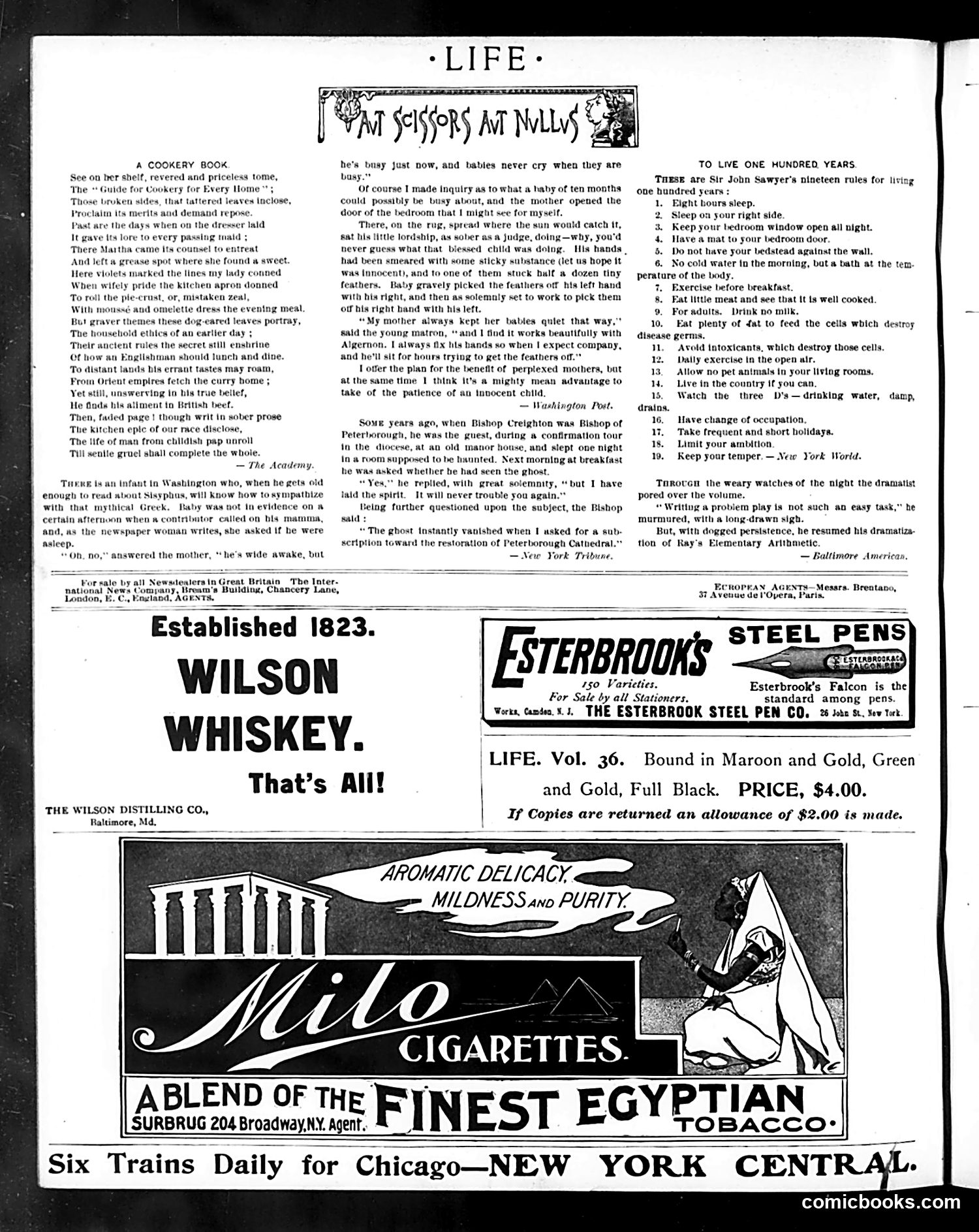
This page from *Life* magazine (Vol. 36) is primarily **literary and advertising content** rather than political cartooning. The main text features several humorous essays: one celebrates a worn cookery book as representing English domestic tradition; another describes a mother who entertains her ten-month-old baby by coating his hands with sticky substance and feathers so he'll occupy himself picking them off—a practice the author considers exploitation of the child's patience; a third anecdote credits Bishop Creighton with exorcising a haunted manor's ghost by requesting a donation toward cathedral restoration (satirizing clergy fundraising tactics). The page also includes "Nineteen Rules for Living One Hundred Years" attributed to Sir John Sawer, covering sleep position, ventilation, and hygiene—reflecting period health preoccupations. **Advertisements** dominate the lower portion: Wilson Whiskey, Esterbrook Steel Pens, and Milo Egyptian Tobacco cigarettes.
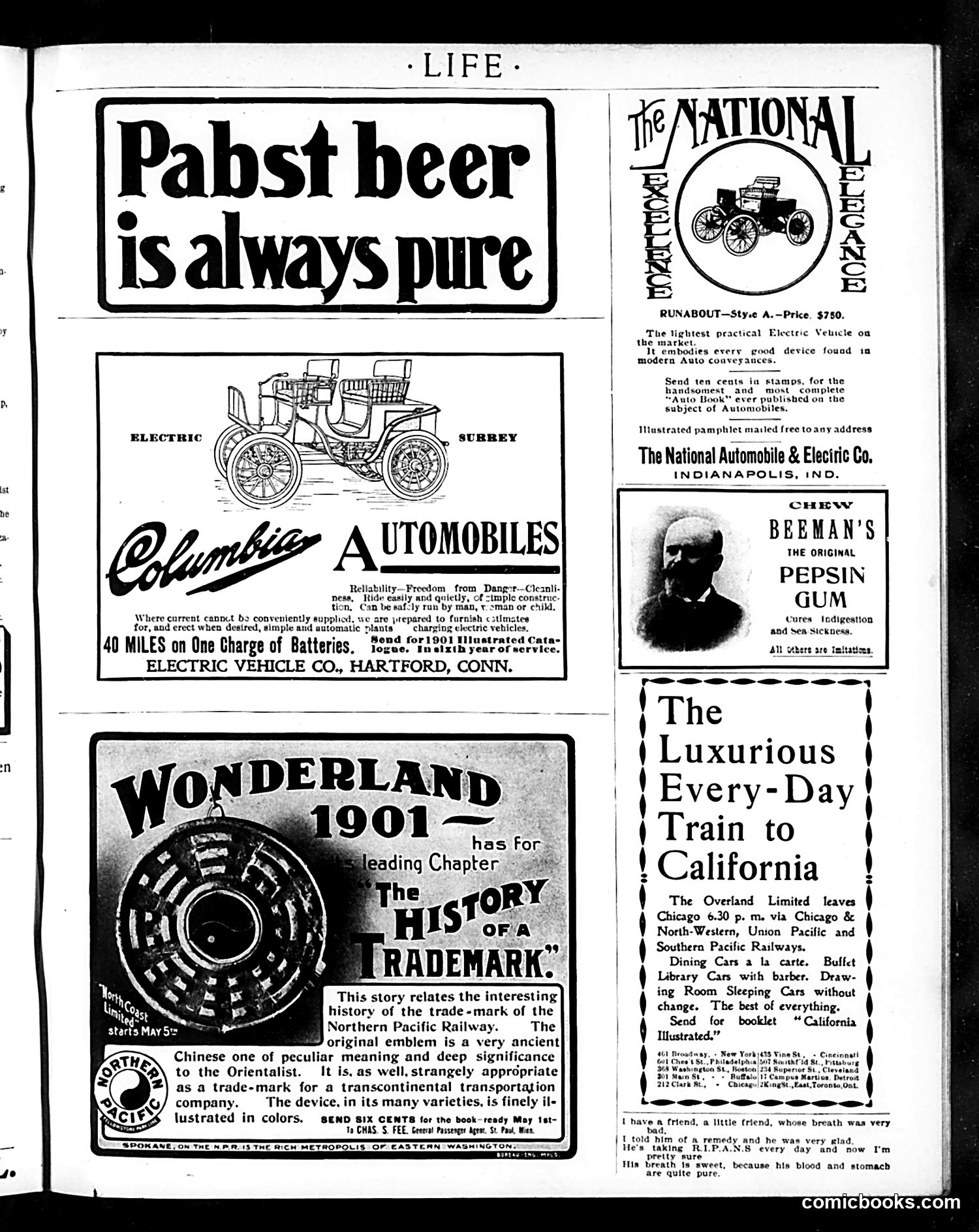
This is primarily an **advertising page** from early 1900s Life magazine, not a satirical cartoon. It contains five distinct advertisements: 1. **Pabst Beer** — a straightforward purity claim 2. **Columbia Electric Automobiles** — promoting electric vehicles capable of 40 miles per charge, emphasizing safety and ease of operation for "man, woman or child" 3. **National Automobile & Electric Co.** — advertising a $780 electric runabout 4. **Northern Pacific Railway's "Wonderland 1901"** — promoting a book about the railroad's trademark history 5. **Various smaller ads** — Beeman's Pepsin Gum, Overland Limited train to California, and Ripans Tabules digestive remedy The page reflects **early 20th-century consumer culture**, notably the optimism about **electric automobiles** as practical, safe alternatives to gasoline vehicles — a technology that would ultimately lose this competition. There is no satirical content visible; this is commercial advertisement typical of the era.
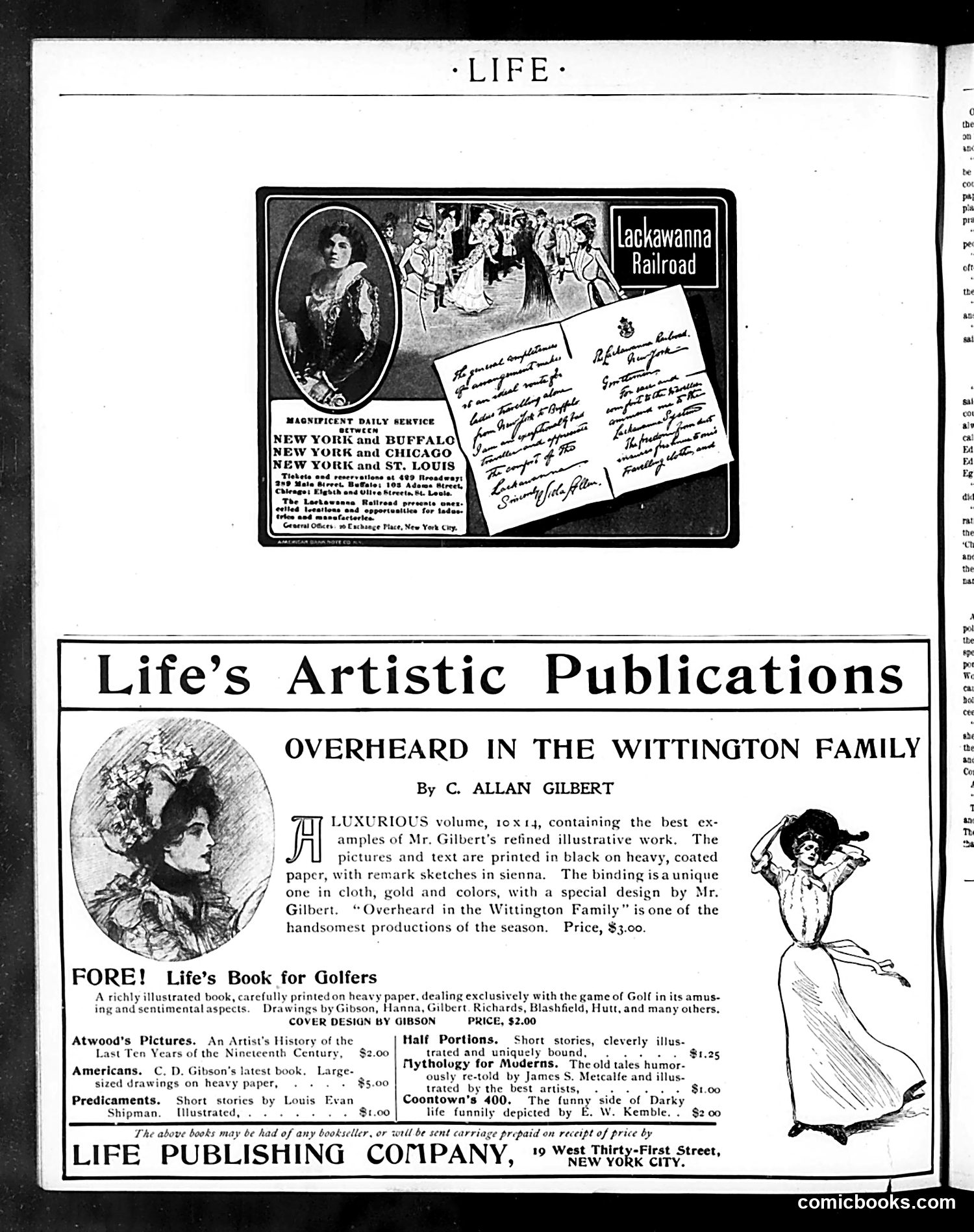
This is primarily an **advertising page** from Life magazine, not a political cartoon. The page promotes Life Publishing Company's books, particularly: **Main Content:** - A Lackawanna Railroad advertisement (top) featuring a society woman and handwritten letters - "Overheard in the Wittington Family" by C. Allan Gilbert—a luxury illustrated book ($3.00) showing refined domestic scenes - Multiple book listings, including "Fore! Life's Book for Golfers" and Gibson's "Americans" **Historical Context:** This reflects early-1900s upper-class American culture: expensive, beautifully-bound gift books were status symbols for affluent readers. The emphasis on fine illustration, gilt binding, and high prices ($2-5, substantial sums then) targets wealthy audiences. **Note on "Coontown's 400":** This title references a racist minstrel-show tradition; it's historically offensive but appears here without apparent satirical intent—reflecting the era's casual racial prejudice in popular media. The page demonstrates Life's dual nature: both satirical magazine and publisher of luxury illustrated books for genteel society.
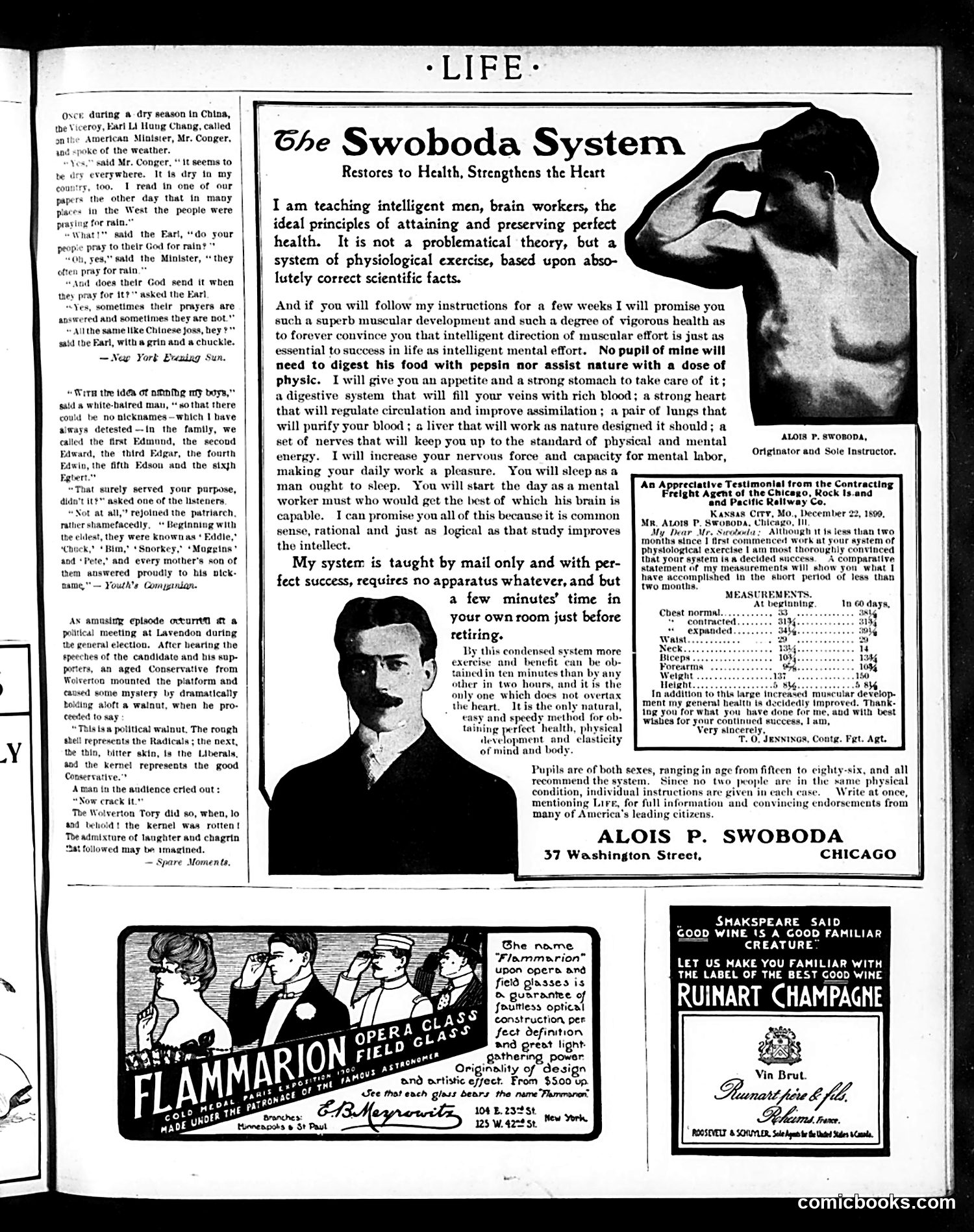
This page is primarily a **turn-of-the-century mail-order fitness advertisement**, not political satire. The main content promotes Alois P. Swoboda's exercise system, marketed to "intelligent men, brain workers" with promises of muscular development, digestive health, and improved mental capacity—all achievable through brief daily exercises requiring no apparatus. The testimonial from a Kansas City contractor claims measurable results (chest expansion, weight gain, muscular development) within ten days to two months. The surrounding content consists of **unrelated anecdotes and jokes** (about Chinese rain-praying, naming children, and a political walnut metaphor), plus period advertisements for **Flammarion Opera Glasses** and **Ruinart Champagne**. The satire, if present, is subtle—the breathless promises of health transformation through mail-order instruction were common targets of contemporary mockery, though the ad itself plays this earnestly straight.
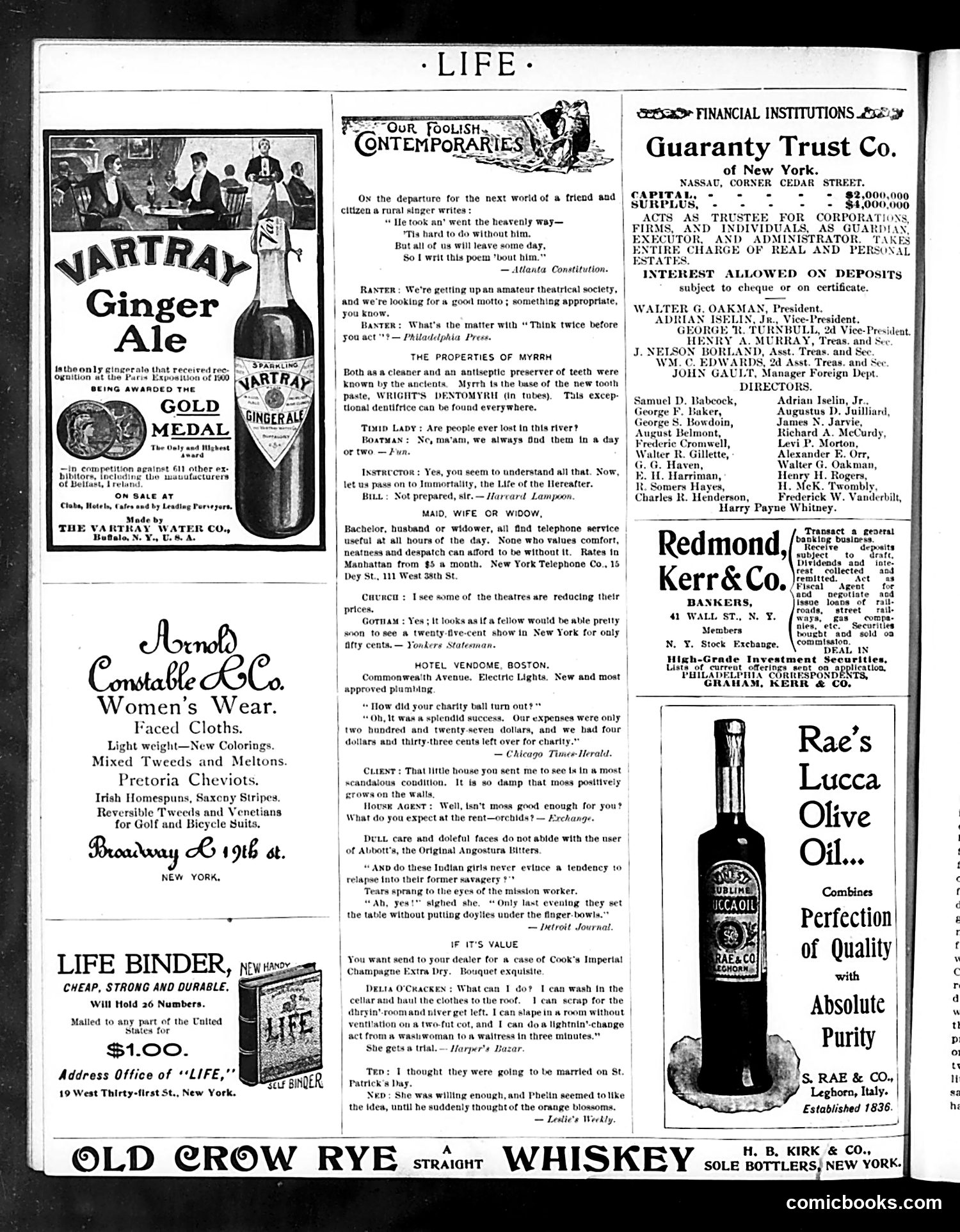
This page is primarily **advertisements and humorous short jokes** rather than political cartoons. The content reflects early 20th-century American life. The main visual is a **Warthay Ginger Ale advertisement** featuring a bottle and what appears to be a social gathering, promoting the beverage as a gold-medal winner. The text consists of brief comedic exchanges mocking various social situations: - Amateur theatricals and their pretentious mottos - Telephone company utility pitches - Theater ticket price reductions during economic difficulty - A charity ball that raises minimal funds for actual charity - Housing conditions and servant labor - Marriage plans disrupted by unspecified circumstances The humor is gentle and observational rather than satirical—poking fun at middle-class concerns, inefficiency, and social contradictions. The advertisements (financial institutions, women's clothing, olive oil, whiskey) and subscription notice indicate this is a magazine aimed at educated, relatively affluent readers interested in satirical commentary on their own society.
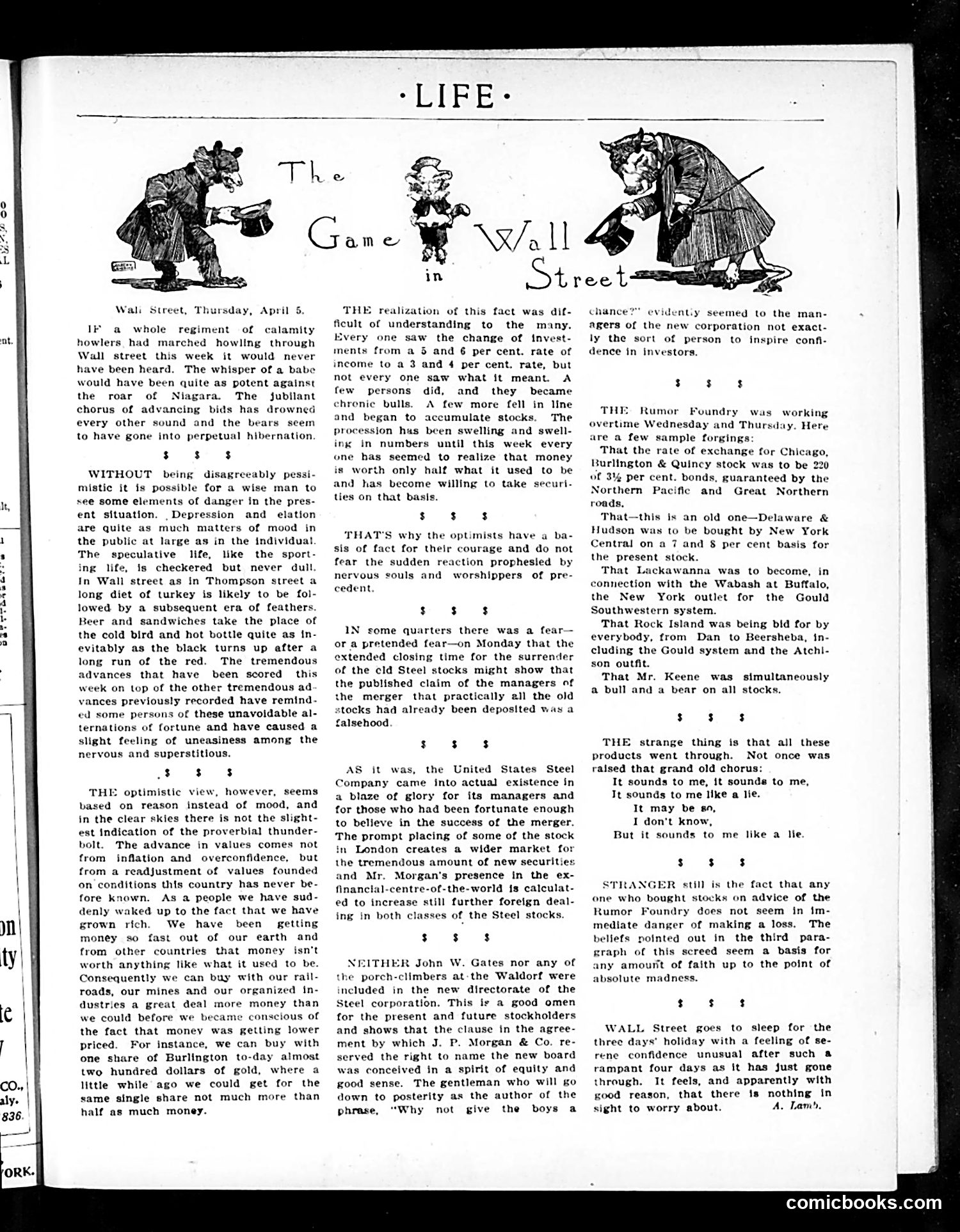
This satirical commentary uses animal caricatures to mock Wall Street's speculative frenzy following the formation of U.S. Steel. The two figures appear to represent different market perspectives—likely a "bull" (optimist) and "bear" (pessimist) engaged in the financial "game." The article critiques the recent stock market boom, warning that extreme optimism and rapid wealth accumulation ("money getting cheaper") creates dangerous conditions. The author acknowledges the merger's legitimacy but cautions that such sustained advances inevitably lead to corrections—comparing market cycles to gambling or the physiological effects of overindulgence ("long diet of turkey...followed by feathers"). The satire targets Wall Street's tendency toward herd mentality and mood-driven speculation, suggesting that ordinary citizens have suddenly realized money's diminished value, fueling indiscriminate stock purchases. The cartoon's central child figure likely represents the public, caught between opposing market forces.
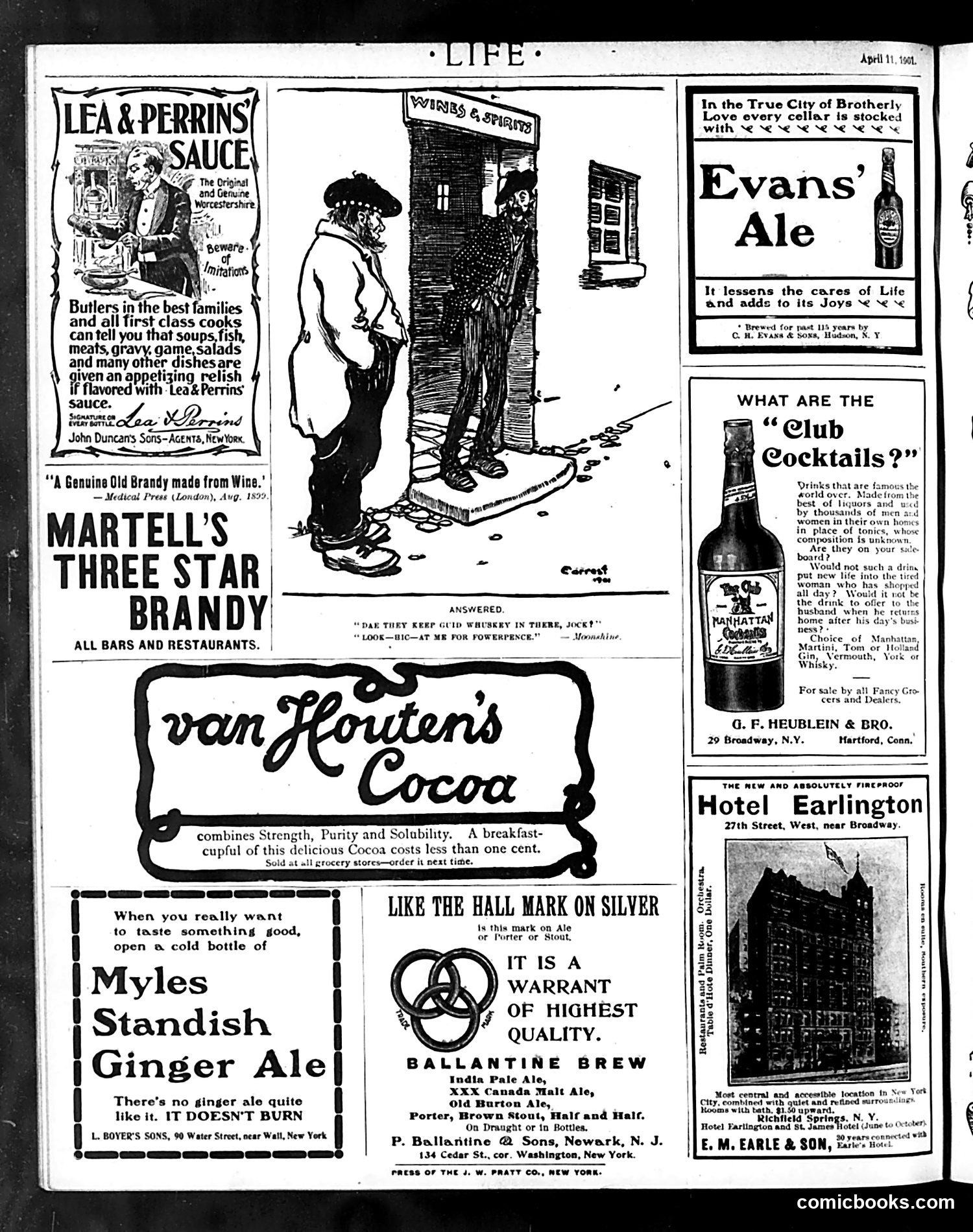
This page is **primarily advertising**—a common feature of Life magazine—with one cartoon in the center. ## The Cartoon The central cartoon shows a poorly dressed man at a "Wines & Spirits" shop door, asking the proprietor to keep "guid whusky in there, Jock" and challenging him to sell him whisky "for fourpence." The caption reads "Answered" with a quote attributed to "Moonshine." **The joke**: This appears to satirize **Scottish working-class drinking culture and dialect**, poking fun at a man too poor to afford quality spirits, attempting to negotiate for cheap whisky using colloquial Scottish English. The humor relies on ethnic/class stereotyping common to the era—mocking both Scottish accent and working-poor desperation. ## Advertisements The remainder features period product ads (Lea & Perrins sauce, Martell's brandy, Evans' Ale, cocktails, cocoa, ginger ale) and a hotel advertisement. These reflect Gilded Age consumer culture targeting middle and upper-class readers. The "True City of Brotherly Love" (Philadelphia) reference in the Evans' Ale ad appears to be generic marketing copy.