
Life, 1901-04-11 · page 6 of 22
Life — April 11, 1901 — page 6: what you’re looking at
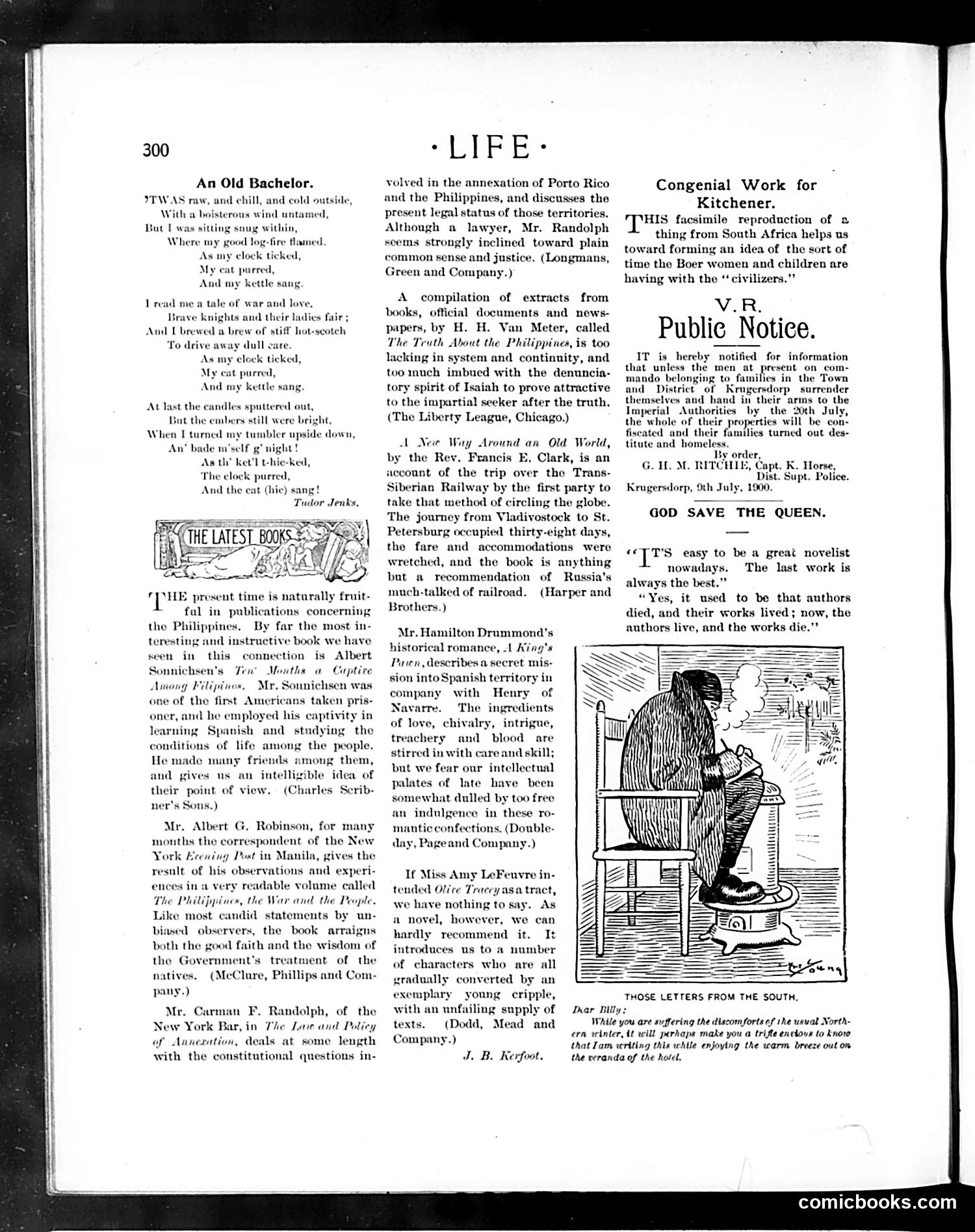
What you’re looking at
This cartoon depicts a woman at a writing desk, apparently a Northern visitor to the South during the post-Reconstruction era. The caption reads: "Dear Diary: While you are enduring the discomforts of the usual Northern winter, I am writing this while enjoying the warm breeze out on the veranda of the hotel." The satire targets Northern tourists who visited the South and wrote back home with romanticized accounts of Southern comfort and hospitality, contrasting it favorably with harsh Northern winters. The cartoon mocks this perspective as naive or self-deceiving—suggesting such visitors were either gullible or deliberately ignoring the South's actual post-war hardships and social conditions to enjoy leisure travel.
📄 Transcribed text from this page (OCR, searchable)
Machine-transcribed from the original scan — historical spelling and the odd misread are preserved.
300 An Old Bachelor. ITWAS raw, and chill, and cold outs With a boisterous w But L was sitting snag within, untamed, ad log-fire flamed. y clock ticked, t purred, And my kettle sang Tread mea tale of war and love, Brave knights and their ladies fie; And [ brewed a brew of stiff hot-scotch, To drive away dull care. As my clock ticked, My cat purred, And my kettle sang. At last the candles sputtered out, But the embers still were bright, I turned my tumbler upside down, An’ bade m’self g' ni As th’ ket'l t-hie-ked, The clock purred, And the eat (hie) sang! Tudor Jenks. Whe THE LATEST. B00K ‘DHE present time is naturally fruit- fal in publications concerning the Philippines. By far the most teresting and instructive book w seen in this connec! i Sonnichsen'’s Tew Captive Mr. Sonnichsen was one of the first Americans taken pris- oner, and he employed his captivity in learning Spanish and studying the conditions of life among the people. He made many friends smong them, and gives us an intelligible idea of their point of view, (Charles Scrib- ner’s Sous.) Mr. Albert G. Robinson, for ma months the correspondent of the New York Erening Post in Manila, gives the result of his observations and experi- ences ina very readable volume called The Philippines, the War and the People. Like most candid statements by un- Diased observers, the book arraigns both the good faith and the wisdom of tho Government's treatment of the natives. (McClure, Phillips and Com- pany.) Mr. Carman F, Randolph, of the New York Bar, in The Lave and Policy of Annexation, deals at some length with the constitutional questions in- “ENPE* volved in the annexation of Porto Rico and the Philippines, and discusses the present legal status of those territories. Although a lawyer, Mr. Randolph seems strongly inclined toward plain common sense and justice. (Longmans, Green and Company.) A compilation of extracts from books, official documents and news- papers, by H. H. Van Meter, called The Truth About the Philippines, is too lacking in system and continuity, and too much imbued with the denuncia- tory spirit of Isaiah to prove attractive to the impartial seeker after the truth. (The Liberty League, Chicago.) 1 New Way Around an Old World, the Rev. Francis E. Clark, is an account of the trip over the Traps- Siberian Railway by the first party to take that method of circling the globe. The journey from Vladivostock to St. Petersburg occupied thirty-eight da: the fare and accommodations were wretched, and the book is anything but a recommendation of Russia's much-talked of railroad. (Harper and Brothers.) Mr. Hamilton Drummond's historical romance, 1 Aing’s Mnien describes a secret m: sion intoSpanish territory in company with Henry of Navarre. The ingredients of love, chivalry, intrigue, treachery and blood are stirred in with care and skill; but we fear our intellectual palates of late have been somewhat dulled by too free an indulgence in these ro- mantic confections. (Double- day, Pageand Company.) If Miss Amy LeFenvre in- tended Olice 7 a we have nothing to a novel, however, we can hardly recommend it. It introduces us to a number Congenial Work for Kitchener. THIS facsimile reproduction of a thing from South Africa helps us toward forming an idea of the sort of time the Boer women and children are having with the “ civilizers.” VLR, IT is hereby notified for information that unless the men at present on com- mando belonging to families in the Town and District’ of Krugersdorp surrender themselves and hand in their arms to the Imperial Authorities by the 20th July, the whole of their properties will be con- fiseated and their families turned out des- titute and homeless. Ly order, G.H. M. RITCHIE, Capt. Dist. Krugersdorp, 9th July, 1900. GOD SAVE THE QUEEN. «<¢7T’S easy to be a great novelist nowadays. The last work is always the best.” “Yes, it used to be that authors died, and their works lived; now, the authors live, and the works die.”” of characters who are all gradually converted by an exemplary young cripple, with an unfailing supply of texts. (Dodd, Mead and Company.) J. B. Kerfoot. THOSE LETTERS FROM THE SOUTH, Ixar Billy: While you are suffering the diacomforts of the usvat North- ern winter, At will perhaps make you a trifle enctove to know that Lam writing this while enjoying the warm breeze out on the veranda of the hotel. comicbooks.com