
Life, 1901-04-11 · page 4 of 22
Life — April 11, 1901 — page 4: what you’re looking at
What you’re looking at
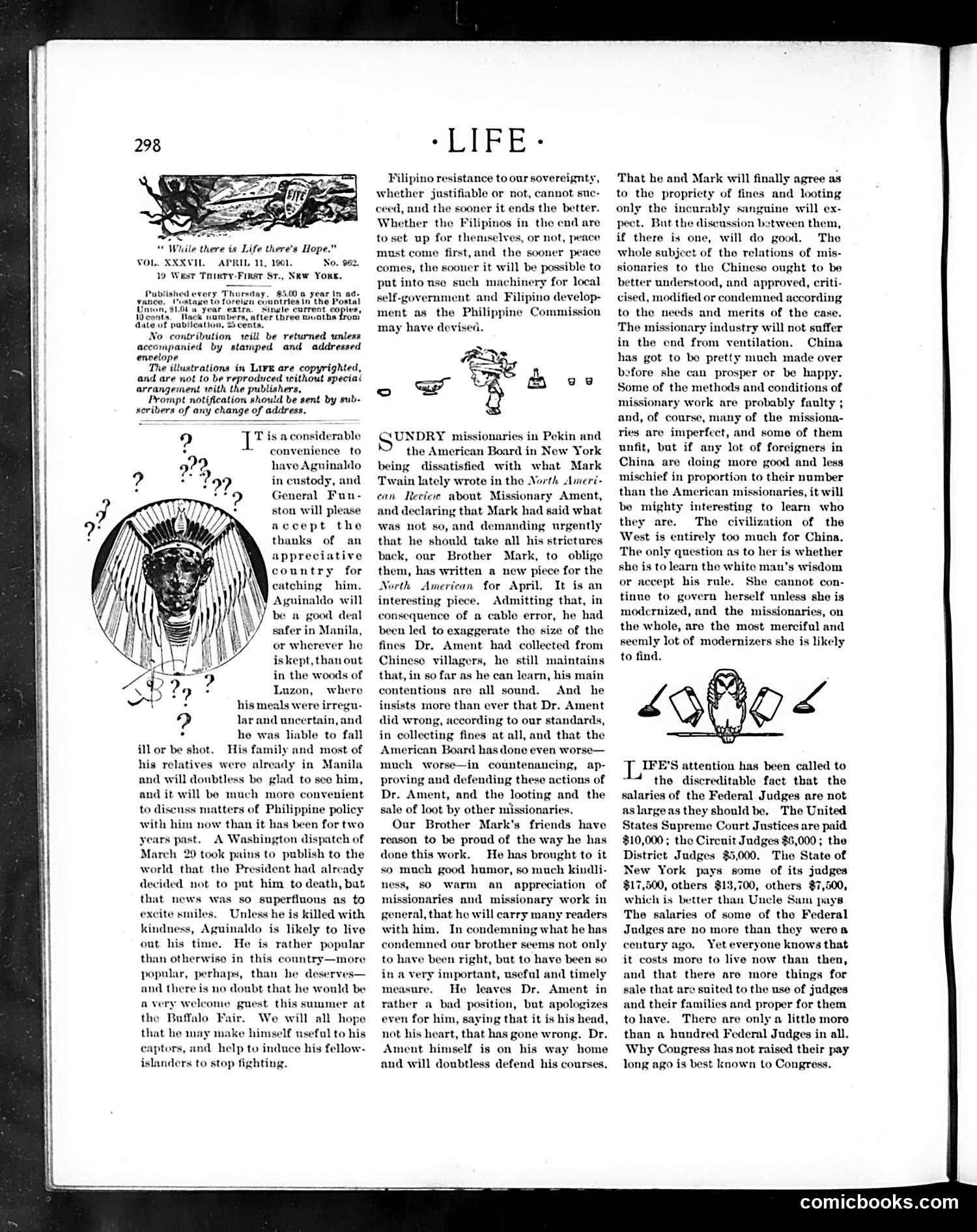
The left cartoon depicts a confused figure surrounded by question marks, appearing to illustrate bewilderment over Philippine policy. The accompanying article discusses tensions between missionary work and American colonial governance in the Philippines during the post-Spanish-American War period. The text critiques contradictions in American policy, particularly regarding Dr. Ament, a missionary accused of collecting excessive fines from Chinese villages. The piece argues that while missionaries are imperfect, China's modernization requires respecting sovereignty—a position seemingly at odds with American imperial expansion. The right section addresses Federal Judges' inadequate salaries, noting that roughly 100 judges earned $10,000-$17,500 annually while costs to live decently were higher. Both items reflect Progressive-era debates about American power abroad and domestic governance fairness.
📄 Transcribed text from this page (OCR, searchable)
Machine-transcribed from the original scan — historical spelling and the odd misread are preserved.
penn “While there is Life there's Hop: XVIL APRIL 11, 1901, 10 West Taiery-Finst § y $5.00 a year in ad- Vostage to foreign countries in the Postal $1.04 a year extra. Single current copies, Nack numbers, after three maths from publication, 3 cents, No contribution will be returned unless accompanied by stamped and addressed envelope The illustrations in Liye are copyrighted, and are not to be reproduced without special arrangement with the publishers, Prompt notification should be sent by sub- scribers of any change of address. J T is aconsiderable - convenience to have Aguinaldo in custody, and General Fun- ston will please accept the thanks of an appreciative country for catching him. Y Aguinaldo will be a good deal safer in Manila, or wherever he iskept,than out in the woods of Luzon, where his meals were irregu- lar and uncertain, and ° he was liable to fall ill or be shot. His family and most of his relatives were already in Manila and will doubtless be glad to see him, and it will be much more convenient to discuss matters of Philippine policy with him now than it has been for two years past. A Washington dispatch of March 29 took pains to publish to the world that the President had already decided not to put him to death, bat that news was so superfluous as to excite smiles. Unless he is killed with kindness, Aguinaldo is likely to live out his time. He is rather popular than otherwise in this country—more popular, perhaps, than he deserves— and there is no doubt that he would be avery welcome guest th mmer at the Buffalo Fair. We will all hope that he may make himself useful to his ors, and help to induce his fellow- anders to stop fighting. LDPE + Filipino resistance to our sovereignty, whether justifiable or not, cannot suc- ceed, and the sooner it ends the better. Whether the Filipinos in the end are toset up for themselves, or not, peace must come first,and the sooner peace comes, the sooner it will be possible to put into nse such machinery for local self-government and Filipino develop- ment as the Philippine Commission may have devised. oF Has GS ONDEE missionaries in Pekin and the American Board in New York being dissatisfied with what Mark Twain lately wrote in the North Ameri- can Revie about Missionary Ament, and declaring that Mark had said what was not so, and demanding urgently that he should take all his strictures back, our Brother Mark, to oblige them, has written a new piece for the North American for April. It is an interesting piece. Admitting that, in consequence of a cable error, he had been led to exaggerate the size of the fines Dr. Ament had collected from Chineso villagers, he still maintains that, in so far as he can learn, his main contentions are all sound. And he insists more than ever that Dr. Ament did wrong, according to our standards, in collecting fines at all, and that the American Board has done even worse— much worse—in countenancing, ap- proving and defending these actions of Dr. Ament, and the looting and the sale of loot by other missionaries. Our Brother Mark’s friends have reason to be proud of the way he has done this work. He has brought to it so much good humor, so much kindli- ness, 80 Warm an appreciation of missionaries and missionary work in general, that he will carry many readers with him, In condemning what he has condemned our brother seems not only to have been right, but to have been so in a very important, useful and timely measure. He leaves Dr. Ament in rather a bad position, but apologizes even for him, saying that it is his head, not his heart, that has gone wrong. Dr. Ament himself is on his way home and will doubtless defend his courses. That he and Mark will finally agree as to the propriety of fines and looting only the incurably sanguine will ex- pect. But the discu n between them, if there is one, will do good, The whole subject of the relations of mis- sionaries to the Chinese ought to be better understood, and approved, criti- cised, modified or condemned according to the needs and merits of the case. The missionary industry will not suffer in the end from ventilation. China has got to be pretty much made over before she can prosper or be happy. Some of the methods and conditions of missionary work are probably faulty ; and, of course, many of the missiona- ries are imperfect, and some of them unfit, but if any lot of foreigners in China are doing more good and less mischief in proportion to their number than the American missionaries, it will be mighty interesting to learn who they are. The civilization of the West is entirely too much for China. The only question as to her is whether sho is to learn the white man’s wisdom or accept his rule. She cannot con- tinue to govern herself unless she is modcrnized, and the missionaries, on the whole, are the most merciful and seemly lot of modernizers she is likely to find. Lgfio < LIFES attention has been called to “4 the discreditable fact that the salaries of the Federal Judges are not aslargeas they should be. The United States Supreme Conrt Justices are paid $10,000 ; the Circnit Judges $6,000; the District Judges $5,000. The State of New York pays some of its judges 317,500, others $13,700, others $7,500, which is better than Uncle Sam pays The salaries of some of the Federal Judges are no more than they were a century ago. Yet everyone knows that it costs more to live now than then, and that there are more things for sale that are suited to the use of judges and their families and proper for them tohave. There are only a little more than a hundred Federal Judges in all. Why Congress has not raised their pay long ago is best known to Congress. comicbooks.com