
Life, 1901-04-11 · page 21 of 22
Life — April 11, 1901 — page 21: what you’re looking at
What you’re looking at
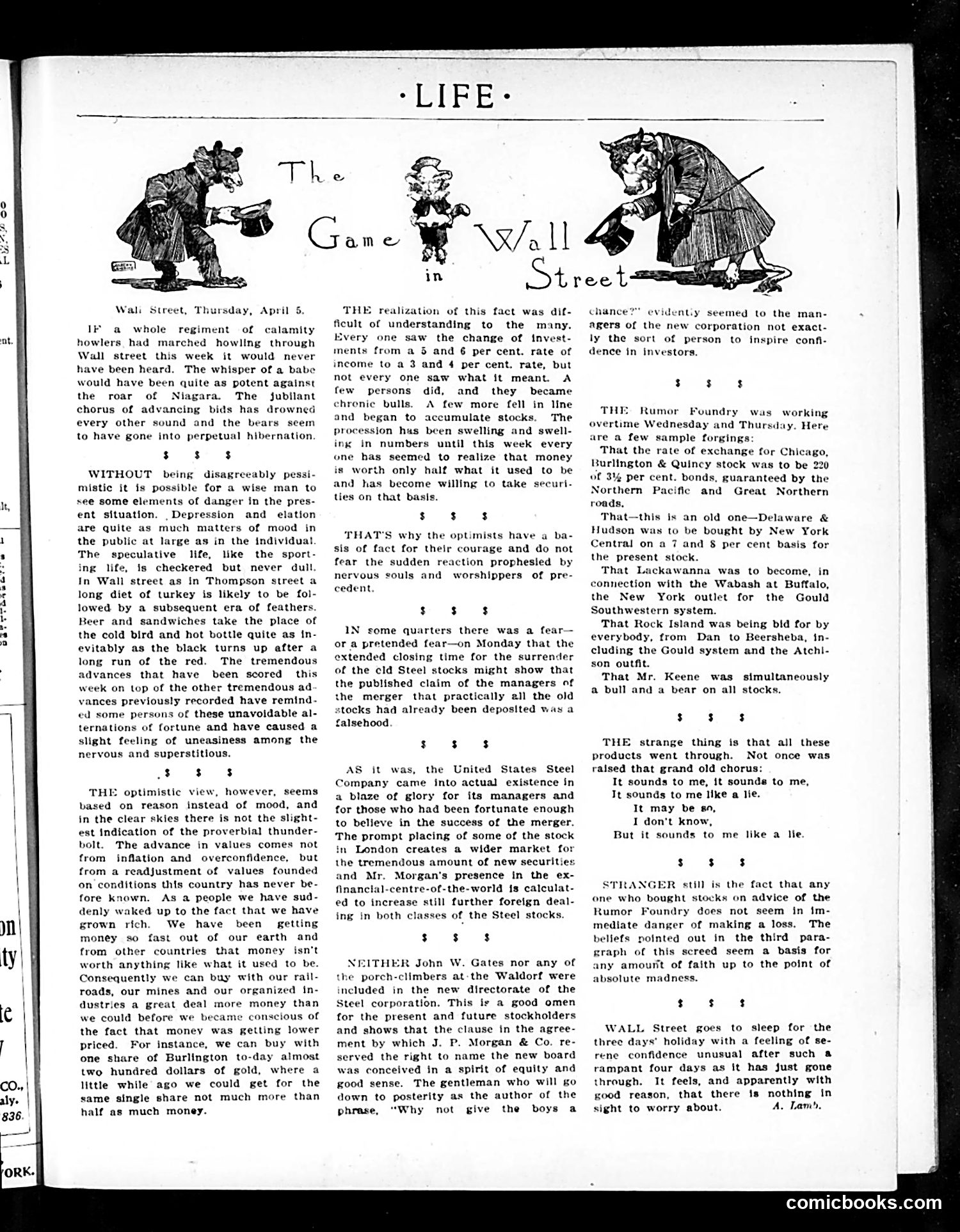
This satirical commentary uses animal caricatures to mock Wall Street's speculative frenzy following the formation of U.S. Steel. The two figures appear to represent different market perspectives—likely a "bull" (optimist) and "bear" (pessimist) engaged in the financial "game." The article critiques the recent stock market boom, warning that extreme optimism and rapid wealth accumulation ("money getting cheaper") creates dangerous conditions. The author acknowledges the merger's legitimacy but cautions that such sustained advances inevitably lead to corrections—comparing market cycles to gambling or the physiological effects of overindulgence ("long diet of turkey...followed by feathers"). The satire targets Wall Street's tendency toward herd mentality and mood-driven speculation, suggesting that ordinary citizens have suddenly realized money's diminished value, fueling indiscriminate stock purchases. The cartoon's central child figure likely represents the public, caught between opposing market forces.
📄 Transcribed text from this page (OCR, searchable)
Machine-transcribed from the original scan — historical spelling and the odd misread are preserved.
Wali Street, Thursday, April 5. IF a whole howlers had marched howling through Wall street this week it would never have been heard. The whisper of a babe would have been quite as potent against the roar of agara. The jubilant chorus of advancing bids has drowned every other sound and the bears seem to have gone into perpetual hibernation. 3 3 3 WITHOUT being disagreeably pessi- mistic it is possible for a wise man to see some elements of danger in the pres- ent situation. Depression and elation are quite as much matters of mood in the public at large as in the individual The speculative life, like the sport- ing life, 1s checkered but never dull. In Wall street as in Thompson street a long diet of turkey is likely to be fol- lowed by a subsequent era of feathers. Beer and sandwiches take the place of the cold bird and hot bottle quite as in- evitably as the black turns up after a long run of the red. The tremendous advances that have been scored this week on top of the other tremendous ad vances previously recorded have remind- ed some persons of these unavoldable al- ternations of fortune and have caused a slight feeling of uneasiness among the nervous and superstitious. 3 3 $ THE optimistic view, however, seems based on reason instead of mood, and in the clear skies there is not the slight- est Indication of the proverbial thunder- bolt. The advance in values comes not from inflation and overconfidence, but from a readjustment of values founded on conditions this country has never be- fore known. As a people we have sud- denly ked up to the fact that we have grown rich. We have been getting money so fast out of our earth and from other countries that money isn’t worth anything like what it used to be. Consequently we can buy with our rail- roads, our mines and our organized in- dustries a great deal more money than we could before we became conscious of the fact that money was getting lower priced. For instance, we can buy with one share of Burlington to-day almost two hundred dollars of gold, where a little while ago we could get for the same single share not much more than half as much money. regiment of calamity THE realization of this fact was dift- ficult of understanding to the many. ery one saw the change of inve: ments from a 5 and 6 per cent. rate of income to a 3 and 4 per cent. rate, but not every one saw what it meant. A few persons did, and they became chronic bulls. A few more fell in line and began to accumulate stocks. The procession has been swelling and swell- ing in numbers until this week every one has seemed to realize that money is worth only half what it used to be and has become willing to take securi- ties on that basis. $ 3 3 THAT'S why the optimists have a ba- sis of fact for their courage and do not fear the sudden reaction prophesied by nervous souls and worshippers of pre- cedent. $ 3 3 1N some quarters there was a fear— or a pretended fear—on Monday that the extended closing time for the surrender of the cld Steel stocks might show that the published claim of the managers of the merger that practically all the old stocks had already been deposited was a falsehood 3 3 AS it was, the United States Steel Company came into actual existence in a blaze of glory for its managers and for those who had been fortunate enough to believe in the success of the merger. The prompt placing of some of the stock in London creates a wider market for the tremendous amount of new securities and Mr. Morgan's presence in the ex- financlal-centre-of-the-world is calculat- ed to increase still further foreign deal- ing in both classes of the Steel stocks. $ $ $ NEITHER John W. Gates nor any of the porch-climbers at-the Waldorf were included in the new directorate of the Steel corporation. This iv a good omen for the present and future stockholders and shows that the clause in the agree- ment by which J. P. Morgan & Co. re- served the right to name the new board was conceived in a spirit of equity and good sense. The gentleman who will go down to posterity as the author of the phrase, “Why not give the boys a ently seemed to the man- agers of the new corporation not exact- ly the sort of person to inspire confi- dence in investors. THE Rumor Foundry was working overtime Wednesday and Thursday. Her are a few sample forgings: That the rate of exchange for Chicago, Burlington & Quincy stock was to be 220 of 3% per cent. bonds, guaranteed by the and Great Northern Northern le roads, -this is an old one—Delaware & Hudson was to be bought by New York Central on a 7 and 8 per cent basis for the present stock. That Lackawanna was to become, in connection with the Wabash at Buffalo, the New York outlet for the Gould Southwestern system. That Rock Island was being bid for by everybody, from Dan to Beersheba, in- cluding the Gould system and the Atchl- son outfit. That Mr. Keene was simultancously a bull and a bear on all stocks. 3 3 3 THE strange thing is that all these products went through. Not once was ralsed that grand old choru: It sounds to me, it sounds to me, Tt sounds to me like a lie. It may be 80, I don’t know, But it sounds to me like a lie. 3 3 $ STRANGER still is the fact that any one who bought stocks on advice of the Rumor Foundry does not seem in im- mediate danger of making a loss. The beliefs pointed out in the third para- graph of this screed seem a basis for any amount of faith up to the point of bsolute madness. $ $ t WALL Street goes to sleep for the three days’ holiday with a feeling of se- rene confidence unusual after such & rampant four days as it has just gone through. It feels, and apparently with good reason, that there is nothing In sight to worry about. A. Lam. comicbooks.com