
Life, 1901-04-11 · page 12 of 22
Life — April 11, 1901 — page 12: what you’re looking at
What you’re looking at
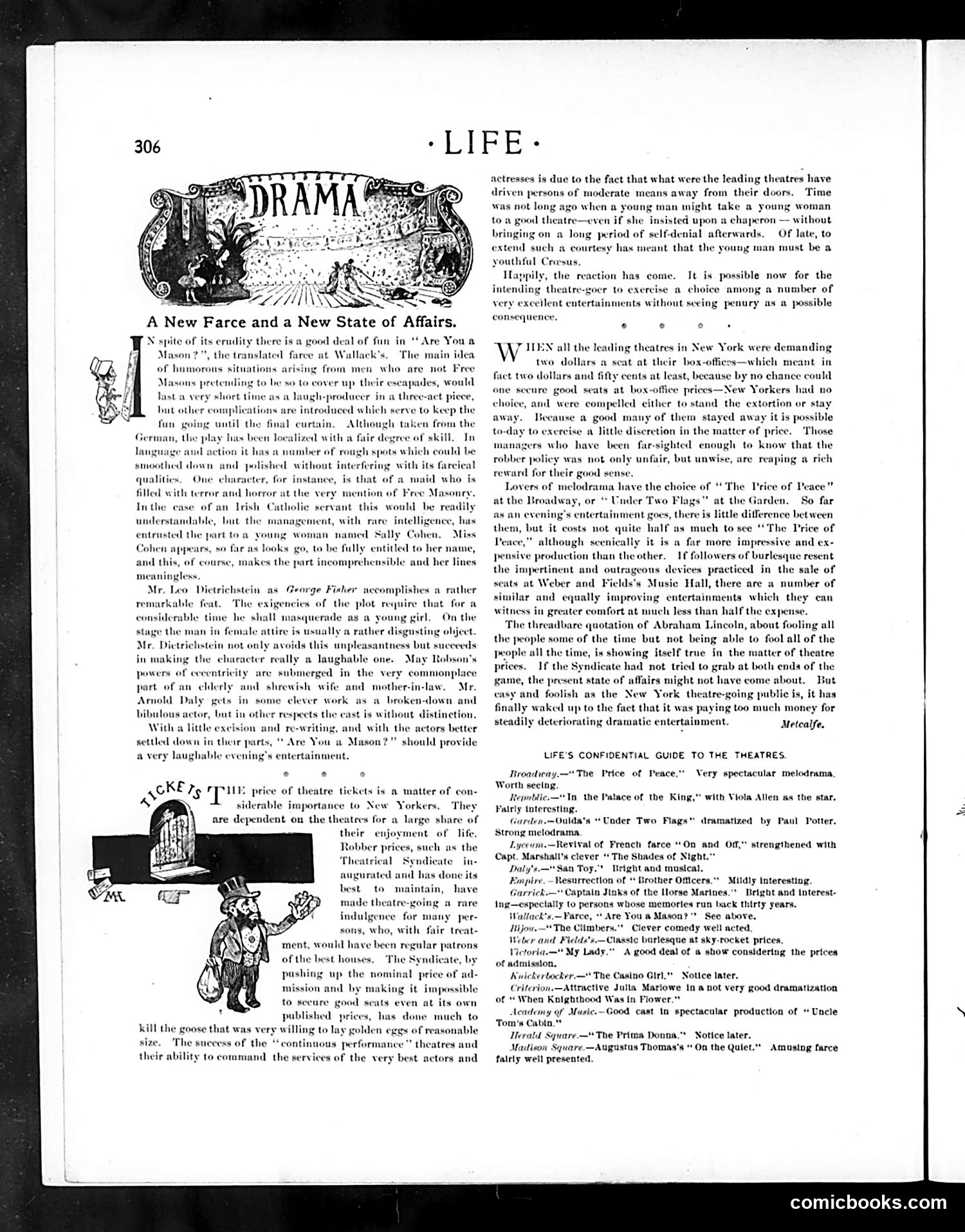
This page discusses New York theater in the early 1900s, focusing on ticket prices and theater management. The main article criticizes the "Theatrical Syndicate"—a monopoly controlling major theaters that raised admission prices substantially, making theater-going inaccessible to many New Yorkers. The illustrated figures (a ticket seller and patron) represent the conflict between theater operators and the public. The satire targets the Syndicate's practice of inflating prices while claiming to offer "reasonable" rates, thereby excluding working-class audiences from entertainment. The "Life's Confidential Guide to the Theatres" section reviews current Broadway productions, noting which shows justify their ticket costs and which don't—reinforcing the page's central complaint about affordability versus quality.
📄 Transcribed text from this page (OCR, searchable)
Machine-transcribed from the original scan — historical spelling and the odd misread are preserved.
LIFE < A New Farce and a New State of Affairs. N spite of its erudity there is a good deal of fun Mason ?”, the translated farce at Wallack’s of humorous sit rising fre who are not Free so to cover up their eseapades, would a laugh-producer in a three-act piece, ations are introduced whieh serve to keep the Although taken from the lized with a fair degree of skill, In has a number of rough spots which could be smoothed down and polished without interfering with its farcical qualities. One character, for instance, is that of a maid who is filled with terror and horre ation of Free Masonry Inthe Irish servant this would be readily understandable, but the ment, with rare intelligence, hus Miss itled to her name, and this, of course, makes the part incomprehensible and her lines in **Are You a The main ide: A men Masons pretending to by Jast a very short tin but other cou fun going until the final curtain. jerman, the play has been | language and 3 atthe very m case of an Catholi entrusted the part toa young woman named Sally Cohen. Cohen appears, so far as looks go, to be fully e meaningless. Mr. Leo Dietrichstein. as George Fisher accomplishes a ather sof the plot require that for a erable time he shall masquerade as a young girl, On the stage the man in female attire is usually a rather disgusting object. Mr. Dictrichstein not only avoids this unpleasantness but succeeds in making the character really a laughable one. May I powers of cc ure submerged in the very commonplace part of an ¢ shrewish wife and mother-in-law. Mr. Ammold Daly gets in some clever work as a broken-down and or, but in other respects the ion and re-writ settled down in their parts, * Are Y; avery lat urkable feat. The exigenc ast is without distinction. and with the actors better 1 a Mason?” should provide ghable evening's entertainment. aCKE 75 FLITE price of theatre tickets is a matter of con- ~‘ siderable importance to New Yorkers. They are dependent on the theatres for a ls their Robber prices, such ‘Theatrical Syndicate in augurated and has done its best to maintain, have made theatre-going a rare indulgence for many pe sons, who, with fair treat- ve been regular patrons of the best houses. The Syndicate, by fad mission and by making it impossible to secure good seats even at its own published prices, has done much to ose that was very willing to lay golden eggs of reasonable ‘The success of the “continuous performance” theatres and their ability to command th up the nominal price kill the size. rvices of the very best actors and actresses is due to the fact that what were the leading theatres have driven persons of moderate means away from their doors. Time pot long ago when a young man might take a young woman to a good theatre—even if she insisted upon a chaperon — without bringing on a long period of self-den afterwards, Of late, to extend such a courtesy has meant that the young man must be a puthful Creesus. Happily, the re It is possible now for the intending theatre-gocr to exercise a choice among a number of very exceilent entertainments without seeing penury as a possible consequence, ction has come. e e e ‘W IIEN all the leading theatres in New York were demanding two dollars a scat at their box-oftices—which meant in fact two dollars and fifty cents at least, because by no chance could one secure good seats at box-oftice priees—New Yorkers had no choice, and were compelled either to stand the extortion or stay Because a good many of them stayed away it is possible to-day to exercise a little discretion in the matter of price. Those managers who have been far-sighted enough to know that the robber policy was not only unfair, but unwise, are reaping a ri reward for their good sense. Lovers of melodrama have the choice of ‘The rice of Peace” at the Broadway, or ‘ Under Two Flags” at the Garden, So far as an evening's entertainment goes, there is little difference between them, but it costs not quite half as much to see “The Trice of Peace,” although scenically it is a far more impressive and ex- pensive production than the other. If followers of burlesque resent the impertinent and outrageous devices practiced in the sale of seats at Weber and Fields’s Music Hall, there are a number of similar and equally improving entertainments which they can Witness in greater comfort at much less than half the expense. The threadbare quotation of Abraham Lincoln, about fooling all the people some of the time but not being able to fool all of the people all the time, is showing itself true in the matter of theatre prices, If the Syndicate had not tricd to grab at both ends of the game, the present state of affairs might not have come about. But casy and foolish as the New York theatre-going public is, it has finally waked up to the fact that it was paying too much money for steadily deteriorating dramatic entertainment. Metcalfe. away, LIFE'S CONFIDENTIAL GUIDE TO THE THEATRES. Broadway.—* The Price of Peace.” Worth seeing. Repnblic.—“Tn the Palace of the King," with Viola Allen as the star, Patrly interesting. Garden.—Oulda’s “Under Two Flags” dramatized by Paul Potter. Strong melodrama. Lycevim.—Revival of French farce “On and Off,” strengthened with Capt. Marshall's clever ‘ The Shades of Night.” Daty'e—"San Toy.” eight and musical, Empire. Resurrection of + Brother Officers." Mildly Interesting. Garrick.—* Captain Jinks of the Horse Marines.” Bright and interest- Ing—especially to persons whose memories run back thirty years. Watlack's.— Farce Are You # Mason?" See above, By The Cilmbers."* Clever comedy well acted. Weber and Fields's—Classte burlesque at sky-rocket prices, Victoria.—" My Lady.” A good deal of a show considertug the prices of admission, Knickertocker.— The Casino Girl," Notice later. Criterion.—Attractive Julla Marlowe tn a not very good dramatization of “ When Kaighthood Was in Flower.” Academy of Music.—Good cast in spectacular production of “Uncle Tom's Cabio.” Herald Square —*The Prima Donna." Notice later. Madison Square.—Augustas Thomas's * On the Quiet." fairly well presented. Very spectacular melodrama, Amusing farce comicbooks.com