
A complete issue · 32 pages · 1901
Life — April 4, 1901
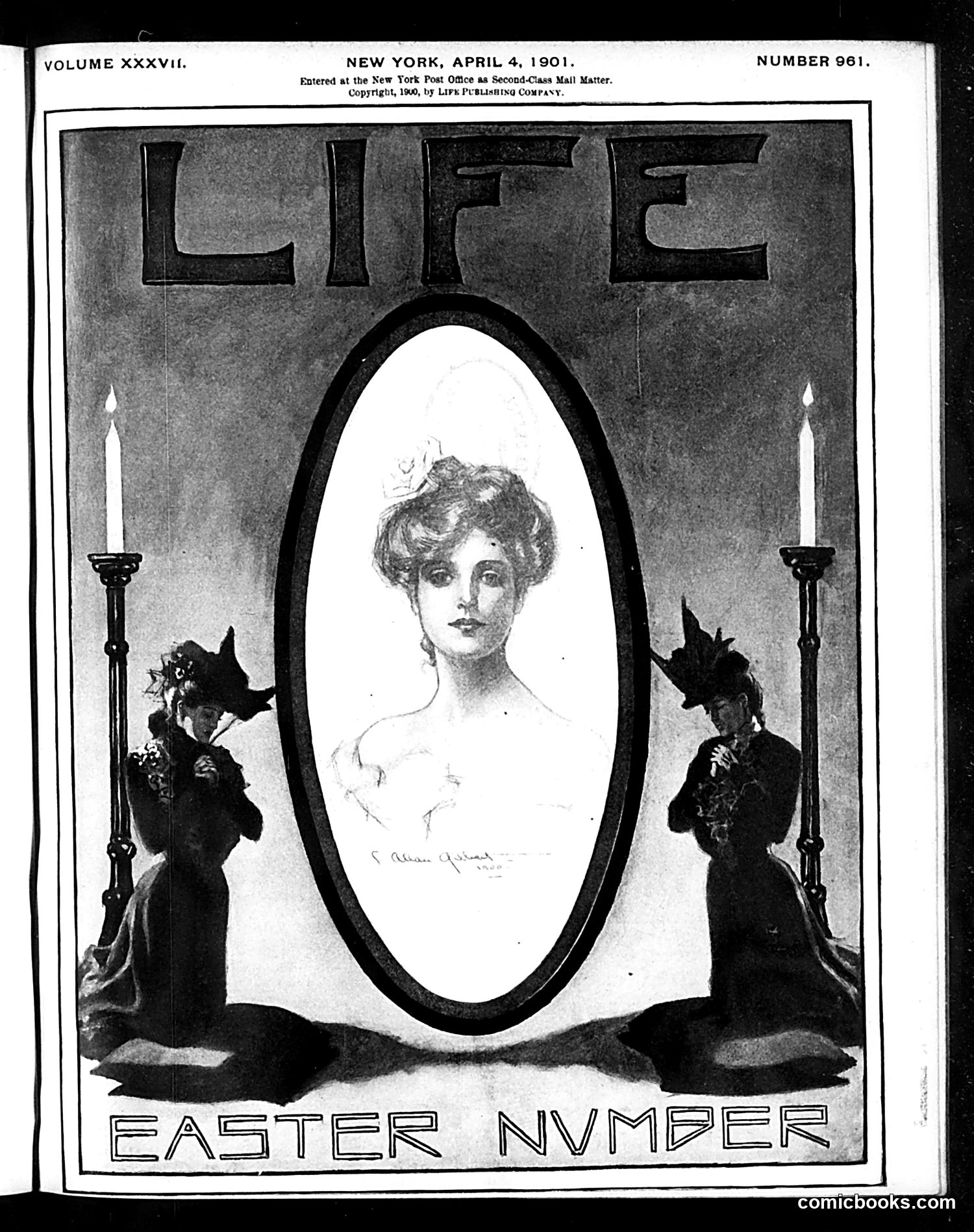
This is the cover of Life's Easter issue. The central image shows a woman's portrait in an oval frame, flanked by two robed figures holding candles—a reverential, religious presentation mimicking traditional Christian iconography (particularly the Virgin Mary). The word "LIFE" appears at the top, with "EASTER NUMBER" at the bottom. The satire likely critiques the idealization or even semi-religious veneration of feminine beauty and youth in turn-of-the-century culture. By presenting an unnamed woman's portrait with solemn, devotional staging, the magazine mocks how society elevated female beauty to near-sacred status—a common target of Life's social commentary. The Easter framing adds ironic religious dimension to this secular "worship" of feminine aesthetics.
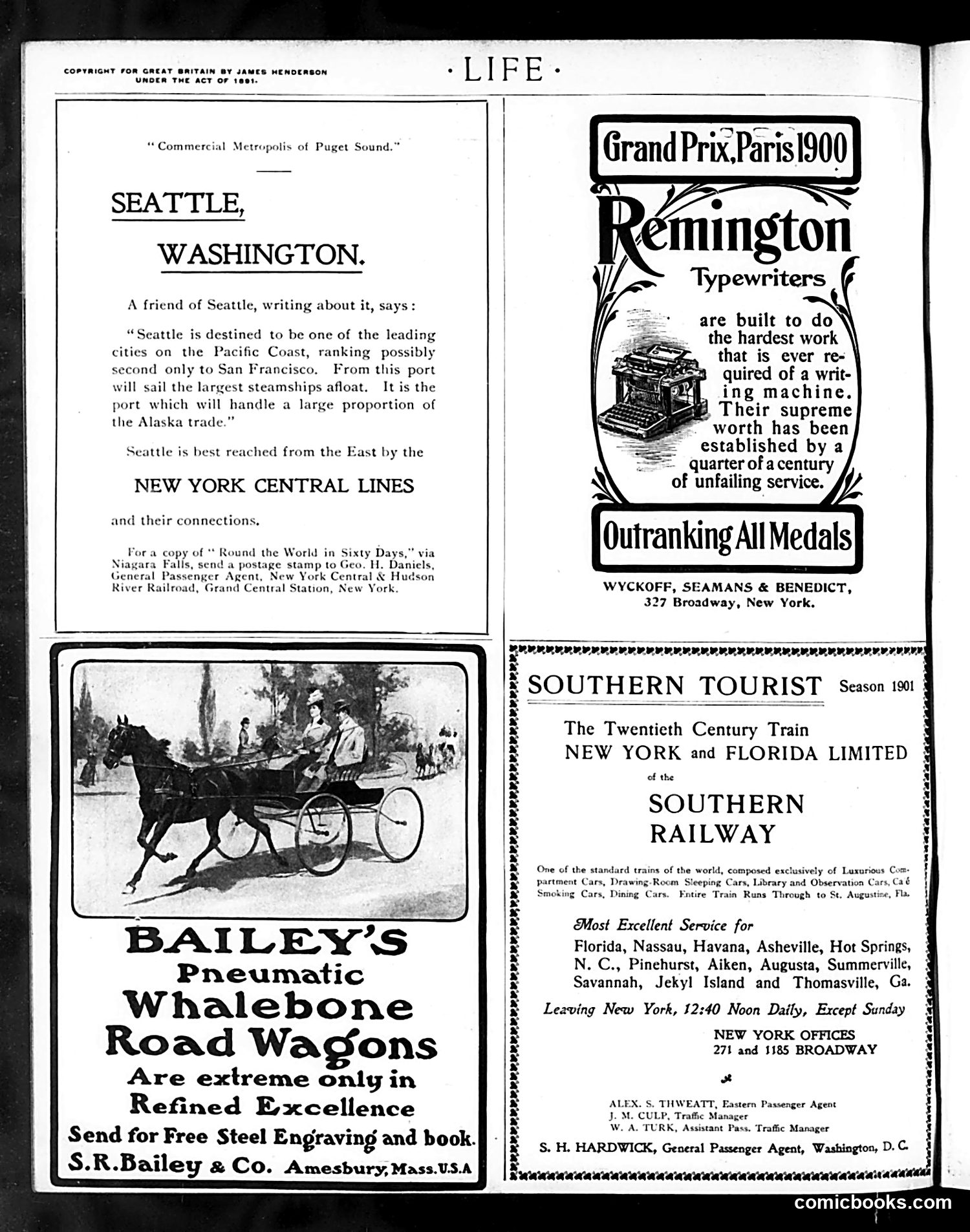
This page is primarily **advertising**, not satirical content. The advertisements include: - **Remington Typewriters**: Promotes their Grand Prix Paris 1900 award, emphasizing durability and "quarter of a century of unfailing service" - **Bailey's Pneumatic Whalebone Road Wagons**: Features an illustration of a horse-drawn carriage, marketing refined excellence in wagon design - **Southern Tourist/Southern Railway**: Advertises the "Twentieth Century Train" running New York to Florida, listing destinations and New York office addresses The top-left editorial content discusses **Seattle, Washington** as a rising Pacific Coast city, second only to San Francisco, accessible via New York Central Lines. There is **no political cartoon or satire** on this page—it's a commercial publication showcasing turn-of-the-century American products and transportation services.
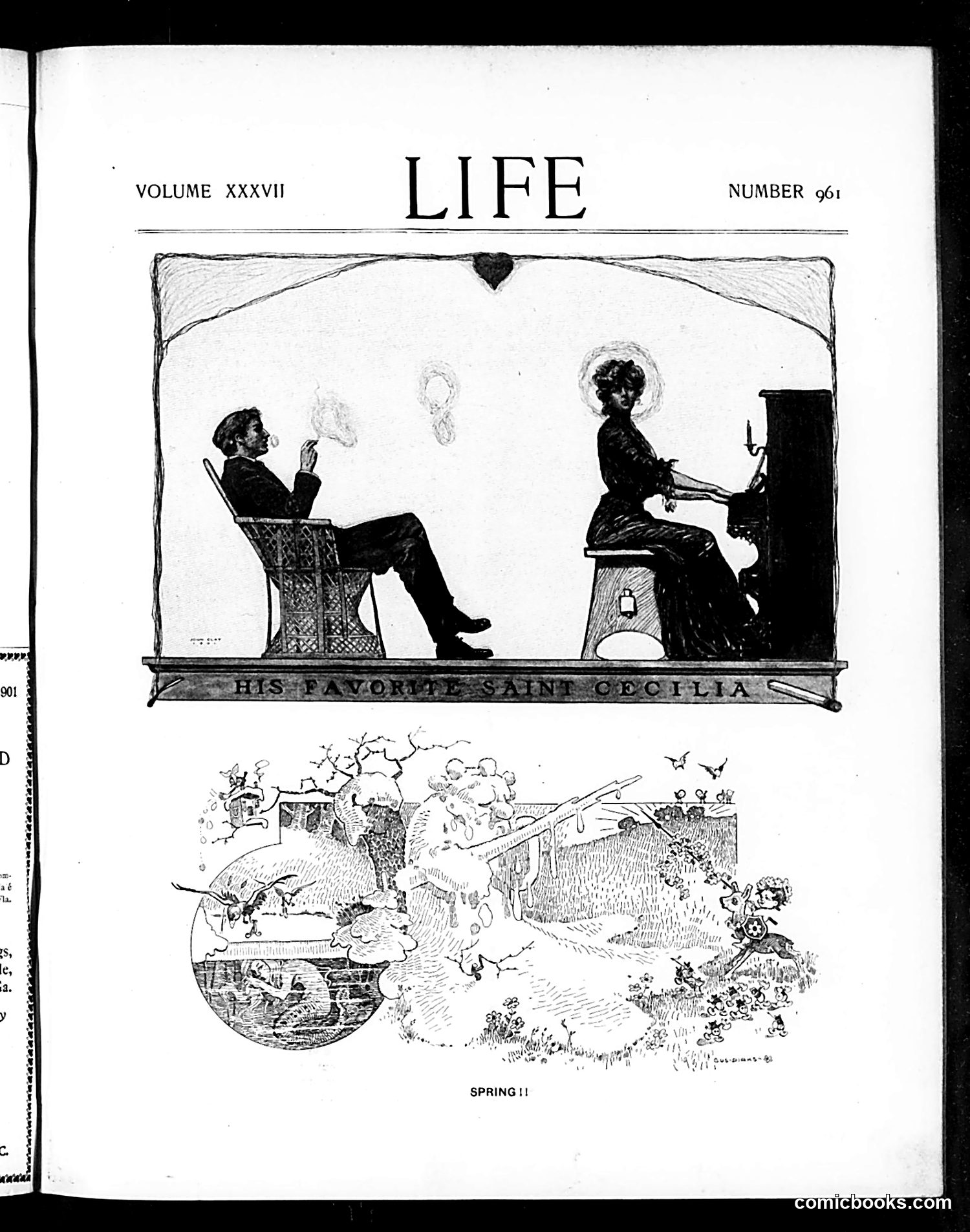
The top cartoon titled "His Favorite Saint Cecilia" depicts a romantic scene: a man in a chair gazes admiringly at a woman playing piano. Saint Cecilia is the patron saint of music and musicians, making this a clever visual pun—the man's "favorite saint" is the woman making music. The bottom illustration labeled "Spring!!" shows a pastoral countryside scene with various spring activities: fishing, farming, and outdoor recreation. It represents the traditional renewal and leisure associated with spring season. Together, these images juxtapose refined indoor romance with outdoor natural pleasures, typical of Life's satirical commentary on American social life and seasonal customs. The specific historical context or date of this issue remains unclear without additional publication information.
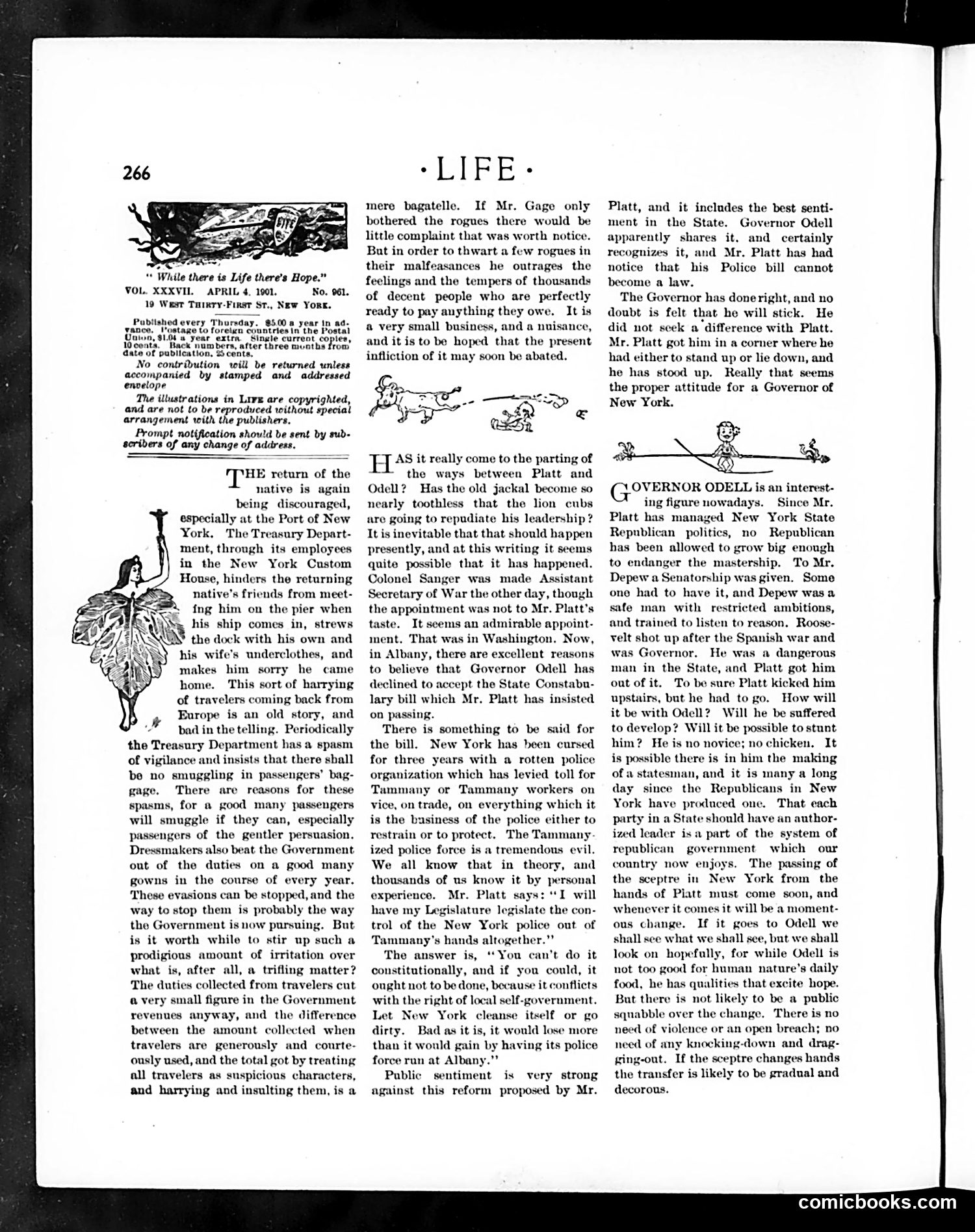
This page critiques New York Governor **Benjamin B. Odell Jr.** and his handling of police corruption. The text discusses tensions between Governor Odell and **Frank Platt** regarding control of the New York police force. The article sarcastically questions whether Odell has the will to reform a police system plagued by the **Tammany Hall** organization—which controlled police through patronage and corruption. The satire suggests Odell lacks political backbone: despite recognizing problems, he'll likely capitulate to Tammany's power rather than implement real reform. The cartoons (small illustrated vignettes) appear to mock political weakness and the difficulty of challenging entrenched machine politics in early 1900s New York.
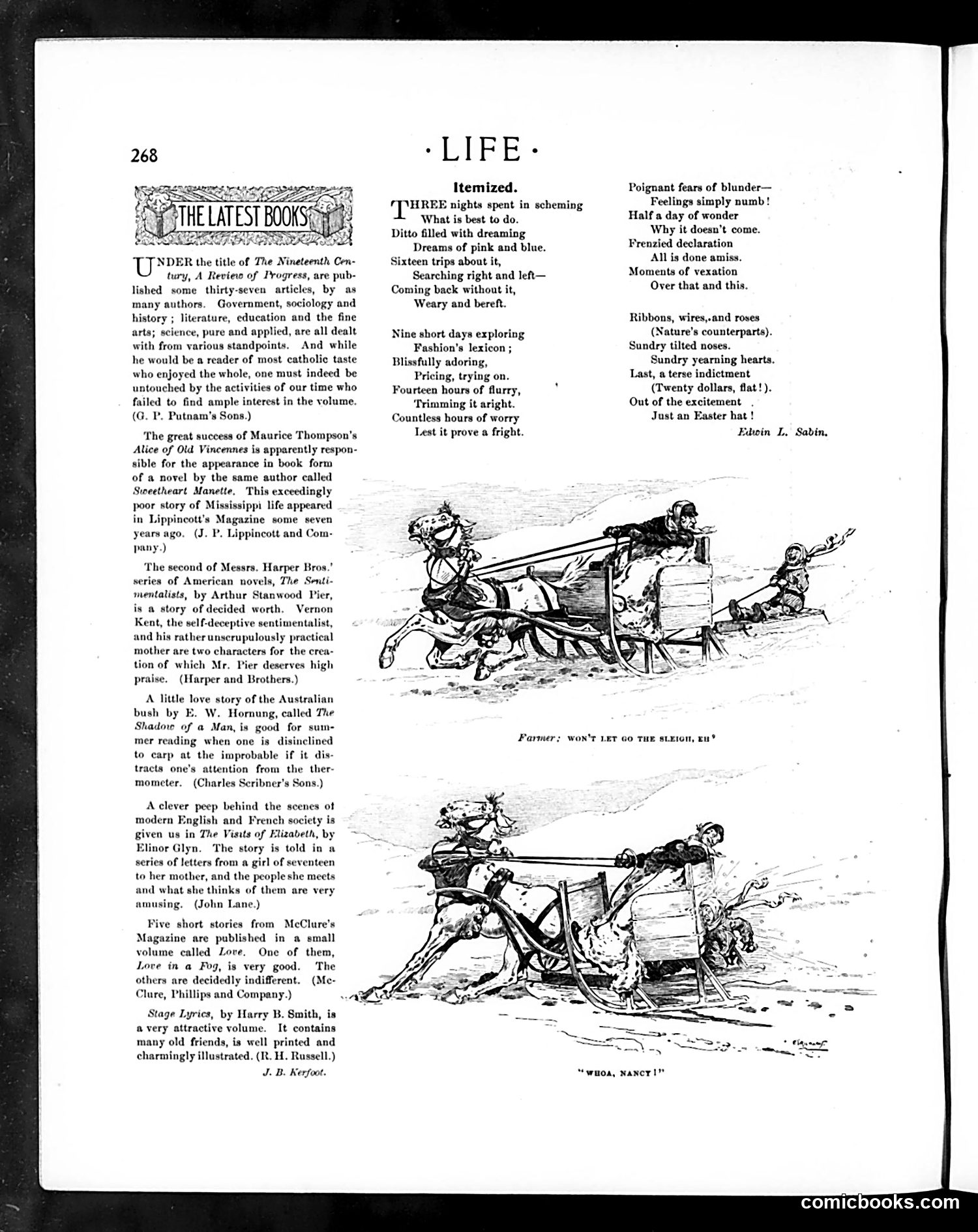
This page features two cartoon illustrations depicting a farmer struggling with a runaway horse-drawn sleigh in winter conditions. The captions read "Farmer: won't let go the sleigh, eh?" and "Whoa, Nancy!" The cartoons appear to illustrate a humorous domestic scene rather than political satire. They depict a comedic struggle between the farmer and his horse, who refuses to release or control the sleigh—a relatable scenario for rural readers of this era. The page's main content is "The Latest Books," a literary review section discussing contemporary publications by authors like Maurice Thompson and Arthur Stanwood Pier. The farm scene cartoons serve as light illustration for this reading-focused magazine page, offering visual humor unrelated to the book reviews.
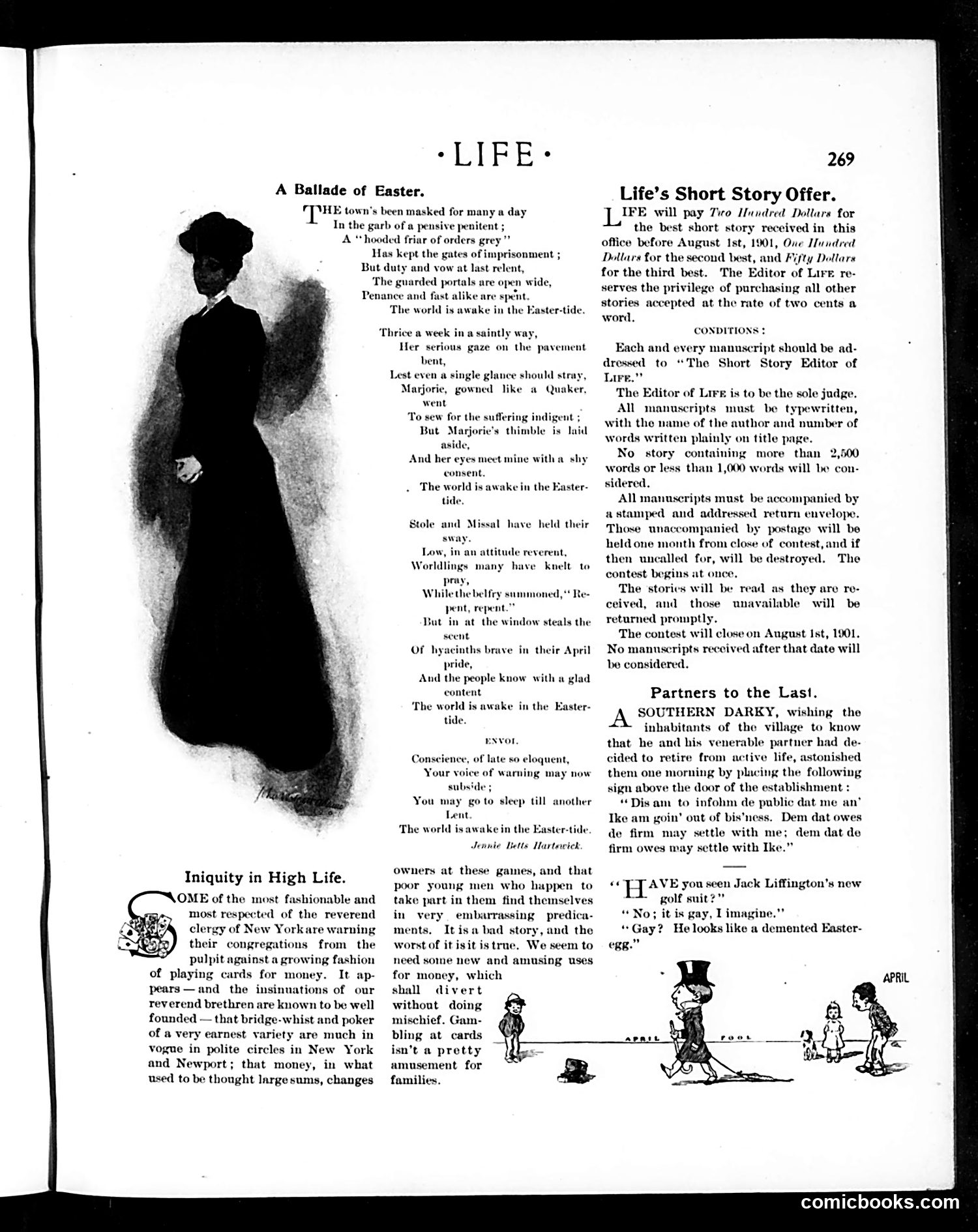
This page contains three distinct pieces: 1. **"A Ballade of Easter"** — A poem by Jessie Belle Harwick about Easter observance in the city, with an accompanying illustration of a woman in dark clothing. 2. **"Life's Short Story Offer"** — A competition announcement offering prize money ($200, $100, $50) for short story submissions before August 1, 1901, with specific submission requirements. 3. **"Iniquity in High Life"** — Social satire criticizing wealthy New York clergy and the fashionable upper classes for endorsing card games and gambling as entertainment. The text warns against "bridge-whist and poker" gaining acceptance in polite society circles. 4. **"Partners to the Last"** and **"Have you seen Jack Liffington's new golf suit?"** — Brief humorous dialogue snippets, likely satirizing fashionable society gossip. The page reflects turn-of-the-century American concerns about wealth, morality, and social propriety.
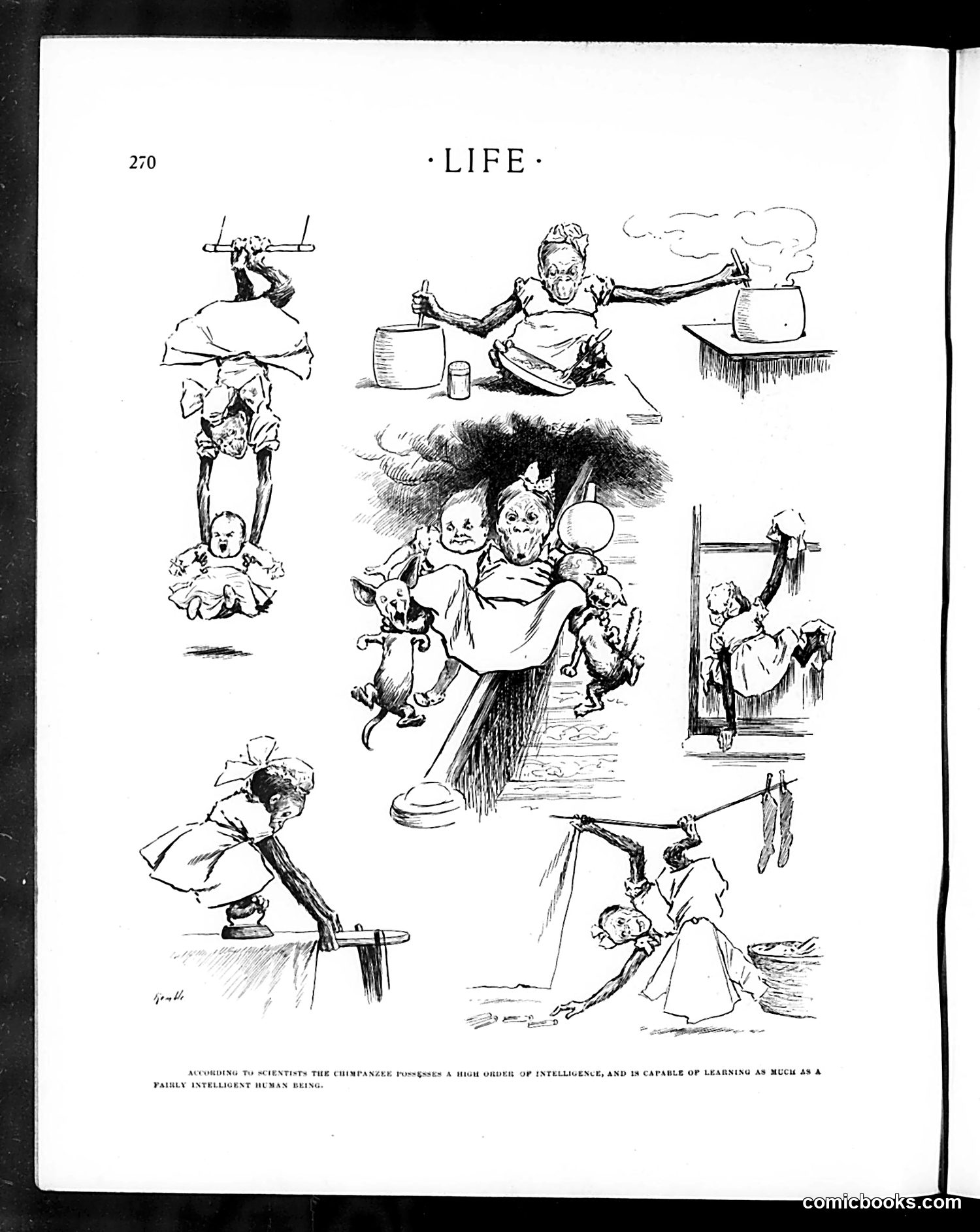
This page satirizes the scientific debate about evolution and human intelligence. The caption states: "According to scientists the chimpanzee possesses a high order of intelligence, and is capable of learning as much as a fairly intelligent human being." The cartoons mock this claim by depicting various domestic scenes where a chimpanzee performs tasks indistinguishable from—or sometimes better than—human women. The ape juggles, cooks, tends children, does laundry, and manages household chores with apparent competence while human figures appear comparatively incompetent or overwhelmed. The satire targets both evolutionary science (questioning its implications about human superiority) and, more pointedly, gender relations—suggesting women's domestic labor requires no more intelligence than a chimpanzee might possess. This represents period attitudes dismissing women's intellectual capacity.
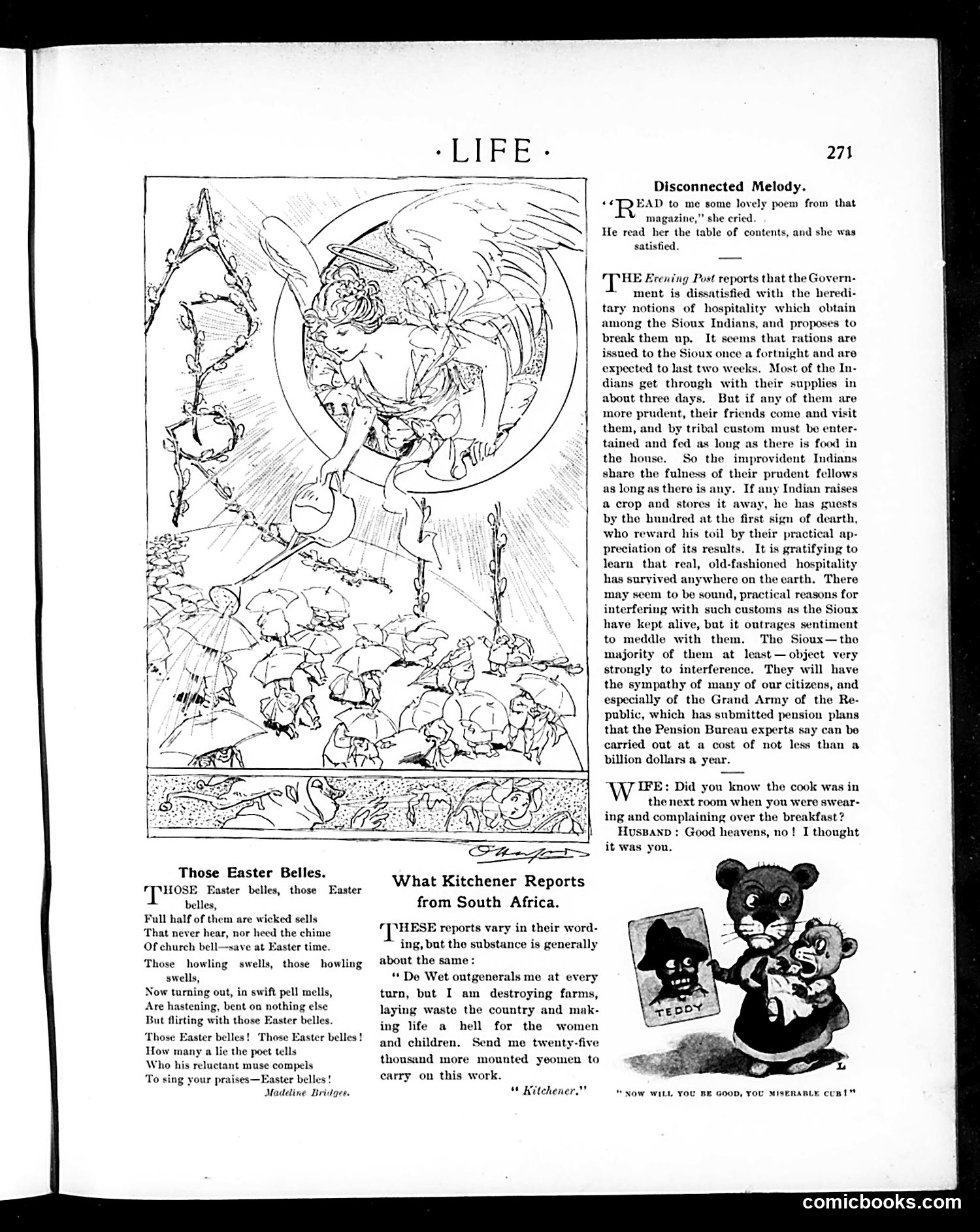
**Top Illustration ("Disconnected Melody"):** This ornate letter "D" contains a chaotic scene of cherubs and figures in classical style, likely a decorative initial for an article. The detailed engraving shows baroque-style composition. **"Those Easter Belles" (poem):** A satirical poem by Madeleine Bridges mocking women who sing loudly in church during Easter services—the "Easter belles" being both church bells and women (belles). **"What Kitchener Reports from South Africa":** References Lord Kitchener's reports on the Boer War, where he describes destroying farms and making conditions hellish for civilians. The excerpt sardonically requests more mounted troops to continue this devastation. **Teddy Bear Cartoon:** Shows a bear (likely Theodore Roosevelt's "Teddy") with a caption mocking compliance/obedience ("You will be good, you miserable cub!").
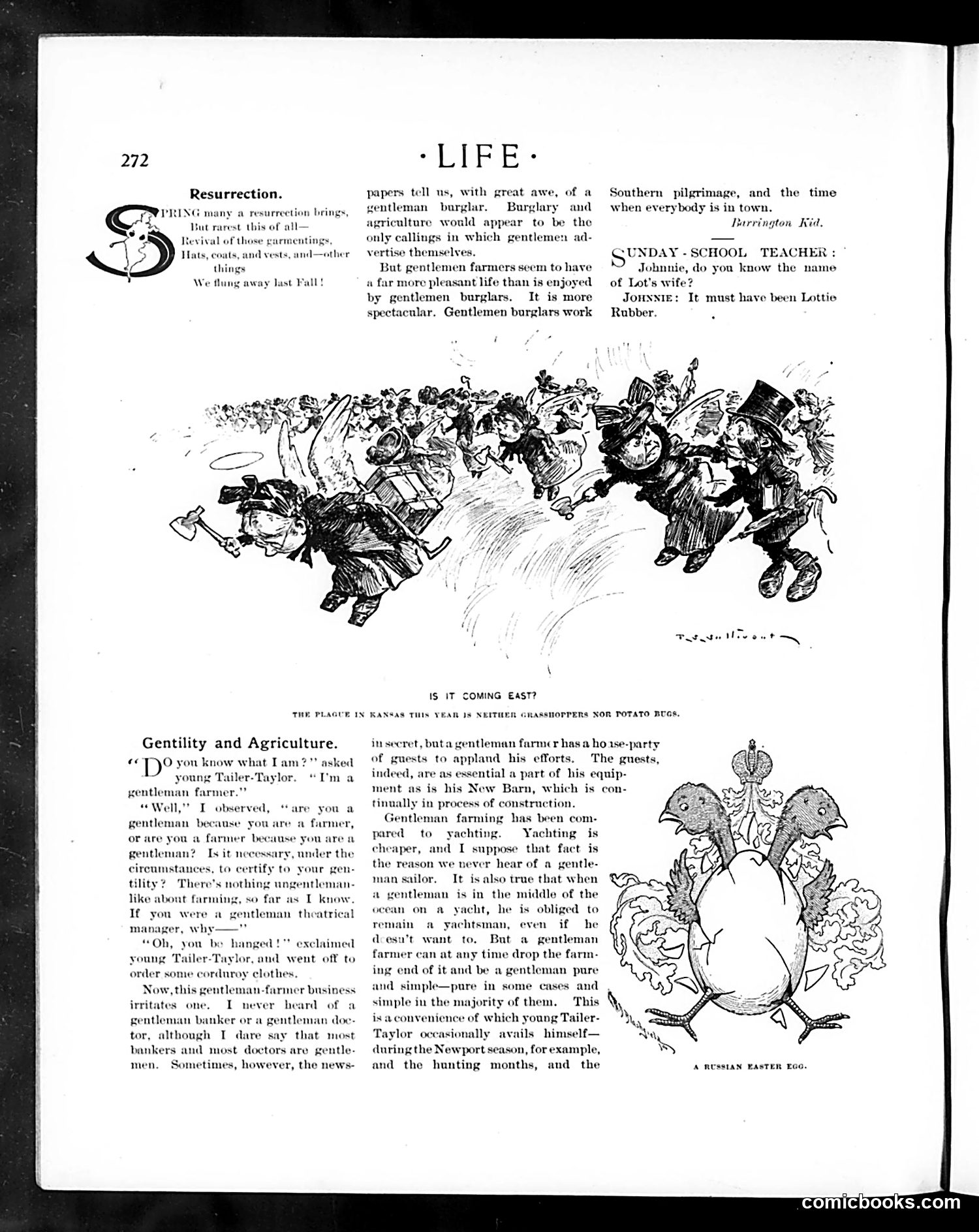
The main cartoon depicts a chaotic crowd fleeing en masse, captioned "IS IT COMING EAST? THE PLAGUE IN KANSAS THIS YEAR IS NEITHER GRASSHOPPERS NOR POTATO BUGS." This references a real agricultural disaster in Kansas—likely a plague of insects (grasshoppers or potato bugs were common crop destroyers in the era). The exaggerated panic shows people running in terror, satirizing the severity of the farming crisis. Below, "Gentility and Agriculture" presents a humorous dialogue mocking gentleman farmers. A wealthy man named Tailer-Taylor claims to be a farmer while clearly engaging in leisure activities (yachting, hunting). The text satirizes the pretense of wealthy urbanites playing at farming while maintaining gentlemanly pursuits, suggesting farming and genuine gentility are incompatible lifestyles.
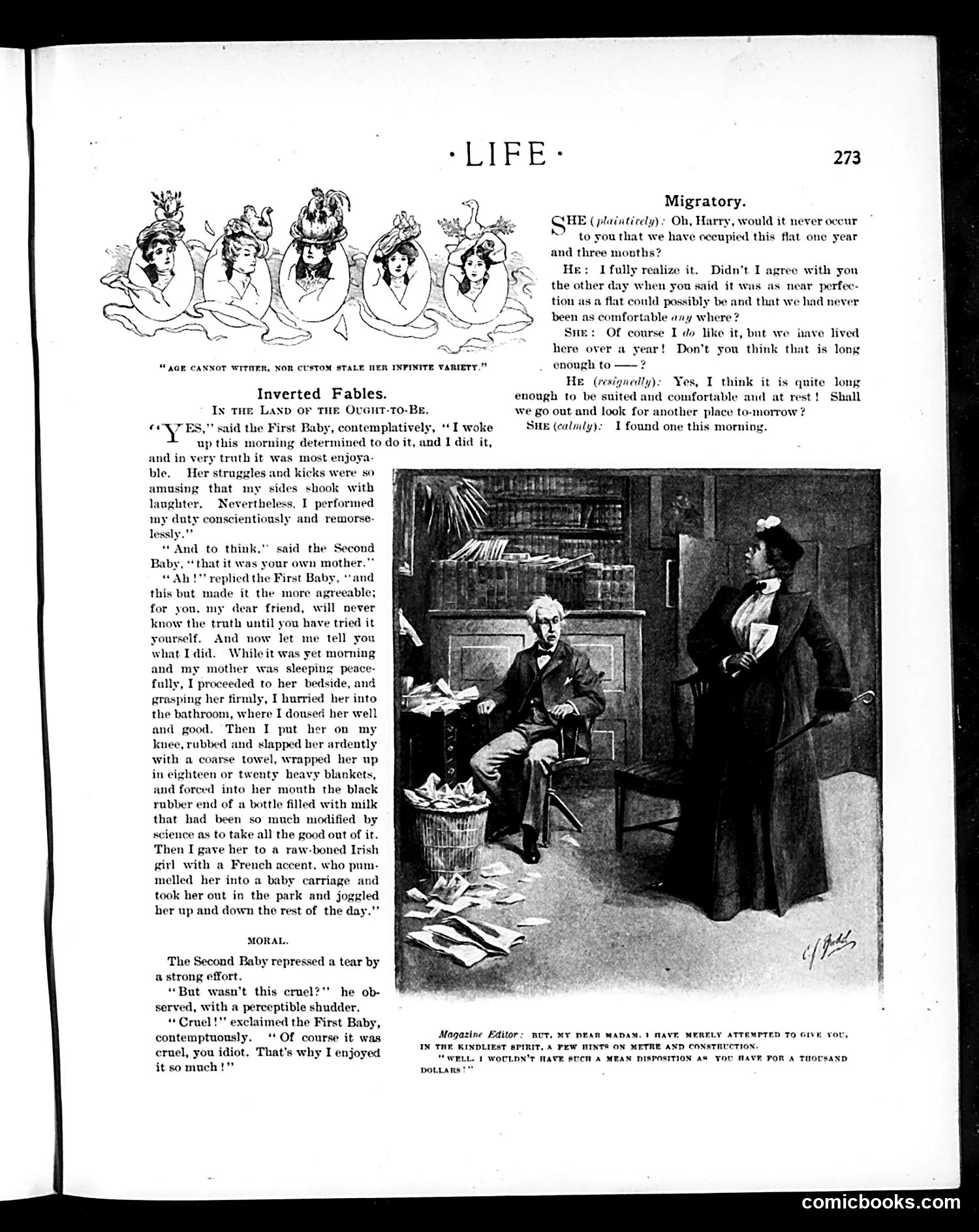
This page presents a satirical story titled "Inverted Fables" that inverts traditional moral lessons. Two babies debate whether deliberately mistreating an infant (dunking her in cold water, wrapping her roughly, forcing medicated milk into her mouth, then passing her to an Irish nanny to be joggled around the park) constitutes cruelty or beneficial hardening. The First Baby claims this rough treatment built character; the Second Baby questions the logic. The satire criticizes turn-of-the-century "scientific" parenting advice that advocated harsh, austere child-rearing methods supposedly to toughen children—what we'd now recognize as harmful neglect disguised as pedagogy. The inverted fable format mocks the pseudoscientific justifications adults used for such practices.
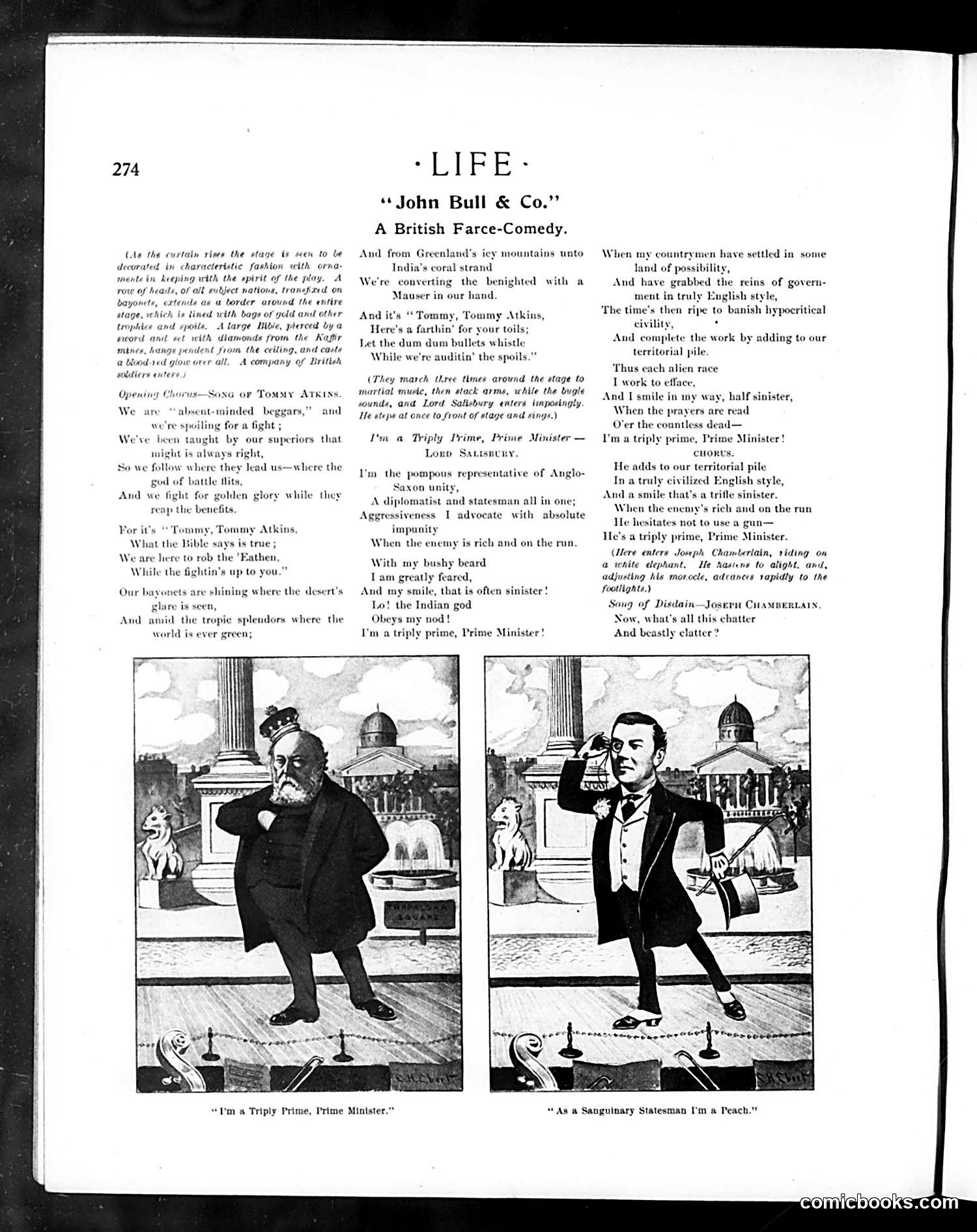
This page presents a British farce-comedy satirizing British imperial governance. The two illustrations depict characters identified by their captions: "I'm a Triply Prime, Prime Minister" (left) and "As a Sanguinary Statesman I'm a Peach" (right). The text mocks British political pretensions, particularly around imperialism ("And from Greenland's icy mountains unto India's coral strand"). The humor targets a Prime Minister character who boasts of his importance while being portrayed as self-aggrandizing and ridiculous. References to "Saxon unity" and "Anglo-Saxon" nationalism suggest this critiques British imperialist ideology of the era. The satire appears designed to deflate pompous British political figures through caricature and self-aware irony about empire-building rhetoric.
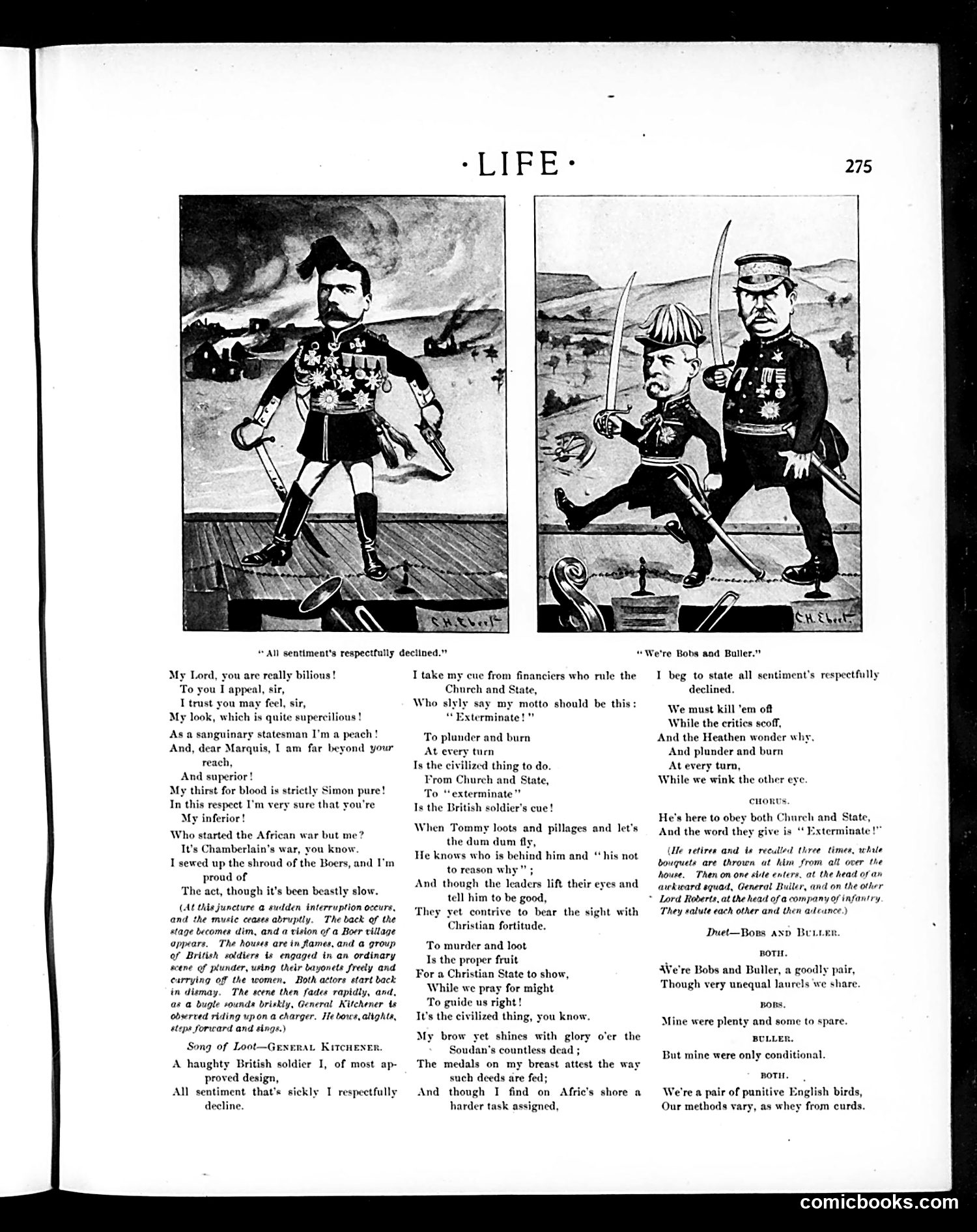
This page satirizes British military conduct during the Second Boer War (1899-1902), targeting what the cartoonist views as hypocrisy and brutality masked by patriotic rhetoric. **The figures appear to be:** - General Kitchener (identified in the song), who orchestrated the war - "Bobs" (likely Lord Roberts) and General Buller, British commanders shown in the right cartoon **The satire's points:** The cartoon mocks British leaders who claim "all sentiment's respectfully declined" while conducting what the text characterizes as indiscriminate plunder, burning, and killing of Boer civilians. The repeated phrase "exterminate" exposes the contradiction between Christian moral claims and actual warfare practices (including "dum dum" ammunition and looting). The vision of burning Boer villages interrupting the patriotic boasting makes the disconnect explicit: the soldiers' rhetoric celebrates "civilization" while committing atrocities. The duet between Roberts and Buller humorously acknowledges their unequal success, using them to represent the war's overall moral bankruptcy.
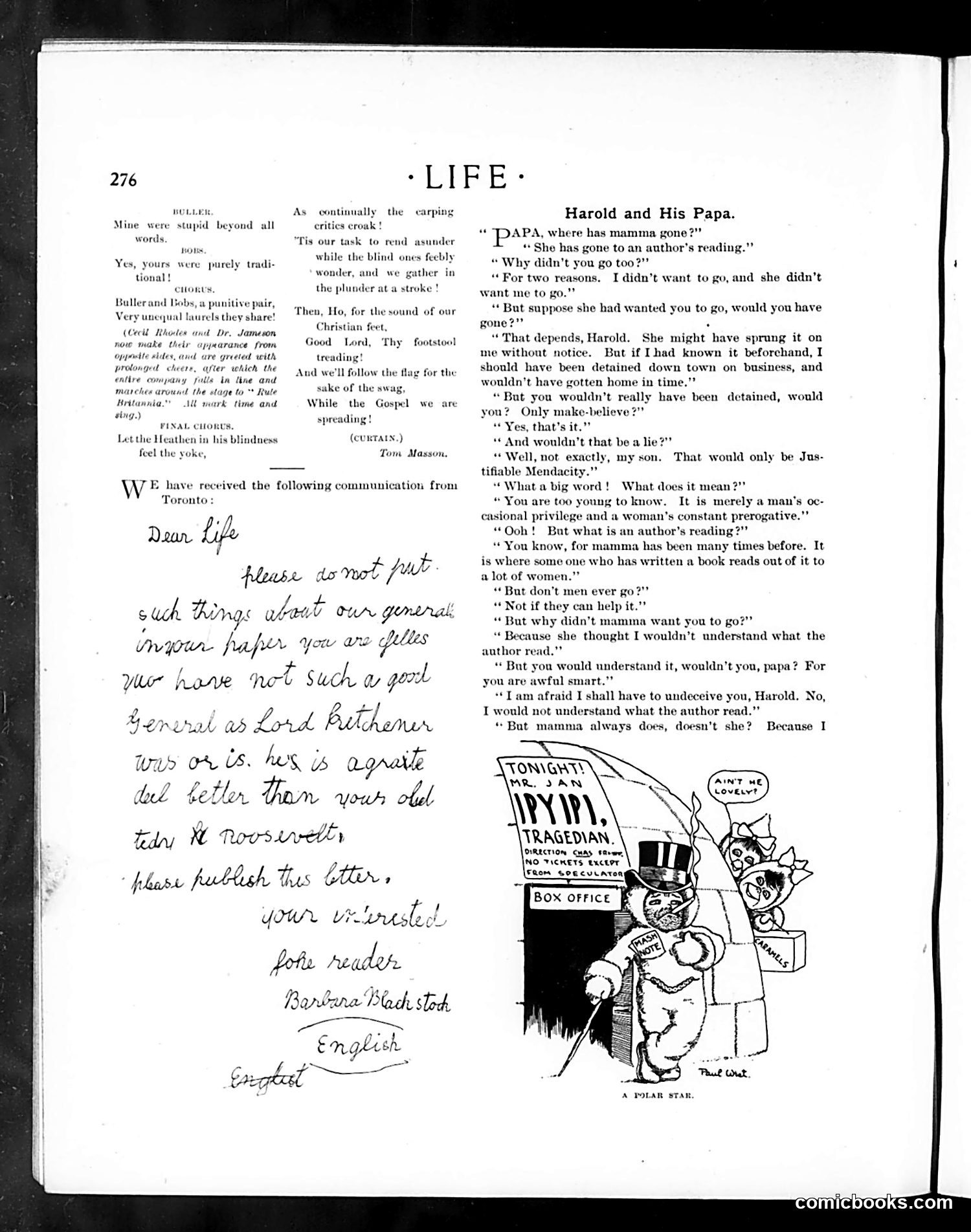
**"Harold and His Papa"** is a humorous domestic dialogue satirizing male excuses and gender dynamics in Edwardian society. A father explains to his curious son why he won't attend his wife's author reading—claiming he'd invent a business excuse if necessary. The joke hinges on the father's candid admission that he doesn't understand literary readings (which he suggests women do, men don't), and his invention of the phrase "justifiable mendacity" to dignify his lie. The satire targets male avoidance of cultural events and their rationalizations for avoiding wives' intellectual pursuits. **"A Polar Star"** (bottom right) appears to be a theatrical advertisement cartoon. It shows figures in formal dress outside a "Box Office," likely advertising a stage production called "A Polar Star" or similar. The cartoon style is typical of Life's theatrical promotion cartoons from this era. Both pieces reflect turn-of-century attitudes about gender, marriage, and domestic culture—husbands' resistance to wives' intellectual activities and entertainment advertising conventions.
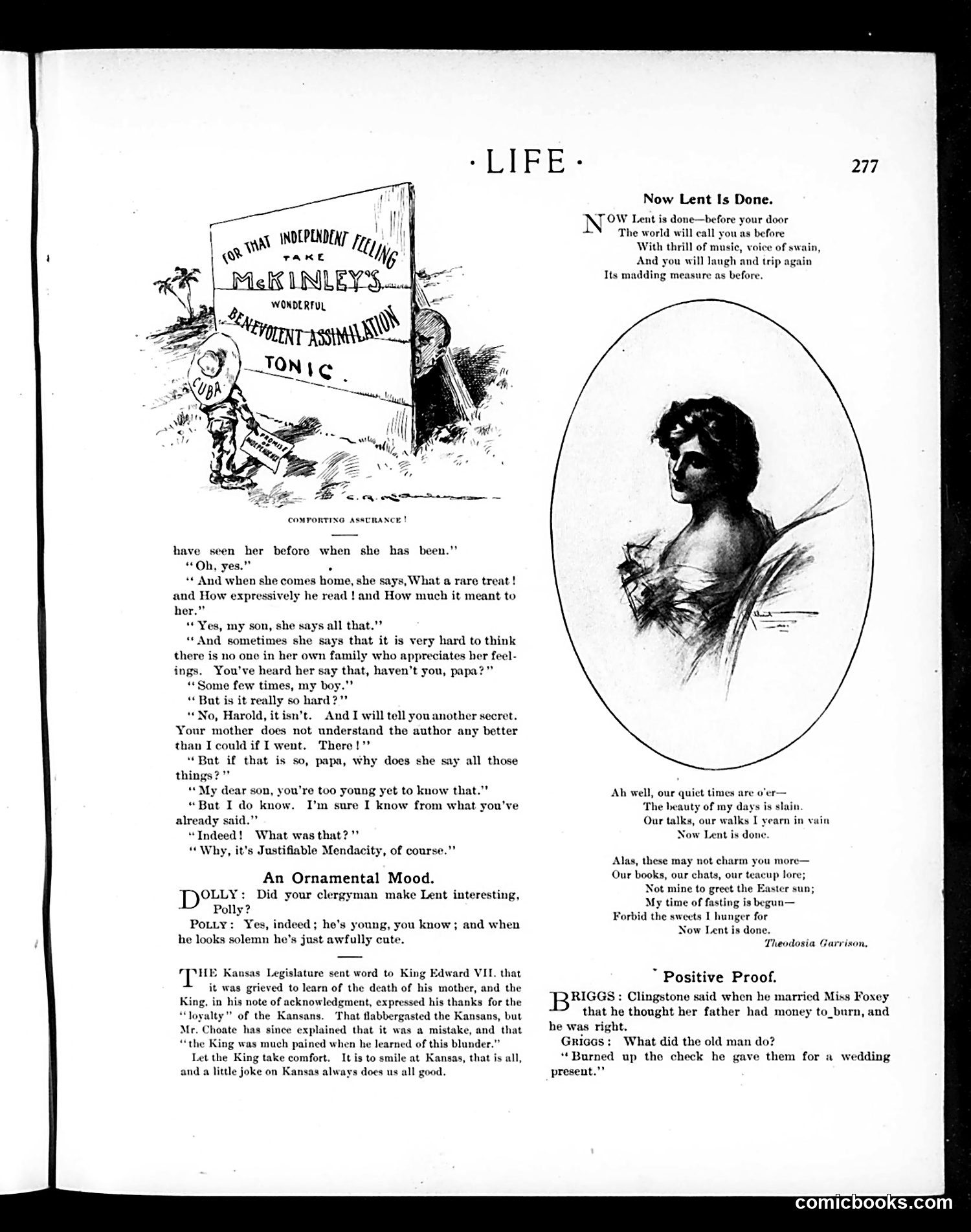
**The McKinley's Tonic Advertisement:** The cartoon depicts a thin, sickly child being "comforted" by a towering bottle of McKinley's patent medicine. The satire mocks both the product's dubious efficacy and the era's widespread faith in tonics and patent medicines—often fraudulent elixirs marketed as cure-alls. **"An Ornamental Mood" Dialogue:** This jokes about hypocrisy during Lent (the Christian fasting period). A woman attends religious services and feigns intellectual engagement with sermons, but her husband reveals she understands nothing—she attends for social appearance and to seem refined. The son's conclusion: "Justifiable Mendacity" (acceptable lying). **Kansas/King Edward VII Item:** Satire on Kansas's diplomatic gaffe—the state legislature awkwardly expressed condolences to the British King about his mother's death, prompting embarrassed clarification. Life mocks Kansas as perpetually worthy of ridicule. **"Now Lent Is Done" Poem:** A woman celebrates Lent's end, anticipating resuming social pleasures (music, romance, sweets) she'd sacrificed for religious observance.
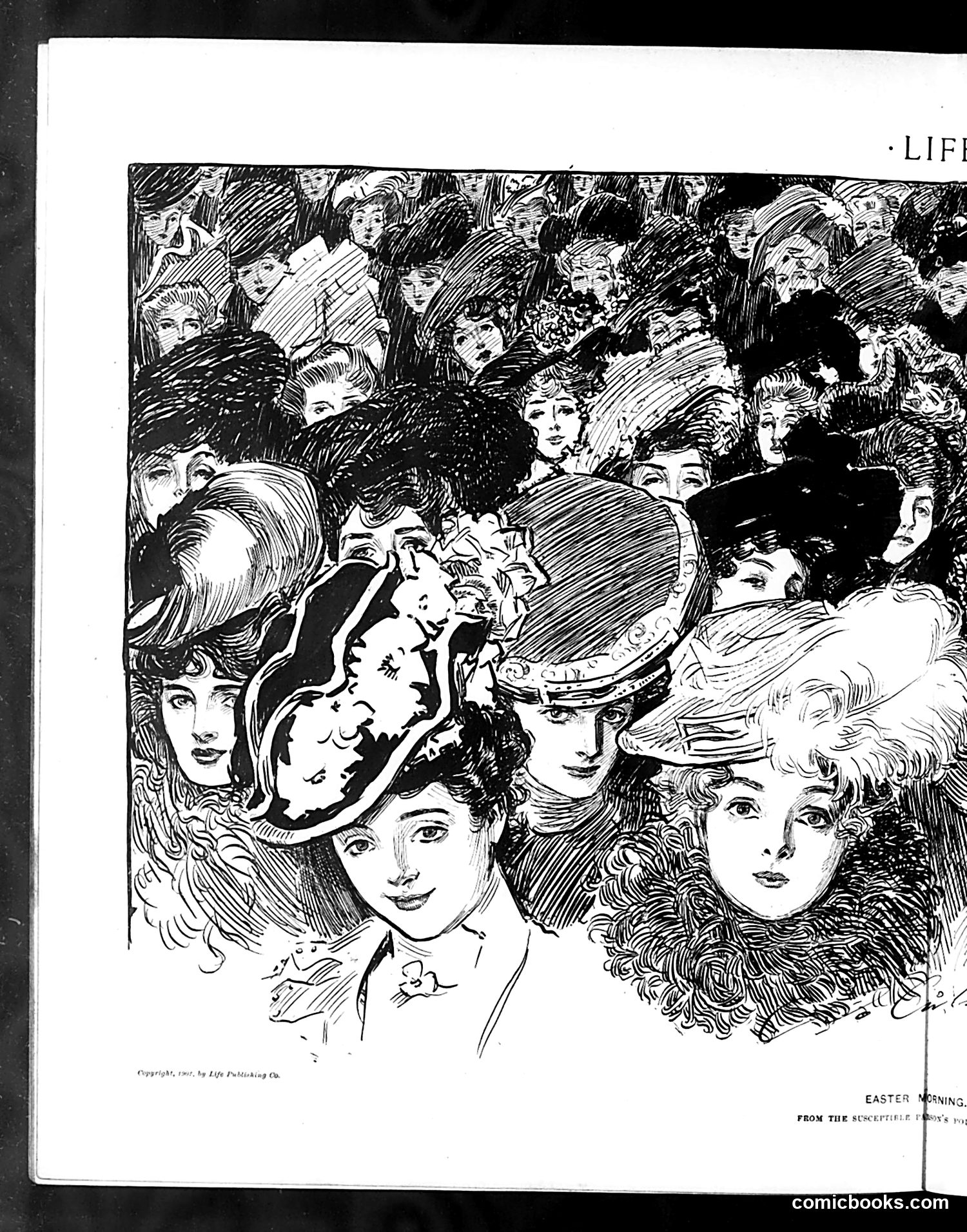
This appears to be an illustration titled "Easter Morning" depicting a crowded scene of fashionably dressed women and girls, rendered in an intricate pen-and-ink style typical of early 20th-century Life magazine. The image satirizes the social custom of elaborate Easter clothing and parading. The densely packed composition shows multiple figures wearing decorative hats, fur stoles, and elaborate bonnets—the height of Easter fashion display. The exaggerated detail and crowding suggests satire of vanity and conspicuous consumption around the holiday. The title references "the susceptible boy's" perspective, implying the illustration pokes fun at young men distracted by fashionable women during Easter celebrations. The work critiques materialism and fashion-obsession surrounding the holiday through comedic visual abundance.
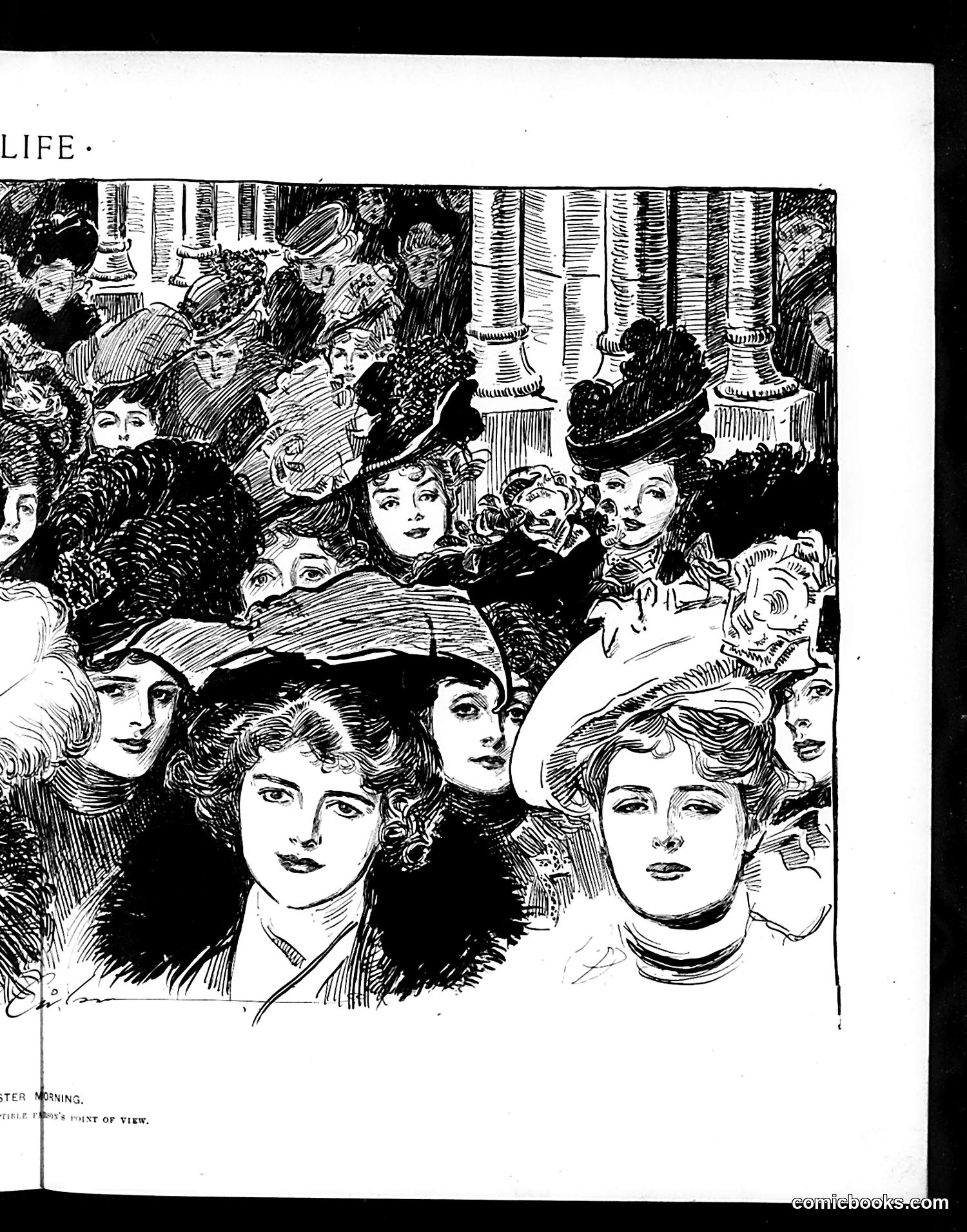
This appears to be a social illustration from *Life* magazine showing a crowded indoor scene, likely at a fashionable social gathering or public venue (note the classical columns in the background). The image depicts numerous women wearing elaborate Edwardian-era hats, clothing, and hairstyles typical of the early 1900s. The caption reads "**'S MORNING**" and references "'S POINT OF VIEW," suggesting this illustrates how women appear from a particular perspective—likely a humorous commentary on female fashion, social gatherings, or women's vanity during the period. The dense composition and exaggerated facial expressions are characteristic of *Life* magazine's satirical style, though without the complete caption text visible, the specific target of the satire remains unclear.
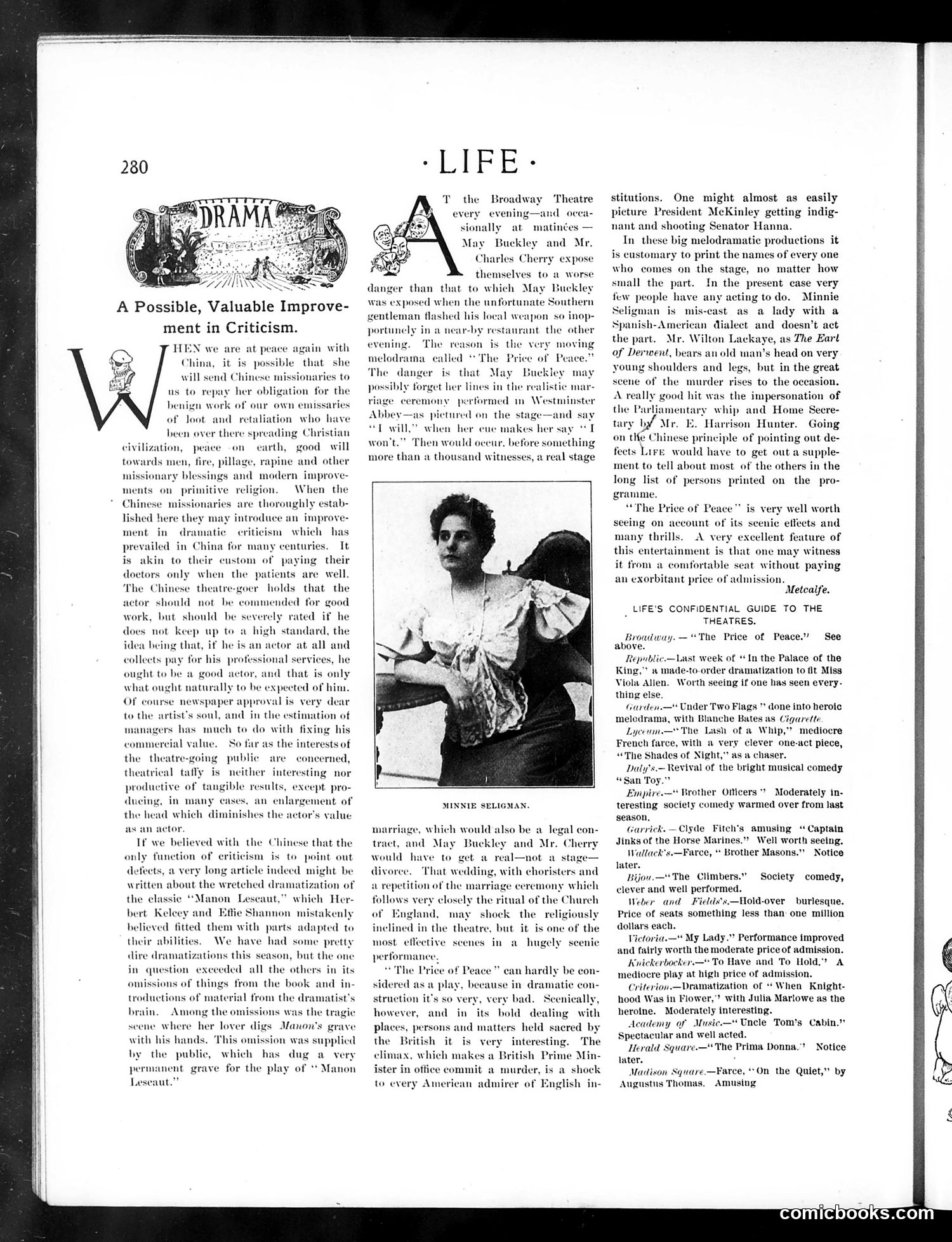
This page contains two distinct pieces: **Main Article ("A Possible, Valuable Improvement in Criticism"):** A satirical essay proposing that China, after Western missionary efforts there, should send critics to America who would adopt the Chinese practice of only praising actors when they meet minimum professional standards—rather than offering flattery. The author uses this as a vehicle to attack poor theatrical criticism and specifically to eviscerate the dramatization of "Manon Lescaut," which he claims omitted crucial scenes and added unnecessary material. The joke relies on the irony that harsh Chinese standards would actually benefit American theater by eliminating undeserved praise. **Theater Review ("Minnie Seligman"):** A review of "The Price of Peace" at Broadway Theatre, praising May Buckley and Charles Cherry's performance in a melodrama involving a realistic on-stage wedding ceremony that creates legal marriage complications. The reviewer finds it scenically effective despite weak dramatic construction, and notes its bold treatment of sacred British institutions (a Prime Minister committing murder). Both pieces assume reader familiarity with specific 1900s Broadway productions now obscure.
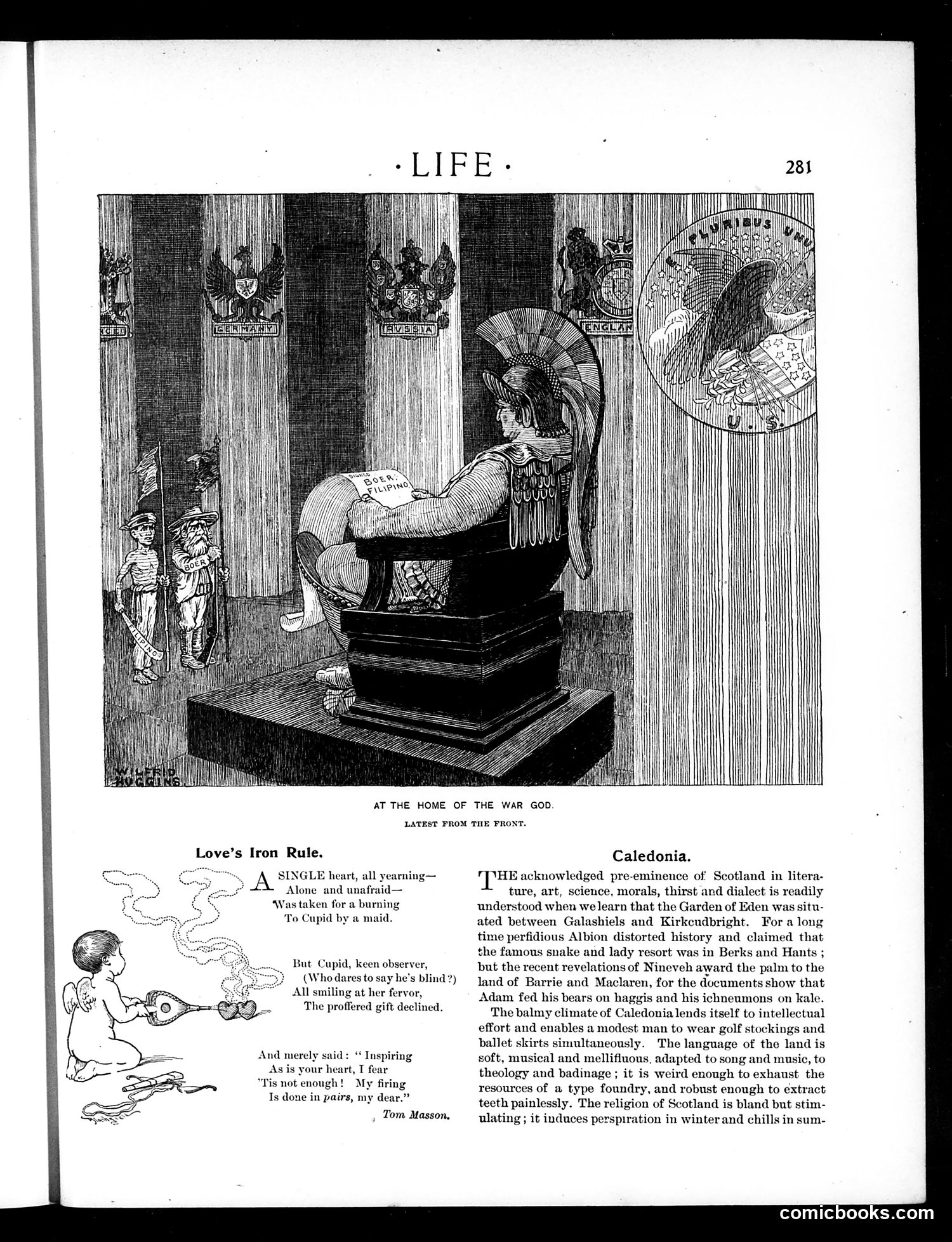
**"At the Home of the War God"** (top illustration): This depicts a classical statue or figure of Mars (the Roman war god) holding what appears to be a sword or spear, positioned in a grand columned hall. Small uniformed figures stand before it. This is satirical commentary on World War I—"latest from the front"—suggesting that military leaders worship at the altar of war itself. The grandeur of the setting mocks the glorification of warfare. **"Love's Iron Rule"** (left): Cupid refuses a single heart offered by a maiden, declaring he works "in pairs." This is witty wordplay: the satire mocks romantic convention and male desires, suggesting true love requires mutual participation rather than one-sided devotion. **"Caledonia"** (right): Humorous pseudo-scholarly praise of Scotland's supposed superiority—claiming Eden was located there, that Scots invented everything. This is gentle ethnic satire, playfully exaggerating Scottish pride and cultural claims through absurd historical "revelations."
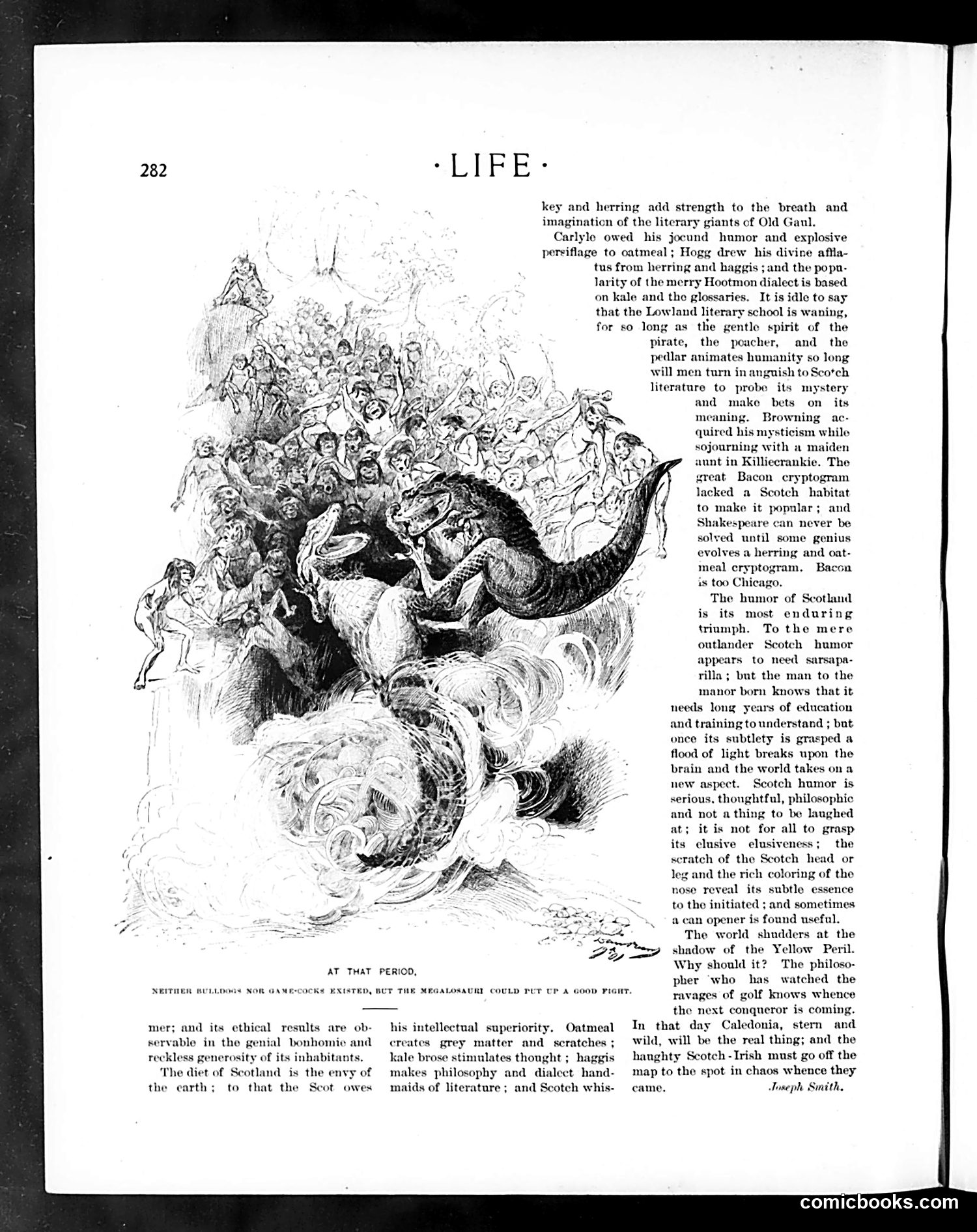
This is a satirical essay on Scottish culture and literature, illustrated by a chaotic engraving showing figures riding what appears to be a prehistoric creature (megalosaur). **The Satire:** The piece mockingly attributes Scottish literary genius to diet—oatmeal, herring, haggis, and kale—crediting these foods with inspiring writers like Carlyle and Hogg. It's absurdist humor, pretending these humble ingredients explain Scotland's intellectual output. **Key Targets:** - Scottish literary pretension and mystique - The notion that Scotch humor requires special education to understand - "Yellow Peril" anxieties (mentioned as less threatening than golf) - The decline of Scottish-Irish influence globally **The Illustration:** The megalosaur image, captioned "Neither Bulldogs Nor Gamecocks Existed, But the Megalosaur Could Put Up a Good Fight," appears to be a whimsical non-sequitur, perhaps suggesting Scottish absurdity or fighting spirit through prehistoric imagery. The entire piece is deliberately ridiculous—suggesting readers must use "can openers" to appreciate Scottish wit—making fun of both Scottish cultural pride and outsider mystification of it.
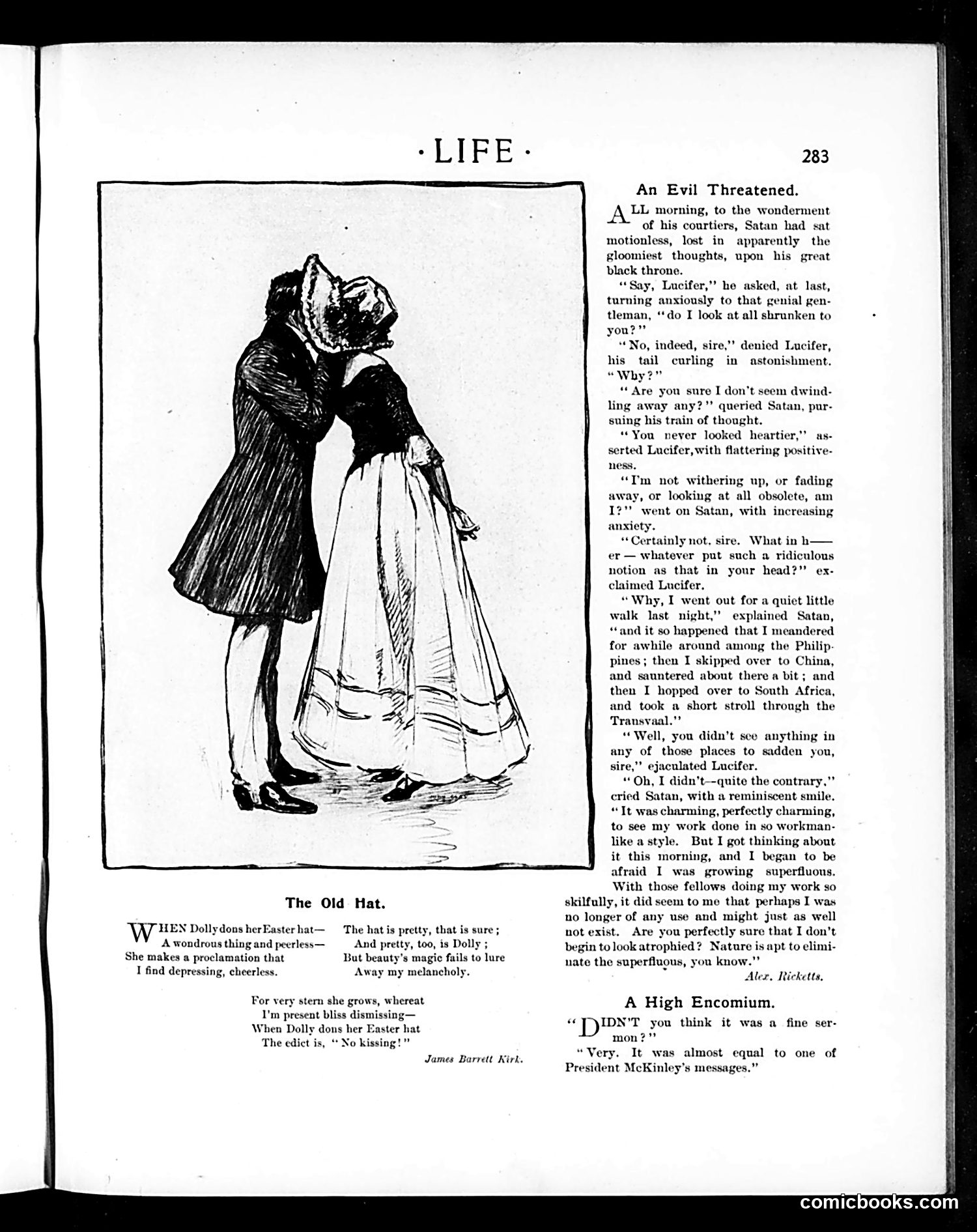
**"The Old Hat"** is a light romantic complaint: a man laments that when his girlfriend Dolly wears her new Easter hat, she forbids kissing. The joke plays on the era's social convention that a woman in her finery demands respectful distance. **"An Evil Threatened"** is the significant political satire. Satan tours the Philippines, China, and South Africa—all sites of recent colonial violence and exploitation (Philippine-American War, Boxer Rebellion, Boer War). He observes his "work" being done so "skillfully" by human hands that he fears becoming obsolete. The satire condemns American imperialism: it suggests these military campaigns are so thoroughly evil they require no demonic intervention—humans are doing Satan's work themselves. The joke's dark irony mocks American foreign policy as inherently corrupt. **"A High Encomium"** briefly satirizes President McKinley's rhetorical style, comparing a sermon favorably to his official messages—likely implying his messages were bland or propagandistic.
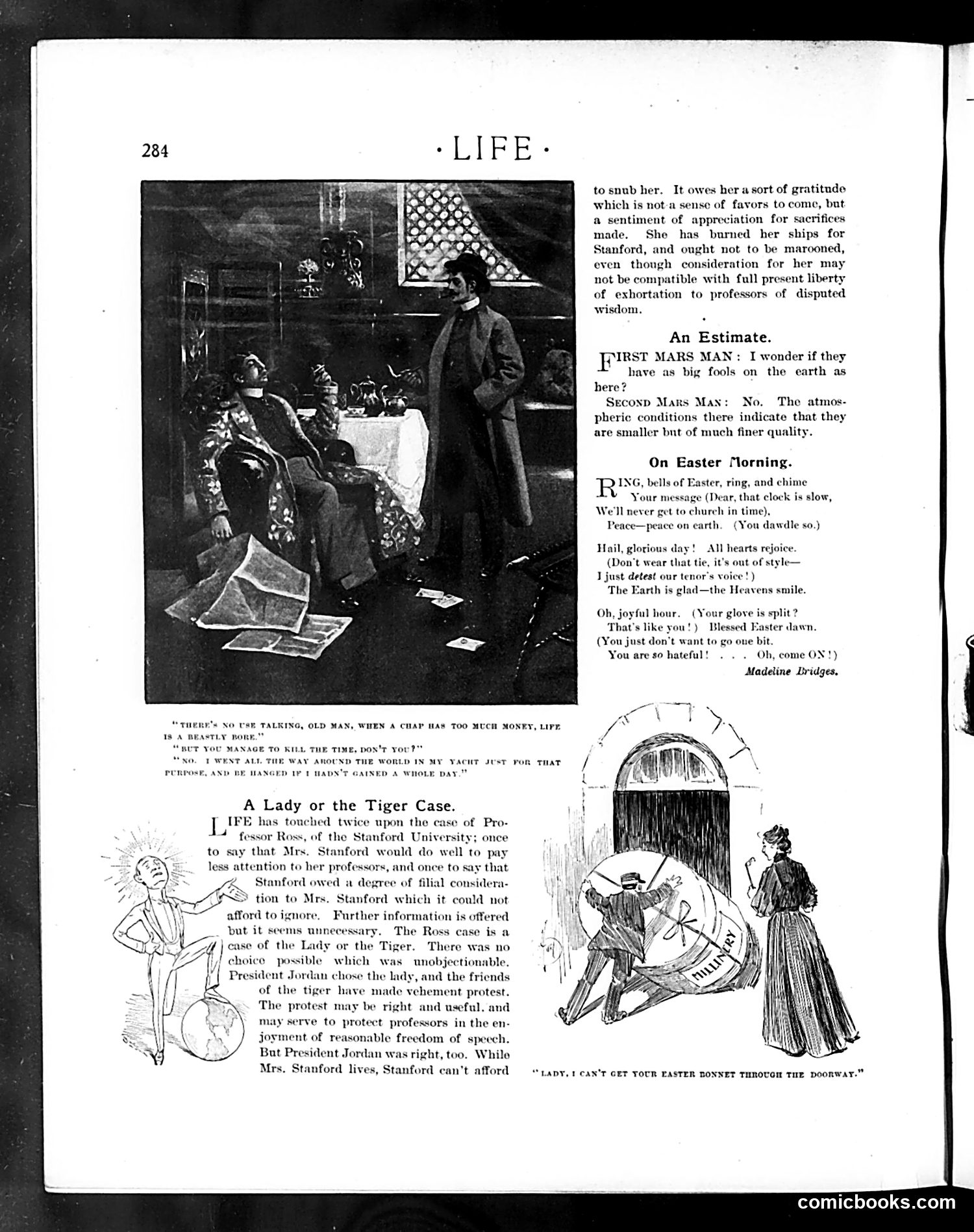
This page satirizes wealthy idleness, academic freedom, and domestic hypocrisy in early 1900s America. **Main cartoon**: Two wealthy men discuss killing time; one spent a fortune sailing around the world but "managed" to lose no days—satire on the pointlessness of rich men's pursuits. **"A Lady or the Tiger Case"**: References Stanford University's conflict involving Professor Ross. The piece critiques the impossible choice between honoring benefactor Mrs. Stanford (who funded the university) and protecting professorial freedom of speech. President Jordan chose loyalty to Mrs. Stanford; critics protested. Life argues both sides had merit—Stanford couldn't afford to alienate its donor, though academic freedom matters. **"On Easter Morning"**: Humorous poem by Madeline Bridges contrasts Easter's spiritual message with petty domestic complaints (clock running slow, fashion critiques, complaints about the tenor). The satire mocks how religious observance gets undermined by marital bickering. **Small cartoon**: A woman cannot fit her Easter bonnet through a doorway—visual joke on the absurdly oversized women's hats fashionable at the time.
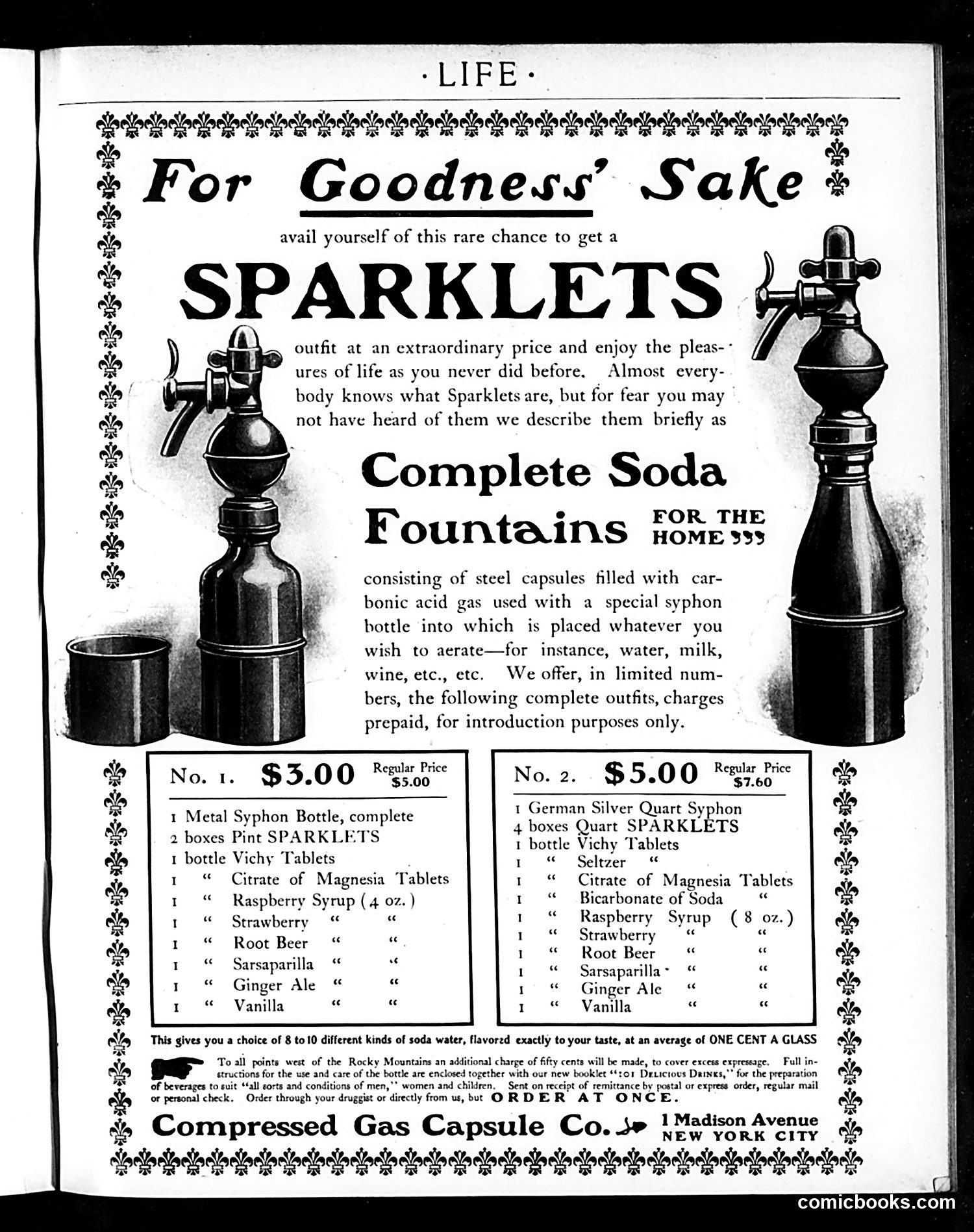
This is **not a cartoon or satire**—it's a straightforward advertisement for Sparklets home soda fountains, a product using pressurized CO₂ capsules to carbonate beverages at home. The page appeals to early 20th-century consumers by marketing convenience and variety: users could make 8-10 flavored sodas (Ginger Ale, Root Beer, Sarsaparilla, Vanilla, etc.) for approximately one cent per glass. Two product tiers are offered ($3 and $5), with different syphon bottles and tablet flavoring options. The "For Goodness' Sake" headline uses mild, moralistic language typical of period advertising—framing home soda-making as wholesome, economical entertainment ("pleasures of life as you never did before"). The phrase reflects early 1900s marketing conventions addressing middle-class consumers concerned with respectability. The Compressed Gas Capsule Company marketed directly through druggists and mail order from their Madison Avenue office, positioning this as an affordable home luxury accessible to ordinary households.
This page contains several satirical pieces: **"Last Scene of All"** — A literary parody of Shakespeare's "Seven Ages of Man," tracking human development from infant to old age. The text appears to mock military ambition and glory through exaggerated descriptions of soldiers and hunters. **The Naval Officer & Church Pew Story** — Satirizes wealth and entitlement. A rich parishioner charges a Navy officer $100 for sitting in "his" church pew, demanding payment for the seat. The joke critiques the absurdity of commodifying religion and social spaces among the wealthy. **The British Colonel Story** — Mocks military bureaucracy. A colonel occupies an empty house in South Africa during wartime; when headquarters telegrams "G.T.M. wants house," he cannot decipher the initials and assumes it's General Lord Kitchener, leading to comedic confusion and investigation. **Senator Tillman Exchange** — References Congressional debate; appears to mock Southern politicians' evasiveness and bombastic rhetoric about legislative matters (likely tariffs or economic policy). The page also advertises new books and Chauncey Hotchkiss's novel "Betsy Ross."
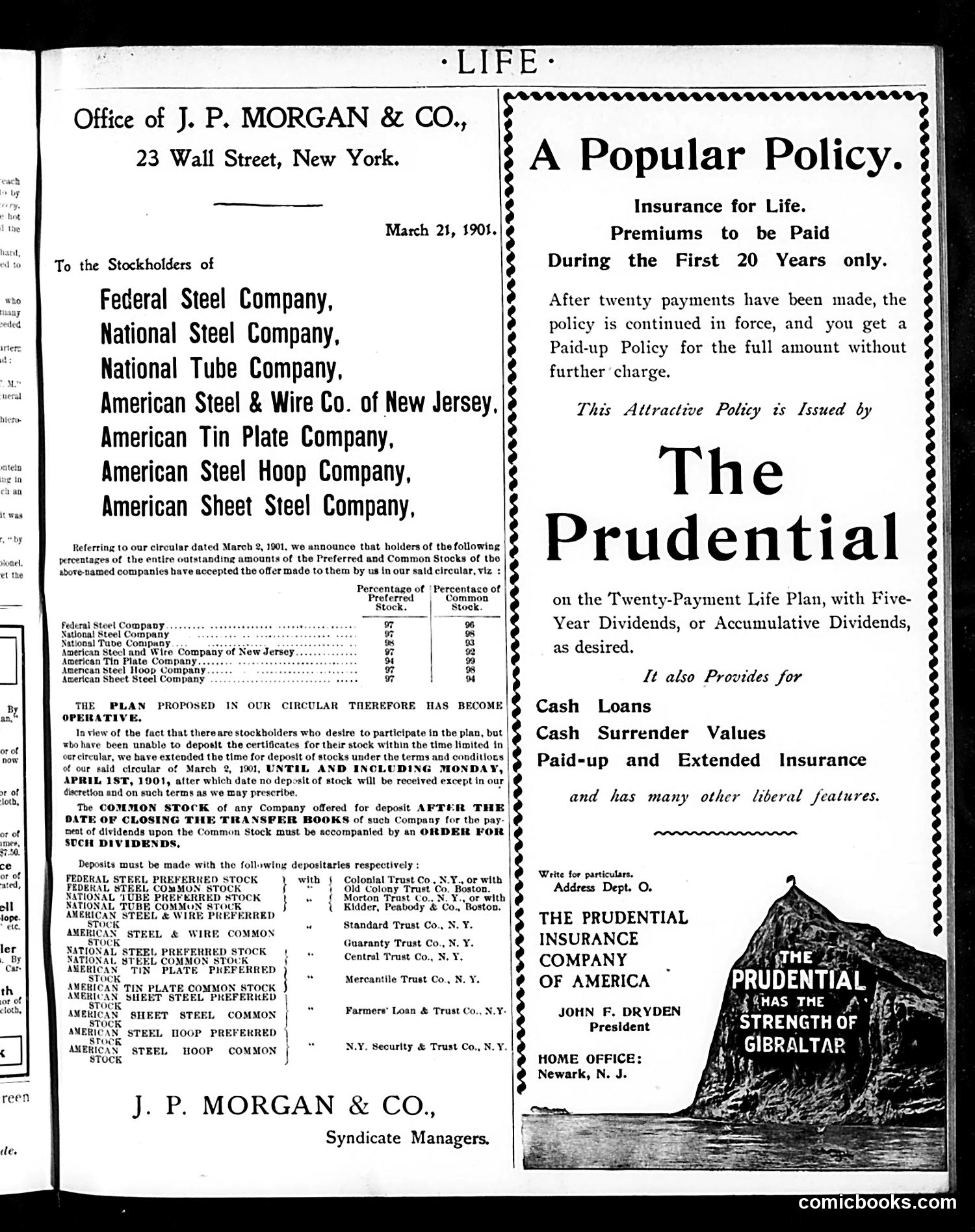
This page is primarily a **financial announcement, not a political cartoon**. It contains: **Left side**: A formal letter from J.P. Morgan & Co. (dated March 21, 1901) to stockholders of seven major steel companies, announcing a corporate consolidation plan. The firms listed—Federal Steel, National Steel, National Tube, and others—are being merged. Morgan, acting as "Syndicate Manager," extends the deadline for stockholders to deposit their shares (to April 1, 1901) to participate in the consolidation. **Right side**: A Prudential Insurance advertisement promoting a "Twenty-Payment Life Plan" with the company's famous Gibraltar Rock logo. **The satire** (if any intended): The juxtaposition is ironic—Morgan's massive steel monopoly announcement sits opposite an insurance ad promising security and strength. A modern reader might see dark humor in pairing financial consolidation with life insurance, but the page appears primarily functional rather than satirical.
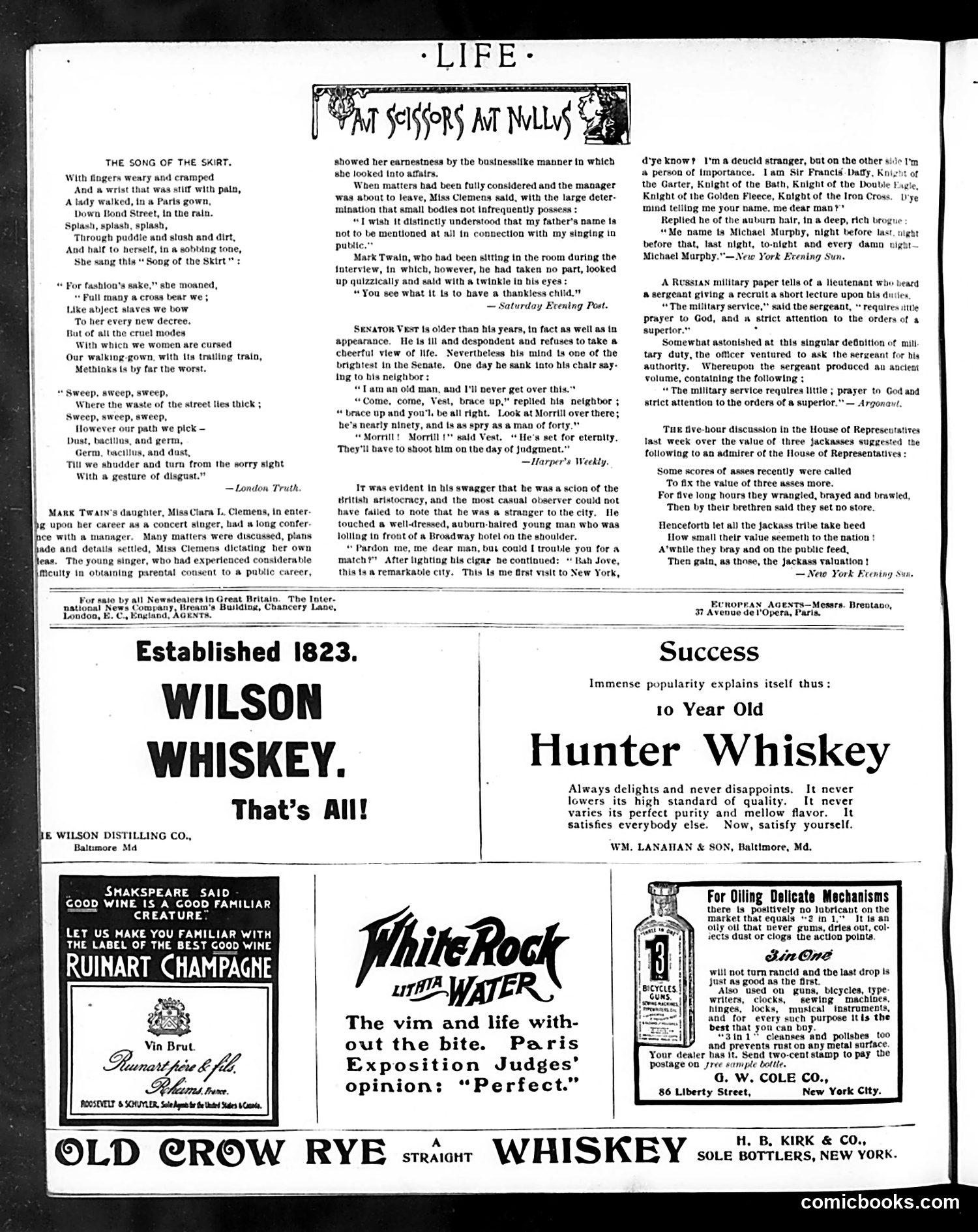
This page mixes satirical commentary with advertising. The main content includes: **"The Song of the Skirt"** — A poem satirizing women's fashion, specifically long trailing skirts. The joke: ladies must sweep filthy street debris (dust, bacteria, germs) while walking in Paris gowns, lamenting fashion's cruel demands on women forced to follow impractical trends. **Mark Twain anecdote** — His daughter Clara, launching a singing career, insists her famous father's name not be used. Twain's dry response ("You see what it is to have a thankless child") is the humor. **Senator Vest story** — An aging senator refuses encouragement, claiming he's worn out. The joke plays on his despondency versus Morrill's spryness. **British aristocrat joke** — A pompous British stranger meets an Irish-American; after listing his titles, he learns the other man is "Michael Murphy, night before last night..." — satirizing Irish immigration and working-class New York versus British pretension. The remaining content is period advertisements for whiskey, champagne, and mechanical oils. The page reflects turn-of-century American attitudes toward fashion, social climbing, and immigrant humor.
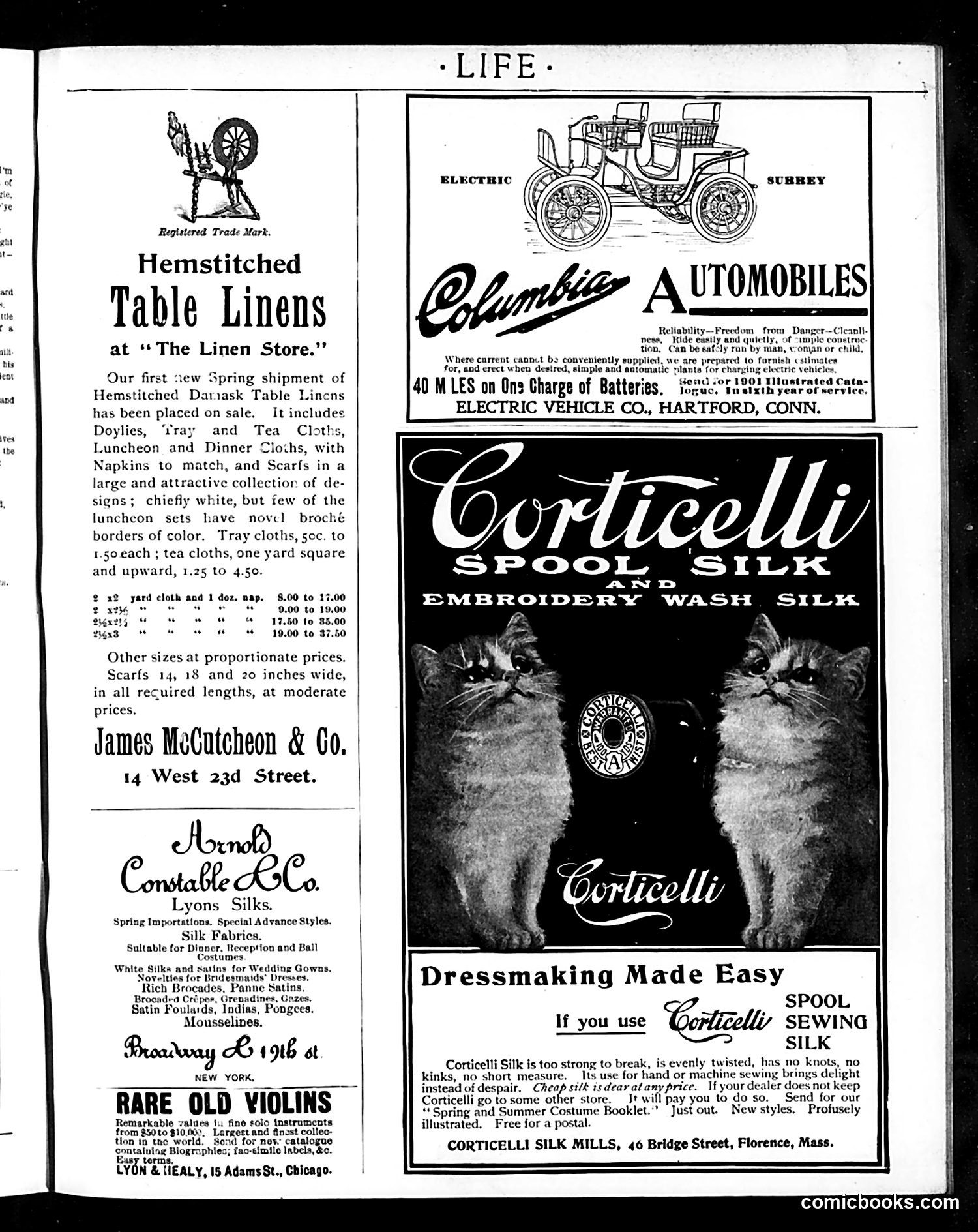
This is primarily an **advertising page**, not a satirical cartoon page. It contains six distinct product advertisements from circa early 1900s: 1. **Hemstitched Table Linens** — fine household textiles 2. **Columbia Electric Automobiles** — early electric vehicles touted for reliability and quiet operation 3. **Arnold Constable Silks** — luxury fabrics for formal wear 4. **Corticelli Spool Silk** — sewing thread (prominently featuring two cats) 5. **Rare Old Violins** — musical instruments 6. **Lyon & Healy** — violin dealer The page reflects **turn-of-the-century consumer culture**: electric cars were novel luxury items, fine imported fabrics signaled wealth, and quality thread was marketed as a solution to domestic frustrations. The cat imagery in the Corticelli ad suggests anthropomorphic product endorsement—a common early advertising technique. There is **no political satire visible** here; this is straightforward period advertising documenting what affluent Americans purchased around 1900-1910.
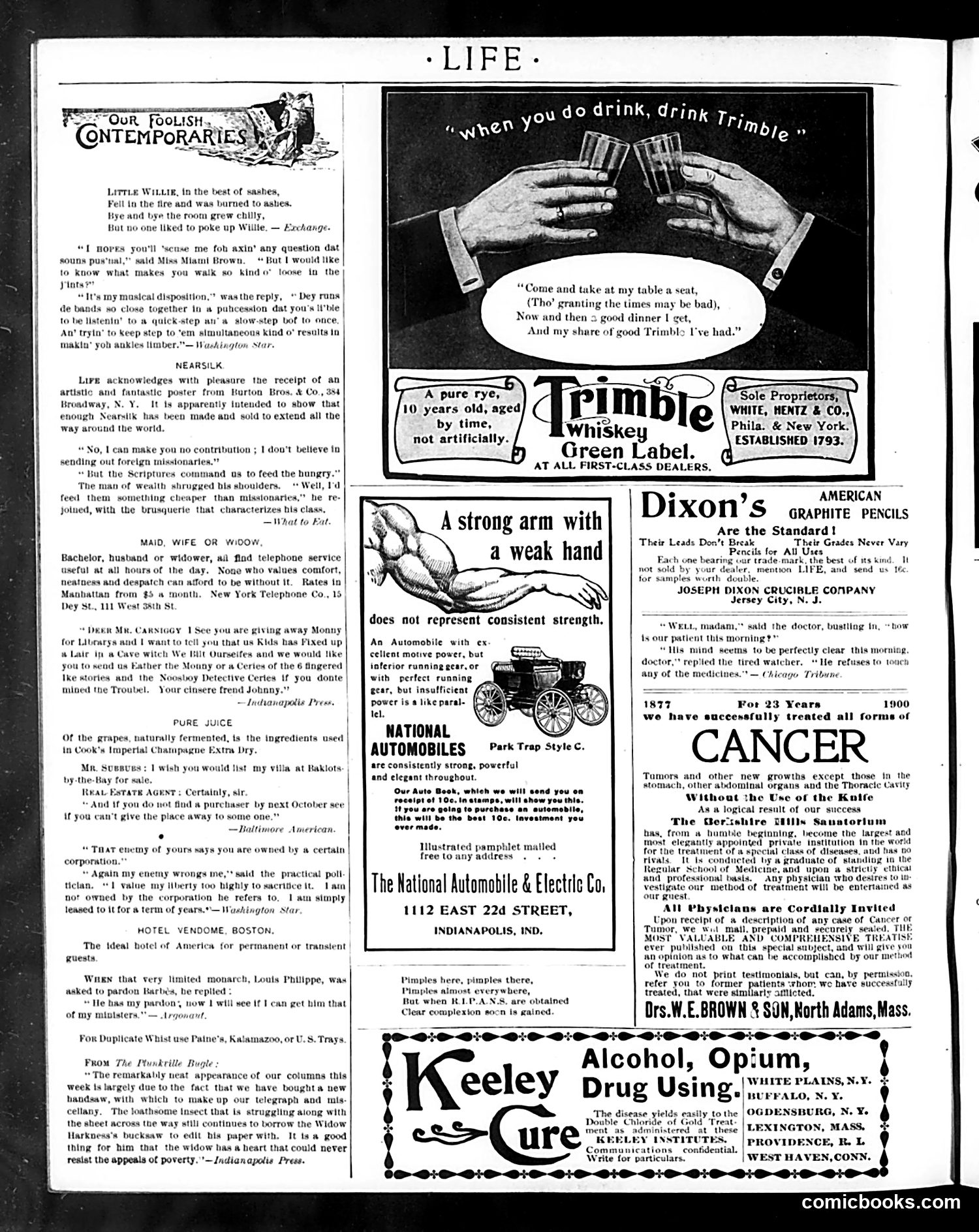
This page is primarily **advertising with satirical filler content**—typical of early Life magazine's format. The left column contains short humorous anecdotes labeled "Our Foolish Contemporaries," mocking human behavior through brief jokes: a child burned in a fire, a woman's loose gait explained by musical rhythm, a wealthy man refusing charity. The right side features **advertisements for products common to the era**: Trimble Whiskey, Dixon's graphite pencils, National Automobiles, and notably, a "Keeley Cure" for alcohol and drug addiction. This last ad reflects the period's genuine social concern about substance abuse before Prohibition. The visual cartoon (center-right) shows two hands clinking whiskey glasses with the slogan "when you do drink, drink Trimble"—advertising alcohol while acknowledging drinking culture. **For modern readers**: This represents early 1900s advertising mixing alcohol promotion with remedial addiction treatments—a contradiction that would seem absurd today. The satirical quips mock class pretension and foolish behavior in ways that remain recognizable, though dated in reference and dialect.
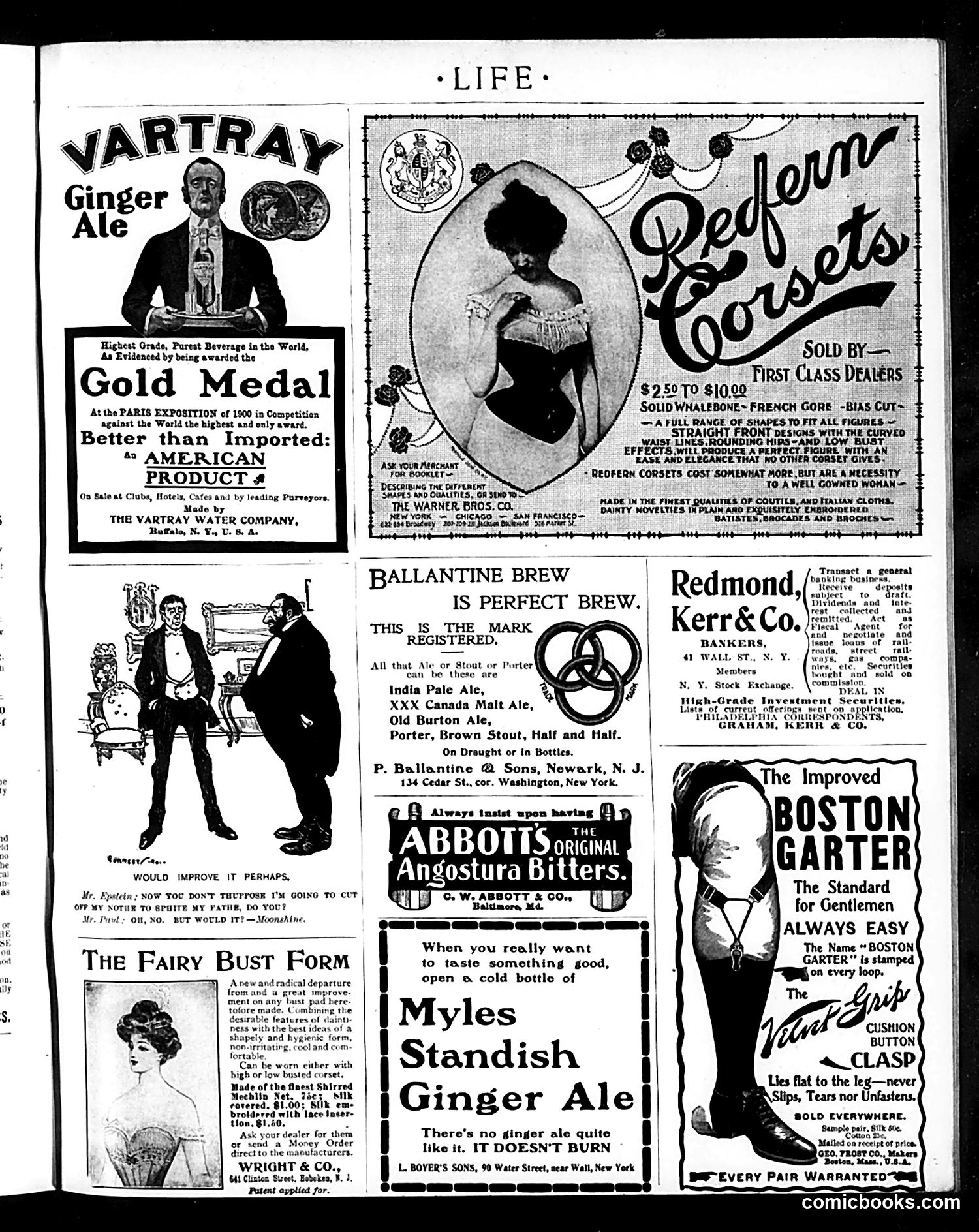
This is **primarily a advertisements page**, not political satire. It showcases early 1900s consumer products targeting affluent Americans. **Key advertisements:** - **Vartray Ginger Ale**: Claims superiority by winning gold at the 1900 Paris Exposition, emphasizing it's "Better than Imported" American product—appealing to nationalist sentiment. - **Redfern Corsets**: High-end women's undergarments ($2.50-$10.00) promising "perfect figure" through whalebone construction—reflects era's rigid beauty standards. - **The Fairy Bust Form**: A corset alternative marketed as "radical departure," addressing evolving fashion. - **Boston Garter**: Men's sock garters advertised as "standard for gentlemen." - **Various beverages**: Ballantine beer, Myles Standish ginger ale, Abbott's Angostura Bitters—all marketed as quality products. The small cartoon showing Mr. Epstein appears to be light social humor rather than satire. Overall, the page reflects Gilded Age consumer culture and advertising strategies emphasizing quality, exclusivity, and respectability.
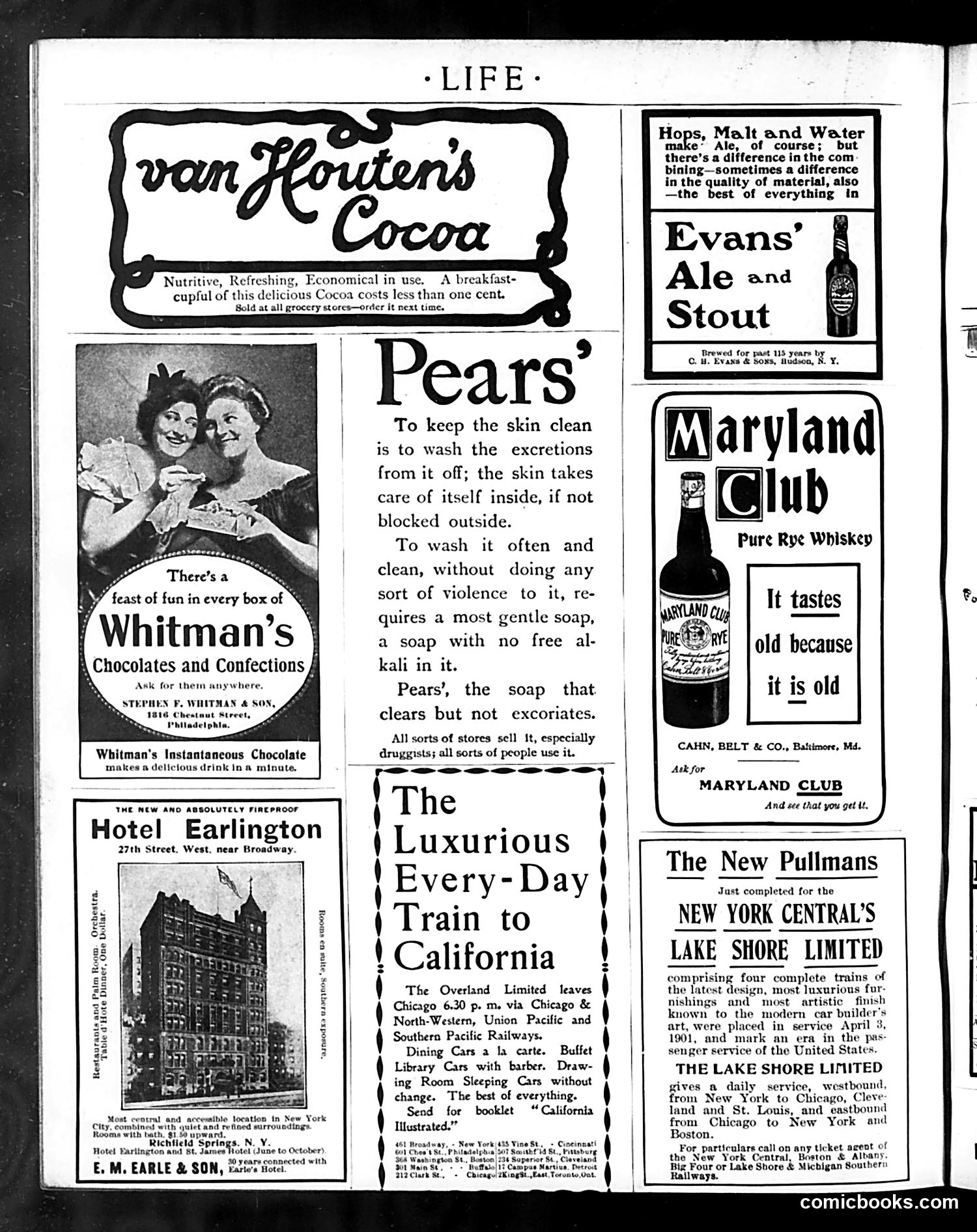
This is **not a cartoon page but an advertising page** from Life magazine, likely from around 1901 (based on the Pullman train reference dated April 3, 1901). The page contains six product advertisements typical of the era: 1. **Van Houten's Cocoa** — breakfast drink 2. **Whitman's Chocolates** — confections 3. **Pears' Soap** — emphasizing gentle cleansing without skin damage 4. **Hotel Earlington** — NYC lodging on West 27th Street 5. **Overland Limited Train** — luxury California travel via Chicago & North-Western Railway 6. **Evans' Ale and Stout, Maryland Club Whiskey, and Lake Shore Limited Pullman Cars** — beverages and rail service The advertisements reflect Gilded Age consumer culture: luxury travel, branded chocolates, patent medicines, and alcoholic beverages marketed without modern restrictions. The emphasis on "the best of everything" appears repeatedly, suggesting aspirational marketing to middle-class readers. No political satire is present; this is commercial content.
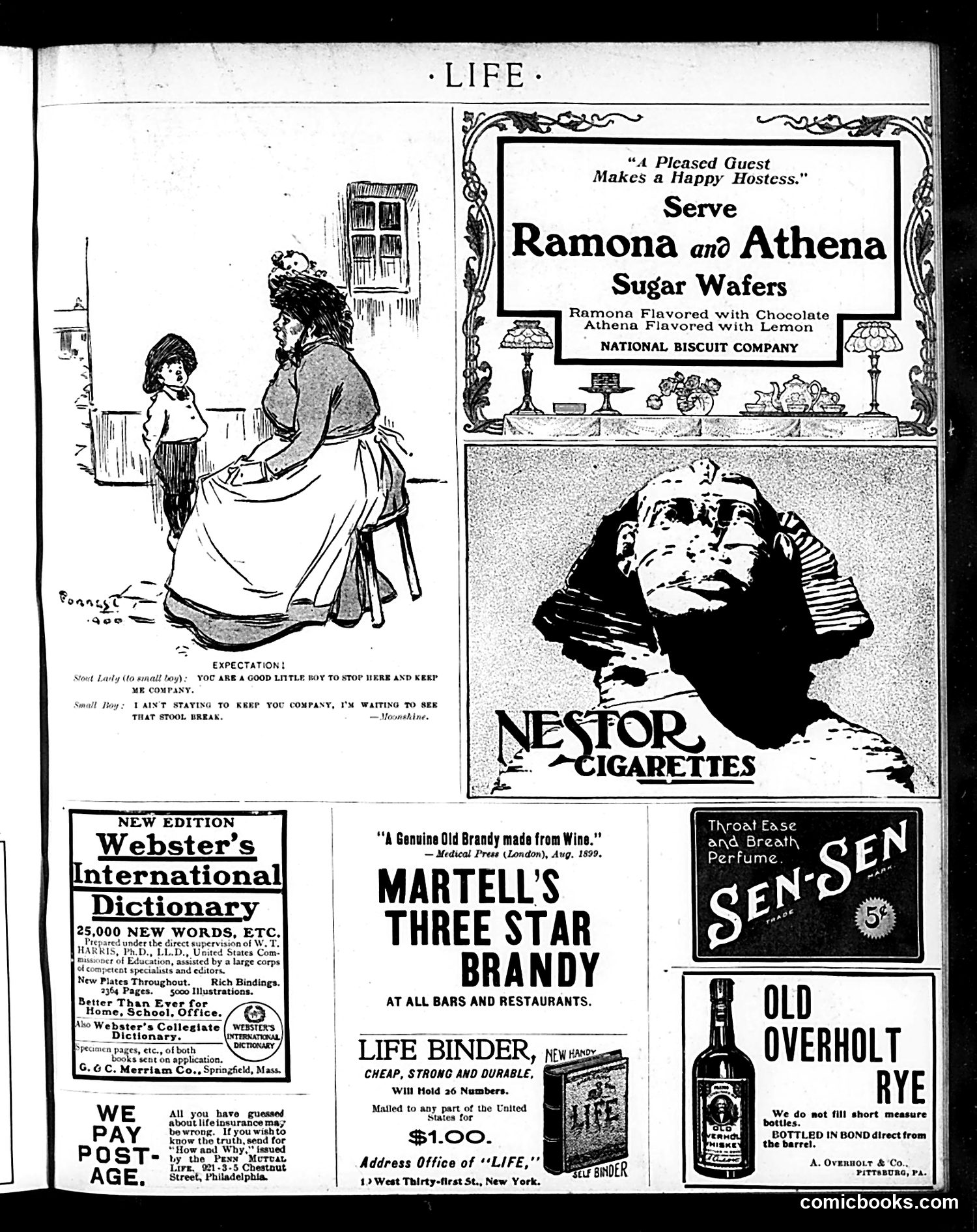
This page is primarily **advertisements** for consumer products (biscuits, brandy, cigarettes, dictionary, rye whiskey, perfume) interspersed with one cartoon. The cartoon titled "Expectation" shows a well-dressed woman and small boy. The boy states he's not staying to keep her company but waiting to see "that stool break"—a joke about the boy's mischievous anticipation that the furniture will fail under the woman's weight. The humor relies on a crude insult about the woman's size, typical of early 20th-century satire. The caption attributes the joke to "Moonshine," likely a pen name for the cartoonist. The page itself demonstrates how *Life* magazine—despite its satirical reputation—depended heavily on advertising revenue, mixing editorial content with product endorsements that used contemporary marketing appeals about hospitality and quality.
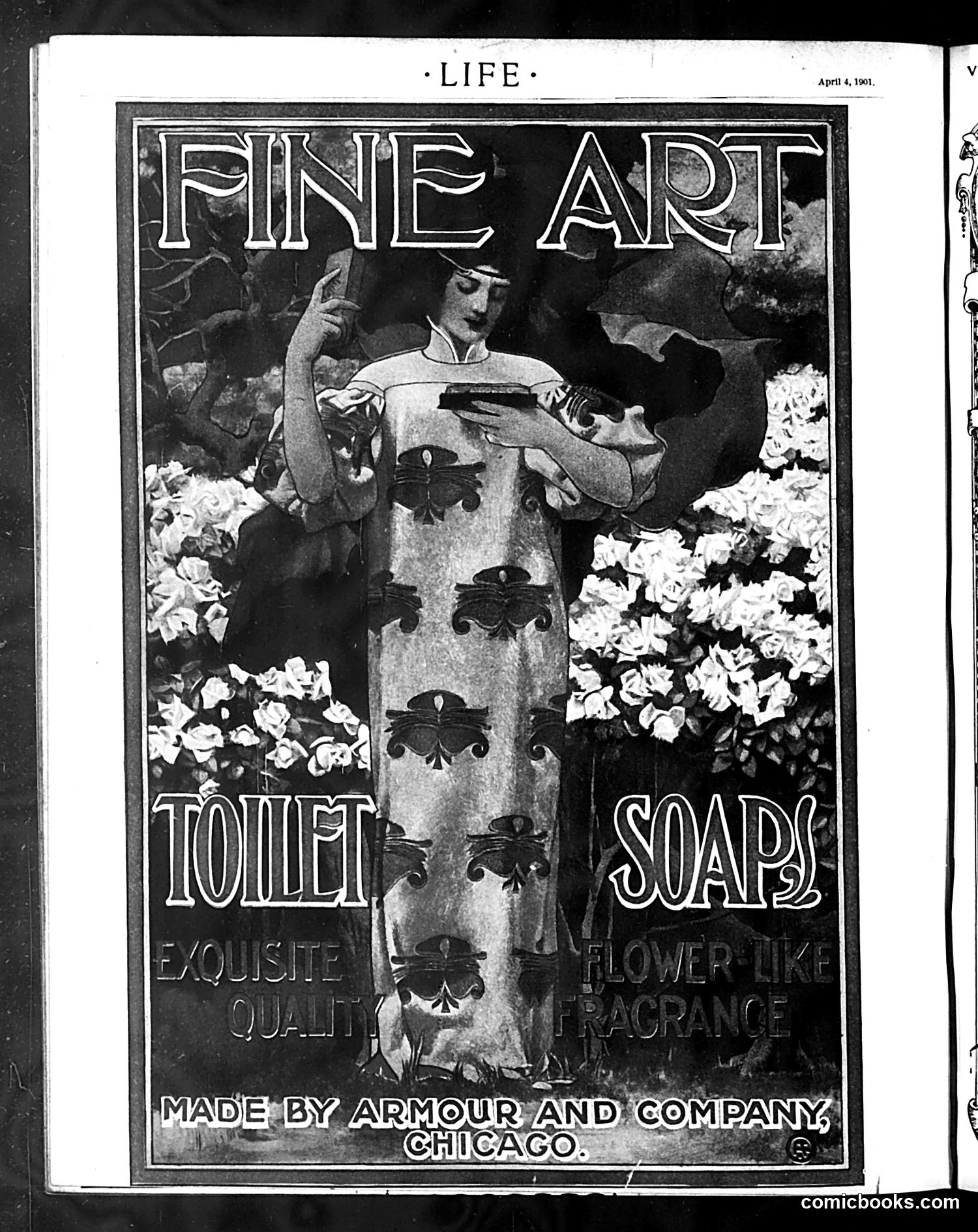
This page is a **product advertisement**, not political satire. It promotes "Fine Art Toilet Soaps" made by Armour and Company of Chicago, published in *Life* magazine on April 4, 1901. The ad uses Art Nouveau styling with decorative typography and features a woman in classical dress surrounded by ornamental floral designs. The soaps are marketed with slogans emphasizing "Exquisite Quality" and "Flower-Like Fragrance." The "fine art" framing—with the woman posed like a classical sculpture—was a common marketing strategy in this era, associating consumer products with high culture and refinement to appeal to middle and upper-class consumers, particularly women.