
Life, 1901-04-04 · page 6 of 32
Life — April 4, 1901 — page 6: what you’re looking at
What you’re looking at
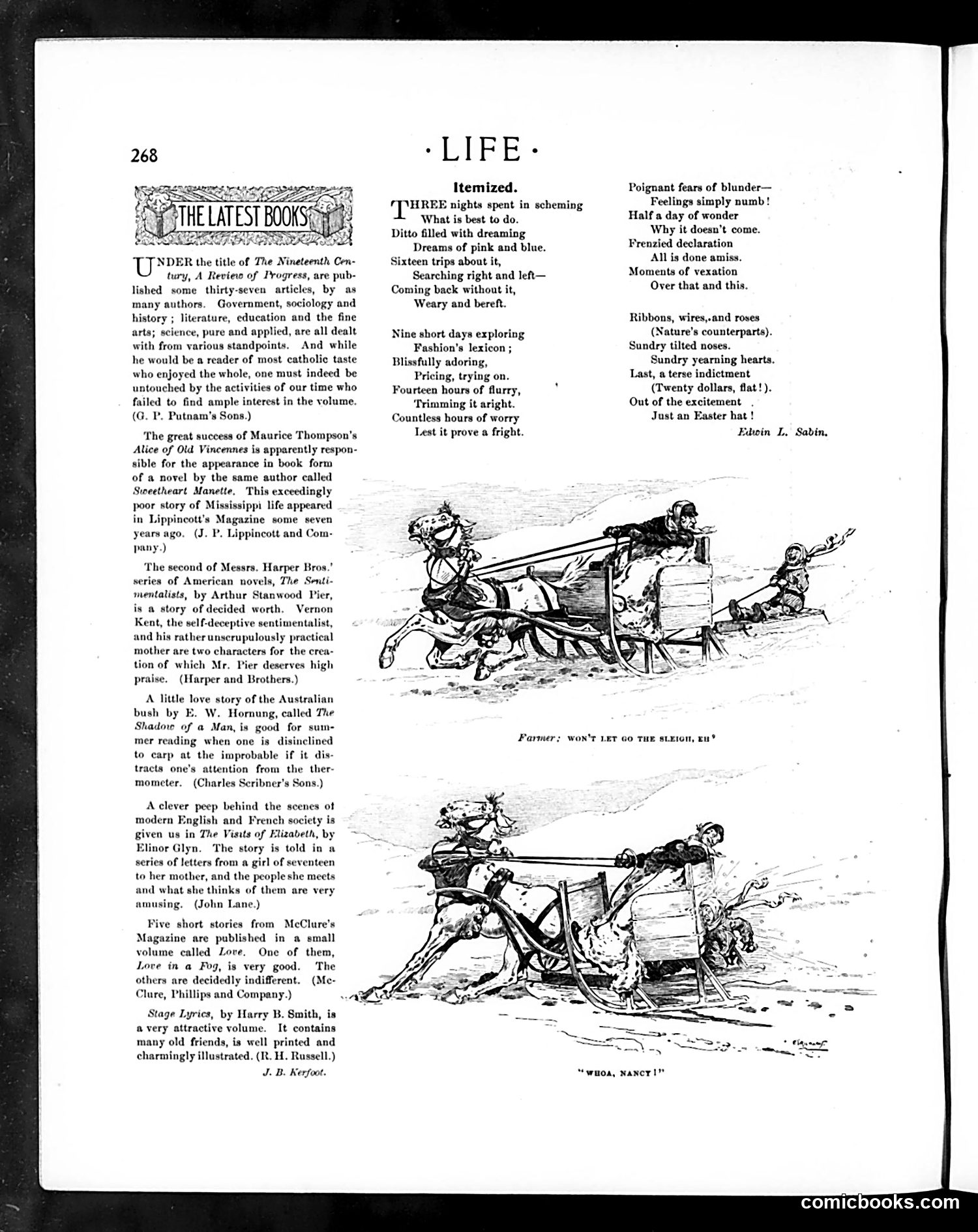
This page features two cartoon illustrations depicting a farmer struggling with a runaway horse-drawn sleigh in winter conditions. The captions read "Farmer: won't let go the sleigh, eh?" and "Whoa, Nancy!" The cartoons appear to illustrate a humorous domestic scene rather than political satire. They depict a comedic struggle between the farmer and his horse, who refuses to release or control the sleigh—a relatable scenario for rural readers of this era. The page's main content is "The Latest Books," a literary review section discussing contemporary publications by authors like Maurice Thompson and Arthur Stanwood Pier. The farm scene cartoons serve as light illustration for this reading-focused magazine page, offering visual humor unrelated to the book reviews.
📄 Transcribed text from this page (OCR, searchable)
Machine-transcribed from the original scan — historical spelling and the odd misread are preserved.
STREAKS NDER the title of The Nineteenth Cen- tury, A Review of Progress, are pub- lished some thirty-seven articles, by as many authors. Government, sociology and history ; literature, education and the fine arts; s¢ pure and applied, are all dealt with from various standpoints. And while he would be a reader of most catholic taste who enjoyed the whole, one must indeed be untouched by the activities of our time who failed to find ample interest in the volume. (G. P, Putnam's Sons.) ‘The great success of Maurice Thompson's Alice of Old Vincennes is apparently respon- sible for the appearance in book form of a novel by the same author called Sweetheart Manette, This exceedingly poor story of Mississippi life appeared in Lippincott's Magazine some seven years ago. (J. P. Lippincott and Com- pany.) The second of Messrs. Harper Bros.’ series of American novels, The Senti- mentalists, by Arthur Stanwood Pier, is a story of decided worth, Vernon Kent, the self-deceptive sentimentalist, and his ratherunscrupulously practical mother are two characters for the crea- tion of which Mr. Pier deserves high praise. (Harper and Brothers.) A little love story of the Australian bush by E. W. Hornung, called The Shadow of a Man, is good for sum- mer reading when one is disinclined to carp at the improbable if it dis- tracts one’s attention from the ther- mometer. (Charles Scribner's Sons.) A clever peep behind the scenes of modern English and French society is iven us in The Visits of Elizabeth, by or Glyn. The story is told in a series of letters from a girl of seventeen to her mother, and the people she meets and what she thinks of them are very amusing. (John Lane.) Five short stories from McClure’s Magazine are published in a small volume called Love. One of them, Love in a Fog, is very good. The others are decidedly indifferent. (Me- Clure, Phillips and Company.) Stage Lyrics, by Harry B. Smith, a very attractive volume. It contains many old friends, is well printed and charmingly illustrated. (It. H. Russell.) J. B. Kerfoot. ‘LIPE + Itemized. (THREE nights spent in scheming What is best to do. Ditto filled with dreaming Dreams of pink and blue. Sixteen trips about it, Searching right and left— Coming back without it, Weary and bereft. Nine short days exploring Fashion’s lexicon ; Blissfully adoring, Pricing, trying on. Fourteen hours of flurry, ‘Trimming it aright. Countless hours of worry Lest it prove a fright. Poignant fears of blunder— Feelings simply numb! Half a day of wonder Why it doesn't come. Frenzied declaration All is done amiss. Moments of vexation Over that and this. Ribbons, wires,.and roses (Nature's counterparts). Sundry tilted noses. Sundry yearning hearts. Last, a terse indictment (Twenty dollars, flat!). Out of the excitement . Just an Easter hat! Edwin L, Sabin, Farmer; won't Ler Go Tur stxion, rut “wuoa, Nancr!” comicbooks.com