
A complete issue · 20 pages · 1901
Life — January 24, 1901
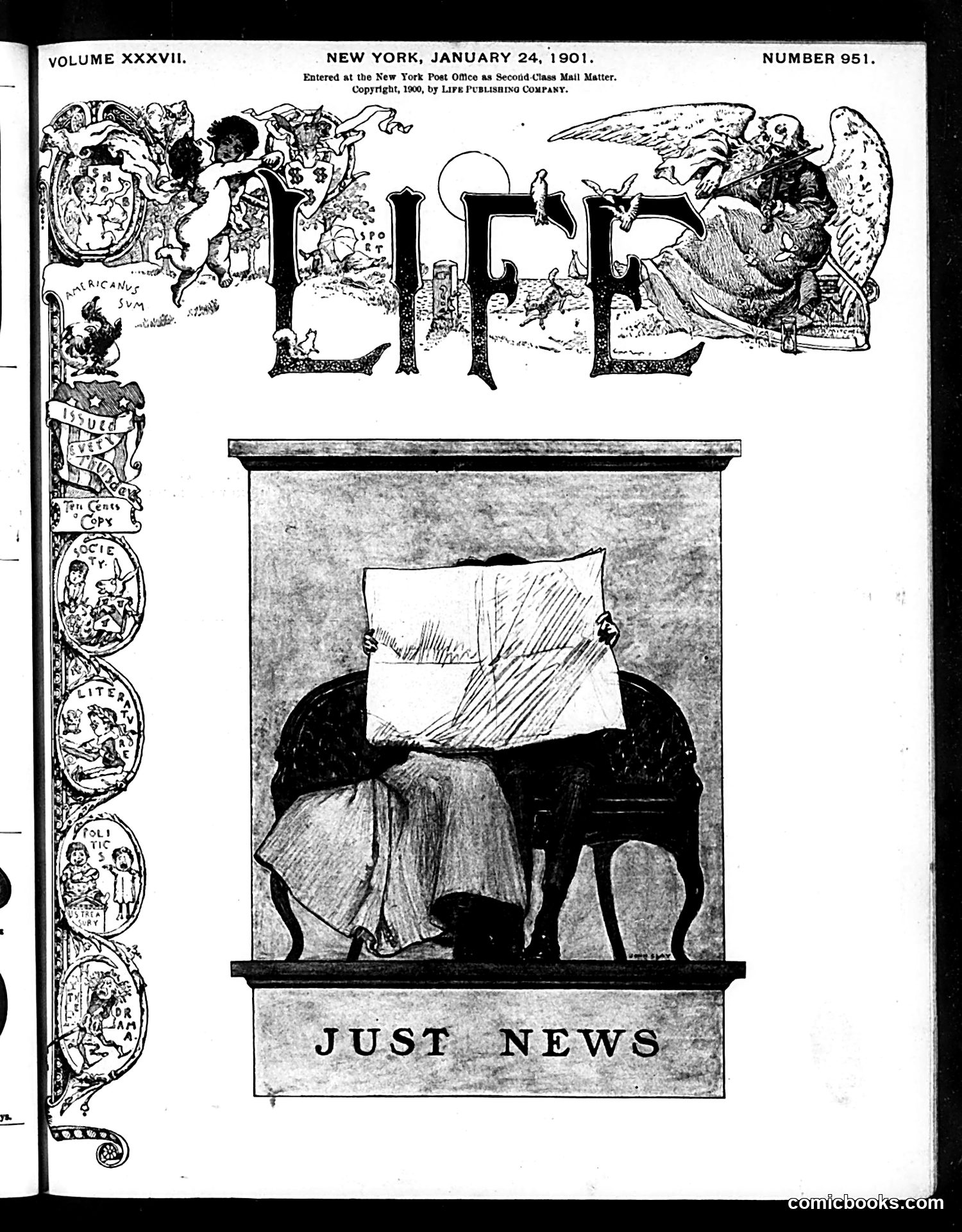
This is the cover page of Life magazine's satirical section titled "JUST NEWS." The main illustration shows a figure seated in a chair, holding up a large newspaper to obscure their face. The figure wears dark formal clothing with a light-colored skirt, suggesting a woman in early 1900s dress. The "JUST NEWS" caption suggests this is satirizing how people hide behind newspapers—likely commentary on public figures or scandals being covered up by the press, or people avoiding uncomfortable truths by burying themselves in news. The ornate left border contains Life magazine's typical decorative masthead with classical figures. Without additional text identifying the specific figure or event, the exact satirical target remains unclear, though it appears to mock either media manipulation or willful ignorance of current events.
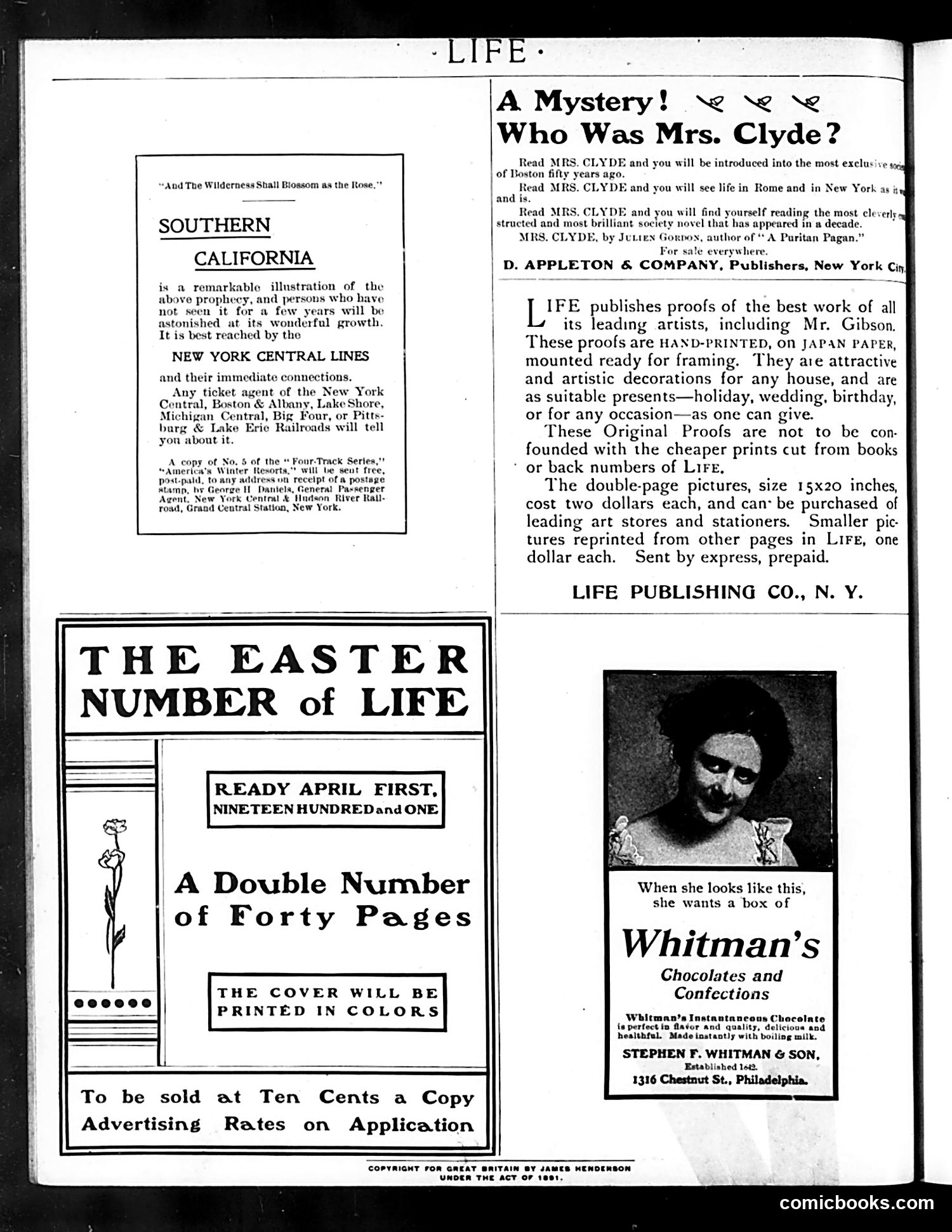
This page is **primarily advertising** rather than satirical content. The main elements are: 1. **Travel advertisements** for Southern California and New York Central Lines railroad connections 2. **"Mrs. Clyde" novel promotion** - advertising a new society novel by Julien Gordon, positioning it as sophisticated entertainment 3. **Life Publishing Company proofs** - promoting hand-printed art reproductions on Japan paper, marketed as upscale home décor for special occasions 4. **Easter Number announcement** - promoting an upcoming 40-page double issue (April 1, 1901) with color cover, priced at ten cents 5. **Whitman's Chocolates advertisement** - featuring a woman's photograph with the tagline "When she looks like this, she wants a box of Whitman's Chocolates" The page reflects early 1900s consumer culture targeting middle and upper-class readers with luxury goods and leisure travel.
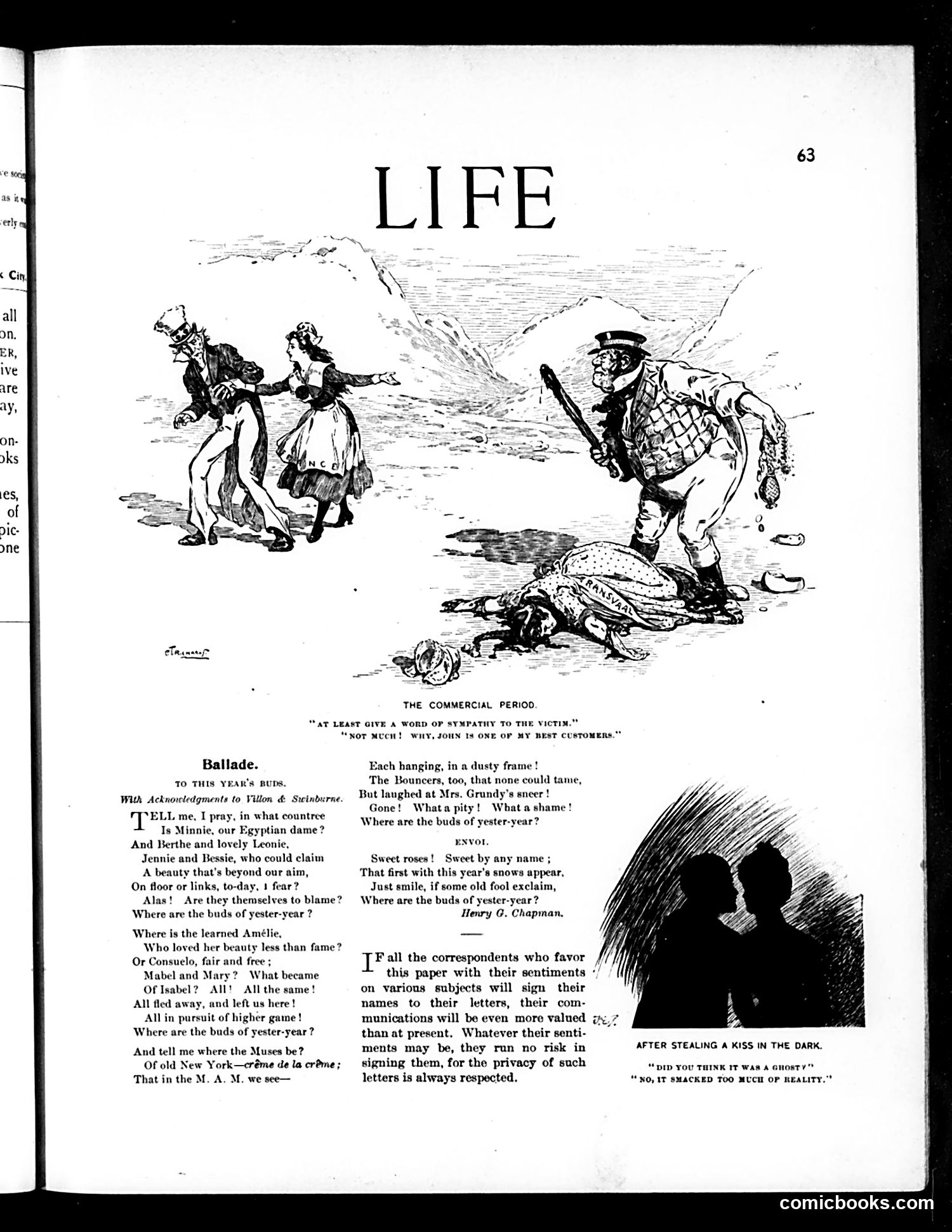
The main cartoon depicts a scene of commercial ruthlessness during what the caption calls "The Commercial Period." A well-dressed businessman strikes down a fallen figure (likely representing a small business or worker) with a club, while another couple observes in the background. The caption's quoted dialogue—"At least give a word of sympathy to the victim" / "Not much! Why, John is one of my best customers"—exposes the hypocrisy of gilded-age capitalism: even as someone is being destroyed economically, social pleasantries mask indifference to their suffering. This satirizes late 19th-century American business practices, where ruthless competition and consolidation were normalized among the wealthy, who maintained polite social facades while enabling economic devastation.
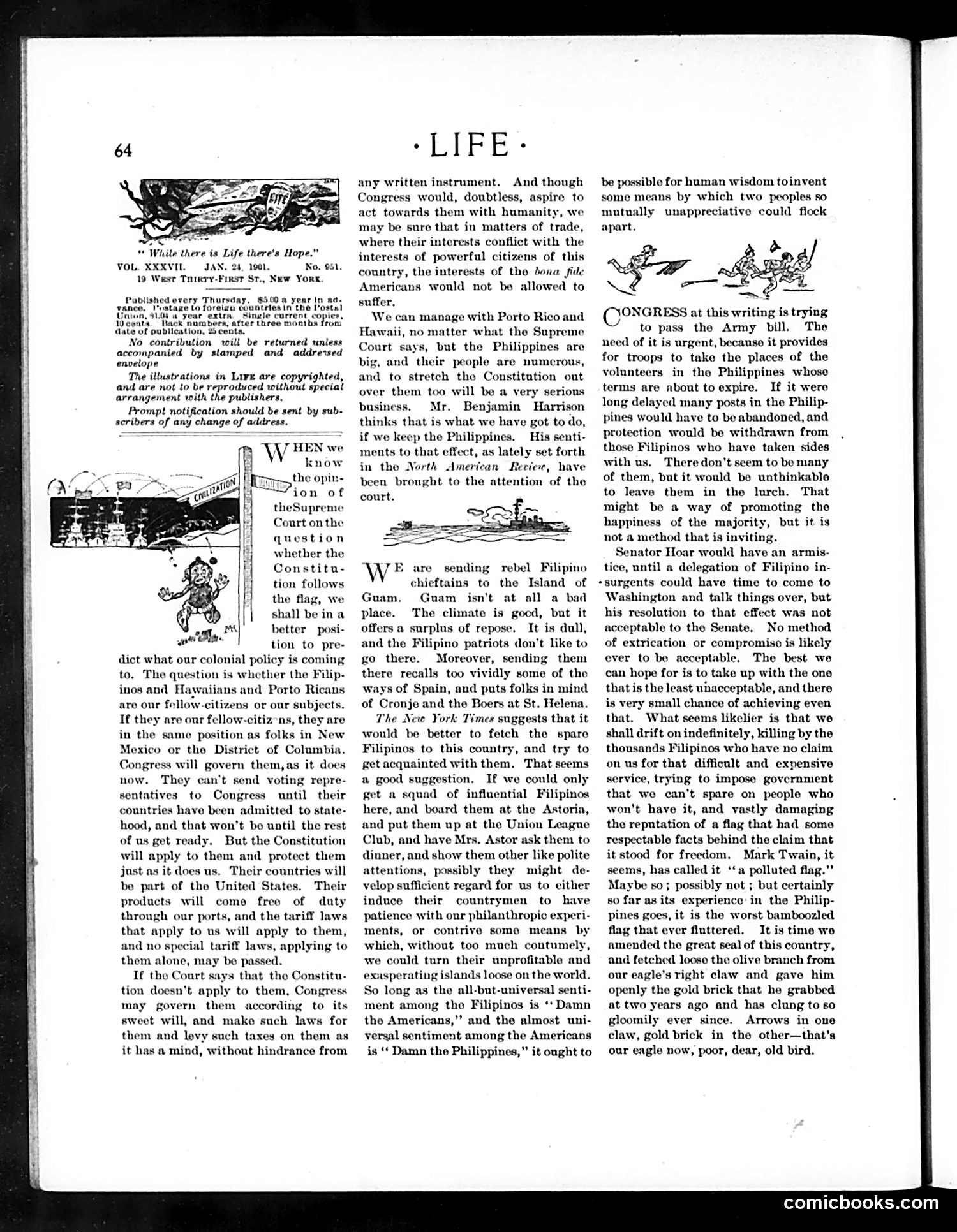
The page contains political commentary on American imperial policy in the Philippines, particularly debating whether to grant Filipino insurgents recognition or military concessions. **The main cartoon** (upper left) appears to satirize the Supreme Court's constitutional authority over colonial policy—specifically whether the Constitution applies to territories like the Philippines and Puerto Rico. **The central illustration** shows a ship, likely referencing military operations or transport of troops to the Philippines. **The satirical point**: The article mocks proposals to negotiate with Filipino rebel leaders or grant them diplomatic status. The tone suggests treating such concessions as absurd—the author ridicules the idea of sending insurgent chieftains to Washington or allowing them influence, comparing it unfavorably to granting similar status to New Mexico or Columbia territories. The "polluted tag" and "eagle" references suggest cynicism about America's moral claims regarding colonial governance.
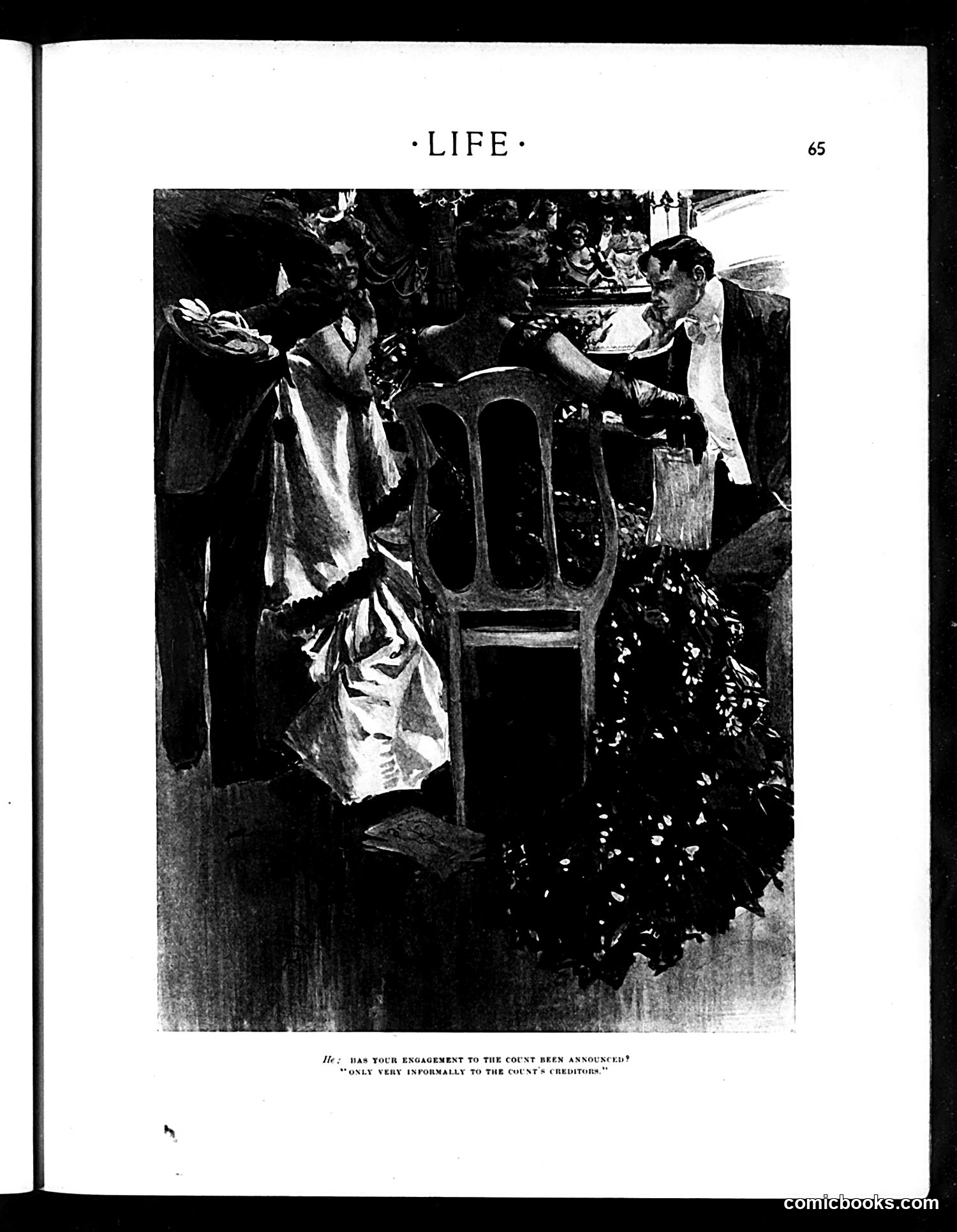
This illustration from *Life* magazine (page 65) depicts a social scene with well-dressed figures in what appears to be an elegant interior. The caption reads: "He: 'HAS YOUR ENGAGEMENT TO THE COUNT BEEN ANNOUNCED?' 'ONLY VERY INFORMALLY TO THE COUNT'S CREDITORS.'" The satire targets wealthy American women's marriages to impoverished European nobility—a common social phenomenon in the Gilded Age. The joke centers on a woman's engagement to a "count" whose primary concern isn't the announcement itself, but rather appeasing his creditors. This mocks both the pretension of such aristocratic matches and the financial desperation behind them, suggesting the count is marrying for money to settle debts. The humor derives from the cynical reality beneath the veneer of romantic aristocratic unions.
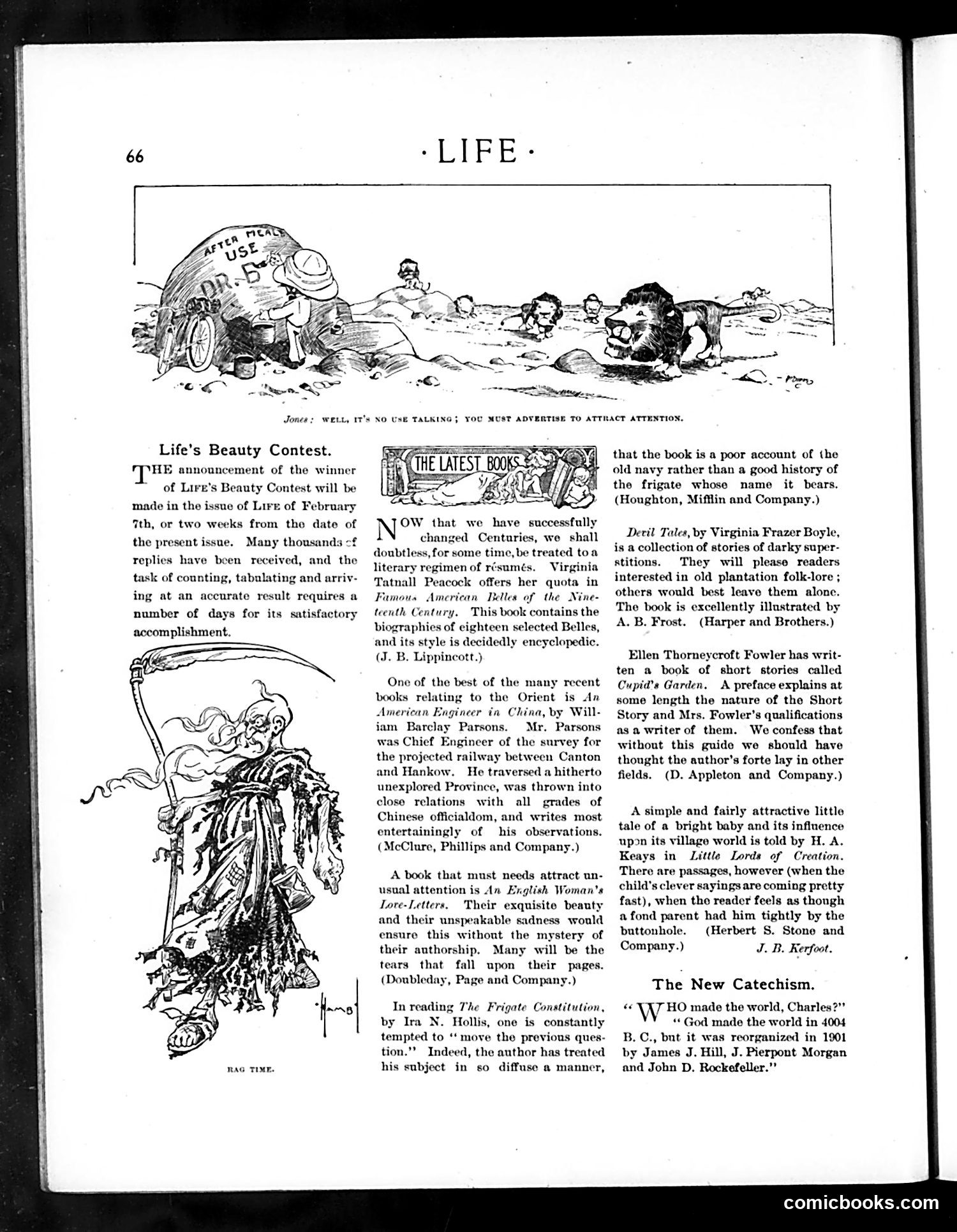
The top cartoon satirizes advertising excess. A heavily decorated automobile labeled "DR. B. S." (likely "Doctor of Bull S—") sits abandoned in a desert landscape while figures crawl past it. The caption reads: "WELL, IT'S NO USE TALKING; YOU MUST ADVERTISE TO ATTRACT ATTENTION." The joke mocks the absurdity of over-the-top advertising—the garish, oversized vehicle fails to actually attract customers, suggesting that excessive ads can backfire or become invisible through saturation. The lower illustration titled "RAG TIME" depicts an exaggerated caricatured figure, likely mocking the "ragtime" music craze popular in the early 1900s through grotesque visual exaggeration. The page's text reviews recent books, including works about China and the Orient, suggesting this is circa 1900s-1910s Life magazine.
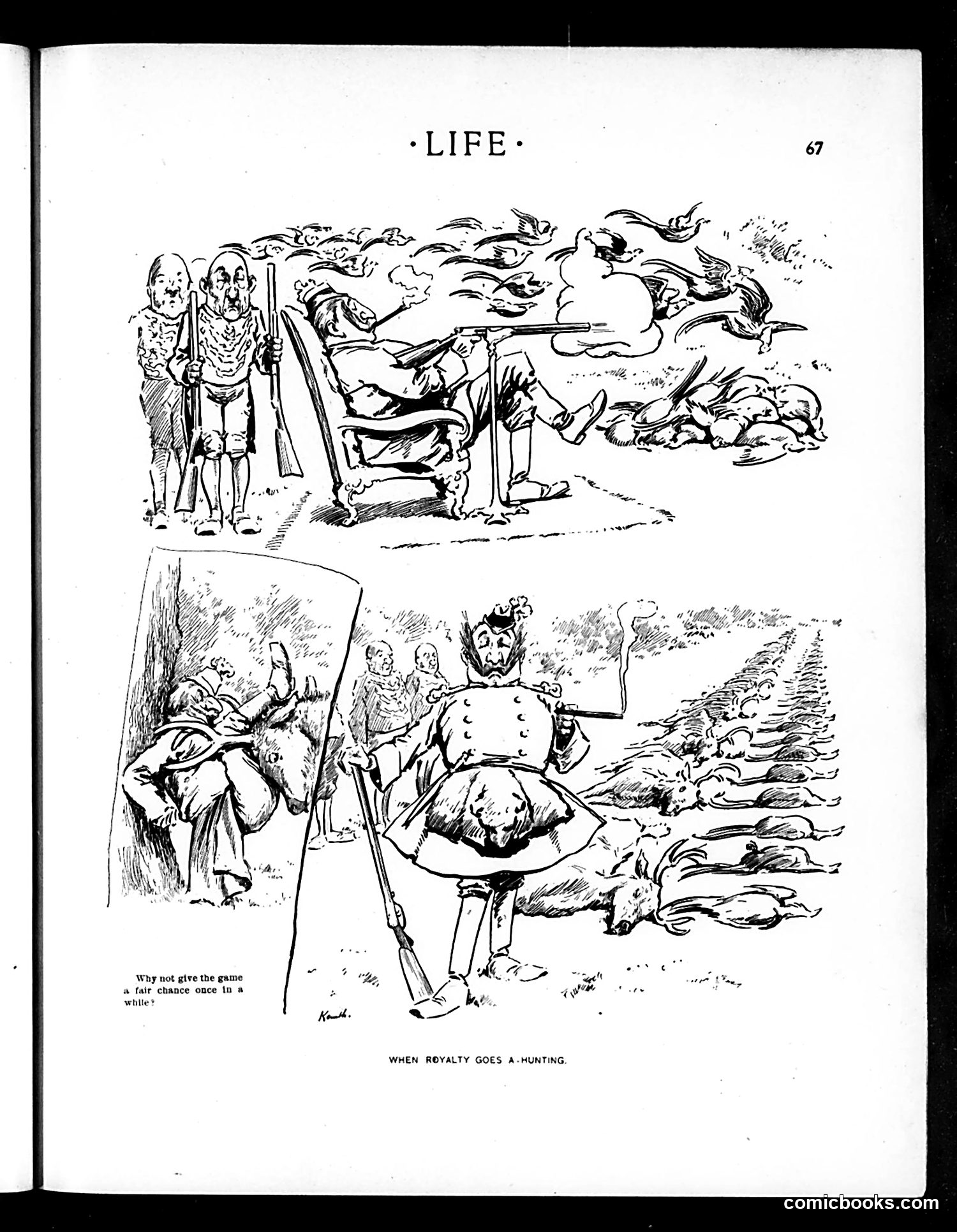
This satirical cartoon titled "When Royalty Goes A-Hunting" depicts a crowned figure (appearing to represent royalty) engaging in what the caption suggests is an unfair hunt. The two observers on the left appear skeptical or disapproving. The joke critiques the concept of "fair chase" in hunting—the crowned hunter has arranged an obviously rigged scenario where the prey (appearing to be game animals) cannot escape. The cartoon suggests that when wealthy or privileged people ("royalty") hunt, they manipulate circumstances to guarantee success rather than accepting genuine sporting risk. The caption's question "Why not give the game a fair chance once in a while?" directly mocks this practice, using hunting as a metaphor for aristocratic privilege and unfair advantages in society more broadly.
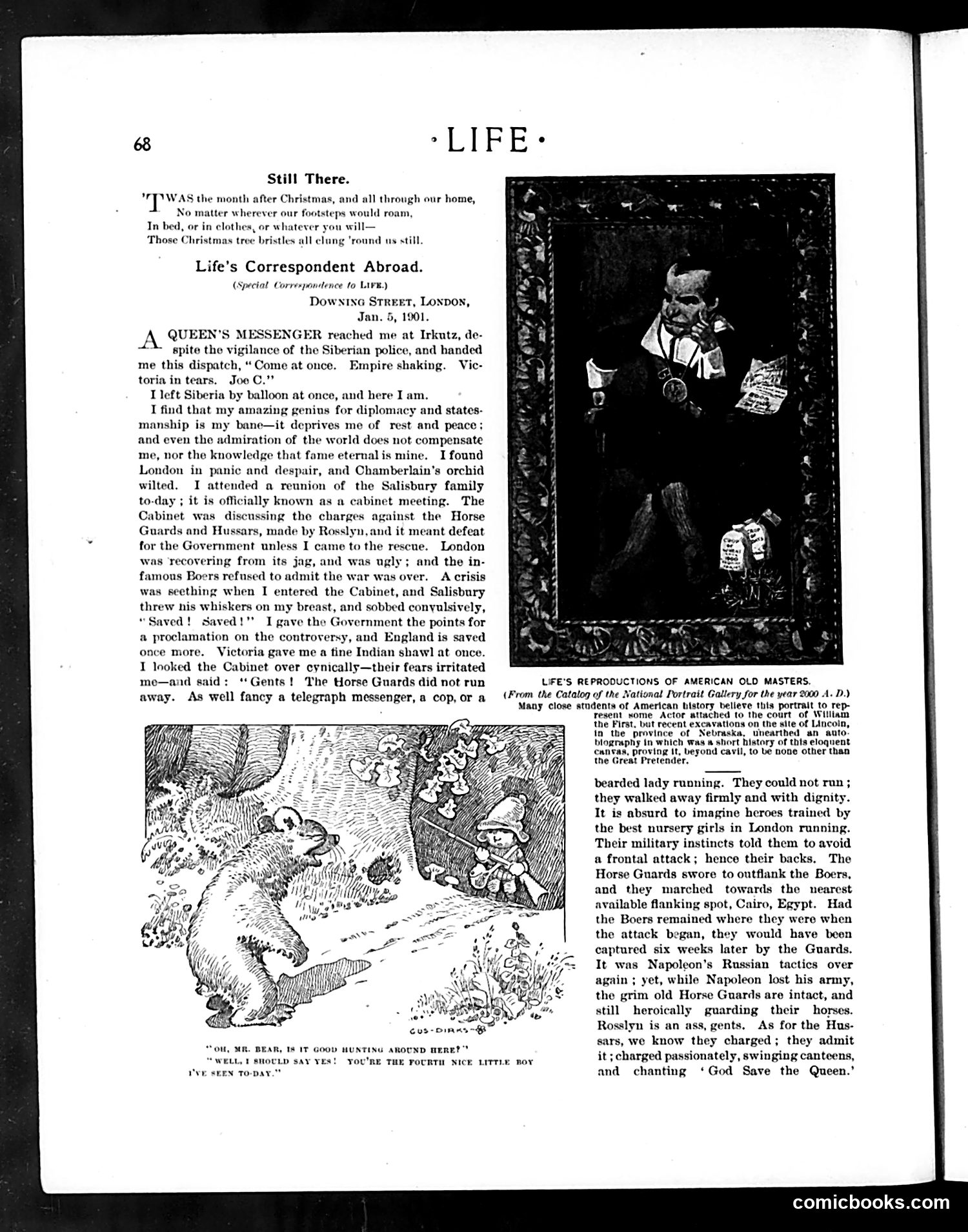
This page contains two satirical cartoons about British military and imperial affairs during the Boer War era (1901, per the dateline). **Top cartoon**: A caricatured British officer or dignitary appears to be receiving or reviewing documents, likely satirizing bureaucratic incompetence during the ongoing Boer War conflict. **Bottom cartoon**: Shows what appears to be a hunter or military figure with a bear, with the caption "Oh, Mr. Bear, is it good hunting around here?" / "Well, I should say yes! You're the fourth nice little boy I've seen to-day." This darkly satirizes British military casualties and losses—depicting soldiers as naive "boys" being hunted/killed like prey. The text accompanying discusses Horse Guards, the Boer conflict, and British military leadership under discussion during this period of imperial crisis.
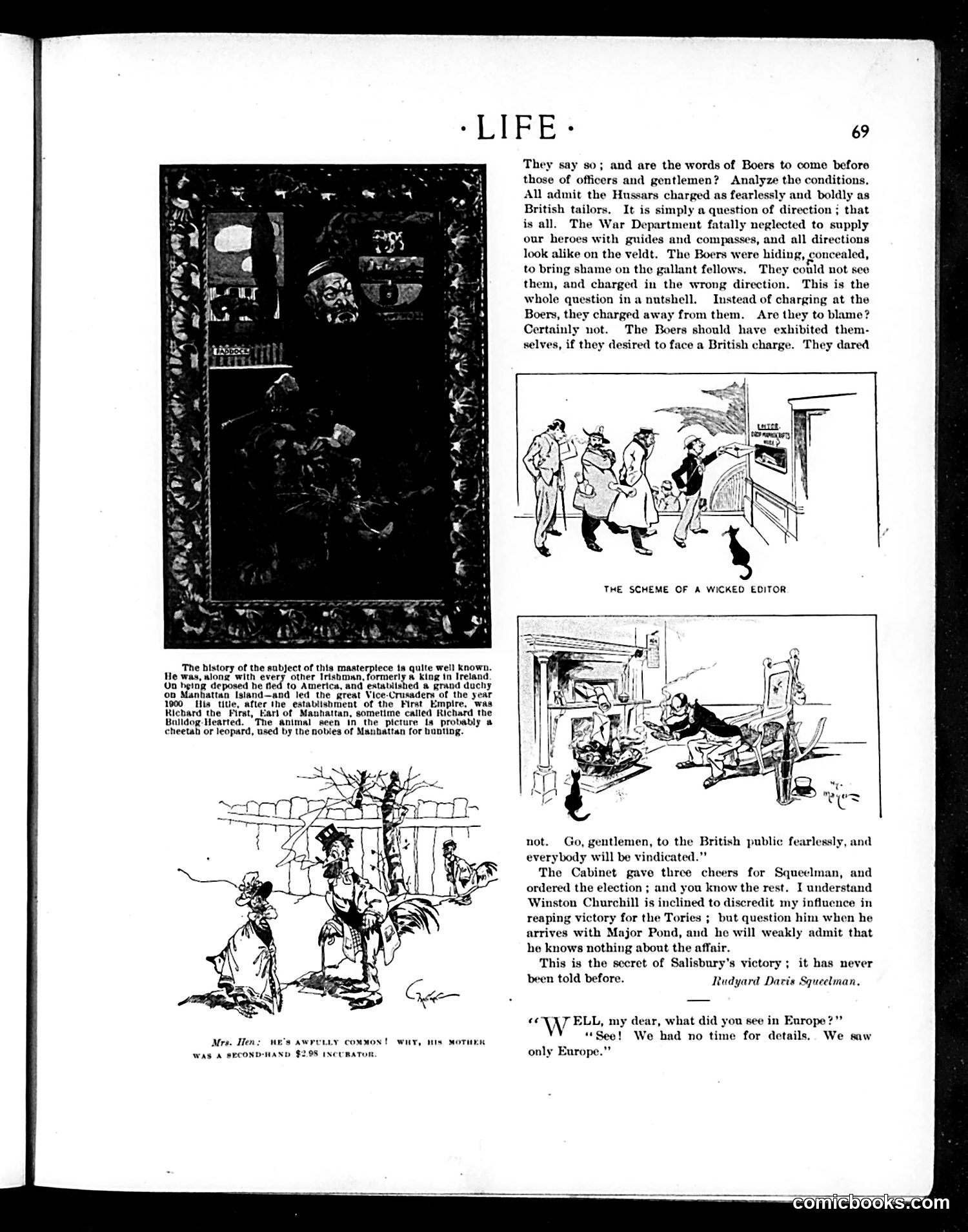
This page satirizes British military incompetence during the Boer War. The main text critiques the War Department's failure to equip soldiers with proper guides and compasses, leading to disastrous misdirected charges. The Boers, the text argues, deliberately retreated to provoke these blunders rather than facing direct British confrontation. The cartoons mock various incompetencies: "The Scheme of a Wicked Editor" depicts editorial manipulation, while another shows domestic chaos. A third cartoon (captioned about "Mrs. Hen") appears to satirize maternal foolishness. The passage concludes with a quote attributed to "Rudyard Davis Speedsman" (likely a satirical pseudonym), discussing political machinations around the election and Winston Churchill's admission of ignorance about military affairs, reinforcing the theme of leadership bungling.
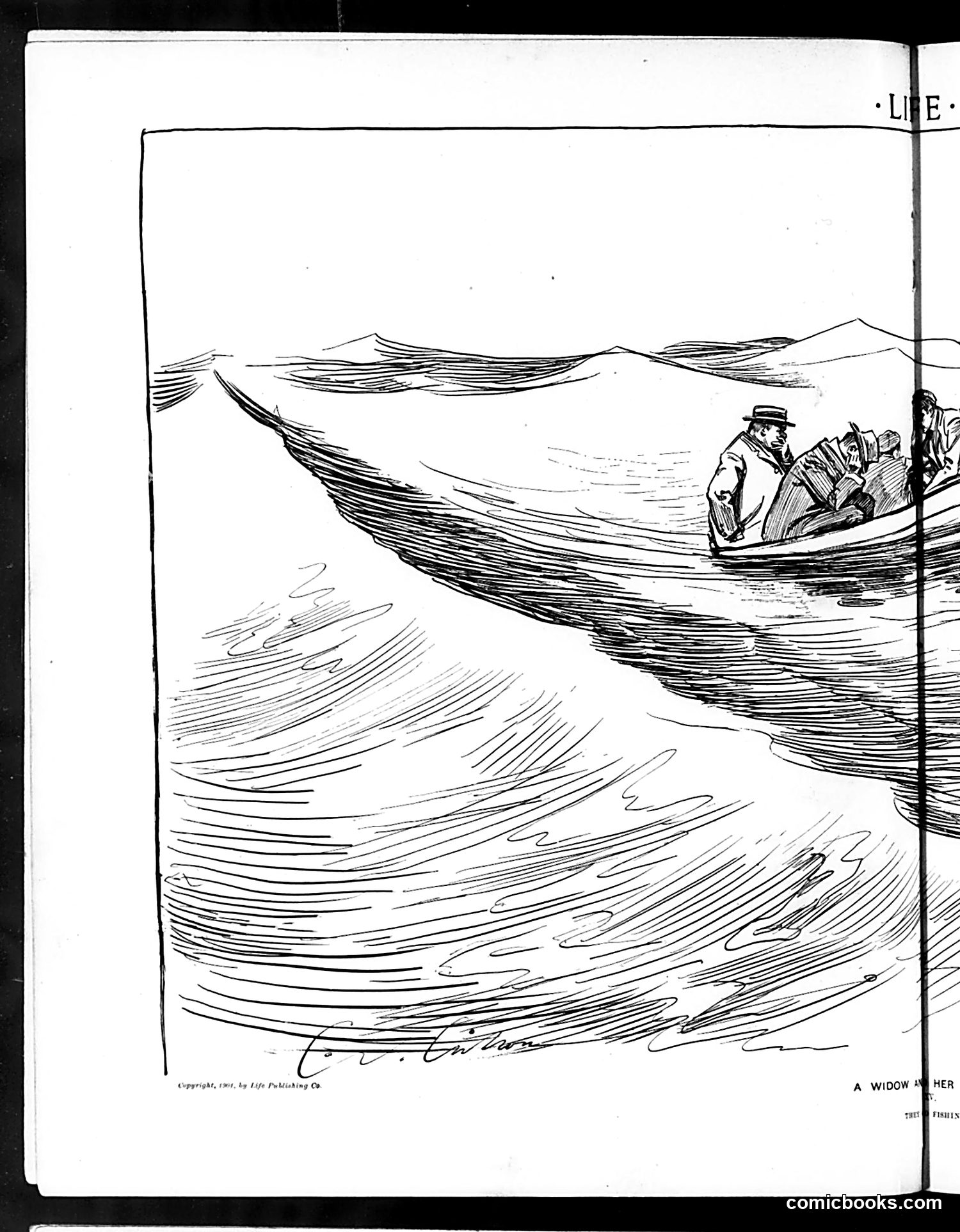
This appears to be a satirical drawing titled "A Widow in Her..." (title cut off). The sketch depicts a man in a hat and coat sitting in a small boat on rough water, with another figure visible on the right. The style uses heavy crosshatching to create water and atmospheric effects. Based on the title fragment "A WIDOW," this likely satirizes a widow's financial situation or romantic prospects—common subjects of early 20th-century Life magazine satire. The man in the boat may represent a suitor or financial advisor. The turbulent water could symbolize troubled circumstances or uncertain fortunes. However, without the complete title and caption text, the specific social commentary or political point remains unclear. The copyright note indicates Life Publishing Company ownership.
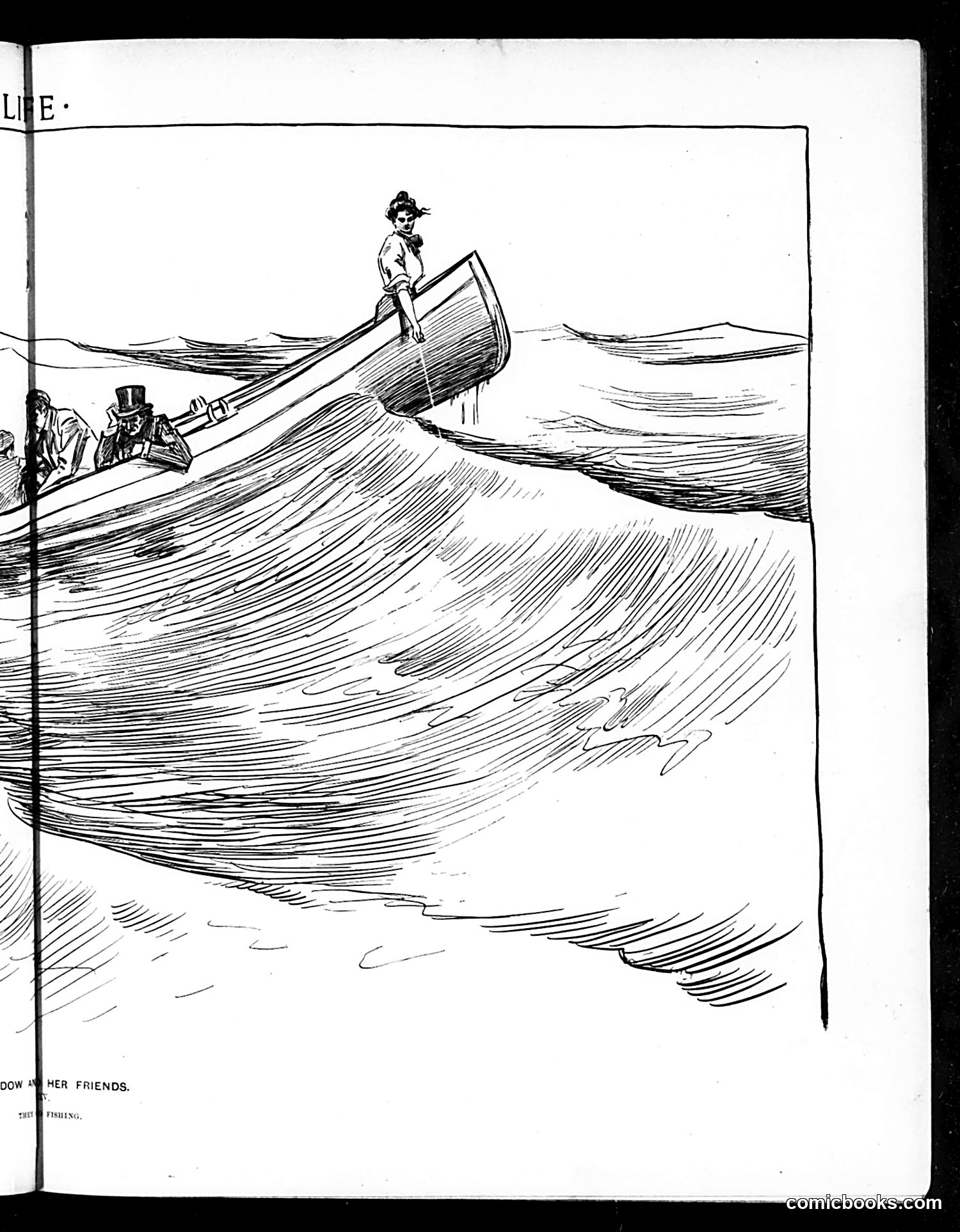
This appears to be a satirical cartoon from *Life* magazine depicting a fishing scene. A figure stands atop a large wave or water formation, holding what appears to be a bucket or container, while two other figures sit in a boat below on the left. The dynamic suggests a commentary on fishing or resource extraction. The partially visible OCR text at bottom reads "DOW IN HER FRIENDS" and "THE FISHING," though the full context is unclear. Without complete text or clearer identifying details, I cannot definitively state who these figures represent or what specific political/social issue is being satirized. The cartoon likely comments on fishing practices or resource management of its era, but the precise target of satire remains uncertain from this image alone.
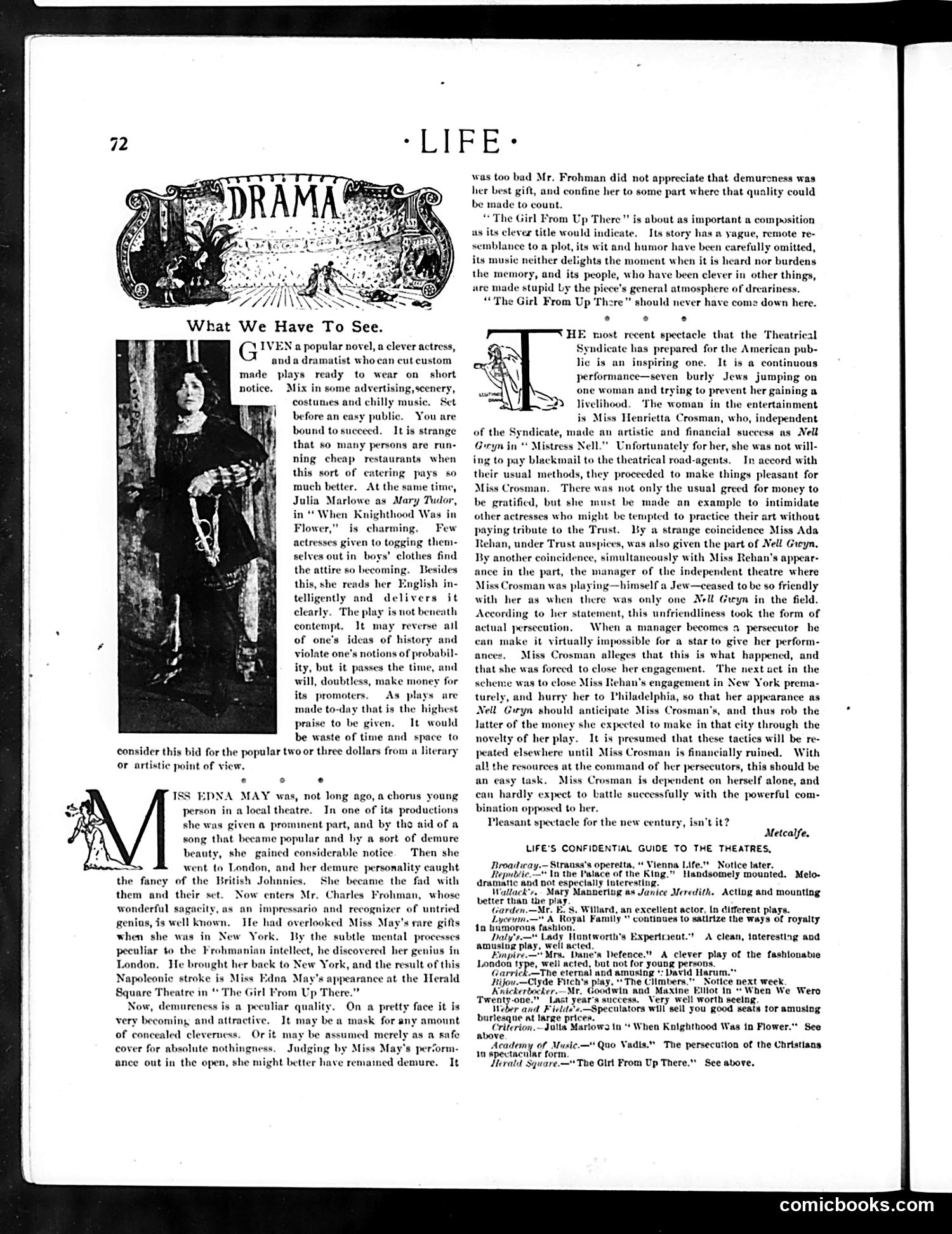
This page reviews theatrical productions circa early 1900s. The main article "What We Have To See" discusses popular plays and performers of the era. Key content includes: - **Miss Edna May**: A chorus performer who gained fame in London and became a theatrical celebrity, now returning to American stages - **"The Girl From Up There"**: A play praised for its wit and music, though criticized as somewhat derivative - Various theater reviews praising or critiquing contemporary productions The page functions as entertainment criticism rather than political satire. It reflects the theatrical culture of the period, when stage productions and their stars were major public entertainments. The reviews assess acting quality, originality, and audience appeal—concerns typical of early 20th-century drama criticism.
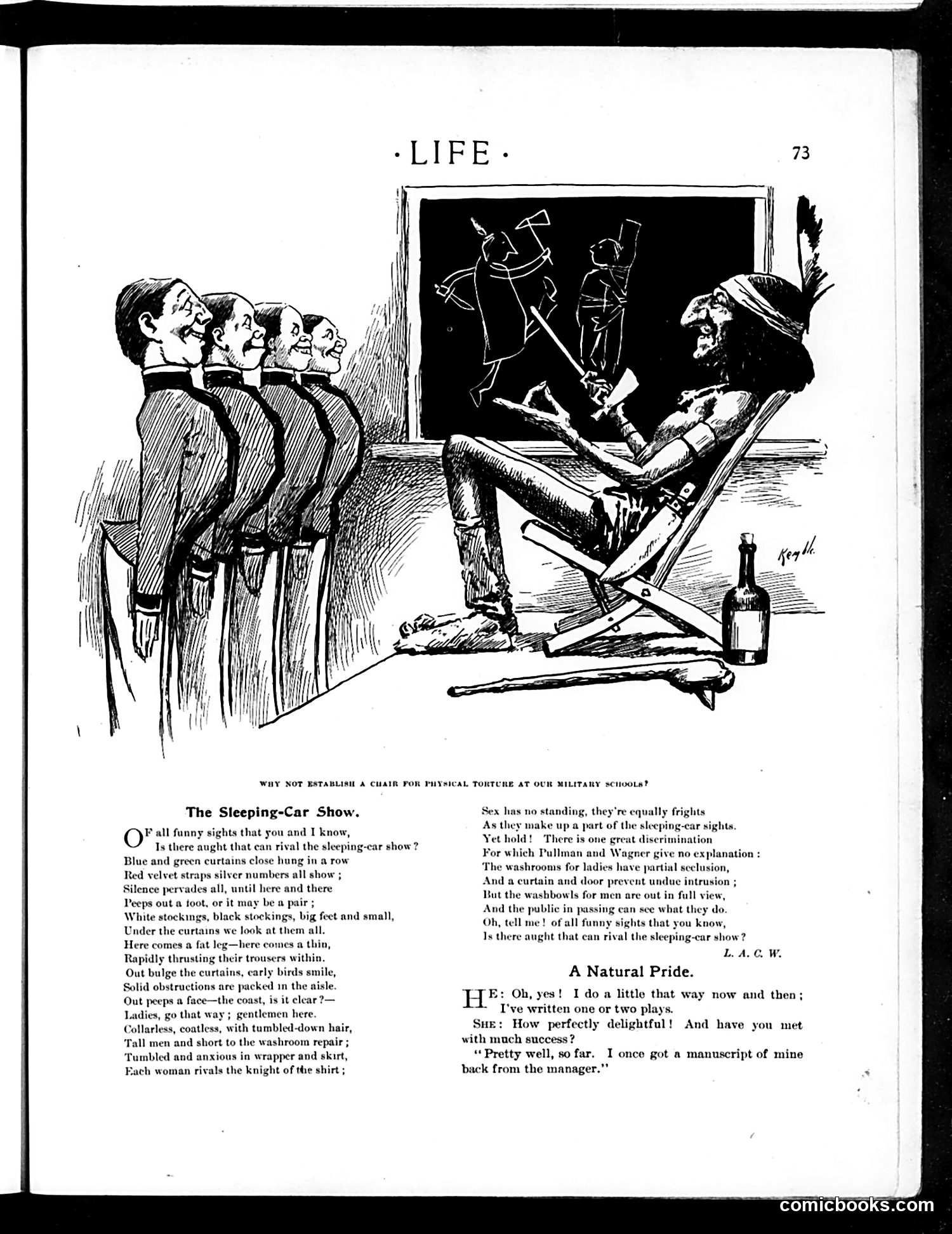
This page contains two separate humor pieces mocking Victorian-era social customs. **"The Sleeping-Car Show"** satirizes the indignity of sleeping cars on trains (likely Pullman or Wagner brand, named in the poem). The verse humorously catalogs passengers in various states of undress entering washrooms—feet, legs, and disheveled people shuffling about in nightclothes. The satire's punch: while women's washrooms have doors and curtains for privacy, men's washbowls sit exposed to public view, creating an absurd asymmetry. The header question sarcastically suggests physical torture at military schools, implying the sleeping-car experience itself is torturous. **"A Natural Pride"** is a brief dialogue joke about an aspiring playwright who mentions writing "one or two plays," claiming modest success because "I once got a manuscript of mine back from the manager"—implying rejection, not acceptance, yet stating it as a point of pride. The humor lies in his obliviousness to this admission of failure. Both pieces mock contemporary manners and pretension.
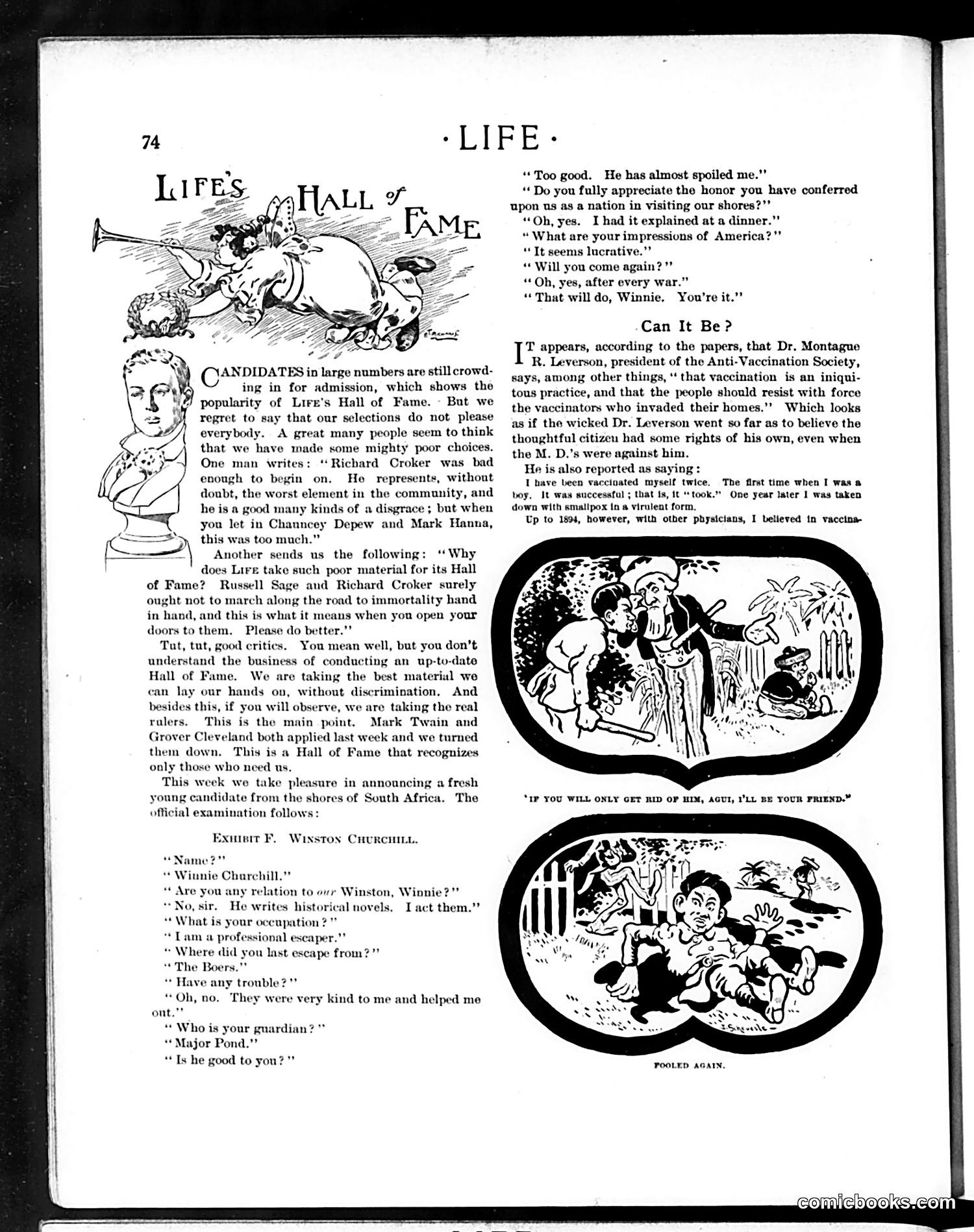
This page satirizes two contemporary figures through mock interviews: **Winston Churchill** (top cartoon): Life presents the young British military officer/writer as a vain opportunist. The "examination" mocks his self-promotion—he claims to be a "professional escaper" (referencing his famous Boer War escape), describes America as "lucrative," and promises to return "after every war." The satire suggests Churchill sees conflict as career advancement and treats his celebrity tour as profitable entertainment. **Dr. Montague Leverson** (lower article): Life ridicules the Anti-Vaccination Society president's hypocrisy. Leverson denounces vaccination as tyranny requiring "force" resistance, yet admits he himself was vaccinated twice—and contracted smallpox anyway. The satire exposes the contradiction: he opposes a medical practice while being a living failure of it. Both pieces mock public figures for inconsistency between stated principles and actual behavior—Churchill's self-interested celebrity versus Leverson's anti-vaccine stance undermined by his own experience.
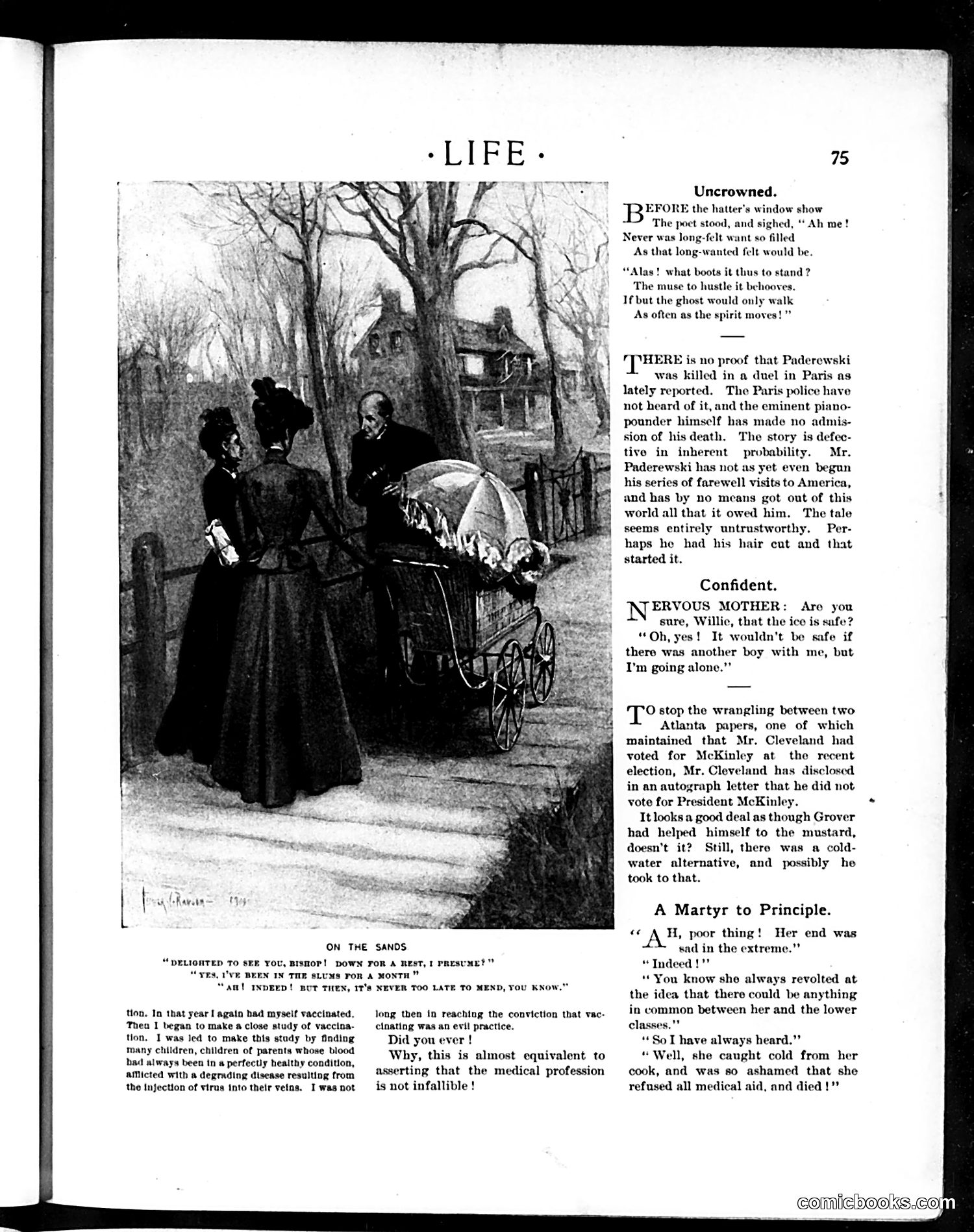
This page contains several brief satirical pieces typical of Life magazine's style: **"On the Sands"**: A cartoon showing a bishop and another figure discussing vaccination. The satire mocks anti-vaccination sentiment by having a character claim vaccines cause disease—leading to the sarcastic retort that this "almost equivalent to asserting that the medical profession is not infallible!" This appears to reference early-1900s vaccine skepticism. **"Uncrowned"**: A humorous poem about a poor poet admiring hats in a shop window, desiring material goods he cannot afford. **Other brief items** include: - A jab at pianist Paderewski regarding rumors of his death - Mockery of Cleveland's voting record - A joke about a snobbish woman who refuses medical help from her cook's social class and dies of a cold The magazine's satire targets pretension, medical pseudoscience, and class hypocrisy—common Life themes. The vaccination piece is historically notable as anti-vax sentiment existed even in this era.
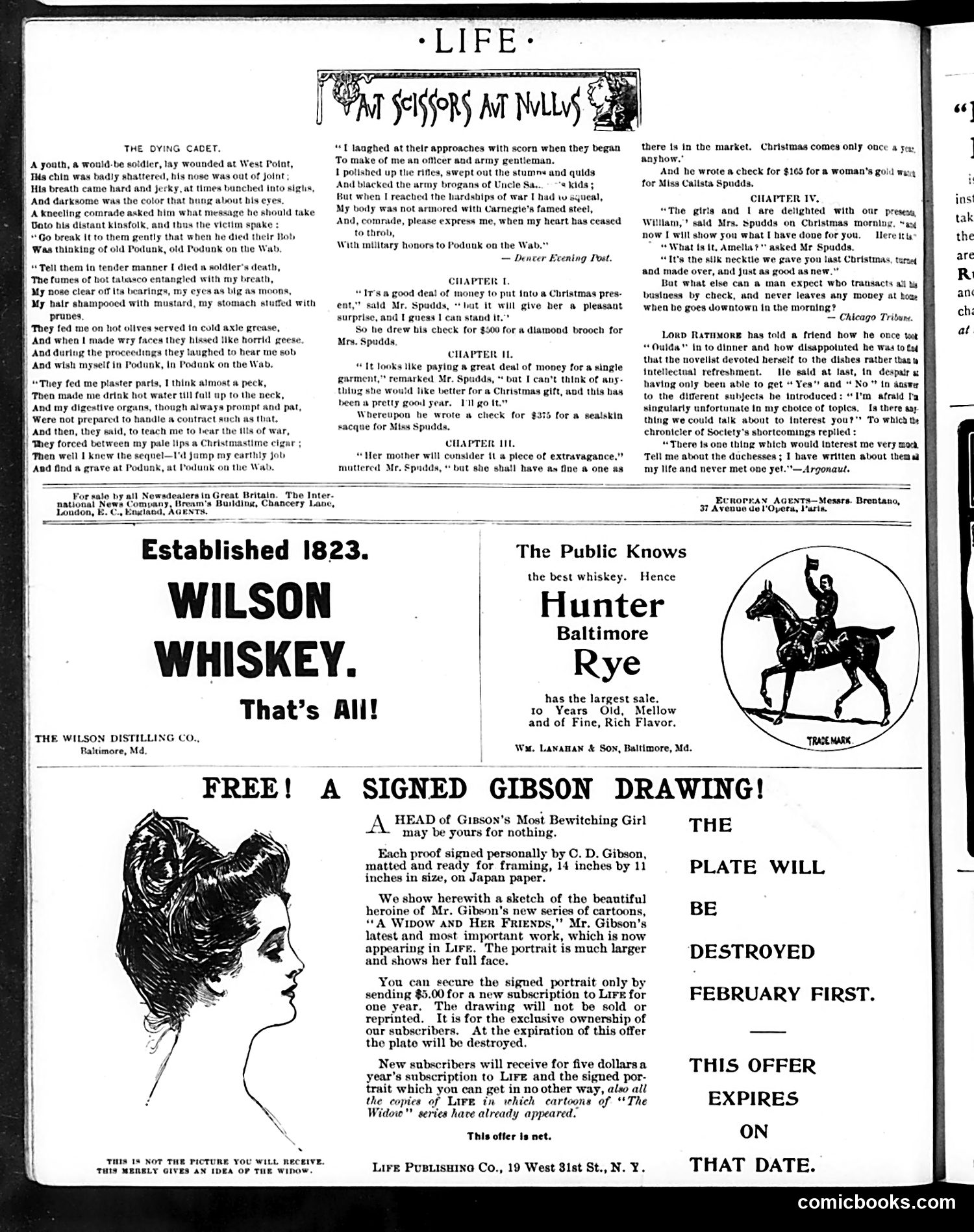
This page contains **mostly advertising and serialized fiction**, not political cartoons requiring historical context. The main content is "The Dying Cadet," a sentimental poem satirizing **rigid military training at West Point**. A wounded soldier regrets becoming an officer, recalling the brutal conditioning—force-fed inedible food (tabasco, olives in grease, mustard-shampooed hair, prunes), harassment, and abuse designed to "teach" soldiers to endure war. The joke is darkly ironic: the grueling "hardships of war" training actually involved absurd kitchen-based torture, not combat preparation. The soldier dies pining for "Podunk on the Wab"—his humble hometown. The "Mr. Spudds" chapters mock **materialistic Christmas gift-giving**, showing a man spending lavishly ($500-$375 checks) on wives and mistresses, only to receive a recycled necktie in return—a commentary on conspicuous consumption's emptiness. The advertisements promote **Wilson Whiskey** and **Hunter Baltimore Rye**, typical period spirits marketing. The promised Gibson Girl drawing offer is standard magazine subscription promotion.
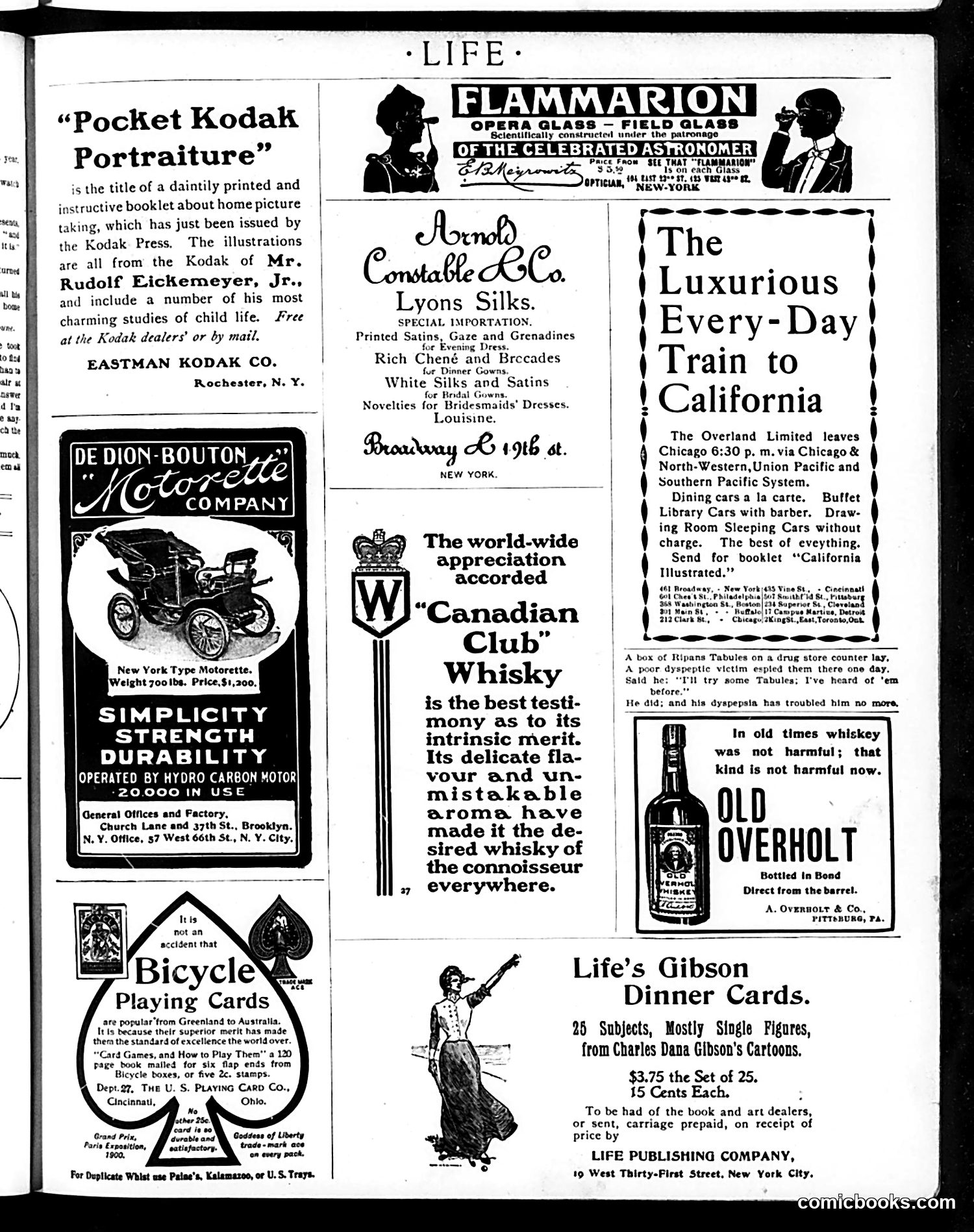
This is primarily an **advertising page** from *Life* magazine, not a political cartoon. The page displays various product advertisements from the early 1900s, including: - **Kodak cameras** and photography supplies - **De Dion-Bouton motorettes** (early automobiles) - **Lyons Silks** fabrics - **Canadian Club whisky** and **Old Overholt whiskey** - **Bicycle playing cards** - **Train travel to California** via the Overland Limited - **Charles Dana Gibson dinner cards** (Gibson was *Life*'s famous cartoonist) The only narrative content is a brief, comedic anecdote about a dyspeptic man discovering Ripans Tabules antacids at a drug store counter—a typical late-19th-century patent medicine advertisement masquerading as humor. There is no political satire or significant social commentary on this page. It reflects the consumer culture and commercial focus of *Life* during this period.
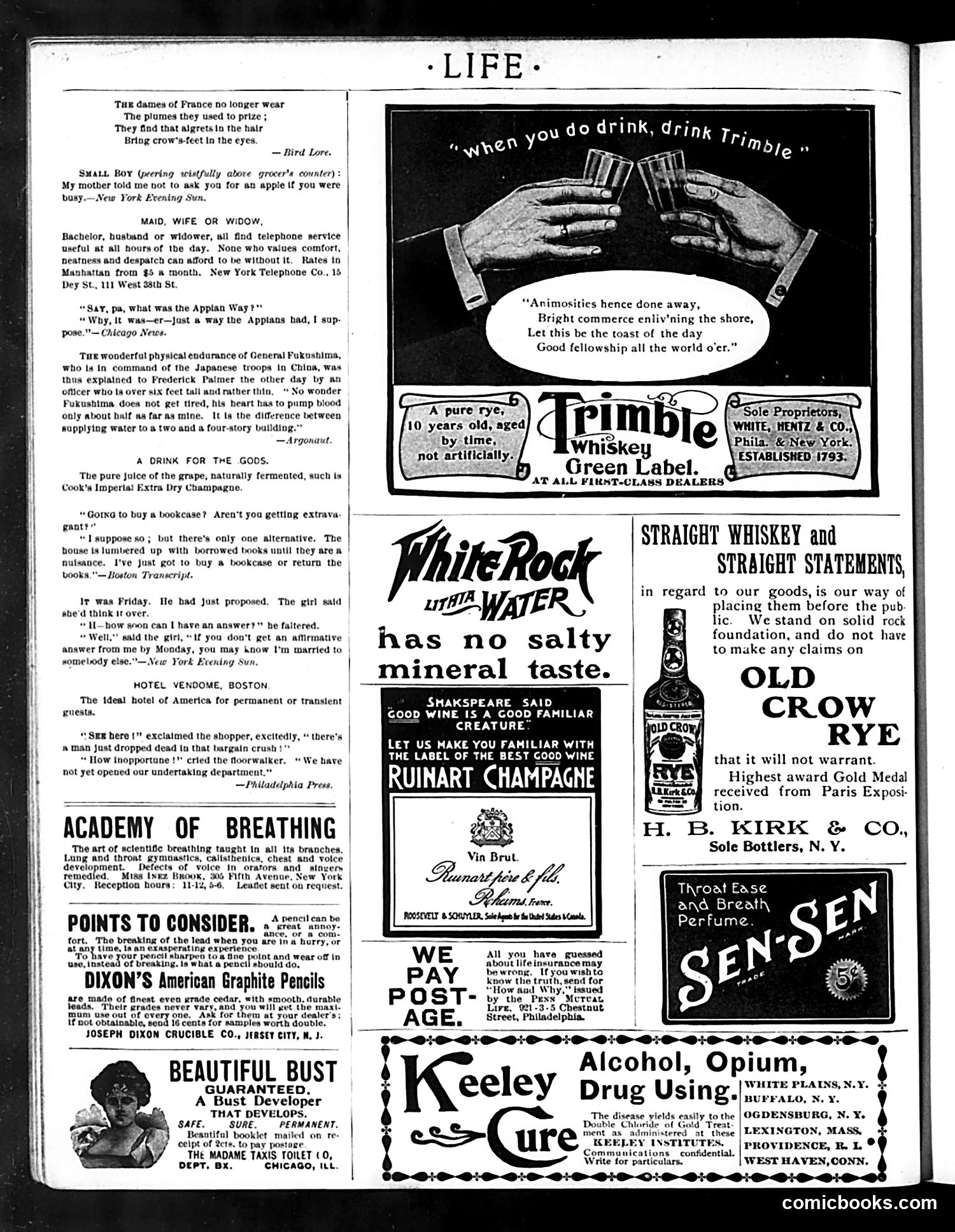
This page is primarily **advertising**, with brief satirical snippets interspersed. The main cartoon depicts two hands clinking glasses with a toast promoting fellowship and commerce—a celebratory drinking scene typical of early 20th-century advertising imagery. The satirical content consists of short, humorous quips about everyday life: a boy politely avoiding asking for an apple, confusion about the Appian Way, a marriage proposal with a Monday deadline, and shopkeeper gallows humor about a person collapsing during a sale. The advertisements dominate—for whiskeys (Trimble, Old Crow Rye, White Rock water), champagne, pencils, beauty treatments, and a "Keeley Cure" for alcohol and drug addiction. This juxtaposition is ironic: the page simultaneously promotes liquor while advertising treatment for substance abuse, reflecting early 1900s American attitudes toward drinking and "cures" for addiction. The overall tone is light and commercial rather than politically satirical.
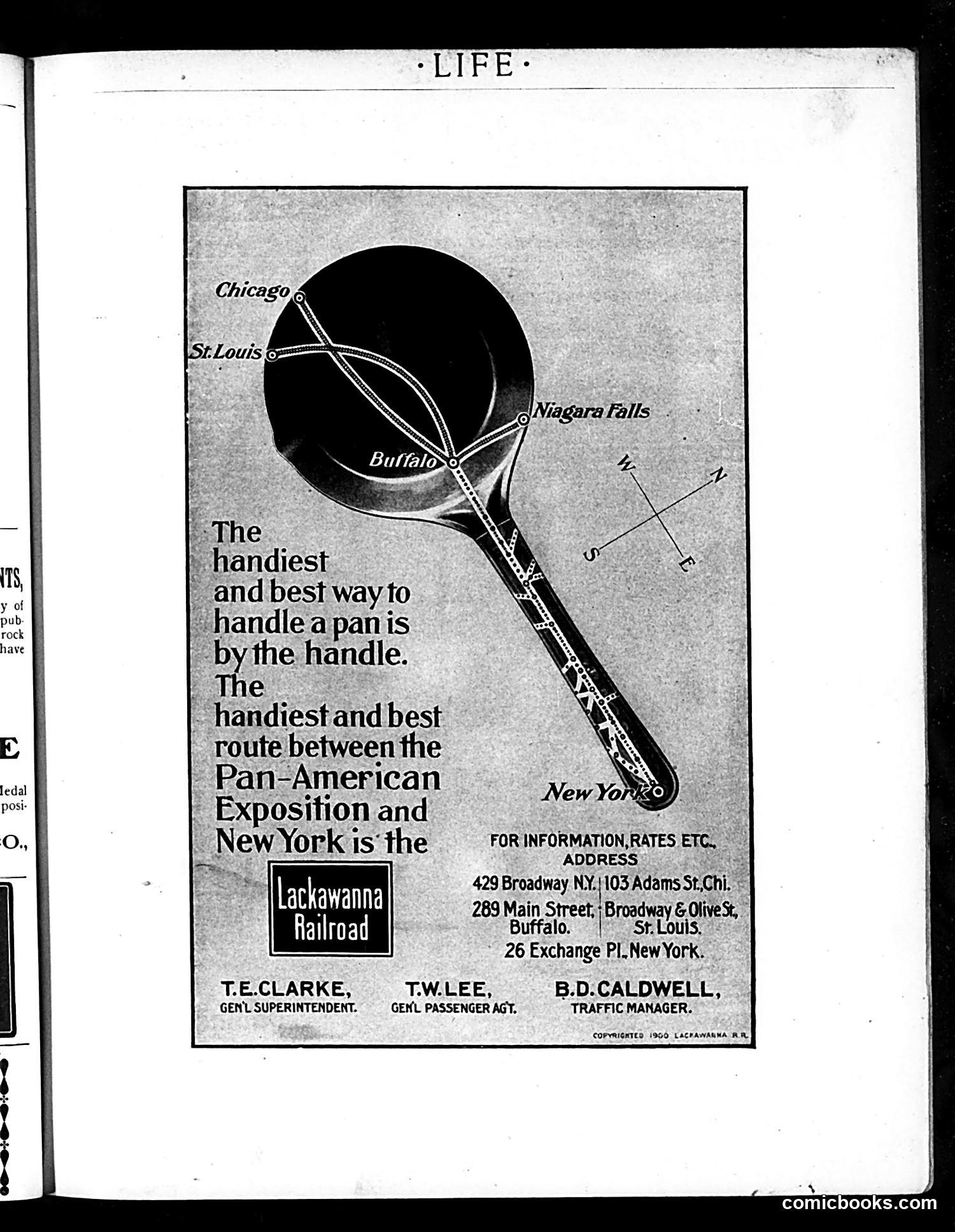
This is a **railroad advertisement**, not political satire. It's a clever visual pun promoting the Lackawanna Railroad's route between the Pan-American Exposition (held in Buffalo, New York in 1901) and New York City. The ad depicts a frying pan with a map of the railroad route illustrated on its surface. The "handle" of the pan becomes the railroad line, connecting Buffalo to New York via stops including Chicago, St. Louis, and Niagara Falls. The wordplay plays on "pan" (the cookware) and "Pan-American" (the exposition). The joke: just as the "handiest way to handle a pan is by the handle," the handiest route to the Pan-American Exposition is via the Lackawanna Railroad. It's commercial advertising using humor and visual creativity typical of early 20th-century magazine ads.
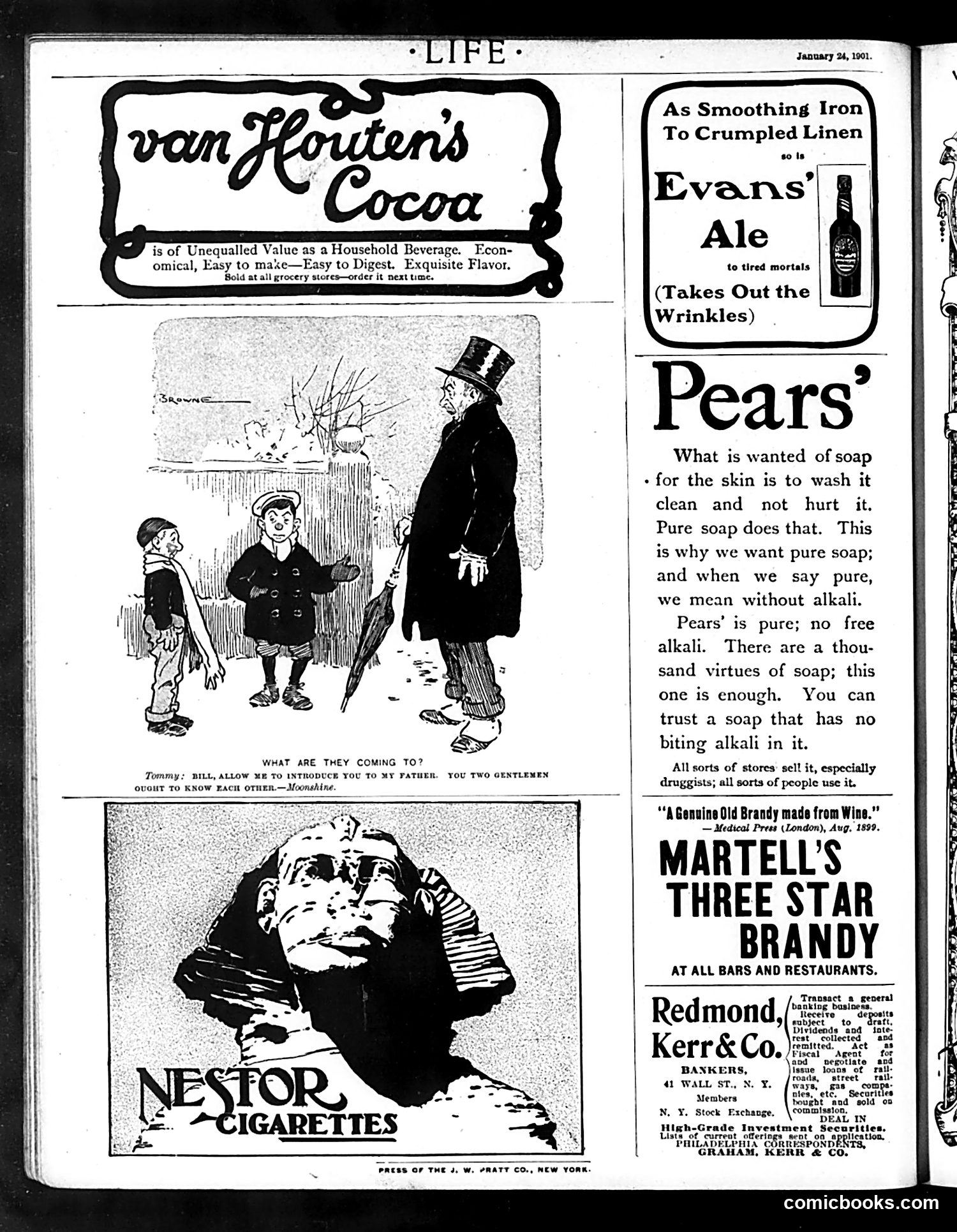
The main cartoon depicts a well-dressed gentleman introducing two boys—apparently his son and a street urchin—suggesting they should know each other. The satire, credited to "Moonshine," mocks upper-class social pretension and anxiety about class boundaries in the Gilded Age. The joke plays on the gentleman's obliviousness: he's introducing his son to someone of vastly lower social station as if they were peers, suggesting either democratic ideals run amok or the father's poor judgment. The caption's worried tone ("What are they coming to?") reflects Victorian concerns about social hierarchies breaking down. The surrounding advertisements for luxury goods (brandy, soap, ale) underscore the class consciousness—Life's readership would recognize the irony of such concerns appearing alongside consumer products marketed to the wealthy. The cartoon is fundamentally about anxiety over changing social order in turn-of-the-century America.