
Life, 1901-01-24 · page 12 of 20
Life — January 24, 1901 — page 12: what you’re looking at
What you’re looking at
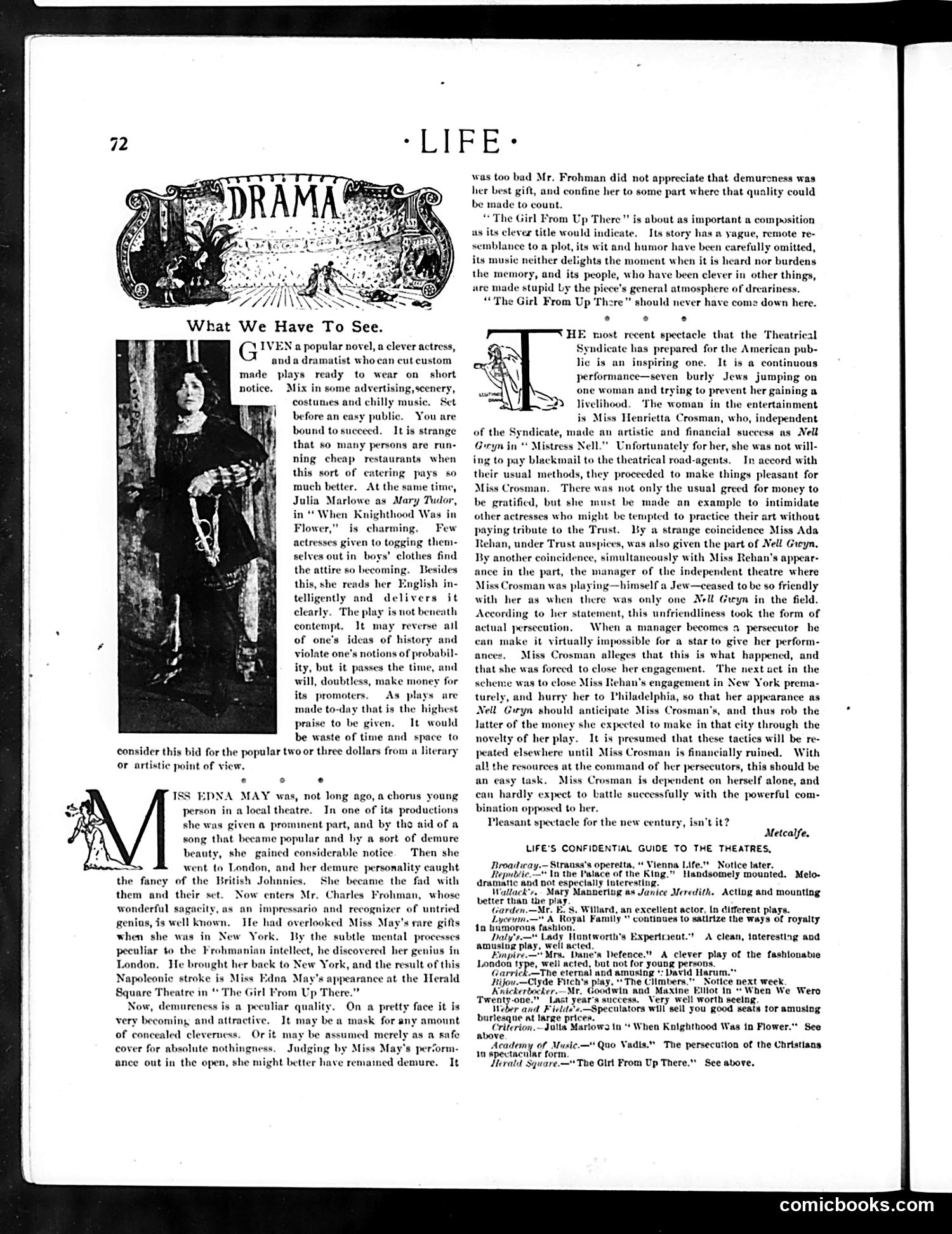
This page reviews theatrical productions circa early 1900s. The main article "What We Have To See" discusses popular plays and performers of the era. Key content includes: - **Miss Edna May**: A chorus performer who gained fame in London and became a theatrical celebrity, now returning to American stages - **"The Girl From Up There"**: A play praised for its wit and music, though criticized as somewhat derivative - Various theater reviews praising or critiquing contemporary productions The page functions as entertainment criticism rather than political satire. It reflects the theatrical culture of the period, when stage productions and their stars were major public entertainments. The reviews assess acting quality, originality, and audience appeal—concerns typical of early 20th-century drama criticism.
📄 Transcribed text from this page (OCR, searchable)
Machine-transcribed from the original scan — historical spelling and the odd misread are preserved.
LIFE IVEN a popular novel, a clever act: anda dramatist who can cut custom made plays ready to wear on short notice. Mix in some advertising,scenery, costumes and chilly music. § before an easy public. You are bound to succeed. It is strange that so many persons are run- ning cheap restaurants when this sort of catering pays so much better. At the same time, Julia Marlowe as Mary Tudor, in “ When Knighthood Was in Flower,” is charming. Few actresses given to togging them- selves out in. boys’ clothes find the attire so becoming. Besides this, she reads her glish in- telligently and delivers clearly. The play is not beneath contempt. It may reverse all of one’s ideas of h and violate one's notions of probabil- ity, but it passes the time, and will, doubtless, make money for its promoters, As plays are made to-day that is the highest praise to be given, It would be waste of time and space to consider this bid for the popular two or three dollars from a literary or artistic point of view. e ° . ISS EDNA MAY was, not long ago, a chorus young person in a local theatre, In one of its productions she was given a prominent part, and by the aid of a song that became popular and by a sort of demure beaut Then she went London, and her demure personality caught the fancy of the British Johnnies. She became the fad with them their set. Now enters Mr. Charles Frohman, whose wonderful sagacity, as an rio and recognizer of untried genius, is well known. He had overlooked Miss May's rare gifts when she was in New York. By the subtle mental processes peculiar to the Frohmanian intellect, he discovered her genius in London. Ie brought her back to New York, and the result of this Napoleonic stroke is Miss Edna May's appearance at the Herald Square Theatre in “ The Girl From Up There.” Now, demureness is a peculiar quality. On a pretty face it is very becoming and attractive. It may be a mask for any amount of concealed cleverness. Or it may be assumed merely as a safe cover for absolute nothingness. Judging by Miss May's perform. ance out in the open, she might better have remained demure. It she gained considerable notice impres: was too bad Mr. Frohman did not appreciate that demurcness was her best gift, and confine her to some part where that quality could be made to count. The Girl From Up There” is about as important a composition as its clever title would indicate, Its story has a yague, remote re- semblance to a plot, its wit and humor have been carefully omitted, its music neither delights the moment when it is heard nor burdens the memory, and its people, who have been clever in other things, ure made stupid Ly the piece’s general atmosphere of drearin “The Girl From Up There” should never have come down here. ° ° ° HE most recent spectacle that the Theatrical rndicate has prepared for the American pub- ic is an inspiring one. It is a continuous performance—seven burly Jews jumping on Sy one woman and trying to prevent her gaining a 2) livelihood, The woman in the entertainment is Miss Henrietta Crosman, who, independent of the Syndicate, made an artistic and financial success as Nell Giryn in © Mistress Nell.” Unfortunately for her, she was not will- ing to pay blackmail to the theatrical road-agents. In accord with their usual methods, they proceeded to make things pleasant for Miss Crosman. There was not only the usual greed for money to be gratified, but she must be made an example to intimidate other actresses who might be tempted to practice their art without paying tribute to the Trust. By a strange coincidence Miss Ada Rehan, under Trust auspices, was also given the part of Nel! Gwyn, By another coincidence, simultancously with Miss Reban's appear- ance in the part, the manager of the independent theatre where Miss Crosman was playing—himself a Jew—ceased to be so friendly with her as when there was only one Nell Geeyn in the field. According to her statement, this unfriendliness took the form of actual pers When a manager becomes a persecutor he can make it virtually impossible for a star to give her perform- ances, Miss Crosman alleges that this is what happened, and that she was foreed to close her engagement. ‘The next act in the scheme was to close Miss Rehan's engagement in New York prema- turely, and hurry her to Philadelphia, so that her appearance as Neil Giryn should anticipate Miss Crosman's, and thus rob the latter of the money she expected to make in that city through the novelty of her play. It is presumed that these tactics will be peated elsewhere until Miss Crosman is financially ruined. With al! the resources at the command of her persecutors, this should be an easy t Miss Crosman is dependent on herself alone, and can hardly expect to battle successfully with the powerful com- bination opposed to her. Pleasant spectacle for the new century, isn’t it? Metcalfe. LIFE'S CONFIDENTIAL GUIDE TO THE THEATRES, Rroadicay.— Stranss’s operedta, “ Vienna Life." Notice later. Republic.—* In the Palace of the King.” !andsomely mounted. Melo- dramatic and not espectally Interesting. Wallack'r.. Mary Mannering as Janice Meredith. Acting and mounting better than the play Garden.—Mr. E, 8, Willard, an excellent actor, In different plays. Lycevm.—" A Royal Famtly ” continues to satirize the ways of royalty 1o bumorons fashion. Daly'e.—" Lady Hontworth’s Expertraent.”* amusing play, weil acted, Empire.—* Mra. Dane's Defence.” A clever play of the fashlonatie London type, well acted, but not for young persons Garrlek--The eternal and amusiig *: David Harum." A clean, toteresting and Notice next week. oodwin and Maxine Elliot in * When We Wero Very well worth seeing. Hijou.—Clyde Fitch's play, «The C limbers.” Knickertocker.— Me. Twenty-one." Las Weber and Fi lite "s.—Speculators will sell you good seats tor amusing burlesqne at large prices. re ‘8 success. Criterion.- above. Academy of Muste- 10 spectacular form. Herat Squares Julla Marlows in When Knighthood Was in Flower." See “Quo Vadis." The persecution of the Christians Tue Girt From Up There." See above. comicbooks.com