
Life, 1901-01-24 · page 4 of 20
Life — January 24, 1901 — page 4: what you’re looking at
What you’re looking at
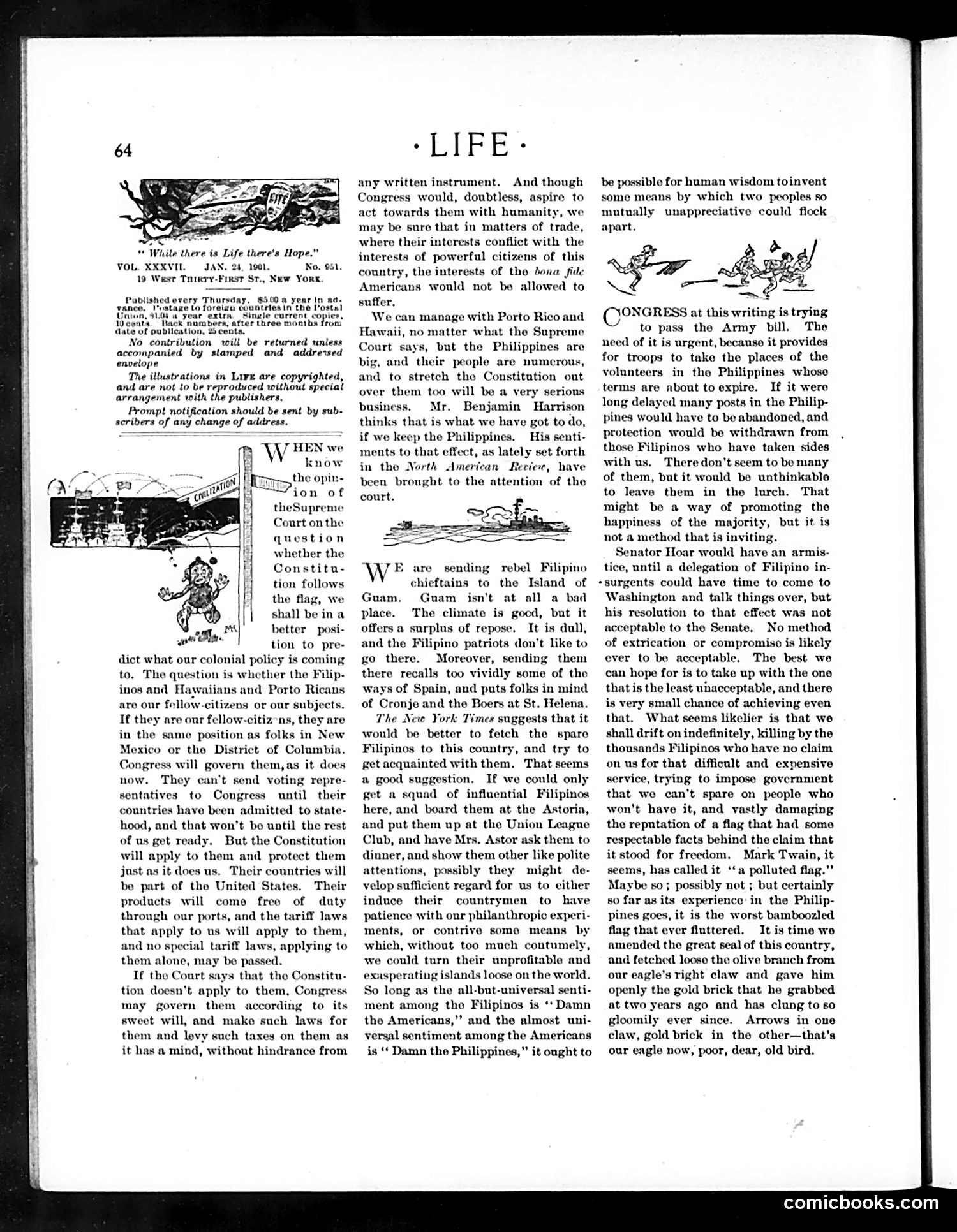
The page contains political commentary on American imperial policy in the Philippines, particularly debating whether to grant Filipino insurgents recognition or military concessions. **The main cartoon** (upper left) appears to satirize the Supreme Court's constitutional authority over colonial policy—specifically whether the Constitution applies to territories like the Philippines and Puerto Rico. **The central illustration** shows a ship, likely referencing military operations or transport of troops to the Philippines. **The satirical point**: The article mocks proposals to negotiate with Filipino rebel leaders or grant them diplomatic status. The tone suggests treating such concessions as absurd—the author ridicules the idea of sending insurgent chieftains to Washington or allowing them influence, comparing it unfavorably to granting similar status to New Mexico or Columbia territories. The "polluted tag" and "eagle" references suggest cynicism about America's moral claims regarding colonial governance.
📄 Transcribed text from this page (OCR, searchable)
Machine-transcribed from the original scan — historical spelling and the odd misread are preserved.
“ While there is Life there’s Hope.” VOL. XXXVII. JAN. 24, 1901, No. 851. IRST ST., New YORE. 19 West Taurry: Published every Thursday. $500 a year In ad. vance, Mustage to foreign countries in the Postal Union, 31.06 a year extra. Single current copier, cents. “Rack numbers, after three months from date of publication, 2 cents, No contribution will be returned unless accompanied by stamped and addrersed envelope The illustrations in Live are copyrighted, and are not to be reproduced without special arrangement with the publishers, Prompt notification should be sent by sub- soribers of any change of address. i; WV BEN we we i ea know the opin- ee of theSupreme Court on the question whether the Constitu- tion follows the flag shall be in a better posi- ! tion to pre- dict what our colonial policy is coming to. The question is whether the Filip- inos and Hawaiians and Porto Ricans are our fellow-citizens or our subjects. If they are our fellow-citizns, they are in the samo position as folks in New Mexico or the District of Columbia. Congress will govern them, as it does now. They can’t send voting repre- sentatives to Congress until their countries have been admitted to state- hood, and that won’t be until the rest of us get ready. But the Constitution will apply to them and protect them just as it does us, Their countries will bo part of the United States, Their products will come free of duty through our ports, and the tariff laws that apply to us will apply to them, and no special tariff laws, applying to them alone, may be passed. If tho Court says that the Constitu- tion doesn’t apply to them, Congress may govern them according to its sweet will, and make such laws for them and levy such taxes on them as it has a mind, without hindrance from we LIFE any written instrument. And though Congress would, doubtless, aspire to act towards them with humanity, we may be suro that in matters of trade, where their interests conflict with the interests of powerful citizens of this country, the interests of the bona fide Americans would not be allowed to n manage with Porto Rico and Ha ,no matter what the Supreme Court says, but the Philippines are big, and their people are numcrous, and to stretch the Constitution out over them too will be a very serious Mr. Benjamin Harrison that is what we have got to do, if we keep the Philippines, His senti- ments to that effect, as lately set forth in the North American Review, have been brought to the attention of the court. ‘W E are sending rebel Filipino chieftains to the Island of Guam isn’t at all a bad place. The climate is good, but it offers a surplus of repose. It is dull, and the Filipino patriots don’t like to go there. Moreover, sending them there recalls too vividly some of the ways of Spain, and puts folks in mind of Cronje and the Boers at St. Helena. The New York Times suggests that it would be better to fetch the spare Filipinos to this country, and try to get acquainted with them, That seems a good suggestion. If we could only get a squad of influential Filipinos here, and board them at the Astoria, and put them up at the Union League Club, and have Mrs. Astor ask them to dinner, and show them other like polite attentions, possibly they might de- velop sufficient regard for us to either induce their countrymen to ve patience with our philanthropic experi- ments, or contrive some means by which, without too much contumely, we could turn their unprofitable and exasperating islands loose on the world. So long as the all-but-universal senti- ment among tho Filipinos is ‘*‘ Damn the Americans,”’ and the almost uni- versal sentiment among the Americans is ‘‘ Damn the Philippines,” it ought to Guam. be possible for human wisdom toinvent some means by which two peoples so mutually unappreciative could flock apart. << CONGRESS at this writing is trying to pass the Army Dill. The need of it is urgent, because it provides for troops to take the places of the volunteers in tho Philippines whose terms are about to expire. If it wero long delayed many posts in the Philip- pines would have to be abandoned, and protection would be withdrawn from those Filipinos who have taken sides with us. There don't seem to be many of them, but it would be unthinkable to leave them in the lurch. That might be a way of promoting the happiness of the majority, but it is not a method that is inviting. Senator Hoar would have an armis- tice, until a delegation of Filipino in- surgents could have time to come to Washington and talk things over, but his resolution to that effect was not acceptable to the Senate. No method of extrication or compromise is likely ever to be acceptable. The best we can hope for is to take up with the one that is the least unacceptable, and there is very small chance of achieving even that. What seems likelier is that we shall drift on indefinitely, killing by the thousands Filipinos who have no claim on us for that difficult and expensive service, trying to impose government that we can't spare on people who won't have it, and vastly damaging the reputation of a flag that had some respectable facts behind the claim that it stood for freedom. Mark Twain, it seems, has called it ‘a polluted flag.”” Maybe so; possibly not ; but certainly so far as its experience: in the Philip- pines goes, it is the worst bamboozled flag that ever fluttered. It is time wo amended tho great seal of this country, and fetched loose the olive branch from. our eagle's right claw and gave him openly the gold brick that he grabbed at two years ago and has clung to so gloomily ever since. Arrows in one claw, gold brick in the other—that's our eagle now, poor, dear, old bird. comicbooks.com