
A complete issue · 21 pages · 1900
Life — December 27, 1900
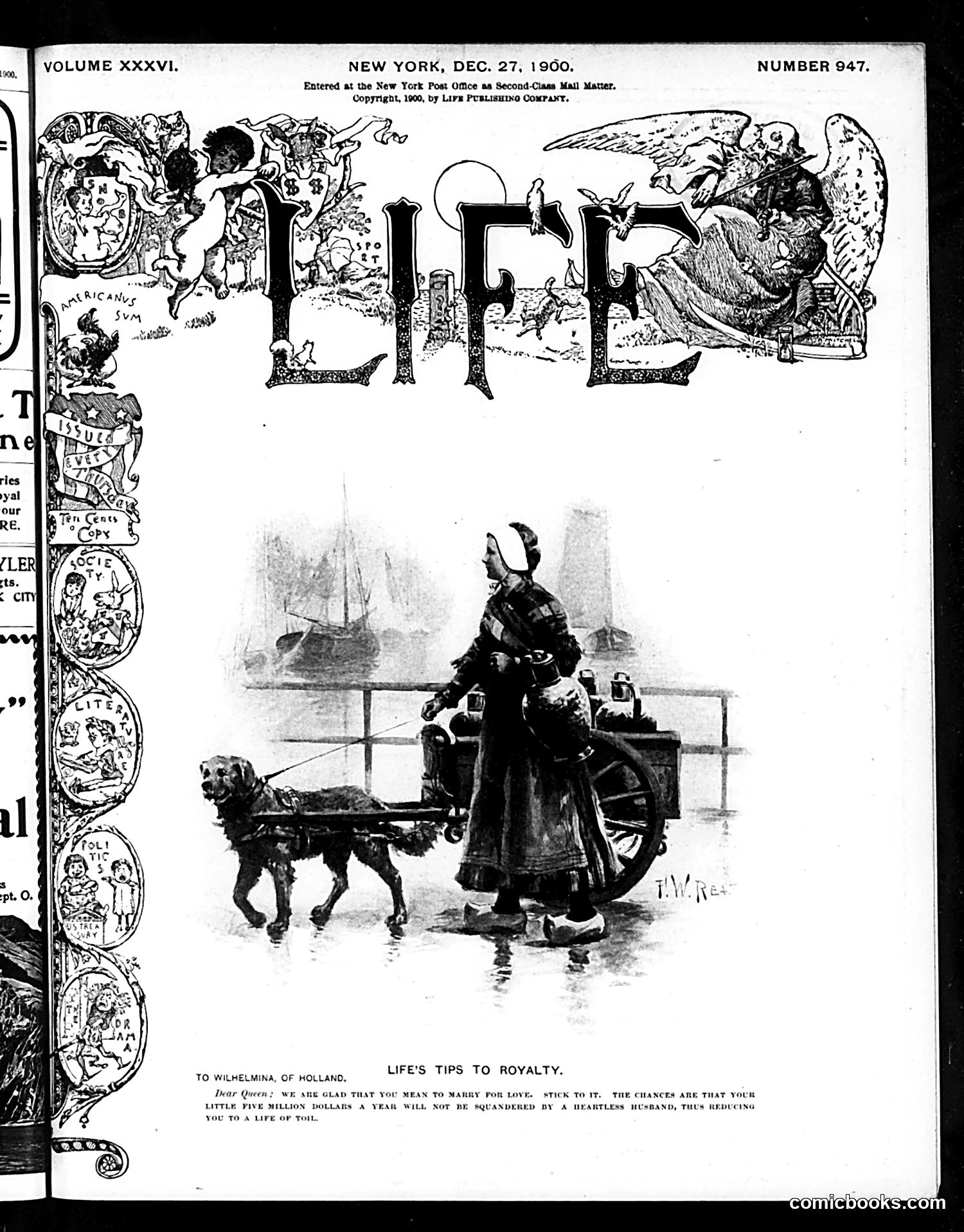
This December 1900 satirical piece addresses "Wilhelmina, of Holland" (Queen Wilhelmina). The cartoon depicts a woman in winter clothing with a dog-drawn cart near a frozen waterway, with ships in the background. The accompanying text offers marital advice: the Queen should marry for love and maintain her marriage, as her "little five million dollars a year" won't prevent being "encumbered by a heartless husband" and ensure "a life of toil." The satire mocks royal marriages of the era, which were typically arranged for dynastic or financial advantage rather than affection. Life's sardonic "tip" suggests that even vast wealth cannot guarantee happiness in loveless unions—a critique of aristocratic marriage conventions that prioritized political alliance over personal fulfillment.
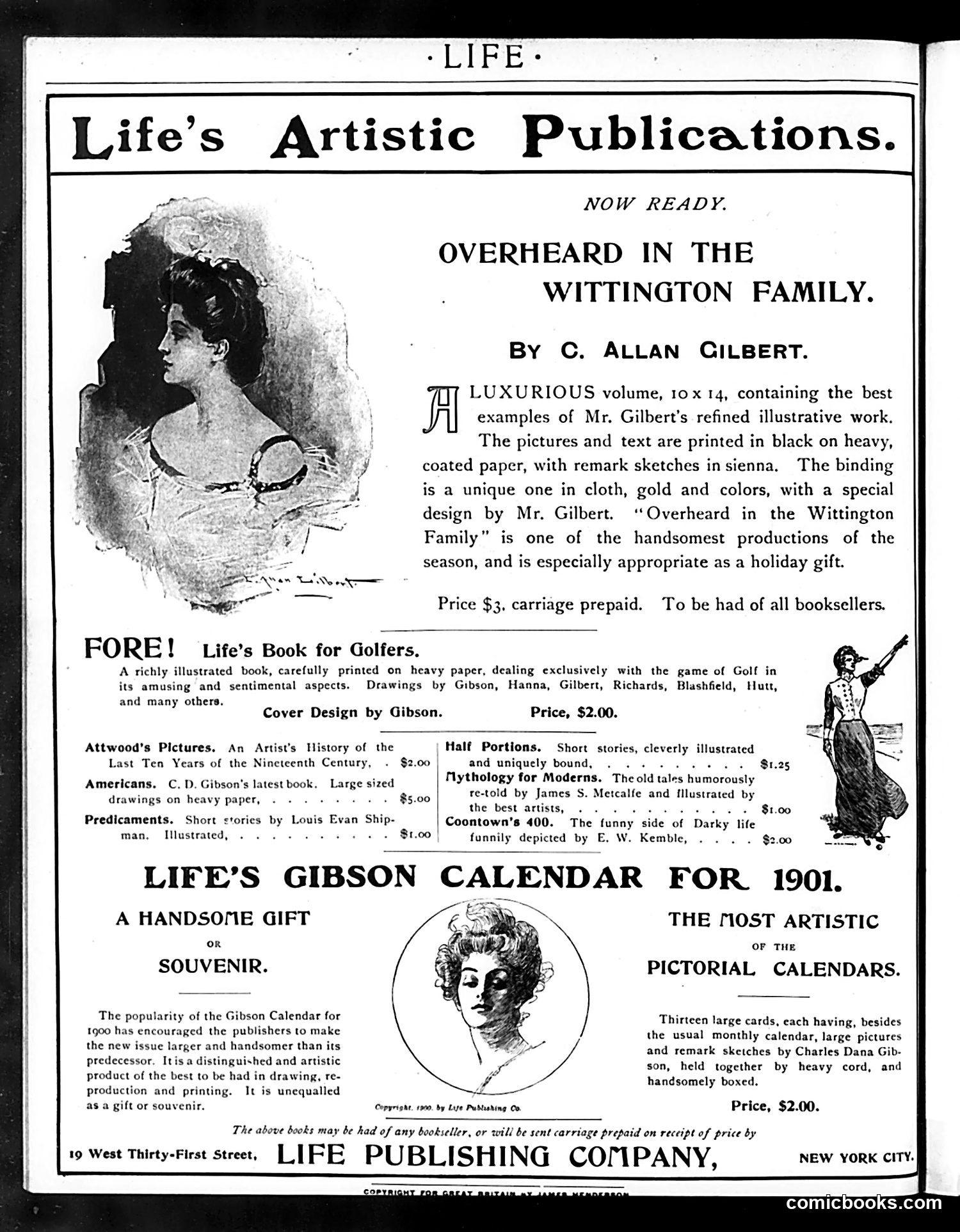
This page is primarily **advertising**, not political satire. It promotes Life Publishing Company's artistic books and products, featuring illustrated portraits by artist C. Allan Gilbert. The main advertised item is "Overheard in the Wittington Family," a luxurious volume with Gilbert's refined illustrations, priced at $3 (carriage prepaid). Additional offerings include "Life's Book for Golfers" ($2), books on Americans and Attwood's pictures ($5), and other titles. The most notable product is **Life's Gibson Calendar for 1901**—featuring artwork by Charles Dana Gibson, the famous illustrator of the "Gibson Girl" ideal of feminine beauty. The calendar, priced at $2, is described as "the most artistic of the pictorial calendars." The page reflects turn-of-century American consumer culture and the popularity of illustrated art books as gifts.
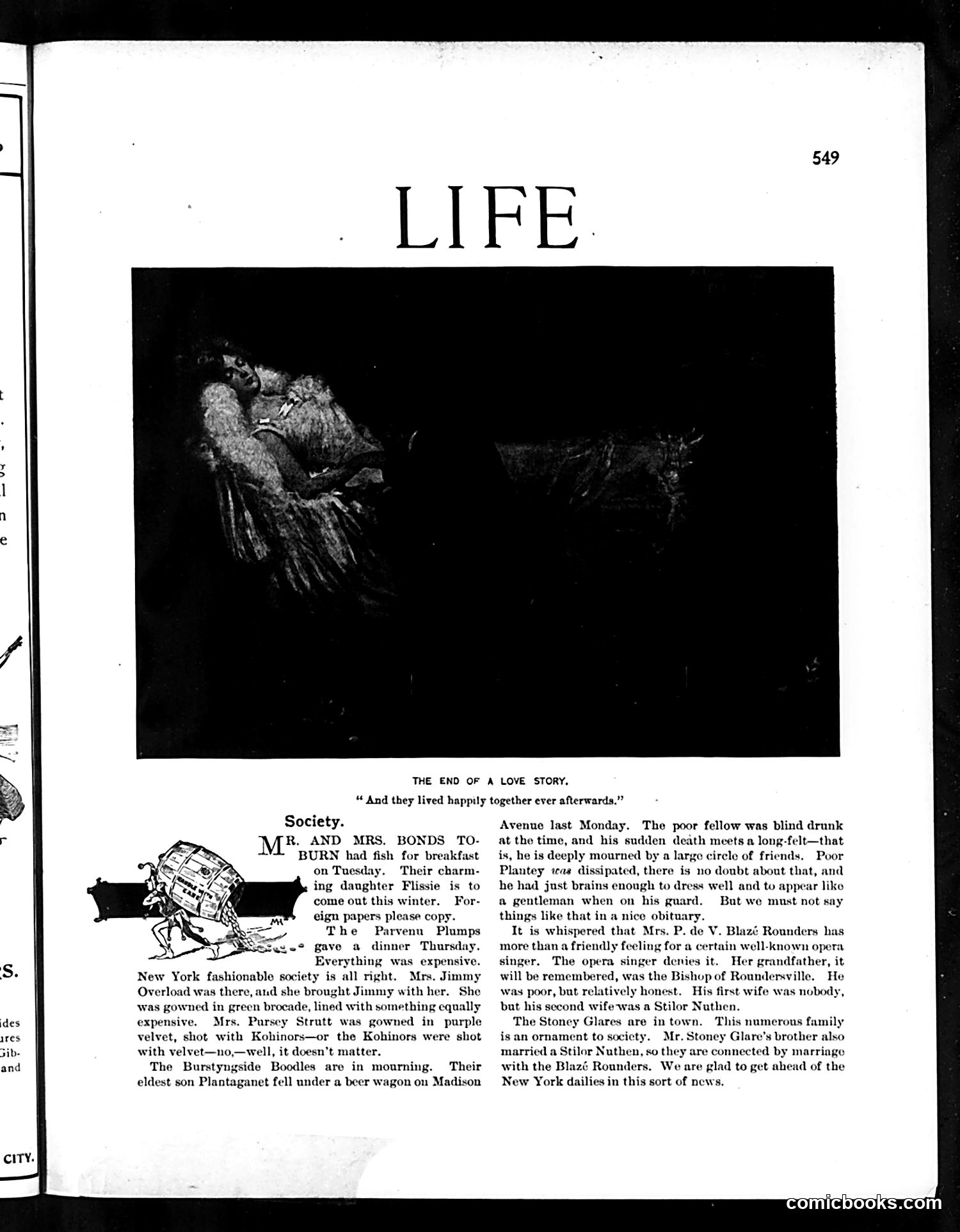
The page features "The End of a Love Story," a romantic illustration captioned "And they lived happily together ever afterwards." Below is a "Society" column containing gossip about New York's fashionable elite. The column describes social events among the wealthy—breakfast gatherings, expensive dinners with elaborate clothing details (green brocade, purple velvet), and scandals. It mentions the Burstygside Doodles, the Stoney Glares family, and Mrs. P. de V. Blazé Rounders, an opera singer. The humor derives from satirizing high society's pretensions: expensive clothing, fashionable events, and social connections are presented with gentle mockery. The column reports both trivial details (what Mrs. Strutt wore) and darker items (a death and family scandals), treating them with equal, deadpan tone—characteristic of Life's satire of Gilded Age society.
This page contains editorial text rather than political cartoons. The decorative header shows stylized geese or ducks, and small pig illustrations appear in the margin. The editorial discusses Life magazine's future editorial direction, promising to avoid excesses while maintaining social criticism. It references specific targets: Filipino independence movements (called "fiscal rebels"), lynching of Black Americans, liquor prohibition debates, and British politics (mentioning "Tammany Hall" and Irish constituencies). The text defends Life's role as a "restraint" on excess while pledging continued scrutiny of powerful institutions. It appears designed to reassure readers of the magazine's balanced approach to controversial social issues of the early 20th century, while still maintaining its satirical voice on contemporary politics.
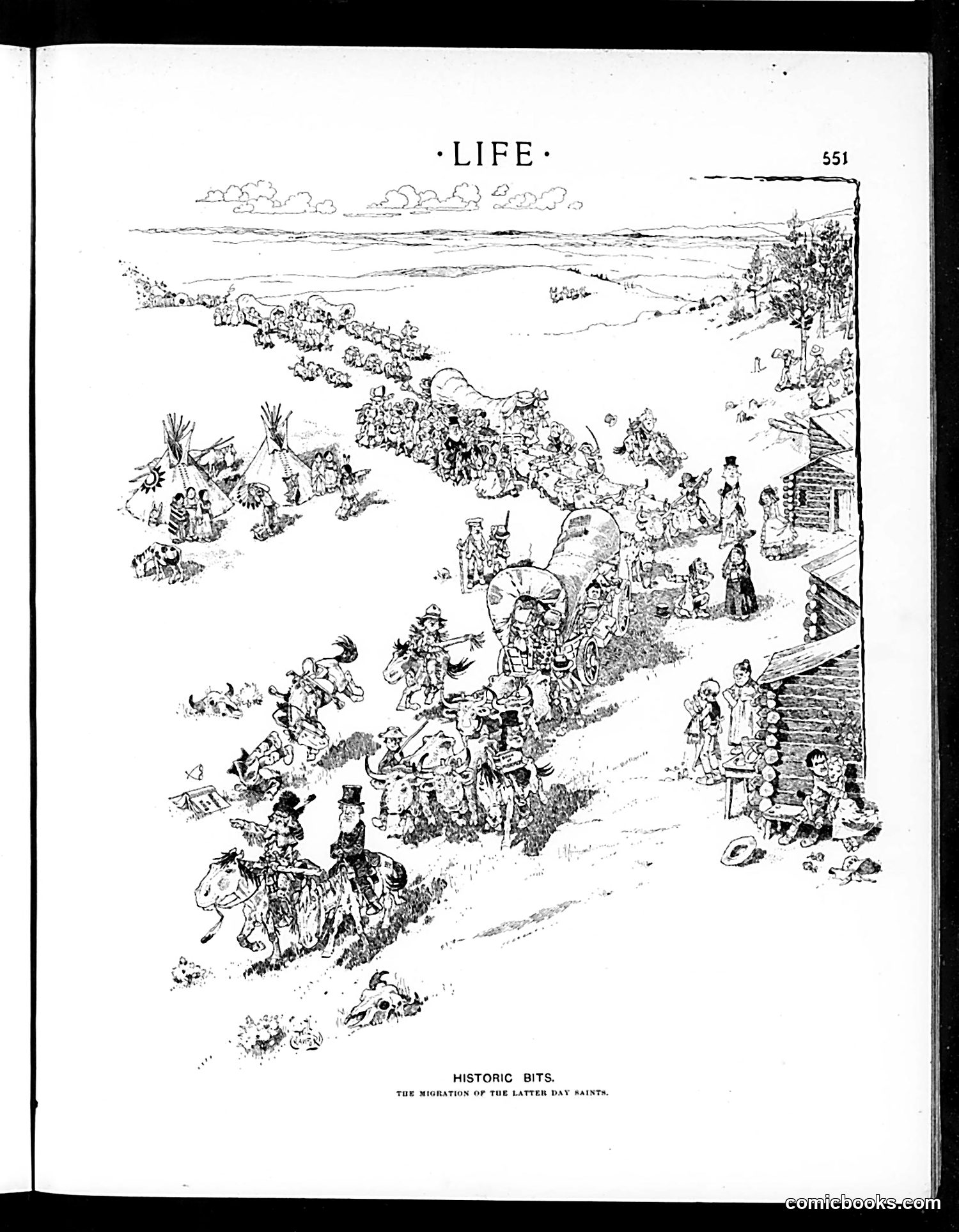
This satirical cartoon depicts the westward movement of the Latter-day Saints (Mormons) during the 19th century. The illustration shows a large procession traveling across the landscape—wagons, people on foot, livestock, and covered tents—moving from left to right across the page. The satire likely mocks the religious migration itself, which was a contentious subject in American popular culture. The Mormons faced significant opposition and were driven westward multiple times, eventually settling in Utah. The detailed, crowded composition humorously portrays the scale and chaos of their journey, treating a serious religious and historical event as comedic spectacle for Life magazine's readers, who generally held skeptical or hostile views toward Mormonism.
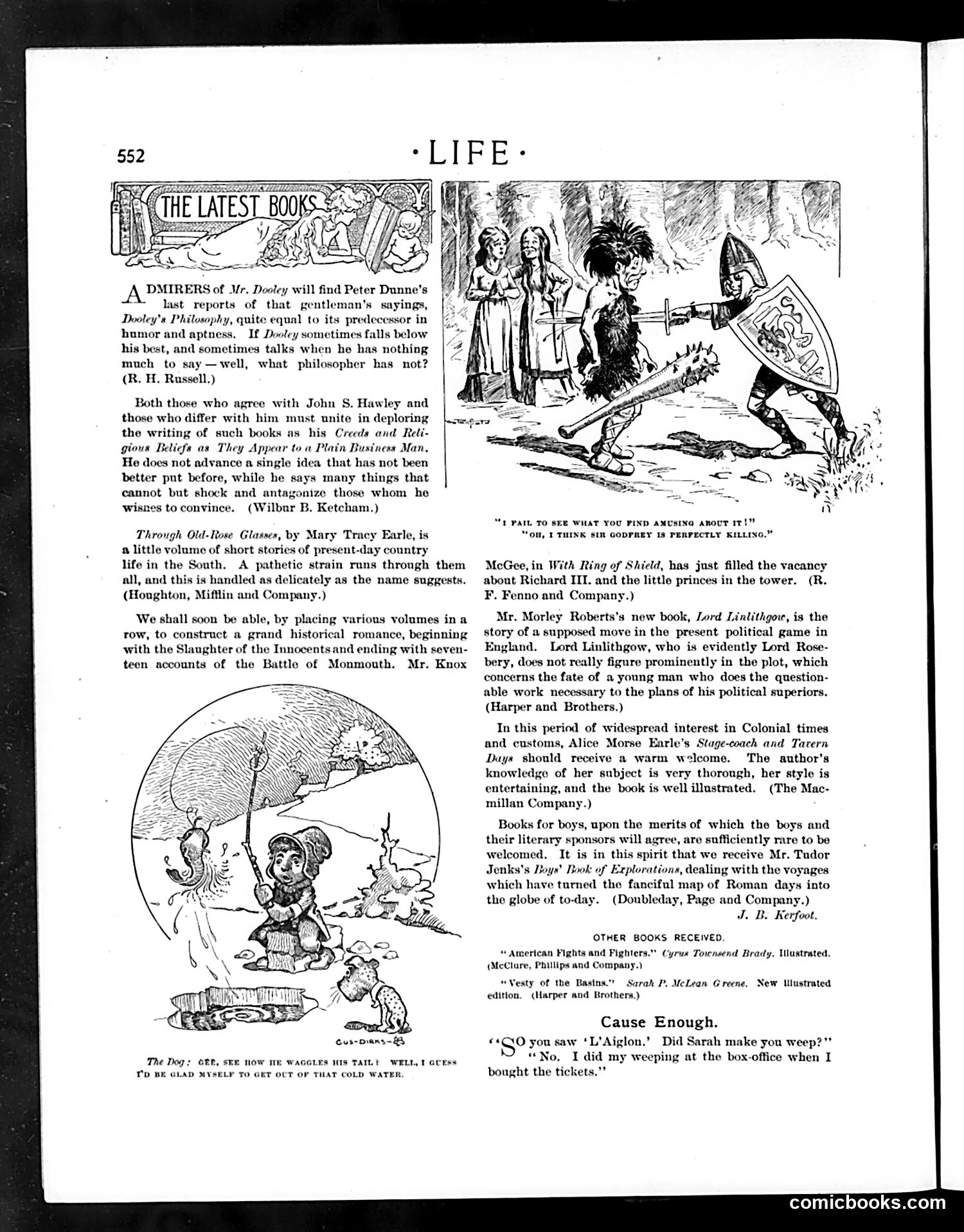
This page contains two distinct cartoons and literary reviews. **Top cartoon**: Depicts a medieval knight with a large shield confronting three figures (likely women or courtiers). The caption reads "I FAIL TO SEE WHAT YOU FIND AMUSING ABOUT IT!" / "OH, I THINK SIR GODFREY IS PERFECTLY KILLING." The satire appears to mock medieval chivalric pretensions—the knight's self-seriousness contrasts with the observers' amusement at his pomposity. **Bottom cartoon** ("The Dog"): Shows a dog under an umbrella in rain, captioned about waggling his tail despite cold water, depicting animal persistence in discomfort—a gentle humorous observation rather than political satire. The remainder is book reviews, including commentary on works about Colonial America and children's adventure stories. The page represents Life's typical mix of satirical humor and cultural criticism.
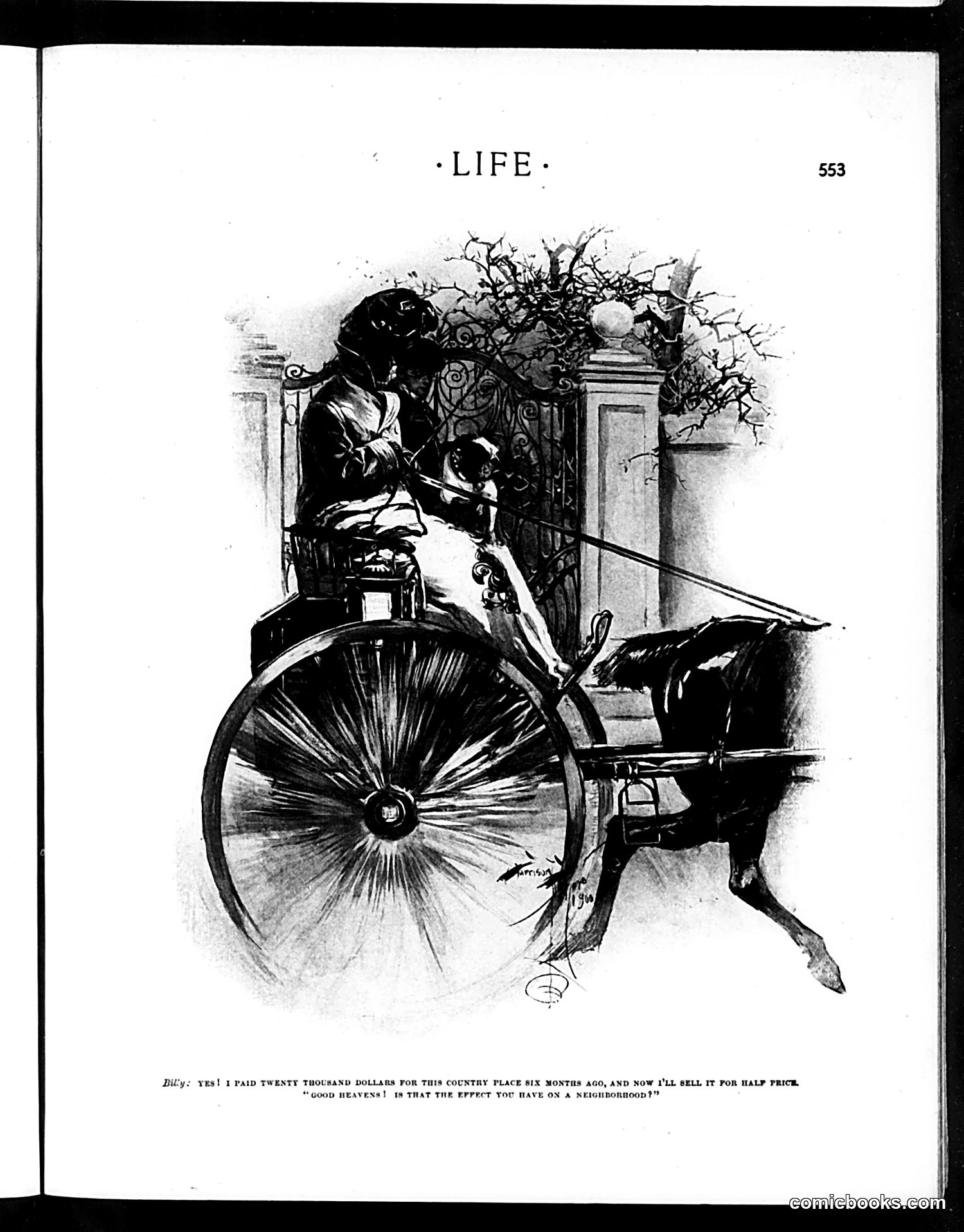
This satirical illustration depicts a woman in a carriage driven by a horse, departing from an ornate gate with ivy. The caption reveals the joke: she paid $20,000 for a country estate six months ago and is now selling it for half price, lamenting, "Good heavens! is that the effect you have on a neighborhood?" The satire targets the real-estate market and social pretension. The woman represents a wealthy buyer who made a poor investment, suggesting her presence itself has devalued the property—implying she's either socially undesirable or that her arrival was so conspicuous it ruined the neighborhood's appeal. The humor mocks both speculative real-estate ventures and the anxiety about social status that characterized wealthy Americans of the early 20th century.
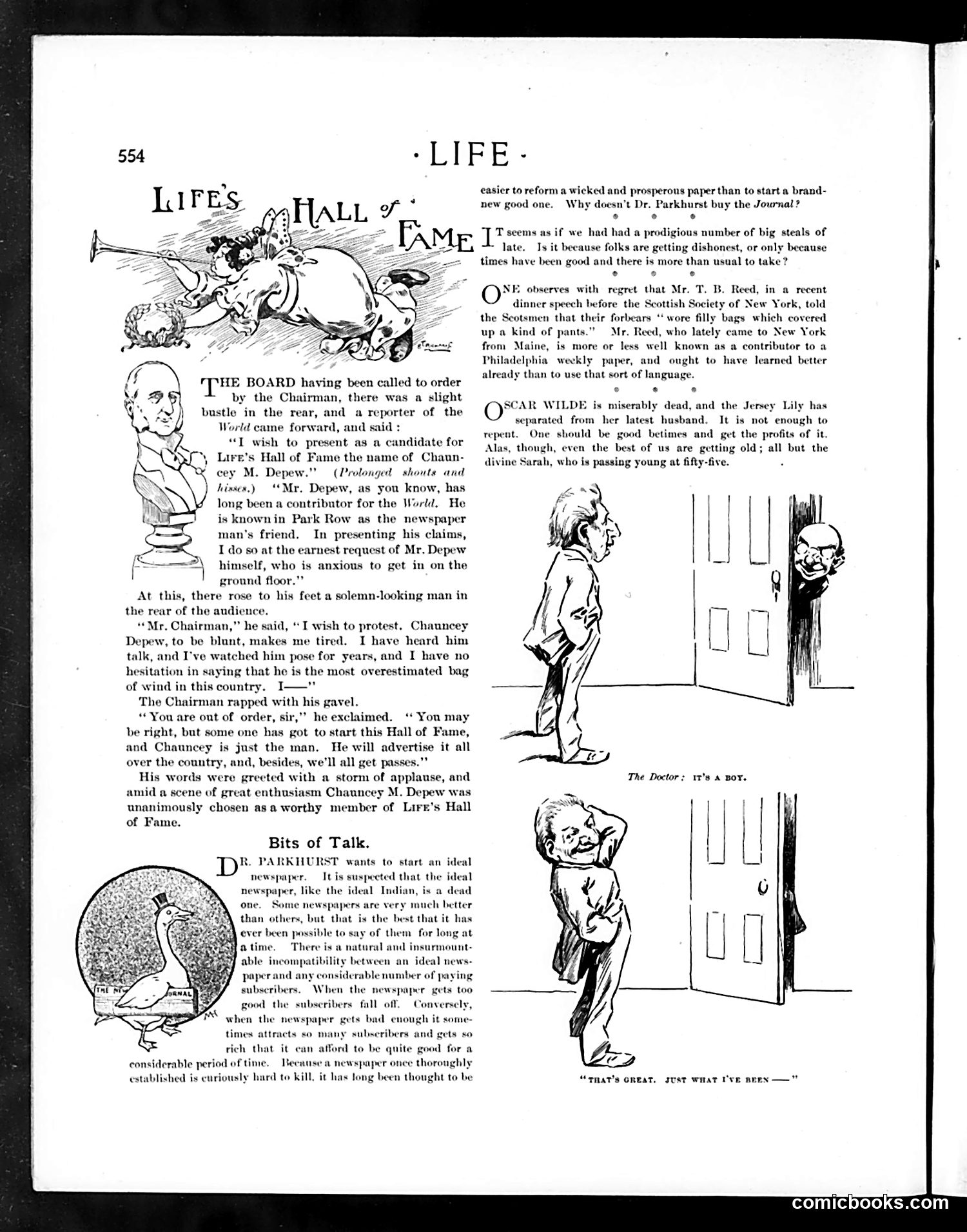
This page satirizes the concept of creating a "Hall of Fame" for newspapers. A board meeting debates nominating **Chauncey M. Depew** (identified in the text as a well-known contributor to the *World* newspaper) as a worthy member. The main satire targets **Dr. Parkhurst**, who apparently wants to start an "ideal newspaper." The text mocks this as naive—established newspapers, though imperfect, are difficult to kill; a new one would be easier to reform than start fresh. The three cartoon panels on the right humorously depict a doctor discovering a boy, with captions suggesting surprise at finding something good ("It's a boy" / "That's great. Just what I've seen"). The page employs ironic commentary on newspaper quality and the futility of idealistic journalism ventures.
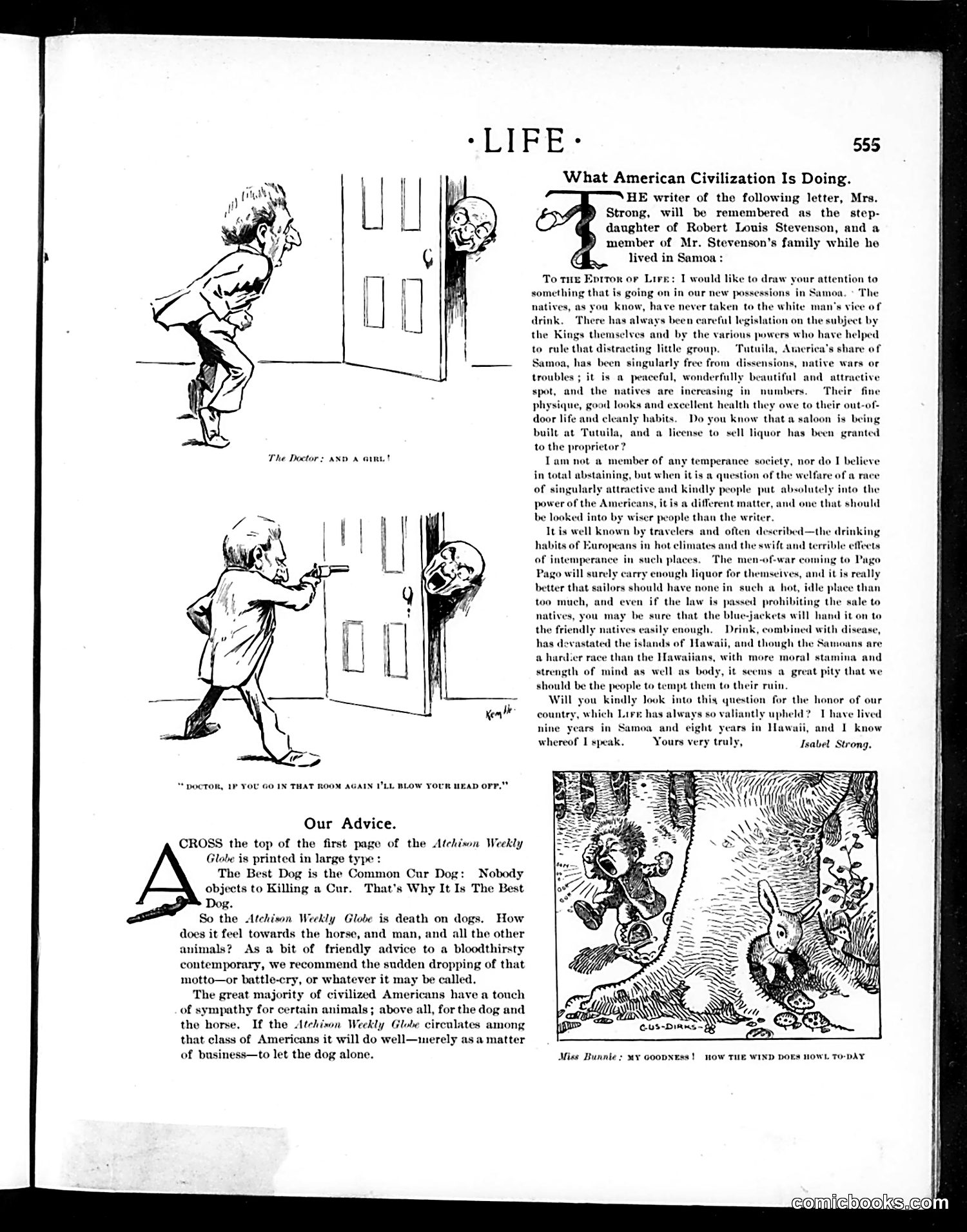
**Main Content: Political Cartoons and Letter** The page features two satirical cartoons depicting a doctor making house calls, with the caption "DOCTOR, IF YOU GO IN THAT ROOM AGAIN I'LL BLOW YOUR HEAD OFF." The joke appears to satirize either medical malpractice or unwanted medical intervention. **Letter: "What American Civilization Is Doing"** A correspondent (Isabel Strong, daughter of Robert Louis Stevenson) writes from Samoa criticizing American colonial influence. She argues that introducing liquor to Pacific Islander populations—contrary to temperance movements—threatens these "kindly people." She advocates for protecting native welfare against American commercial exploitation, particularly regarding alcohol sales. **"Our Advice" Section** This dismisses the *Atchison Weekly Globe's* anti-dog stance, defending dogs' role in American society and animal sympathy.
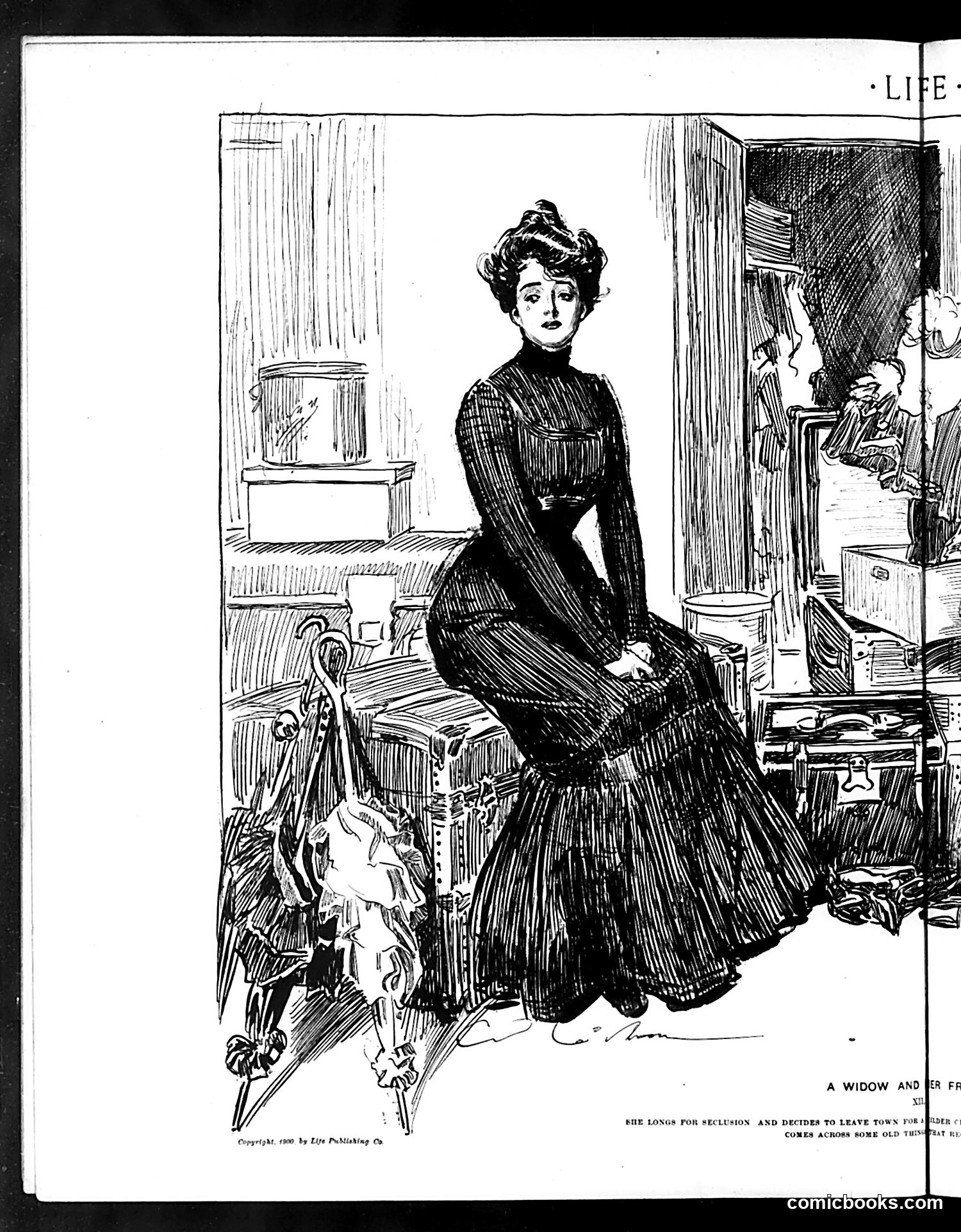
This illustration depicts a fashionably dressed widow in an early 1900s interior, seated beside what appears to be a bicycle. The caption—partially cut off but readable as "SHE LONGS FOR SECLUSION AND DECIDES TO LEAVE TOWN FOR A..."—suggests satirical commentary on widow behavior and social expectations. The cartoon likely mocks contemporary attitudes about widows' conduct: the bicycle symbolizes modern independence and mobility, while her elegant black dress signals mourning propriety. The humor appears to rest on the contradiction between expected widow seclusion and her apparent desire for freedom and activity. The detailed domestic setting emphasizes the contrast between confined domestic life and the liberation promised by modern transportation.
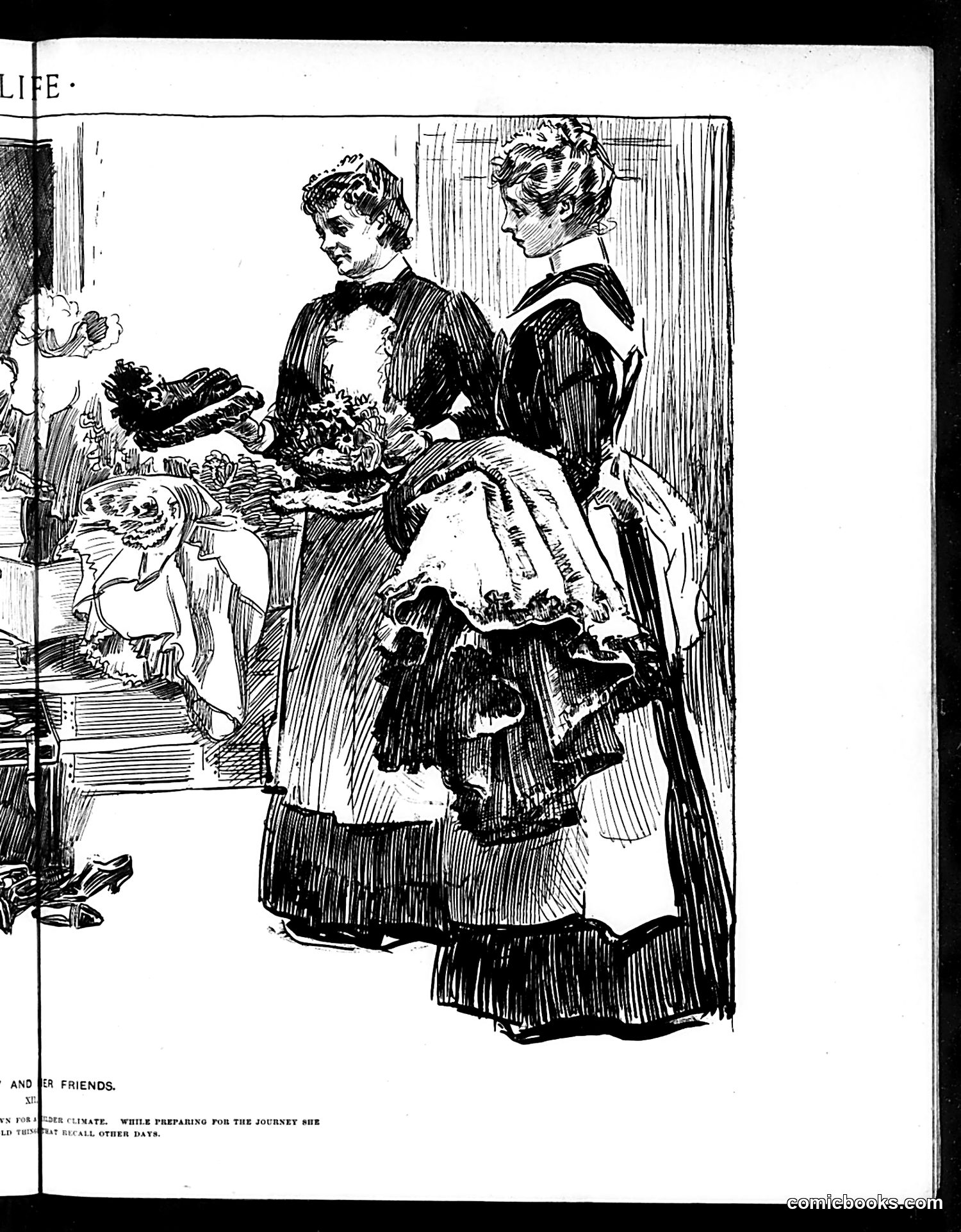
This is an illustration depicting two well-dressed women in late Victorian/Edwardian era clothing, engaged in what appears to be a social visit or conversation. The partial caption visible at bottom references "preparing for the journey" and mentions "climatic" conditions. Based on the artistic style and magazine context, this likely satirizes upper-class women's social conventions—possibly mocking their elaborate dress preparations, social rituals, or concerns about travel. The detailed rendering of their fashionable clothing (with prominent bustles and decorative elements) suggests the satire may target the impracticality or absurdity of fashionable dress of the period. However, **without the complete caption text, I cannot definitively identify the specific social commentary or historical reference intended**. The full context necessary for accurate interpretation is cut off in this reproduction.
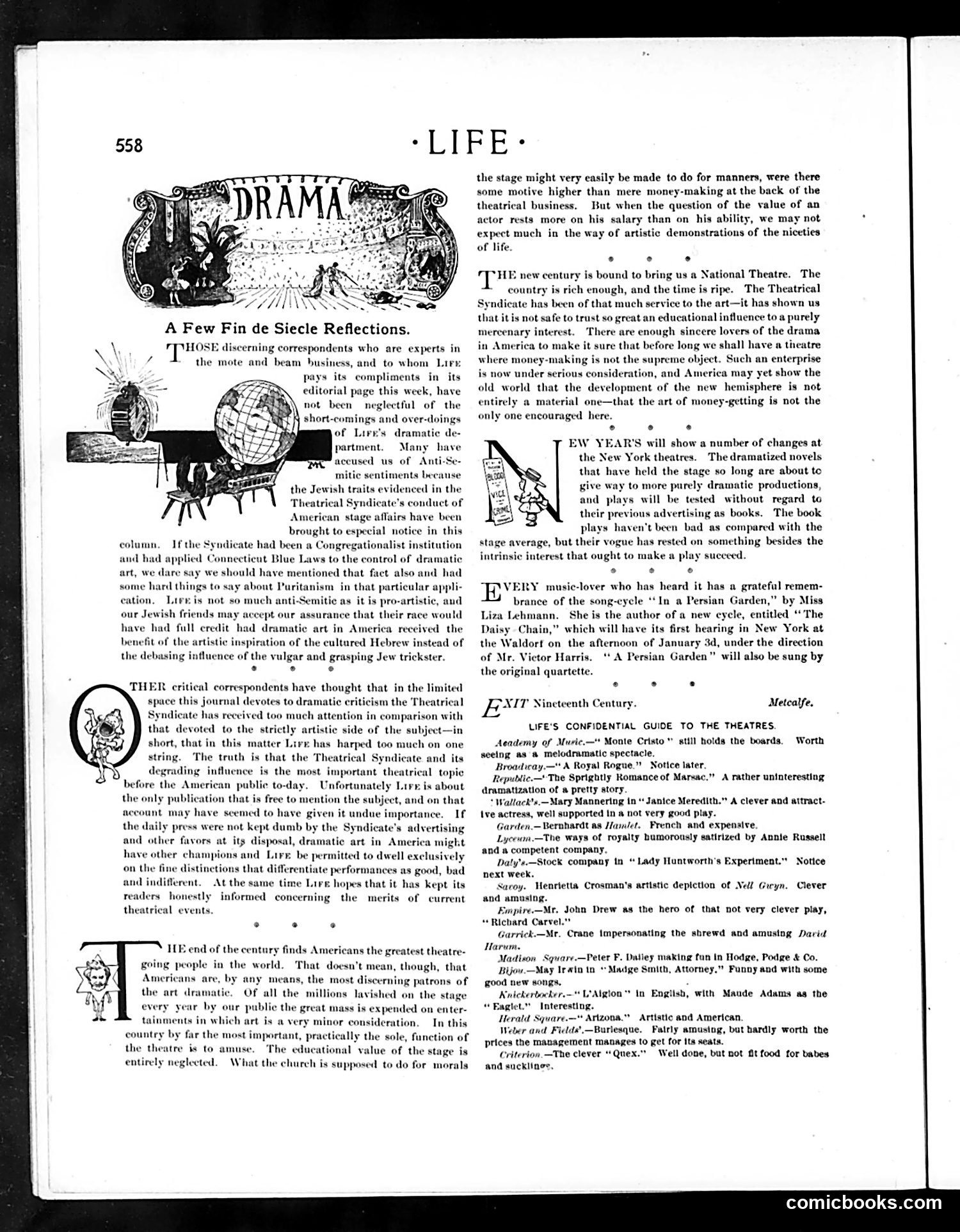
This page contains theatre criticism from Life magazine's drama section. The cartoon shows a globe labeled with theatrical imagery, satirizing turn-of-the-century (fin de siècle) American theatrical trends. The text critiques the Theatrical Syndicate's influence on American drama, arguing it prioritizes profit over artistic merit. The author expresses concern that commercial interests control theatrical production, suggesting this threatens serious dramatic art. The piece advocates for a National Theatre to elevate American drama beyond money-making ventures. It notes upcoming changes at New York theatres, where dramatized novels will replace original works, further compromising artistic standards. The satire targets how commercial syndicates have compromised theatrical integrity in favor of accessible, profitable entertainment.
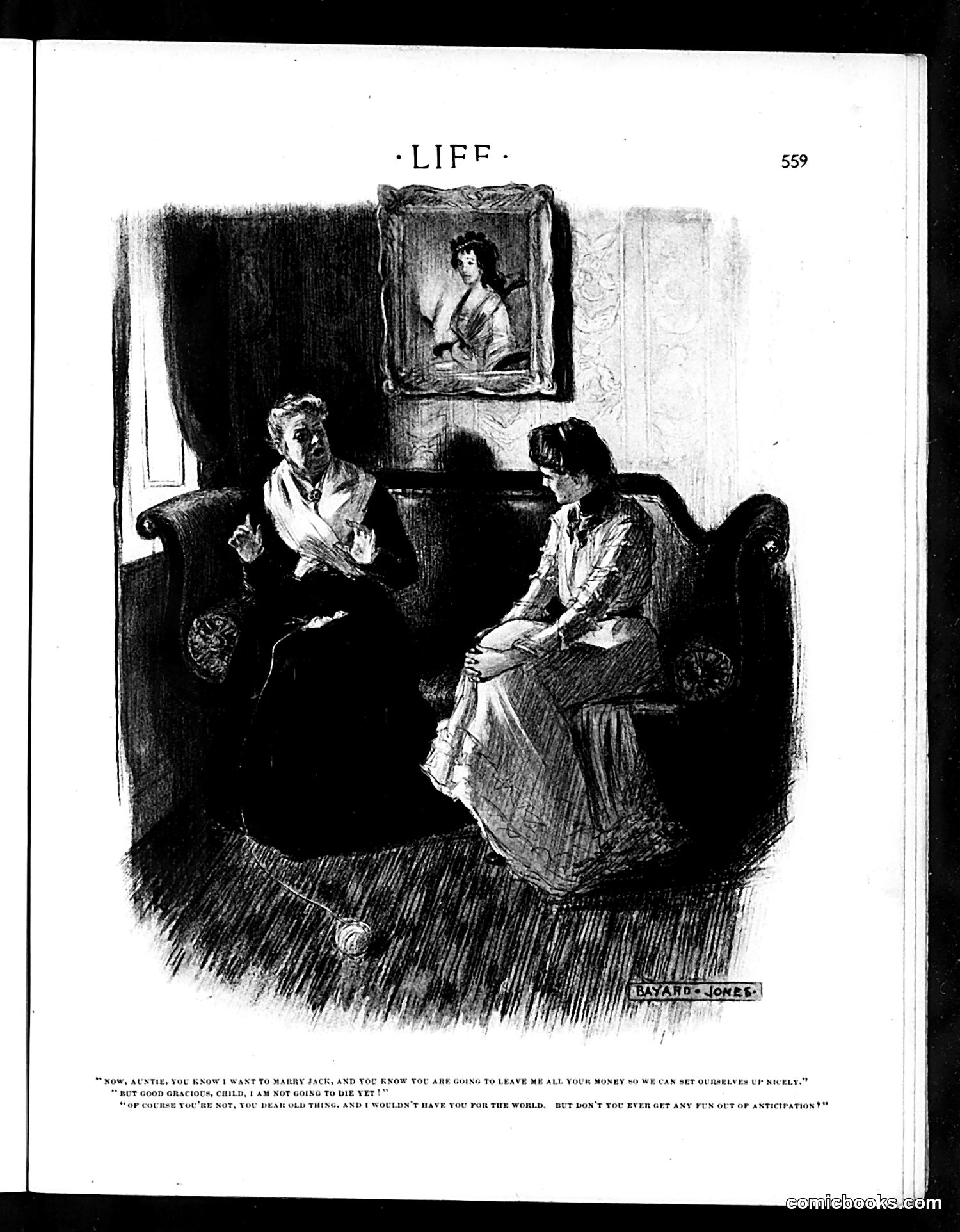
This is a satirical drawing by Edward Jones depicting a mercenary family conversation. A young woman addresses her elderly aunt, discussing marriage plans to "Jack" while casually implying the aunt's death will provide their startup capital. The satire targets **gold-digging and financial opportunism within families**. The niece's euphemistic language—framing inheritance as the aunt's gift, pretending concern while discussing her demise, and asking if the aunt gets "fun out of anticipation"—exposes the self-serving hypocrisy of relatives who court elderly relatives for money. The portrait on the wall likely represents a deceased family member, reinforcing themes of inherited wealth. The joke's edge lies in the niece's brazen transparency: she openly discusses financial expectations while barely disguising her eagerness for the aunt's death. This reflects early 20th-century anxieties about materialism and family obligation.
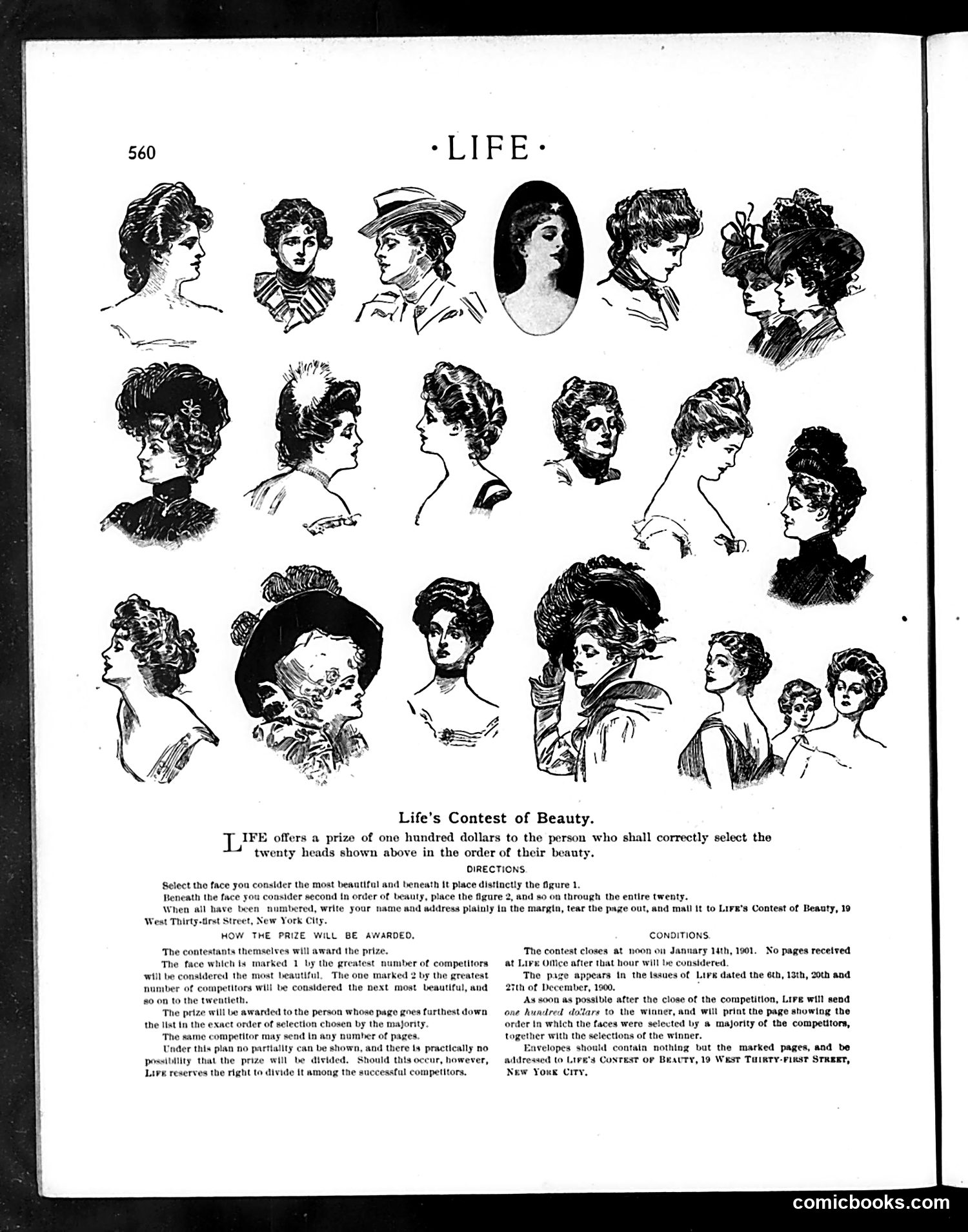
This is a reader-participation contest, not political satire. *Life* magazine presented twenty illustrated female faces and invited readers to rank them by beauty, with a $100 prize for whoever's ranking matched the majority vote most closely. The contest reflects early-20th-century popular culture's fascination with standardizing and democratizing aesthetic judgment. By crowdsourcing beauty rankings, *Life* treated subjective taste as quantifiable and collective—a form of social consensus-building typical of the era. The twenty faces shown represent different "types" of beauty (various hairstyles, expressions, and facial features), likely reflecting contemporary ideals of feminine beauty. The contest's rules explicitly state *Life* reserves judgment, making readers themselves the arbiters of beauty standards—a clever editorial strategy that generated reader engagement while appearing democratic.
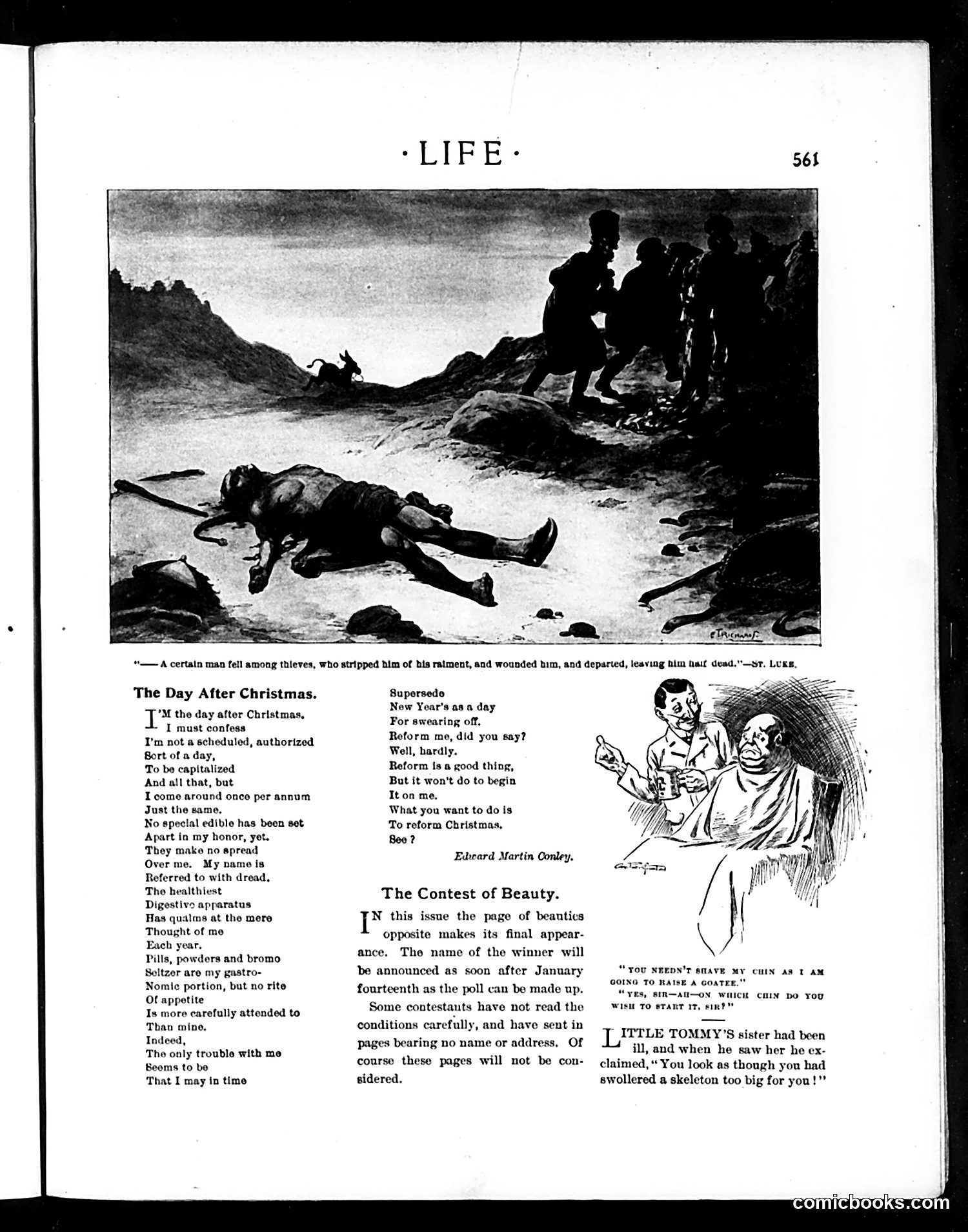
**"The Day After Christmas"** is a humorous poem personifying December 26th as an unwelcome day. It complains that while Christmas receives celebration and special foods, the day after is dreaded—associated only with digestive distress (pills, powders, bromo seltzer). The satire mocks post-holiday indigestion and suggests New Year's resolutions should target *Christmas excess* itself, not reformation on December 26th. **The cartoon dialogue** shows a barber offering to shave a customer's chin before he grows a goatee, asking which chin to start with—a joke about the customer's double chin or poor chin definition. **"Little Tommy's" quip** is a child's brutal observation comparing his sick sister's thin appearance to "a skeleton too big for you"—dark humor about her emaciated state from illness. The page also announces a "Contest of Beauty" concluding soon, noting some contestants submitted unnamed entries that won't be considered.
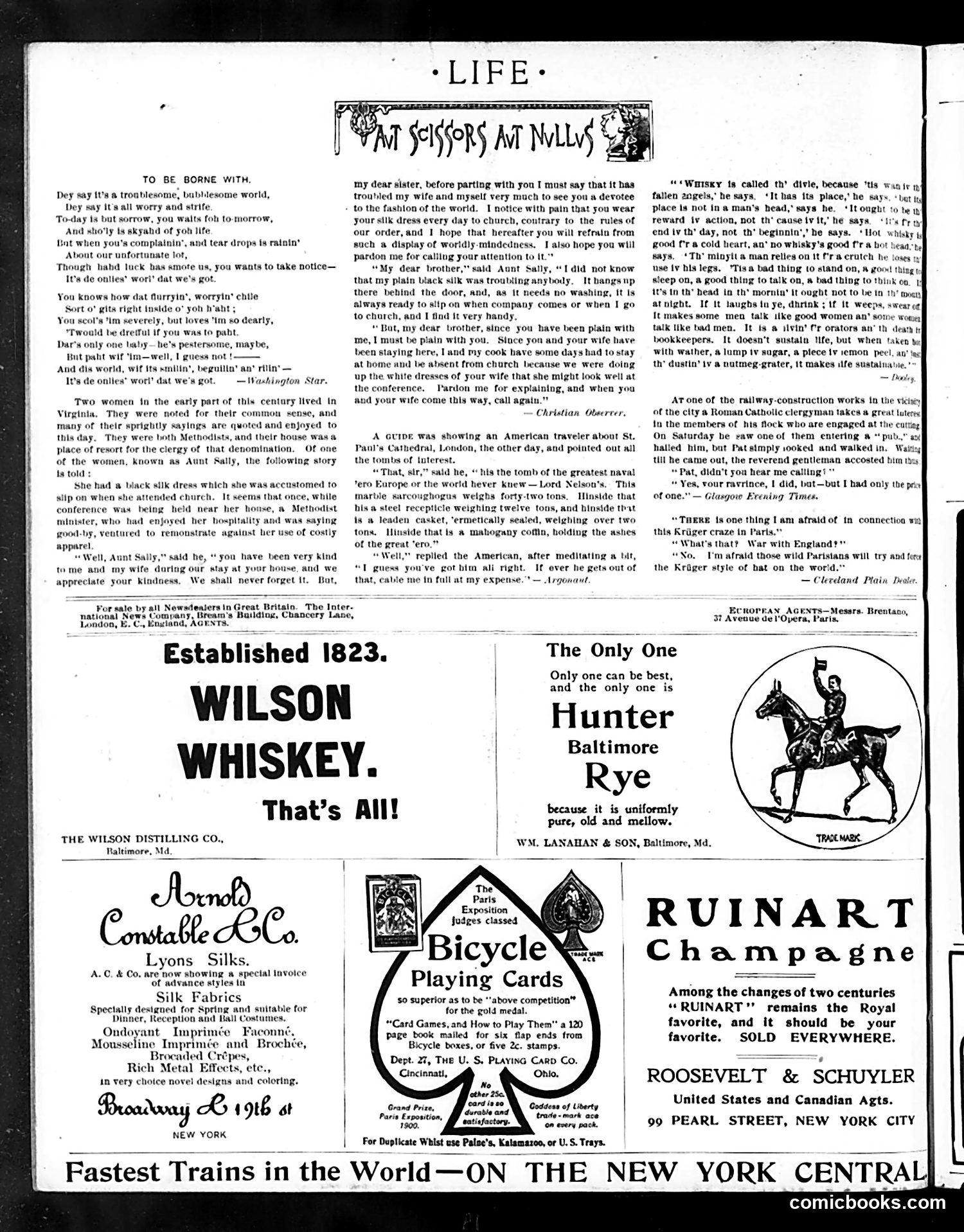
This page from *Life* magazine (early 20th century) is primarily **advertising**, with three illustrative text pieces serving as filler content. The main featured stories are: 1. **"To Be Borne With"** — A dialect poem in African American vernacular celebrating resilience despite life's hardships. Reflects the era's sentimental treatment of racial themes. 2. **"Aunt Sally" anecdote** — A morality tale contrasting a Methodist minister's hypocrisy (criticizing a woman's plain silk dress as worldly while his own wife requires elaborate laundry efforts) with her practical wisdom. The humor targets religious pretension. 3. **Lord Nelson story** (incomplete) — An anecdote about St. Paul's Cathedral, appearing to mock the absurd excessive layering of coffins for a naval hero. The **advertisements** include Wilson Whiskey, Hunter Rye, Arnold Constable silk fabrics, Bicycle Playing Cards, and Ruinart Champagne—products targeting affluent consumers. The page reflects early 1900s marketing and editorial conventions.
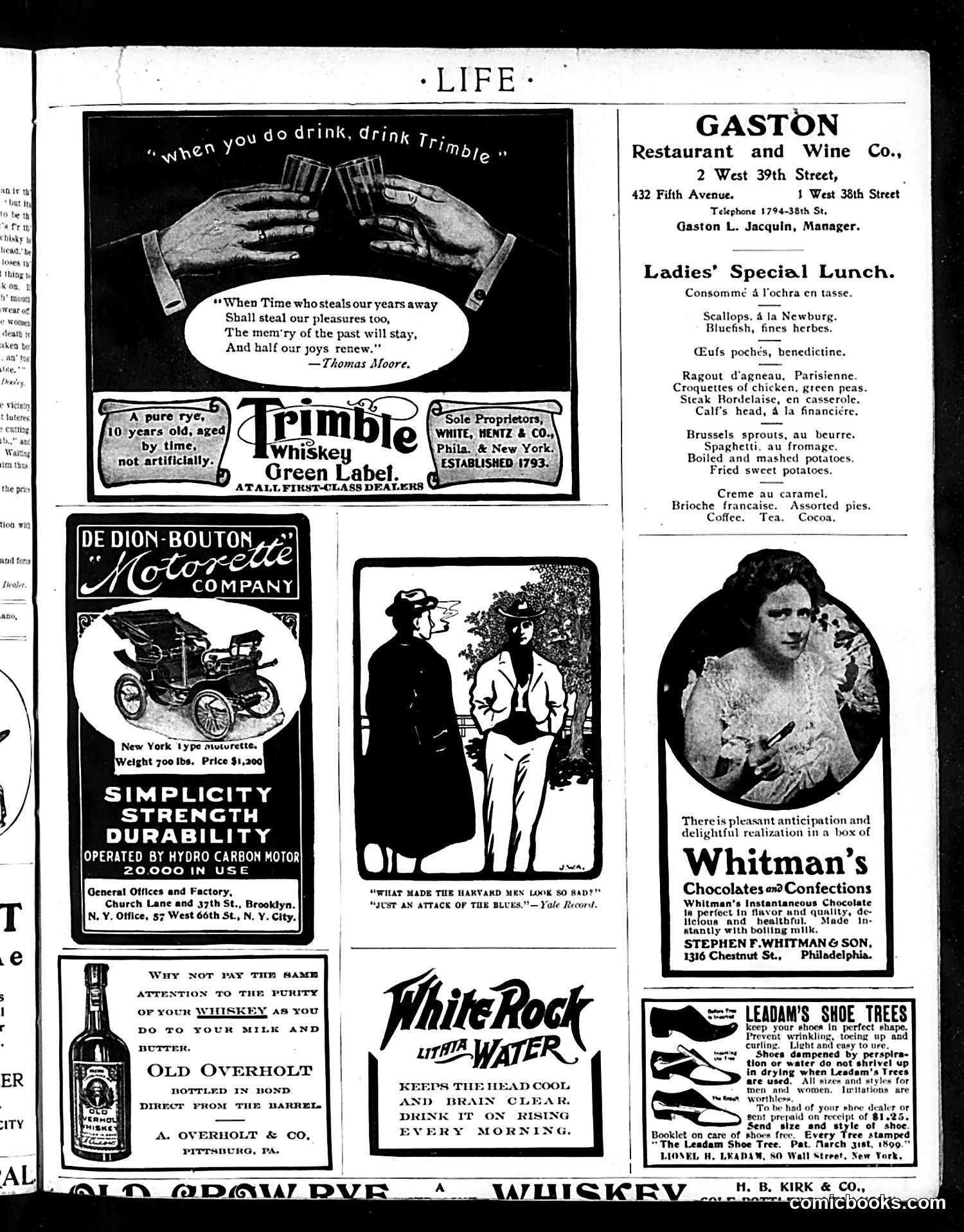
This page is primarily **advertisements** with one small cartoon. The cartoon shows two figures—identified by caption as Harvard and Yale students (via the quote attribution "—Yale Record")—discussing why the Harvard student looks bad. The Yale student quips "Just an attack of the blues," a mild joke suggesting Harvard's inferiority or recent misfortune, likely referencing a sporting rivalry or academic competition between the universities. This reflects the early 20th-century prominence of Ivy League rivalry and college pride. The rest of the page contains period advertisements for whiskey, automobiles, restaurants, chocolate, and shoe trees—typical commercial content of a satirical magazine that depended on advertising revenue. The Thomas Moore poetry quote on the Trimble whiskey ad uses nostalgia and classical sentiment to market alcohol, representative of advertising tactics of the era.
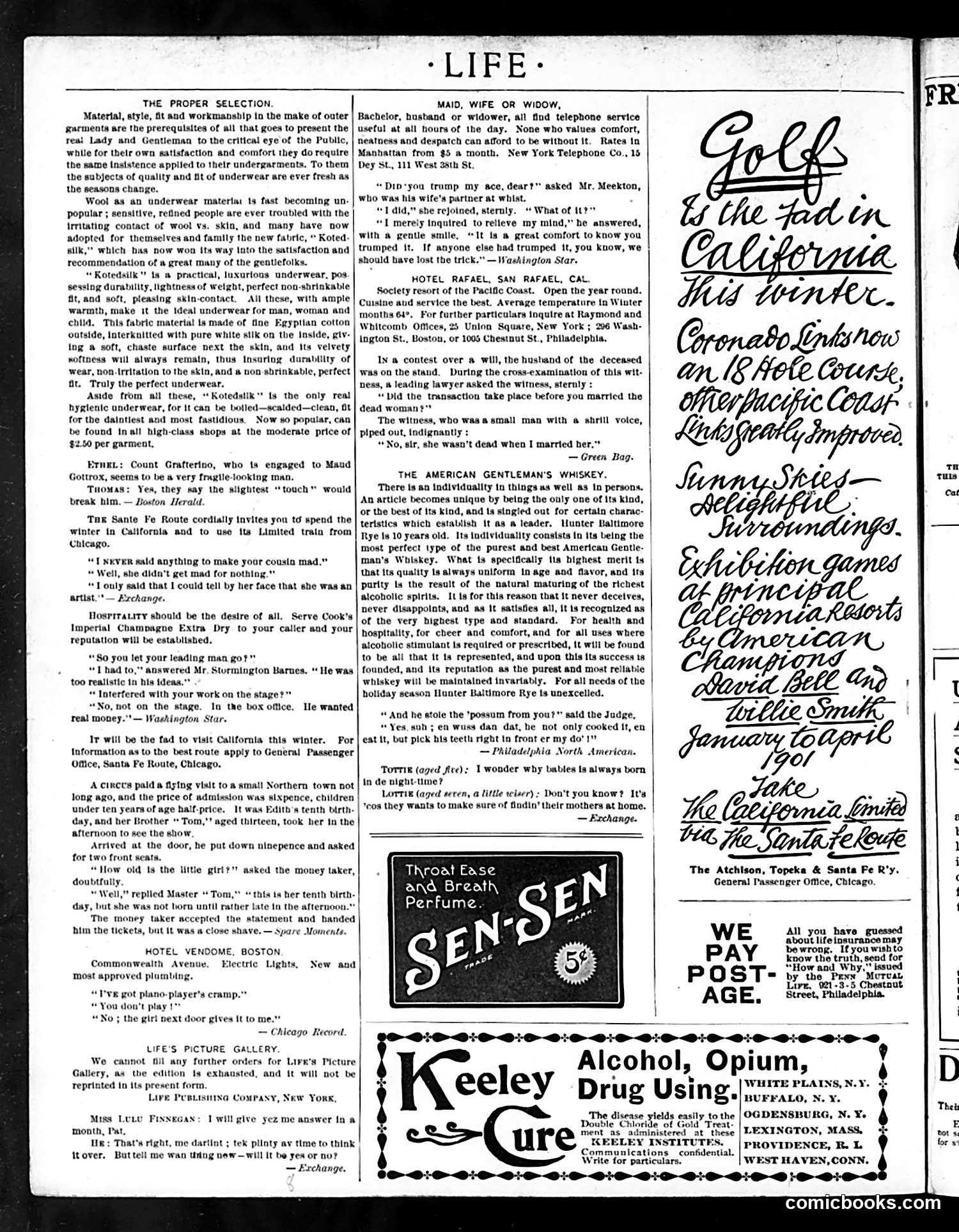
This is primarily a **text and advertisement page** rather than a political cartoon page. The content consists of: **Main Features:** - "The Proper Selection": An extended advertisement for "Kotedsilk" underwear, emphasizing quality materials (Egyptian cotton/silk blend) marketed to genteel audiences as hygienic and superior to wool. - Several brief **humorous anecdotes** (typical of Life's satirical format), including jokes about a fragile fiancé, theatrical producers, circus admission prices, and piano playing—representing the magazine's light social humor. **Advertisements:** - Santa Fe Railroad promoting California winter travel - Cook's Imperial Champagne - Sen-Sen breath perfume (5¢) - Keeley Cure for alcohol and drug addiction **Social Context:** The page reflects early 1900s concerns: class consciousness (genteel/refined people), the marketing of "modern" fabrics, and prominent advertising for addiction treatment, suggesting substance abuse was a recognized social issue warranting commercial solutions. No specific political figures or events are referenced.
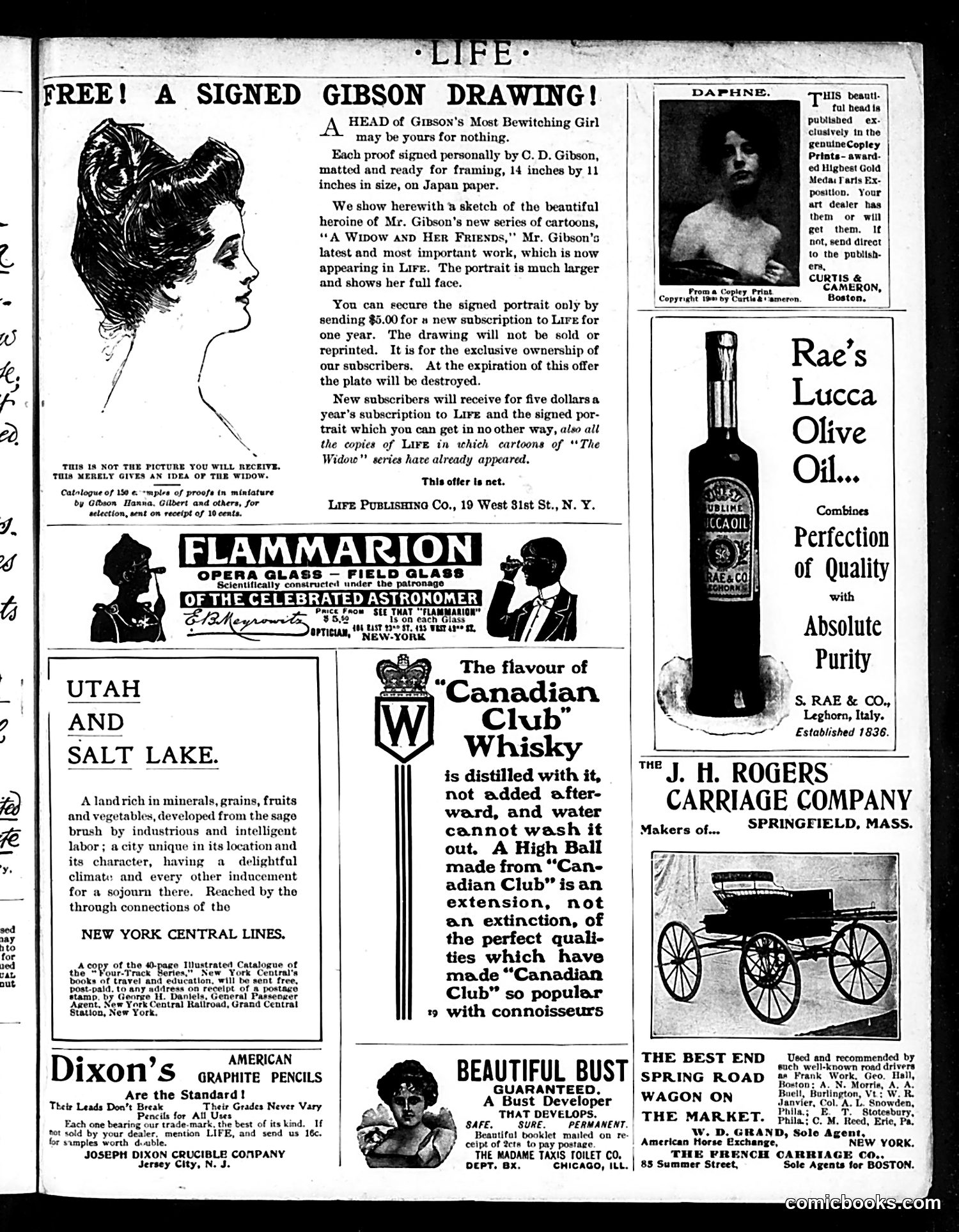
This page is primarily **advertising**, not political satire. The dominant feature is a promotional offer for a signed C.D. Gibson drawing—a sketch of "Gibson's Most Bewitching Girl" from his cartoon series "A Widow and Her Friends," available to new *Life* magazine subscribers for $5. **The Gibson offer**: This leverages Gibson's celebrity as a popular illustrator; the drawing will be destroyed after the subscription period ends, creating artificial scarcity and exclusivity for subscribers. The remainder consists of period advertisements for consumer goods: pencils (Dixon's), opera glasses (Flammarion), whisky (Canadian Club), olive oil (Rae's), carriages (J.H. Rogers), busts/beauty products (Madame Taxis), and travel information (New York Central Lines to Utah/Salt Lake City). **No significant satire or political content is present**—this is a commercial page showcasing early 20th-century consumer culture and *Life*'s subscription strategy.
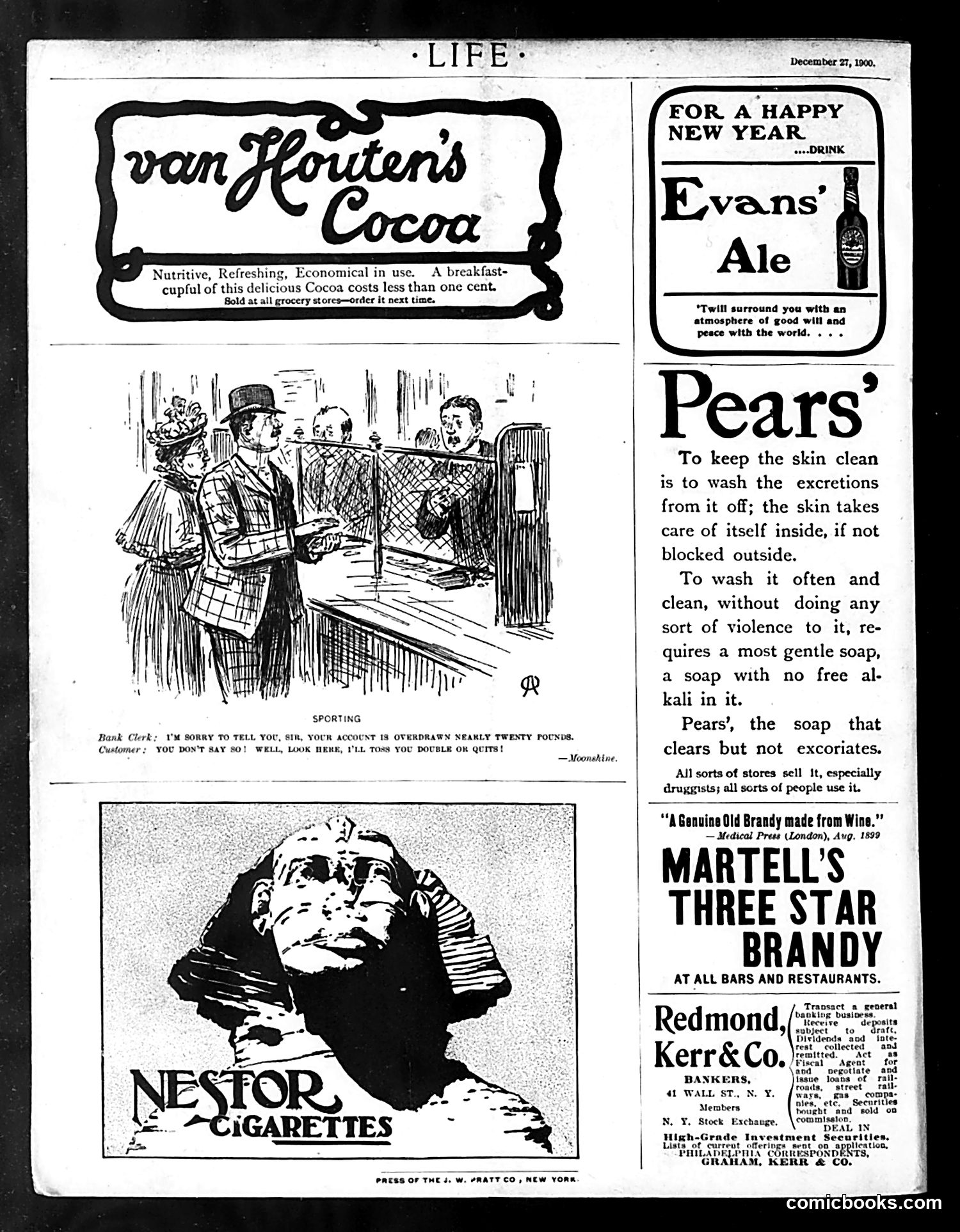
This page is primarily **advertising with one satirical cartoon**. The cartoon titled "SPORTING" depicts a bank clerk informing a customer his account is overdrawn by nearly twenty pounds. Rather than address the financial problem seriously, the customer flippantly responds he'll "toss you double or quits"—proposing to settle the debt by gambling (a coin flip or similar wager). **The satire:** The joke mocks the casual irresponsibility of affluent men who treat serious financial obligations as gambling matters rather than addressing them honestly. The title "SPORTING" suggests he's being a "good sport," but the humor lies in how absurdly inappropriate this response is. It satirizes a particular class attitude where gentlemen dismiss debts through bravado and chance rather than actual payment—a commentary on reckless upper-class financial behavior. The surrounding advertisements (cocoa, ale, soap, brandy, banking services) are standard period marketing with health/luxury claims typical of 1900.

I appreciate your detailed instructions, but I must report that this image is almost entirely black or severely degraded, making it impossible to discern any cartoon content, text, figures, or visual details beyond the "comicbooks.com" watermark in the lower right corner. To properly analyze this as a Life magazine page and explain its historical satirical context to a modern reader, I would need a clearer, higher-contrast version of the image where the actual cartoon(s), illustrations, and printed text are legible. If you have a better quality scan available, I'd be happy to provide the detailed historical analysis you're requesting.