
Life, 1900-12-27 · page 12 of 21
Life — December 27, 1900 — page 12: what you’re looking at
What you’re looking at
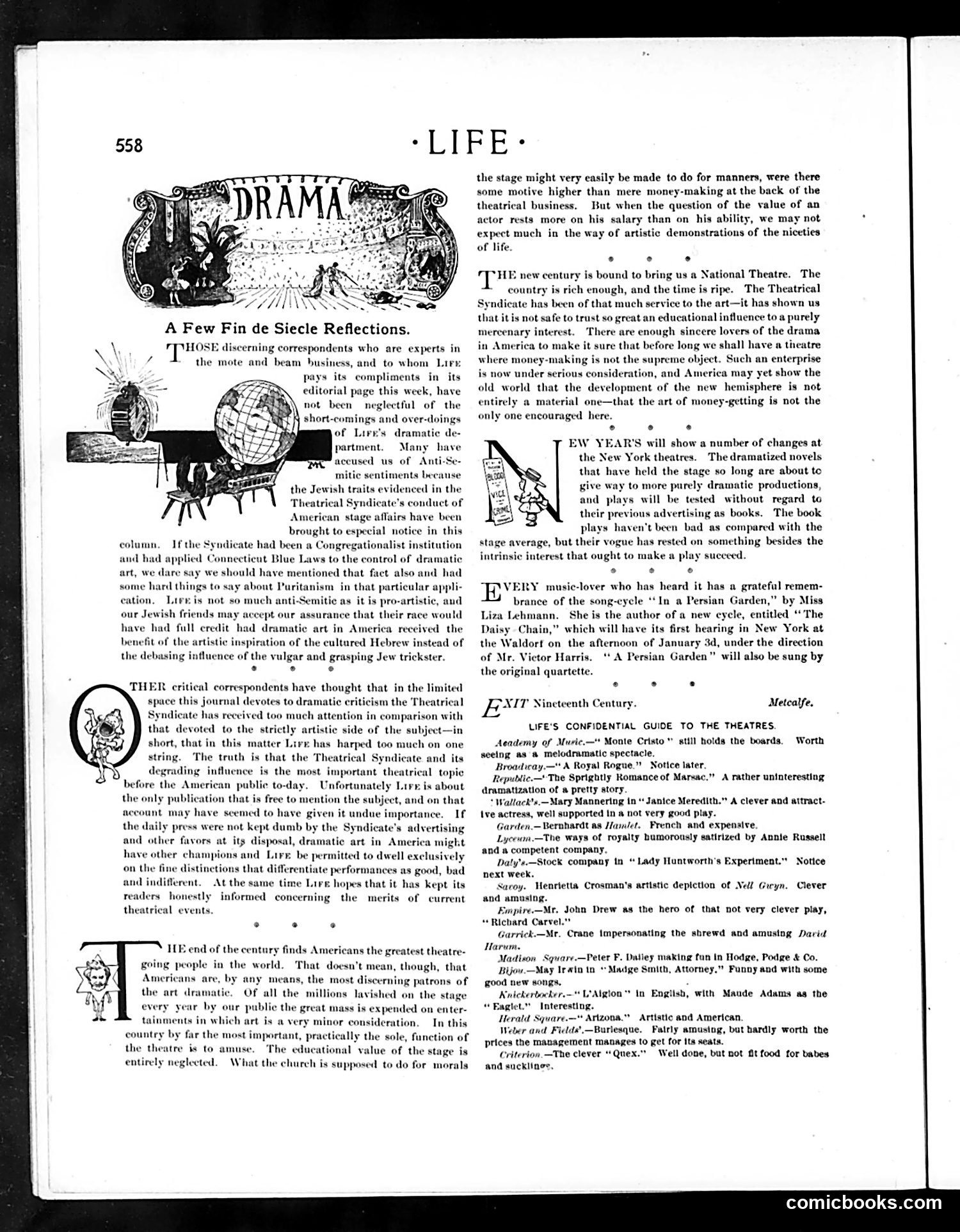
This page contains theatre criticism from Life magazine's drama section. The cartoon shows a globe labeled with theatrical imagery, satirizing turn-of-the-century (fin de siècle) American theatrical trends. The text critiques the Theatrical Syndicate's influence on American drama, arguing it prioritizes profit over artistic merit. The author expresses concern that commercial interests control theatrical production, suggesting this threatens serious dramatic art. The piece advocates for a National Theatre to elevate American drama beyond money-making ventures. It notes upcoming changes at New York theatres, where dramatized novels will replace original works, further compromising artistic standards. The satire targets how commercial syndicates have compromised theatrical integrity in favor of accessible, profitable entertainment.
📄 Transcribed text from this page (OCR, searchable)
Machine-transcribed from the original scan — historical spelling and the odd misread are preserved.
“LIFE: A Few Fin de Siecle Reflections. HOSE discerning correspondents who are experts in the mote and beam business, and to whom Lir pays its compliments in its editorial page this week, have not been neglectful of the short-comings and over-doings of Lire’s partment. dramatic de- Many have of Ant the Jewish traits eviden Theatrical Syndicate American stag brought to espe: If the Syndicate had been a Congregati and had applied Connecticut Blue Laws to the control of dramatic art, we dare say we should have mentioned that fact also and hi some hard things to say about Puritanism in that particular appli- ion. Litrris not so much anti-Semitic as it is pro our Jewish friends may accept column. ir assurance that their race would have had full credit had dramatic art in America received the benefit of the artistic inspiration of the cultared Hebrew instead of the debasing influence of the vulgar and grasping Jew trickster. ° ° ° THER critical correspondents have thought that in the limited ¢ this journal devotes to dramatic criticism the Theatrical ndicate has received too much attention in compari that devoted to the strictly artistic side of the subject—in short, that in this matter Lire has harped too much on one string. ‘The truth is that the Theatrical Syndicate and its degrading influence is the most important theatrical topic before the American public to-day, Unfortunately Lire ix about the only public free to mention the subject, and on that account may have seemed to have given it undue importance. If the daily press were not kept dumb by the Syndicate’s advertising and other favors at ity disposal, dramatic art in America might have other champions and Lire, be permitted to dwell exclusively distinctions that differentiate performances as good, bad and indif rent. At the same time Lire hopes that it has k readers honestly informed concerning the merits of current I events, ° ° ° ILE end of the century finds Americans the greatest theatre- ing people in the world. Americans are the art dramati every. yea tainm That doesn't mean, though, that by any means, the most discerning patrons of Of all the milli y our public the nts in which art is a ve y fart] ons lavished on the stage reat mass is expended on enter- ‘y minor consideration. In this country b 1 important, pi y the sole, function of the theatre is to amuse. alue of the stage is entirely neglected. What the church is supposed to do for morals the stage might very easily be made to do for manners, were there some motive higher than mere money-making at the back of the theatrical business. But when the question of the value of an actor rests more on his salary than on his ability, we may not expect much in the way of artistic demonstrations of the niceties of life. Bis new century is bound to bring us a National Theatre. The country is rich enough, and the time is ripe. The Theatrical Syndicate has been of that much service to the art—it has shown us that itis not safe to trust so great an educational influence to a purely mercenary interest. There are enough sincere lovers of the drama in America to make it sure that before long we shall have a theatre where money-making is not the supreme object. Such an enterprise is now under serious consideration, and America may yet show the old world that the development of the new hemisphere is not entirely a material one—that the art of money-getting is not the only one encouraged here. ° ° . EW YEAR'S will show a number of changes at the New York theatres. The dramatized novels that have held the stage so long are about to give way to more purely dramatic productions, and plays will be tested without regard to their previous advertising as books. The book plays haven't been bad as compared with the stage average, but their vogue has rested on something besides the intrinsic interest that ought to make a play succeed. ° ° ° ‘BY RY music-lover who has heard it has a grateful remem- brance of the song-cycle ‘In a Persian Garden,” by Miss Liza Lehmann. She is the author of a new cycle, entitled “The Daisy Chain,” which will have its first hearing in New York at the Waldorf on the afternoon of January 3d, under the direction of Mr. Victor Harris. ‘A Persian Garden” will also be sung by the original quartette. fx! Ninete LIFE'S CONFIDENTIAL GUIDE TO THE THEATRES. Academy of Muric.—" Monte Cristo” still holds the boards. seeing as ® melodramatic spectacle. Broadway.—" A Royal Rogue.” Notice later. Republic.— The Sprightly Romance of Marsac.” A rather uninteresting dramatization of a pretty story. *Wallack's.—Mary Mannering in“ Janice Meredith.” A clever and attract- Ive actress, well supported In a not very good play. Garden.— Bernhardt as Han/et. French and expensive Lycewmn.—The ways of royalty humorously satirized by Ante Russell and a competent company, Daty’e.—Stock company tn “Lady Huntworth’s Experiment.” Notice next week. Saroy. Henrietta Crosman’s artistic depiction of Nel Gicyn. and amusing. Empire—Mr, John Drew as the hero of that not very clever play, “Richard Carvel."* Garrick.—Mr. Crane Impersonating the sbrewd and amusing David Harum. Madison Square.—Peter F. Datiey making fun in Hodge, Podge & Co. Bijow.—May Irain tn * Madge Smith, Attorney.” Funny and with some good new songs, F Knickerbocker." L'Algion in English, with Mande Adams as the “Eaglet." Interesting. Herald Square.—" Arizona.” Artistlo and American, Weber and Fields',—Burlesque, Fairly amusing, but hardly worth the prices the management manages to get for Its seats. Criterion.—The clever “Quex." Well done, but not fit food for babes and sucklines, ° ° nth Century. Metcalfe, Worth Clever comicbooks.com