
A complete issue · 22 pages · 1900
Life — December 20, 1900
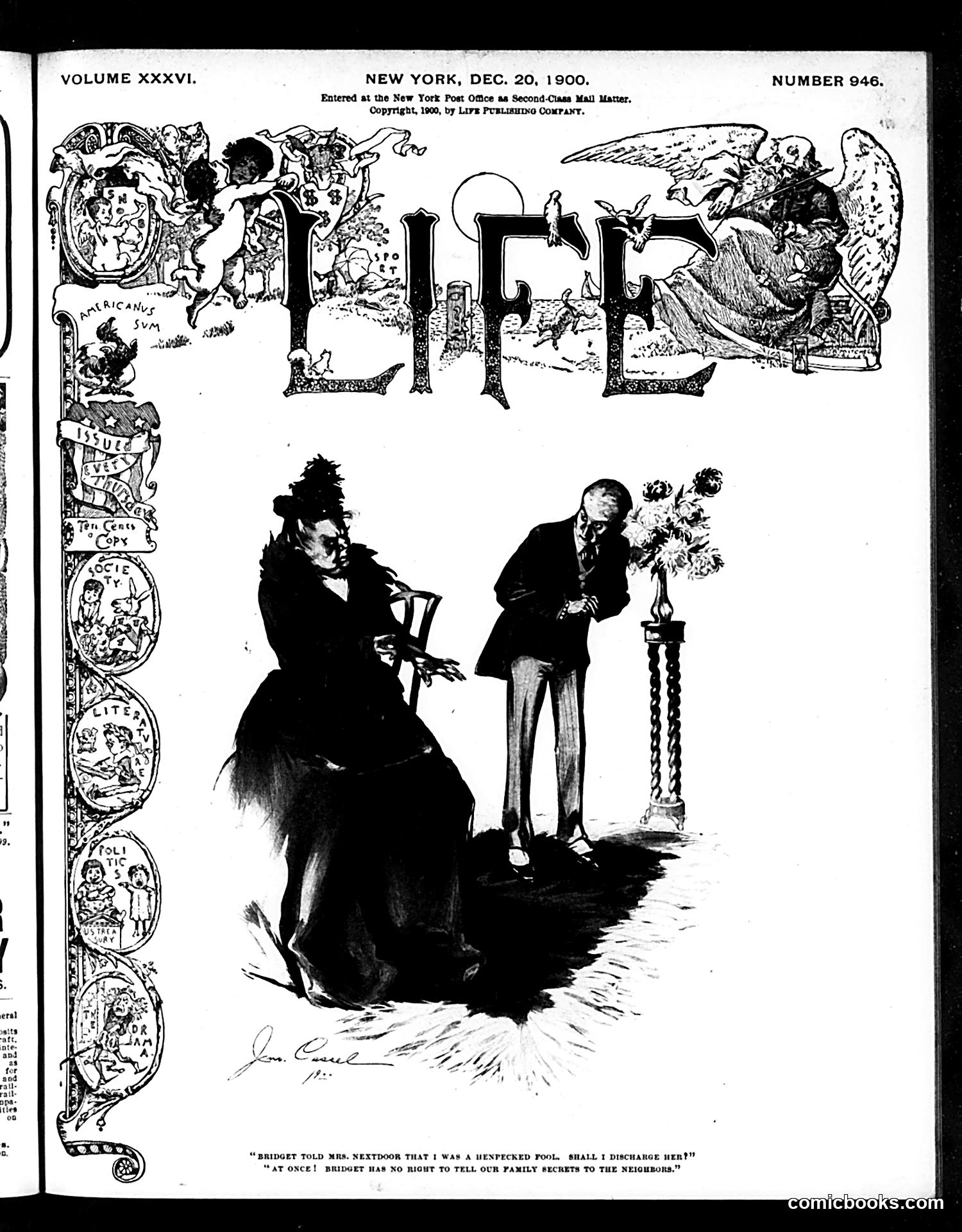
This satirical cartoon depicts a domestic scene where a woman (seated) confronts a man holding flowers. The caption reads: "Bridget told Mrs. Nextdoor that I was a henpecked fool. Shall I discharge her?" followed by "At once! Bridget has no right to tell our family secrets to the neighbors." **The Satire:** The joke mocks marital dynamics of the era. The man admits to being "henpecked" (dominated by his wife) while asking whether to fire their servant Bridget for gossiping about it. The wife's response—that the real offense is *telling neighbors* rather than the henpecking itself—exposes Victorian-era hypocrisy: families preferred keeping shameful domestic troubles private over actually addressing the underlying power imbalance in marriage. The ornate left border contains decorative vignettes typical of Life's design aesthetic.
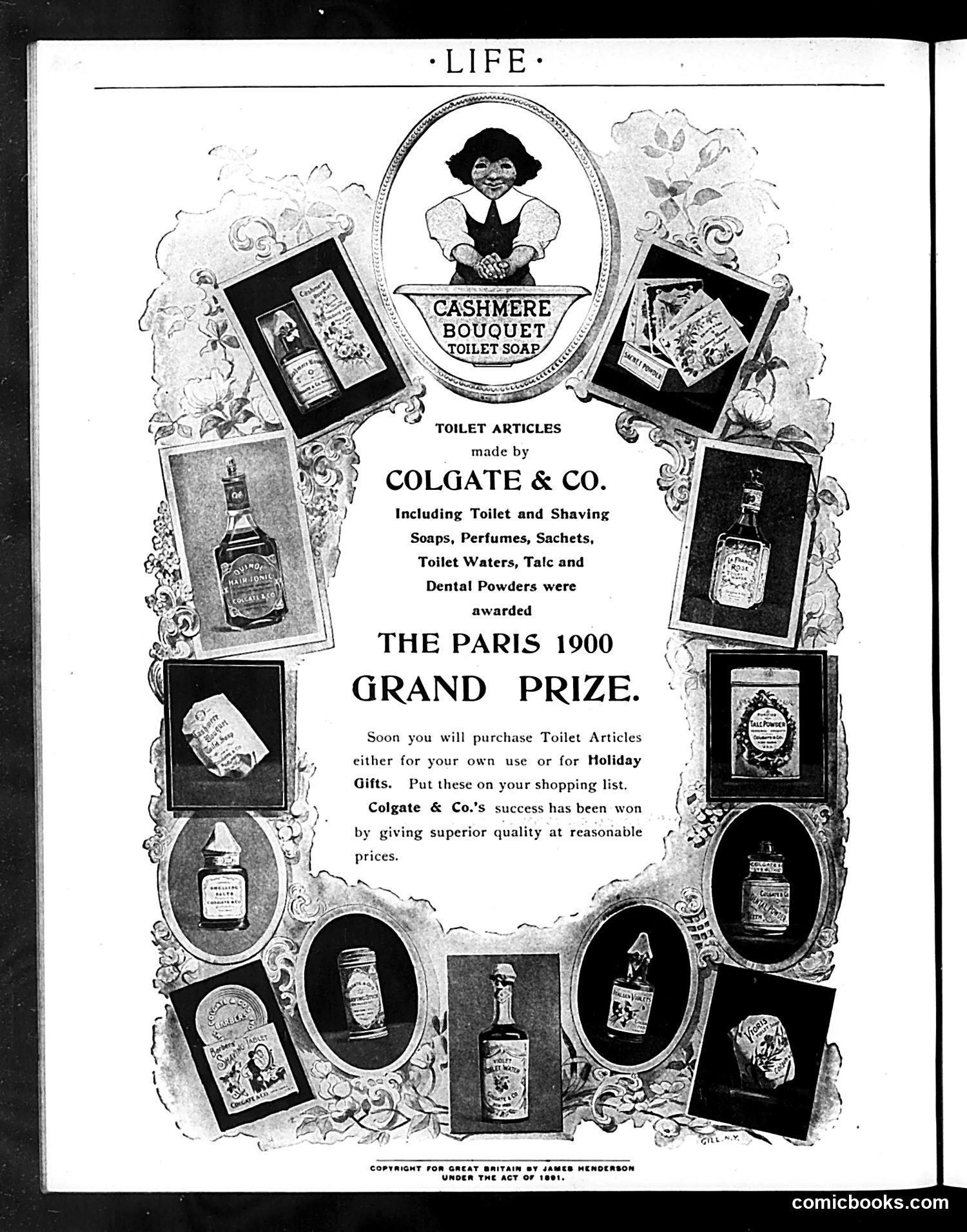
This is **not a cartoon or satire—it's a straightforward advertisement** for Colgate & Co.'s toilet articles (soaps, perfumes, powders, etc.). The page celebrates the company's achievement: winning the **Grand Prize at the Paris 1900 Exposition**. The ornate decorative border frames various product images and a central "Cashmere Bouquet" soap logo featuring a smiling woman's face. The ad targets holiday shoppers, suggesting these products make suitable gifts. It emphasizes Colgate's competitive advantage: "superior quality at reasonable prices." The Paris 1900 Exposition was a prestigious international fair; winning prizes there significantly boosted a company's prestige and marketing appeal in this era. This is pure commercial promotion, not political commentary.
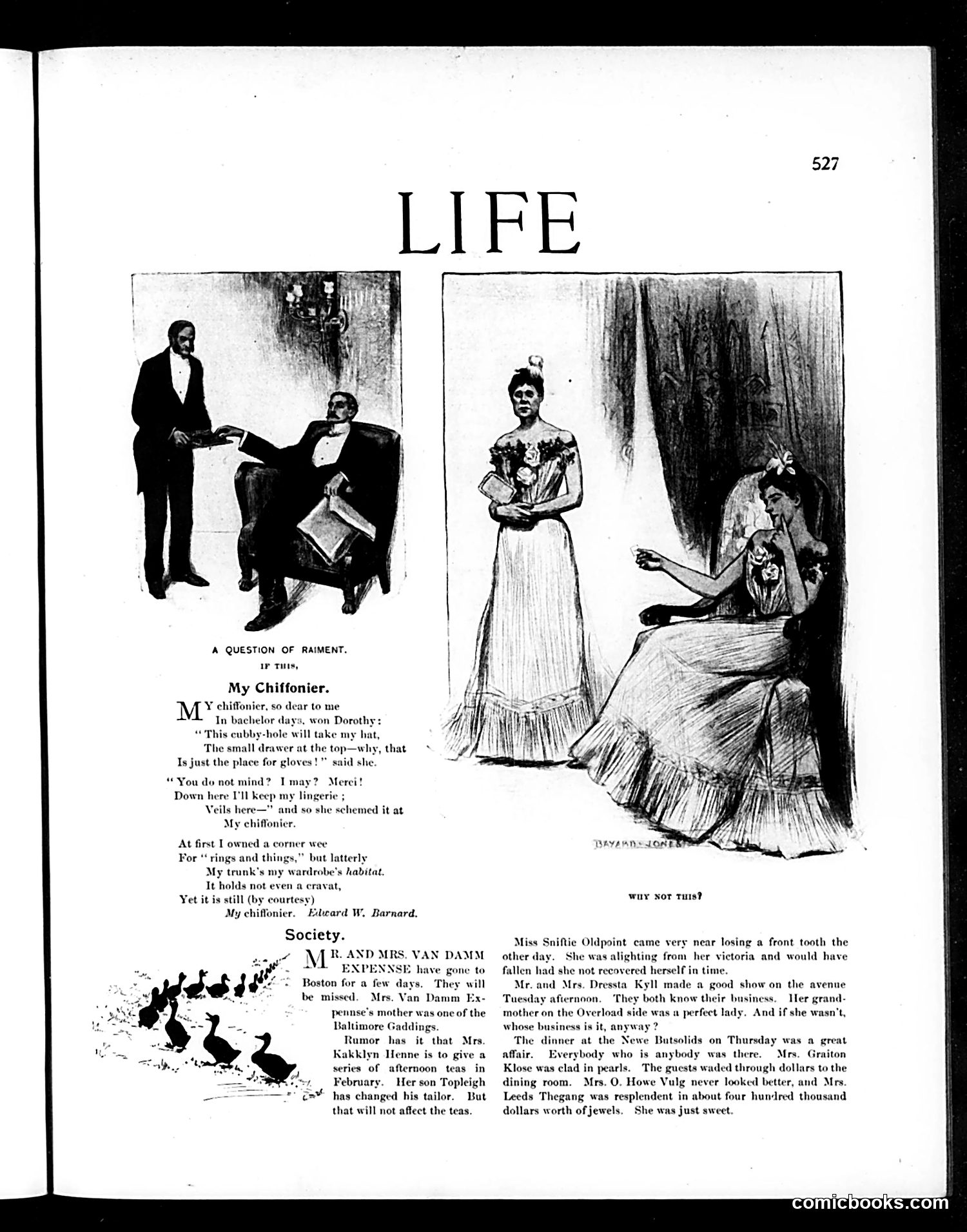
This page contains two distinct sections: **"A Question of Raiment"** (left): A cartoon showing two well-dressed men in business attire, one seated and one standing. The accompanying poem "My Chiffonier" by Edward W. Barnard humorously describes a bachelor's struggle with wardrobe storage, using the chiffonier (a type of dresser) as metaphor for life's accumulations. **"Society" section** (right): A satirical column mocking high-society social events and wealthy New York families (Van Damm, Dresta Kyll, O. Howe Vulg, Leeds Thegang). The writer ridicules their ostentatious displays—expensive jewelry, lavish dinners, and pretentious gatherings—while subtly critiquing their vapid social preoccupations and conspicuous consumption during what was likely the Gilded Age. The cartoon and text together lampoon contemporary American class anxieties and material excess.
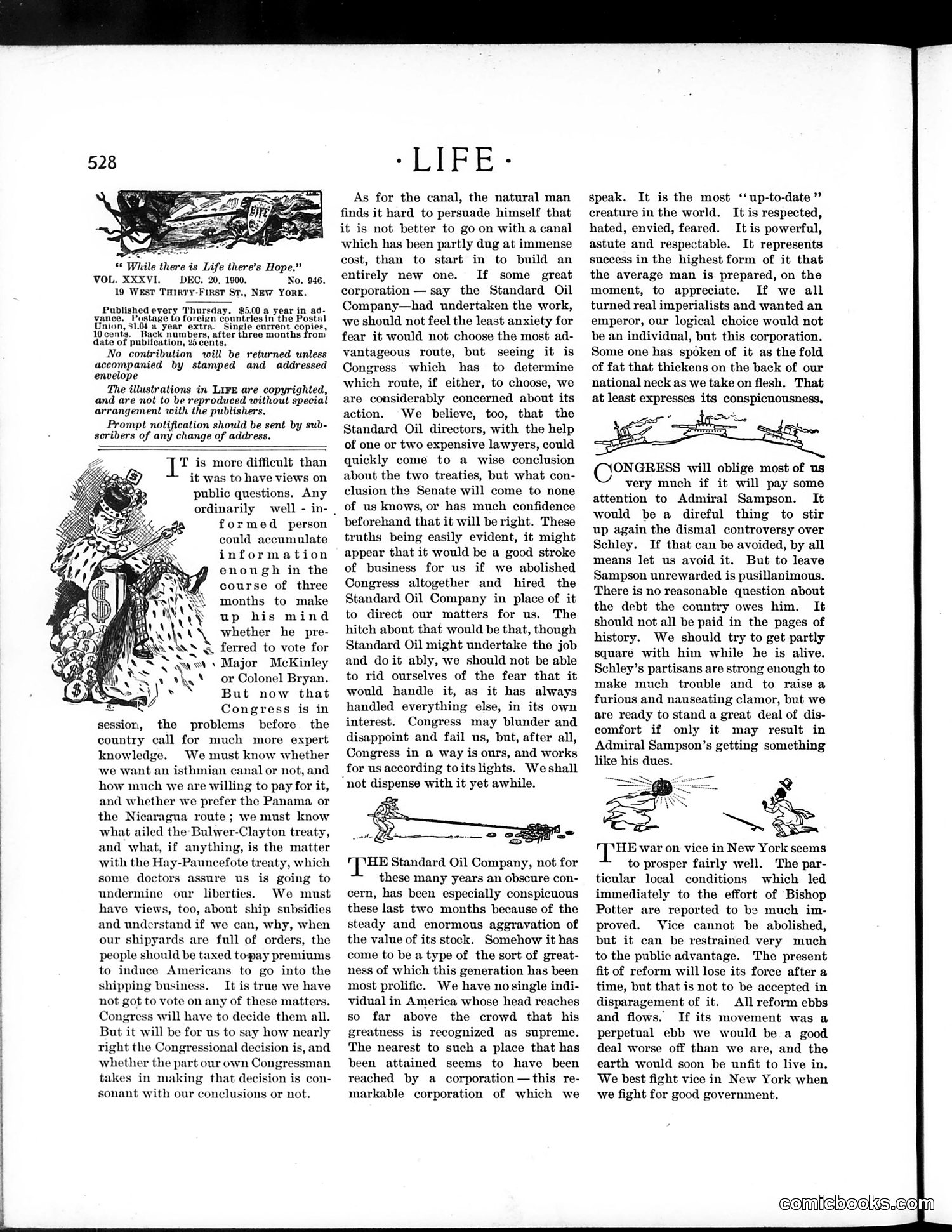
This page discusses major early-1900s political controversies. The main editorial debates canal construction routes (likely Panama vs. Nicaragua), whether the Standard Oil Company should manage American infrastructure, and the Hay-Pauncefote Treaty governing canal rights. The left illustration appears to be a generic political figure representing congressional debate. The small sketches on the right seem to depict Vice Bishop Potter's campaign against vice in New York City. The core satire targets concerns about corporate monopolies—specifically Standard Oil—controlling public projects. The author argues Congress must make informed decisions rather than outsource governance to private corporations, warning that unchecked corporate power threatens American democracy and liberty. The anti-monopoly sentiment reflects Progressive Era anxieties about big business influence.
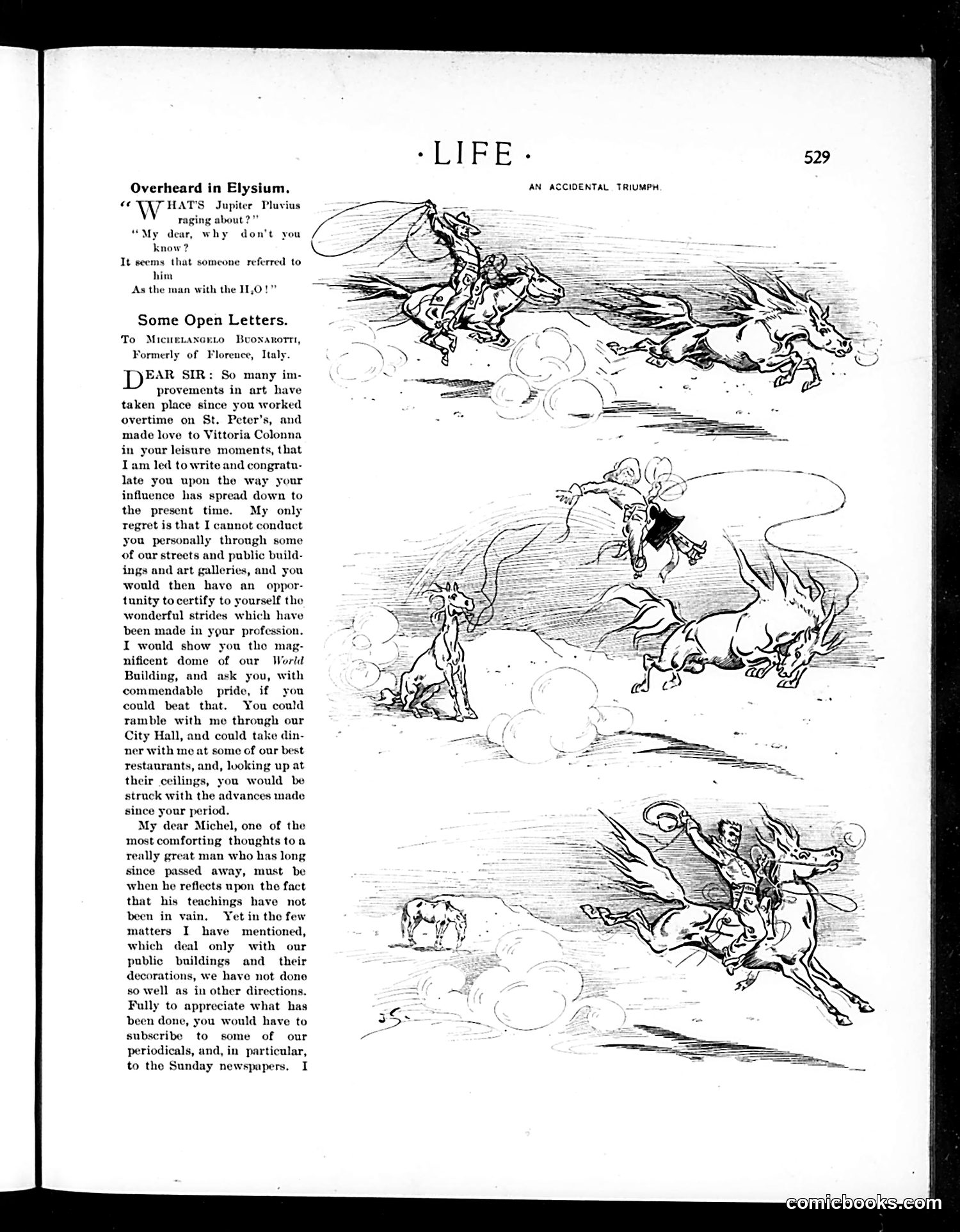
The top cartoon, "An Accidental Triumph," depicts classical/mythological figures (appearing to be Cupids or cherubs) riding winged horses through clouds. The humor appears to derive from the chaotic, comedic collision or interaction between these flying figures—suggesting an "accidental" outcome from their celestial activities. Below is "Some Open Letters," a letter to Michelangelo Buonarotti praising his artistic influence on modern architecture and public buildings. The writer congratulates him on how his Renaissance principles continue shaping contemporary design, and regrets being unable to show Buonarotti the modern advances in construction and decoration inspired by his work. The text is satirical commentary on artistic legacy rather than political satire.
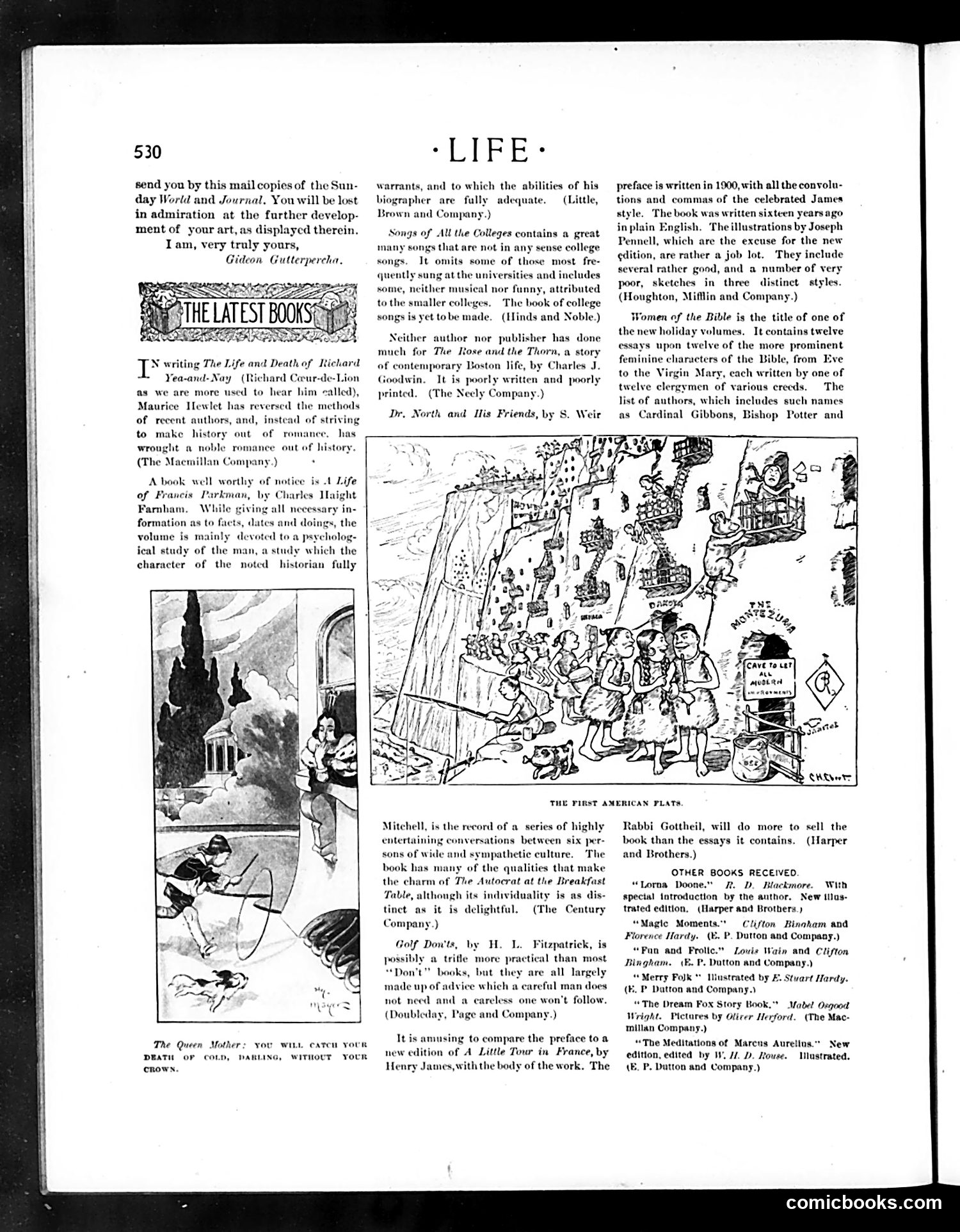
This page is primarily **book reviews and literary criticism**, not political satire. The main illustrated feature is "The First American Flats"—a humorous cartoon showing early settlers in a primitive dwelling carved into a hillside. The joke contrasts historical "flats" (cave dwellings) with modern apartment buildings, using period-appropriate illustration style typical of Life's satirical approach to American history and social customs. The page reviews contemporary books including works about Boston life and essays on female historical figures. The cartoon's humor derives from American nostalgia and the contrast between primitive and modern living conditions—a common satirical theme in early 20th-century magazines. No specific political figures or events are identifiable in this literary section.
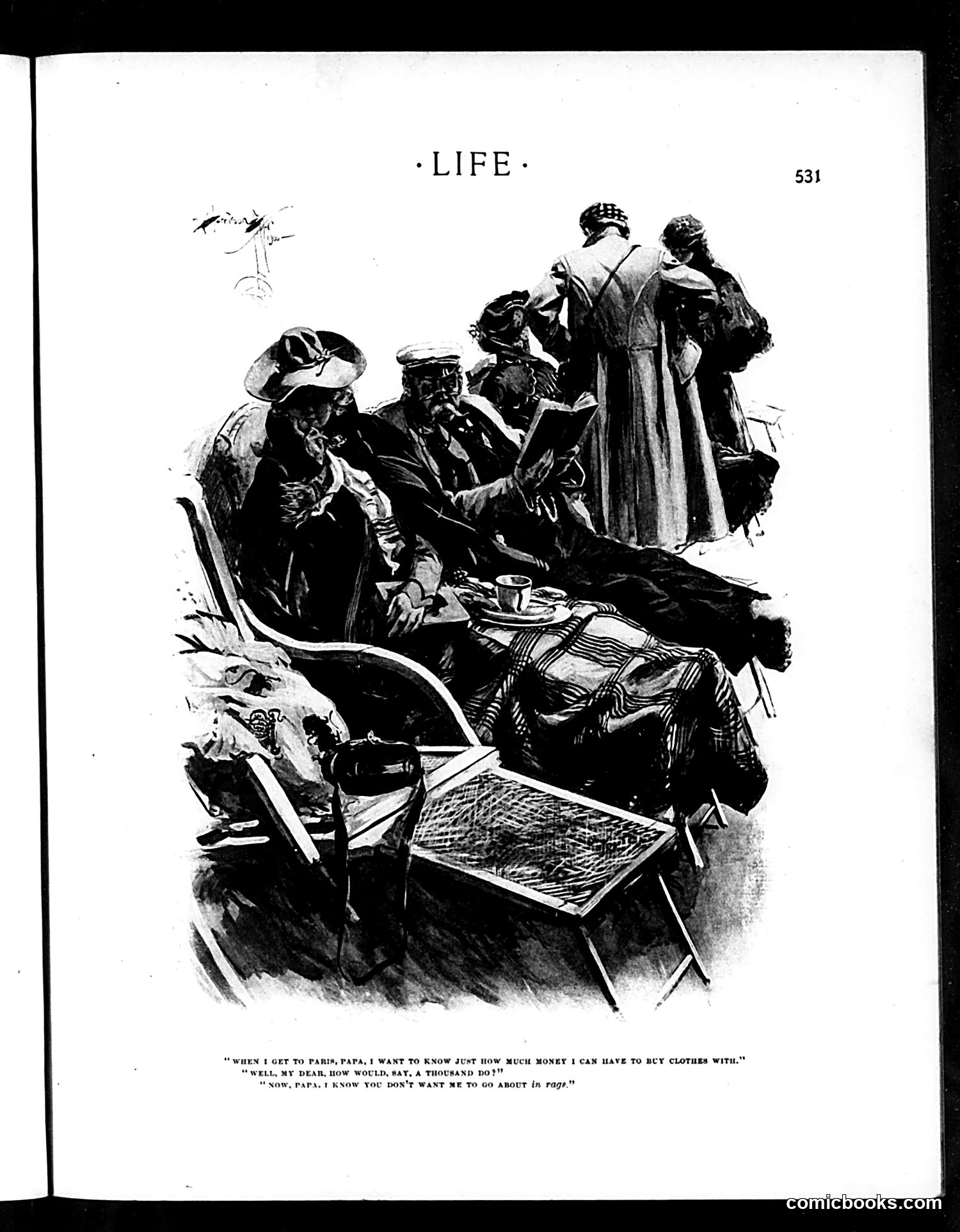
This satirical illustration depicts a family scene centered on a financial discussion about clothing allowances. A father ("Papa") sits with what appears to be his wife and children, with two additional figures standing in the background. The dialogue reveals the joke's premise: a child asks how much money they can spend on clothes in Paris, the father replies "a thousand do's" (likely "dollars"), and the mother warns the child not to "go about in rags." The satire targets parental anxiety about children's extravagant spending abroad, particularly regarding fashion. The illustration mocks both children's materialism and parents' inability to control their spending while traveling in Europe—a common concern for affluent American families of the early 20th century.
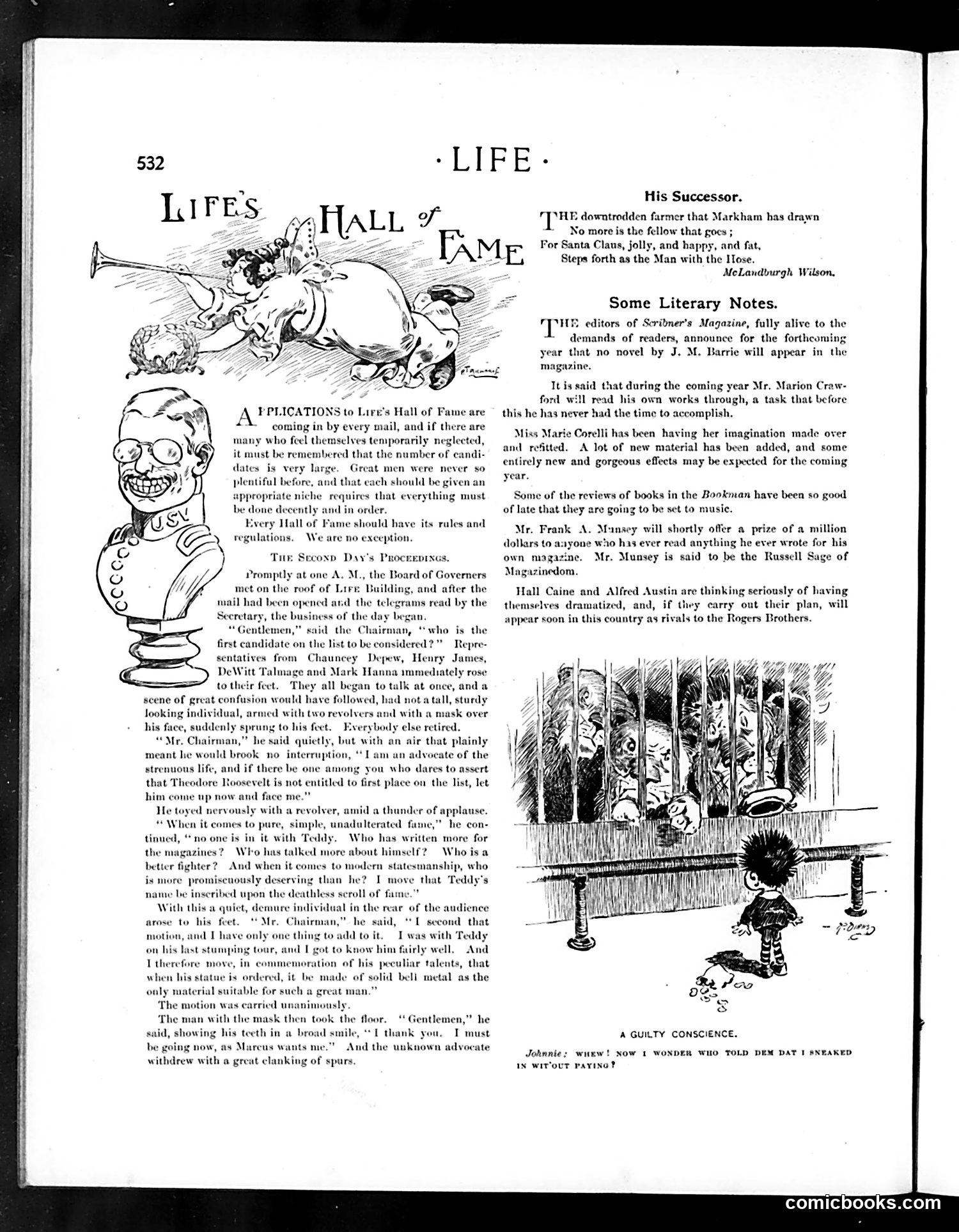
This page features satirical commentary on American public figures and literary matters. The left column discusses nominations to "Life's Hall of Fame," with rules requiring candidates be "great men" and nominations be "done decently and in order." **"The Second Day's Proceedings"** describes a humorous meeting at Life's building where a Chairman asks which candidate should be first on the list. References to figures like Theodore Roosevelt, Teddy (likely President Theodore Roosevelt), and others debating their rankings suggest satire about determining who deserves recognition. The right side contains "Some Literary Notes" about forthcoming magazine content and author announcements. **The cartoon** (titled "A Guilty Conscience") shows a small figure asking about unpaid debt, likely satirizing either a debtor or commentary on financial obligations—the exact reference is unclear without additional context.
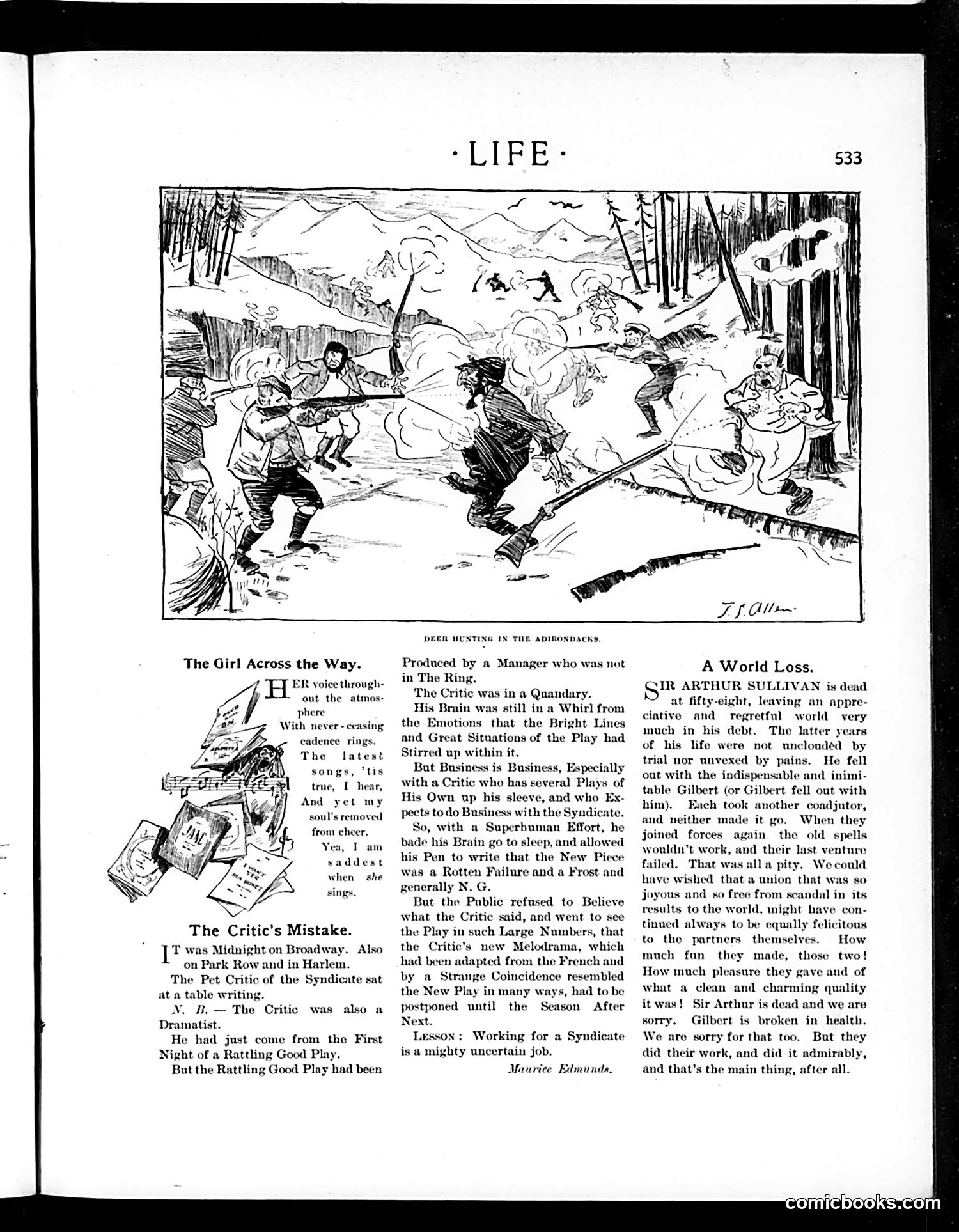
This page contains three theatrical sketches and commentary: 1. **"Deer Hunting in the Adirondacks"** (main illustration): Shows a chaotic winter scene with multiple figures engaged in slapstick action around a snowman, likely satirizing a theatrical production. 2. **"The Girl Across the Way"**: A brief review noting a female performer singing in a theatrical production. 3. **"The Critic's Mistake"**: Describes a critic attending Broadway shows at midnight, then reviewing a play in Harlem. The critic apparently made an error in his judgment of a theatrical work. 4. **"A World Loss"**: An obituary for Sir Arthur Sullivan (composer), noting his death at fifty-eight and his collaborative theatrical achievements, expressing that his final years brought both achievements and disappointments. The page primarily focuses on theatrical reviews and entertainment commentary rather than political satire.
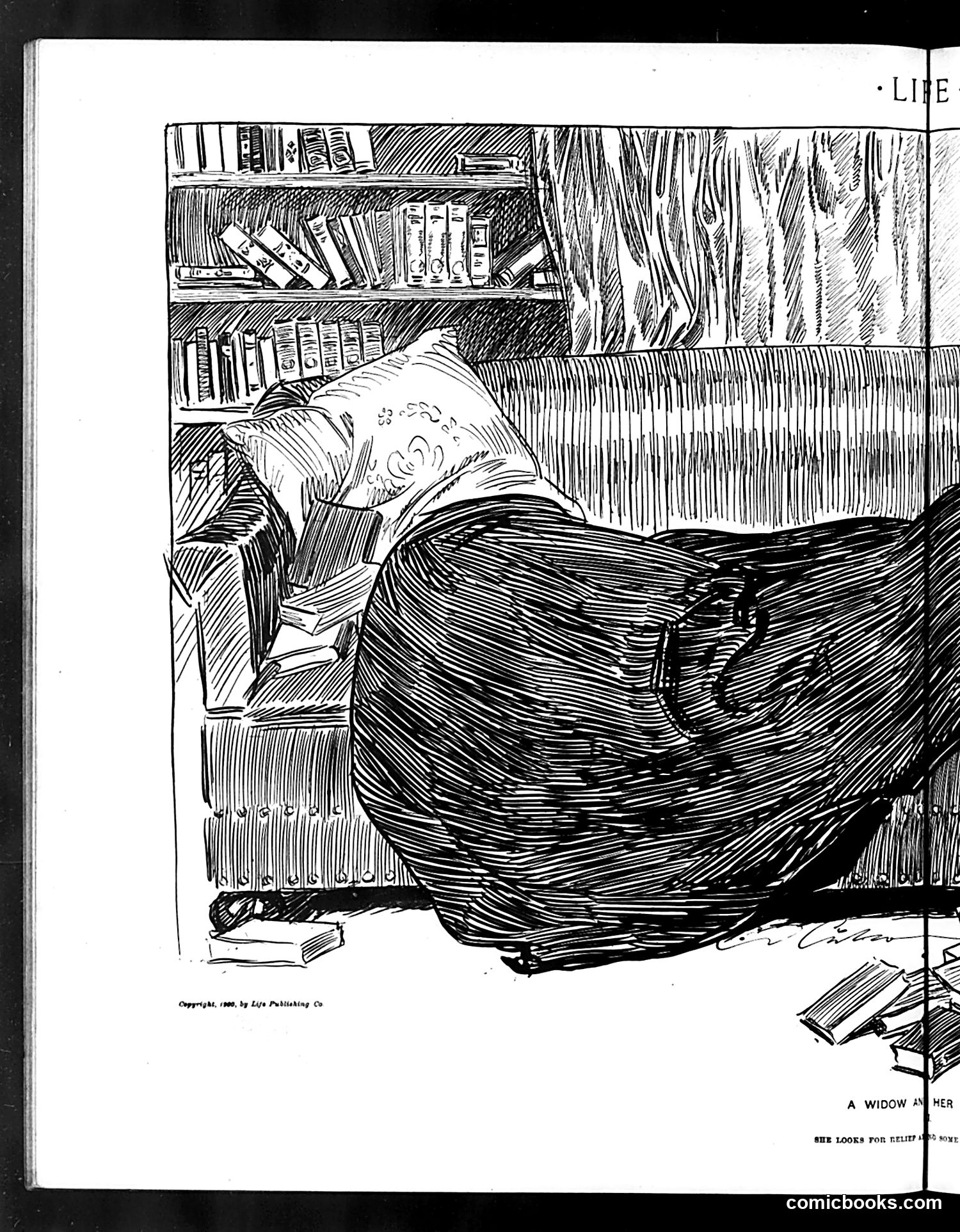
This cartoon depicts a widow searching through bookshelves, apparently looking for financial or practical guidance. The caption "She looks for relief in one" suggests she's seeking help navigating widowhood—likely addressing finances, property management, or legal matters typically handled by husbands in that era. The satire appears to target the inadequacy of available resources for widows facing independent decision-making. Her bent-over posture and the scattered books convey frustration. The cartoon likely comments on women's vulnerability after losing spouses, the gap between educational resources and practical needs, or perhaps the publishing industry's failure to address widows' real concerns with useful guidance. The exact date and publication context would clarify whether this references a specific social reform movement.
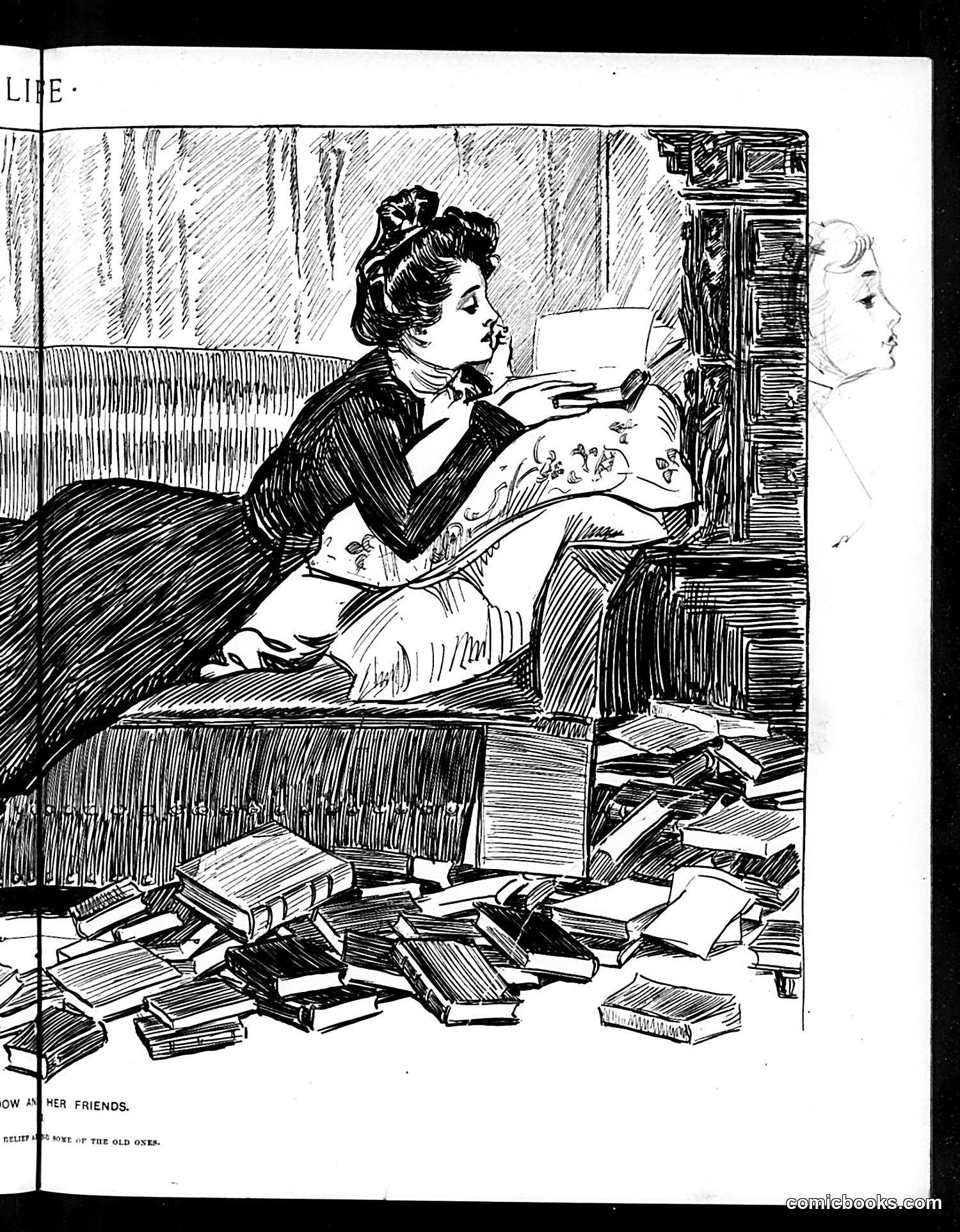
This illustration depicts a woman reclining on a bed surrounded by scattered books, holding what appears to be a manuscript or document. The caption mentions "her friends" and references "relief" and "woke up of the old order." The satire appears to criticize intellectual or literary pretension—specifically, a woman surrounded by books, suggesting she fancies herself a serious reader or writer. The scattered volumes and her relaxed posture humorously undermine this pretense. The reference to "woke up of the old order" is unclear without additional context, but likely comments on changing social attitudes, possibly regarding women's roles or education. The cartoon may be mocking either excessive literary affectation or, conversely, women's newfound intellectual independence—depending on *Life* magazine's editorial stance at the time of publication.
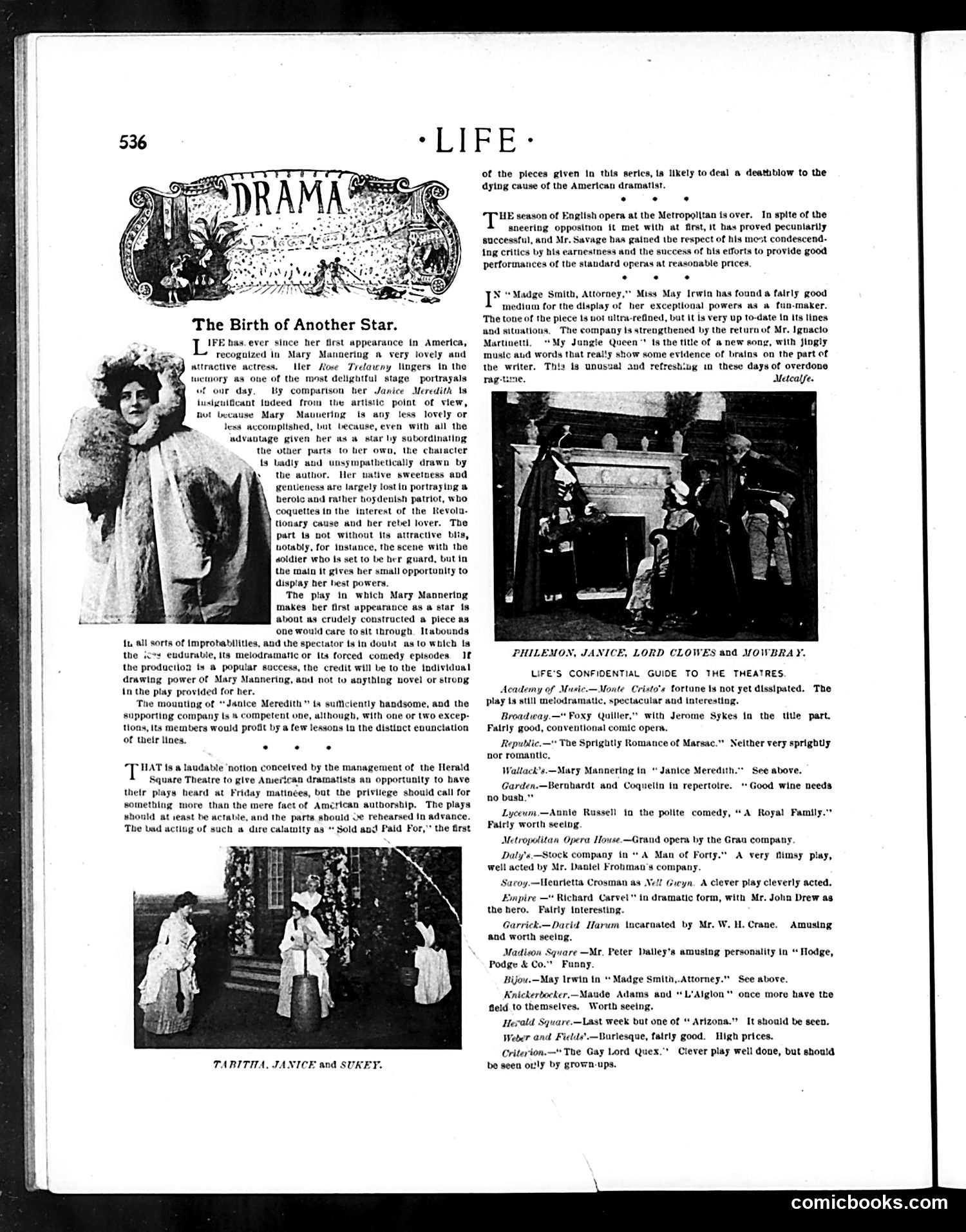
This page covers theatrical reviews and entertainment news. The main article, "The Birth of Another Star," discusses actress Mary Mannering's performances in various plays, including "Janice Meredith." The text praises her talent while critiquing some of the melodramatic or poorly-constructed plays she appears in. Two photographs show stage scenes: one labeled "PHILEMON, JANICE, LORD CLOWES and MOWBRAY" and another labeled "TARITITA, JANICE and SUKEY." The page includes a guide to theater performances, reviewing multiple productions with brief critiques. Most reviews are dismissive of the plays' quality, using phrases like "fairly good" and "should be seen only by grown ups" to describe entertainment options—typical of Life magazine's satirical theater criticism from this era.
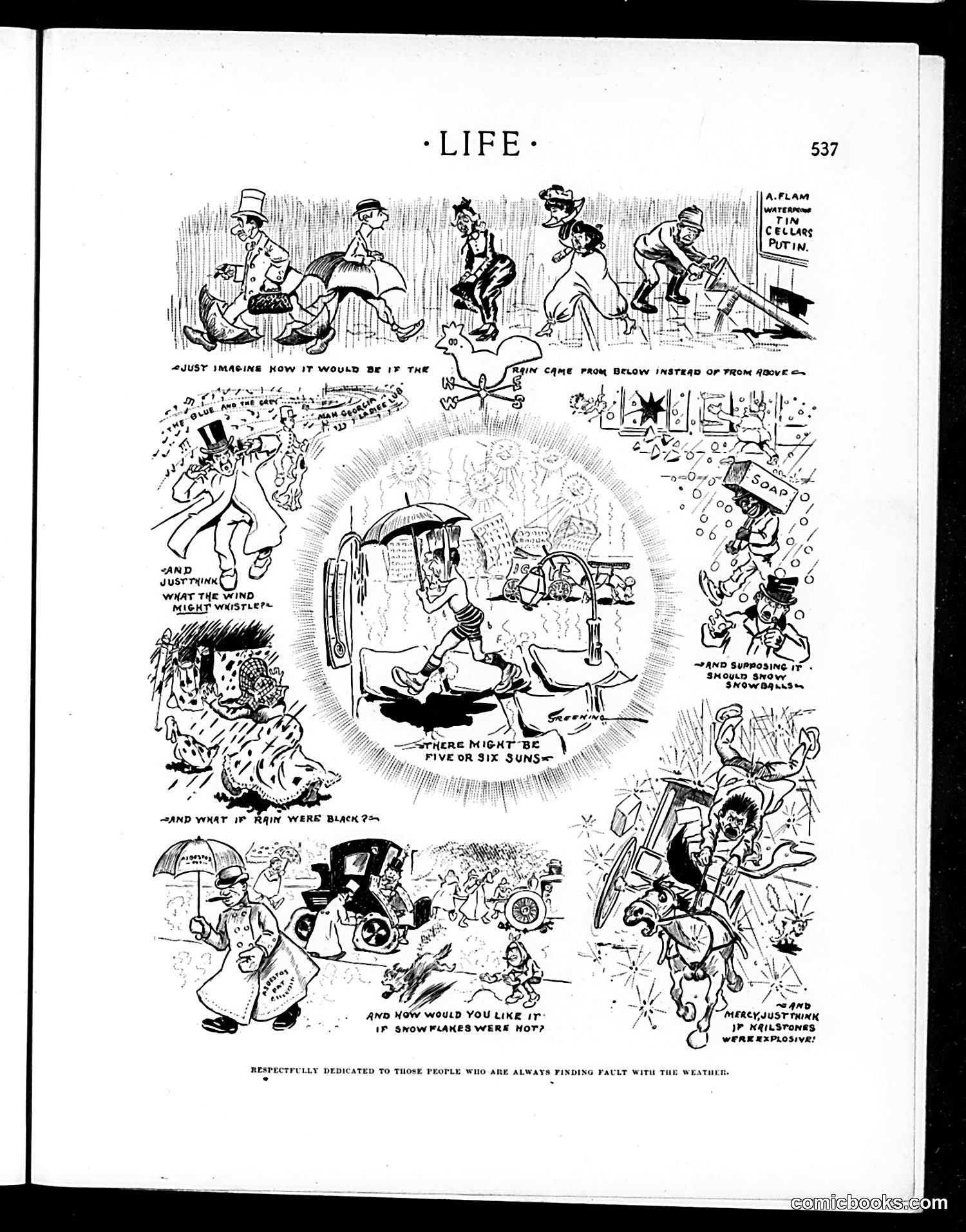
This is a humorous satirical cartoon about weather complainers. The page depicts people constantly criticizing the weather through absurd hypotheticals: **The Central Concept:** People who perpetually complain about rain, wind, or snow are shown imagining ridiculous alternate weather scenarios—what if rain fell upward, wind whistled differently, there were five suns instead of one, rain were black, or snowflakes were explosive hailstones. **The Satire:** The cartoon mocks chronic complainers by suggesting that any alternative weather system would likely be far worse than what actually occurs. The dedication at the bottom explicitly targets "those people who are always finding fault with the weather." **Style:** This appears to be from early-to-mid 20th-century *Life* magazine, using typical period comic illustration techniques with exaggerated characters in various dramatic poses. The joke remains timeless: no matter the conditions, some people will complain—a fundamental human tendency.
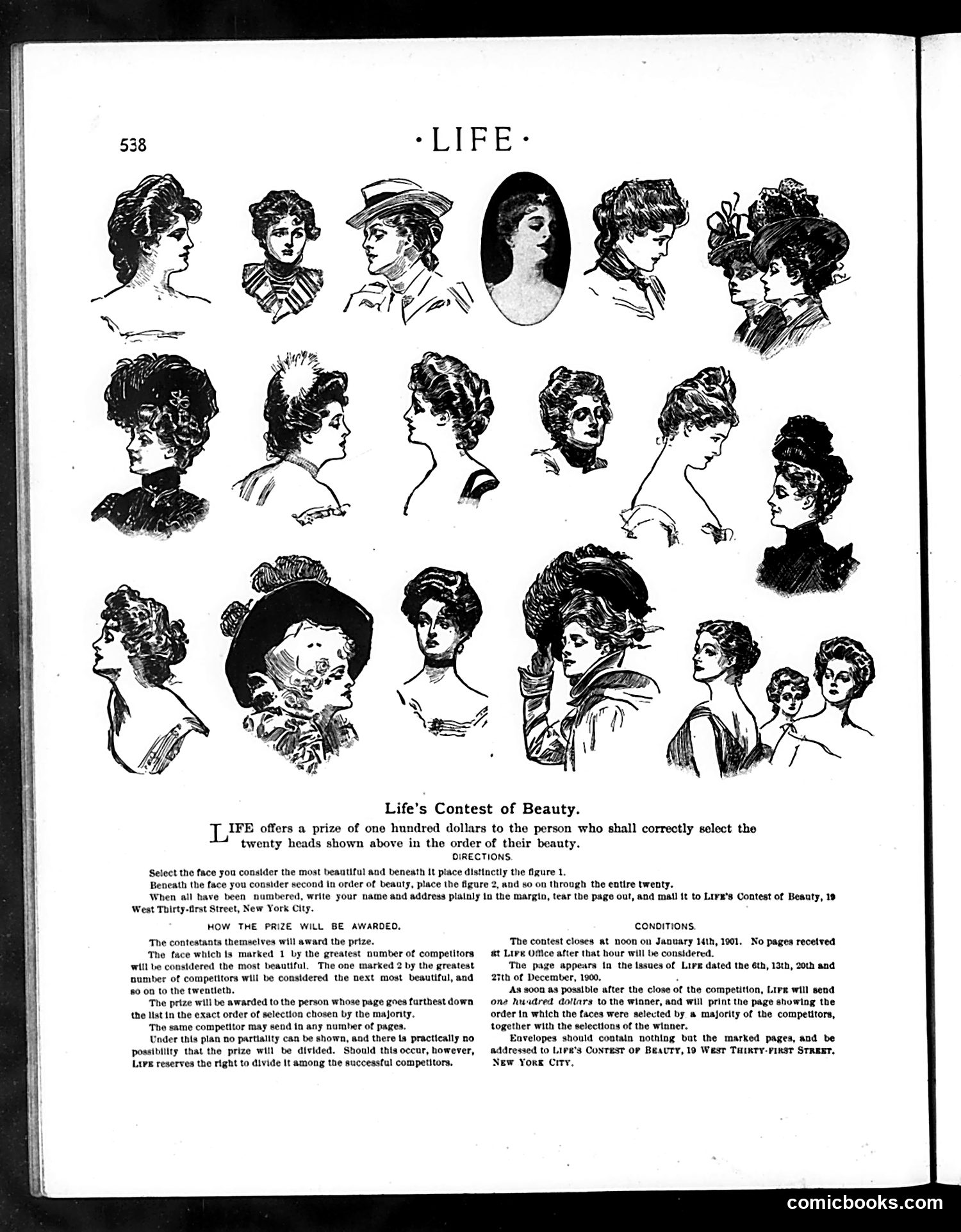
This page presents a democratic beauty contest where Life magazine readers rank twenty illustrated female heads by attractiveness. The winner is whoever's ranking most closely matches the majority consensus—a clever inversion of typical beauty judgments, which normally relied on expert or editorial authority. The contest reflects turn-of-the-century American culture: growing mass participation in print media, emergence of "scientific" or quantifiable aesthetics, and the magazine's satirical approach to society's obsession with female beauty standards. The $100 prize (substantial for 1901) incentivized widespread participation. The illustrated faces appear to represent various feminine ideals of the era—different hairstyles, expressions, and fashions—suggesting beauty was debatable and culturally constructed, even if readers didn't consciously recognize this satire. Life weaponizes democratic voting to simultaneously celebrate and mock society's preoccupation with ranking women's appearances.
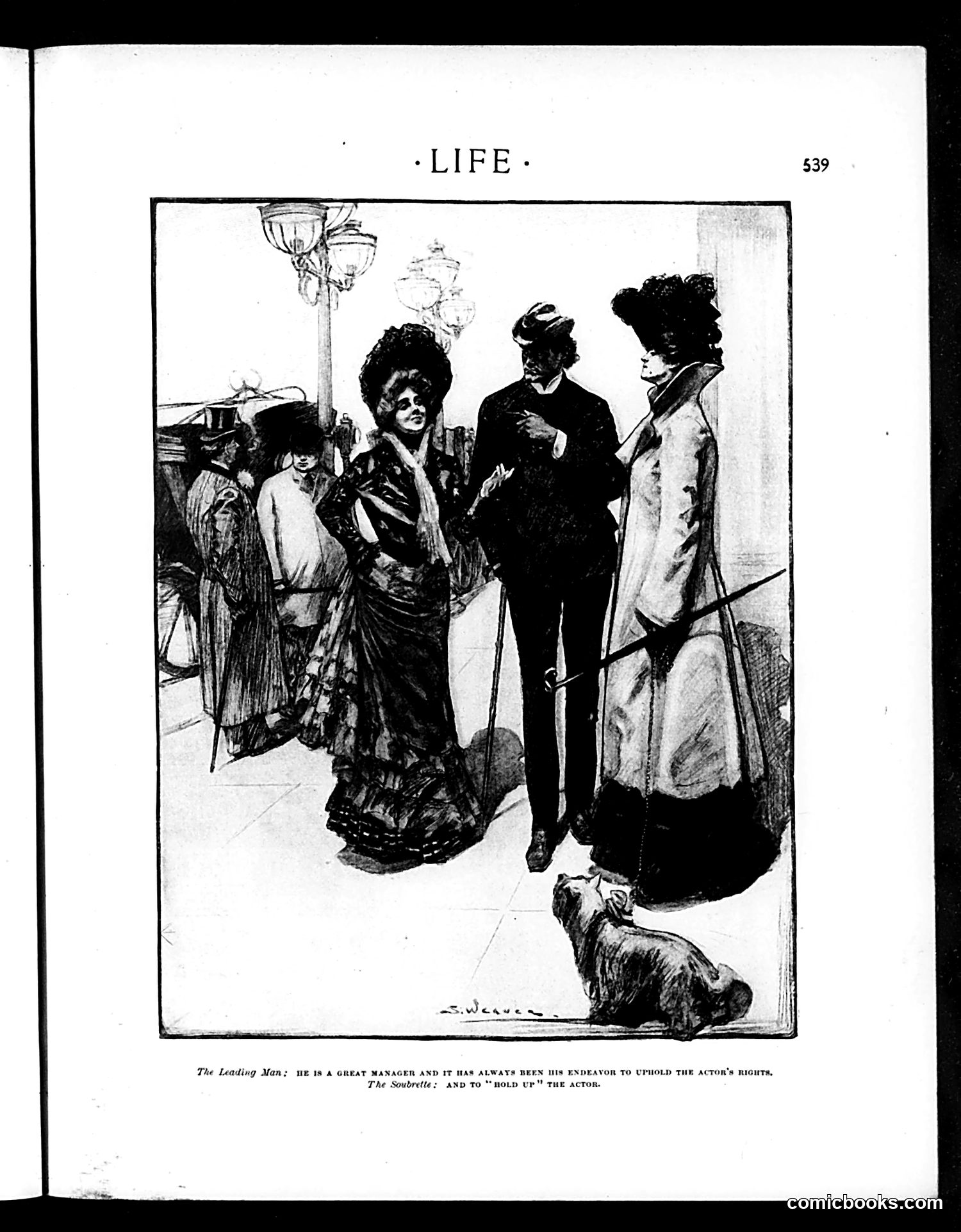
This cartoon satirizes theater management and actor relations. The scene shows well-dressed theatrical figures in conversation on a street. The caption contrasts two claims about a "Leading Man" who is a theater manager: - He claims to uphold "the actor's rights" - The soubrette (a female comic actress) cynically counters that his real goal is to "hold up" the actor—meaning to exploit or financially drain them The joke targets the hypocrisy of theater managers who publicly present themselves as protectors of performers while actually extracting maximum profit from them. This reflects early 20th-century tensions between theatrical management and performers over working conditions, compensation, and fair treatment.
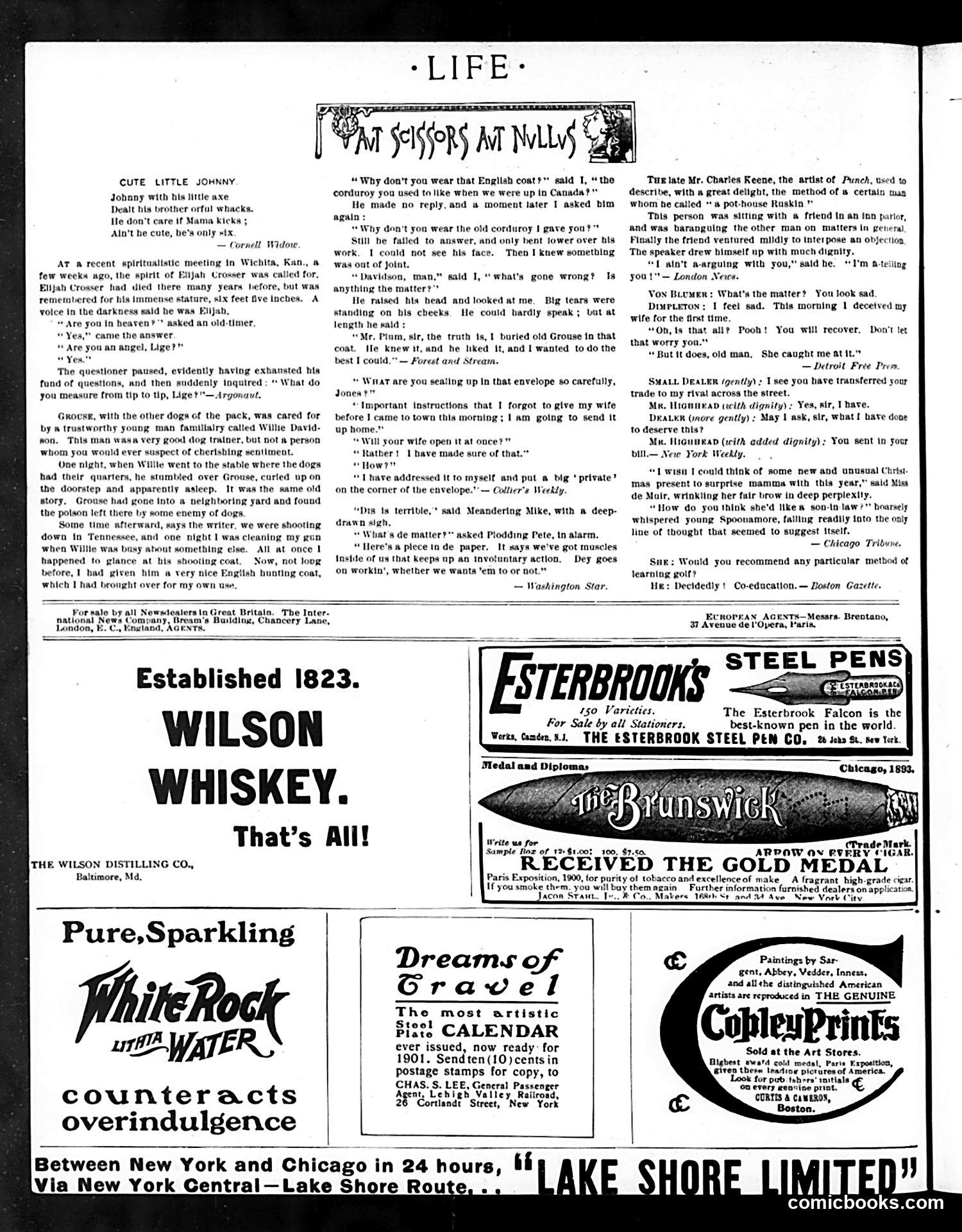
This is primarily a **humor/anecdote page** rather than political cartoons. It collects brief humorous stories and jokes typical of Life magazine's satirical format: **Main content:** Short comedic anecdotes including: - "Cute Little Johnny" (a child misbehaving) - A spiritualist séance joke about a deceased giant - A touching story about a dog trainer burying his beloved dog in a borrowed coat - Various one-liner jokes about marriage, envelopes, and involuntary muscles **Social references:** The stories reflect early 1900s concerns—spiritualism's popularity, class dynamics (the faithful working man), marital relations, and physical science/anatomy. **The satire/humor:** These are gentle, sentimental pieces mixing pathos (the dog burial story) with light social observation. No specific political targets are visible. **Also present:** Period advertisements for Wilson Whiskey, Esterbrook Steel Pens, White Rock Lithia Water, and other products typical of the era. The page offers snapshot glimpses of Edwardian-era sensibilities and humor conventions rather than commentary on specific events or figures.
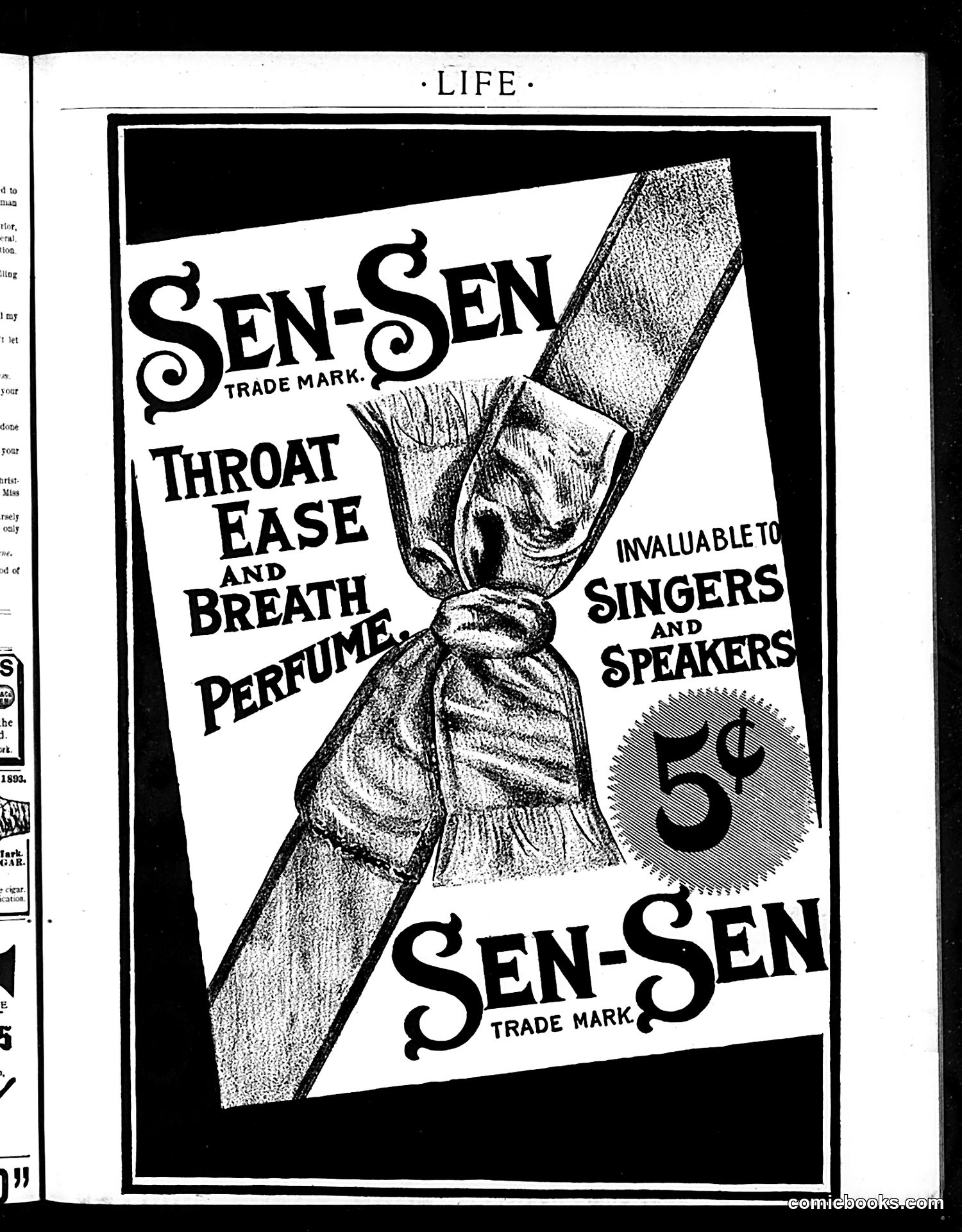
This is a **commercial advertisement**, not political satire. It promotes Sen-Sen, a trademarked breath perfume product priced at 5 cents. The ad uses an illustration of a throat/neck area (rendered in detailed anatomical style) to visually represent the product's claimed benefits: "Throat Ease and Breath Perfume." The messaging targets a specific professional demographic—"Invaluable to Singers and Speakers"—suggesting the product helps these vocal professionals maintain clear throats and fresh breath during performances. The art style and layout are typical of early-to-mid 20th century magazine advertising, emphasizing the product's utility for people who rely on their voices professionally. There is no political or satirical content visible here.
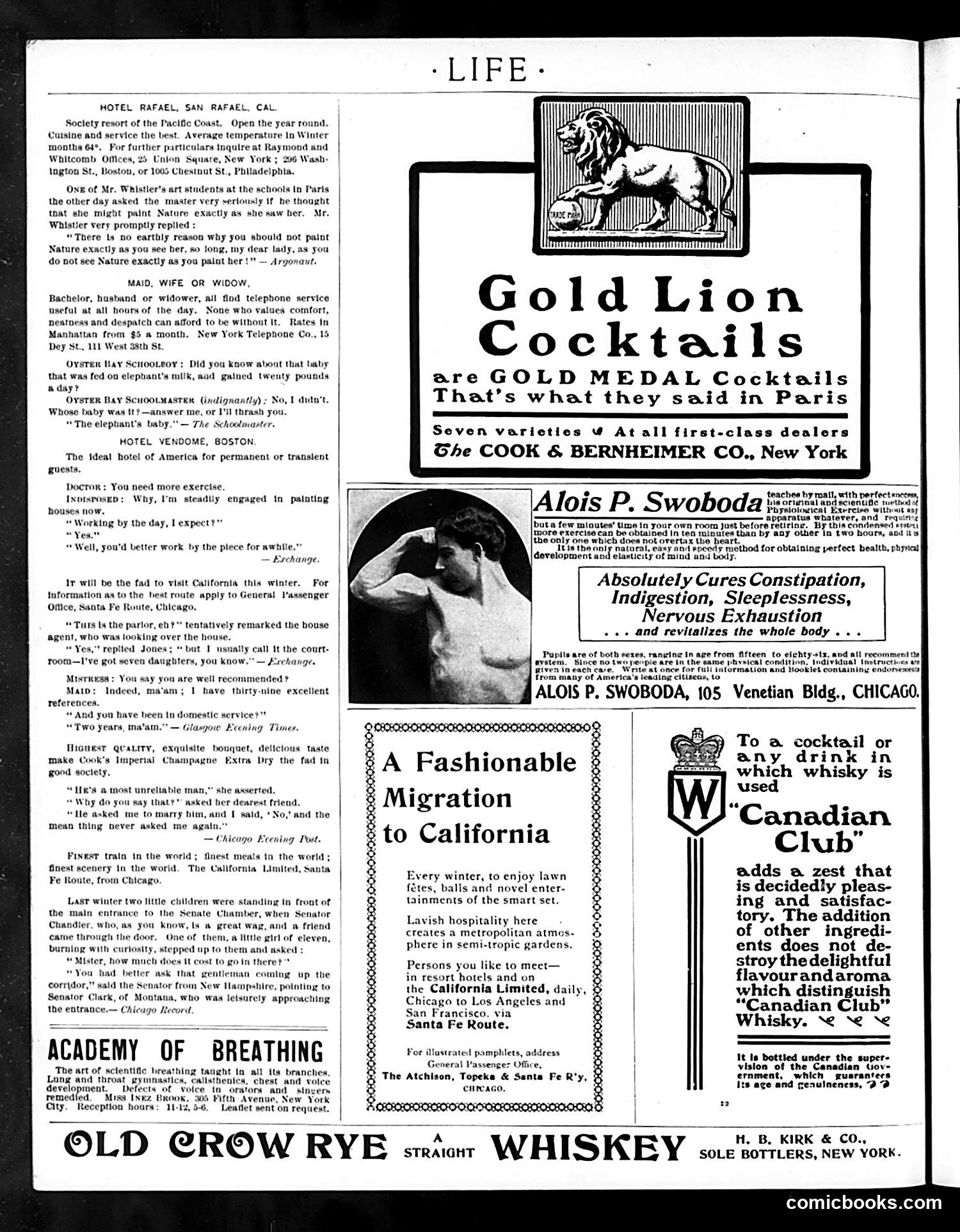
This page is primarily **advertising and humorous anecdotes**, with no political cartoons. The content consists of: **Advertisements** for luxury goods and services (hotels, cocktails, whiskey, champagne) targeting wealthy readers, reflecting Gilded Age consumer culture. **Humorous short jokes and anecdotes** scattered throughout, including: - A quip about artist James McNeill Whistler advising a student on painting nature - A schoolmaster confusion about an elephant's baby - Domestic service and courtship humor - A story about Senator Chandler of New Hampshire directing children to Senator Clark of Montana **The satire** is gentle and social rather than political—poking fun at servants, courtship mishaps, and wealthy pretensions. The Senator Chandler anecdote appears to be a mild jab at political vanity (directing attention to a colleague), but it's presented as good-natured wit rather than serious critique. The page reflects *Life* magazine's role as entertainment for the affluent, mixing advertising with light humor rather than hard political commentary.
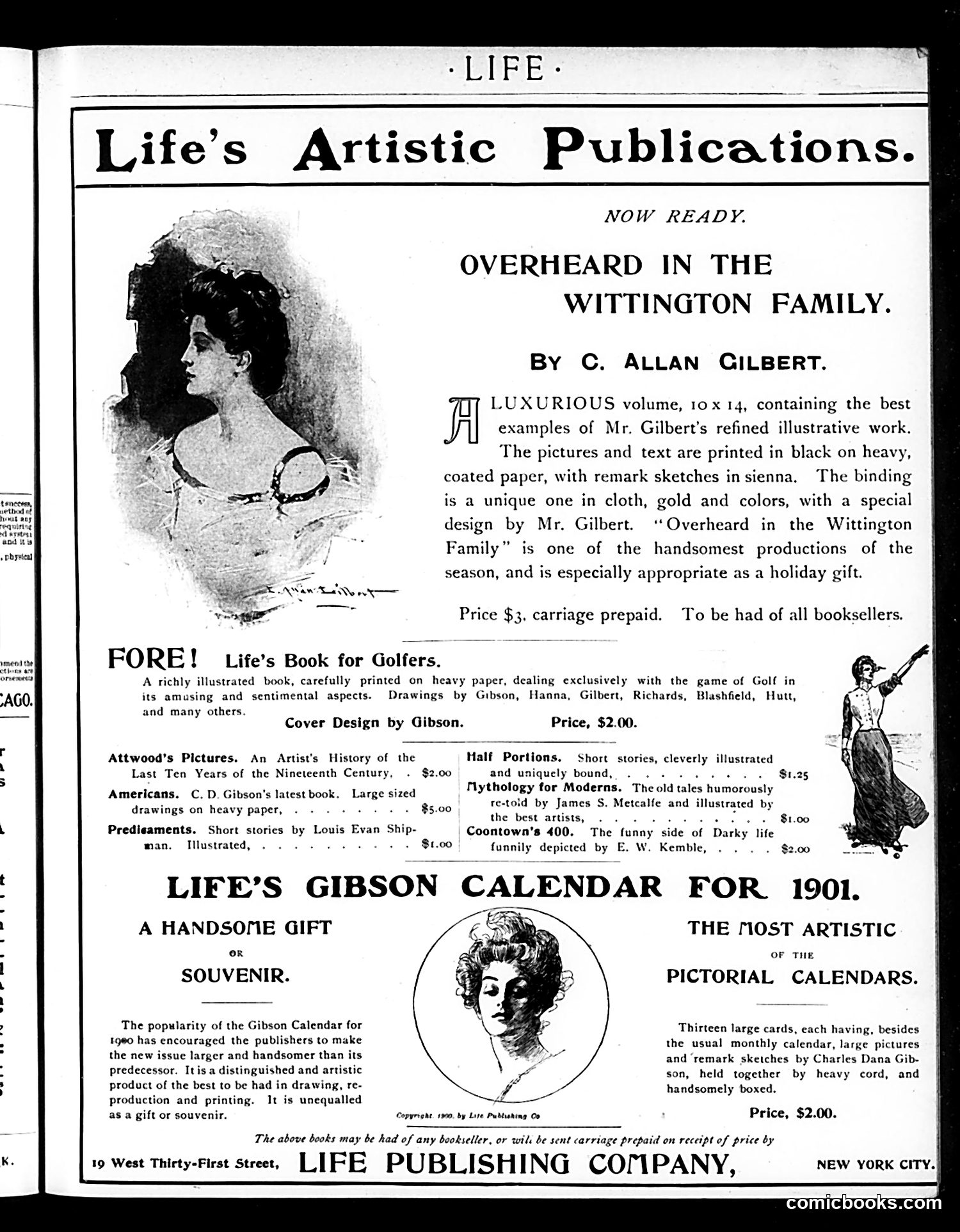
This is primarily a **book advertisement page**, not a political cartoon. It advertises Life magazine's artistic publications, circa 1901. The featured book is *"Overheard in the Wittington Family"* by C. Allan Gilbert—a luxurious illustrated volume ($3). The page showcases other publications including *Life's Book for Golfers*, *Gibson Calendar for 1901*, and works by prominent illustrators like Charles Dana Gibson and C.D. Gibson. Notable for modern readers: one advertised book is *"Coontown's 400,"* illustrated by E.W. Kemble, described as depicting "the funny side of Darky life." This reflects the casual racial caricature common in early 1900s American publishing—content that would be considered deeply offensive today but was marketed without controversy as family entertainment and gift books. The page documents both the sophistication of Life's artistic output and the casual racism embedded in Gilded Age popular culture.
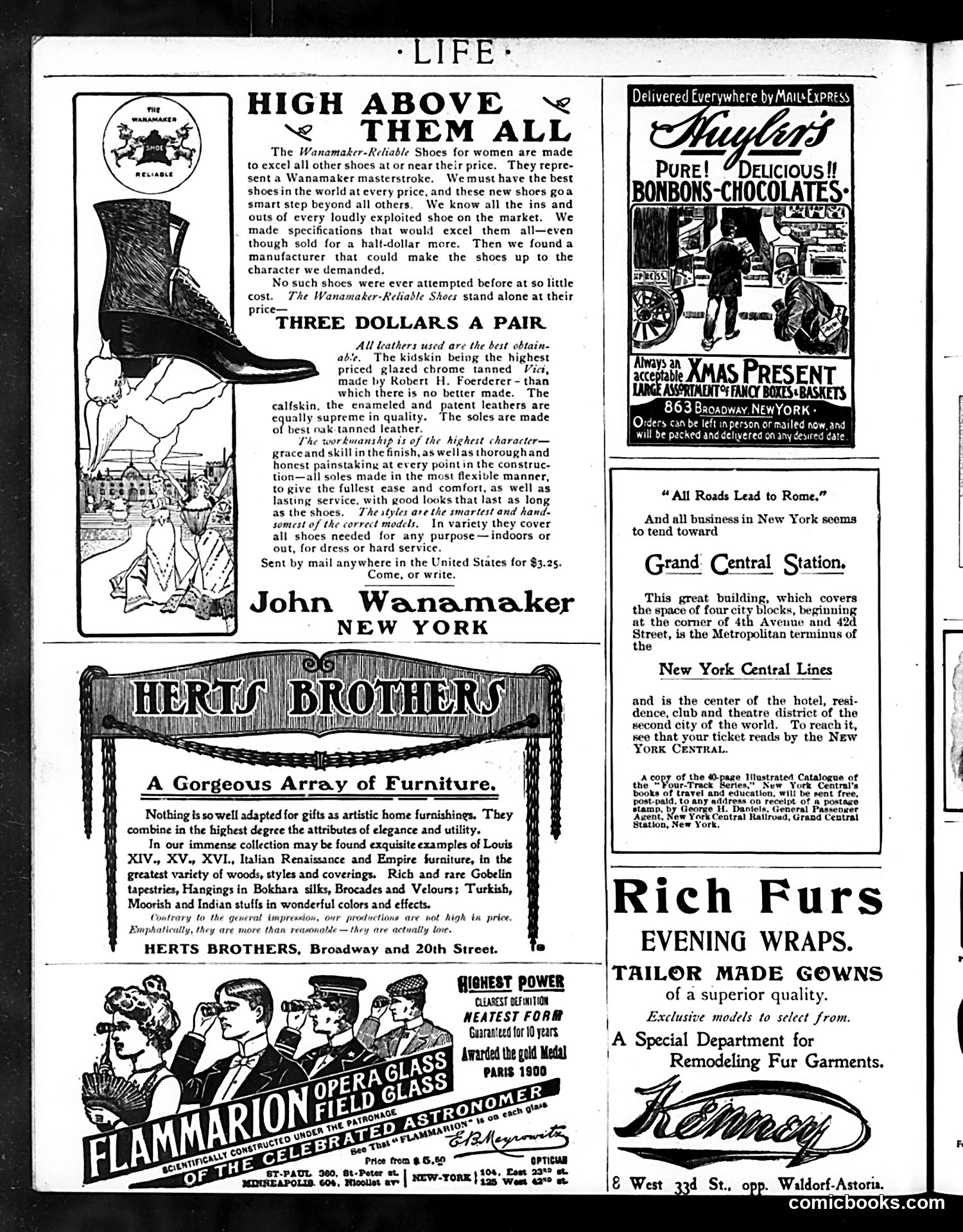
This is primarily an **advertising page** from Life magazine, not a satirical cartoon page. It contains five separate commercial advertisements with no political content or satire. The ads promote: 1. **Wanamaker Shoes** — women's footwear priced at $3 per pair, emphasizing quality materials and craftsmanship 2. **Naylor's Bonbons-Chocolates** — candy delivered by mail 3. **Grand Central Station** — promoting New York's new transportation hub as a business center 4. **Herts Brothers Furniture** — home furnishings in historical styles (Louis XIV, Renaissance, Empire) 5. **Flammarion Opera Glasses** — optical instruments guaranteed 10 years, award-winning (Paris 1900) 6. **Hemway Furs** — evening wear and tailor-made gowns with fur remodeling services The page represents early 1900s consumer culture and mail-order commerce. There is no discernible satire, political commentary, or caricature present—it is straightforward product marketing typical of the era.
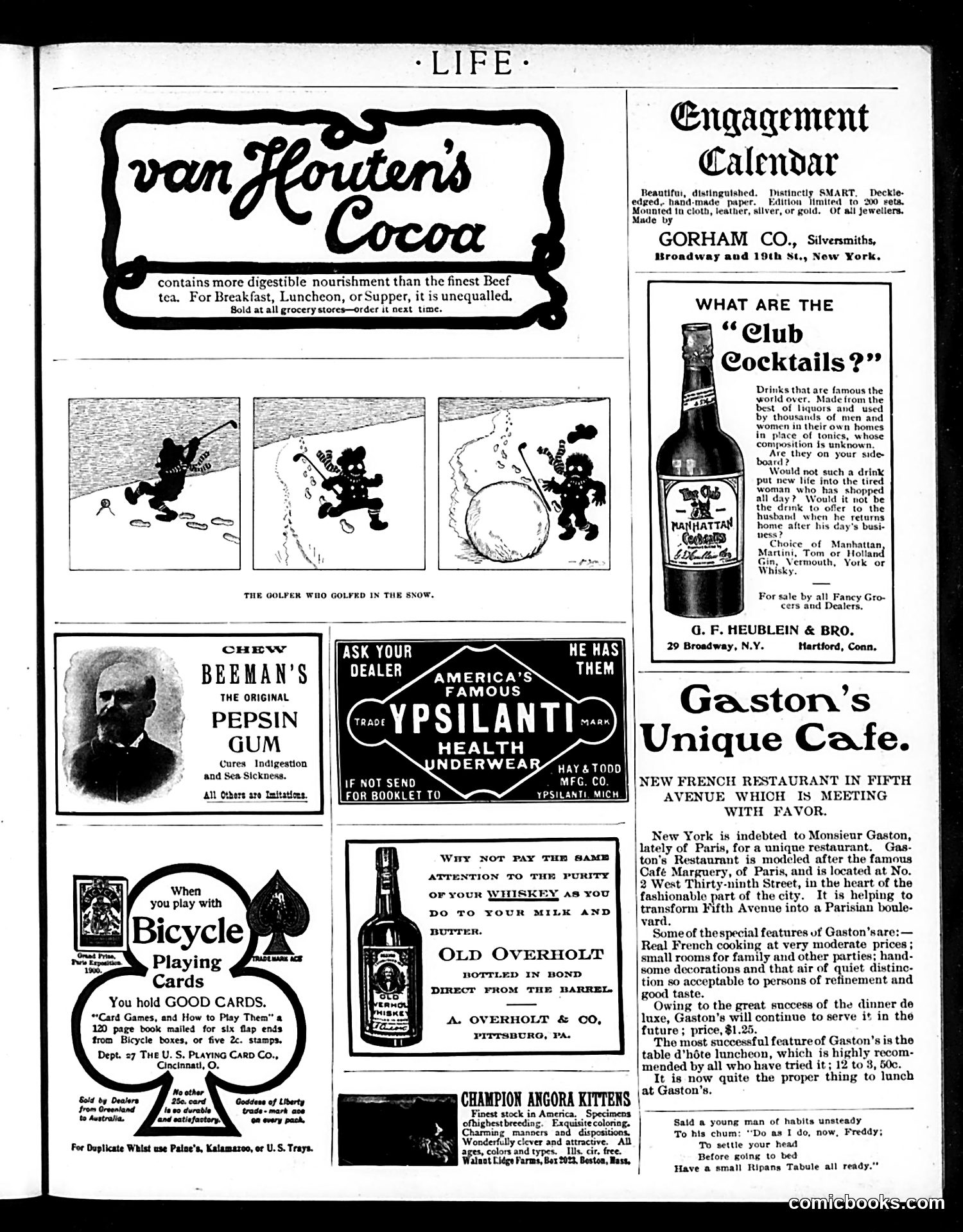
This is primarily a **advertising page** from Life magazine, circa early 1900s. The only cartoon content is "The Golfer Who Golfed in the Snow"—a three-panel visual gag showing a golfer's mishap in winter conditions, culminating in a snowball resembling a golf ball. The rest consists of product advertisements typical of the era: cocoa, chewing gum, playing cards, whiskey, underwear, and a French restaurant. These ads reflect contemporary consumer culture and social attitudes—note the patronizing copy about wives needing tonics, the emphasis on "purity" in whiskey (likely referencing food safety concerns of the Progressive Era), and the fashionable appeal of Parisian dining. The Ripans Tabule ad at bottom is a humorous testimonial promoting a patent medicine digestive tablet, reflecting the era's widespread promotion of such remedies as cure-alls.
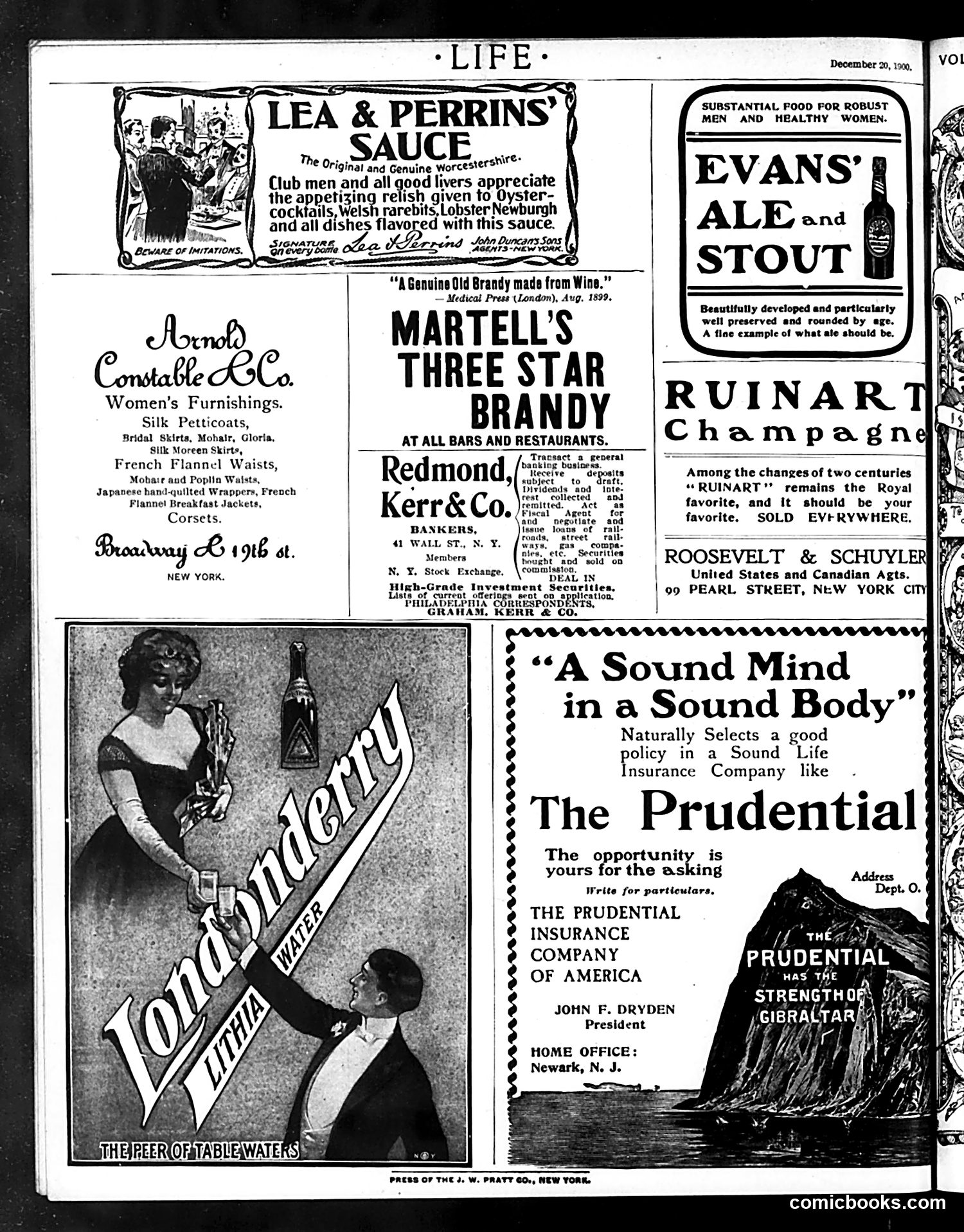
This page is primarily **advertising**, not political satire. It contains multiple full-page and half-page advertisements typical of early 20th-century Life magazine. The largest illustration shows **"The Beer of Table Waters"**—a woman and man examining what appears to be a beverage bottle or product. This advertises a carbonated drink or similar product, using the era's common marketing approach of depicting well-dressed, aspirational figures to sell consumer goods. Other ads promote luxury items: women's clothing (Arnold Constable & Co.), brandy (Martell's Three Star), champagne (Ruinart), ale and stout (Evans'), and insurance (The Prudential Insurance Company). The Prudential ad uses the phrase "A Sound Mind in a Sound Body"—classical rhetoric about health and stability—to promote life insurance policies, associating financial security with physical well-being. **No political cartoon or satire is present.** This is a commercial page reflecting Edwardian consumer culture and marketing conventions.