
Life, 1900-12-20 · page 4 of 22
Life — December 20, 1900 — page 4: what you’re looking at
What you’re looking at
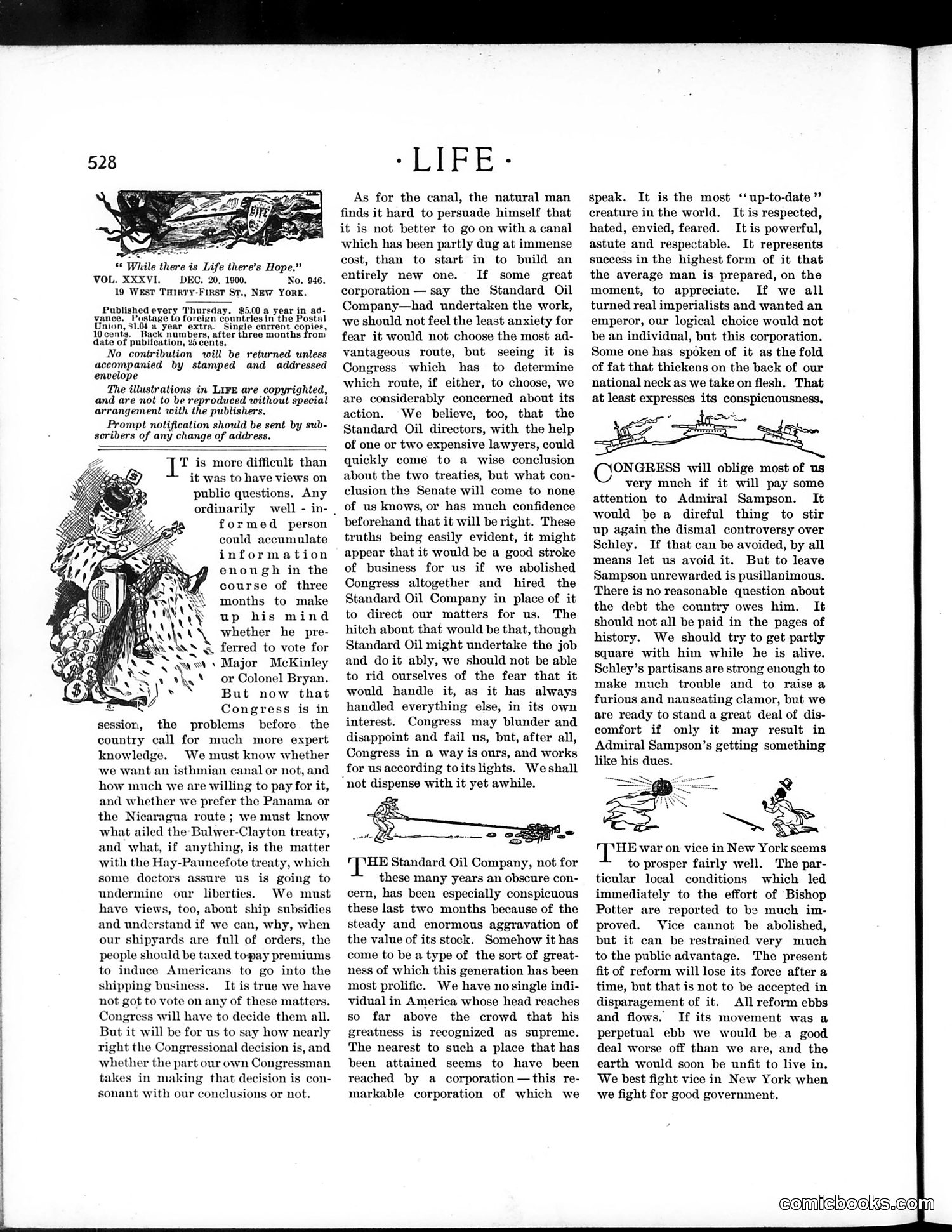
This page discusses major early-1900s political controversies. The main editorial debates canal construction routes (likely Panama vs. Nicaragua), whether the Standard Oil Company should manage American infrastructure, and the Hay-Pauncefote Treaty governing canal rights. The left illustration appears to be a generic political figure representing congressional debate. The small sketches on the right seem to depict Vice Bishop Potter's campaign against vice in New York City. The core satire targets concerns about corporate monopolies—specifically Standard Oil—controlling public projects. The author argues Congress must make informed decisions rather than outsource governance to private corporations, warning that unchecked corporate power threatens American democracy and liberty. The anti-monopoly sentiment reflects Progressive Era anxieties about big business influence.
📄 Transcribed text from this page (OCR, searchable)
Machine-transcribed from the original scan — historical spelling and the odd misread are preserved.
VOL. XXXVI. 19 West Tary Published every Thursday. $5.00 a year in ad- vance, Hostage to foreign countries in the Postal Un 31.04 4 year extra. Single current copies, We . Back numbers, after three months from date of publication, 25 cents. No contribution will be returned unless accompanied by stamped and addressed envelope The illustrations in LiFe are copyrighted, and are not to be reproduced without special arrangement with the publishers. Prompt notification should be sent by sub- soribers of any change of address. T is more difficult than it was to have views on public questions. Any formed person could accumulate information enough in the course of three months to make vty tp his mind a vk x whether he pre- ASAAS S ferred to vote for > Ayo) Major McKinley \ \ ‘or Colonel Bryan. * But now that = S Congress is in session, the problems before the country call for much more expert knowledge. We must know whether we want an isthmian canal or not, and how much we are willing to pay for it, and whether we prefer the Panama or the Nicaragua route; we must know what ailed the Bulwer-Clayton treaty, and what, if anything, is the matter with the Hay-Pauncefote treaty, which some doctors ure us is going to undermine our liberties. We must have views, too, about ship subsidies and understand if we can, why, when our shipyards are full of orders, the people should be taxed topay premiums to induce Americans to go into the shipping business. It is true we have not got to vote on any of these matters. Congress will have to decide them all. But it will be for us to say how nearly right the Congressional decision is, and whether the part our own Congre takes in making that decision is sonant with our conclusions or not. ordinarily well - in- . “LIFE + As for the canal, the natural man finds it hard to persuade himself that it is not better to go on with a canal which has been partly dug at immense cost, than to start in to build an entirely new one. If some great corporation — say the Standard Oil Company—had undertaken the work, we should not feel the least anxiety for fear it would not choose the most ad- vantageous route, but seeing it is Congress which has to determine which route, if either, to choose, we are considerably concerned about its action. We believe, too, that the Standard Oil directors, with the help of one or two expensive lawyers, could quickly come to a wise conclusion about the two treaties, but what con- clusion the Senate will come to none of us knows, or has much confidence beforehand that it will be right. These truths being easily evident, it might appear that it would be a good stroke of business for us if we abolished Congress altogether and hired the Standard Oil Company in place of it to direct our matters for us. The hitch about that would be that, though Standard Oil might undertake the job and doit ably, we should not be able to rid ourselves of the fear that it would handle it, as it has always handled everything else, in its own interest. Congress may blunder and disappoint and fail us, but, after all, Congress in a way is ours, and works for us according toits lights. Weshall not dispense with it yet awhile. THE Standard Oil Company, not for these many years an obscure con- cern, has been especially conspicuous these last two months because of the steady and enormous aggravation of the value of its stock. Somehow it has come to be a type of the sort of great- ness of which this generation has been most prolific. We have no single indi- vidual in America whose head reaches so far above the crowd that his greatness is recognized as supreme. The nearest to such a place that has been attained seems to have been reached by a corporation—this re- markable corporation of which we speak. It is the most ‘‘up-to-date” creature in the world. It is respected, hated, envied, feared. It is powerful, astute and respectable. It represents success in the highest form of it that the average man is prepared, on the moment, to appreciate. If we all turned real imperialists and wanted an emperor, our logical choice would not be an individual, but this corporation. Some one has spoken of it as the fold of fat that thickens on the back of our national neck as we take on flesh. That at least expresses its conspicuousness, - Pee CONGRESS will oblige most of us very much if it will pay some attention to Admiral Sampson. It would be a direful thing to stir up again the dismal controversy over Schley. If that can be avoided, by all means let us avoid it. But to leave Sampson unrewarded is pusillanimous. There is no reasonable question about the debt the country owes him. It should not all be paid in the pages of history. We should try to get partly square with him while he is alive. Schley’s partisans are strong enough to make much trouble and to raise a furious and nauseating clamor, but we are ready to stand a great deal of dis- comfort if only it may result in Admiral Sampson’s getting something like his dues. \HE war on vice in New York seems to prosper fairly well. The par- ticular local conditions which led immediately to the effort of Bishop Potter are reported to be much im- proved. Vice cannot be abolished, but it can be restrained very much to the public advantage. The present fit of reform will lose its force after a time, but that is not to be accepted in disparagement of it. All reform ebbs and flows. If its movement was a perpetual ebb we would be a good deal worse off than we are, and the earth would soon be unfit to live in. We best fight vice in New York when we fight for good government. comichooks.