
A complete issue · 20 pages · 1900
Life — November 29, 1900
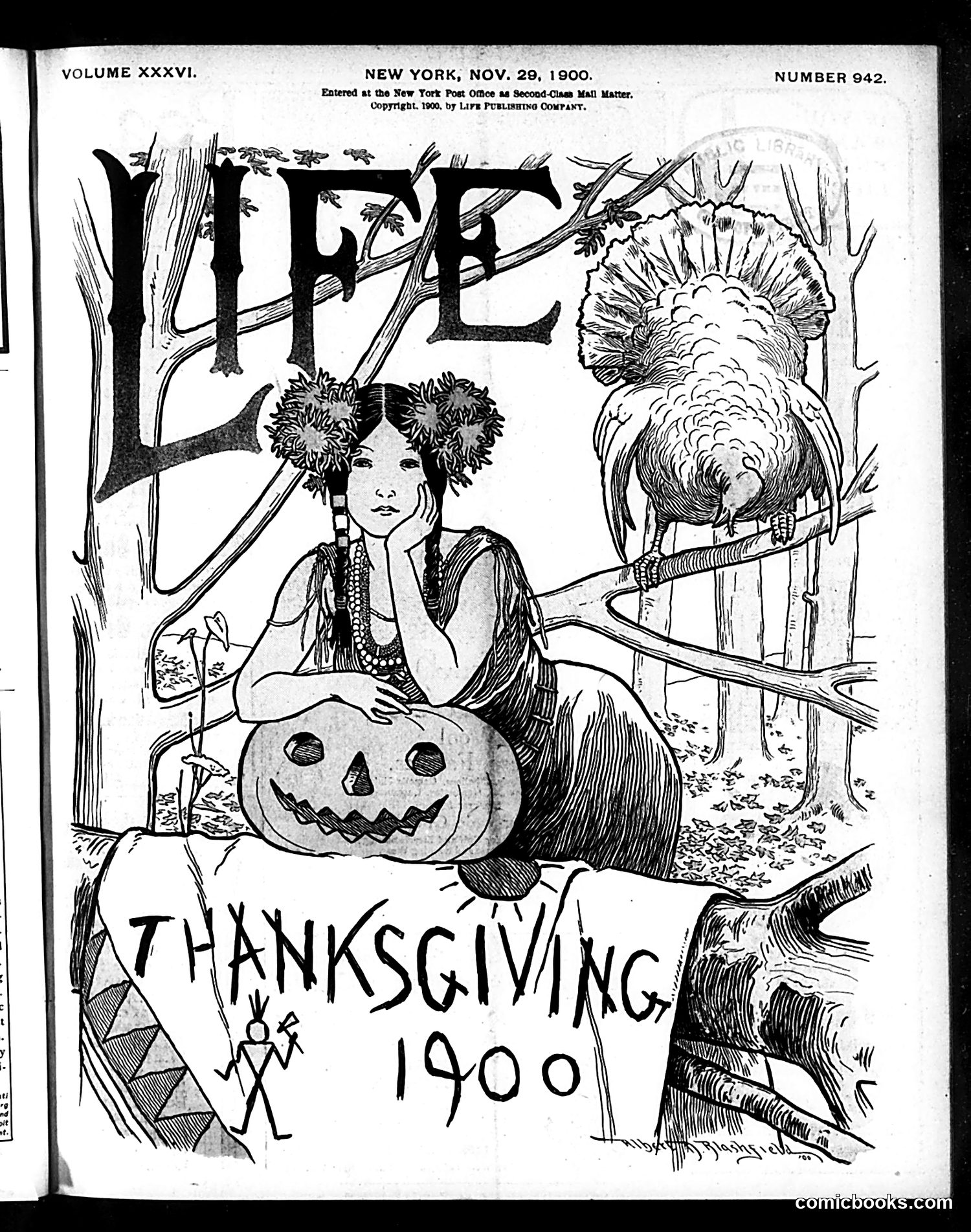
This is a cover from Life magazine dated November 29, 1900, titled "Thanksgiving 1900." The illustration depicts a woman in elaborate dress sitting with a large jack-o'-lantern pumpkin. The woman wears puffed-sleeve clothing and decorative beads typical of the era's fashion. The satire likely comments on American celebration traditions blending Halloween and Thanksgiving imagery—the jack-o'-lantern (a Halloween symbol) appears incongruously in a Thanksgiving scene. This may be mocking contemporary commercialization of holidays or satirizing current fashions and social customs of 1900s America. The specific political or social critique remains unclear without additional context, though Life was known for satirizing contemporary society and popular culture trends.
This page is primarily **advertising content** from an early 20th-century Life magazine. The central illustration depicts a woman and man examining a large bottle of Apollinaris mineral water, labeled "The Peer of Table Waters." The accompanying Arnold Constable & Co. advertisement emphasizes wool dress fabrics and tailor-made gowns. Surrounding ads promote luxury goods: Martell's brandy, Pears' soap, Whitman's chocolates, and Canadian Club whiskey. The page reflects the magazine's dual function as satirical journal and advertising vehicle. Rather than political satire, this demonstrates how Life's editorial model relied on premium product endorsements targeting affluent readers. The "peer" pun in Apollinaris's slogan represents the gentle wordplay typical of period advertising copy.
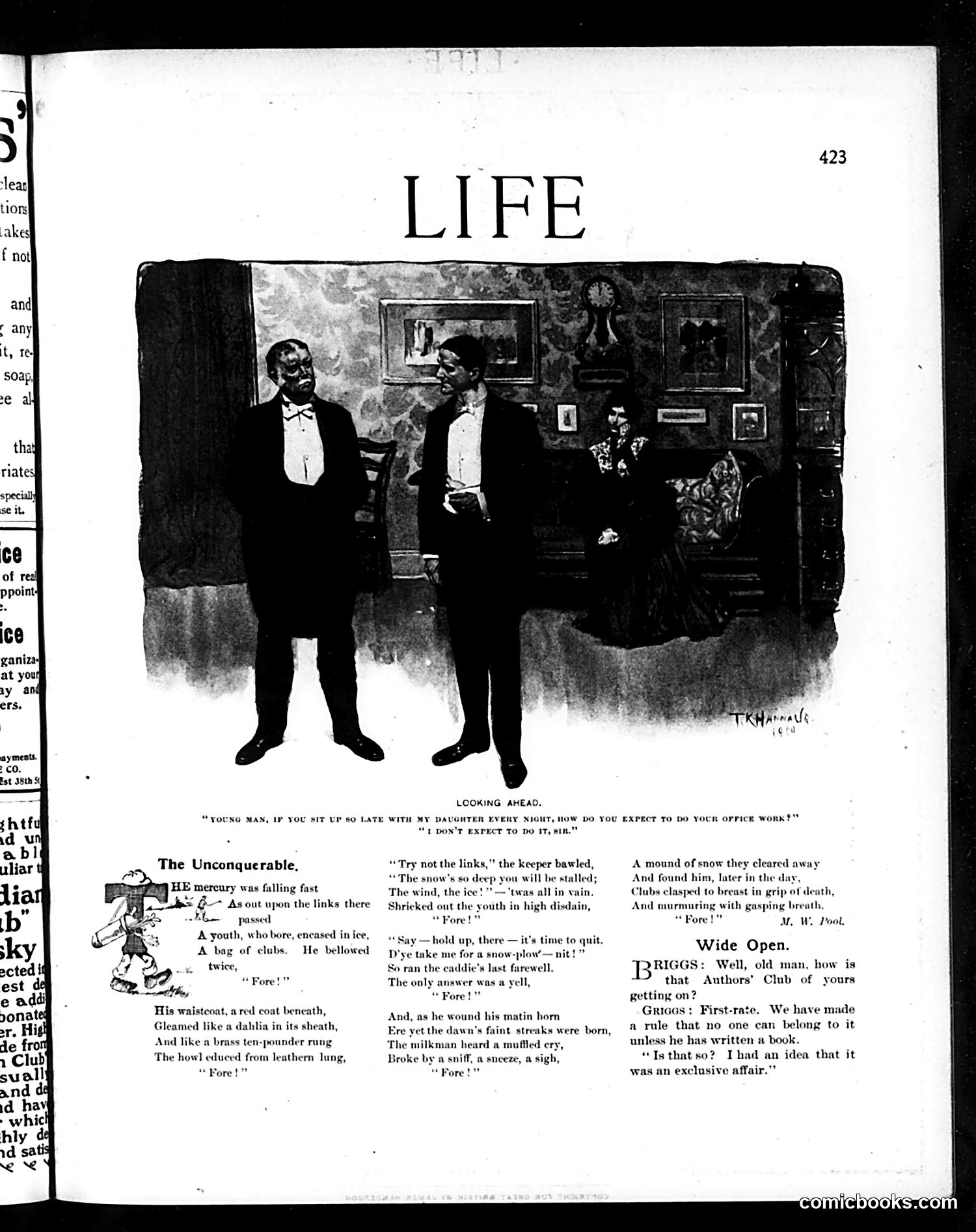
**Main Cartoon ("Looking Ahead"):** Two formally-dressed men converse while a woman sits in the background of what appears to be an art gallery or formal interior. The caption quotes one man asking another how he expects to do office work when sitting up late with his daughter every night. This satirizes the tension between professional obligations and parental duties—specifically, the challenge fathers faced managing late-night socializing with eligible daughters during the courtship era. **Text Content:** The page includes three separate pieces: "The Unconquerable" (a humorous poem about a youth persisting despite golf mishaps), "Wide Open" (a dialogue between authors discussing club membership rules), and other literary content typical of Life's satirical format. The humor reflects early 20th-century concerns about balancing family obligations with work and social expectations.
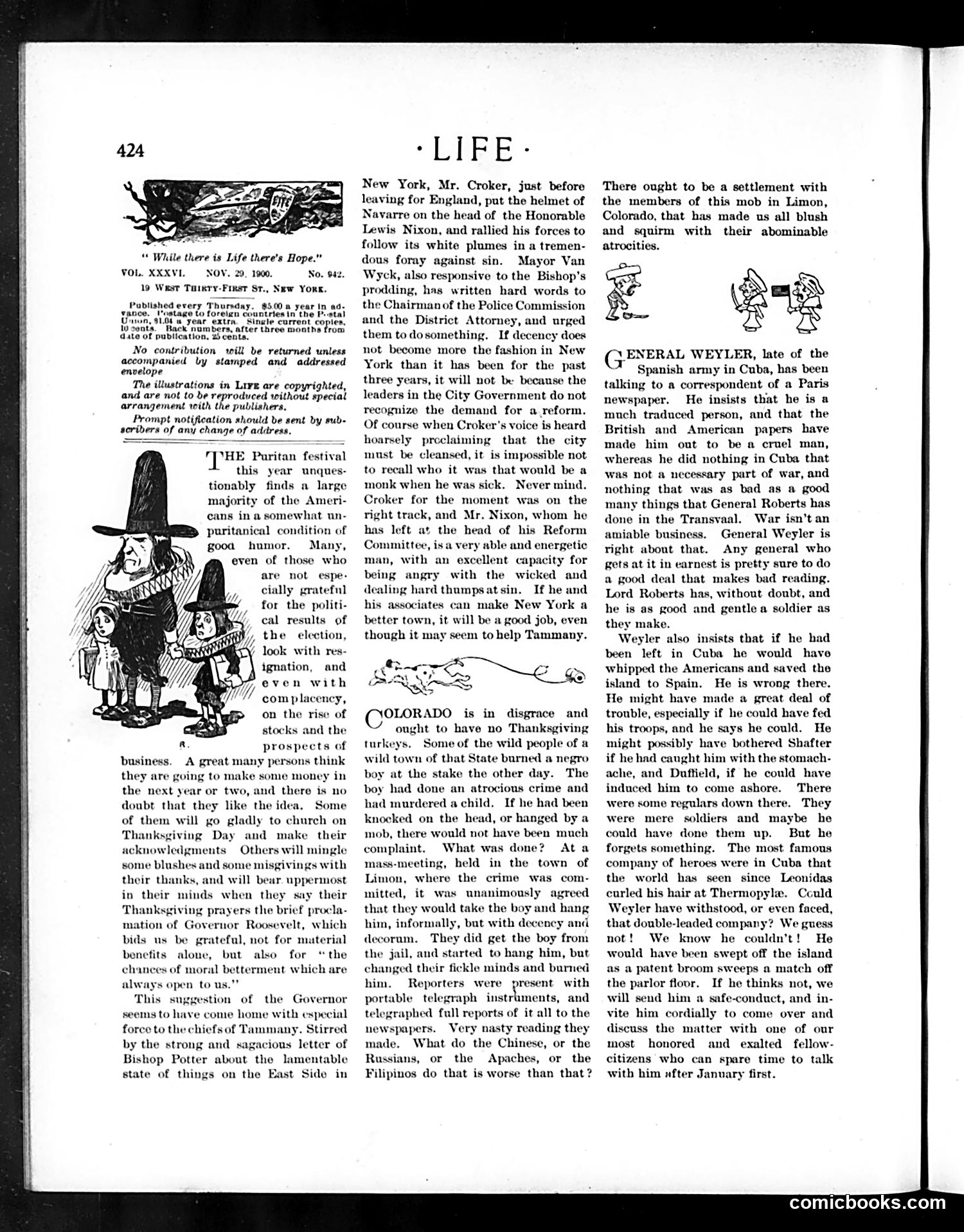
The prominent cartoon depicts a tall figure in pilgrim attire (tall hat, large collar) with two children—likely representing the Puritan tradition and American youth. This illustrates the article's discussion of Thanksgiving and the "Puritan festival," satirizing how Americans celebrate this holiday while embodying contradictory values. The main text discusses political corruption and reform in New York City, referencing Mayor Van Wyck and Police Commissioner Croker's response to demands for civic cleansing. It criticizes ineffectual leadership while praising Reform Committee chair Nixon's efforts. A secondary section critiques General Weyler's defense of his Cuba military record against accusations by Lord Roberts, suggesting Weyler's justifications are self-serving rather than substantive. The satire targets governmental hypocrisy and failed accountability.
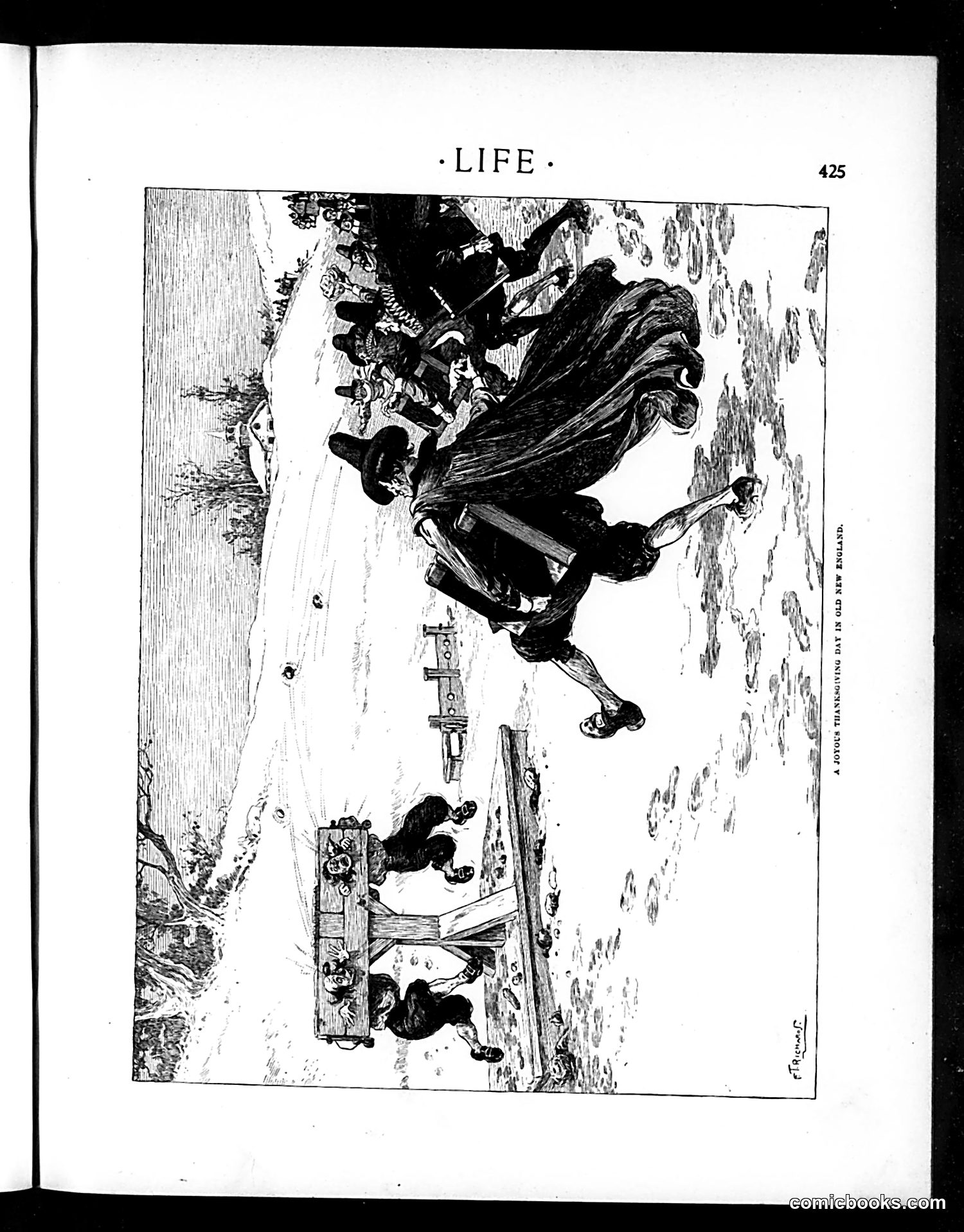
This page from *Life* magazine (page 425) shows a single illustration rotated 90 degrees, depicting what appears to be a social or domestic scene. The image shows multiple figures in period dress interacting on what looks like a beach or seaside setting, with a wooden structure or boat visible. However, **I cannot definitively identify the specific figures, historical event, or satirical point being made** from the image alone. The OCR text provided contains no caption or explanatory text to clarify the cartoon's meaning, political references, or intended joke. To properly explain this to a modern reader would require either: the original caption/title, the publication date, or additional context about contemporary events the illustration references. Without these, I cannot accurately identify who is being caricatured or what social/political commentary is intended.
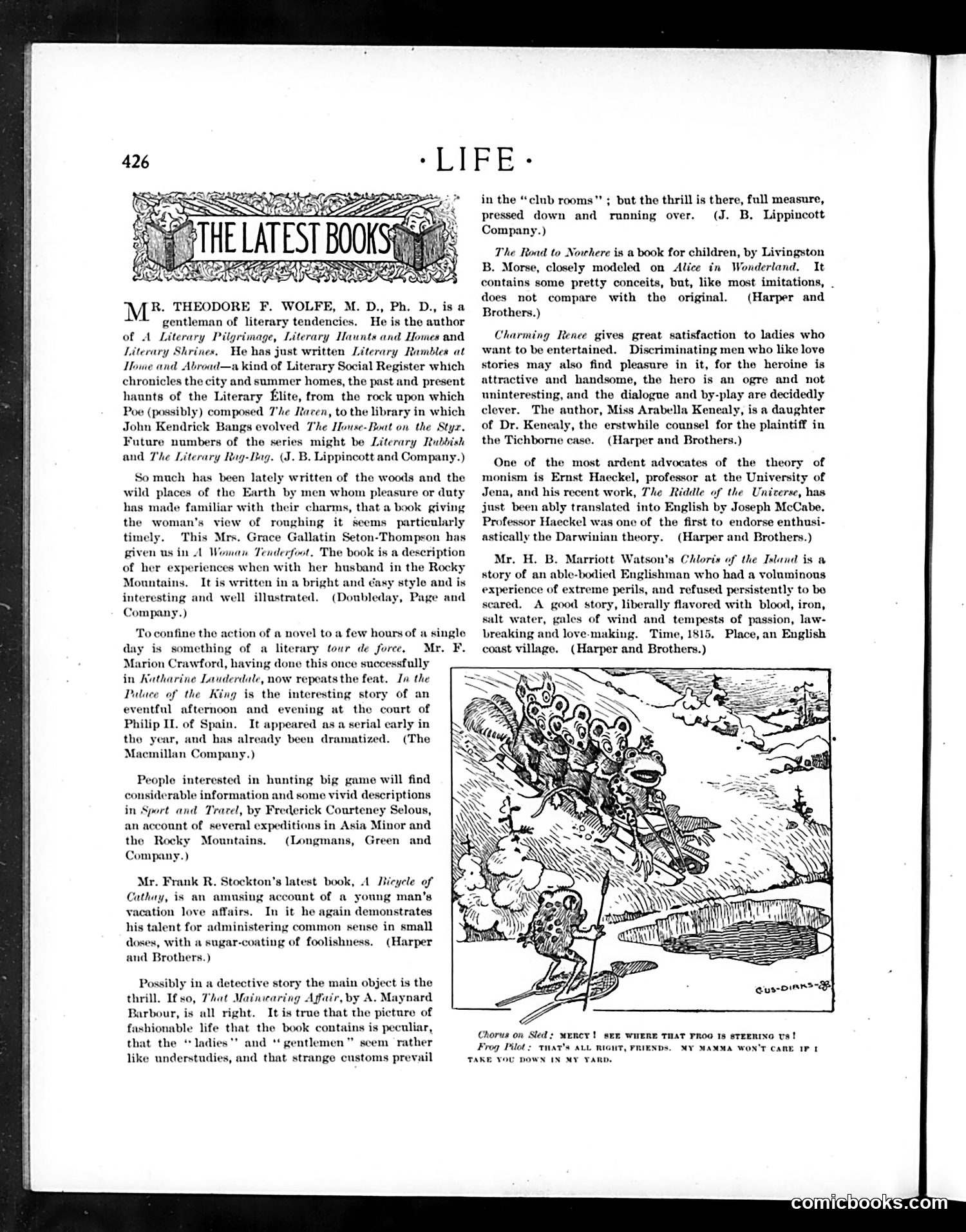
This page is primarily a **book review section** titled "The Latest Books," containing literary criticism rather than political cartoons or satire. The accompanying illustration appears to be a **humorous cartoon showing an anthropomorphic frog character** in period dress, steering what looks like a small boat or vessel. The caption reads: "Darling, oh darling! where is the where that from is steering us? Frog child: 'That's all right, friends. My mamma won't care if I take you down in my yard.'" This seems to be **whimsical editorial art** accompanying book reviews—likely illustrating a children's or humorous story being reviewed on the page. The joke appears to be the frog's oblivious confidence despite steering his passengers toward his yard, playing on animal absurdity rather than political commentary.
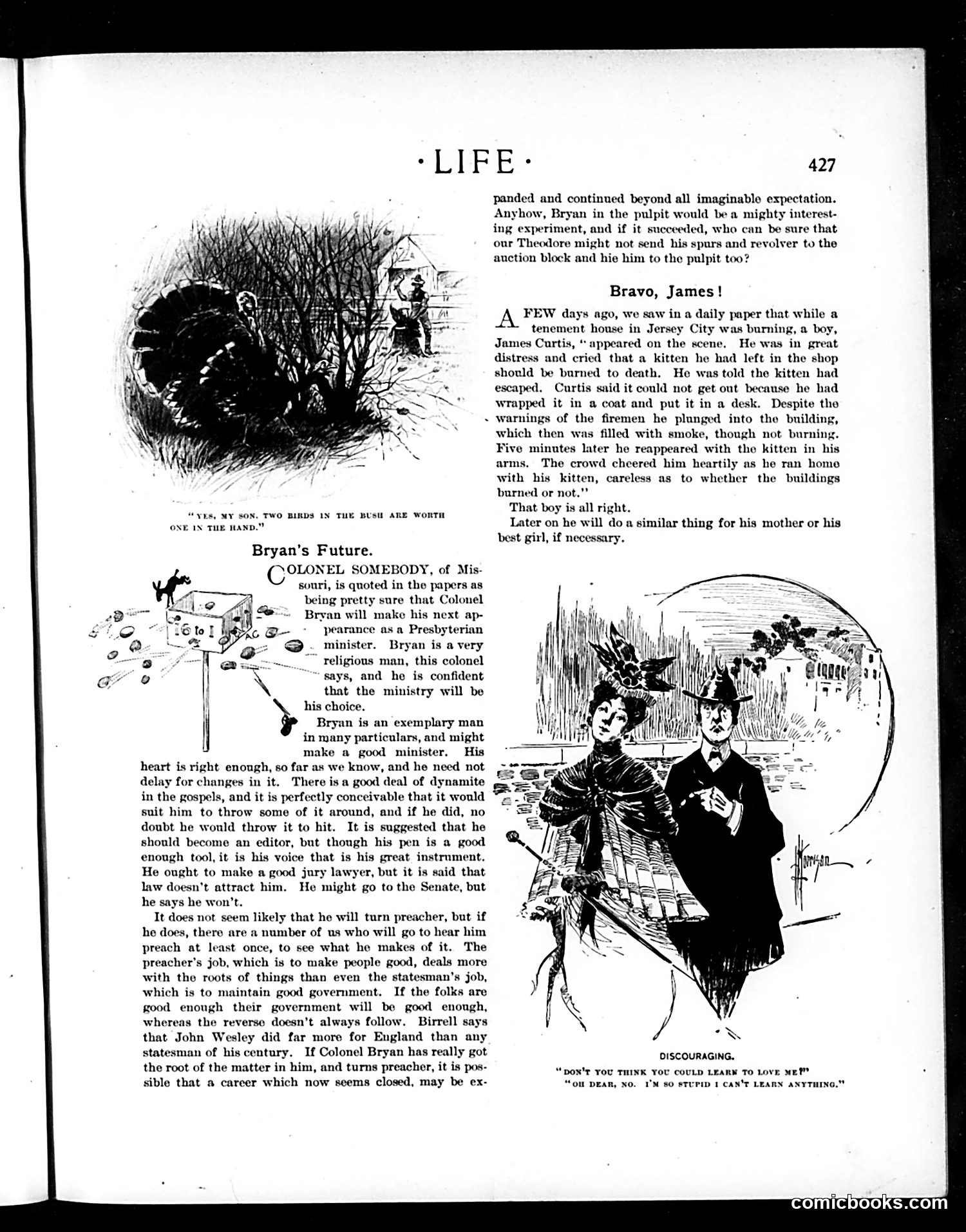
This page contains two distinct items: **"Bravo, James!"** discusses a newspaper story about James Curtis, a man who rescued a kitten from a burning tenement building in Jersey City despite firefighters' warnings. The text humorously suggests Curtis might make a good Presbyterian minister based on his moral character and willingness to risk danger for a helpless creature. **"Bryan's Future"** satirizes Colonel William Jennings Bryan, the three-time presidential candidate and prominent politician. The piece mocks speculation that Bryan might become a Presbyterian minister, analyzing his suitability for the role. It suggests his oratorical talents and moral conviction could suit preaching, though notes his actual career trajectory remains uncertain. Both items use the kitten rescue anecdote to humorously explore Bryan's potential religious vocation.
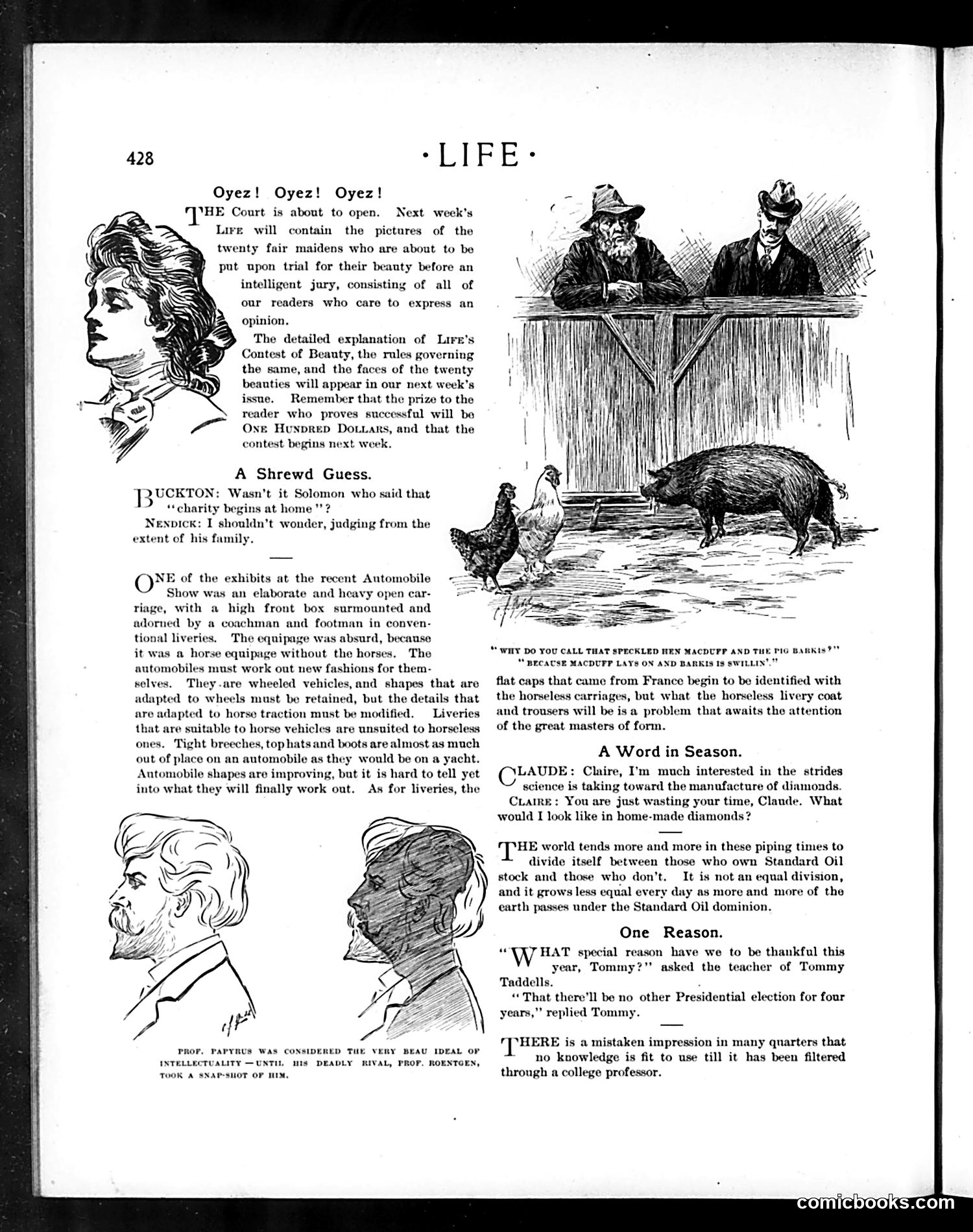
This page contains satirical commentary and humorous anecdotes rather than political cartoons. **"A Shrewd Guess"** mocks Solomon's biblical assertion that "charity begins at home" by suggesting one's charitable impulses reveal family size—implying people are selfish about supporting dependents. **The automobile section** ridicules the nascent automobile industry's attempts to adapt horse-carriage designs to horseless vehicles. The satire points out that features like "liveries" (decorative trim suitable for horse carriages) are absurdly out of place on automobiles, showing how new technologies awkwardly retained outdated aesthetic conventions. **"A Word in Season"** discusses Standard Oil's market dominance, noting the world divides into those owning Standard Oil stock versus those excluded—a jab at monopolistic economic inequality. **"One Reason"** presents a brief joke about Tommy Taddells being grateful for the four-year gap before the next Presidential election.
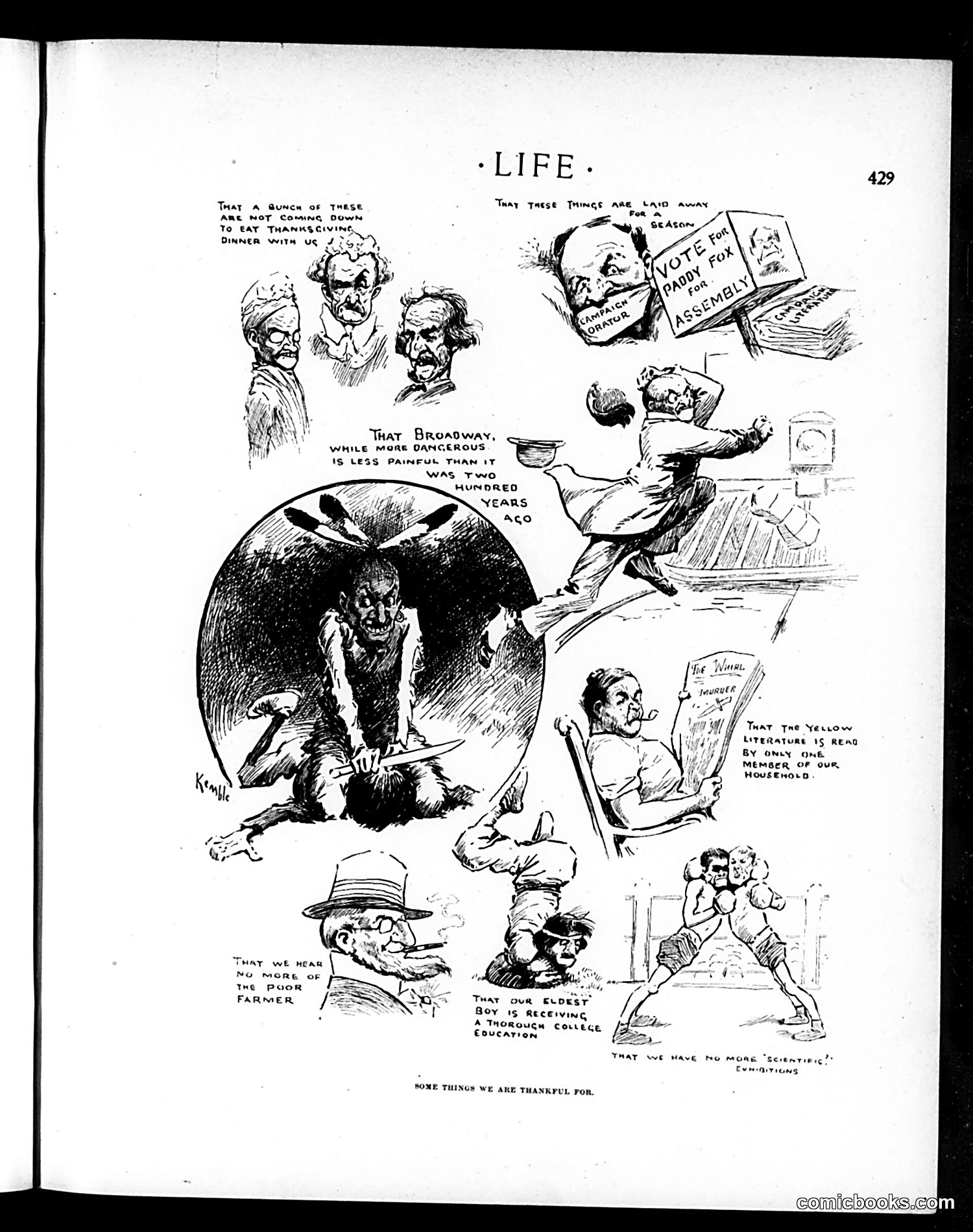
This appears to be a Thanksgiving-themed satirical cartoon from Life magazine, likely early 20th century. The cartoonist uses irony to critique American society by listing things supposedly worth celebrating while depicting them negatively: - **Top left**: Three figures representing political/social issues Americans claim gratitude for while suffering ("not coming down to eat Thanksgiving dinner with a crash") - **Center**: A large bird cage containing a demonic figure, sardonically labeled as something to be "thankful" for - **Scattered vignettes**: Include voting/political participation, Broadway, yellow journalism, college education, and sports—each presented with implicit criticism The cartoon's central joke: Americans pretend to be grateful for systems and institutions that actually harm them. The dark imagery and ironic captions expose hypocrisy in contemporary American life.
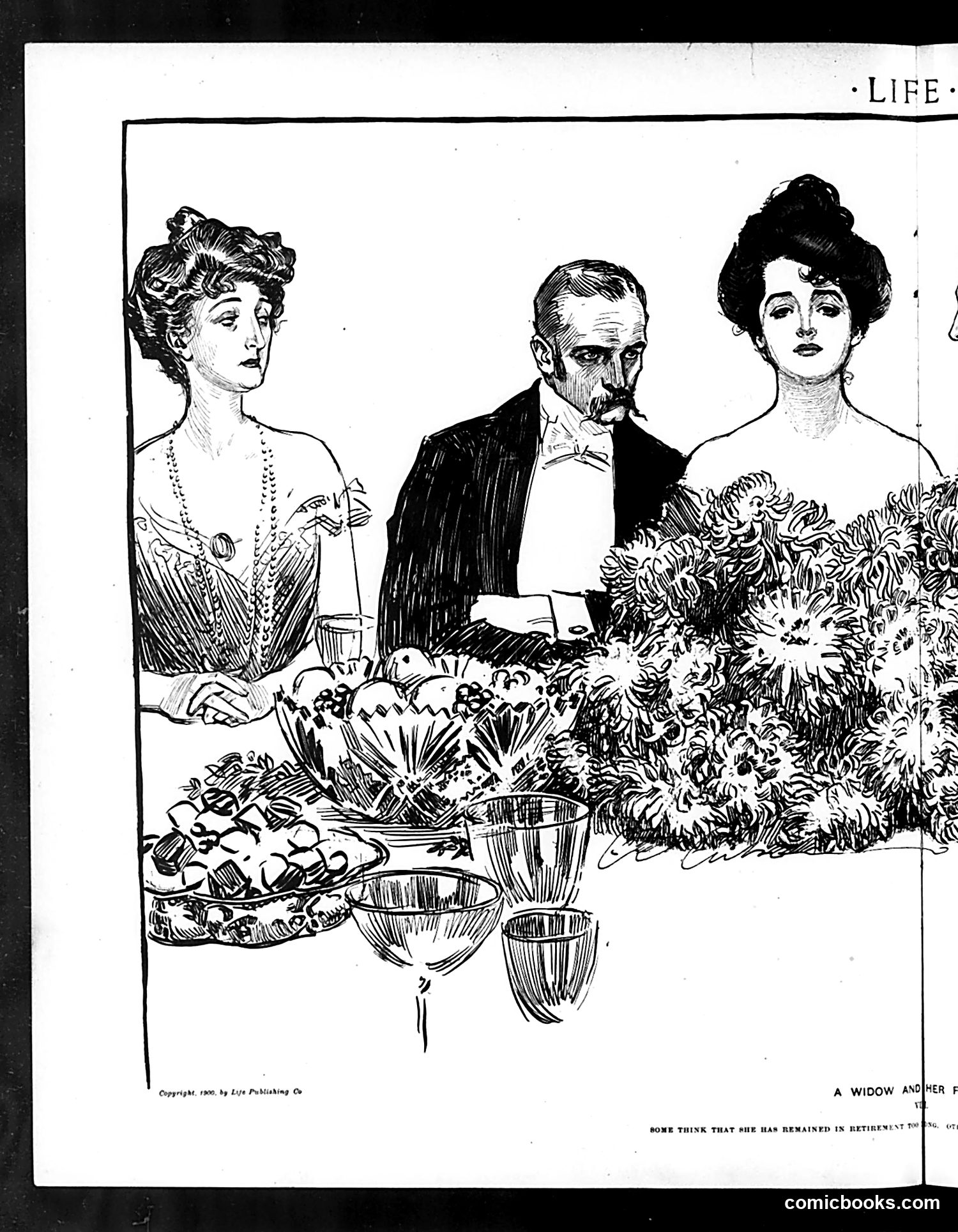
This appears to be a satirical illustration from Life magazine (copyright 1906, per the visible text). The image shows three elegantly dressed figures at what seems to be a social gathering with flowers and drinks. The partial caption reads "A WIDOW AND HER F[RIENDS]" and references "SOME THINK THAT SHE HAS REMAINED IN RETIREMENT TOO LO[NG]." The satire appears to target a wealthy widow who has observed a prolonged mourning period. The joke likely concerns social expectations around widows returning to public society and social life—specifically, that her extended "retirement" (withdrawal from social activities) is being remarked upon, suggesting she should rejoin society sooner. The illustration's elegant styling emphasizes her social status and the formality of the social world she inhabits.
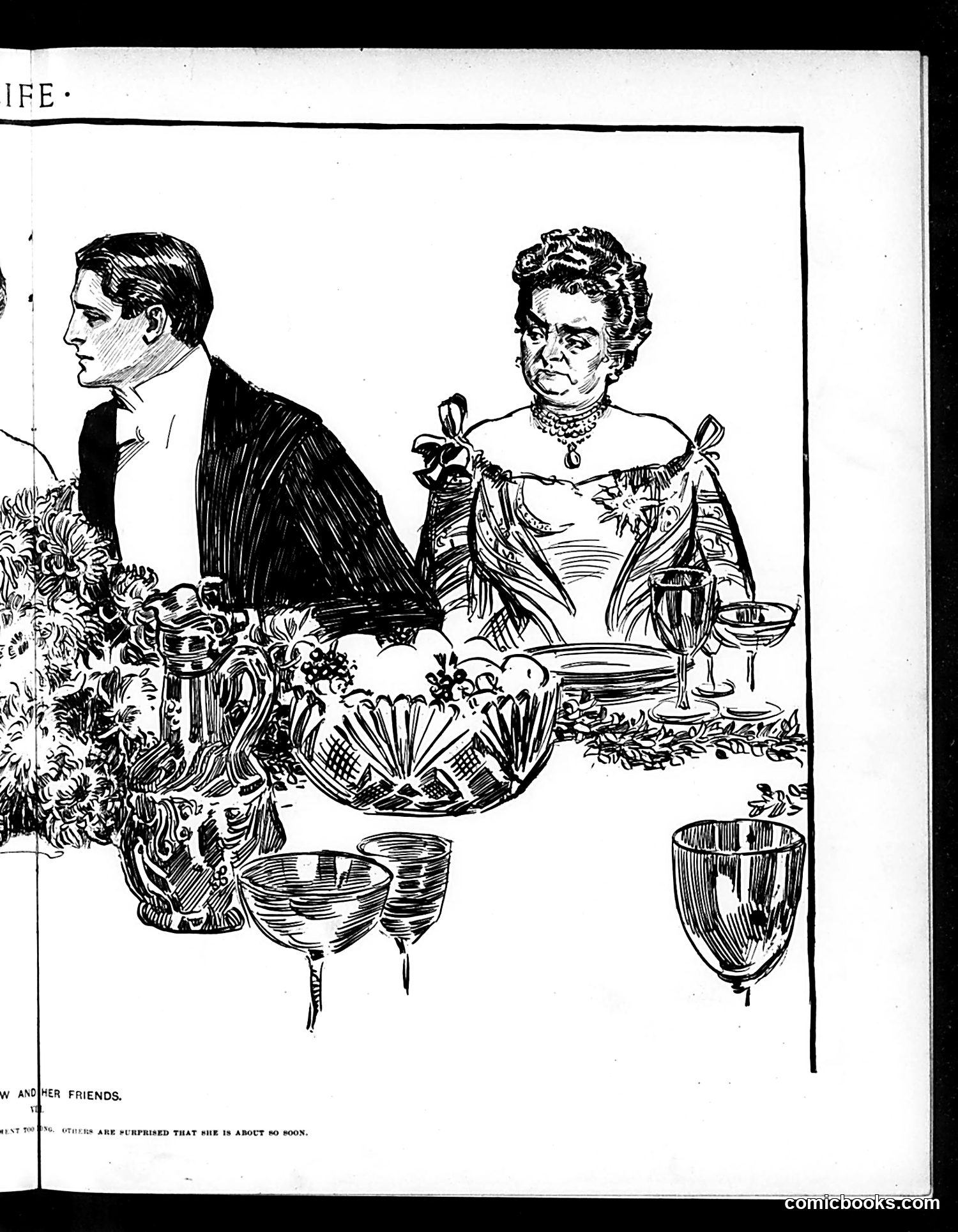
This appears to be a satirical cartoon from Life magazine depicting a formal dinner scene. A well-dressed man in profile (left) sits beside an older woman adorned with jewelry and elegant dress (right). The table is laden with flowers, wine glasses, and formal dining settings. The visible OCR text at bottom reads: "...ARE SURPRISED THAT SHE IS ABOUT SO SOON," suggesting the cartoon comments on someone's unexpected reappearance or quick return to social activities. The satire likely mocks either a remarriage, a widow's rapid return to society, or perhaps an affair—topics of social scandal in early 20th-century American high society. However, without the complete caption or publication date, I cannot definitively identify the specific figures or social commentary intended.
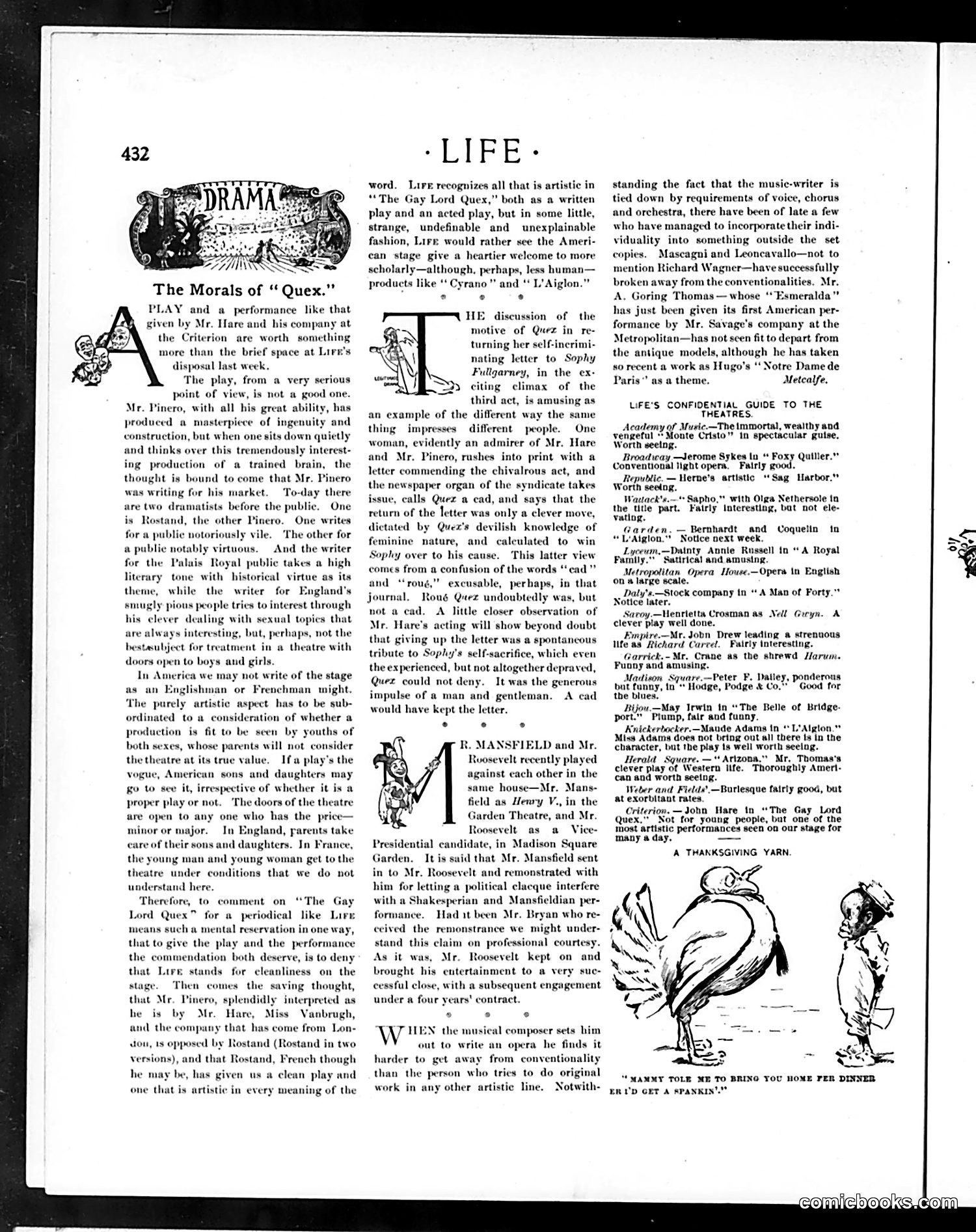
This page reviews theatrical productions, focusing on "The Gay Lord Quex," a play by Henry V. Esmond. The text discusses the play's merits and compares different actors' interpretations of the lead role. The bottom cartoon shows a turkey (drawn in a comic style) with the caption: "MAMMY TOLE ME TO BRING YOU HOME FER DINNER ER'D GET A SPANKIN'." This appears to be humorous holiday content, using a speaking turkey character to create a joke about Thanksgiving dinner preparations. The cartoon reflects period-typical dialect humor common in early 20th-century American satire, though the racial dialect would be considered offensive by modern standards. The page is primarily theatrical criticism rather than political satire.
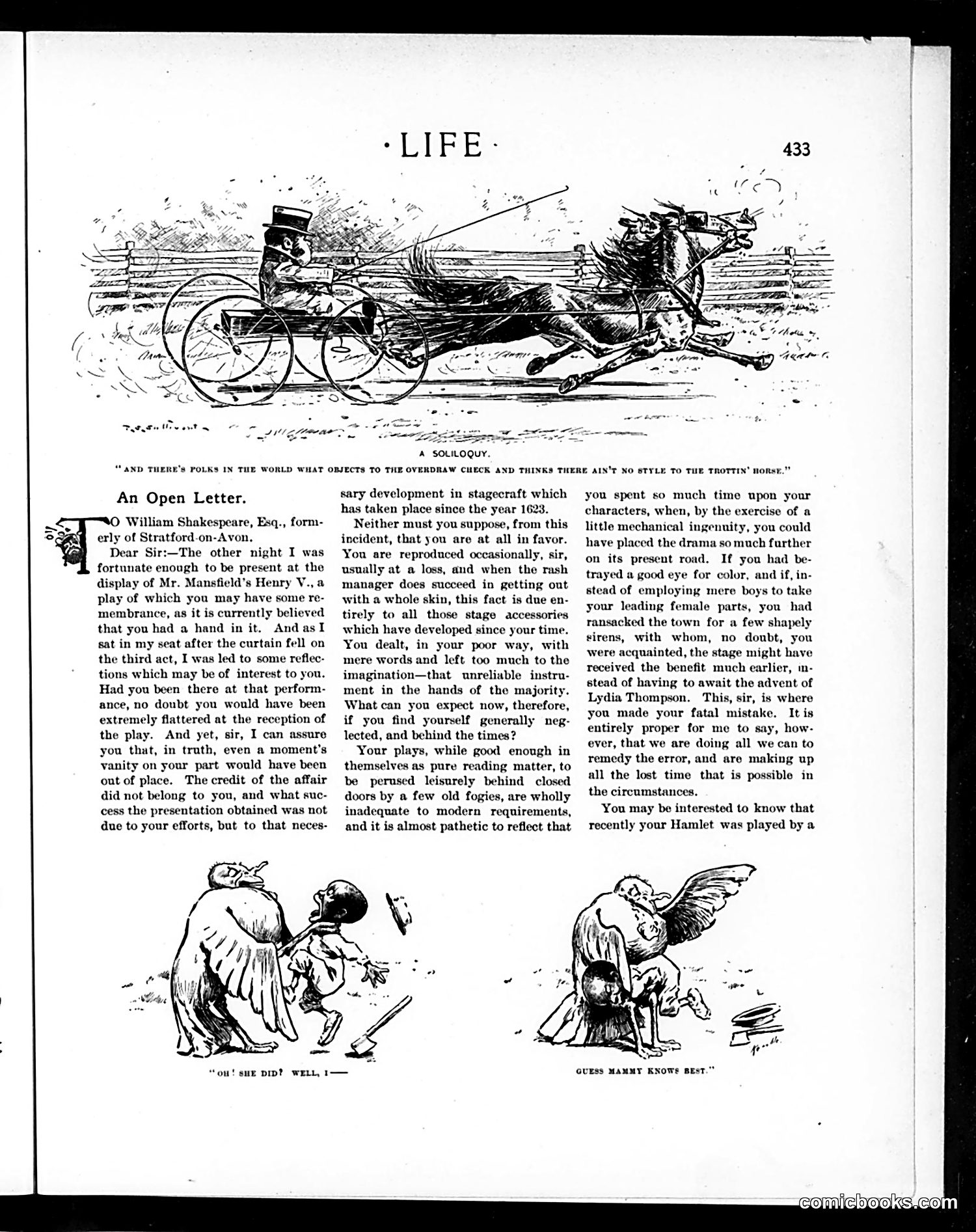
This 1870s Life magazine page satirizes the staging of Shakespeare's plays by contemporary theater producers, particularly Richard Mansfield's production of *Henry V*. **The Main Satire:** The "Open Letter" mocks modern theater managers who credit themselves—not Shakespeare—for successful productions. The writer argues Shakespeare's dialogue alone is inadequate; modern stagecraft, elaborate sets, and attractive actresses (notably referencing performer Lydia Thompson) are what actually draw audiences. It's a backhanded insult: Shakespeare needs modern theatrical technology to succeed. **The Top Cartoon** depicts a man in a cart being dragged wildly by a horse, illustrating the soliloquy about "overdraw checks" and theatrical excess—likely mocking how producers recklessly spend money on spectacle. **The Bottom Cartoons** (captioned "Oh! she did? Well, I—" and "Guess Mammy Knows Best") appear to be separate, unrelated vignettes with cherubs/angels, their meaning unclear without additional context. The page's core joke: modern producers have made Shakespeare's genius irrelevant through technological showmanship.
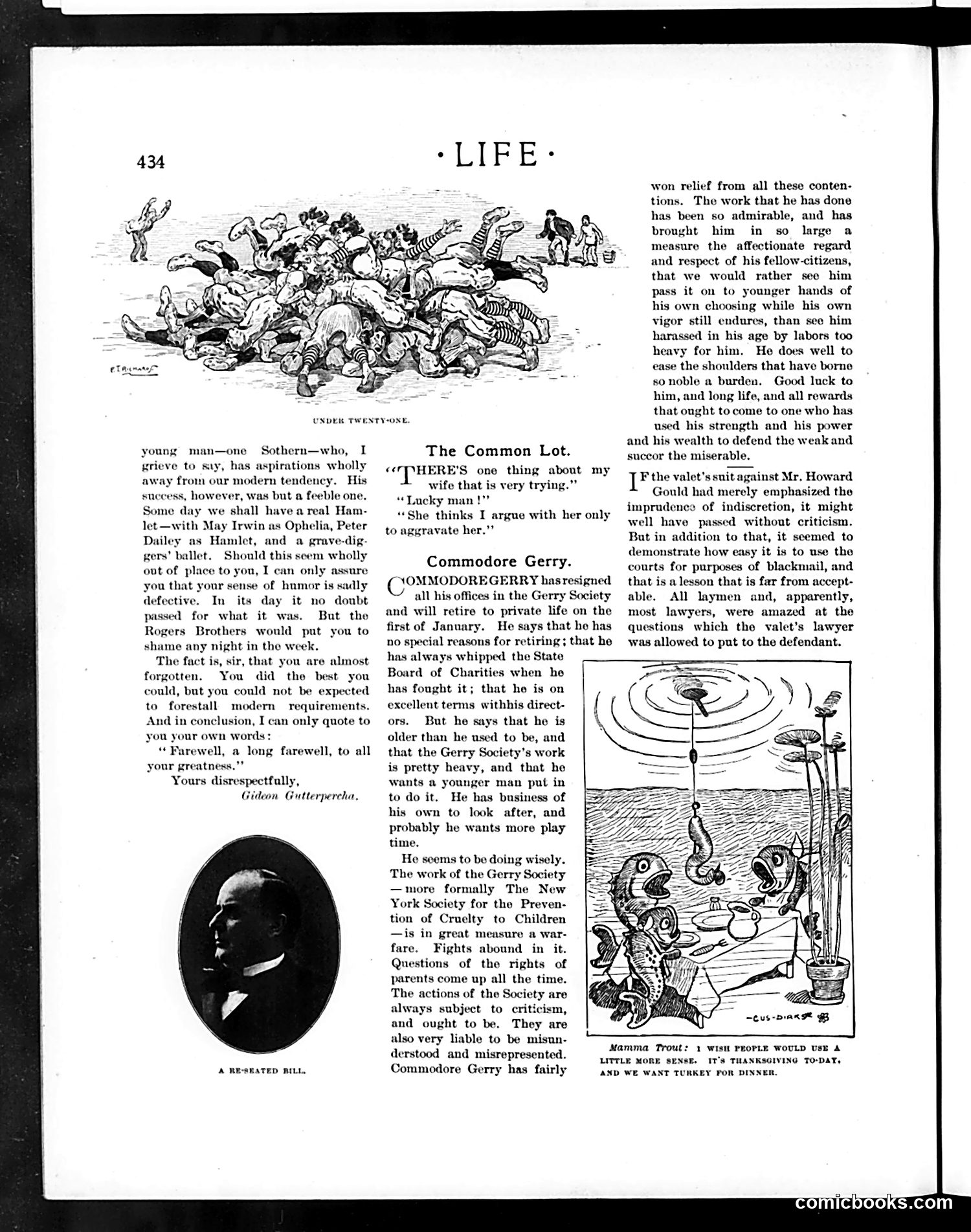
This *Life* magazine page contains three satirical pieces: **"Under Twenty-One"**: A mock letter from "Gideon Gutterpercha" dismissing an aging actor (likely E.H. Sothern) as obsolete. The writer sarcastically praises modern vaudeville performers (Rogers Brothers) over classical Shakespearean actors, mocking both the actor's outdated career and the writer's own pretentious nostalgia. **"The Common Lot"**: A brief domestic humor piece about marital bickering—a wife who claims her husband argues only to aggravate her, a common domestic complaint. **"Commodore Gerry"**: Discusses Commodore Frederick Gerry's retirement from the New York Society for the Prevention of Cruelty to Children. The piece praises his charitable work defending vulnerable people while noting his stepping aside was wise, given the role's constant public criticism and controversy. The bottom cartoon satirizes Thanksgiving excess and materialism through "Mamma Trout," suggesting people prioritize turkey dinners over practical wisdom.
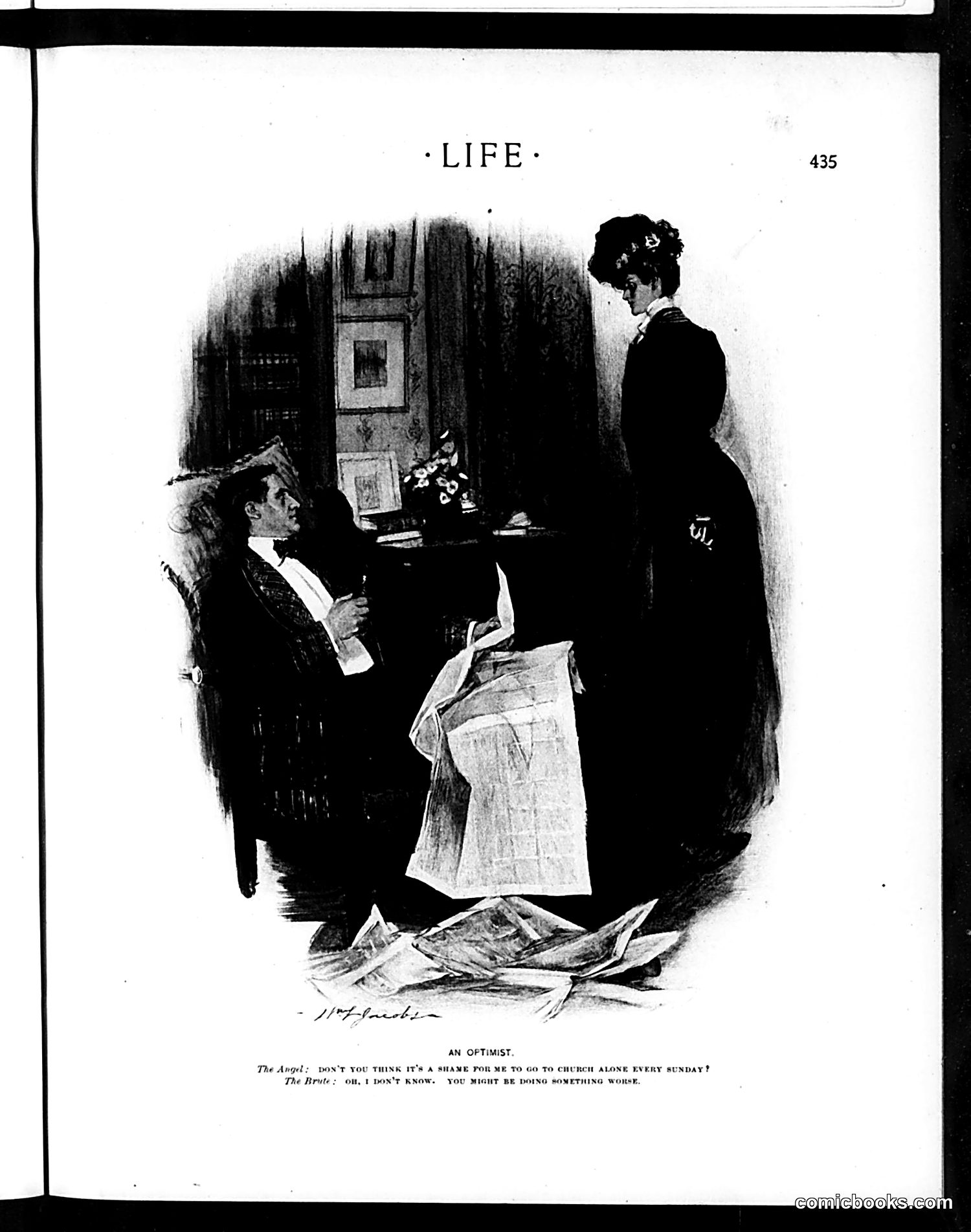
This is a satirical cartoon about a married couple's Sunday habits. An angelic woman (dressed formally, holding a newspaper) asks a man seated at home why she must go to church alone every Sunday, implying he should accompany her. His response—"You might be doing something worse"—is the joke's punchline. He's suggesting that while her solo church attendance is mildly inconvenient, it's actually preferable to what she *could* be doing instead. The implication is darkly humorous: he'd rather she be at church than engaged in worse behavior (infidelity, gambling, drinking, etc.). The cartoon satirizes both marital dynamics and male indifference to religious observance, presenting the husband as a cynical "brute" who views her piety as a fortunate containment of worse impulses rather than a virtue worth supporting.
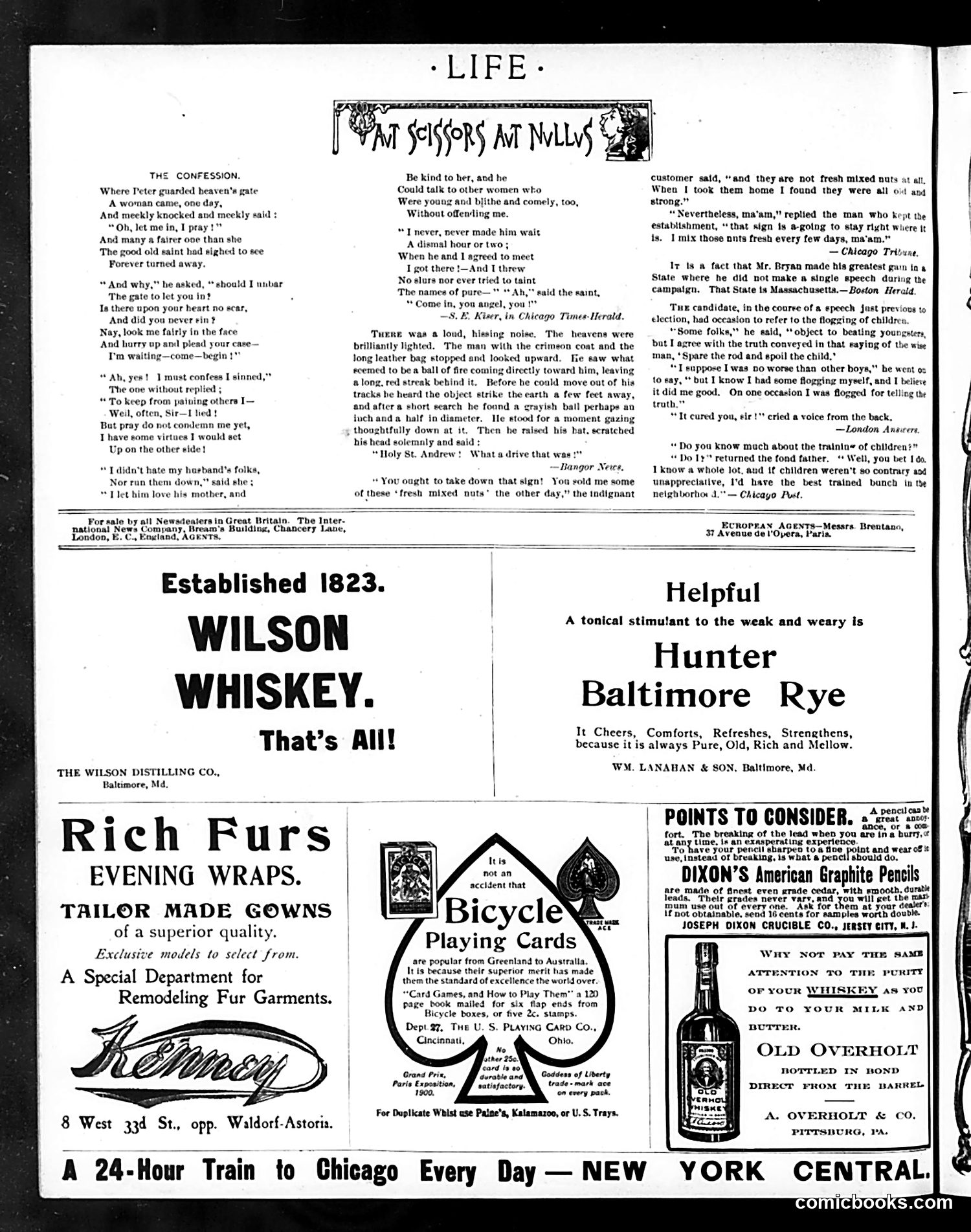
This page contains three humorous short stories satirizing social hypocrisy and human nature, typical of *Life* magazine's satirical style: 1. **"The Confession"**: St. Peter admits a woman to heaven based on her virtues—notably her tolerance of her husband's friendships with other women and her punctuality. The joke mocks how we define moral worth, suggesting that avoiding petty jealousy qualifies one for paradise. 2. **"A Drive"**: A Scottish golfer (suggested by "Holy St. Andrew") witnesses a meteor strike nearby but interprets it as a spectacular golf shot. The satire targets gullible admiration and self-aggrandizement. 3. **Shopkeeper anecdote**: A store owner refuses to remove a "fresh mixed nuts" sign despite selling rancid product, claiming he refreshes them daily. The joke mocks mercenary dishonesty hiding behind technical truth. The remaining content consists of period advertisements for whiskey, playing cards, graphite pencils, and fur garments—typical commercial matter for the era.
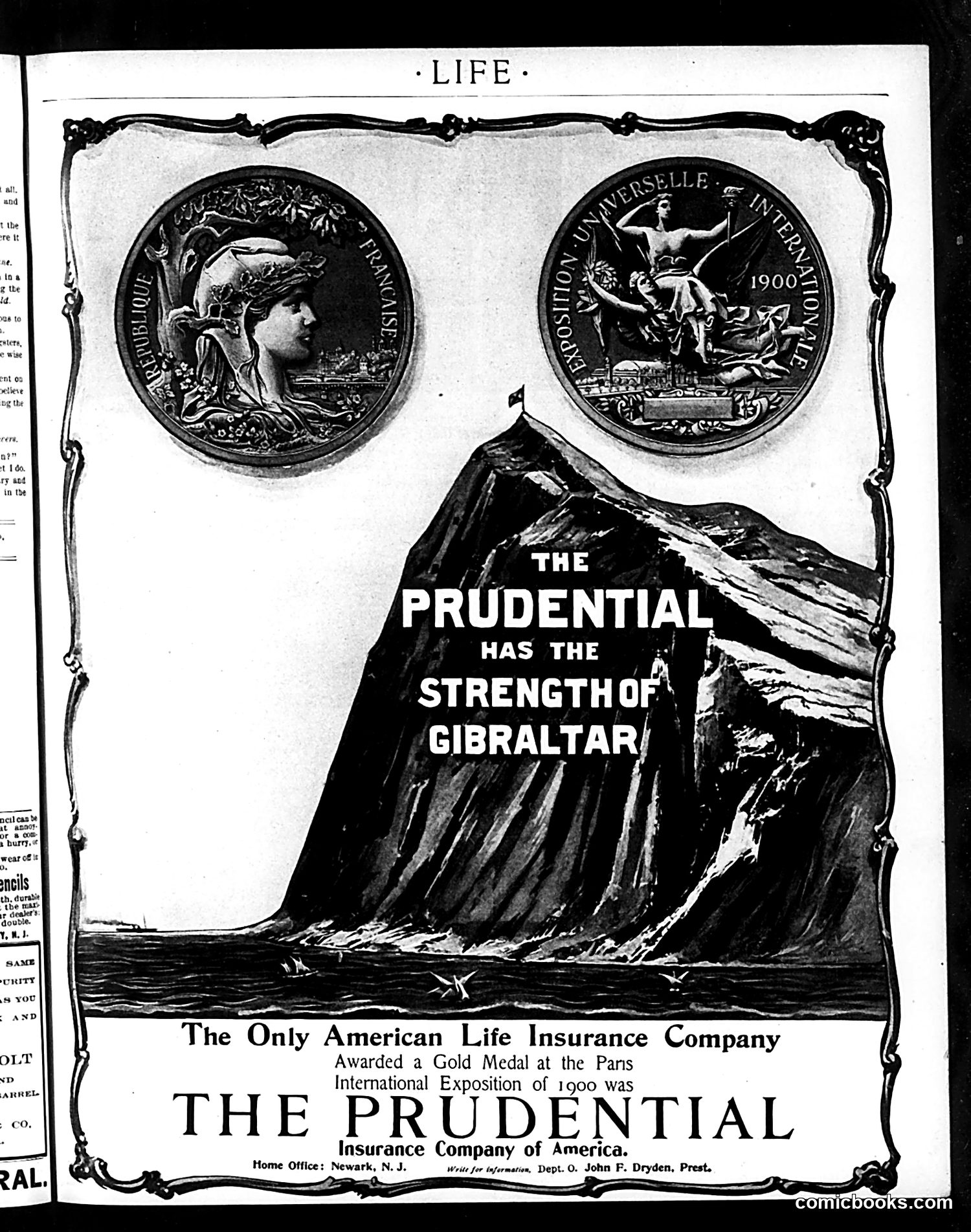
This is a **Prudential Insurance advertisement**, not political satire. The page shows two commemorative medals at the top (from the 1900 Paris International Exposition) and a dramatic illustration of the Rock of Gibraltar below. The ad's central message—"THE PRUDENTIAL HAS THE STRENGTH OF GIBRALTAR"—uses the famous rock formation as a metaphor for the company's stability and reliability. The claim that Prudential was "The Only American Life Insurance Company" awarded a gold medal at the 1900 Paris exposition serves as proof of its trustworthiness. This is straightforward corporate advertising leveraging an iconic natural landmark to suggest permanence and security to potential insurance customers.
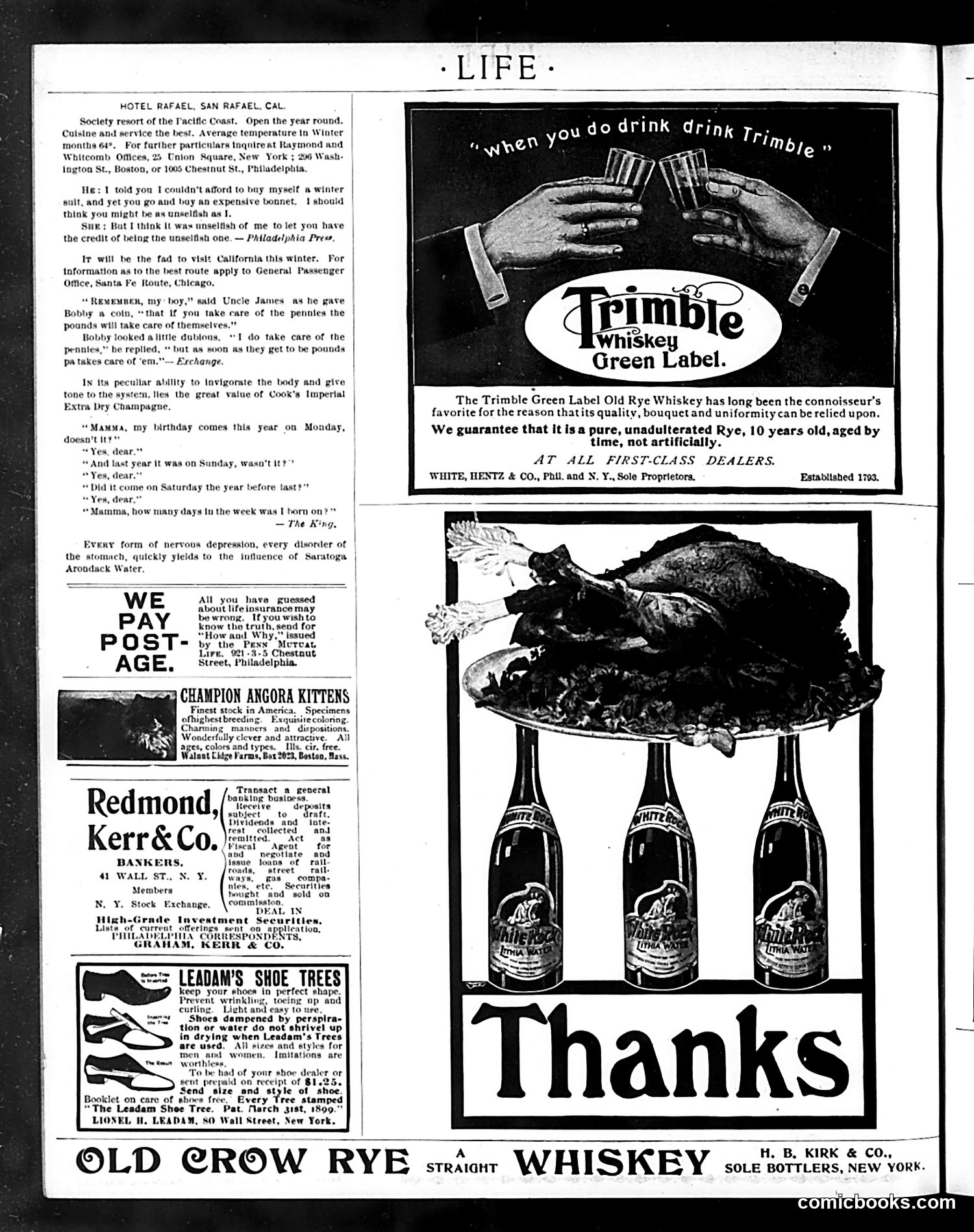
This page is primarily **advertising and filler content** from Life magazine, with minimal satirical cartoons. The visible cartoons are brief domestic humor pieces: one depicts a marital disagreement about spending priorities (he can't afford a winter suit, she buys an expensive bonnet), and another shows Uncle James giving monetary advice to Bobby, who jokes that pounds don't take care of themselves as promised. The page is dominated by period **advertisements**: Trimble Whiskey (promising "pure, unadulterated" spirits), Cook's Imperial champagne, Saratoga Arondack Water, Champion Angora Kittens, insurance and banking services, Leadam's Shoe Trees, and Old Crow Rye. Hotels and travel services are also promoted. The ads reflect early 1900s consumer goods and services. Notable is the whiskey advertising's emphasis on purity—likely referencing contemporary concerns about adulterated spirits. Overall, this appears a typical revenue-generating page mixing light humor with commercial content rather than political satire.
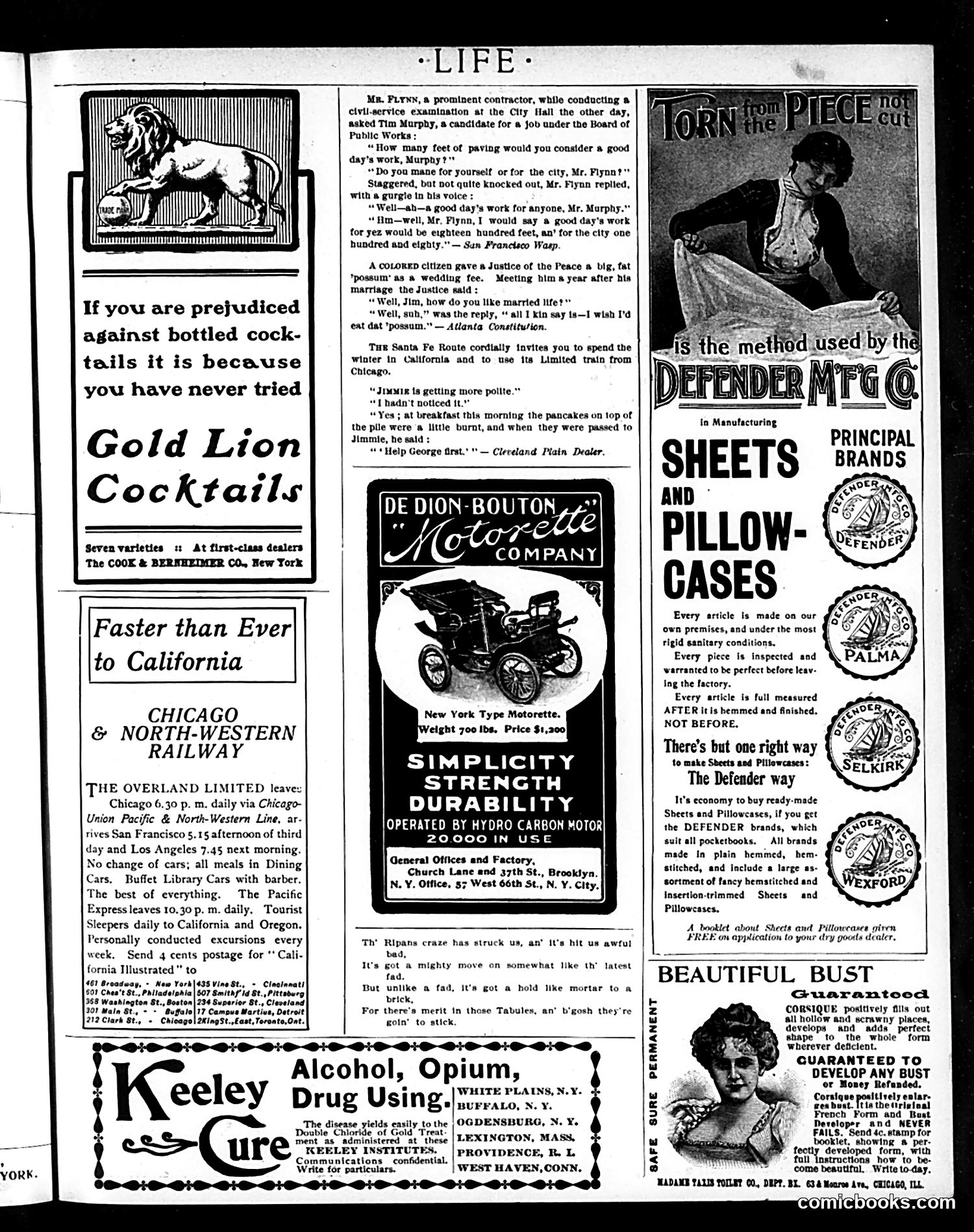
This page from *Life* magazine (appears early 20th century based on styling) consists primarily of **advertisements and humorous anecdotes** rather than political cartoons. The single cartoon depicts a **civil service examination exchange**: contractor Mr. Flynn asks job candidate Tim Murphy how much paving constitutes a good day's work. Murphy shrewdly asks whether Flynn means work for himself or the city—implying workers produce less for employers than for personal gain. Flynn, caught in this critique of labor efficiency/honesty, awkwardly retreats to a non-answer. **The satire targets** municipal hiring practices and the implicit understanding that public works employees work less diligently than private workers—a common Progressive Era concern about government waste and corruption. The page also includes humorous anecdotes about politeness, pancakes, and Ripans tablets (a patent medicine), alongside advertisements for cocktails, railways, motorettes, linens, and drug-addiction treatment—typical of the era's *Life* format mixing satire with commercial pitches.
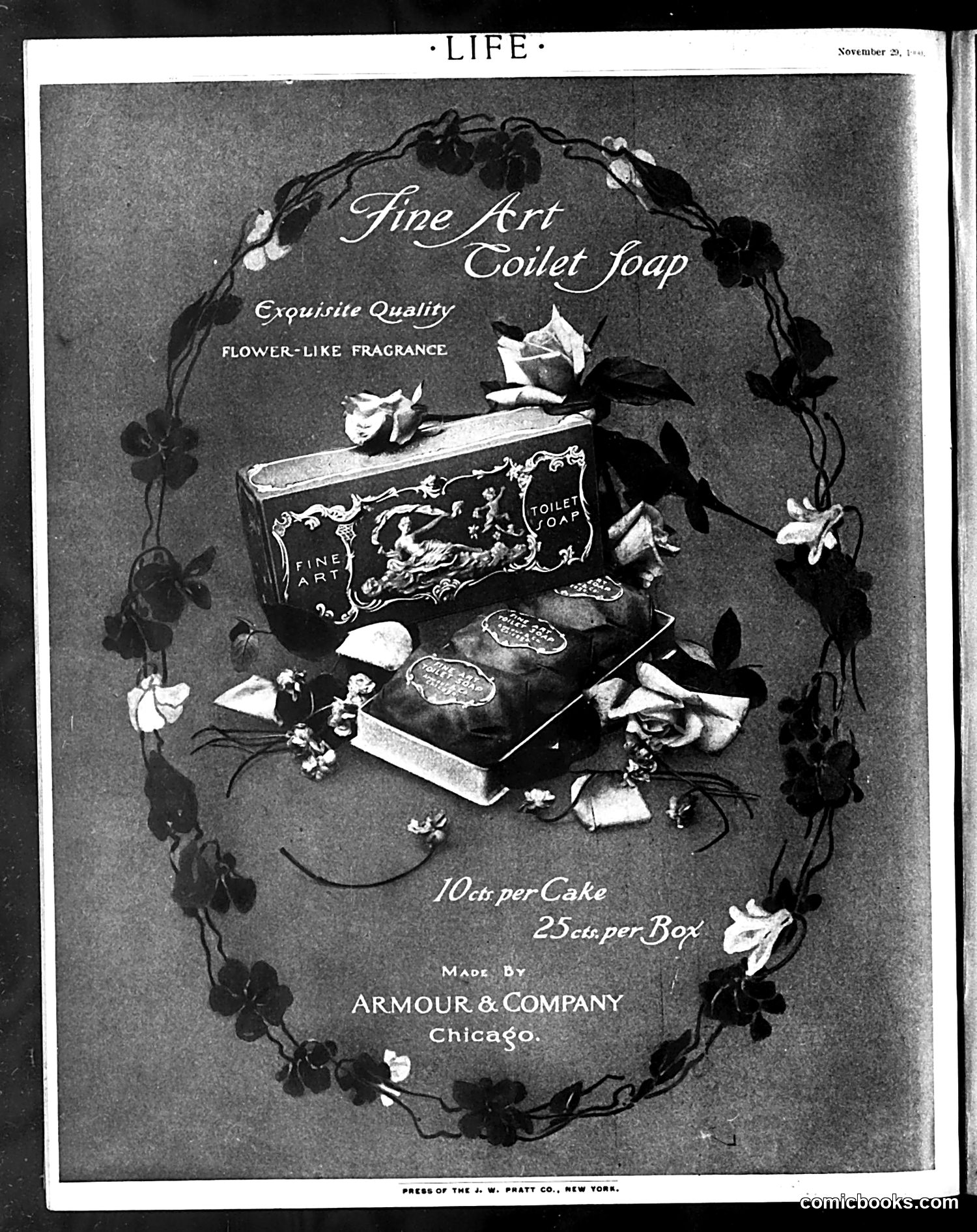
This is a **product advertisement**, not political satire or a cartoon. The page promotes "Fine Art Toilet Soap" by Armour & Company of Chicago, published in *Life* magazine (November 29, based on visible date). The ad uses decorative design rather than satire: ornamental soap bars arranged with flowering vines and botanical imagery to emphasize luxury and aesthetic appeal. The marketing copy highlights "Exquisite Quality" and "Flower-Like Fragrance" to position this as a premium toiletry product. Pricing is listed as 10¢ per cake and 25¢ per box—typical early 20th-century consumer goods advertising in magazines. There is no political commentary or satirical intent visible here; it's straightforward commercial promotion using period-appropriate visual styling.