
Life, 1900-11-29 · page 6 of 20
Life — November 29, 1900 — page 6: what you’re looking at
What you’re looking at
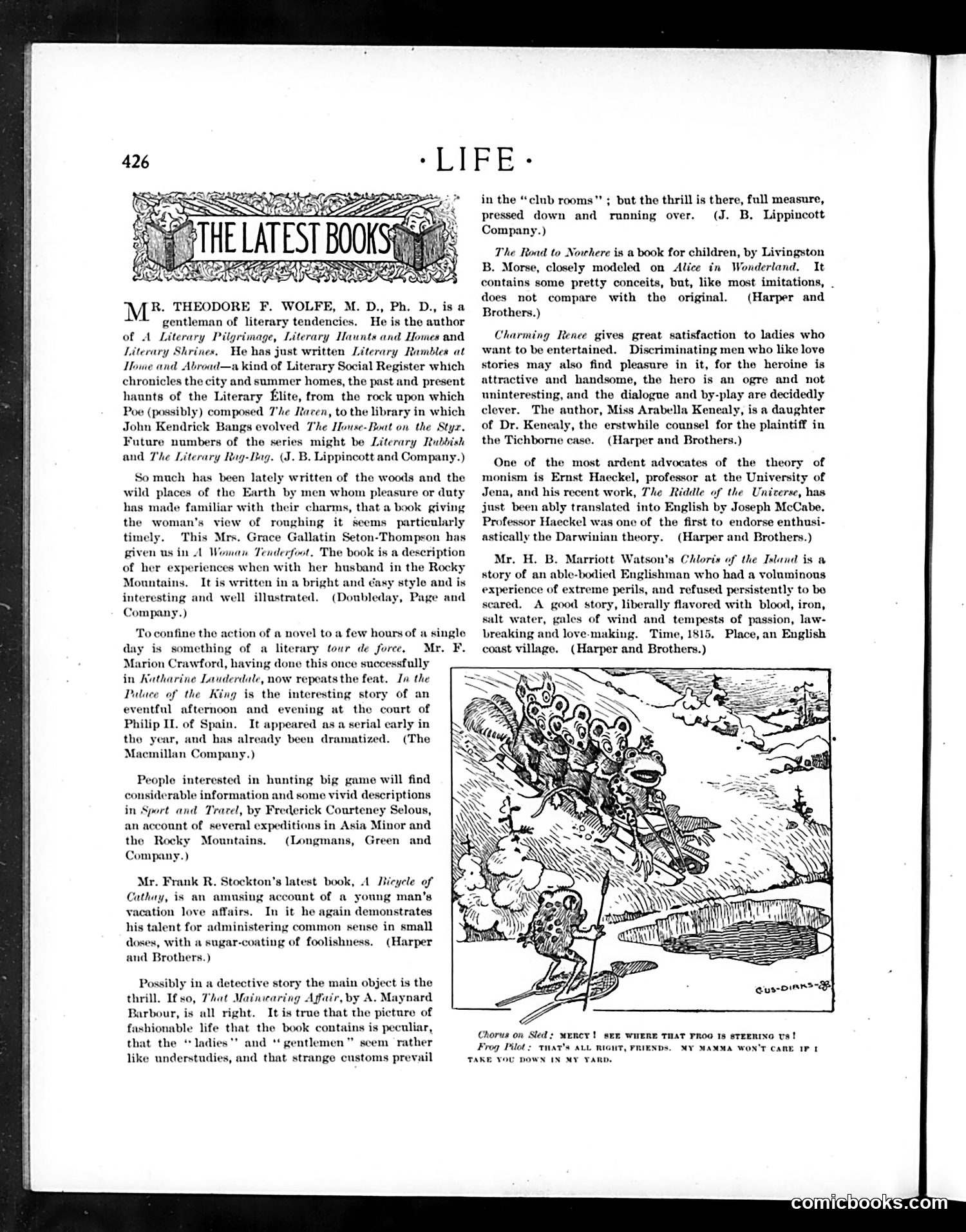
This page is primarily a **book review section** titled "The Latest Books," containing literary criticism rather than political cartoons or satire. The accompanying illustration appears to be a **humorous cartoon showing an anthropomorphic frog character** in period dress, steering what looks like a small boat or vessel. The caption reads: "Darling, oh darling! where is the where that from is steering us? Frog child: 'That's all right, friends. My mamma won't care if I take you down in my yard.'" This seems to be **whimsical editorial art** accompanying book reviews—likely illustrating a children's or humorous story being reviewed on the page. The joke appears to be the frog's oblivious confidence despite steering his passengers toward his yard, playing on animal absurdity rather than political commentary.
📄 Transcribed text from this page (OCR, searchable)
Machine-transcribed from the original scan — historical spelling and the odd misread are preserved.
‘LIVE * R. THEODORE F. WOLFE, M. D., Ph. D., is a Bl gentleman of literary tendencies. He is the author of A Literary Pilgrimage, Literary Haunts and Homes and Literary Shrines. He has just written Literary Rambles at Howe and Abroad—a kind of Literary Social Register which chronicles the city and summer homes, the past and present haunts of the Literary Elite, from the rock upon which Poe (possibly) composed The Raven, to the library in which John Kendrick Bangs evolved The House-Boat on the Styx. Future numbers of the series might be Literary Rubbish and The Literary Rag-Bag. (J.B. Lippincott and Company.) So much has been lately written of the woods and the wild places of the Earth by men whom pleasure or duty has made familiar with their charms, that a book giving the woman's view of roughing it seems particularly timely. This Mrs. Grace Gallatin Seton-Thompson has given us in A Woman Tenderfoot. The book is a description of her experiences when with her husband in the Rocky Mountains. It is written ina bright and éasy style and is interesting and well illustrated. (Doubleday, Page and Company.) To confine the action of a novel to a few hours of a single day is something of a literary four de force, Mr. F. Marion Crawford, having done this once successfully in the “club rooms” ; but the thrill is there, full measure, pressed down and running over. (J. B. Lippincott Company.) The Road to Nowhere is a book for children, by Livingston B. Morse, closely modeled on Alice in Wonderland. It contains some pretty conceits, but, like most imitations, . does not compare with the original. (Harper and Brothers.) Charming Renee gives great satisfaction to ladies who want to be entertained. Discriminating men who like love stories may also find pleasure in it, for the heroine is attractive and handsome, the hero is an ogre and not uninteresting, and the dialogue and by-play are decidedly clever. The author, Miss Arabella Kenealy, is a daughter of Dr. Kenealy, the erstwhile counsel for the plaintiff in the Tichborne case. (Harper and Brothers.) One of the most ardent advocates of the theory of monism is Ernst Haeckel, professor at the University of Jena, and his recent work, The Riddle of the Universe, has just been ably translated into English by Joseph McCabe. Professor Haeckel one of the first to endorse enthusi- astically the Darwinian theory. (Harper and Brothers.) Mr. H. B. Marriott Watson's Chloris of the Island is a story of an able-bodied Englishman who had a voluminous experience of extreme perils, and refused persistently to be scared. A good story, liberally flavored with blood, iron, salt water, gales of wind and tempests of passion, law- breaking and love-making. Time, 1815, Place, an English coast village. (Harper and Brothers.) in Katharine Lauderdale, now repeats the feat. In the uluce of the King is the interesting story of an eventful afternoon and evening at the court of Philip IL. of Spain. It appeared as a serial early in tho year, and has already been dramatized. (The Macmillan Company.) People interested in hunting big game will find derable information and s« vivid descriptions in Sport and Trarel, by Fret Courteney Selous, an account of several expeditions in Asia Minor and the Rocky Mountains. (Longmans, Green and Company.) Mr. Frank R. Stockton’s latest book, A Bicycle of Cathay, is an amusing account of a young man’s vacation love affairs. In it he again demonstrates his talent for administering common sense in small doses, with a sugar-coating of foolishness. (Harper and Brothers.) Possibly in a detective story the main object is the thrill. Ifso, That Mainwaring Affair, by A. Maynard Barbour, is all right. It is true that the picture of fashionable life that the book contains is peculiar, that the “ ladies"? and ‘* gentlemen” scem rather like understudies, and that strange customs prevail cur one Chorus on Sled : Frog Pilot; tH» Ency! Sex WHERE THAT FROO 18 sTEERIXG Us! ALL RIGHT, PRIENDS. MY MAMMA WON'T CARE IPT TARE YOU DOWN IN MY YARD.