
Life, 1900-11-29 · page 12 of 20
Life — November 29, 1900 — page 12: what you’re looking at
What you’re looking at
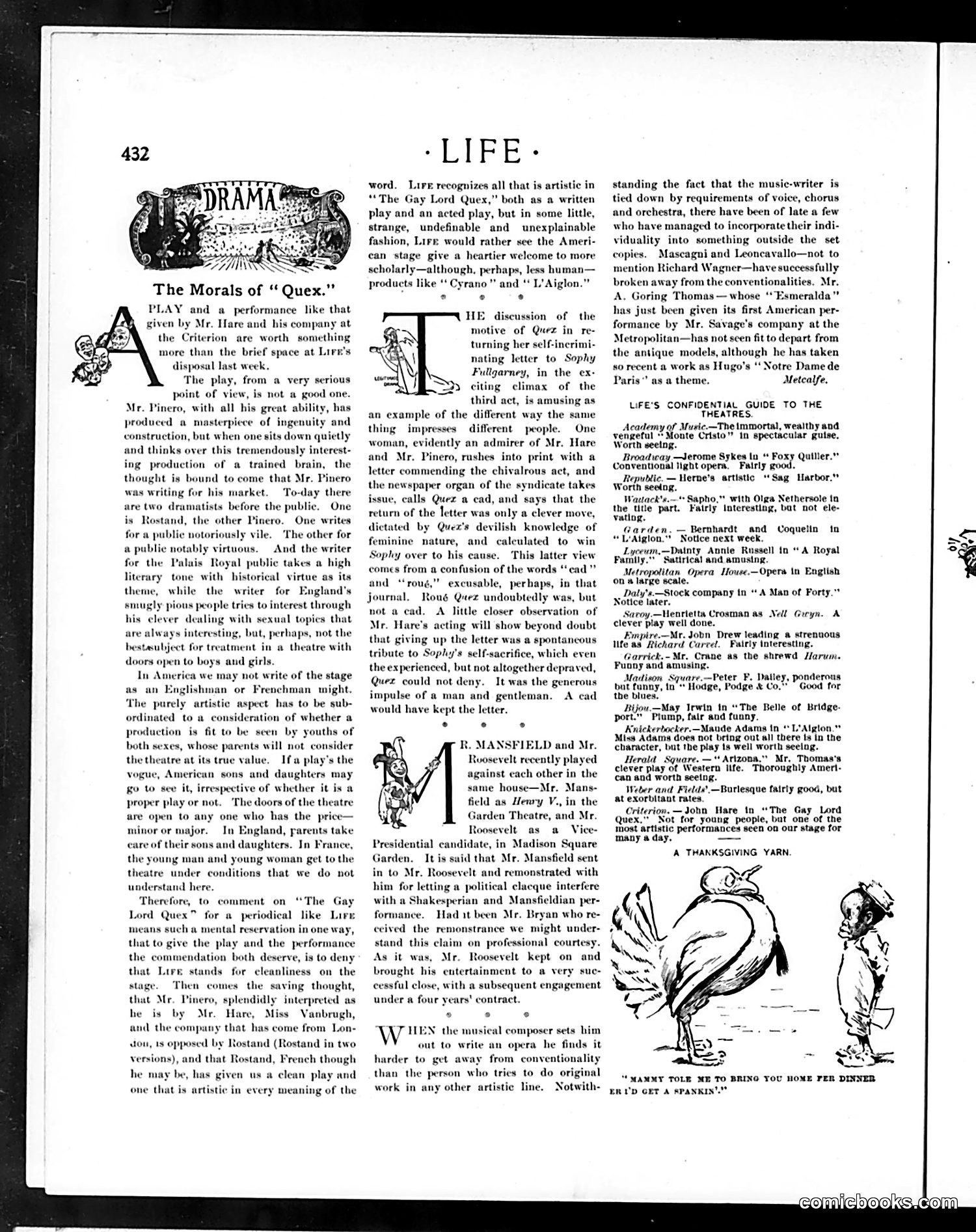
This page reviews theatrical productions, focusing on "The Gay Lord Quex," a play by Henry V. Esmond. The text discusses the play's merits and compares different actors' interpretations of the lead role. The bottom cartoon shows a turkey (drawn in a comic style) with the caption: "MAMMY TOLE ME TO BRING YOU HOME FER DINNER ER'D GET A SPANKIN'." This appears to be humorous holiday content, using a speaking turkey character to create a joke about Thanksgiving dinner preparations. The cartoon reflects period-typical dialect humor common in early 20th-century American satire, though the racial dialect would be considered offensive by modern standards. The page is primarily theatrical criticism rather than political satire.
📄 Transcribed text from this page (OCR, searchable)
Machine-transcribed from the original scan — historical spelling and the odd misread are preserved.
The Morals of “ Quex.” PLAY and a performance like that given by Mr. Hare and his company at the Criterion are worth something more than the brief space at Live's point of view, is not a good o' Mr. Vinero, with all his great ability, has produced a masterpiece of ingenuity and construction, but when one sits down quietly and thinks over this tremendously interest- ing production of a trained brain, the thought is bound to come that Mr. Pinero was writing for his market. To-day there are two dramatists before the public, One is Rostand, the other Pinero. One writes ly vil he other for And the writer 1 public takes a high tone with historical virtue as its » while the writer for England's smugly pious people tries to interest through his clever dealing with sexual topics that are always interesting, but, perh: t the bestaubject for treatment in a theatre with doors open to boys and girls. In America we may not write of the stage as an Englishinan or Frenchman might. ‘The purely artistic aspect has to be sub- ordi: sideration of whether a production is fit to be seen by youths of both sexes, whose parents will not consider the theatre at its true value. Ifa play's the vogue, American sons and daughters may go to see it, irrespective of whether it is a proper play or n ‘The doors of the theatre are open to any one who has the price— minor or major. In England, parents take care of their sons and daughters. In France, the young man and young woman get to the theatre under conditions that we do not understand hes Therek to comment on “The Gay Lord Quex” for a periodical like Lir ans such a inone way, and the performance both deserve, is to den that Lire stands for cleanliness on the stage cn comes the saving thought, that Mr. Pinero, splendidly interpreted as he is Mr. Miss Vanbrugh, and the company that has come from Lon- for a public notoriot a public notably virtuous. for the Palais [i led to a ptal reserva: that to give the pla the commendat Hare, aon, 18 opposed by Rostand (Rostand in two versions), and that Rostand, French though he may be, has given us a clean play and one that is artistic in every meaning of the «LIFE word. Lire recognizes all that is artistic in “The Gay Lord Quex,” both as a written play and an acted play, but in some little, strange, undefinable and unexplainable fashion, L would rather see the Ameri- can stage give a heartier welcome to more scholarly—although, perhaps, less human— products like ‘‘ Cyrano" and “ L’Aiglon.” * ° . HE discussion of the motive of Quez in re- turning her self-incrimi- nating letter to Sophy Fullgarney, in the ex- citing climax of the third act, is amusing as an example of the different way the same thing impresses different peop woman, evidently an admirer of Mr. Hare and Mr. Pinero, rushes into print with a letter commending the chivalrous act, and the newspaper organ of the syndicate takes issue, calls Quez a cad, and says that the return of the letter was only a clever mo: dictated by Quez's devilish knowledge of feminine nature, and calculated to win Sophy over to his cause. This latter view ¢ 8 from a confusion of the words ‘cad ” and “roué,” excusable, perhaps, in that journal. Roué Quez undoubtedly was, but not a cad. A little closer observation of Mr. Hare's acting will show beyond doubt that giving up the letter was a spontancous tribute to Sophy's self-sacrifice, which even the experienced, but not altogether depraved, Quez could not deny. It was the generous impulse of a man and gentleman. A cad would have kept the letter. ° ° ° R. MANSFIELD and Mr. Roosevelt recently played against each other in the same house—Mr. Mans- field as Henry V., in the Garden Theatre, and Mr. Roosevelt as a Vice- Presidential candidate, in Madison Square Garden. It is suid that Mr. Mansfield sent in to Mr. Roosevelt and remonstrated with him for letting a political clacque interfere with a Shakesperian and Mansfieldian per- formance. Had it been Mr. Bryan who re- ed the remonstrance we might under- stand this claim on professional courtesy. As it was, Mr. Roosevelt kept on and brought his entertainment to a very suc- cessful close, with a subsequent engagement under a four years' contract. ° ° ° V HEN the musical composer sets him out to write an opera he finds it harder to get away from conventionality than the person who tries to do original work in any other artistic line. Notwith- standing the fact that the music-writer is tied down by requirements of voice, chorus and orchestra, there have been of late a few who have managed to incorporate their indi- viduality into something outside the set copies. Mascagni and Leoncavallo—not to mention Richard Wagner—have successfully broken away from the conventionalities. Mr. A. Goring Thomas — whose ‘* Esmeralda has just been given its first American per- formance by Mr. Savage's company at the Metropolitan—has not scen fit to depart from the antique models, although he has taken so recent a work as Hugo's ‘ Notre Damede Paris” as a theme. Metcalfe. LIFE'S CONFIDENTIAL GUIDE TO THE THEATRES. Academy of Muxic.—The tmmortal, wealthy and vengeful “Monte Cristo” in spectacular guise. Worth seeing. Broadway —Jerome Sykes lu “ Foxy Quiller.” Conventional light opera, Fairly good. Republic. — Werne’s artistic “Sag Marbor.* Worth seeing. Wartack's.—** Sapo,” with Olga Nethersole tn the tle part. Fairly Interesting, bat not ele- vating. . — Bernhardt and Coquelin in Notice next week. Lycewm.—Dainty Annie Russell in “A Royal Family." " Satirical and amusing. Metropolitan Opera House.—Opera in English on # large scale. Daty's.—Stock company tn “A Man of Forty."* Notice later. Saroy.—Venrtetts Crosman as Nell Giryn. A clever play well done. Empire.—Mr. Jobn Drew leading & strenuous Ute as Richard Carcet. Fairly interesting. Garrick.- Mr. Crane as the shrewd Harum. Punny and amusing. Madison Square.—Peter P. Dalley, ponderous bat funny, in * Hodge, Podge & Co."" " Good for the blues. Bijou.—May Irwin in “The Belle of Bridge- port.” ‘Plump, fir and fuony. Knickerbocker.—Mande Adams tn * L'Algion.* Miss Adams does not bring out all there ts in the character, but the play ts well worth seeing. Herald Square. —“' Arizona.” Mr, ‘Thomas's clever play of Western life. Thoroughly Amert- can and worth seeing. Weber and Fields’ —Burlesque fairly good, but at exorbitant rates. Criterion. — John Hare in “The Gay Lord Quex."" Not for young people, but one of the thost artistic performances seen on our stage for many @ day, A THANKSGIVING YARN.