
Life, 1900-11-29 · page 13 of 20
Life — November 29, 1900 — page 13: what you’re looking at
What you’re looking at
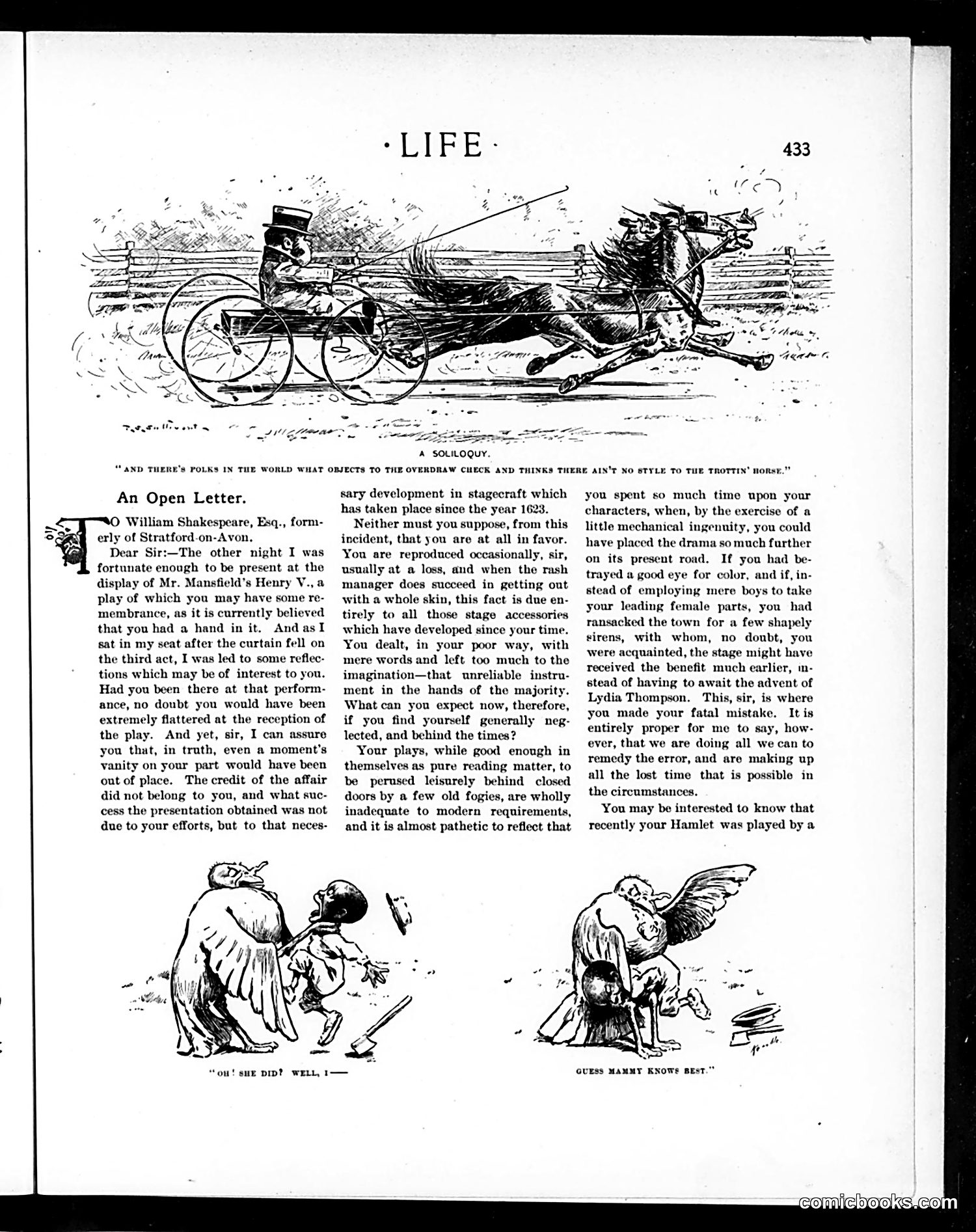
This 1870s Life magazine page satirizes the staging of Shakespeare's plays by contemporary theater producers, particularly Richard Mansfield's production of *Henry V*. **The Main Satire:** The "Open Letter" mocks modern theater managers who credit themselves—not Shakespeare—for successful productions. The writer argues Shakespeare's dialogue alone is inadequate; modern stagecraft, elaborate sets, and attractive actresses (notably referencing performer Lydia Thompson) are what actually draw audiences. It's a backhanded insult: Shakespeare needs modern theatrical technology to succeed. **The Top Cartoon** depicts a man in a cart being dragged wildly by a horse, illustrating the soliloquy about "overdraw checks" and theatrical excess—likely mocking how producers recklessly spend money on spectacle. **The Bottom Cartoons** (captioned "Oh! she did? Well, I—" and "Guess Mammy Knows Best") appear to be separate, unrelated vignettes with cherubs/angels, their meaning unclear without additional context. The page's core joke: modern producers have made Shakespeare's genius irrelevant through technological showmanship.
📄 Transcribed text from this page (OCR, searchable)
Machine-transcribed from the original scan — historical spelling and the odd misread are preserved.
Teen eet 6 An Open Letter. William Shakespeare, Esq., form- erly of Stratford-on-Avon, Dear Sir:—The other night I was fortunate enough to be present at the display of Mr. Mansfield’s Henry V., a play of which you may have some re- membrance, as it is currently believed that you had a hand in it. AndasI sat in my seat after the curtain fell on the third act, I was led to some reflec- tions which may be of interest to you. Had you been there at that perform- ance, no doubt you would have been extremely flattered at the reception of the play. And yet, sir, I can assure you that, in truth, even a moment's vanity on your part would have been out of place. The credit of the affair did not belong to you, and what suc- cess the presentation obtained was not due to your efforts, but to that neces- o yWignewae? al “GA A SOLILOQuUY. “AND THERE'S YOLKS IN THE WORLD WHAT OBJECTS TO THE OVERDRAW CHECK AND THINKS THERE AIN'T NO STYLE To THE TROTTIN' HORSE.” sary development in stagecraft which has taken place since the year 1623. Neither must you suppose, from this incident, that you are at all in favor. You are reproduced occasionally, sir, usually at a loss, and when the rash manager does succeed in getting out with a whole skin, this fact is due en- tirely to all those stage accessories which have developed since your time. You dealt, in your poor way, with mere words and left too much to the imagination—that unreliable instru- ment in the hands of the majority. What can you expect now, therefore, if you find yourself generally neg- lected, and behind the times? Your plays, while good enough in themselves as pure reading matter, to be perused leisurely behind closed doors by a few old fogies, are wholly inadequate to modern requirements, and it is almost pathetic to reflect that “ou! sux pip? wri, 1— you spent so much time upon your characters, when, by the exercise of a little mechanical ingenuity, you could have placed the drama so much further on its present road. If you had be- trayed a good eye for color, and if, in- stead of employing mere boys to take your leading female parts, you had ransacked the town for a few shapely sirens, with whom, no doubt, you were acquainted, the stage might have received the benefit much earlier, m- stead of having to await the advent of Lydia Thompson. This, sir, is where you made your fatal mistake. It is entirely proper for me to say, how- ever, that we are doing all we can to remedy the error, and are making up all the lost time that is possible in the circumstances. You may be interested to know that recently your Hamlet was played by a GUESS MAMMY KNOWS BEST.”