
Life, 1900-11-29 · page 4 of 20
Life — November 29, 1900 — page 4: what you’re looking at
What you’re looking at
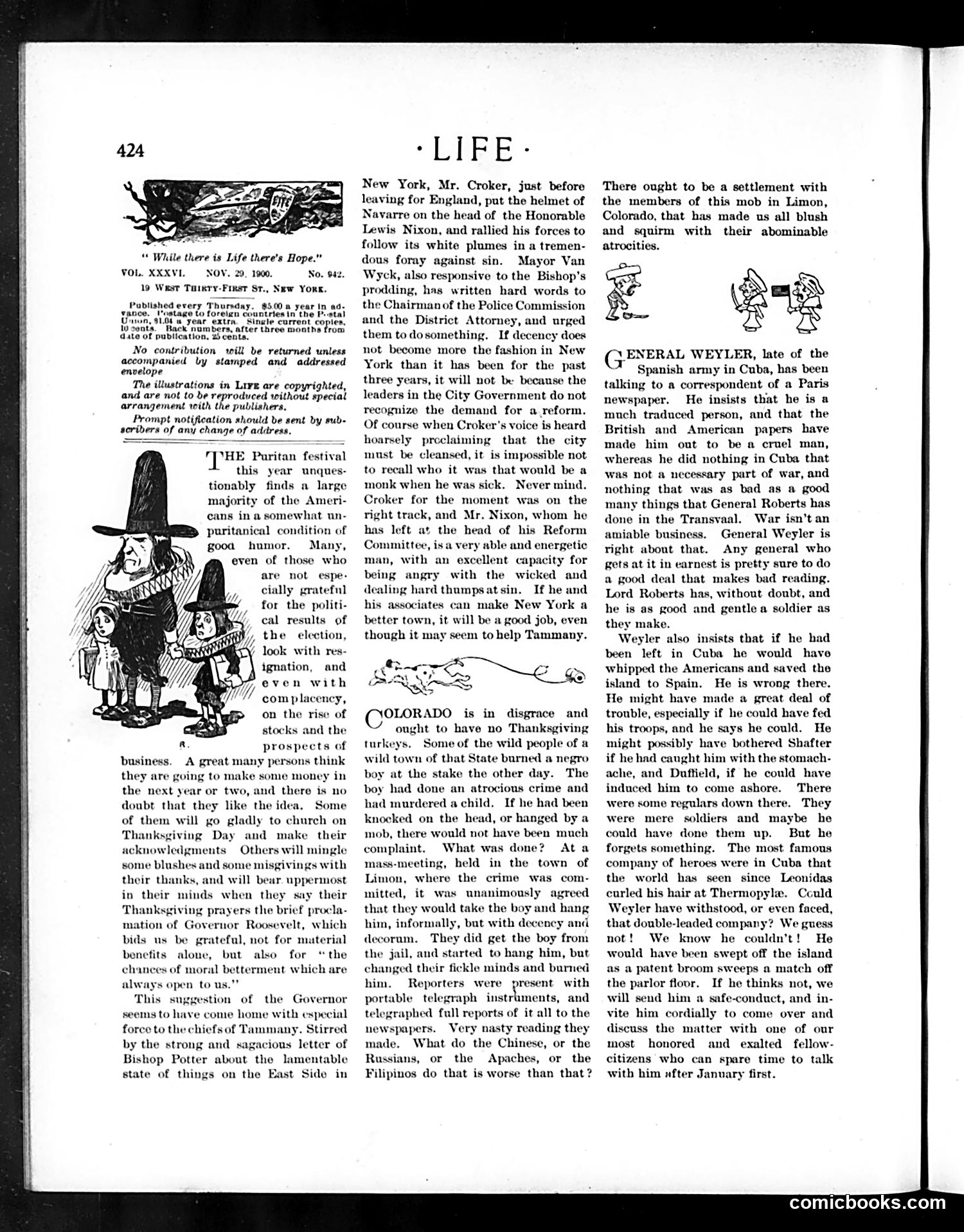
The prominent cartoon depicts a tall figure in pilgrim attire (tall hat, large collar) with two children—likely representing the Puritan tradition and American youth. This illustrates the article's discussion of Thanksgiving and the "Puritan festival," satirizing how Americans celebrate this holiday while embodying contradictory values. The main text discusses political corruption and reform in New York City, referencing Mayor Van Wyck and Police Commissioner Croker's response to demands for civic cleansing. It criticizes ineffectual leadership while praising Reform Committee chair Nixon's efforts. A secondary section critiques General Weyler's defense of his Cuba military record against accusations by Lord Roberts, suggesting Weyler's justifications are self-serving rather than substantive. The satire targets governmental hypocrisy and failed accountability.
📄 Transcribed text from this page (OCR, searchable)
Machine-transcribed from the original scan — historical spelling and the odd misread are preserved.
“ While there is XXXVI. 19 Wast Taixry-Finsr St., New Yore. VOL. Published every Thursday. $5.00 a year in ad- vance, . Hostage to foreign countries in the Postal Un Oa Fear extra. Single current copies. Iv s90ts. Hack numbers, after three months from date of publication, 25 cents. No contribution will be returned unless accompanied by stamped and addressed envelope The illustrations in Live are copyrighted, and are not to be reproduced without special arrangement with the publishers, Prompt notification should be sent by sub- soribers of any change of address. r tionably finds a large majority of the Ameri- cans in a somewhat un- puritanical condition of gooa humor. Many, even of those who are not espe- cially grateful for the politi- cal results of , the election, TY look with res- ignation, and even with complacency, on the rise of stocks and the prospects of business. A great many persons think they are going to make some money in the next year or two, and there is no doubt that they like the idea, Some of them will go gladly to church on Thanksgiving Day and make their acknowledgments Others will mingle some blushes and some misgivings with their thanks, and will bear uppermost in their minds when they say their Thanksgiving prayers the brief procla- mation of Governor Roosevelt, which bids us be grateful, not for material benefits alone, but also for “the chances of moral betterment which are always open to us.”” This suggestion of the Governor seems to have come home with especial force to the chiefs of Tammany. Stirred by the strong and sagacious letter of Bishop Potter about the lamentable state of things on the East Side in LIFE New York, Mr. Croker, just before leaving for England, put the helmet of Navarre on the head of the Honorable Lewis Nixon, and rallied his forces to follow its white plumes in a tremen- dous foray against sin. Mayor Van Wyck, also responsive to the Bishop's prodding, has written hard words to the Chairmanof the Police Commission and the District Attorney, and urged them todosomething. If decency does not become more the fashion in New York than it has been for the past three years, it will not be because the leaders in the City Government do not recognize the demand for a reform. Of course when Croker's voice is heard hoarsely prcclaiming that the city must be cleansed, it is impossible not to recall who it was that would be a monk when he was sick. Never mind. Croker for the moment was on the right track, and Mr. Nixon, whom he has left at the head of his Reform Committee, isa very able and energetic man, with an excellent capacity for being angry with the wicked and dealing hard thumpsatsin, If he and his associates can make New York a better town, it will be a good job, even though it may seem to help Tammany. SAS a0 es KS ~<_w@ Qor0n10 is in disgrace and / ought to have no Thanksgiving turkeys. Some of the wild people of a wild town of that State burned a negro boy at the stake the other day. The boy had done an atrocious crime and had murdered a child. If he had been knocked on the head, or hanged by a mob, there would not have been much complaint. What was done? Ata mass-meeting, held in the town of Limon, where the crime was com- mitted, it was unanimously agreed that they would take the boy and hang him, informally, but with decency and decorum. They did get the boy from the jail, and started to hang him, but changed their fickle minds and burned Reporters were present with je telegraph instruments, and legraphed full reports of it all to the newspapers. Very nasty reading they made. What do the Chinese, or the Russians, or the Apaches, or the Filipinos do that is worse than that? There ought to be a settlement with the members of this mob in Limon, Colorado, that has made us all blush and squirm with their abominable atrocities. Rene G ENERAL WEYLER, late of the Spanish army in Cuba, has been talking to a correspondent of a Paris newspaper. He insists that he is a much traduced person, and that the British and American papers have made him out to be a cruel man, whereas he did nothing in Cuba that was not a necessary part of war, and nothing that was as bad as a good many things that General Roberts has done in the Transvaal. War isn’t an amiable business. General Weyler is right about that. Any general who gets at it in earnest is pretty sure to do a good deal that makes bad reading. Lord Roberts has, without doubt, and he is as good and gentle a soldier as they make. Weyler also insists that if he had been left in Cuba he would havo whipped the Americans and saved the island to Spain. He is wrong there. He might have made a great deal of trouble, especially if he could have fed his troops, and he says he could. He might possibly have bothered Shafter if he had caught him with the stomach- ache, and Duftield, if he could have induced him to come ashore. There were some regulars down there. ‘They were mere soldiers and maybe he could have done them up. But he forgets something. The most famous company of heroes were in Cuba that the world has seen since Leonidas curled his hair at Thermopyle. Could Weyler have withstood, or even faced, that double-leaded company? We guess not! We know he couldn’t! He would have been swept off the island as a patent broom sweeps a match off the parlor floor, If he thinks not, we will send him a safe-conduct, and in- e him cordially to come over and cl the matter with one of our most honored and exalted fellow- citizens who can spare time to talk with him »fter January first. comicbooks.com