
A complete issue · 20 pages · 1900
Life — September 27, 1900
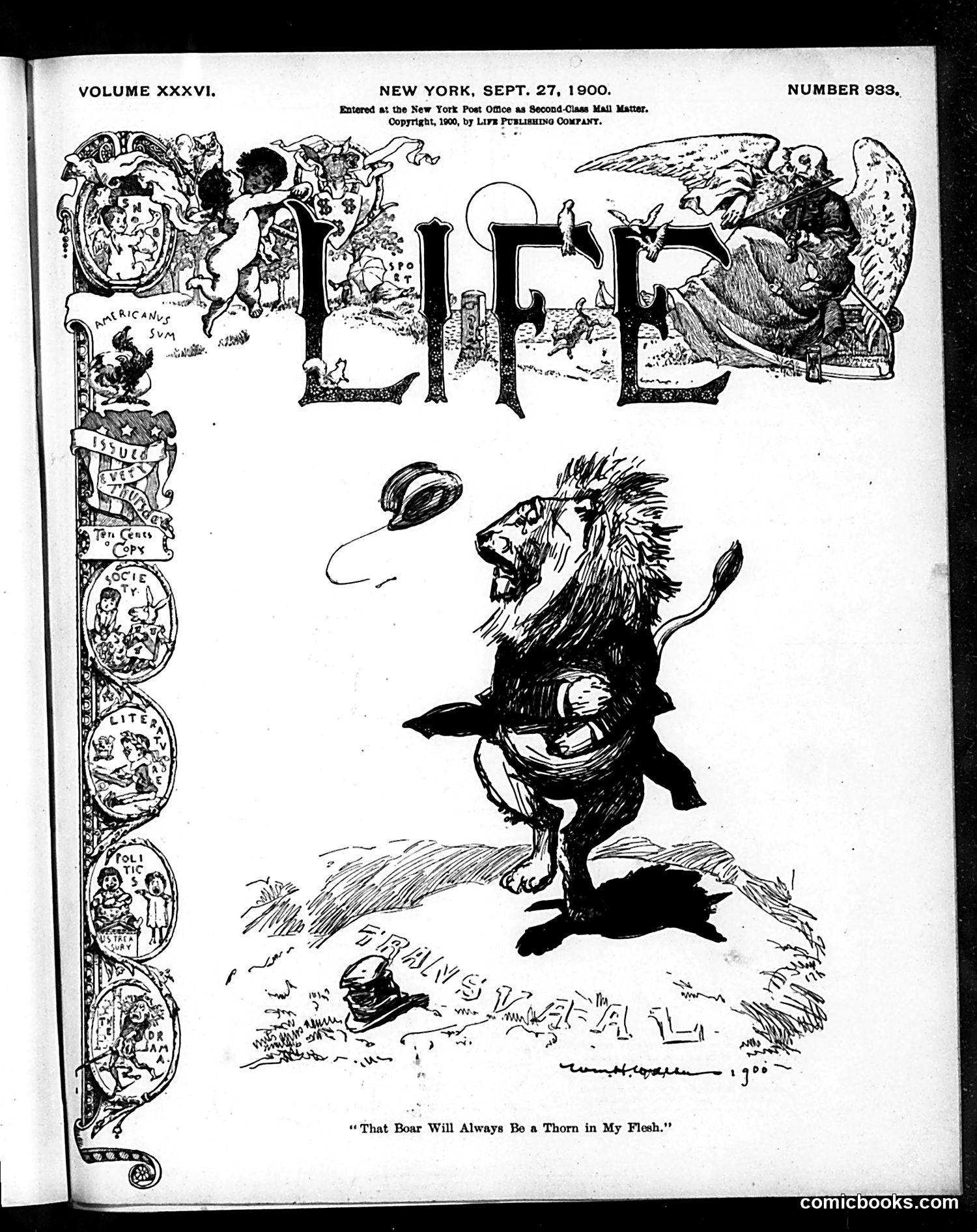
The main cartoon depicts a large bear labeled "STARVATION" standing upright on hind legs, tossing a hat in the air. The caption reads "That Bear Will Always Be A Thorn in My Flesh." The bear likely represents the Boer War in South Africa (1899-1902), which was causing British military and economic hardship. The figure appears to be a caricatured British military or political leader expressing frustration that this conflict remains an ongoing problem. The "starvation" label suggests the war's devastating effects on soldiers and civilians. The decorative left border contains various ornamental vignettes typical of Life's satirical style. This reflects contemporary American editorial commentary on British imperial struggles in South Africa.
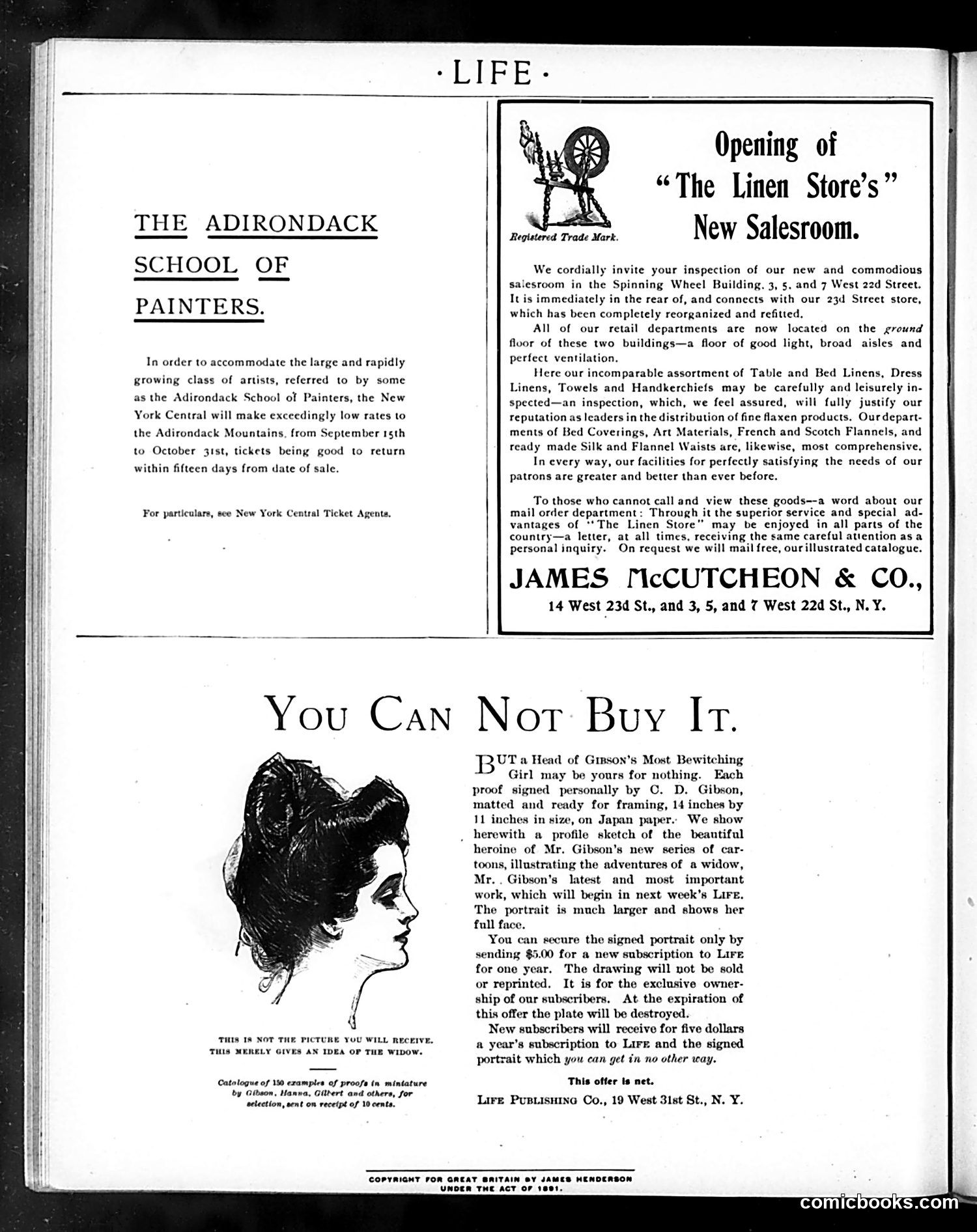
This page is primarily **advertising and announcements** rather than political satire or comics. The top half contains two ads: one for the Adirondack School of Painters (offering excursions September 15-October 31) and one for James McCutcheon & Co.'s linen store opening. The lower half advertises a **C.D. Gibson portrait** available exclusively to *Life* magazine subscribers. Gibson was a famous illustrator known for "Gibson Girl" drawings depicting idealized young women. The text emphasizes exclusivity—subscribers can obtain a signed portrait for $5, but it "will not be sold or reprinted" and "the plate will be destroyed" after the subscription period ends. The small sketch shows a woman's profile in Gibson's characteristic style. This is essentially a premium offer to boost magazine subscriptions, not satire.
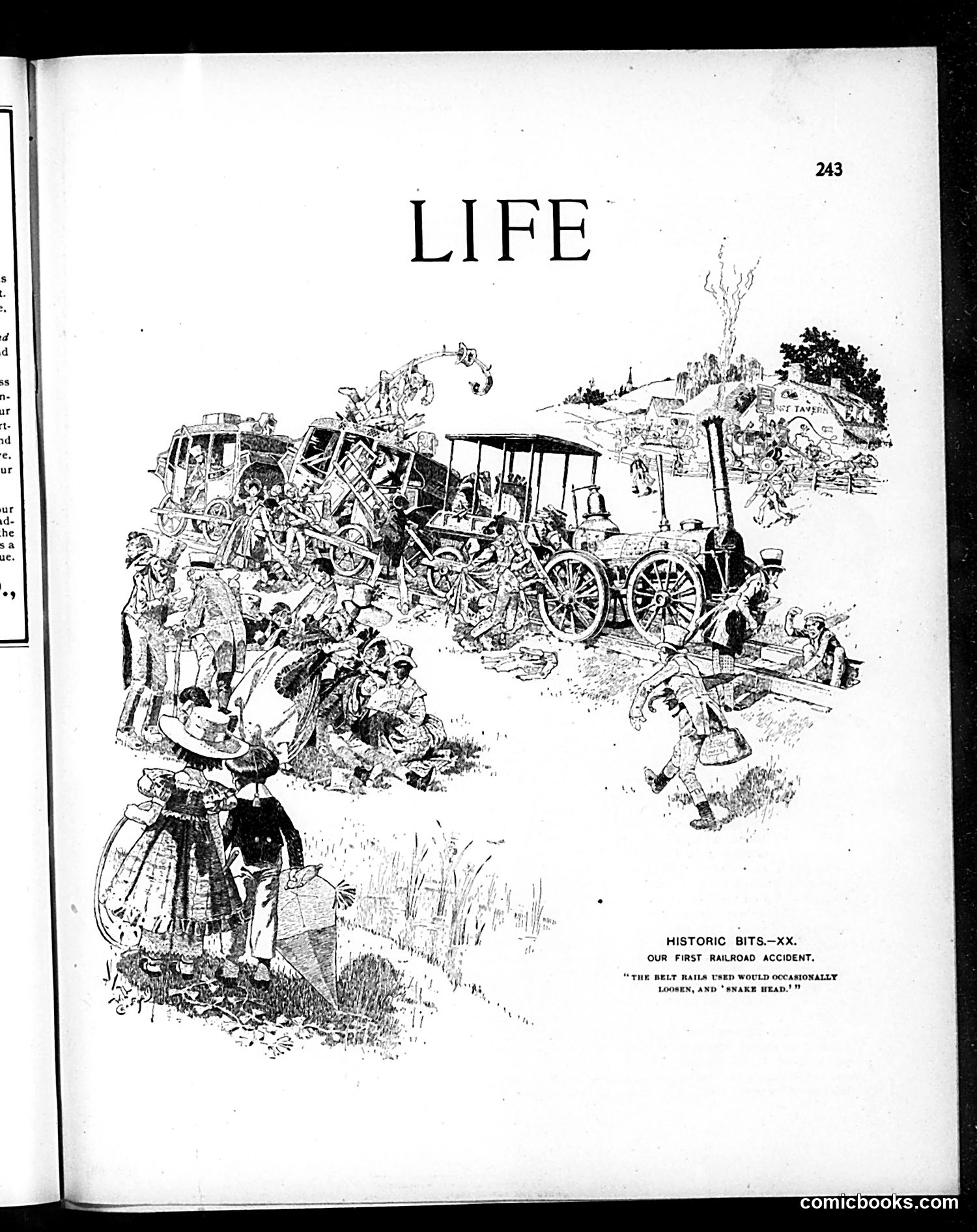
This satirical illustration depicts "our first railroad accident," referencing an early American railway disaster. The chaotic scene shows a derailed or crashed train with passengers, luggage, and cargo scattered about. The caption mentions "the first bell-shaped occasion [when] lookers and 'snake head'" — likely referring to early railroad terminology or specific figures involved in the incident. The satire appears to mock the novelty and danger of early railroad travel, portraying the accident as a comedic spectacle of confusion rather than tragedy. The densely packed composition emphasizes the disorder and absurdity of the scene, typical of Life magazine's approach to contemporary events. Without identifying the specific accident referenced, the image satirizes public anxiety about this new technology and early railroad safety failures.
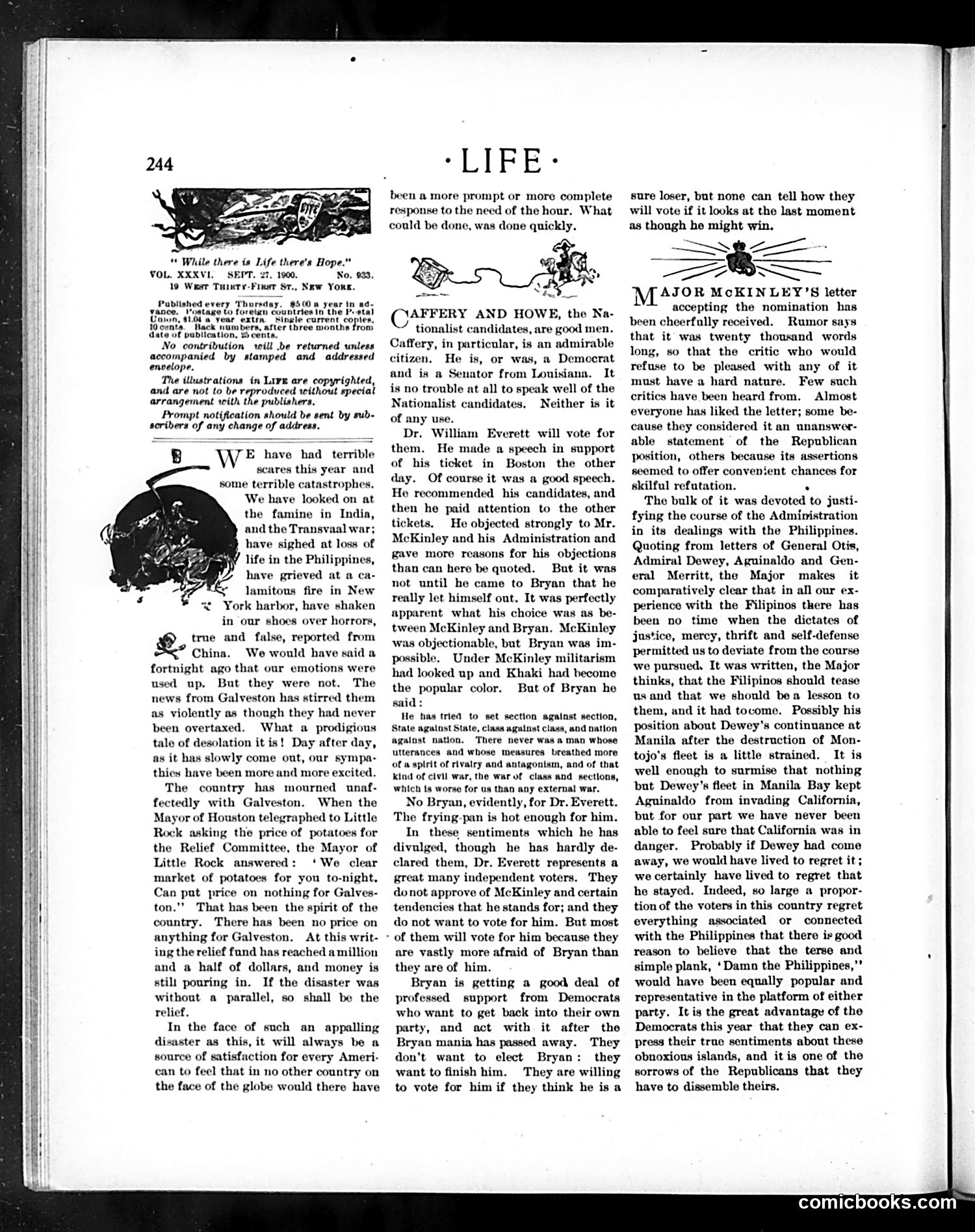
This page contains political commentary about the 1900 presidential election. The text discusses **Caffery and Howe** (Nationalist Party candidates) and **William Everett**, who supports **McKinley's Administration**. The main editorial criticizes **Bryan** and discusses voter sentiment regarding his candidacy. It references McKinley's handling of the **Philippines** and praises **Admiral Dewey**, suggesting Dewey's popularity contrasts with Bryan's declining support among Democrats. The satirical point appears to be that Bryan, despite some Democratic backing, has lost momentum—even his own party prefers other figures like Dewey. The piece mocks Bryan's "mania" as having "passed away," suggesting his political relevance has diminished since the 1896 election. The decorative illustration (top left) appears ornamental rather than directly satirical.
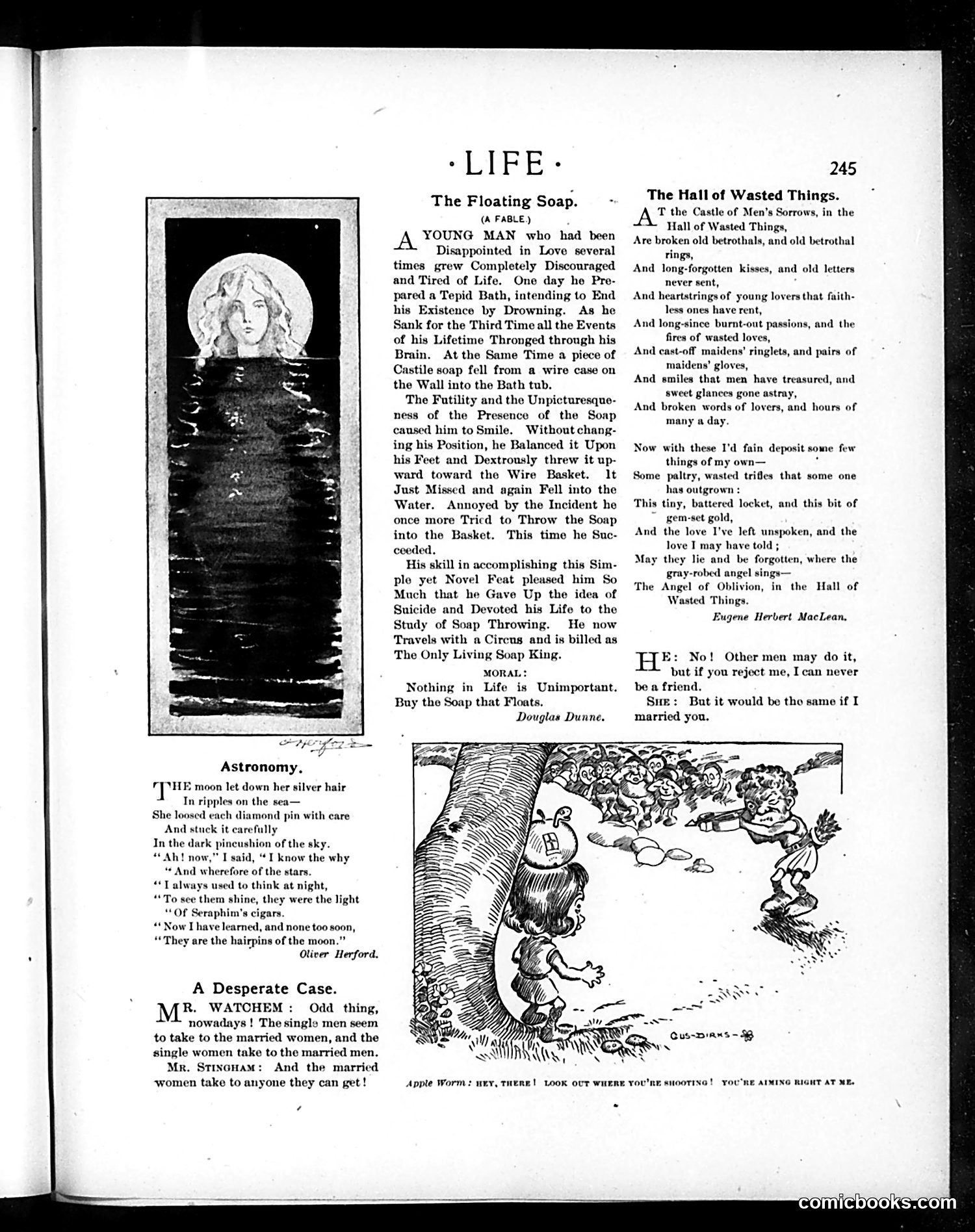
This page contains several literary/humorous pieces rather than political cartoons: **"The Floating Soap"** (fable by Douglas Dunne): A satirical story about a discouraged young man who attempts suicide by drowning, but keeps being interrupted by a floating bar of soap he's thrown into the bath. The moral: "Nothing in Life is Unimportant. Buy the Soap that Floats"—a commercial joke mocking advertising's tendency to find profound meaning in trivial products. **"Astronomy"** (by Oliver Hereford): A poem about the moon and stars, unrelated to satire. **"A Desperate Case"**: A brief dialogue exchange between characters (Watchem and Stigham) about marriage and relationships, presenting marital complications as absurd social observation rather than political commentary. The page is primarily literary satire and humor rather than political cartooning.
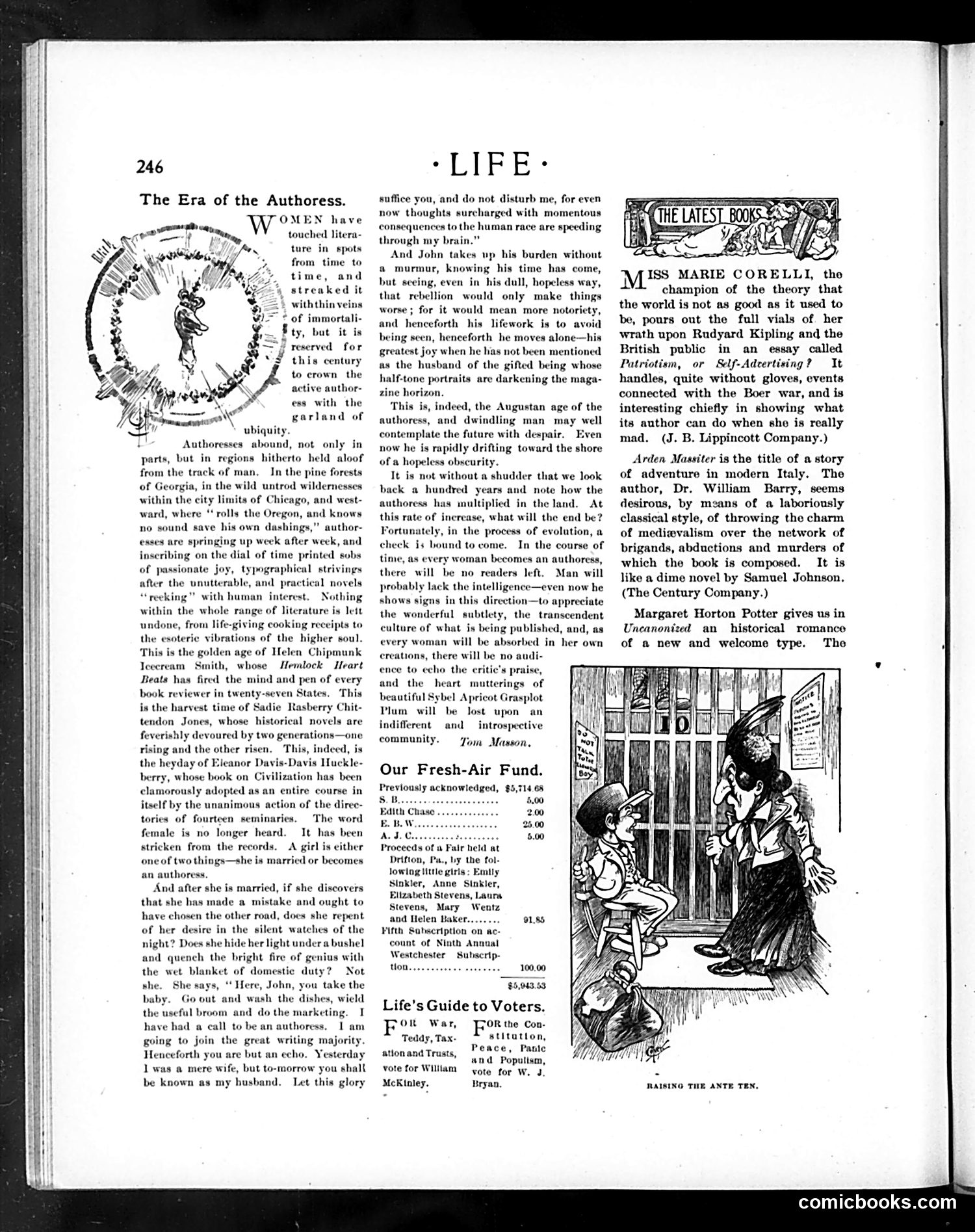
The cartoon illustrates a woman at a window labeled with various notices, appearing to solicit money or support. The illustration is captioned "RAISING THE ANTE TEN," a phrase suggesting increasing demands or stakes. While the full context requires more information about this specific Life issue, the cartoon likely comments on women's activism or fundraising efforts of the early 20th century. The window-display format and the title's implication of escalating requests suggest satire directed at women's organizations—possibly suffrage groups or charity fundraisers—portrayed as increasingly aggressive or persistent in their appeals. The surrounding page includes articles on female authors and a "Fresh-Air Fund," suggesting themes of women's public roles and charitable causes were central to this issue's focus.
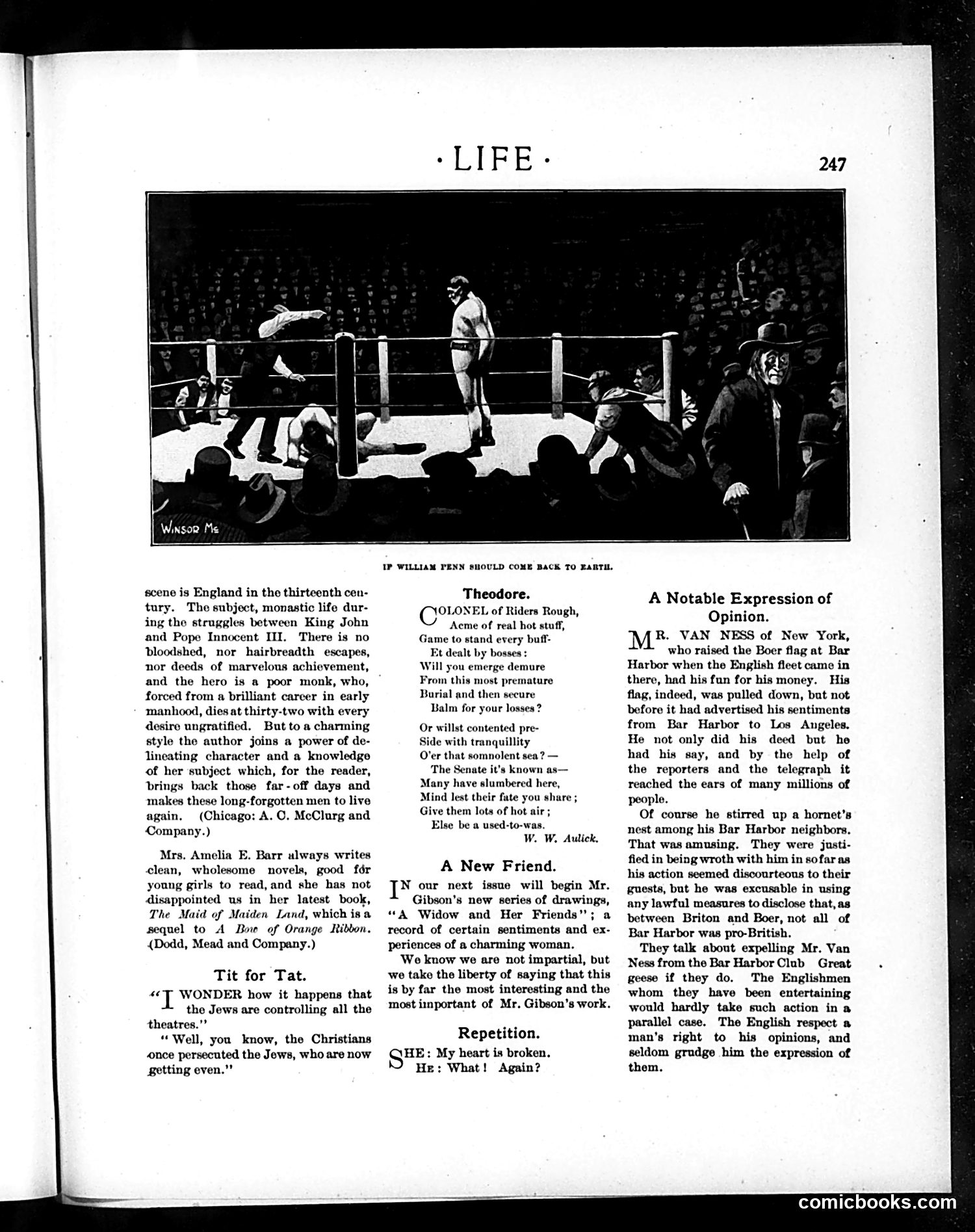
**The Boxing Image:** The top illustration depicts a boxing match with a large crowd. The caption reads "IF WILLIAM PENN SHOULD COME BACK TO EARTH," suggesting a historical/satirical commentary. The drawing style and crowd composition suggest early 20th-century boxing culture being used as social commentary, though the specific satirical point isn't entirely clear from the image alone. **Text Content:** The page contains several brief pieces: poetry about "Theodore" (likely Theodore Roosevelt), commentary on Mrs. Amelia E. Barr's novels, a piece titled "Tit for Tat" about Jews controlling theaters, and sections on "A New Friend" (referencing Mr. Gibson's drawings), and "Repetition." The "Tit for Tat" section appears to present an antisemitic stereotype as humor—reflecting unfortunately common attitudes in this era of *Life* magazine.
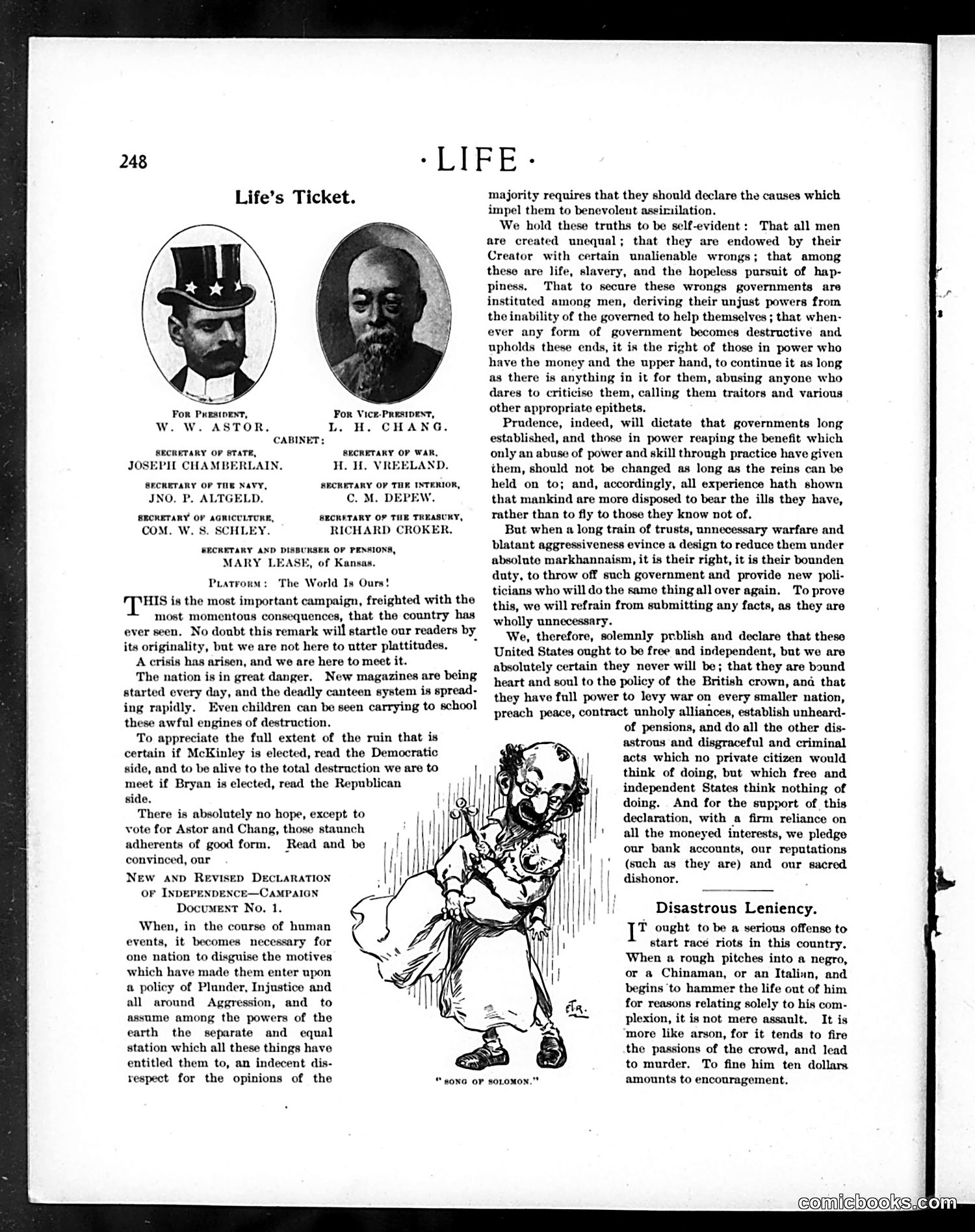
This page presents campaign material for the 1904 U.S. presidential election. The top shows portraits of the proposed ticket: W.W. Astor for President and L.H. Chang for Vice President, with various cabinet positions assigned to wealthy industrialists and figures like J.P. Morgan (suggested as Secretary of State). The central cartoon—labeled "Lord of Sorrows"—depicts a caricatured Asian figure being brutally beaten, satirizing American racial violence. The accompanying text condemns lynching and racial attacks against immigrants, ironically juxtaposed with the ticket above, which appears to mock the very wealthy establishment the article criticizes. The satire targets both upper-class dominance and racial prejudice in American politics and society.
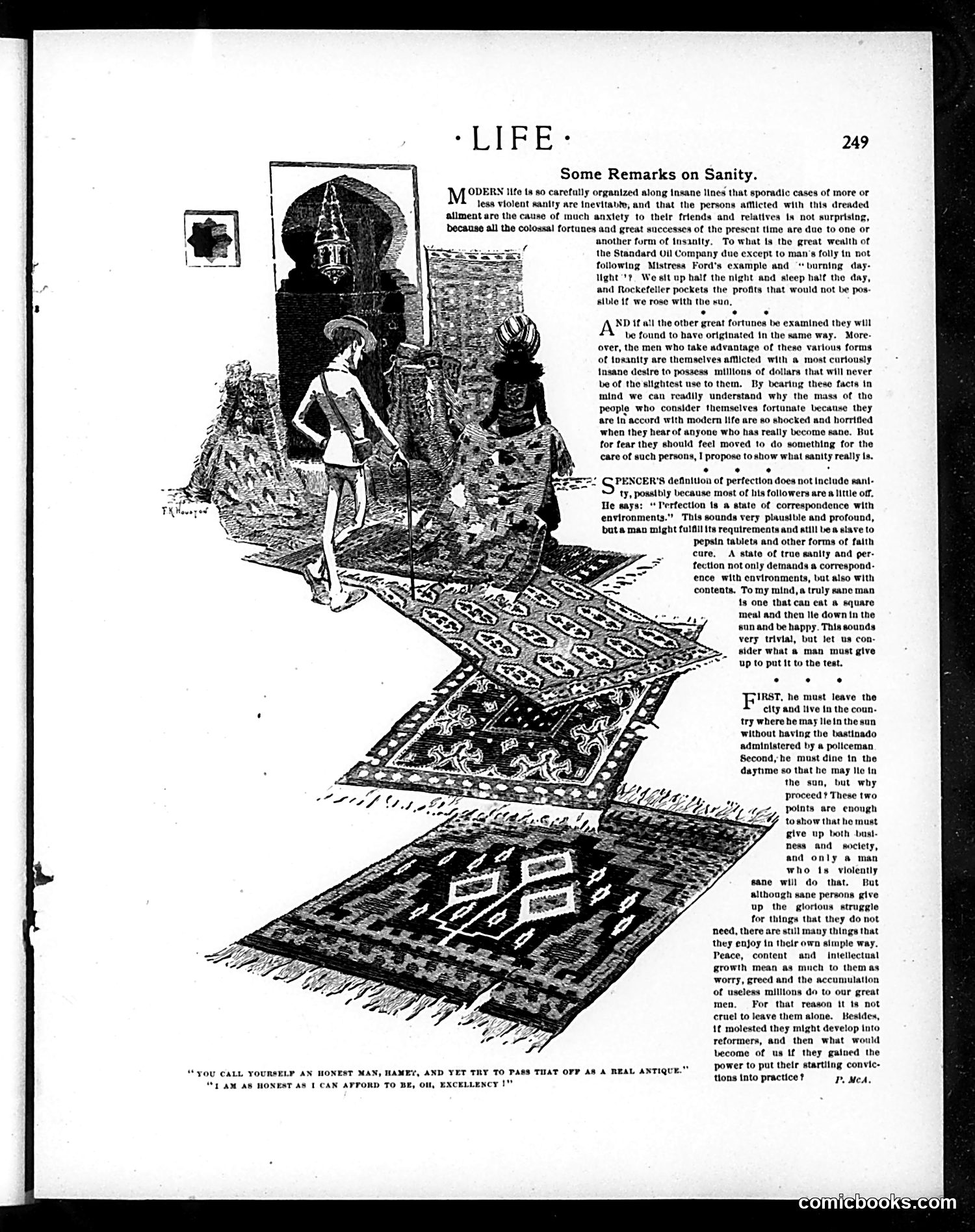
This page satirizes wealthy industrialists who accumulate vast fortunes while claiming mental stability. The article critiques the contradiction between being "sane" and obsessively pursuing millions that bring no practical benefit. The illustration depicts a man in oriental dress reclining on expensive carpets and cushions, suggesting the absurd luxury wealth enables. The caption quotes someone calling themselves an "honest man" while trying to pass off a fake antique—mocking the hypocrisy of the rich. The text argues that true sanity requires leaving the city for simple country living, valuing "peace, content and intellectual growth" over wealth accumulation. The satire suggests that modern wealthy men are actually insane despite their social status, driven by irrational desire for possessions rather than genuine needs.
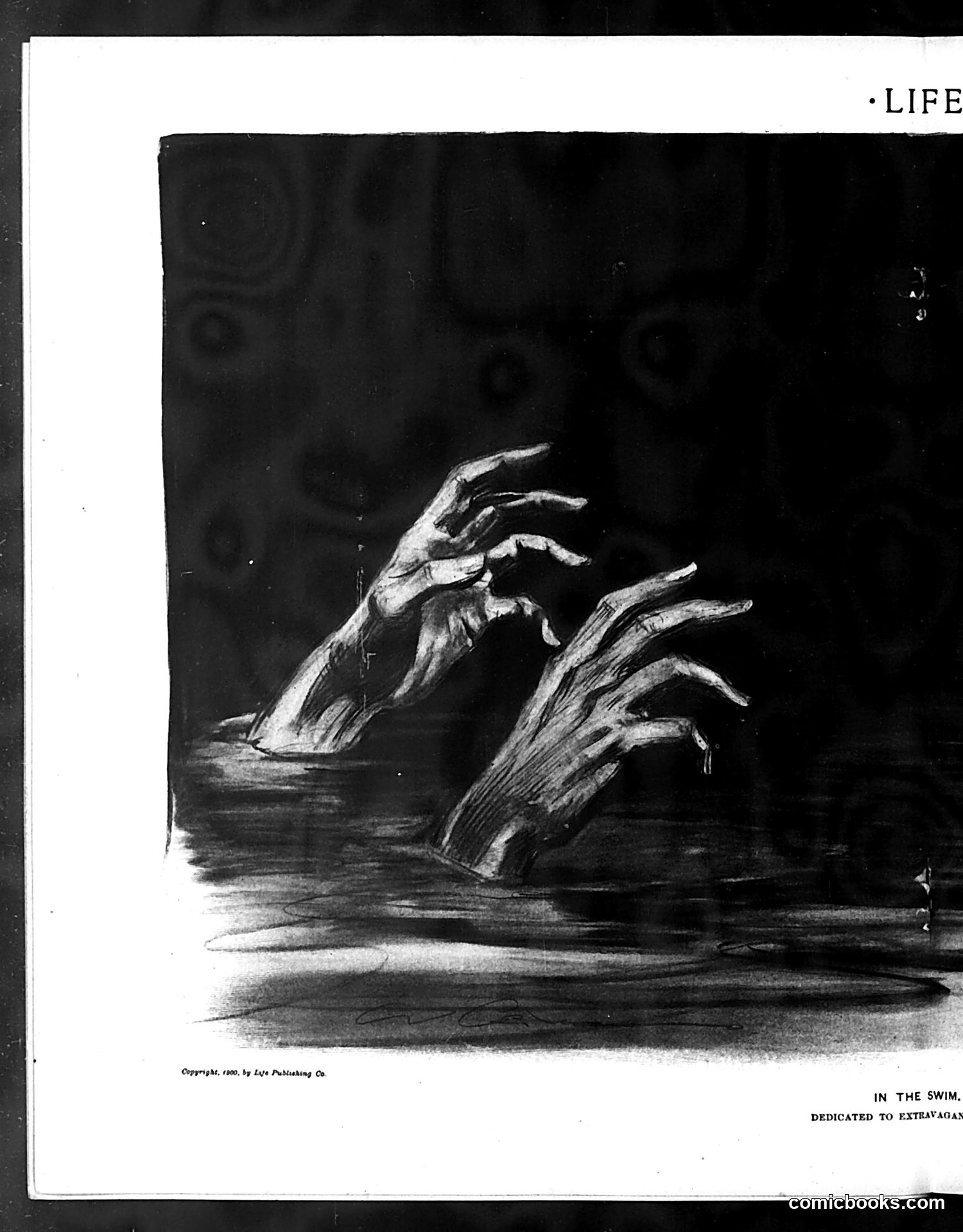
This is an illustration titled "In the Swim, Dedicated to Extravagans" from Life magazine (copyright 1900, Life Publishing Co.). The image shows hands emerging from water—appearing to depict drowning or struggling figures. The title "In the Swim" is a period idiom meaning to be fashionable or part of the social scene, while "Extravagans" (likely "Extravagants") suggests wasteful spenders. The satire appears to mock wealthy or fashionable people who engage in excessive spending or frivolous behavior—they're "in the swim" socially but literally drowning in their own extravagance. The dramatic, somewhat grotesque rendering of the hands emphasizes the critique's moral tone, suggesting such excess leads to ruin or peril.
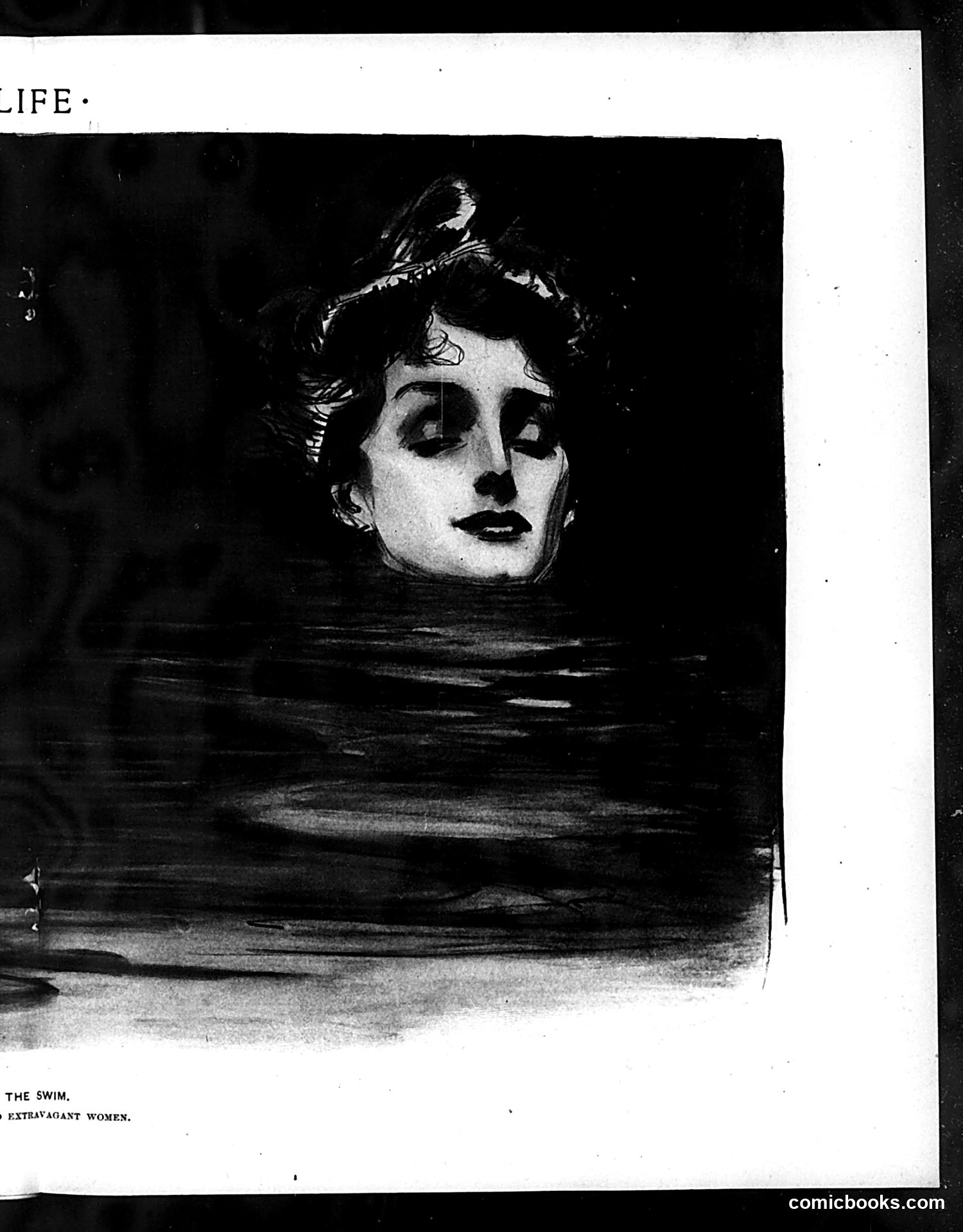
This appears to be a satirical illustration titled "The Swim" from Life magazine's section on "Extravagant Women." The image shows a woman's head and shoulders emerging from or submerged in dark, turbulent water, with her eyes closed and head tilted back in what seems an exaggerated, dramatic pose. The satire likely mocks wealthy or fashionable women of the era for their theatrical, ostentatious behavior—even during mundane activities like swimming. The dramatic rendering and the "extravagant women" caption suggest the piece critiques excessive affectation or pretension among the upper classes. The actual historical context and identity of any specific person being caricatured remains unclear from the visible text and image alone.
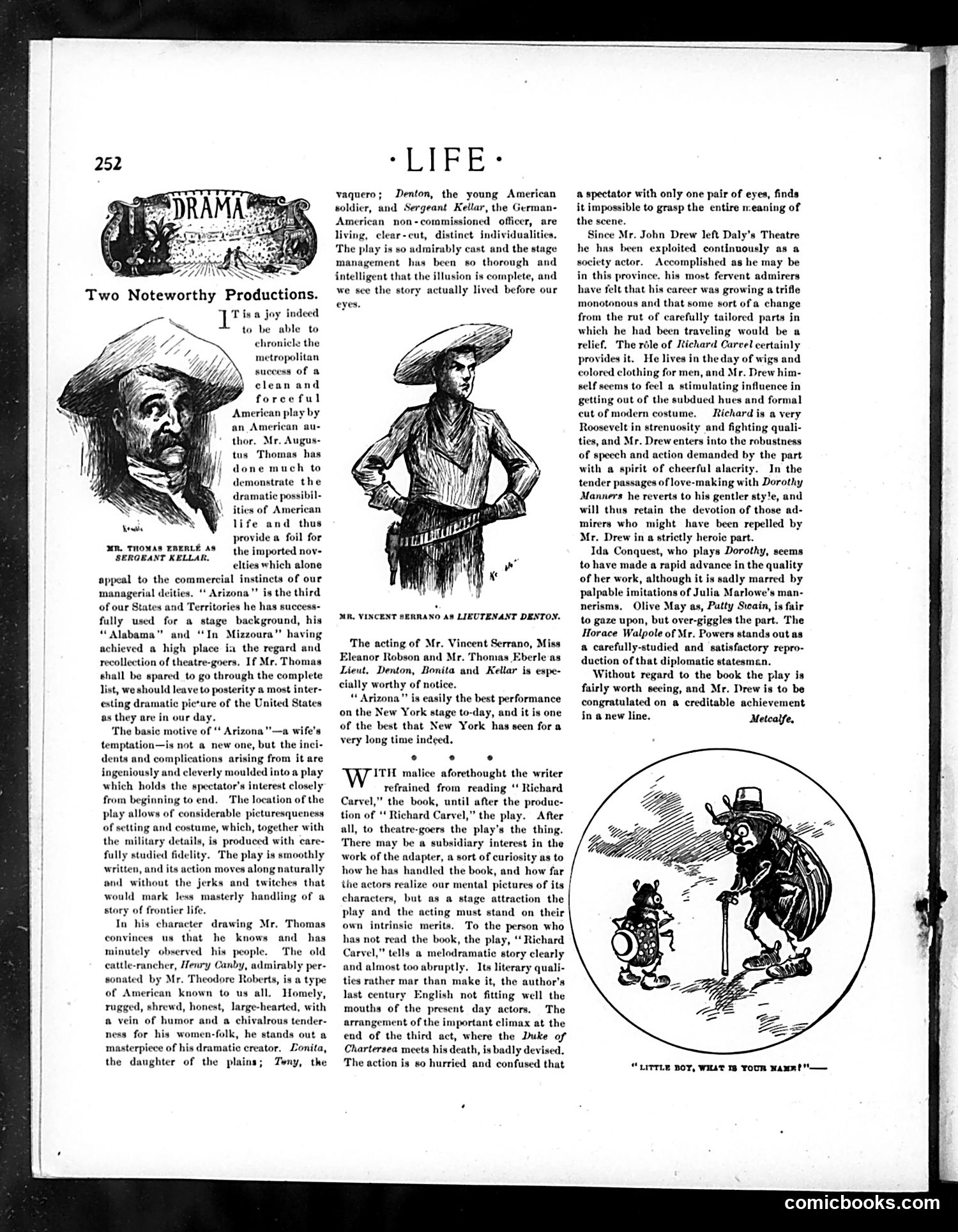
This page reviews two theatrical productions. The left illustration shows **Mr. Thomas Eberle as Sergeant Kellar** in "Arizona," a play about American frontier life. The text praises the production's authenticity and Eberle's performance in depicting the rugged, honest character. The right section discusses **"Richard Carvel,"** adapted from a novel, praising actor **Mr. Vincent Serrano as Lieutenant Deston**. The review notes the play succeeds on its own merits despite the book's literary qualities. The bottom cartoon shows a small boy confronting what appears to be a chimney sweep or laborer, with the caption **"Little Boy, What is Your Name?"** — likely satirizing class encounters or social awkwardness of the era. The page reflects Life magazine's role as cultural arbiter of theatrical merit for its educated readership.
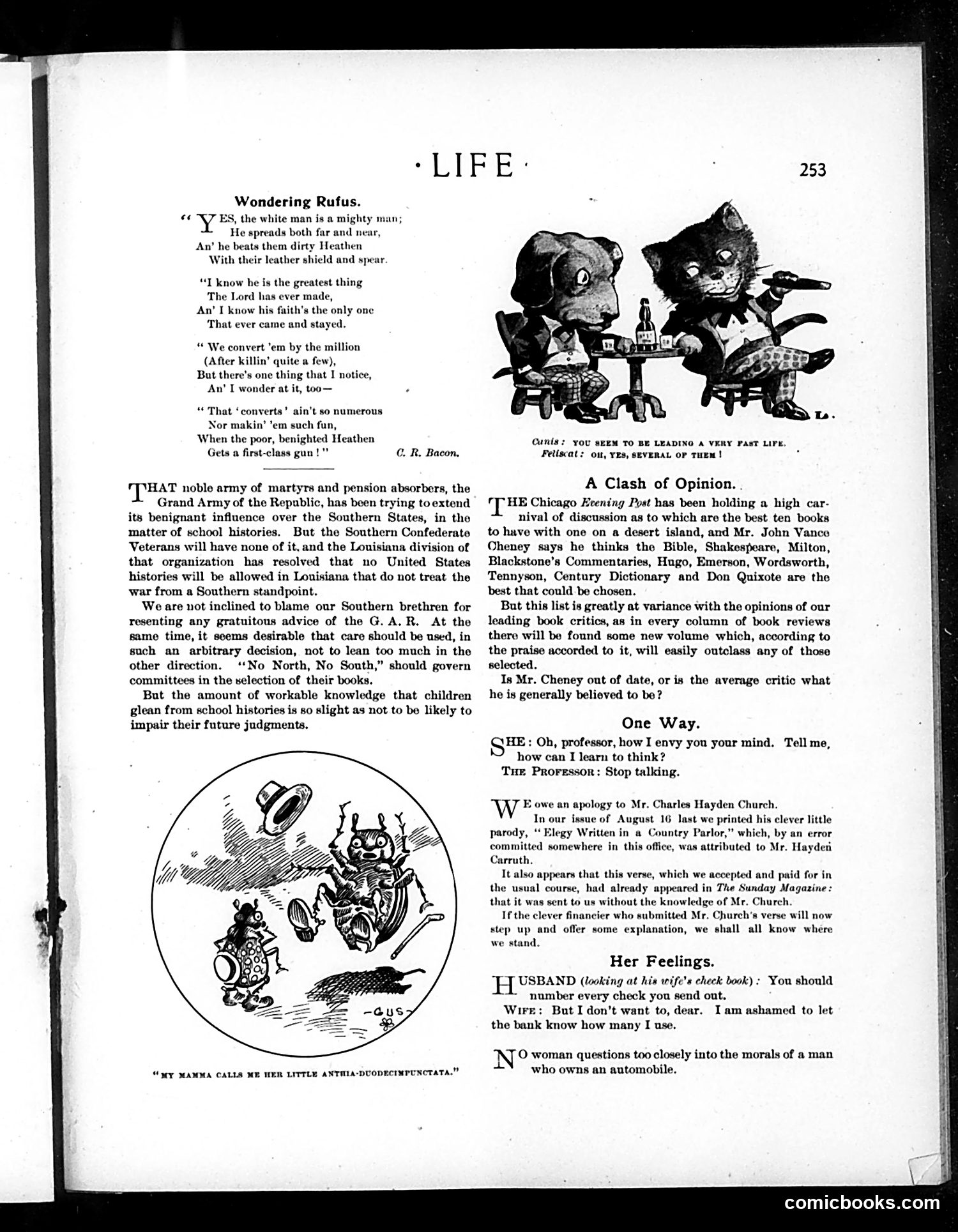
This page contains multiple satirical pieces typical of early 20th-century American humor: **"Wondering Rufus"** is a dialect poem by C.R. Bacon satirizing Christian missionary work. A Black speaker observes that white colonizers "convert" indigenous peoples "by the million" while simultaneously killing them, then notes the converts lose enthusiasm once they obtain modern weapons—undermining the moral superiority claims of Western imperialism. **The school history debate** criticizes both the Grand Army of the Republic (Union veterans' organization) for imposing Northern textbooks on the South, and Southern Confederate Veterans for rejecting them outright. Life argues neither "North, No South" bias should govern educational materials. **Animal cartoons** ("Canis/Feliscat") use anthropomorphized pets discussing fast living—light humor with no apparent deeper meaning. **"A Clash of Opinion"** disputes which books are "best"—mocking that newspaper critics constantly praise new volumes while ignoring classics like those John Vanco Cheney advocates (Bible, Shakespeare, Milton, etc.). Minor pieces include editorial corrections and jokes about professors, women's checkbooks, and automobile owners—typical period humor reflecting gender and class anxieties.
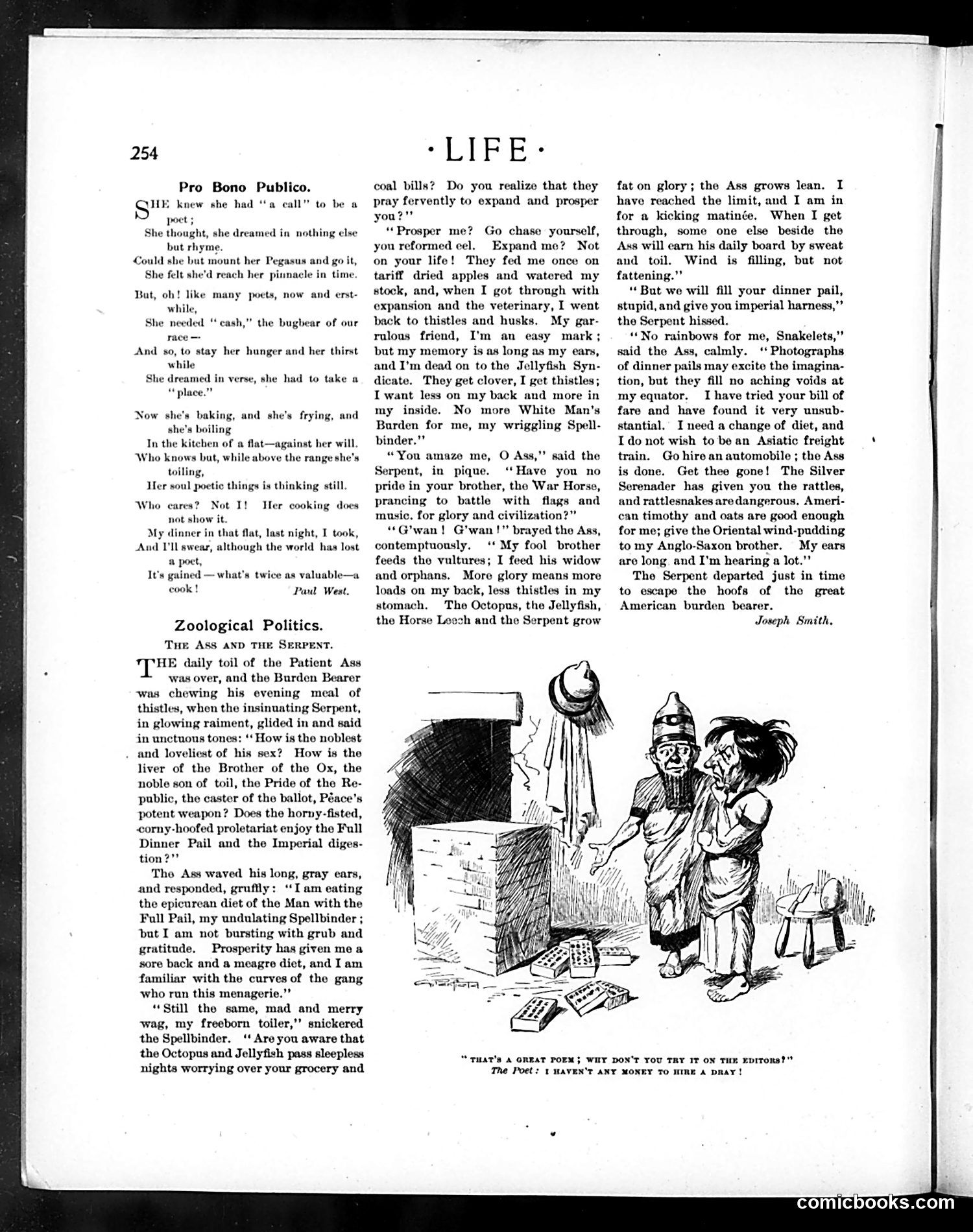
This *Life* page contains two satirical pieces critiquing early 20th-century American society. **"Pro Bono Publico"** mocks the romantic ideal of the poor poet. A woman dreams of literary glory but must work as a cook to survive. The joke: while she's artistically lost to the world, she's gained something "twice as valuable"—practical cooking skill. It satirizes the gap between artistic aspiration and economic necessity. **"The Ass and the Serpent"** is political allegory. The Ass represents the working class; the Serpent is a smooth-talking politician or "Spellbinder" offering false promises. The Ass refuses flattery about the "War Horse" (likely military glory/imperialism) and rejects talk of "Full Dinner Pails" and expansion—having learned that worker prosperity never materializes. The dialogue attacks political rhetoric that exploits laborers with patriotic language while delivering only hardship. The message: workers should distrust establishment promises.
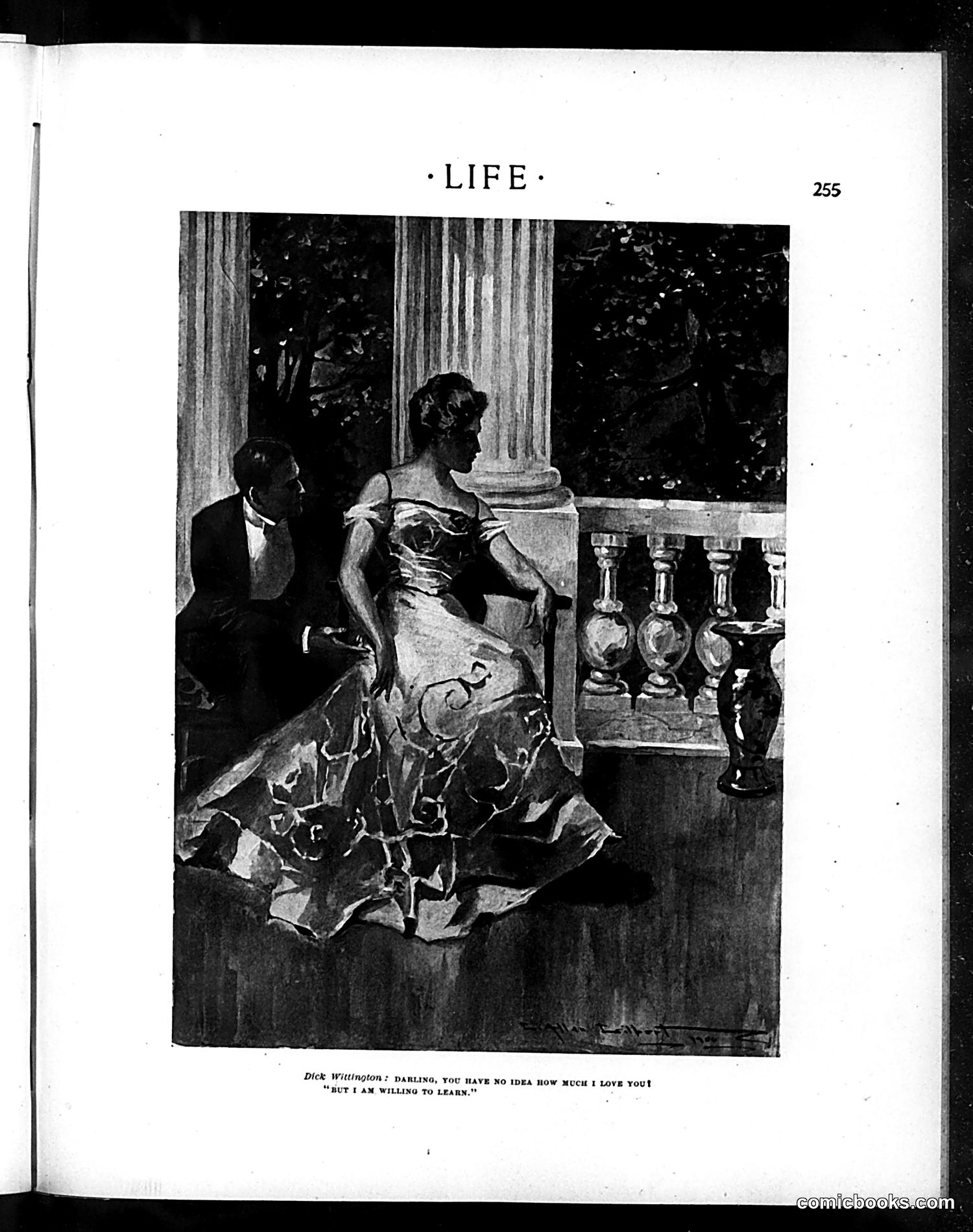
This page from *Life* magazine (page 255) contains a single illustration labeled "Dick Wilmington" with the caption: "Darling, you have no idea how much I love you! 'But I am willing to learn.'" The image depicts an elegant indoor scene with a well-dressed couple on a balcony overlooking gardens. The man speaks the sentimental line while the woman responds with romantic encouragement. This appears to be a humorous domestic scene satirizing courtship rituals and romantic declarations among the upper class—specifically the gap between grandiose emotional proclamations and practical willingness to demonstrate love through action. The joke relies on the woman's witty, slightly skeptical response to his flowery sentiment, suggesting both affection and a pragmatic expectation that he prove his words.
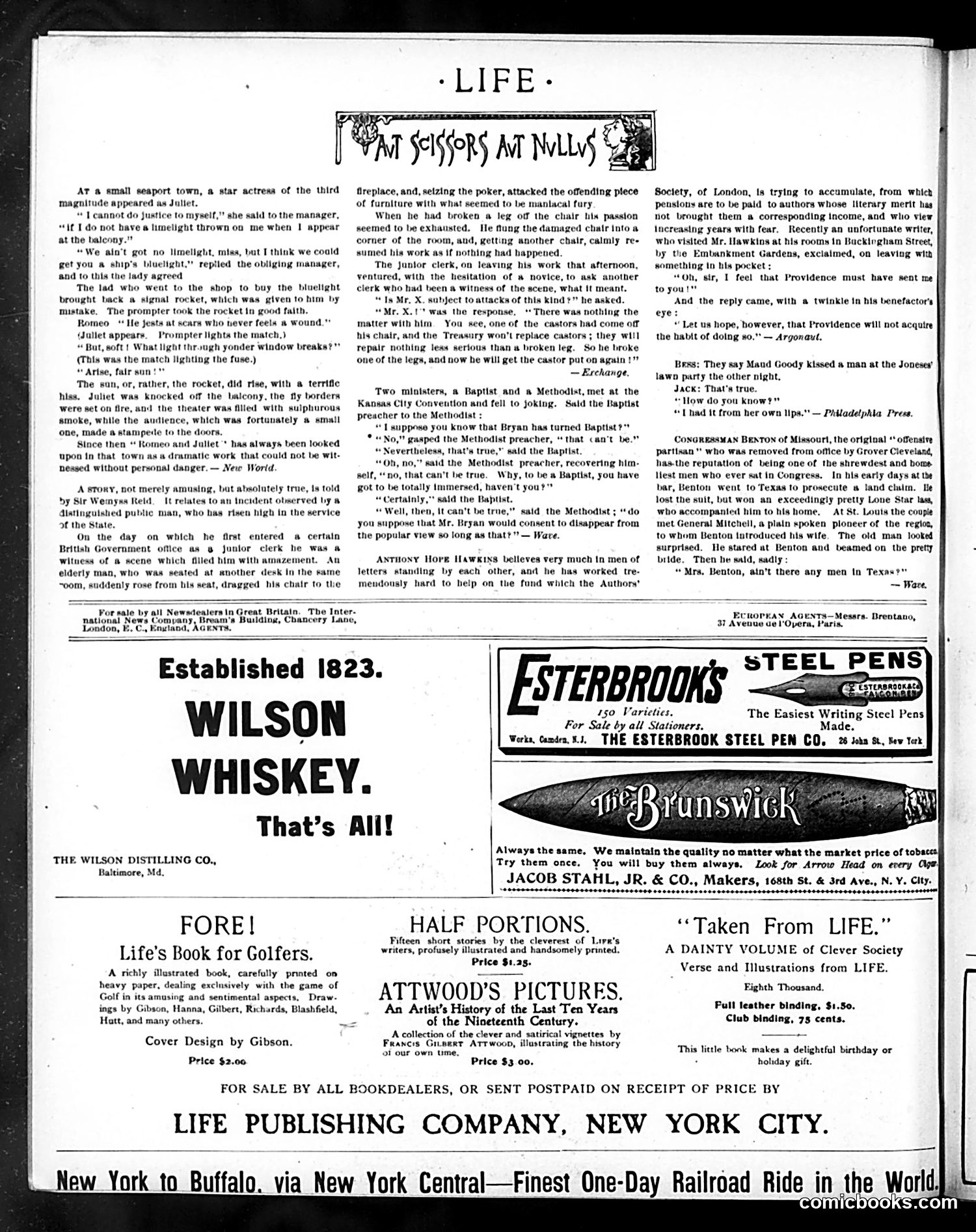
This page contains three humorous anecdotes rather than political cartoons: 1. **"Romeo and Juliet" disaster**: A third-rate actress demands a limelight for her balcony scene. A stage prompter mistakenly uses a signal rocket instead, which launches Juliet off the balcony, sets the theater on fire, and causes a panic. The satire mocks both theatrical vanity and small-town incompetence. 2. **The broken chair story**: A Treasury Department clerk deliberately breaks his chair's leg to force the government to replace it, since they refuse to repair minor damage. This satirizes bureaucratic absurdity and worker frustration with penny-pinching administration. 3. **Bryan as Baptist**: A joke about William Jennings Bryan (the prominent politician), with Methodist and Baptist ministers debating whether Bryan could have "converted." The humor relies on the Baptist requirement of full immersion—implying Bryan is too prominent/visible to disappear underwater. The page is primarily advertisements and book promotions; these anecdotes are brief satirical filler content typical of *Life* magazine's humor section.
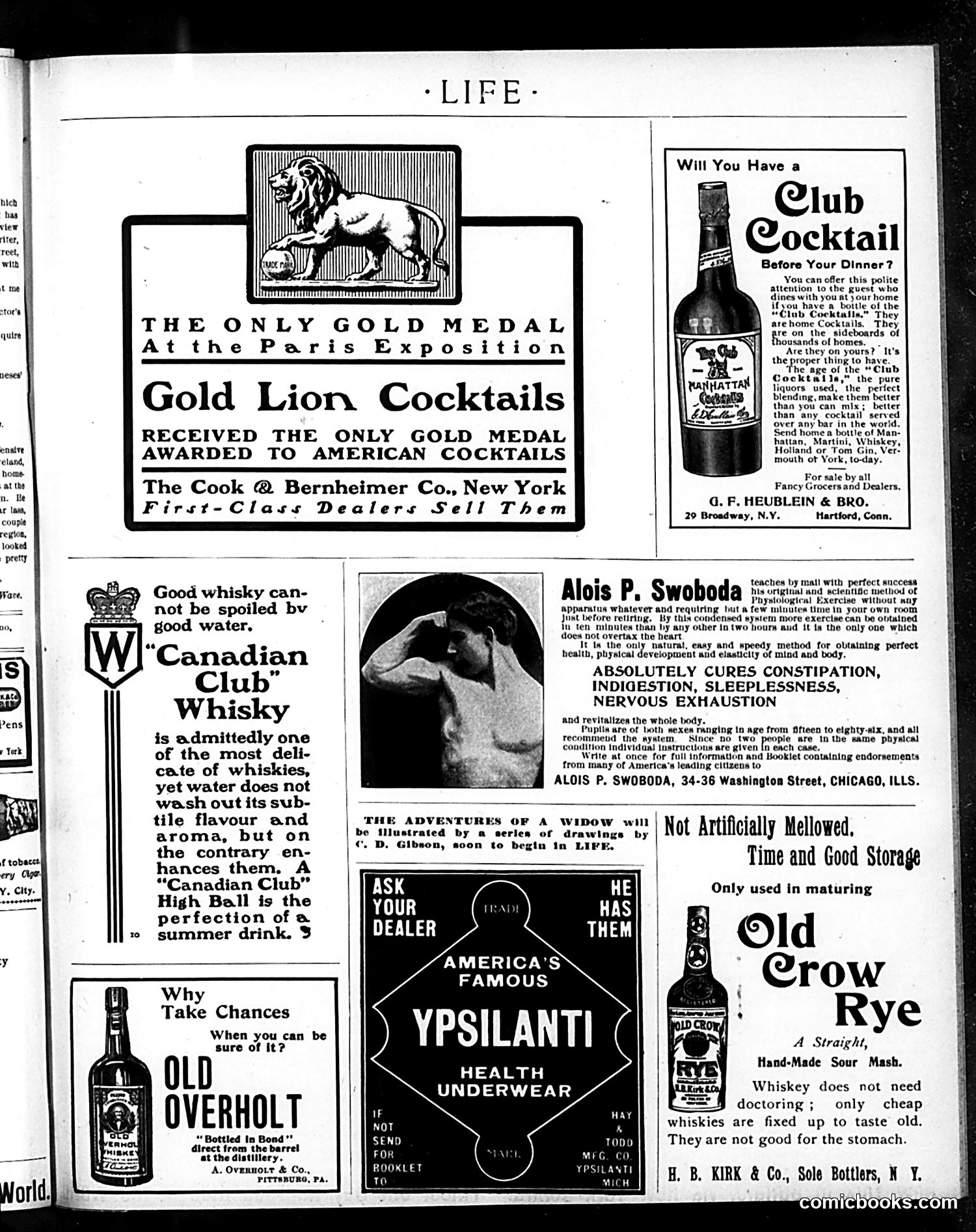
This page is **entirely advertising**—no cartoons or satirical content. It's a collection of liquor and patent medicine ads typical of early 20th-century American magazines. Key ads include: **Alcohol products**: Gold Lion Cocktails (claiming a Paris Exposition medal), Canadian Club Whisky, Old Overholt bourbon, Old Crow Rye, and Club Cocktails. These ads emphasize quality and social respectability—cocktails as proper home entertainment for guests. **Patent medicine**: Alois P. Swoboda advertises mail-order "Physiological Exercise" claiming to cure constipation, indigestion, and nervousness through a mysterious home system. This represents the era's largely unregulated wellness industry. **Other**: Ypsilanti Health Underwear and a teaser for C.D. Gibson's upcoming "Adventures of a Widow" serial in *Life*. The page reflects pre-Prohibition attitudes toward alcohol as socially acceptable luxury goods, and the prevalence of dubious medical claims in advertising before FDA regulation.
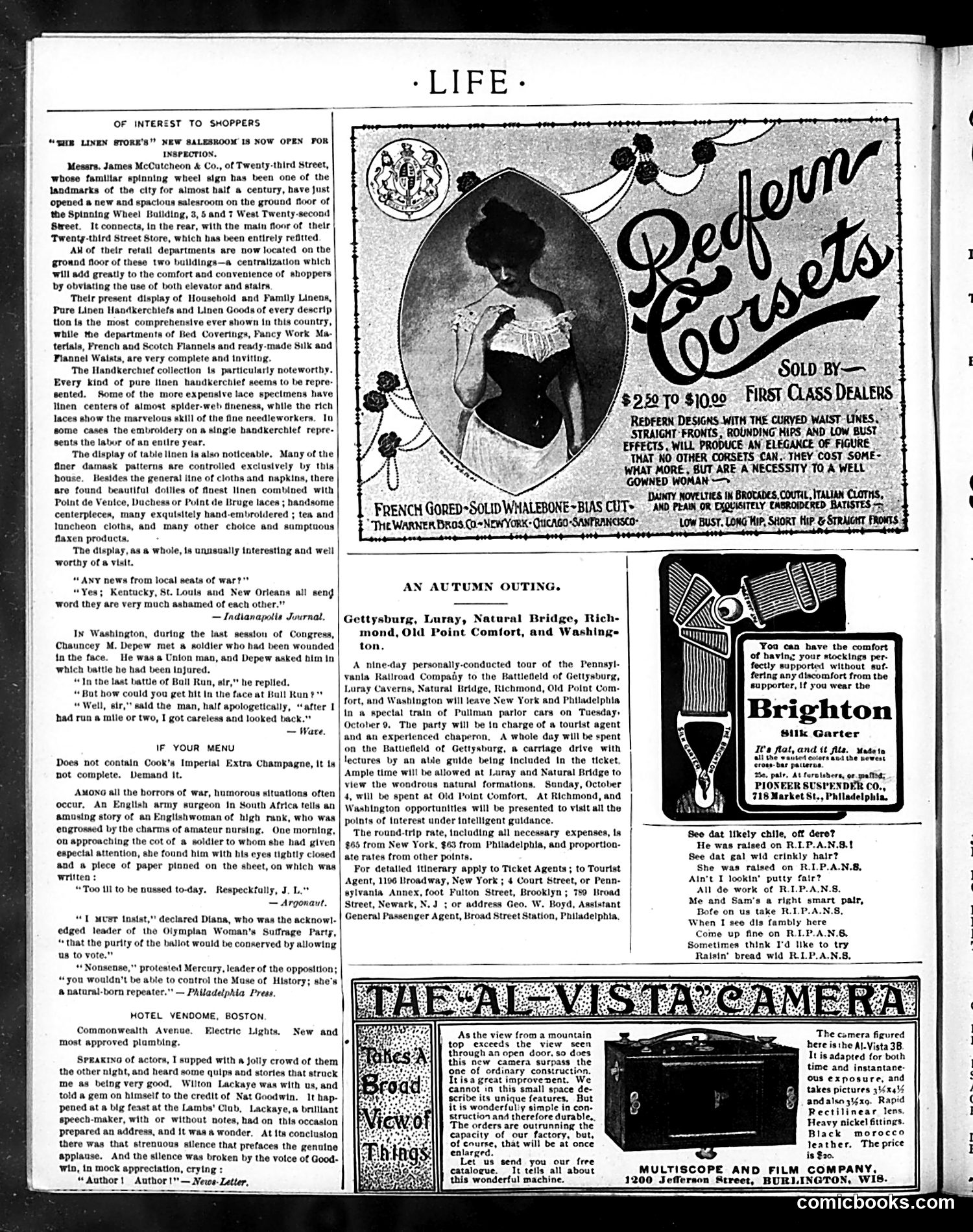
This page from *Life* magazine (a satirical publication, not the modern photo magazine) combines shopping advertisements with humorous anecdotes about war. **Content Summary:** The main text discusses a new linen salesroom opening in New York, featuring detailed descriptions of handkerchief and table linen displays—typical retail journalism of the era. **The Humor:** Two brief satirical pieces mock military incompetence: 1. A quip about Southern cities being "ashamed of each other"—likely referencing Civil War tensions or post-war regional rivalry. 2. An anecdote featuring Chauncey M. Depew (a prominent politician/speaker) questioning a wounded Union soldier. The joke: when asked where he was injured at the Battle of Ball Run, the soldier admits he got careless and "looked back" while *retreating*—satirizing the Union Army's disastrous first Bull Run defeat (1861) by suggesting soldiers were fleeing rather than fighting. **Advertisements** for corsets and silk garters fill the remaining space, typical of the era's fashion marketing.
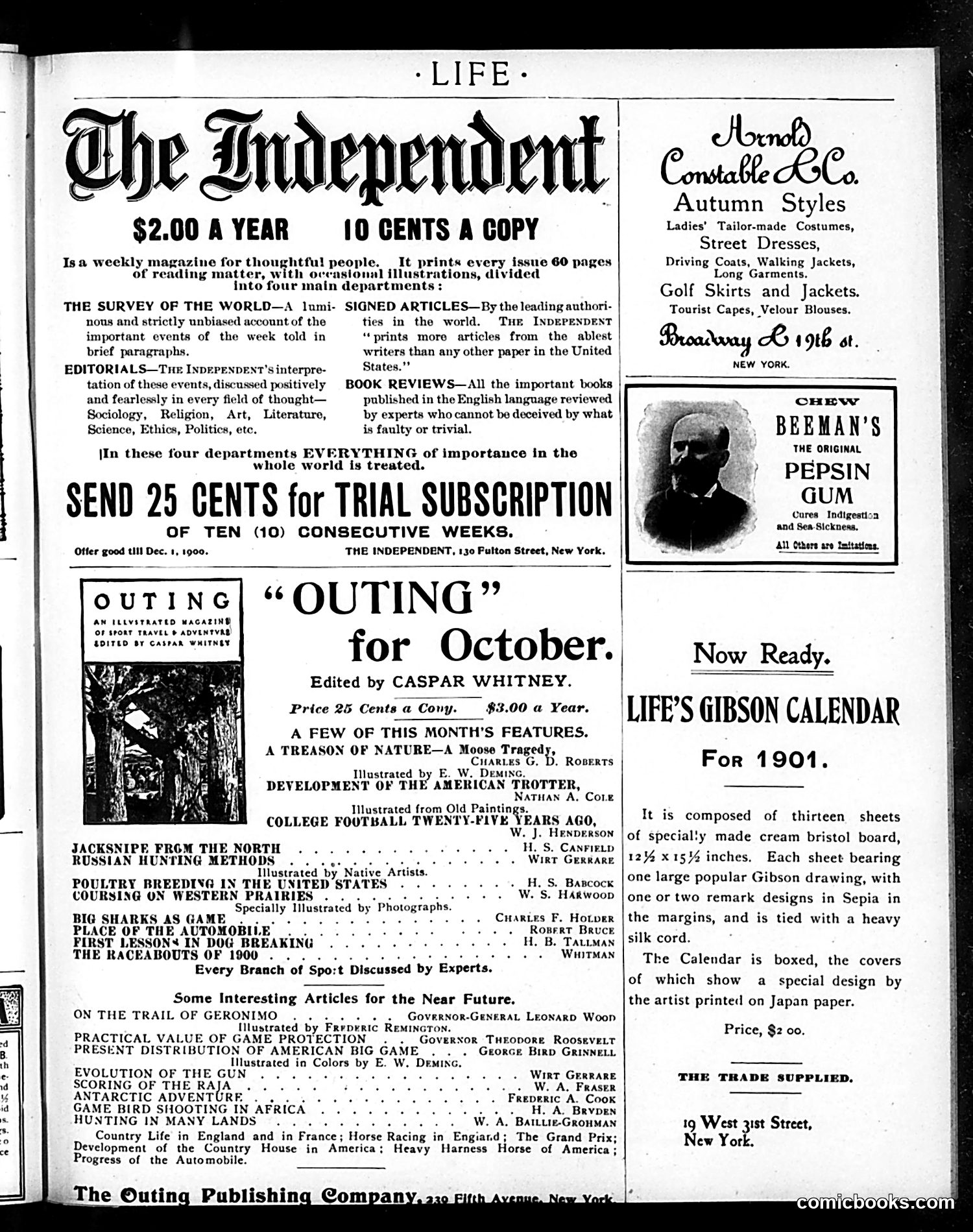
This page is primarily advertising and promotional material for magazines and products from 1900, not a political cartoon. The page announces *The Independent*, a weekly magazine ($2.00/year) claiming to offer comprehensive news coverage, editorials, signed articles, and book reviews across sociology, religion, art, literature, science, ethics, and politics. It offers a 25-cent trial subscription for ten weeks. The page also advertises *Outing* magazine (edited by Caspar Whitney), featuring hunting and outdoor adventure content; *Life's Gibson Calendar for 1901*, featuring illustrations by the popular Gibson Girl artist; and commercial products including Arnold Constable clothing and Beeman's Pepsin Gum. There are no political cartoons or satirical commentary visible on this page—it functions as a magazine industry trade advertisement circa 1900.
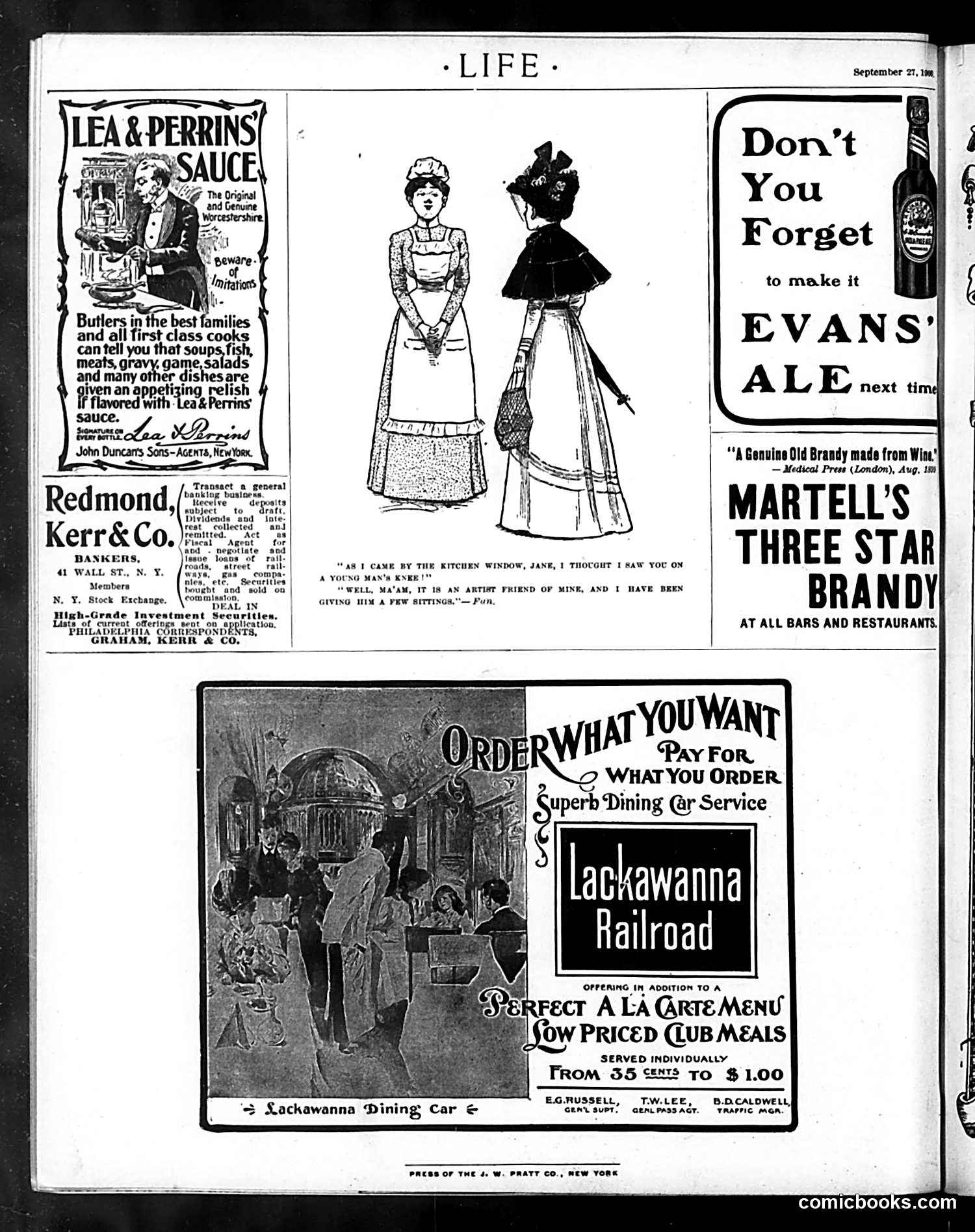
This page is primarily **advertising content** rather than editorial satire. It features period product advertisements and one small cartoon illustration. The central image shows two women in Edwardian dress with accompanying dialogue: a servant or young woman seen "by the kitchen window" is identified as "an artist friend" receiving "a few sittings." The joke appears to be a mild social innuendo—suggesting improper behavior or a romantic assignation disguised under the pretense of artistic modeling, playing on period anxieties about unchaperoned interactions between young women and men. The ads include Lea & Perrins sauce, Evans' Ale, Martell's brandy, and prominently the Lackawanna Railroad advertising its dining car service with meals from 35 cents to $1.00. The cartoon's humor relies on Victorian-era social conventions around propriety and the double meanings of "sittings"—a modest joke by modern standards.